Sonata Form in Spain: Manuel Blasco de Nebra’s Seis sonatas (1780)
Bryan Stevens Espinosa
KEYWORDS: keyboard sonata, Spanish music, eighteenth century, form, schema theory, partimento, sonata theory, formal function, Manuel Blasco de Nebra
ABSTRACT: In this article, I describe formal and stylistic norms present in a collection of six two-movement keyboard sonatas published in Madrid in 1780 by Spanish composer Manuel Blasco de Nebra (1750–1784). While developments in classical form studies of the past twenty-five years have provided new insights into classical form (Caplin 1998; Hepokoski and Darcy 2006), such scholarship has tended to privilege Viennese Classicism in its codification of ideal formal types and norms. Parallel sonata traditions like that of Spain have often been marginalized, with deviations from the high Viennese models frequently cast as “failed attempts, misunderstandings or anomalies that deviated from the norm” (Marín and Bernadó 2014).
Through a close analysis of Blasco de Nebra’s twelve published sonata movements using Caplin’s form-functional theory (1998), certain key elements of Hepokoski and Darcy’s Sonata Theory (2006; 2021), Burstein’s neo-Kochian galant-punctuation-form theory (2020), and Gjerdingen’s schema theory (2007; 2020), I elucidate some of the exceptional qualities of Blasco de Nebra’s music. These include chaining together intrathematic formal functions to create nonconventional and often asymmetrical phrases, a penchant for repetition across many formal levels, and a consistent but unique treatment of the second half of his sonatas.
DOI: 10.30535/mto.31.4.2
Copyright © 2025 Society for Music Theory
Introduction
[0.1] In 1780, Manuel Blasco de Nebra (1750–1784) published a set of six two-movement sonatas titled Seis sonatas para clave y fuerte piano (Blasco de Nebra 1964). Many aspects of the style and organization of the collection and its individual sonatas may strike the listener as quaint or even strange: their two-movement structure, a penchant for exact repetition across different formal levels, and the sometimes odd engagement with sonata-form norms, just to name a few. Marín and Bernadó summarize the problem that Spanish compositions face in their introduction to Instrumental Music in Late Eighteenth-Century Spain:
Perhaps [the obscurity of Spanish music] is not a cause, but a consequence of another element that, undoubtedly, is more decisive: the secondary position usually assigned to the composers active in Spain (or, for that matter, France, England or Italy, allowing for all the obvious differences) in relationship to the Viennese models of (supposed) perfection. For decades, it has been accepted that Viennese Classicism represented the compositional standard of this period. The rise of a prototypical sonata form led the compositional patterns that did not conform to this model to be perceived as failed attempts, misunderstandings or anomalies that deviated from the norm. (Marín and Bernadó 2014, 10)
[0.2] In that same collection, Dean Sutcliffe echoes this sentiment with reference to Blasco de Nebra: “What [Blasco de Nebra] most needs, in fact, is simply promulgation of his works by performers and writers, especially given the exceptional qualities of the music” (2014).(1) Through a close analysis of Blasco de Nebra’s twelve published sonata movements, this article elucidates some of these exceptional qualities.
[0.3] Blasco de Nebra was a church organist and composer from Seville.(2) Born into a family of church organists, he likely received his initial musical training from his father José Blasco de Nebra (1714–1785) at the Seville Cathedral and then later in his teenage years from his uncle José de Nebra (1702–1768) while assisting him in the Royal Chapel in Madrid. Blasco de Nebra was well-known as an organist and improviser in both his native Seville and Madrid, where the collection was initially published. Although he composed at least 172 pieces, only the Seis sonatas para clave y fuerte piano was published in his lifetime.(3) Of those left unpublished, only twenty additional sonatas and six pastorellas are extant, all for solo keyboard.
[0.4] Blasco de Nebra sits at an interesting crossroads in Spanish music history. The previous generations of Spanish composers (c. 1740–1770) had already integrated Spanish with the new and increasingly cosmopolitan Italian styles.(4) The Italian keyboard sonata was introduced into Spain in the late 1740s by native composers such as José Elías (1678–1755), Vicente Rodríguez (1690–1760), and Sebastián Albero (1722–1756) and imported Italian composers such as Domenico Scarlatti (1685–1757). However, while these composers almost invariably used the older Type 2 Sonata (with the return of the home key at the subordinate theme; Hepokoski and Darcy 2006, 334 and 353ff.), Blasco de Nebra’s Seis sonatas is remarkable for its earliest consistent use of the Type 3 Sonata (with the return of the home key at the main theme; Hepokoski and Darcy 2006, 344) in a Spanish keyboard sonata. The arrival of the double return in Spain was likely influenced by Germanic symphonic music in the 1770s (Cascudo 1998), and in particular the music of Joseph Haydn (1732–1809) (Fisher 1978). Even more importantly for the Seis sonatas, Blasco de Nebra himself had an extensive personal collection including works by Spanish, French, Italian, and Austro-Germanic composers, as evidenced by an advertisement placed by the Nebra family in the Gazeta de Madrid on December 30, 1785:
In Seville, on Encisos Street, in the house of the Nebras, there is found a collection of 1,833 pieces for harpsichord, fortepiano, and organ, on which Don Manuel Blasco de Nebra—organist of that Cathedral— pursued his studies. He died on September 12, 1784, at the age of 34 years, having reached the point where he could play at sight, with refinement, boldness, and expression, whatever was placed before him. His music consists of 172 pieces that remain with the family, who provides copies at 20 reales vellón per piece, and those of the other authors according to their merit from 2 to 10 reales vellón, whose names are as follows: Alberti, Baton, Benaut, [Couperin], Carrier, Crusells, [Daquin], Dupré, Dandrieu, Elías, Ferrer, Handel, [Michael? Haydn], [Hoffmann], [Havingha], Irribarren; Lidon, Martini, Monserrat, Mondonville, Marriner, Nebra, organist of the king; Nebra, organist of Cuenca; Nebra, organist of Zaragoza; [Pellegrini], Rameau, Rosi, Rutini, Roseyngrave, [Scarlatti], Stamitz, Sesé, Soler, Toeschi, Vila, Zipoli, [Jospeh Haydn].(5)
[0.5] In order to bring attention to the “exceptional qualities of the music” (Sutcliffe 2014, 308), then, requires a sensitive approach to analysis that acknowledges these influences but does not automatically try to fit them into a preconceived notion of “Viennese models of (supposed) perfection” (Marín and Bernadó 2014, 10). To achieve my goal of describing the formal norms particular to this collection, I use Caplin’s form-functional theory (1998), certain key elements of Hepokoski and Darcy’s Sonata Theory (2006; Hepokoski 2021), and Burstein’s punctuation-form theory of Galant expositions (2020).(6) For local harmonic analysis, I almost exclusively use Galant Schema theory (Gjerdingen 2007), referring to conventional Roman numeral analysis only when necessary for clarity.
[0.6] Caplin’s theory of formal functions is particularly useful in understanding phrase construction in the Seis sonatas. As expected, Blasco de Nebra and his contemporaries chain together short intrathematic units to form phrases; however, the way they typically do this is atypical for contemporaneous Austro-Germanic composition. For example, periodic forms—extremely common in Haydn and Wolfgang Amadeus Mozart (1756–1791)—are almost wholly absent from the Spanish repertoire. Sentences and sentence-like formal structures abound but are put together in unusual ways: it is easy to parse out initial, medial, and cadential functions, but the results very often appear non-conventional from the point of view of high Viennese Classicism. It is therefore important not to presume the normative organization of intrathematic units that form phrases for this repertoire.
[0.7] Each sonata movement follows the basic conventions of sonata form: two main thematic areas in contrasting keys, a more loosely knit transitional area that modulates between the two and ends with a clear medial caesura, and a second half of the sonata with all the same musical material and a tonal resolution (the “crux”) after which all material is in the original key. Most of the sonatas have the tonal resolution at the return of the main theme (Hepokoski and Darcy’s Type 3), but three follow the older convention of having the home-key return at the subordinate theme (Type 2). For this reason, three of Hepokoski and Darcy’s key ideas prove useful for the analysis of these sonatas: their concept of rotational form, the distinction between Type 2 and Type 3 Sonata, and their insight that each section may have its own rhetorical elements associated with it that might persuade the listener that it really is that moment in the formal structure (Hepokoski and Darcy 2006, 16–20).
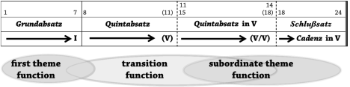
Example 1. Reproduced from Burstein Ex. 7.1b (2020, 125). An example of Standard Punctuation Form from Baldassare Galuppi, Overture/i to Il Mondo della Luna
(click to enlarge)
[0.8] The overall form of these sonatas is probably better understood through the more historically informed lens of Burstein’s neo-Kochian analysis that he describes in Journeys through Galant Expositions (Burstein 2020), especially since Blasco de Nebra’s style is much closer to the mid-century Galant composer than that of Haydn or Mozart. In Koch’s terminology, as adopted by Burstein, the exposition is a single Periode (complete unit of the form ending with a Cadenz, or formal cadence) consisting of multiple Sätze. After a number of Absätze (passages that lead to a weaker resting point), the Periode ends with a Schlußsatz (passage that leads to a Cadenz and ends the Periode). Grundabsätze end on a local tonic (usually in the form of an authentic cadence), Quintabsätze end on a local dominant (usually in the form of a half cadence), and Schlußsätze end with strong perfect authentic cadences. Example 1 shows one such analysis (of Baldassare Galuppi’s Overture to Il Mondo della Luna). The entire exposition is a single Periode (mm. 1–24) of four Sätze (ending IAC, HC, HC/V, and PAC/V) that concludes with a formal Cadenz (m. 24). The parsing of the thematic zones is still required, either because of formal fusion between zones or because often the Quintabsatz in V is the antecedent in the subordinate theme, and other times it is the end of a modulating transition. Moreover, many other sequences of Sätze (Burstein’s “Journeys”) are possible. For example, Blasco de Nebra uses the very form from Example 1 in a quarter of his sonata movements but uses three other arrangements in the others.
[0.9] Finally, this repertoire greatly benefits from being understood in relation to the Italian Partimento tradition. Partimenti developed in Naples c. 1700 as an integral part of a pedagogical system to instruct emerging composers in the realization of a bass line (basso continuo), common patterns (schemata), improvisation, and composition (Sanguinetti 2007, 2012). There are at least three lines of evidence of the partimento tradition in Spain: First, the wave of Italian influence in the early eighteenth-century also included sources by the early partimento masters such as Leonardo Leo and Francesco Durante.(7) Second, as demonstrated throughout this article, the harmonic structure of Blasco de Nebra’s music follows this Italian practice. Finally, Félix Máximo López’s (1742–1821) Reglas generales (Madrid, c. 1790) is an important Spanish partimento manuscript (Alonso de Molina 2023); although likely composed around a decade after the Seis sonatas, it provides evidence that such a pedagogical tradition was practiced in Madrid in the late eighteenth century. Reglas generales is a 146-page manuscript divided into six major sections: one section on the general rules and five with various kinds of figured and unfigured bass lines progressing in complexity and length from section to section.
[0.10] Stock bass patterns in a partimento are frequently realized with typical figures (often with specific metric placements) and melodic realizations. These three elements of partimento (bass, figure, and melodic realization) form a schema (Gjerdingen 2007, 2020): an archetype that composers use as the basis for realization of partimento. Diminution, or the dividing of structural notes into ever smaller notes, is a key aspect of this style, and understanding these basic patterns—or schemata—allows for the reduction of smaller note values into longer, more structural ones. Throughout this article, I use the now-conventional numbers in circles to indicate structural notes of a bass line (unfilled circles) or melody (filled circles).
1. General Organization
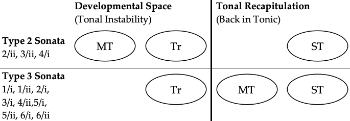
Example 2. Two thematic layouts for the second half of Blasco de Nebra’s Seis sonatas
(click to enlarge)
[1.1] The Seis sonatas (1780) consists of six two-movement sonatas, each with a slow movement followed by a fast movement. Blasco de Nebra’s particular attention to large-scale organization is demonstrated by his choice of key relationships from each sonata to the next: C minor,
[1.2] Blasco de Nebra’s sonatas may be categorized into either Type 2 or Type 3 following Hepokoski and Darcy’s (2006) sonata form typology (see Example 2). The double return of the main theme and tonic key (Type 3) was extremely rare on the Iberian Peninsula before 1780. As mentioned earlier, Blasco de Nebra was the first Spanish composer to consistently employ it in his work, with nine of the twelve movements in the newer Type 3 format and the other three in the older Type 2 format.(10) However, a caveat must accompany such an analysis: the second half of his sonatas always brings back all the themes only once. This is contrary to Hepokoski and Darcy’s principle of rotation, which suggests that the Type 3 Sonata should bring back at least part of the exposition twice during the second half.(11) If the first half may be schematically represented as MT Tr′ ST, then the second half is either MT Tr′ | ST (Type 2) with the tonal resolution at the recurrence of the subordinate theme (ST), or it is Tr′ | MT ST (Type 3) with the tonal resolution at the recurrence of the main theme (MT). Blasco de Nebra seems to move the main theme after the transition and medial caesura (Tr′) from its place in the Type 2 Sonata prevalent in Spain, perhaps to emulate the double return already popular in the music of Haydn, with which he would have been well acquainted.(12)
[1.3] The remainder of this article will focus on how Blasco de Nebra treats the musical material in each of these formal regions. While clear differences exist between the expositional thematic areas of his sonata forms, there is great formal consistency among his main themes, transitions, and subordinate themes across the twelve sonata movements, whether Type 2 or Type 3. Moreover, many traits that at first seem strange are in continuity with the Spanish keyboard tradition, even while Blasco de Nebra incorporates innovations both seemingly his own and from elsewhere.
2. The Main Theme
[2.1] One remarkable feature of Blasco de Nebra’s themes is their intrathematic organization. Rather than consistently employing the tight-knit formal archetypes described in Classical Form (Caplin 1998),(13) Blasco de Nebra constructs most of his themes through the chaining together of two- to four-measure subphrases to create a series of phrases whose irregular lengths span from four to eleven measures. These subphrases are readily recognizable as serving Caplin’s initial, medial, or cadential function by their choice of fundamental progression (schema).(14) In this section, I discuss this particular intrathematic organization, how schemata are used to provide tight-knit structure to these phrases, and the concluding rhetoric consistently employed.
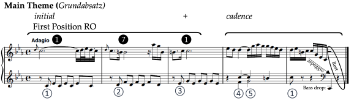
Example 3. Blasco de Nebra’s Sonata No. 1 in C minor, i (Adagio, Main Theme, mm. 1–5)
(click to enlarge and listen)
[2.2] One particularly interesting development in the late-eighteenth-century Spanish repertoire is the prevalence of the three-measure initial idea.(15) While there are various ways to conform any three-stage schema to a four-measure hypermeter (see Gjerdingen 2007, 78ff. for numerous examples), each of Blasco de Nebra’s three-measure initial ideas compose out the three-stage schema with one stage per measure that does not metrically fuse with the following subphrase. A total of five of the twelve sonata movements begin with such a three-measure passage, representing the most common option, which typically outlines a three-stage Galant schema such as a Do-Re-Mi (Gjerdingen 2007, 77) or Heartz (Rice 2014).
[2.3]The main theme of the first movement of Sonata No. 1 in C Minor (Example 3) provides a simple case of this. The work begins with a three-measure figure over a ①–②–③ rule-of-the-octave bass line, with each stage receiving one measure, and concludes with a two-measure cadenza composta (④–⑤–① with a 4–3 suspension).(16)①This three-measure opening figure outlines a first-position realization of the first three stages of a standard minor rule of the octave, with a ➊–➐–➊ melodic outline. This is among the most common schemata in eighteenth-century music, often presenting itself in an inverted form that Gjerdingen (2007) calls the Do-Re-Mi schema. What makes its use in Example 3 remarkable is that, because the schema is metrically disjunct from the following two-measure cadential schema, it causes the phrase to consist of five measures.
[2.4] The cadence in mm. 4–5 of Example 3 illustrates a number of important stylistic elements of Blasco de Nebra’s cadences: it is a ④–⑤–① bass progression precisely two measures in length that ends with an overhang (Koch 1787; Burstein 2020, 39–45; Caplin 2024, 392–96), arpeggio, low bass note, and rest. The (➍–)➌–➋–➊ overhang occurs in half of Blasco de Nebra’s main themes (and none of his subordinate themes).(17) The downward arpeggiation and low bass note seems to be a new feature of Spanish music, since insofar as it occurred in previous Spanish or Italian practice, it did so only sparingly and not to the consistent degree found in Blasco de Nebra’s music. Finally, the separation between the main theme and transition may be seen as a continuation of earlier practice, but one that takes a common option and turns it into a rule: each and every one of Blasco de Nebra’s main themes is followed by a medial-caesura-like rest. These features occur with great regularity at the end of main themes and transition modules (but not subordinate themes, whose cadential subphrases can be two- or three-measures long and always end without any of the features common at internal cadence points). For this reason, these features may be understood as having a rhetorical function: they signal to the listener that, although an important formal punctuation has been reached, the formal Cadenz that ends the exposition has not.(18)
[2.5] Of the seven movements with non-sentential main themes, five begin with a three-measure initial idea. While Example 3 shows the simplest case of an initial+cadence theme, the other four include some sort of medial function between the initial and cadential functions. One common strategy is to include a basic idea+basic idea structure that evokes the sense of presentation; however, its harmonic progression and formal placement evokes medial function. For this reason, I use the term medial presentation (and medial ideas, or m.i.) to describe these presentational subphrases that occur between the initial and cadential subphrases.
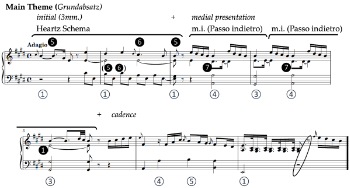
Example 4. Blasco de Nebra’s Sonata No. 6 in E Major, i (Adagio, Main Theme, mm. 1–7)
(click to enlarge and listen)
[2.6] The Adagio of the Sonata No. 6 in E Major (Example 4) exemplifies such a theme. As with the simple case in Example 3, the initial idea of this passage composes out a three-event schema—this time the Heartz schema (Rice 2014)—and the cadence is a two-measure cadenza composta. Between them, however, are two one-measure medial ideas that embellish Passi indietri schemata (④–③ in the bass counterpointed with ➐–➊ above). This passage has elements of continuation function, including fragmentation with one- rather than three-measure units, harmonic acceleration with two rather than one chord per measure, and rhythmic intensification with its sixteenth notes.(19)
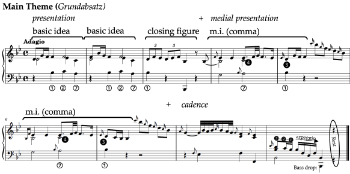
Example 5. Blasco de Nebra’s Sonata No. 2 in
(click to enlarge and listen)
[2.7] The first movement of the Sonata No. 2 in
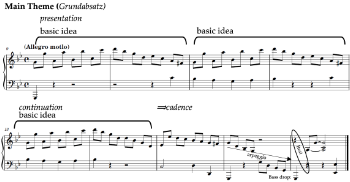
Example 6. Blasco de Nebra’s Sonata No. 4 in G Minor, ii (Allegro molto, Main Theme,
(click to enlarge and listen)
[2.8] The standard eight-measure sentence is almost wholly absent from main themes (but not subordinate themes) in Blasco de Nebra’s repertoire. While two of Blasco de Nebra’s sonatas (Nos. 3/ii and 4/ii) do feature eight-measure sentences for their main themes, and a third (No. 5/ii) features a slightly expanded nine-measure sentence, all of these combine basic ideas with cadences without clear medial function. The Allegro molto of Sonata No. 4 is a representative case; see Example 6. As with most of the basic ideas in the Spanish keyboard repertoire (and more generally following the tendency for repetition), the second instance of the basic idea is an exact repetition of the first. This is followed not by clear continuation features, but rather by a third repetition of the basic idea, which Caplin refers to as an expanded presentation whenever it continues the prolongation of tonic harmony (see Caplin 1998, 47, 99). In this case, the third basic idea is modified to remain on the initial tonic harmony for the entire two-measure unit and leads seamlessly into another cadenza composta, which is extended an extra measure after the cadential point of arrival by the downward arpeggiation, low bass note, and rest. The resulting structure may be described either as an asymmetrical 6+3 presentation+cadence or perhaps more satisfyingly as a 4+5 presentation+basic-idea⇒cadence. Either way, this nine-measure sentential theme seems to be governed not by the sentential archetype, but rather by the same chaining together of intrathematic functions as in previous examples.
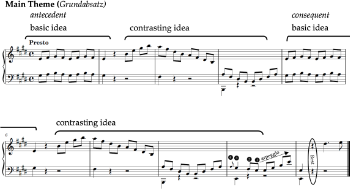
Example 7. Blasco de Nebra’s Sonata No. 6 in E Major, ii (Presto, Main Theme, mm. 1–10)
(click to enlarge and listen)
[2.9] Finally, the second movement of Sonata No. 6 (Example 7), while unique in this collection (and very rare in eighteenth-century Spanish sonatas in general) for its periodic structure, nonetheless demonstrates Blasco de Nebra’s freer construction of main themes. It begins with a simple two-measure basic idea in
3. The Transition
[3.1] As with the main theme, Blasco de Nebra’s transitions follow a set of formal and stylistic norms: they are typically longer than the opening phrase (often at least twice as long), consist of one to three modules that begin in the tonic key, sometimes move through an intermediate key such as IV or VI, and always end in the subordinate key area. The medial caesura is not only punctuated with a longer rest than the caesura that is typical between the main theme and transition, but it is additionally reinforced by several other features discussed below. In all but the Adagio of Sonata No. 1, the final cadence of the transition is a half cadence in the subordinate key.
[3.2] Hepokoski and Darcy characterize the transition as “a series of continuation modules, the upshot of which was to provide the energy-gain needed to produce an effective [medial caesura]” (Hepokoski and Darcy 2006, 93).(22) They highlight that the function of the transition is to accept the main theme through energy-gain (primarily through an increase of texture, rhythm, and dynamics) that drives toward the medial caesura and sets the stage for the subordinate theme. While the general idea of continuation modules also applies to Blasco de Nebra’s works, the typically sedate pacing of the modules does not lead to an “energy-gain” interpretation. His transitions consistently employ AA and AAB structures, in which the As and Bs may each constitute their own phrase, together form a single phrase, or exhibit some combination of the two. Therefore, I employ Hepokoski and Darcy’s term module to refer to these units in the transition.(23)
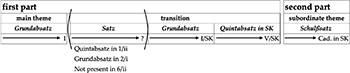
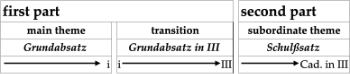
[3.3] Burstein (2020) captures how these transitions operate in the context of the exposition as a whole. Following the initial Grundabsatz (a passage that ends with an authentic cadence) that serves as the main theme, the transitions of eleven of the twelve sonata movements end with a Quintabsatz (a passage that ends with a half cadence) in the subordinate key. Three of these consist of only that Quintabsatz in the subordinate key (Example 8), and five more begin with a Quintabsatz in the home key (Example 9). Three more contain a Grundabsatz in the subordinate key before the Quintabsatz in the subordinate key (Example 10). The Adagio of the Sonata No. 1 in C Minor is the only transition that consists of a single, three-module (AAB) Grundabsatz that modulates from the home key to the subordinate key (Example 11).
Example 8. Standard three-Sätze Layout (Sonatas Nos. 2/ii, 3/ii, and 5/i)
(click to enlarge) | Example 9. Standard four-Sätze (Sonatas Nos. 3/i, 4/i, 4/ii, 5/ii, and 6/i)
(click to enlarge) |
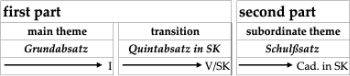

Example 10. Layouts with Grundabsatz before final Quintabsatz (Nos. 1/ii, 2/i, and 6/ii)
(click to enlarge) | Example 11. Layout for Sonata No. 1/i
(click to enlarge) |
Example 12. Blasco de Nebra’s Sonata No. 5 in
(click to enlarge and listen)
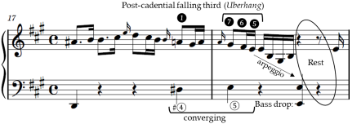
[3.4] Blasco de Nebra uses a consistent set of closing features similar to those employed in the main theme to signal the end of the transition. These include a converging cadence (
Example 13. Modular layout of the Transitions in Blasco de Nebra’s Seis sonatas
(click to enlarge)
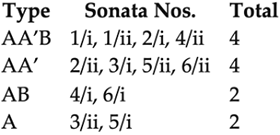
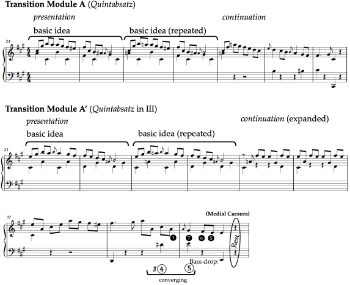
[3.5] Although the intrathematic makeup of these transitions is highly varied, they all employ one to three modules independent of their cadential structure, and sentential structures are common at multiple levels. The most common strategy is to begin with an A module in one key—either I, IV, or VI—followed by an A′ module transposed to a closely related key (III, IV, V, or VI). Example 13 shows the four modular layouts the transition may take, from a single module that ends with a half cadence in the new key to the more common parallel-module construction, with or without a third contrasting module (AA′ or AA′B). Fully eight of the twelve sonata movements begin with AA′, four of which include a third, contrasting B module.
Example 14. Blasco de Nebra’s Sonata No. 5 in
(click to enlarge and listen)
[3.6] The Allegro movement of Sonata No. 5 (Example 14) provides an example of a transition with the form AA′. The A module is a seven-measure sentence in the main key of
Example 15. Blasco de Nebra’s Sonata No. 2 in
(click to enlarge and listen)
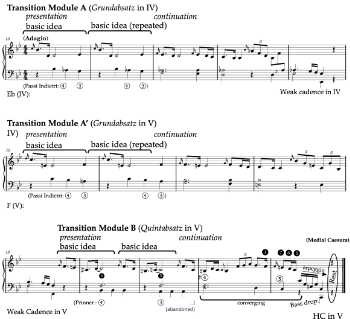
[3.7] Sentence-like musical structures predominate in these transitions, as has already been seen in Example 14. This principle recurs on a higher formal level in the four transitions that take an AA′B, which may be analyzed as a large-scale sentence (Martinkus 2021). The Adagio movement of the
Example 16. Form Diagram for Blasco de Nebra’s Sonata No. 2 in
(click to enlarge)
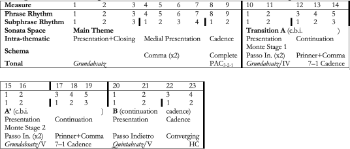
[3.8] It is worth pausing for a moment to consider the effects that these irregular phrase lengths have on phrase rhythm and hypermeter. Consider, for example, the first movement of Sonata No. 2 (see Examples 5 and 15), for which a hypermetric form diagram is given in Example 16. The nine-measure 3+4+2 main theme and fourteen-measure 5+5+4 transition—itself divided into two 3+2 A modules and a 2+2 B module—does not readily lend itself to an analysis of an underlying regular hypermeter with defined hypermetric manipulations, as is common in the music of Haydn and Mozart.(24) In general, given the proclivity for five-, seven, and even nine-measure phrases, it may be understood as a style feature that these works do not have any sense of regular hypermeter.
4. The Subordinate Theme
[4.1] Following the strong half cadence at the end of the Quintabsatz in the new key (except for Sonata No. 1/i) and medial caesura, the subordinate theme begins in the new key. Blasco de Nebra’s subordinate themes typically consist of a single repeated Schlußsatz that ends with a conclusive PAC without any of the concluding embellishments common to internal cadences in this repertoire, thus meeting the criteria for Koch’s förmliche Cadenz (or the essential expositional closure). These themes are more likely to take the form of a sentence than the main themes, albeit with looser organization more typical of subordinate themes.(25) In particular, beginning function is often weakened by starting with an inverted tonic harmony, on the dominant, or (in two cases) with a Fonte schema that begins with the dominant of ii.(26)
Example 17. Blasco de Nebra’s Sonata No. 4 in G Minor, i (Adagio, Subordinate Theme, mm. 18–33)
(click to enlarge, listen, and see the rest)
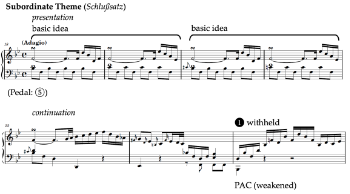
[4.2] The Adagio of Sonata No. 4 (Example 17) provides a representative case of Blasco de Nebra’s subordinate themes. Following the strong converging half cadence in the relative major along with all the typical concluding rhetoric, the theme begins with a four-measure presentation consisting of a basic idea and its exact repetition. The presentation consists of two two-measure basic ideas over a weak dominant pedal, a mild case of formal loosening that Blasco de Nebra often uses at the beginning of his subordinate themes. The dominant pedal resolves to a first-inversion tonic chord that launches a ③–④–⑤–① cadential progression that is stretched out over three measures. In addition to showcasing the three-measure cadential unit that Blasco de Nebra often uses at the end of his subordinate themes, this seven-measure phrase further demonstrates Blasco de Nebra’s use of asymmetrical phrases and their resultant irregular hypermeter.
[4.3] While previous sections of the exposition feature exact repetition at the intrathematic level—e.g., two basic ideas—the subordinate theme replicates this tendency at a higher level. In addition to the two-measure basic idea being exactly repeated, the entire subordinate theme is itself exactly repeated. While all of Blasco de Nebra’s subordinate themes are repeated, the strategy for weakening the first cadence varies. Often, the cadence elides with the beginning of the repeated theme. In other cases, such as the one in Example 17, a strong close is subverted by withholding some important aspect of the cadential gesture the first time.①In this movement, Blasco de Nebra withholds the expected ➊ on the downbeat of m. 24. This final ➊ arrives at the end of the repetition of the subordinate theme in m. 31, marking the essential expositional closure (or the essential structural closure at the end of the recapitulation). Both the exposition and recapitulation reinforce this arrival with two Quiescenza schemata.(27)
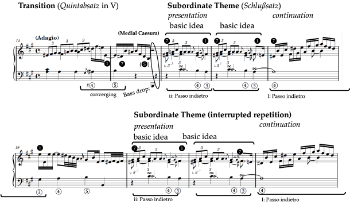
Example 18. Blasco de Nebra’s Sonata No. 3 in A Major, i (Adagio, Subordinate Theme, mm. 14–30)
(click to enlarge, listen, and see the rest)
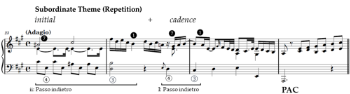
Example 19. Blasco de Nebra’s Sonata No. 5 in
(click to enlarge and listen)
[4.4] The subordinate theme in the Adagio of Sonata No. 3 in A Major (Example 18) demonstrates one of Blasco de Nebra’s more extreme examples of beginning the subordinate theme off the local tonic. The theme begins following typical end-of-transition rhetoric (mm. 14–15). However, rather than opening on a more typical tonic or dominant harmony, it begins with a one-measure basic idea that tonicizes the supertonic with a Passo indietro.(28) Although this more radical off-tonic opening occurs only in a handful of cases in this repertoire, it does illustrate the extreme of a tendency to begin away from a stable, root-position tonic harmony. For example, Blasco de Nebra’s Adagio to his Sonata No. 5 in
[4.5] Example 18 exemplifies another asymmetrical sentence (mm. 16–20), this time with a one-measure basic idea (m. 16), its exact repetition (m. 17), and a three-measure continuation (mm. 18–20). The continuation begins with a Passo indietro in the subordinate key, completing a Fonte schema begun by the basic idea. The resolution of that Passo Indietro begins the final ③–④–⑤–① cadence. However, in a fashion typical for Blasco de Nebra, this phrase is interrupted at its would-be cadential arrival by the beginning of the repetition of the subordinate theme (mm. 20–24), which ends in m. 24 with a conclusive PAC.
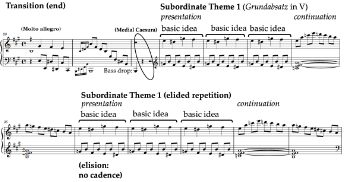
Example 20. Blasco de Nebra’s Sonata No. 3 in A Major, ii (Allegro molto, Subordinate Theme, mm. 28–62)
(click to enlarge, listen, and see the rest)
[4.6] Two of Blasco de Nebra’s sonata movements have two subordinate themes, both of which are marked as such by their placement after the medial caesura and their exact repetition. In these cases, the first phrase is a Grundabsatz in V that ends in either an IAC (Sonata No. 3, Allegro molto) or elided PAC (Sonata No. 4, Allegro molto), and the second phrase is the Schlußsatz that provides the final PAC. The Allegro molto of his Sonata No. 3 in A Major (Example 20) demonstrates this kind of subordinate theme group. Following the typical concluding transition rhetoric of a half cadence in the subordinate key, the subordinate theme begins in the minor dominant with a one-measure figure (m. 31) that is repeated twice (mm. 32 and 33) and continues with an elided three-measure cadential gesture (mm. 34–36). As with the first movement (given in Example 18, mm. 19–20), the cadence in this movement (Example 20, mm. 34–36) elides with the repetition of this subordinate theme in the subordinate key. Unlike the first movement, however, the repeated phrase (mm. 36–41) ends not with a PAC but with an IAC. A second subordinate theme follows: a six-measure sentence (mm. 42–47; repeated in mm. 48–53) with a two-measure basic idea, its exact repetition, and a two-measure cadence.
5. The Second Half
[5.1] The developmental space (see Example 2) only includes either transition (for Type 3 sonatas) or the main theme and transition (for Type 2 sonatas). The subordinate theme and optional closing section invariably come back without alteration, except of course for its transposition into the main key. The developmental space also leaves its material relatively undeveloped, whether from the main theme or transition, and includes only two kinds of tonal alterations to the original material. First, each module is typically in a different key from its initial statement in the exposition, and often also in a different relationship with each other. Second, although the material is kept more or less the same, Blasco de Nebra includes modulations in the middle of many of the modules.
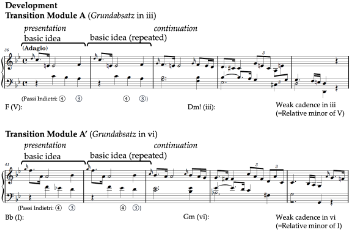
Example 21. Blasco de Nebra’s Sonata No. 2 in
(click to enlarge, listen, and see the rest)
[5.2] Consider the developmental space of the Blasco de Nebra’s Sonata No. 2, Adagio (Example 21). Like its corresponding transition (Example 15), the development takes the form of AA′B, but each of the A modules provides a cadence in its relative minor. The A module begins in the dominant (F major) but ends on the relative of the dominant (D minor). The A′ module begins in the home key but similarly modulates to the relative minor (G minor). The B module stays in the relative key, ending on the V/vi half cadence typical of developments in both the Austro-Germanic as well as the Spanish repertoire. A lead-in figure is added to smoothly retransition to the double return in m. 50.
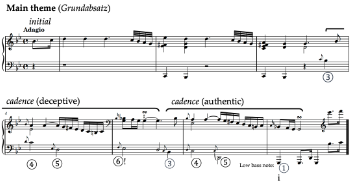
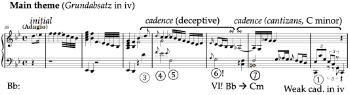
[5.3] The three sonata movements whose second half begins with the main theme (Type 2) begin in the subordinate key and modulate to another non-tonic key, after which they proceed to the transition that follows the same developmental procedures discussed above. The point of recapitulation is then not at the main theme, but rather at the subordinate theme (see the chart in Example 2). The Adagio of Sonata No. 4 in G Minor begins with the main theme material in the key of the mediant. The initial occurrence of the main theme (Example 22) consists of a three-measure basic idea followed by a two-measure deceptive cadence and a two-measure proper cadence. In the development (Example 23), this phrase expansion via deceptive cadence becomes a modulation, with the initial deceptive cadence on G minor being followed by a cadential figure in C minor. The first transition module (A) is then presented in C minor, ending on a half cadence in that key, and the second transition module (B) then occurs in the tonic, ending with a half cadence in the home key. Neither contain any alteration beyond choice of key.
Example 22. Blasco de Nebra’s Sonata No. 4 in G Minor, i (Adagio, Main Theme in Exposition, mm. 1–7)
(click to enlarge and listen) | Example 23. Blasco de Nebra’s Sonata No. 4 in G Minor, i (Adagio, Main Theme in Development, mm. 35–41)
(click to enlarge and listen) |
Conclusion
[6.1] Blasco de Nebra’s sonatas feature a number of exceptional qualities. He constructs beautiful and often asymmetrical themes through a variety of means, including three-measure initial units, medial presentations, and exact repetition. His transitions are heavily weighted: they follow a caesura after the main theme, are highly thematic, and are usually longer than the main theme. They often use AA′ or AA′B forms, sometimes with their own internal cadences and caesuras, but which always (except for No. 1/i) end with a strong half cadence in the subordinate key with convincing concluding rhetoric (converging cadence, overhang, arpeggiation, low bass note, and a caesura that is usually longer than previous ones). His subordinate themes tend more towards sentential types, often with weakening of the initial tonic harmony and expansion of the cadential area. The subordinate theme is always exactly repeated, with the first cadence weakened either through elision or by withholding an important aspect of the final cadence (Cadenz). And finally, for the second half of the sonata, Blasco de Nebra is the first Spanish composer to consistently place the tonal recapitulation at the recurrence of the main theme, although it seems that he merely switches the main theme and transition of a second full rotation (Tr′ | MT ST) instead of having three full rotations of the thematic areas. In this sense, Blasco de Nebra seems to model his Type 3 forms on the bi-rotational Type 2 forms (MT Tr′ | ST) prevalent in Spain to that point, which he continues to use in three of his twelve sonata movements.
[6.2] De Nebra’s sonatas seem to evoke a more sedate pacing than is often expected from the Austro-Germanic sonatas. One wonders if there is a fundamental difference between the ways that de Nebra and his Austro-Germanic contemporaries think about time. Hepokoski and Darcy highlight the goal-directedness of sonata form in a highly energetic way: the main theme (“the initiator of the form”) launches the form, the transition (“a series of energy-gain modules”) provides the necessary energy gain for the launch of the subordinate theme, and the subordinate theme pushes towards the final goal of the essential expositional closure (and eventually the essential structural closure at the end). On the other hand, the consistent repetition of formal units at all formal levels (e.g., basic ideas, medial ideas, transition modules, and the subordinate theme as a whole), the prevalence of caesuras between all sections of the form, and the non-energetic, almost thematic transitions give the feeling of walking, not running, toward the end of the form. Even in the fast movements, it feels more like each moment is being enjoyed for its own sake rather than being used to propel forward to some ultimate goal. Even when the goal is reached, it is often reached quietly and then reinforced through a post-cadential closing section that also seems to be in no hurry.
[6.3] There are other aspects of these works that deserve more attention. For example, the Spanish keyboard style c. 1780–1800 presents a challenge to common notions of hypermeter and phrase rhythm. In particular, the phrase proportions in this repertoire do not demonstrate a strong tendency toward either phrase symmetry or a consistent duple or quadruple hypermeter like the contemporary late-eighteenth-century Austro-Germanic style. Instead, Spanish composers use Galant schemata to form phrases made up of two-, three-, or four-measure subphrases without regard to hypermetric implications. For example, a nine-measure (3+4+2) main theme may be followed by a fourteen-measure transition (5+5+4), preventing a sense of predictable hypermeter.
[6.4] Naturally, a greater contextualization is needed for a more thorough appreciation of these works. Many of the features discussed here are clearly present, sometimes in a more inchoate form, in Spanish (and Italian) sonatas of the 1740s and ’50s. Certain features, such as the two-movement structure and tonal pairings of movements, are present in works in Spain from even earlier. Spain also has its own rich history of keyboard music (e.g., the tiento), dramatic vocal music (zarzuela), and music for theater. An important direction for future research is not just what the features of this repertoire are, but how they developed.(29) By studying how each individual element emerges in its original context and then only later gets subsumed into the form as a whole, we gain a better understanding of how form itself evolves, which has immense potential for understanding parallel regional developments of sonata form, such as those in Spain.
Bryan Stevens Espinosa
Sam Houston State University
SHSU School of Music
P.O. Box 2208
Huntsville, TX 77341-2208
bse013@shsu.edu
Works Cited
Alonso de Molina, Isaac. 2023. “‘Acompañamientos con las llamadas del Baxo y lo que se puede tocar sobre cada uno de ellos’: Partimenti Diminuiti in Manuscript M/1188 of the Biblioteca Nacional de España (Madrid).” In Figured Bass Accompaniment in Europe, ed. Livio Ticli, 65–86. Brepols.
Álvarez, María Salud. 1992. “José y Manuel Blasco de Nebra: La otra casa de la familia Nebra Blasco.” Revista de Musicología 15: 775–814. https://doi.org/10.2307/20795841.
—————. 1996. “Blasco (II).” In Diccionario de música y músicos, ed. Waldemar Axel Roldán. El Ateneo.
Blasco de Nebra, Manuel. 1964. Seis sonatas para clave y fuerte piano. Edited by Robert Parris. Unión Musical Española.
Buelow, George J. 2004. A History of Baroque Music. Indiana University Press. https://doi.org/10.2979/1915.0.
Burstein, L. Poundie. 2020. Journeys through Galant Expositions. Oxford University Press. https://doi.org/10.1093/oso/9780190083991.001.0001.
Caplin, William E. 1998. Classical Form: A Theory of Formal Functions for the Instrumental Music of Haydn, Mozart, and Beethoven. Oxford University Press. https://doi.org/10.1093/oso/9780195104806.001.0001.
—————. 2015. “Harmony and Cadence in Gjerdingen’s Prinner.” In What Is a Cadence? Theoretical and Analytical Perspectives on Cadences in the Classical Repertoire, ed. Markus Neuwirth and Pieter Bergé, 17–58. Leuven University Press. https://doi.org/10.2307/j.ctt14jxt45.4.
—————. 2024. Cadence: A Study of Closure in Tonal Music. Oxford University Press. https://doi.org/10.1093/oso/9780190056445.001.0001.
Cascudo, Teresa. 1998. “Iberian Symphonism, 1770–1809: Some Observations.” In Music in Spain during the Eighteenth Century, ed. Malcolm Boyd and Juan José Carreras, 144–56. Cambridge University Press.
Drabkin, William. 2007. “Review: Mostly Mozart.” The Musical Times 148 (1901): 89–100. https://doi.org/10.2307/25434500.
Drosopoulou, Loukia. 2014. “Luigi Boccherini’s copyists active at the Spanish royal court.” In Instrumental Music in Late Eighteenth-Century Spain, ed. Miguel Ángel Marín and Márius Bernadó, 183–200. Edition Reichenberger.
Ezquerro, Antonio. 2002. “Nuevos datos para el estudio de los músicos Nebra en Aragón.” Anuario Musical 57: 113–56. https://doi.org/10.3989/anuariomusical.2002.57.85.
Fisher, Stephen C. 1978. “A Group of Haydn Copies for the Court of Spain: Fresh Sources, Rediscovered Works, and New Riddles.” Haydn-Studien 4 (2): 65–84.
Gándara, Xosé Crisanto. 2014. “Sonatas italianas en archivos ibéricos: el caso del manuscrito MM 63 de Coimbra.” In Instrumental Music in Late Eighteenth-Century Spain, ed. Miguel Ángel Marín and Márius Bernadó, 47–68. Edition Reichenberger.
Gjerdingen, Robert O. 2007. Music in the Galant Style. Oxford University Press. https://doi.org/10.1093/oso/9780195313710.001.0001.
—————. 2020. Child Composers in the Old Conservatories: How Orphans Became Elite Musicians. Oxford University Press. https://doi.org/10.1093/oso/9780190653590.001.0001.
Greenberg, Yoel. 2022. How Sonata Forms: A Bottom-up Approach to Musical Form. Oxford University Press.
Hepokoski, James. 2021. A Sonata Theory Handbook. Oxford University Press. https://doi.org/10.1093/oso/9780197536810.001.0001.
Hepokoski, James, and Warren Darcy. 2006. Elements of Sonata Theory: Norms, Types, and Deformations in the Late-Eighteenth-Century Sonata. Oxford University Press. https://doi.org/10.1093/acprof:oso/9780195146400.001.0001.
Johnsson, Bengt. 1985. “Manuel Blasco de Nebra, ein Unbekannter Klaviermeister.” Fontes artis musicae 32 (4): 191–208.
Jones, David Wyn. 1998. “Austrian Symphonies in the Royal Palace, Madrid.” In Music in Spain during the Eighteenth Century, ed. Malcolm Boyd and Juan José Carreras, 125–43. Cambridge University Press.
Koch, Heinrich Christoph. 1787. Versuch einer Anleitung zur Composition. Vol. 2. Bey Adam Friedrich Böhme.
Le Guin, Elisabeth. 2014. The Tonadilla in Performance: Lyric Comedy in Enlightenment Spain. University of California Press. https://doi.org/10.1525/9780520956902.
Livermore, Ann. 1972. A Short History of Spanish Music. Vienna House.
Marín, Miguel Ángel. 2014. “Joseph Haydn y el Clasicismo vienés en España.” In Historia de la música en España e Hispanoamérica. Vol. 4: La música en el siglo XVIII, ed. José Máximo Leza, 484–500. Fondo de Cultura Económica.
—————. 2023. “Haydn from the ‘Frontier.’” Eighteenth-Century Music 20 (1): 5–11. https://doi.org/10.1017/S1478570622000355.
Marín, Miguel Ángel, and Márius Bernadó, eds. 2014. Instrumental Music in Late Eighteenth-Century Spain. Edition Reichenberger.
Martinkus, Caitlin G. 2021. “Schubert’s Large-Scale Sentences: Exploring the Function of Repetition in Schubert’s First-Movement Sonata Forms.” Music Theory Online 27 (3). https://doi.org/10.30535/mto.27.3.2.
Mirka, Danuta. 2020. Hypermetric Manipulations in Haydn and Mozart: Chamber Music for Strings, 1787–1791. Oxford University Press.
Morales, Nicolás. 2005. Las voces de Palacio: El Real Colegio de Niños Cantores de Madrid (siglos XVII–XVIII). Ayuntamiento de Madrid, Área de Gobierno de las Artes.
Newman, William S. 1963. The Sonata in the Classic Era. University of North Carolina Press.
Pedrero-Encabo, Águeda. 1997a. “Los 30 Essercizi de Domenico Scarlatti y las 30 Tocatas de Vicente Rodríguez: paralelismos y divergencias.” Revista de Musicología 20 (1): 373–92. https://doi.org/10.2307/20797425.
—————. 1997b. La sonata para teclado: su configuración en España. Universidad de Valladolid.
—————. 1998. “Some Unpublished Works of José Elías.” In Music in Spain during the Eighteenth Century, ed. Malcolm Boyd and Juan José Carreras, 214–21. Cambridge University Press.
—————. 2019. “Spain.” In The Cambridge Companion to the Harpsichord, ed. Mark Kroll, 185–200. Cambridge University Press. https://doi.org/10.1017/9781316659359.011.
Powell, Linton E. 1980a. “The Sonatas of Manuel Blasco de Nebra and Joaquín Montero.” Music Review 41 (3): 197–206.
—————. 1980b. A History of Spanish Piano Music. Indiana University Press.
Rabinovitch, Gilad. 2018. “Gjerdingen’s Schemata Reexamined.” Journal of Music Theory 62 (1): 41–84. https://doi.org/10.1215/00222909-4450636.
Rice, John A. 2014. “The Heartz: A Galant Schema from Corelli to Mozart.” Music Theory Spectrum 36 (2): 315–32. https://doi.org/10.1093/mts/mtu016.
Sanguinetti, Giorgio. 2007. “The Realization of Partimenti: An Introduction.” Journal of Music Theory 51 (1): 51–83. https://doi.org/10.1215/00222909-2008-023.
—————. 2012. The Art of Partimento: History, Theory, and Practice. Oxford University Press.
Schmalfeldt, Janet. 2019. “Domenico Scarlatti, Escape Artist: Sightings of His ‘Mixed Style’ towards the End of the Eighteenth Century.” Music Analysis 38 (3): 253–96. https://doi.org/10.1111/musa.12139.
Sutcliffe, W. Dean. 2014. “Poet of the Galant: The Keyboard Works of Manuel Blasco de Nebra.” In Instrumental Music in Late Eighteenth-Century Spain, ed. Miguel Ángel Marín and Márius Bernadó, 303–43. Edition Reichenberger.
Vincent, Michael. 2018. Boccherini’s Chamber Music in Cosmopolitan Europe. PhD diss., University of Florida.
Yáñez Navarro, Celestino. 2012. “Obras de Domenico Scarlatti, Antonio Soler y Manuel Blasco [¿de Nebra?] en un manuscrito misceláneo de tecla del Archivo de Música de las Catedrales de Zaragoza.” Anuario Musical 67: 45–102. https://doi.org/10.3989/anuariomusical.2012.67.137.
Discography
Discography
Blasco de Nebra, Manuel. 2011. Complete Piano Works, Vol. 3. Pedro Piquero, piano. Columna Música. 1CM0240.
Footnotes
1. So far, Powell (1980a, 1980b) and Sutcliffe (2014) have addressed Blasco de Nebra’s music directly. Blasco de Nebra and his music are also briefly discussed in Newman 1963; Livermore 1972; and Buelow 2004.
Return to text
2. A summary of Blasco de Nebra and the Blasco family is given in Álvarez (1992, 1996). The current primary sources are provided and summarized in Ezquerro (2002). Other important secondary sources on Blasco de Nebra (in addition to those already listed) include Johnsson 1985 and Yáñez Navarro 2012.
Return to text
3. There seems to have been something of a trend of Seis sonatas in Madrid in the 1780s: José Ferrer (fl. 1780–1781) also published his own Seis sonatas para forte piano ó clavicordio in Madrid in 1780, and Joaquin Montero (1764–1815) would publish his own Seis sonatas para clave y fuerte piano in Madrid in 1790.
Return to text
4. However, Michael Vincent (2018) has argued that the galant style may be better understood as a form of transmediterranean syncretism; from this perspective, Blasco de Nebra appears less an exception than a representative case. See also Le Guin 2014.
Return to text
5. Excerpted from an advertisement in Gazeta de Madrid, no. 104 (December 30, 1785), 860, https://www.boe.es/gazeta/dias/1785/12/30/pdfs/GMD-1785-104.pdf. Translation mine. Transcription of original text (diacritics and spelling preserved):
En Sevilla calle de Encisos casa de los Nebras se halla una colección de 1833 piezas de clave, forte-piano y órgano en que hizo su estudio D. Manuel Blasco de Nebra, Organista que fué de aquella Catedral. Falleció en 12 de Setiembre de 1784 de edad de 34 años, habiendo llegado á tocar de repente con finura, valentía y expresión quanto le presentaban. Su música, que consiste en 172 piezas, queda vinculada á la familia que franquea copias á 20 rs. vn. cada pieza, y la de los demas autores según su mérito desde 2 rs. hasta 10, cuyos nombres son los siguientes: Alberti, Baton, Benaut, Coupric, Carrier, Crusells, Daguin, Dupré, Dandrieu, Elías, Ferrer, Handel, Heyden, Offnam, Habinga, Irribarren; Lidon, Martini, Monserrat, Mondonville, Marriner, Nebra, organista del Rey; Nebra, organista de Cuenca; Nebra, organista de Zaragoza; Pelegrino, Rameau, Rosi, Rutini, Roseyngrave, Scarlati, Stamitz, Sesé, Soler, Toeschi, Vila, Zipoli, Jusepe Hayden.
6. While all of these approaches aid in the understanding of eighteenth-century form, they each do the best job describing works in their core data set. For Caplin (1998), that is the work of Haydn, Mozart, and Beethoven. Although not as transparent in their presentation, Hepokoski and Darcy (2006) best represent the same composers, and perhaps even Mozart more than the other two (Drabkin 2007). Burstein’s Journeys through Galant Expositions (2020) takes a more historically informed approach—following Koch—to better understand the average Galant composer around the middle of the eighteenth century.
Return to text
7. See Morales 2005 for a transcription of the books in the Royal College in Madrid, which include these partimento sources.
Return to text
8. Some caution is required when considering the organization of single-key sonatas. As with Domenico Scarlatti’s works, it is possible that a later editor rather than Albero himself arranged these pieces to form apparent pairs (see also note 9).
Return to text
9. To this list may be added Vicente Rodriguez’s Libro de tocatas para cimbalo repartidas por todos los puntos de un diapason (“Book of toccatas for harpsichord arranged through all the steps of an octave”), a printed work with the date 1744 that contains thirty pieces titled Sonata (along with one Pastorella). The sonatas mostly form pairs of keys starting from D minor and ascending in the scale. They alternate between minor and major, with black keys only receiving a single sonata (all of which are major except for one sonata in
Return to text
10. There are occasional examples of Type 3 (or perhaps proto-Type 3) Sonata in Spain prior to 1780. One of the most famous examples is of course D. Scarlatti’s Sonata in C major (K. 159), most recently the topic of Schmalfeldt (2019). Another equally strange example—and the only other one I have come across—is Joaquín Oxinaga’s (1719–1789) Sonata in C Major (c. 1750), in which the second half seems to follow a MT Tr | MT ST layout with the tonal resolution at the recurrence of the main theme. Like the Scarlatti example, other aspects of the work do not conform so neatly to standard Sonata-Allegro form. Looking forward a decade, Montero’s Seis sonatas (1790) used the Type 3 form for eleven of his Sonata movements and Type 2 for only one, showing the older forms waning popularity.
Return to text
11. This rotational principle is central to Sonata Theory: “Sonata-form structures are centrally concerned with the formal principle that we call rotational form or the rotational process: two or more (varied) cyclings—rotations—through a modular pattern or succession laid down at the outset of the structure” (Hepokoski and Darcy 2006, 17, see also 611–14). Type 3 sonatas consist of an expositional, developmental, and recapitulatory rotation, although the devlopmental rotation (Hepokoski and Darcy 2006, 205ff) often consists of only a half-rotation (such as P–Tr, see 217) and the recapitulatory rotation is often recomposed, reordered, and interpolated (Hepokoski and Darcy 2006, 233–35). Given their strong rejection of the reversed recapitulations (Hepokoski and Darcy 2006, 282–86), Hepokoski and Darcy would likely also not endorse the view presented here that Blasco de Nebra has a two-rotational model in mind with a reversal of the transition and main theme.
Return to text
12. Because it is also evident that Blasco de Nebra is engaging with these two Sonata Types, albeit in his own way, I use the Type 2 and Type 3 terminology to categorize these movements. However, I will continue to use Caplin’s nomenclature for the thematic regions (MT=Main Theme, Tr=Transition, ST=Subordinate Theme).
Return to text
13. Caplin (1998, 199) remarks that main themes are significantly more likely to be formed by conventional theme types than subsequent sections of the form, such as transitions and subordinate themes.
Return to text
14. I take Caplin’s “Fundamental Progressions of Harmony” (1998, Chapter 2) to be best represented by Galant schemata as outlined by Gjerdingen (2007), following more recent scholarship by Caplin 2015; Rabinovitch 2018; and Caplin 2024, Chapter 7.
Return to text
15. I employ the term initial idea whenever it serves initial function but does not reoccur in a sentential or periodic form, in which case I use basic idea.
Return to text
16. For a more in-depth discussion of the Galant cadenza composta (or compound cadence), see Gjerdingen (2007, 141) and Caplin (2024, 380–81).
Return to text
17. An overhang (German Überhang) occurs when the final melodic descent to tonic occurs after the cadential point of arrival. It is prominent in early works of Italian keyboard sonata composers such as Lodovico Giustini (1685–1743) and Domenico Alberti (1710–1740), as well as those of the first generation of Spanish composers of the Sonata a decade or so later (such as Sebastián Albero). Although it seems to have fallen out of fashion in Germany by Mozart’s time, it was described by Koch as late as 1787 in the second volume of his Versuch (vol. II, §§94–96).
Return to text
18. Burstein (2020, 20) uses Koch’s term förmliche Cadenz to describe the end of the first Hauptperiode (the Exposition). This is essentially Hepokoski and Darcy’s (2006) essential expositional closure (EEC).
Return to text
19. At the same time, the near-exact repetition of the medial idea followed by a two-measure cadence aligns exactly with the four-measure presentation+cadence phrase type common in Spanish keyboard music—a form that is essentially what Caplin refers to as a miniature sentence; see Example 4.6 and 5.4 in Classical Form (1998, 51, 61). Although less common in the late-eighteenth-century, the four-measure presentation+cadence was ubiquitous in mid-century Spanish keyboard sonatas. For example, nearly one-third of Sebastián Albero’s main themes from c. 1750 began with two one-measure basic ideas followed by a simple two-measure cadence.
Return to text
20. While repetition is a common feature of eighteenth-century periodic syntax, Blasco de Nebra often favors exact over varied repetition, seemingly more so than contemporaries such as Haydn or Mozart. This tendency may suggest an expectation for performers to supply embellishment in performance.
Return to text
21. The nine-measure theme created by two overlapping five-measure phrases is more typical of Blasco de Nebra subordinate themes.
Return to text
22. In the more recent Handbook for Sonata Theory, Hepokoski seems to abandon the “post-P continuation modules” (Hepokoski and Darcy 2006, 94) terminology, instead leaning in on the idea of energy-gain: “Considered as wholes, TRs typically give the impression of accepting P with an enhanced textural, registral, or rhythmic fullness. This is most clearly the case in many symphonic expositions” (Hepokoski 2021). His reference to symphonies as the locus for this energy gain is also important to this study, given Iberian symphonism had not yet taken off in 1780 (Fisher 1978; Cascudo 1998; Jones 1998; Drosopoulou 2014; Marín 2014, 2023; Gándara 2014).
Return to text
23. Note that Hepokoski and Darcy use “module” even more generally as any valid parsing of an action-zone or its constituent parts. For example, module P1 may be the antecedent of a period, paired with its consequent phrase P2. But each may be further divided into modules P1.1 and P2.1 (the basic idea) and P1.2 and P2.2 (the contrasting ideas) as needed.
Return to text
24. This point should not be overstated, however. As Mirka (2021) shows, claims of hypermetric regularity are often exaggerated: Haydn in particular, and even Mozart, frequently manipulate hypermeter in subtle but significant ways. Blasco de Nebra may be more aptly compared to earlier Austro-Germanic galant composers such as C. P. E. Bach (1714–1788), whose treatment of phrase rhythm was notably freer.
Return to text
25. While only five of Blasco de Nebra’s main themes take the form of a sentence, ten of his subordinate themes do. This pattern holds for the sonatas of Sebastián Albero’s Treinte sonatas as well, in which (out of the twenty-eight in sonata form) eighteen of the main themes and twenty-six of the subordinate themes are sentential.
Return to text
26. “A tonic prolongation can be weakened by inverting the prolonged harmony, by placing the subordinate harmonies on metrically accented positions, or by undermining the prolongation with a dominant pedal” (Caplin 1998, 99).
Return to text
27. The Quiescenza—“a state of repose or inactivity” (Gjerdingen 2007, 183)—schema occurs over a tonic pedal with a
Return to text
28. The Passo indietro involves a ④–③ bass motion harmonized
Return to text
29. This dovetails nicely with one new and exciting area of research: the evolution of sonata form. Yoel Greenberg’s How Sonata Forms (2022) provides not only a fine example of how this might be done, but also a framework and the beginning of a whole research paradigm for this kind of empirical work. Greenberg (paralleling Richard Dakwins’s Selfish Gene theory of biological evolution) argues that it is the individual features of sonata form that are primary and not the form as a whole.
Return to text
Copyright Statement
Copyright © 2025 by the Society for Music Theory. All rights reserved.
[1] Copyrights for individual items published in Music Theory Online (MTO) are held by their authors. Items appearing in MTO may be saved and stored in electronic or paper form, and may be shared among individuals for purposes of scholarly research or discussion, but may not be republished in any form, electronic or print, without prior, written permission from the author(s), and advance notification of the editors of MTO.
[2] Any redistributed form of items published in MTO must include the following information in a form appropriate to the medium in which the items are to appear:
This item appeared in Music Theory Online in Volume 31, Issue 4 in December 2025. It was authored by Bryan Stevens Espinosa (bse013@shsu.edu), with whose written permission it is reprinted here.
[3] Libraries may archive issues of MTO in electronic or paper form for public access so long as each issue is stored in its entirety, and no access fee is charged. Exceptions to these requirements must be approved in writing by the editors of MTO, who will act in accordance with the decisions of the Society for Music Theory.
This document and all portions thereof are protected by U.S. and international copyright laws. Material contained herein may be copied and/or distributed for research purposes only.

Prepared by Amy King, Editorial Assistant
Number of visits:
3089