Chord Tone or Harmonic-Bass Divorce? An Enactive Approach to Hearing Pedals in Popular Music
Stephen Hudson and Jiayi Wang
KEYWORDS: popular music, harmony, jazz theory, phenomenology, embodied cognition, melodic-harmonic divorce
ABSTRACT: This article synthesizes concepts from studies of harmony in popular music to create a new theory of pedals as multi-layered sonorities. We explore how pedal sonorities potentially have plural identities and possibilities for perception, shedding new light on several paradoxes or ambiguities that pedals have presented within traditional, triadic ontologies of harmony. Pedals have been historically associated with the bass voice, strictly separate from the chords above them, and usually understood as a harmonic prolongation of the tonic or dominant. But within popular music, pedals may appear in any voice, may participate in every chord, and may not play a clear prolongational role. We present a multiparameter framework for understanding pedals, and observe two new types of pedal in popular music: the sentimental pedal and the cinematic pedal. We also show how pop and jazz theories make it easier to conceptually integrate pedal notes with the surrounding harmonies. Our analyses widen the picture presented by the growing literature on melodic-harmonic divorce and harmonic-bass divorce, showing how some pedal passages can be experienced either as a stratification of divorced layers or as an integrated harmony. Finally, our conception of pedal is described from an enactive cognition perspective, foregrounding the potential for listener agency and subjectivity in the perception of these multilayered harmonies.
DOI: 10.30535/mto.31.4.3
Copyright © 2025 Society for Music Theory
Introduction
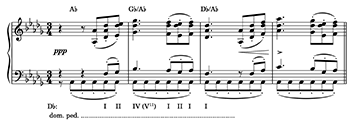
Example 1. Johannes Brahms, Piano Sonata no. 3 in F minor, op. 5 (1853), second movement,
(click to enlarge and listen)
[0.1] Pedal notes are often given somewhat mystical, paradoxical explanations, such as Nachum Schoffman’s riddle-like assertion, “The pedal point both is and is not the bass of the progression” (Schoffman 1983, 372).(1) Even straightforward textbook examples of pedals provoke analyses that seem superficial and self-contradictory; Piston analyzes the second measure of Example 1 (from Brahms’s piano sonata op. 5) as a
[0.2] In this article, we elucidate pedals in two ways. Our first contribution is to outline a set of multiple sonic parameters that make it easier to identify and describe different types of pedals, drawing on a framework from recent topic theory (Frymoyer 2017) to define and distinguish these types and their associated extramusical meanings. Our second contribution is a phenomenological model of pedals that demystifies some of the apparent contradictions of conventional explanations. Drawing on the Berklee school’s codification of jazz theory (Mulholland and Hojnacki 2013) and recent investigations into “melodic-harmonic divorce” in pop and rock (Temperley 2007; Nobile 2015; de Clercq 2019), we show how it is quite natural for pedals to offer multilayered, plural possibilities for perception. Specifically, we propose an “enactive” theory of pedal harmonies (building on Doll 2017, Kozak 2020, Ferrandino 2022, and Hudson 2023a and 2023b), in which listeners often have agency to hear a pedal as either divorced from the harmony around it or as a chord tone integrated into that harmony. This contrasts with an objective perspective, in which a pedal is multiple mutually contradicting things at once, such as bass and not-bass. It is thus often possible to hear a pedal and its surrounding pitches in several different ways, with different tonal and theoretical connotations; these differences might arise from listeners’ different ideas about what counts as a chord tone, or from their choice to focus on different instruments or layers, or from nuances of the performers’ voicing, or perhaps even from listeners’ preferences for hearing divorce. This enactive perspective dispels some of the apparent paradoxes of pedals in textbook theory, and adds a layer of plurality to theories of melodic-harmonic divorce.
[0.3] We begin by reviewing how pedals are often defined within common-practice and jazz textbooks and in popular music scholarship; we then review the melodic-harmonic divorce literature. Next, we present two motivating examples of pedals that appear to go beyond textbook theories. We then outline a multiparameter framework that can be used to define and identify specific types within the broad universe of pedals, including the traditional dominant pedal as well as two new categories: the sentimental pedal and the cinematic pedal. We especially highlight upper-voice pedals, which are often mentioned but under-theorized in the textbooks, and which are relatively prominent in popular music. Finally, we will introduce enactivism and describe how our understanding of pedals is enactive, showing how this perspective clarifies certain explanations offered by the melodic-harmonic divorce literature and conventional definitions of pedals.
1. Pedals as Harmonic-Bass Divorces in Rock Music Scholarship
[1.1] In common-practice theory, pedals are often described as sustained bass notes that are usually either the tonic or the dominant scale degree. They are often non-chord tones for at least some of the harmonies played above them; and their function is harmonic prolongation.(2) Walter Piston, for instance, defines pedal as follows:
The pedal effect, where a tone, usually the bass, is held through harmonies which are foreign to it, is rhythmically static, since it tends to deprive the harmonic progressions above of their basses and to cause them to be heard as melodic tones over a single root. (Piston 1962, 133)(3)
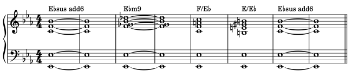
Example 2. The opening measures of “Green Dolphin St.” (1975) by Bronislau Kaper
(click to enlarge and listen)
One consistent difference between common-practice and jazz/pop definitions is that the latter often omit the criterion that pedals should be non-chord
[1.2] The idea of a pedal being conceptually separate from the harmonies around it resonates with a growing literature on “melodic-harmonic divorce” in rock music, and this literature provides the most extensive scholarly discussions to date of pedals in popular music. A brief overview of the history of this area will provide context for the following discussion of each source’s contributions. Scholars first discussed divorce as a newly recognized phenomenon of stratification between melody and harmony of rock bands, with the melodies seeming to move independently from the chord changes. They framed divorce in rock as a departure from classical practice, where melody was anchored in chord tones, and non-chord-tones had to follow strict rules for preparation and resolution. Later scholars specifically identified different types of melodic-harmonic divorce (for example: syntax or loop divorce as in de Clercq 2019), and expanded these concepts to harmonic-bass divorce.
[1.3] The conceptual foundation for melodic-harmonic divorce is Allan F. Moore’s argument that rock music consists of several different layers with distinct functions, first articulated in Rock, the Primary Text (1993). Moore proposes that rock songs have a four-layer structure: melody, harmony, bass, and rhythm, each of which corresponds to the main categories of instruments prevalent in rock music, namely vocals, piano/guitar, bass, and drums (1993, 31–32; 2012, 20–21). Moore notes that rock music can sometimes display a noticeable divergence between melody and harmony layers, describing this situation as a “divorce” (1995, 189).
[1.4] Following up on Moore’s observation, David Temperley (2007) examines divorces between melody and harmony layers, arguing that these “melodic-harmonic divorces” show how rock music departs from “common-practice” rules. In Temperley’s analyses, a crucial indicator of melodic-harmonic divorce is when melodic non-chord tones fail to resolve by step as they are required to under the rules of common-practice theory, signifying a disconnection between melodic and harmonic elements. Temperley observes how these instances tend to manifest under specific circumstances, such as in melodies based on the pentatonic. One recurring pattern is what Temperley calls the “loose-verse/tight-chorus” model (335), when a song’s verse exhibits melodic-harmonic divorce, but the subsequent chorus shifts towards a more “unified” organization.
[1.5] Drew Nobile (2015) objects to Temperley’s negative characterization of melodic-harmonic divorce as any passage that breaks classical rules, and creates a more constructive framework, asking, “since the traditional rules of counterpoint do not apply in these situations, what processes, if any, govern melodic and harmonic structure?” (189). To answer this question, Nobile describes three types of melodic-harmonic divorce: hierarchy divorce, syntax divorce, and loop divorce. Hierarchy divorce refers to a situation where the melody occupies a deeper level of structural importance than the harmony, or vice versa. For example, the harmony layer could contain embellishments or ornamentations, while the melody layer outlines a single prolonged harmony. Loop divorce occurs when the harmony repeats a fixed loop, while the melody moves independently, implying dominant or tonic functions at different times. Syntax divorce occurs when “both melody and harmony participate in a cadence or other structural motion but in incompatible ways” (189). For example, a melody could approach tonic by step while the harmony outlines a plagal cadence. This taxonomy defines melodic-harmonic divorces concretely and constructively on their own terms, creating a new theory for popular music, as opposed to Temperley’s characterization of melodic-harmonic divorce as an exception from classical practice.
[1.6] Trevor de Clercq (2019) expands the theory of melodic-harmonic divorces considerably by proposing that divorces can exist between all different combinations of musical layers, focusing especially on harmonic-bass divorces. De Clercq follows Nobile’s taxonomy of three types, explaining the traditional conception of a bass pedal as a harmonic-bass hierarchy divorce. In this account, the sustained pedal note in the bass layer prolongs a single tonal function, while the harmony layer above moves through other chords which can have other harmonic functions. In addition to helping explain a broad range of phenomena within popular music, de Clercq’s conception of the harmonic-bass divorce also helps explain pedals, providing a simple formalization for the insight of classical theorists that a bass pedal is separate from the harmony above it.
[1.7] Many pedals in popular music, of course, follow de Clercq’s explanation of pedals as a hierarchy divorce between the bass and harmonic layers, and are broadly consonant with conventional textbook conceptions of pedals. Certainly, it is quite common to have a traditional tonic or dominant pedal in rock, pop, musical theater, and other popular styles. However, many of the pedals we analyze below depart from this model for one or more of the following reasons: (1) they are played by a chordal or melodic instrument, not the bass; (2) they are within the same register as the harmonic filler layer, or are in a higher register; (3) they are chord tones—or at least, they can be heard as chord tones, integrated with the active chord; (4) they are not always clearly the root of a prolonged harmony. These conditions make it hard to analyze some pop music pedals as “hierarchical harmonic-bass divorces” as de Clercq has described them (2019, 273).
[1.8] Since we observe pedals in almost every functional layer, including in the same harmony instrument or harmonic filler layer which articulates the chords that move around the pedal, we have found it practical to coin a general term “harmonic divorce” which encompasses melodic-harmonic divorce, bass-harmonic divorce, and pedal tones within the harmonic filler layer. This sense of “harmonic” refers to a more generalized sense of harmony as the set of all notes present at a given moment, rather than specifically the harmonic filler layer; so “harmonic divorce” refers to any divorce between any notes in the harmony, without specifying the layers between which the divorce occurs.
[1.9] The analyses we present demonstrate the need for a multi-layered, plural, enactive ontology of harmony for popular music, in which a single sounding harmony can be heard as belonging to multiple meaningfully different chord identities. Similar arguments are proposed by Matthew Ferrandino (2022), although he focuses on pitch center rather than chord identity; his conception of “multi-centric complexes” builds on the concept of “positional listening” described by John Covach (2020) to propose that listeners focusing on different layers or instruments within the arrangement can perceive different pitch centers, and that these different perceptions should be treated as equal options rather than flattened into an ideal analysis. We extend these arguments to the level of chord identity and chord-tone inclusion. The ultimate consequence of these arguments is that such plurality in perception might be understood as a foundational property of everyday popular music tonality, not just an exotic special effect.
2. Two Motivating Examples: “You Keep Me Hangin’ On” and “Wake Me Up When September Ends”
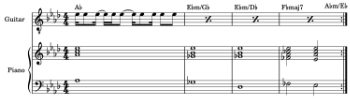
Example 3. The Supremes, “You Keep Me Hangin’ On” (1967), (0:00–0:08)
(click to enlarge and listen)
[2.1] The intro to “You Keep Me Hangin’ On” (Example 3), composed by the Motown songwriting team Holland–Dozier–Holland and recorded in 1967 by the Supremes, includes an
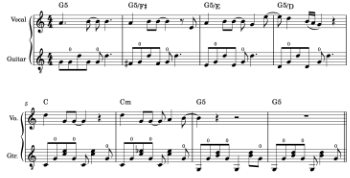
Example 4. Green Day, “Wake Me Up When September Ends,” (2004), verse (0:09–0:26)
(click to enlarge and listen)
[2.2] The introduction and verse of “Wake Me Up When September Ends” by Green Day (Example 4) includes a pedal that might (at first, on paper) seem more conventional. A G4 lasts through the entire phrase; the first four measures feature a repeated tonic harmony over a descending bass, then the second half of the phrase features a common plagal figure of IV–iv–I. This G might appear to be a relatively conventional tonic pedal, prolonging a tonic function across the whole phrase.
[2.3] But “Wake Me Up When September Ends” departs from the traditional textbook definition of the pedal in a more fundamental way: the pedal is not clearly separate from harmonies that might be said to move against it. In the first half of the phrase, there are actually two pedal notes in the guitar, G and D. These two pedal notes are voiced on the open G string and the third fret on the B string, while the moving bass line is on the next string down for the first four measures. The close pitch proximity here undermines the sense of stratification between static pedal and moving harmony that is often mentioned in traditional definitions. (Arguably, the recurring B in the voice is a third pedal tone, and the A that it alternates with could also be heard as implying a pedal.) Further, it is not clear when the sustained pedal notes are chord tones and when they are not. This is clearest in m. 3, when the G5/E could just as easily be heard as Em7 or vi7. In short, rather than a static pedal clearly divorced from moving chords, this phrase features two sustained notes that are threaded through the harmonies, rubbing up against the other notes and participating in harmony or dissonance with them in a way that (as we will explain later) adds substantially to the song’s sentimental affect.
3. A Multiparameter Framework for Describing Pedals
[3.1] In order to understand all pedals through the same comparable terms, we propose a multiparameter framework. This framework can help dispel the apparent paradoxes of previous discussions of pedals, but also will help us identify and describe some new phenomena. The following parameters or characteristics can be used to distinguish among the construction, function, and effects of various pedals we have encountered: 1) Register; 2) Instrumentation and Functional Layer; 3) Mixing & Stereo Space; 4) Sustain & Presence; and 5) Perceived Harmonic Function. We will examine these in detail in the following section.
Register
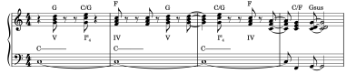
Example 5. Van Halen, “Jump” (1984), synthesizer part, which contains bass and harmony layers (0:00–0:14)
(click to enlarge and listen)
[3.2] The register in which a pedal appears (both absolute register, and relative register within a given instrument or part) is one of the most prominent criteria discussed in textbook definitions of pedal. A bass-register pedal is the most conventional, such as the pedal in the intro to Van Halen’s “Jump” (1984), which is sustained in the bass range of a synthesizer while syncopated staccato chords are played above it (Example 5). But a pedal can appear in any pitch-based layer, and in any register. Green Day’s “Wake Me Up” (Example 4) features a medium-register pedal that is higher than the moving bass notes in the guitar part, but not very much higher, and in absolute terms, it falls in a medium register. This registral proximity makes it feel more connected to the harmonies. A high-register pedal, as in the opening of the Supremes’ recording of “You Keep Me Hanging On” (Example 3), can feel disconnected from other pitch-bearing elements of the arrangement, just like a low-register pedal.
Instrumentation and Functional Layer
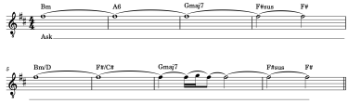
Example 6. A-ha, “Summer Moves On” (2000), lead vocal (3:10–3:32)
(click to enlarge and listen)
[3.3] Instrumentation might be the most significant parameter in distinguishing between different kinds of pedals and their functions. Moore argues that rock music is structured in four “functional layers”: the “functional bass layer,” the “harmonic filler layer,” the “melodic,” and the “explicit beat layer” (Moore 2012, 20–21; building on Moore 1993). The functional bass layer is separated from other layers not just by pitch, but also by timbre. Pedals within the bass layer are often easy to hear as harmonic-bass divorces, since the bass often plays only the sustained pedal tone and no other notes. For example, in the Beatles’ original recording of “Blackbird” (1968), the G pedal is crowded in the middle of a complex guitar voicing, but Brad Mehldau’s cover (1997) has this pedal moved to a separate upright bass part, which gives it more prominence. A pedal occurring in the bass layer is often (but not always) doubled within the voicing of harmony-layer instruments. The harmonic filler layer often blends into the background in popular music, and pedals within the harmonic layer are often easy to hear integrated into the chord, especially if they are in the same instrument and register as other notes. For example, “Why I Love You” by MAJOR. features two simultaneous pedals in the piano part, which often are chord tones (see our discussion later of Example 12). Occasionally a singer or solo instrumentalist will sustain a note across multiple chord changes, making a melodic layer pedal. One example is A-ha’s “Summer Moved On” (2000), where during the bridge section the singer sustains an
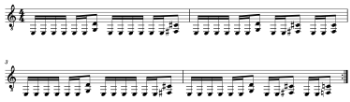
Example 7. Metallica, “Fight Fire With Fire” (1984), verse riff (0:41–1:00, 1:11–1:20, etc.)
(click to enlarge and listen)
[3.4] Pedals almost always occur within the layers of bass, harmony, or melody, but it is possible to identify pedals outside these layers, too. Heavy metal songs often feature a kind of repeated-note pedal that some writers argue plays a rhythmic function, rather than a melodic or harmonic one, making it arguably an explicit beat layer pedal. For example, Jose Garza claims that “the palm-muted notes in pedal-tone riffs fill space between the open notes’ timbral accents while maintaining momentum via continuous note onsets” (Garza 2021, 16). Usually, the “open notes’ timbral accents” create a melody that (harmonically) is completely independent from the pedal. These riffs are found within all metal styles; a classic example is the verse riff to Metallica’s “Fight Fire With Fire” (Example 7).
Mixing & Stereo Space
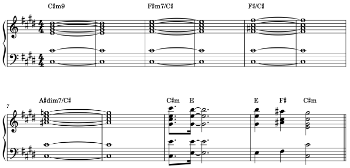
Example 8. Michael Jackson, “Thriller” (1982, album version), intro (0:21–0:40)
(click to enlarge and listen)
Audio Example 1. No Resolve (feat. From Ashes to New), –Thriller” (2023), intro (0:16–0:36)
[3.5] Another parameter that can affect perceptions of harmonic divorce is its relative position within the three-dimensional conception of acoustic space in mixing that Ruth Dockwray and Allan Moore call the “sound box” (Dockwray and Moore 2010), which consists of width (stereo panning), depth (a sense of distance), and height (high vs. low pitch). A separately mixed pedal is easier to hear as a divorced layer with its own identity or function, whether the pedal is panned differently, or given a different sense of distance with reverb or presence. In the intro to Michael Jackson’s “Thriller” (1983), a bass pedal (0:17–0:36) is panned somewhat to the right, while the main synthesizer chords are centered, the acoustic guitar is panned all the way to the left, and a higher descending-glissando synth (0:17–0:22) is panned all the way to the right (Example 8). This makes the bass pedal’s apparent spatial location different from all the other instruments, adding a sense of disconnection that makes the pedal feel more independent from the harmonies. But a similarly mixed pedal, which is less distant in the sound box from other instruments, often feels like part of the chords. Covers of “Thriller” often omit the intro passage from the original recording or rearrange it to remove the pedal, but an alternative-metal cover by No Resolve & From Ashes to New (2023) features an analogous bass-pedal passage (0:16–0:36), with the same harmonies but less extreme stereo panning. This makes the bass and synth parts feel more integrated into a single harmony layer.
Perceived Harmonic Function
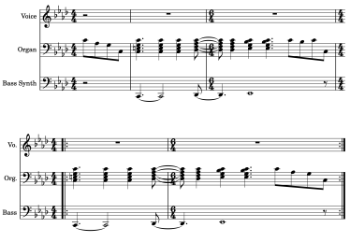
[3.6] Another parameter that distinguishes different pedals is their compatibility with surrounding harmonies and their sense of harmonic function. Like roots and chord identity, a pedal’s connection to surrounding harmonies and sense of harmonic function are subjective effects rather than objective structures (see Doll 2017, 9). A drone pedal is a sustained note that remains static and continuous throughout a whole section, taking on a background role, and is not heard to participate in any cadential progression. Details vary in different traditions. Ida Vujović (2017) describes “folk drones” in Western classical music that consist of a tonic and a dominant pitch sustained throughout a piece or section, and “foundational drones” in a variety of traditions, including Hindustani classical music where a single note is sustained on a tanpura throughout a piece. Drones are a “sonorous base” of the piece (Vujović 2017, “Foundational Drones”) but do not necessarily represent a prolonged harmony; for example, Hindustani classical music does not feature “chord changes” so the concept of a prolonged harmony would not be relevant. A popular music example of a drone pedal is “Like Real People Do” (2014) by Hozier, which features a repeating bass note G on an acoustic guitar throughout the whole song. Contrasting with a drone pedal, a functional or cadential pedal can be heard to occupy a particular stage in a larger-scale cadential progression. In a traditional dominant pedal such as Example 1, the sustained note is heard to prolong dominant function through its continued presence, while the harmonies around it may create small-scale functional progressions or may not have any clear sense of harmonic function in themselves. The ending of the pedal often coincides with a progression to the next stage in a cadence.(9)
Example 9. Radiohead, “Everything in its Right Place” (2000), intro (0:00–0:30)
(click to enlarge and listen)
[3.7] Regardless of whether it is a static drone or a stage in a functional progression, a chord tone pedal may be heard to participate in one or more of the harmonies around it as a chord tone. In this case, the pedal is (temporarily, at least) not perceived as a harmonic divorce, but as participating in the function and identity of that chord. A pedal may be the root of the chord, as in conventional definitions of tonic and dominant pedals, but it may also appear as a non-root chord tone, in both popular and classical
4. Types of Pedals
[4.1] This multiparameter framework allows one to identify and characterize particular categories or types of pedals. Following Ida Vujović (2017), we argue that categories of pedals are not mutually exclusive, but can significantly overlap, while remaining distinctive and useful in analysis:
Such a categorization is naturally always open for additions and adjustments. Furthermore, the categories are not exclusive. They are defined here according to what is considered to be their most active parameter. In concrete musical pieces, we shall rarely encounter any “pure” category; in most cases a pedal/drone will have combined properties, and the models that one can recognize in it will most probably interact with each other, assisting or undermining each other’s working. (Vujović 2017, “Models-introduction”)
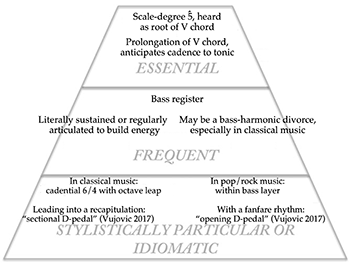
Example 10. Weighted hierarchy definition of the dominant pedal, following the terminology and format of Frymoyer (2017)
(click to enlarge)
Expanding on Vujović’s argument, we believe that not only one “most active parameter” but a hierarchy of parameters characterize each particular type of pedal, and thus a pedal’s perceived categorization might depend on interactions between several parameters. Johanna Frymoyer suggests that, in addition to compiling a list of parameters that characterize a musical topic, “the analyst must arrange these characteristics in a weighted hierarchy that asserts the relative importance of the characteristics to the overall topical identity” (2017, 85). We have adopted Frymoyer’s hierarchy of “essential,” “frequent,” and “stylistically particular or idiomatic” characteristics to define each type of pedal. To illustrate, Example 10 shows a category definition for a traditional dominant pedal, following Frymoyer’s format.
[4.2] Interfacing with Frymoyer’s theories about topics also serves an additional purpose, which is to discuss a degree of topical signification exhibited by some types of pedal. The core traditional categories of pedal, like tonic and dominant pedals, have no general, consistent extra-musical reference, but the drone pedal has long had an association with folk music and pastoral settings.(11) We suggest two new categories of pedal in popular music, the “sentimental pedal” and “cinematic pedal,” that seem to also have relatively clear extramusical associations.
Sentimental Pedals: Upper-Voice Pedals that Create Sentimental Affect
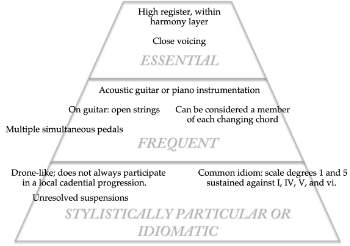
Example 11. Weighted hierarchy definition of the sentimental pedal
(click to enlarge)
[4.3] One new category of pedal, which we have named the “sentimental pedal,” often occurs in the higher notes of the harmony layer, evoking a sense of earnest emotion because it creates a fluctuating sense of dissonance and tension. The sentimental pedals we consider most characteristic (see Example 11) are played on acoustic guitar or piano, instruments associated with intimacy and sentimentality, in part through their frequent use in singer-songwriter styles. Sentimental pedals’ high register evokes a sense of keening or yearning that is usually not an effect of a bass- or middle-register pedal.
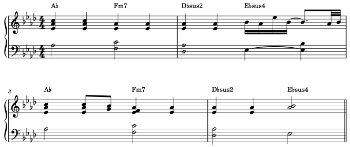
Example 12. MAJOR., “Why I Love You” (2016), intro (0:00–0:16)
(click to enlarge and listen)
Example 13. Led Zeppelin, “Stairway to Heaven” (1971), intro (0:00–0:27)
(click to enlarge and listen)
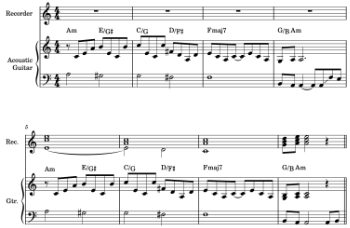
[4.4] Sentimental pedals’ close voicing often makes them feel like they merely participate in and color the moving chords, rather than defining a harmonic prolongation in the bass that undermines the identities and functions of the moving chords. This means the moving chords’ identities and functions remain the primary, most salient harmonic information. Due to their relatively high register, sentimental pedals often change roles in each chord, as chord tones or suspended tones or extensions, and the fluctuation of tension this creates is central to their sentimental effect. For example, “Why I Love You” by MAJOR. is effectively a modern update of the classic doo-wop progression I–vi–IV–V, featuring scale degrees and as pedals sustained throughout the whole progression (Example 12). Scale degree starts out as a chord tone (the fifth of the I chord) before becoming the seventh of the vi chord, then a suspended second of the IV chord, before finally turning into the root of the V chord. The unresolved suspensions in m. 2 provide a contemporary sound reminiscent of musical theater and Disney films.(12) A more famous example is the opening of Led Zeppelin’s “Stairway to Heaven” (Example 13), in which the repeated E and C in the middle register of the acoustic guitar part both function as sentimental pedals over a descending chromatic lament bass line; the E and C tones each play a different role in each chord (except the fourth chord, D/
Example 14. Sarah Bareilles, “Chasing the Sun” (2013), verse (0:00–0:23)
(click to enlarge and listen)
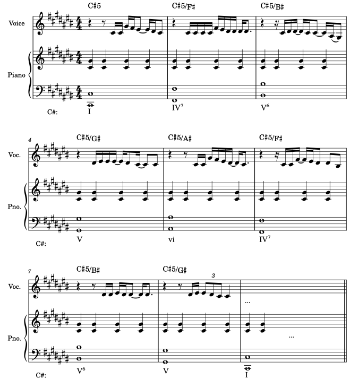
[4.5] A common construction of sentimental pedal is a double-pedal in the upper notes of the harmony layer consisting of scale degrees and sustained through some ordering of the chords I, IV, V, and vi. “Why I Love You” (Example 12) and “Wake Me Up When September Ends” (Example 4) are both examples of this construction, although the latter arguably features a full tonic triad if the B in the voice is considered to be a pedal too. Another example of this common sentimental double-pedal construction, but one that is not loop-based, is Sara Bareilles’s “Chasing the Sun” (Example 14). “Chasing the Sun” features a
[4.6] Many sentimental pedals on guitar use the highest or the two highest open strings as the pedal tones, which rings longer than a fretted string and has a more open or clear timbre, creating a distinctive sound. This is true of many of the examples we have already mentioned, including “California Sky,” “Photograph,” and “Crash Into Me”; additionally, Stephenson (2002, 77) describes a similar passage in John Denver’s “The Eagle and the Hawk.” These examples are relatively easy to compose and play, since one can easily experiment with various chord shapes on the lower strings without having to dedicate any left-hand fingers to the open-string pedal. From this perspective, Green Day’s “Wake Me Up” (Example 4) is less characteristic, since one of its pedal tones (D) is fretted and neither is played on the top string.(14)
[4.7] Sentimental pedals are also a central aspect of what Dan DiPiero has called “Big Feelings” music (2021, 17). DiPiero defines “Big Feelings” as “a tendency or an orientation” (17) in feminist indie rock from the post-2000s, a genre that eschews power chords (a common rock guitar voicing with a root and 5th but not 3rd) in favor of extended chords for the purpose of “breaking outside the bounds of rational, masculine [rock] harmony by literally adding notes on top of it
Example 15. Snail Mail, “Heat Wave” (2018), intro and verse 1 (0:00–0:48), guitar (representative four-measure passage)

(click to enlarge and listen)
Example 16. Land of Talk, “This Time” (2017), intro (0:00–0:24), reduced to whole notes
(click to enlarge and listen)
Example 17. Pinegrove, “Need 2” (2014), intro (0:19–0:44), guitar part, reduced to whole notes

(click to enlarge and listen)
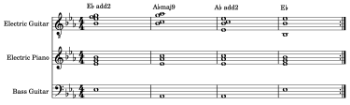
[4.8] We can clarify DiPiero’s concept substantially by pointing out that many of his examples of “Big Feelings” use sentimental pedals sustained through extended chords on electric guitars with custom tunings and dirty or distorted tone. For example, the guitar part to Snail Mail’s “Heat Wave” alternates between Emaj9 and
Cinematic pedals: pedals that create a cinematic sense of space, scene, or atmosphere
Example 18. Weighted hierarchy definition of the cinematic pedal
(click to enlarge)
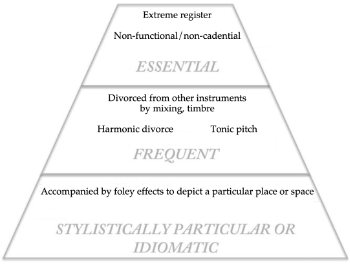
[4.9] Another category of pedal is the “cinematic pedal,” which creates a sense of dramatic tension or expansive space in a way that invokes the dramatic spatial and visual language of film (Example 18). We have already mentioned an especially vivid cinematic pedal in the introduction to Michael Jackson’s megahit “Thriller.” It features the chords
[4.10] While a sentimental pedal relies on the pedal being voiced within the harmony layer, a cinematic pedal relies on separation from the harmony layer by extreme differences in register and spatial mixing. The pedal in “Thriller” functions in an analogous way to the visual device of a horizon line or spacious backdrop, creating a sense of enormous space that makes the objects within it seem isolated or distant. When we listen to music, we tend to experience it metaphorically in terms of physical motion through space—and since the pedal is sustained over time, we might experience the pedal as an embodiment of expansive space through which the other sounds move (Cox 2016, 132–33). In “Thriller,” the stereo mixing adds to this ominous sense of space; the synth chords and drum kit are centered in the mix and are mostly dry (Walther-Hansen 2020, 97), as they would be in a normal rock arrangement (see Dockwray and Moore 2010). The other details (the wolf howl, the footsteps, and the door creaking and slamming shut) are wet with reverb and panned to the left and right, creating an impression of a large space that is mostly empty. The bass pedal, however, is panned hard to the right, creating an unsettling feeling of physical imbalance that adds a spatial dimension to the ominous acoustic and harmonic setting. This cinematic effect is limited to the intro; in the rest of the song, the bass is centered more conventionally in the stereo mix (although wolf howls continue to sweep between left and right channels).
[4.11] The most vivid cinematic pedals utilize a multilayered atmospheric production that transports listeners to an imagined space, sometimes with details so specific and evocative that one almost feels one can see it or touch it—just like in a transporting cinematic scene. “Thriller,” for example, opens with an unnervingly long creak of a door opening, followed by hard-soled footsteps that ring ominously as they move through the door. The door swings shut with a thunderclap. Fading in gradually, the sound of wind through the trees and a wolf howling at the moon place us in an outdoor nightscape and create a feeling of exposure or vulnerability. It is at this moment (0:16) when the harmonies and pedal begin, which serve as one more sonic layer reinforcing this ominous setting and amplifying its spooky tension. This sonic scene invokes thriller and horror film’s conventional trope of the quiet before the scare, a moment whose apparent peacefulness is heard as a foreshadowing of future frights.
[4.12] Pedals such as these build on the cinematic qualities of film music as described by Frank Lehman (2018). Lehman describes “pitch plateaus” (19) as a typical special effect in the Classic Hollywood Era style, citing Ben Winters (2007, 28), who describes “plateau notes” that are sustained to prolong a moment or atmosphere quietly in the background of the scene without distracting from dialogue or diegetic sounds. Lehman also mentions “pedal complexes” as one of many “musical habits that irresistibly call to mind Hollywood’s Golden Age,” resulting from “composers’ appetite for sonorous intensification” (2018, 21).
[4.13] These sustained pitches in film or popular music can carry powerful cinematic effects through what Lehman (2018, 18–19) calls “referentiality,” one of three tendencies or practices by which he defines the sound of cinema. Briefly, referentiality can be understood as the assumption that all cinematic music is not merely music, but is conjuring or transporting us to an extramusical world: film music is almost always understood to be evoking various emotions, atmospheres, narratives, actions, or spaces (real or imaginary), rather than merely “filling time”. Popular music, too, can be heard as “cinematic” in this way; a pedal can be heard as a prolonged feeling or atmosphere, or more literally as an aural depiction of space.
Example 19. Smokey Robinson, “Quiet Storm” (1975), intro and verse (0:00–1:12), bass and synths
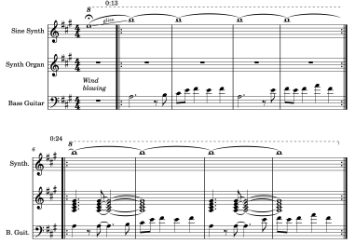
(click to enlarge and listen)
[4.14] Smokey Robinson’s “Quiet Storm” (Example 19) shows how a cinematic pedal effect can be achieved without any chord changes. The song begins with a synth playing a single E that gradually fades in, accompanied by a gentle sound of a breeze, creating a sense of large space in a similar way to “Thriller.” In the subsequent intro, this synth organ E5 continues while the electric bass regularly articulates an A pedal. These parts continue in the verse, which adds an electric piano part playing Amaj9. The entire intro and verse, then, has essentially no chord changes, just accumulating layers of Amaj9 over an A bass pedal. The chorus features the same A pedal, underlying shifts between Amaj7 and Dmaj7 in the harmony layer. The harmonic stasis of “Quiet Storm” is probably inherited from funk, which developed the novelty of having entire song sections on a single chord into a consistent practice (Ripani 2006, 116). In this song, the extreme registral differences between the bass, electric piano, and synth organ parts maintain a cinematic reference—one that frames the album by initiating the opening of “Quiet Storm” and concluding the final track “Coincidentally.” This cinematic pedal thus sonically locates the entire album in a peaceful, contemplative fantasy space. This atmosphere is so evocative that it inspired an eponymous “Quiet Storm” radio format of easy-listening R&B.
Example 20. Jason Robert Brown, “Sanctuary” from Coming From Inside the House (A Virtual SubCulture Concert) (2020, 0:19–0:43)
(click to enlarge, see the rest, and listen)
Example 21. Radiohead, “How to Disappear Completely” (2000), intro (0:00–0:23)
(click to enlarge and listen)
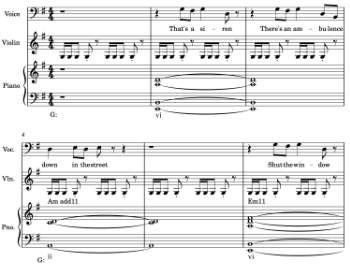
[4.15] But a song does not need to have foley sound effects or cinematic production in order for one to feel that part of a pedal’s role is to create a sense of large physical space or atmosphere. U2’s song “I Still Haven’t Found What I’m Looking For” has a two-note guitar pedal figure echoing throughout most of the song to create a sense of expansive physical space. This pedal can be heard as a cinematic pedal, although “cinematicness” is to some degree a subjective effect that depends on one’s mode of attention and frame of mind. “Sanctuary” by the musical theater composer Jason Robert Brown (as arranged for the Coming From Inside the House live album produced during the COVID lockdown) likewise creates a cinematic pedal, this time with a single violin that plays a repeating rhythm on its open G string, panned toward the right (Example 20). Other strings, playing sul ponticello trills, are panned to the left, and the bass is centered and extremely low. The violin pedal is thus separated from all other parts by register, timbre, and spatial mixing—creating a cinematic sense of tension and space that is resolved in the chorus.
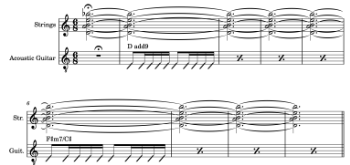
[4.16] Harmonic alienation from the other layers only adds to the sense of separation and space that creates the effect of a cinematic pedal. One unique example is Radiohead’s “How to Disappear Completely,” which has an intro featuring a faint cluster of pedals in sustained strings playing the unsettling pitch collection [D, A, B, E,
Example 22. “???” (“Lonely Warrior”) by ??? (Eason Chan) (2021), intro and verse (0:08–0:36)
(click to enlarge, see the rest, and listen)
Example 23. “??” (“Names”) by ??? (Ronghao Li) (2024), chorus (0:50–1:25)
(click to enlarge and listen)
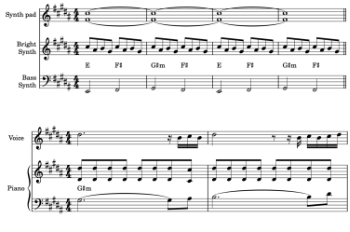
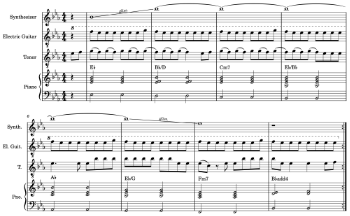
[4.17] Finally, the cinematic pedal is not mutually exclusive with other pedal categories: “孤勇者” (“Lonely Warrior”) by 陳奕迅 (Eason Chan) was produced in 2021 for the TV series Arcane: League of Legends and was one of the top singles of 2022 in China. The opening uses a cinematic and a sentimental pedal in back-to-back fashion; first, a cinematic pedal created by sustained
5. Conclusion: Enactive harmony, and rethinking the opposition of classical and popular
[5.1] In addition to mapping out some pedal idioms in popular music, our analyses highlight broader consequences for the theory of harmony that can be understood in terms of enactivism. Enactivism is a cognitive science paradigm that draws on phenomenology, positing that cognition can be understood as the enaction of familiar patterns by a perceiving subject. Mariusz Kozak (2020) argues that musical structure, and even musical time itself, is something subjective (or intersubjective) that a listener enacts through active recognition and construal, rather than an objective structure that a listener discovers or passively receives through their senses. In a review of Kozak’s book (Hudson 2023b), we argue that a broader set of music theory and music cognition scholars take an “enactive” stance, in that their work describes musical structure as something subjectively construed or enacted, but without citing phenomenologists (such as Maurice Merleau-Ponty) or enactivists (such as Varela, Rosch, and Thompson 1991).
[5.2] Our analyses in this article are enactive in the sense that they show how pedal passages can afford different hearings, and that these differences are not merely different ways to label the same sounding harmony but also different ways to enact an understanding of harmony in the first place. A pedal can often be heard as a harmonic divorce but also as part of the harmony, depending on the listener. Some listeners hearing a pedal (or a musician playing it) might think of the passage in terms of integrated harmonies that include the pedal, while some other listeners might understand the same passage as a harmonic divorce in which the pedal is separated as a distinct, independent layer. Further, we have argued above that the way a pedal interacts with and participates in the harmony above or around it (rather than being strictly independent) is often crucial to its expressive effects. This resonates with Doll’s broader arguments that many aspects of harmony in popular music, including chord identity, root, and function, are subjective “effects” rather than “objects” (2017, 9). It also resonates with Matthew Ferrandino’s discussion of “multi-centric complexes” cited earlier, which advocates for equal status between different possible hearings, as opposed to flattening subjectivity into a mono-centric “ideal” hearing, which privileges one pitch center as the “objective” tonic and demotes other potential perceived pitch centers to mere dissonances or divorces (2022, 29–30). When these perspectives are cast in enactive cognition terms, one can say that “divorcedness” is not an objective property of a multi-layered harmony or particular layers within it (such as a pedal tone), but a subjective effect that listeners enact.
[5.3] Divorcedness is not only an effect heard in passages with obviously divergent functional layers; it is also a way of understanding harmony that can be subjectively enacted in a much wider range of cases—including, as explored in this article, almost any note that is sustained through chord changes, regardless of whether or not it can be counted as a non-chord tone. This conclusion resembles one made by de Clercq in his analysis of “White Hardware” by the Nashville-based songwriter and author Chas Williams:
In the second measure, we see a tonic chord with in the bass (“1 over 6”). We might wonder: Why[. . .] notate this chord as a tonic triad with in the bass rather than as a minor-seventh chord with a root of (i.e., a 6m7 chord)? When posed this question, Williams replied, “I want the guitar players to think more in terms of hanging on a 1 chord while the bass does the movement.” The use of the word “think” in his reply is telling[. . . this example reveals that] the idea that bass lines and an upper harmonic layer can be independent entities was an important conceptual factor in the writing and performance of the song (de Clercq 2019, 276).
In short, de Clercq argues that some harmonic-bass divorces can be heard with integrated hearings, and that some integrated chords can also be heard as harmonic-bass divorces. The plural or layered hearings, traditionally associated with pedals, apply more broadly than just to clear examples of bass-harmonic divorce, but includes middle- and upper-voice pedals which, as we’ve shown in this article, may not always be clear instances of harmonic divorce.
[5.4] This enactive, plural perception of pedals in popular music also demystifies some of the more paradoxical aspects of traditional accounts of pedals. Analysts have long described a paradox of motion and stasis in pedals. Common-practice theories suggest that a bass pedal can create this effect only if it is independent from the moving harmonies above it. But pedals in pop music, and especially sentimental pedals, show how this paradox of stasis and motion can be created without requiring a clear sense that the pedal is independent from the chords around it. The perception of simultaneous stasis and motion—including all pedals and harmonic divorces—is produced by the impression that one note is a continuous, unmoving object while other notes move around it, not by special harmonic or tonal circumstances. Apparent paradoxes such as Schoffman’s statement that “the pedal point both is and is not the bass of the progression” (1983, 372) are no paradox at all, but simply the basic nature of our enactive perception of any multilayered harmony that allows listeners to prioritize one or the other layer in their attention.
[5.5] There is thus some resonance between popular-music-oriented theories of harmonic divorce and classically oriented theories of pedals, even though harmonic divorce was originally framed as a popular-music departure from common-practice rules (Temperley 2007). In fact, de Clercq argues that “a traditional bass pedal might not be considered a divorce if we take the term ‘divorce’ to mean only those cases that diverge from common-practice pitch organization” (de Clercq 2019, 273). Nobile (2015) worked to define melodic-harmonic divorce in terms other than popular deviation from classical rules, and the popular music practice of harmonic divorce clearly overlaps with the classical practice of pedals. In short, harmonic divorce is not exclusive to popular music, and both the theory of harmonic divorce and the enactive approach we propose can add new layers of flexibility and explanatory power to the insights of classical explanations of pedals as well.
[5.6] Finally, there is also growing evidence that the plural hearings of many pedals reflect a broader propensity towards hearing hybrid chords (Mulholland and Hojnacki 2013, 218) or plural perceptual possibilities within popular music tonality. Nobile (2020) describes “double-tonic complexes” that reflect a combination of two relative tonalities (such as C major and A minor) with a potential for individual chords to function in both tonalities simultaneously, as well as a potential for hybrid tonic sonorities (such as Am7, a union of the C major and A minor tonics). A specific manifestation of the double-tonic complex in popular music that has received quite a bit of scholarly attention is the “axis progression”—for example, Am–F–C–G, which can be heard in two keys, A minor or C major (Murphy 2014; Richards 2017). Various familiar pentatonic progressions can be heard to orient around more than one tonic (Capuzzo 2009, 161; Biamonte 2010, 98); for example, the “double-plagal” progression
Stephen Hudson
Occidental College
shudson@oxy.edu
Jiayi Wang
Occidental College
Jameswangjiayi@gmail.com
Works Cited
Berkman, David. 2013. The Jazz Harmony Book: A Course in Adding Chords to Melodies. Sher Music Company.
Biamonte, Nicole. 2010. “Triadic Modal and Pentatonic Patterns in Rock Music.” Music Theory Spectrum 32 (2): 95–110.
Caplin, William. 1998. Sonata Form: A Theory of Formal Functions for the Instrumental Music of Haydn, Mozart, and Beethoven. Oxford University Press. https://doi.org/10.1093/oso/9780195104806.003.0014.
Capuzzo, Guy. 2009. “Sectional Tonality and Sectional Centricity in Rock Music.” Music Theory Spectrum 31 (1): 157–74.
Covach, John. 2020. “The Performer’s Experience: Positional Listening and Positional Analysis.” In Investigating Musical Performance: Theoretical Models and Intersections, ed. Gianmario Borio, Giovanni Giuriati, Alessandro Cecchi, and Marco Lutzu, 56–68. Routledge. https://doi.org/10.4324/9780429026461-7.
Cox, Arnie. 2016. Music and Embodied Cognition: Listening, Moving, Feeling, and Thinking. Indiana University Press. https://doi.org/10.2307/j.ctt200610s.
Cutler, Timothy. 2010. “Cryptic Audiodiversity and the Dissonant Perfect Unison.” Music Theory Online 16 (1). https://doi.org/10.30535/mto.16.1.6.
de Clercq, Trevor. 2019. “The Harmonic-Bass Divorce in Rock.” Music Theory Spectrum 41 (2): 271–84. https://doi.org/10.1093/mts/mtz006.
—————. 2013. “A Pop-Rock Theory for the Future: A Response to Christopher Doll and Joseph Swain.” Dutch Journal of Music Theory 18 (3): 173–79.
DiPiero, Dan. 2021. “Big Feelings: Feminist Affect in Indie Rock After 2000.” Journal of Popular Music Studies 33 (4): 16–22. https://doi.org/10.1525/jpms.2021.33.4.16.
Dockwray, Ruth, and Allan F. Moore. 2010. “Configuring the Sound-Box 1865–1972.” Popular Music 29 (2): 181–97. https://doi.org/10.1017/S0261143010000024.
Doll, Christopher. 2017. Hearing Harmony: Toward a Tonal Theory for the Rock Era. University of Michigan Press. https://doi.org/10.3998/mpub.3079295.
—————. 2013. “Definitions of ‘Chord’ in the Teaching of Tonal Harmony.” Dutch Journal of Music Theory 18 (2): 91–106.
Ewer, Gary. 2013. “Building Song Energy By Using a ‘Dominant Pedal.’” Essential Secrets of Songwriting (blog). April 18. https://www.secretsofsongwriting.com/2013/04/18/building-song-energy-by-using-a-dominant-pedal/.
Ferrandino, Matthew. 2022. “Multi-Centric Complexes in Pop-Rock Music.” Intégral 35: 27–43.
Frymoyer, Johanna. 2017. “The Musical Topic in the Twentieth Century: A Case Study of Schoenberg’s Ironic Waltzes.” Music Theory Spectrum 39 (1): 83–108. https://doi.org/10.1093/mts/mtx004.
Garza, Jose M. 2021. “Transcending Time (Feels): Riff Types, Timekeeping Cymbals, and Time Feels in Contemporary Metal Music.” Music Theory Online 27 (1). https://doi.org/10.30535/mto.27.1.3.
Hudson, Stephen S. 2022. “Reconsidering IV/Sol in Soul Music.” Paper presented at the Theorizing African-American Music conference, Case Western Reserve University, Cleveland, OH, June 16–18.
—————. 2023b. “Review of Focal Impulse Theory, by John Paul Ito, and Enacting Musical Time, by Mariusz Kozak.” Journal of Music Theory 67 (1): 187–98. https://doi.org/10.1215/00222909-10232117.
—————. 2023a. “Reverse Extensions and Multi-Layered Harmony in Drake’s Harmonic Loops.” Current Musicology 109/110: 74–99. https://doi.org/10.52214/cm.v109i.10139.
Kozak, Mariusz. 2020. Enacting Musical Time: The Bodily Experience of New Music. Oxford University Press. https://doi.org/10.1093/oso/9780190080204.001.0001 .
Lehman, Frank. 2018. Hollywood Harmony: Musical Wonder and the Sound of Cinema. Oxford University Press. https://doi.org/10.1093/oso/9780190606398.001.0001.
Levine, Mark. 1995. The Jazz Theory Book. Sher Music Company.
MacFarland, Mark. 2012. “Bill Evans and the Limits of Schenkerian Analysis.” Journal of Schenkerian Studies 6: 33–65.
Monelle, Raymond. 2006. Musical Topic: Hunt, Military, and Pastoral. Indiana University Press.
Moore, Allan F. 2012. Song Means: Analyzing and Interpreting Recorded Popular Song. Ashgate.
—————. 1995. “The So-Called ‘Flattened Seventh’ in Rock.” Popular Music 14 (2): 185–201. https://doi.org/10.1017/S0261143000007431.
—————. 1993. Rock, the Primary Text: Developing a Musicology of Rock. Open University Press.
Mulholland, Joe, and Tom Hojnacki. 2013. The Berklee Book of Jazz Harmony. Berklee Press.
Murphy, Scott. 2014. “A Pop Music Progression in Recent Popular Movies and Movie Trailer.” Music, Sound & the Moving Image 8 (2): 141–62. https://doi.org/10.3828/msmi.2014.9.
Nobile, Drew. 2020. “Double-Tonic Complexes in Rock Music.” Music Theory Spectrum 42 (2): 207–26. https://doi.org/10.1093/mts/mtaa003.
—————. 2015. “Counterpoint in Rock Music: Unpacking the ‘Melodic-Harmonic Divorce.’” Music Theory Spectrum 37 (2): 189–203. https://doi.org/10.1093/mts/mtv019.
Piston, Walter. 1962. Harmony. 3rd ed. W. W. Norton.
Richards, Mark. 2017. “Tonal Ambiguity in Popular Music’s Axis Progressions.” Music Theory Online 23 (3). https://doi.org/10.30535/mto.23.3.6.
Ripani, Richard J. 2006. The New Blue Music: Changes in Rhythm & Blues, 1950–1999. University Press of Mississippi.
Schenker, Heinrich. [1935] 1977. Free Composition. Translated and edited by Ernst Oster. Pendragon Press.
—————. [1906] 1954. Harmony. Edited by Oswald Jones. Translated by Elizabeth Mann-Borgese. University of Chicago Press.
Schoffman, Nachum. 1983. “Pedal Points, Old and New.” The Journal of Musicological Research 4 (3-4): 369–97. https://doi.org/10.1080/01411898308574537.
Spicer, Mark. 2017. “Fragile, Emergent, and Absent Tonics in Pop and Rock Songs.” Music Theory Online 23 (2). https://doi.org/10.30535/mto.23.2.2.
Stephenson, Ken. 2002. What to Listen for in Rock: A Stylistic Analysis. Yale University Press.
Stover, Chris. 2018. “Jazz Theory’s Pragmatics.” In Norton Guide to Teaching Music Theory, ed. Rachel Lumsden and Jeffrey Swinkin, 234–51. W. W. Norton.
Strunk, Steven. 1979. “The Harmony of Early Bop: A Layered Approach.” Journal of Jazz Studies 6: 4–53.
Temperley, David. 2007. “The Melodic-Harmonic ‘Divorce’ in Rock.” Popular Music 26 (2): 323–42. https://doi.org/10.1017/S0261143007001249.
Varela, Francisco J., Eleanor Rosch, and Evan Thompson. 1991. The Embodied Mind: Cognitive Science and Human Experience. The MIT Press. https://doi.org/10.7551/mitpress/6730.001.0001.
Vujović, Ida. 2017. “The Power of Long Notes.” Master’s thesis, The Hague: The Royal Conservatoire. https://www.researchcatalogue.net/view/231816/231817.
Walther-Hansen, Mads. 2020. Making Sense of Recordings: How Cognitive Processing of Recorded Sound Works. Oxford University Press. https://doi.org/10.1093/oso/9780197533901.001.0001.
Winters, Ben. 2007. Erich Wolfgang Korngold’s The Adventures of Robin Hood: A Film Score Guide. Scarecrow Press. https://doi.org/10.5771/9781461658436.
Footnotes
1. Another example is Timothy Cutler’s statement in an analysis of the “Prelude” from Bach’s Solo Violin Partita No. 3 (BWV 1006): “Although the pedal is situated in a middle voice, it functions as the bass” (2010, 11). While such statements are certainly meaningful to those who are intimately familiar with the nature of pedals, at face value, they often appear counterintuitive or contradictory.
Return to text
2. “Common practice” theory is, of course, an enormously reductive conception which we hope readers will indulge us in, in exchange for keeping this article from getting any longer to read. There are of course much more diverse ways of using pedals and common-tone constructions.
Return to text
3. Our review of classical perspectives on pedal tones is greatly assisted by Ida Vujović’s 2017 dissertation. Piston later reinforces this definition, arguing that “A good pedal will be at some moment foreign to the harmony with which it sounds” (1962, 264). Definitions with similar ingredients are given by other authorities, including Heinrich Schenker (1954, 313–314) and William E. Caplin (1998, 25), although their precise wording and mixture of those ingredients varies.
Return to text
4. For example, David Berkman defines a pedal as “when changing harmony occurs as an upper structure over a held note in the bass” (Berkman 2013, 161), and Mark Levine similarly states that “pedal
Return to text
5. It’s worth noting that some theories of classical music also define “chord” in a more inclusive way than common-practice textbooks; see de Clercq’s response to Doll (de Clercq 2013), which discusses the writings of C.P.E. Bach. And of course these chords are in classical practice, too, not only in theory. One of our editors, Cecilia Oinas, points out that many late-nineteenth-century composers (including Grieg, Rachmaninoff, and Sibelius) use these kinds of extended chords quite frequently.
Return to text
6. The Berklee Book of Jazz Harmony (Mulholland and Hojnacki 2013) is designed to address a wide stylistic range that includes modern jazz and pop. Jazz theories whose scope focuses on older jazz styles (such as Strunk 1979) often adhere more strictly to traditional conceptions of chord membership and harmonic function. In Example 2,
Return to text
7. For example, Mark Levine (1995, Figure 5–3) shows how a C bass note can be used under any major triad.
Return to text
8. We are grateful to our editor Cecilia Oinas for suggesting the connection to Schenker’s “cover tone” [Deckton].
Return to text
9. Example 1 is slightly more complex; the
Return to text
10. One example of a chord tone pedal in classical music is mm. 31–36 of the Prelude to Bach’s Cello Suite in G major, which features an upper-voice pedal on the A open string that functions as the fifth of a prolonged dominant harmony.
Return to text
11. For example, Raymond Monelle observes that “the most pervasive signifier of the pastoral topic is the drone bass” (2006, 208).
Return to text
12. Thanks to Richard Desinord for suggesting this insight.
Return to text
13. Admittedly, “Chasing the Sun” is somewhat less characteristic of the sentimental pedal than other examples, since the differences in register between the pedals and the changing bass line, as well as the differences in instrumentation between these pedals and the vocal melody, make a stronger case for a hearing of harmonic divorce.
Return to text
14. Another sentimental pedal that is also less characteristic because the sustained pedal is in a midrange inner voice is Coldplay’s “Fix You.”
Return to text
15. DiPiero’s attempts to theorize the characteristic musical parameters of “Big Feelings” are vague and terminologically incorrect: he mentions “chord extensions, most often the seventh scale degree,” but he likely means the seventh of the chord, not the seventh of the scale; and though he mentions “a fourth chord tone” and seems to mean adding a seventh to the chord, his examples include ninths and higher extensions (i.e., more than four notes). Furthermore, this musical definition is rather unspecific, as there are many other areas of rock music (depending, of course, on what one considers to be included in “rock”) where sevenths are common, including jazz fusion, prog rock, soft rock, soul, and neo-soul.
Return to text
Copyright Statement
Copyright © 2025 by the Society for Music Theory. All rights reserved.
[1] Copyrights for individual items published in Music Theory Online (MTO) are held by their authors. Items appearing in MTO may be saved and stored in electronic or paper form, and may be shared among individuals for purposes of scholarly research or discussion, but may not be republished in any form, electronic or print, without prior, written permission from the author(s), and advance notification of the editors of MTO.
[2] Any redistributed form of items published in MTO must include the following information in a form appropriate to the medium in which the items are to appear:
This item appeared in Music Theory Online in Volume 31, Issue 4 in December 2025. It was authored by Stephen Hudson (shudson@oxy.edu) and Jiayi Wang ( Jameswangjiayi@gmail.com), with whose written permission it is reprinted here.
[3] Libraries may archive issues of MTO in electronic or paper form for public access so long as each issue is stored in its entirety, and no access fee is charged. Exceptions to these requirements must be approved in writing by the editors of MTO, who will act in accordance with the decisions of the Society for Music Theory.
This document and all portions thereof are protected by U.S. and international copyright laws. Material contained herein may be copied and/or distributed for research purposes only.

Prepared by Leah Amarosa, Editorial Assistant
Number of visits:
5478