Lines and Points: Caroline Shaw’s Partita for 8 Voices and Sol LeWitt’s Wall Drawings*
Timothy A. Johnson
KEYWORDS: Caroline Shaw, Roomful of Teeth, Sol LeWitt wall drawings, MASS MoCA, compositional process, visual art and musical performance
ABSTRACT: In Partita for 8 Voices Caroline Shaw incorporates texts from Sol LeWitt: A Wall Drawing Retrospective at the Massachusetts Museum of Contemporary Art (MASS MoCA). As the analysis in this article shows, in addition to featuring these texts from LeWitt’s rule-based instructions for executing these wall drawings, Shaw responds compositionally to LeWitt’s visual art in significant and structural ways. Partita bears evidence of influences from these drawings in construction, content, shape, and conception. Furthermore, both the execution of her Pulitzer-Prize winning piece by performers and her approach to the creation of the piece directly depend on the place (MASS MoCA) and subject (LeWitt’s wall drawings) that inspired her compositionally. Shaw’s music suggests aspects of the lines and points drawn on walls by drafters, following LeWitt’s accompanying instructions. Movement involved with changing perspectives, as viewers of drawings shift locations in the gallery space, suggests a similar experience to listeners of Partita, as sung notes move toward and away from spoken texts. In some ways Shaw’s approach to musical composition and performance in this piece closely resembles LeWitt’s approach to creating and rendering visual artworks with these wall drawings.
DOI: 10.30535/mto.31.4.4
Copyright © 2025 Society for Music Theory
Introduction: Shaw’s Influences
[0.1] In the spirit of Sol LeWitt’s wall drawings, many of which feature lines connecting points on a wall, Caroline Shaw’s Partita for 8 Voices reflects “our basic desire to draw a line from one point to another,” as she proclaims in the preface to the score (Shaw 2014, i). She also borrows some of LeWitt’s texts that accompany his drawings into two movements of her piece. Beyond these seemingly surface-level connections between the two artists, however, the analytical approach taken in this article will suggest multiple additional ways that Shaw’s Partita may connect with LeWitt’s visual art from both musical and philosophical perspectives.
[0.2] In addition to the LeWitt wall drawings, interrelations between Shaw’s Partita and a variety of influences permeate the piece. Shaw seems to derive the title and movements of Partita from J.S. Bach’s violin suites.(1) Shaw’s Partita contains three of the movement titles in Bach’s Partita No. 2 in D minor (BWV 1004) in a slightly different order.(2) Although none of Bach’s partitas include a Passacaglia, the title of Shaw’s fourth movement, this Partita by Bach ends with a Ciaccona (Chaconne), a comparable continuous variations form built on a short, repeated bass line and/or chord progression. In addition to these titular correspondences, both partitas are dance suites.(3) Viewed in the context of Shaw’s Partita, LeWitt’s square shapes could be viewed as an analog to square dancing, an overt component of the Allemande in her Partita.
[0.2] In addition to the borrowed texts from LeWitt, Shaw borrows “found phrases from an urban environment” and square dance calls (2014, iii). She also borrows George F. Root’s hymn tune, “Shining Shore,” which appears prominently in the Courante, as well as Germanic Alpine yodeling, Georgian vocal practices, Tuvan throat singing (khoomei), Inuit throat singing (katajjaq), and Korean p’ansori. Her use of found spoken texts fits well within the extensive compositional traditions of more than the last half century—spanning composers whose names begin with almost the entire alphabet, from John Adams’s “On the Transmigration of Souls” (2002) to Pamela Z’s “Parts of Speech” (1998). Shaw’s use of the borrowed hymn tune links her with the American compositional tradition of Charles Ives, who borrowed this same tune in multiple pieces.
[0.3] Shaw’s expansive vocal techniques and styles produce timbres that draw from well-established worldwide traditions. Brad Wells, the founder and director of Roomful of Teeth,
invited vocal experts from around the world to teach singing techniques not traditionally heard in the Western vocal canon. In order to incorporate these techniques into music that would be performed at the end of the residency, composers were invited to the workshops and members of the ensemble were invited to contribute compositions or improvisational designs as well. (Harper 2020b, 27)
Shaw’s Partita is one of the pieces that came out of this collaboration. Joshua Saulle explores the specific vocal techniques that produce the non-Western timbres used in this piece in detail (2019, 69–130). Although Roomful of Teeth, the ensemble for which Shaw wrote Partita, hired Tuvan and Inuit singers/practitioners to teach them these vocal techniques, Shaw’s borrowings from Inuit throat singing, in particular, have generated criticisms of cultural appropriation, initially from Tanya Tagaq, an Inuit singer, who was not one of the Inuit musicians selected and hired by the ensemble to teach them Inuit vocal techniques. For some listeners this criticism has rendered the piece problematic at best, and readers who wish to explore this topic further may wish to consult the thorough and engaging discussion of this and related issues in an article by Sara Haefeli (2022).
1. LeWitt’s Wall Drawings and Mass MoCA
[1.1] In the (1) Allemande and the (4) Passacaglia, Shaw incorporates written texts that LeWitt created to direct drafters to execute his wall drawings. Sol LeWitt: A Wall Drawing Retrospective, a major installation of 105 large-scale wall drawings at the Massachusetts Museum of Contemporary Art (MASS MoCA) in North Adams, MA, displays the texts and the executed drawings from which Shaw borrows these texts. This long-term exhibit of LeWitt’s wall drawings fills a separate building (Building #7), a repurposed and renovated historic mill building in the museum complex. In many of his wall drawings “LeWitt extrapolated the idea of shape and line construction as a fundamental process of drafting . . . [showing] an artistic interest in the geometry of the wall, in geometric point-finding, and in the potential for communicating an image through textual instruction” (MASS MoCA 2015b).
[1.2] Roomful of Teeth was ensemble-in-residence during Shaw’s composition of the piece. Through this residency, Shaw was able to surround herself with LeWitt’s wall drawings, each labeled with the texts used to execute them, while she composed Partita. Shaw borrows some texts from LeWitt’s specific rule-based instructions for executing wall drawings that allow drafters to construct and exhibit his art at museums throughout the world, even after his death, and includes them as spoken texts in the music of Partita.
[1.3] The idea of combining visual and performing arts is integral to the concept of this museum. MASS MoCA offers “extended . . . rehearsal residencies,” such as the residencies of Roomful of Teeth, during which Shaw composed Partita, allow performing musicians to draw resources from the museum in a mutually beneficial interaction between the visual and performing arts, contributing significantly to the mission of the museum. As MASS MoCA Director, Joseph C. Thompson, noted:
With this exhibition, Sol LeWitt has left an amazing gift for us all. Great art draws upon previous artists . . . . And the most essential art argues for new ways of seeing, even as it is almost immediately absorbed into the work that surrounds and supersedes it. . . . This amazing collection of works is on long-term view as a sort of proton at the center of our museum around which our program of changing exhibitions and performances will orbit with even more energy (MASS MoCA 2015a).
This interaction between art forms is an integral component of the conception of the museum, and Shaw’s interaction with LeWitt’s wall drawings in Partita lies at the museum’s physical and conceptual center.
[1.4] Interrelationships between composers and the visual arts have received considerable attention in the musicological literature. The influence of the visual arts on experimental and minimalist composers, for example, is substantial and well documented, in studies such as those by Jonathan Bernard (1993, 2002). Steven Johnson (1994) and Orit Hilewicz (2021) explore connections between visual art and music composed specifically for installations or images, such as Morton Feldman’s Rothko Chapel that musically reflects the architectural space of the chapel and Mark Rothko’s series of paintings installed within it. Ryan Dohoney explores religious contexts of the architectural space of the chapel, Rothko’s art, and Feldman’s music, along with the “interdisciplinary exchange” between the chapel and the composer (2019, 13). He places this exploration in dialog with a thorough and fascinating examination of the collaborative relationship between Feldman and John and Dominique de Menil, the patrons of the chapel, art, and music. Another study of art and music by Hilewicz (2018) investigates reciprocal relationships between Paul Klee’s Die Zwitscher-Maschine [The Twittering Machine] and various composers’ musical interpretations of it. From a broader perspective, Kyle Gann discusses Robert Rauschenberg’s White Paintings in relation to John Cage’s 4’33” (2010, 155–60). As Gann explains, “Cage saw in the white paintings a visual analogue of the ‘silent’ piece he’d been yearning to create” (160). Also from a more general perspective, Steven Johnson (2002) explores relationships between experimental composers of the New York School and abstract expressionist art, particularly in terms of influences between composers and artists. This sort of interrelationship between composers and art continues in the form of Shaw borrowing and drawing inspiration from DeWitt’s wall drawings. Some authors have developed ways to interpret visual artworks from the perspective of music, such as the three studies of art-music relationships in Hilewicz (2018), as well as von Maur (1985, 1999) and Vergo (2010). Explorations of music based on the visual art that inspired it, on the other hand, have been more common, including Hilewicz’s (2021) analysis of structure in Shaw’s Plan and Elevation in relation to structural, spatial, and experiential aspects of the garden at Dumbarton Oaks, Washington, DC. My article explores both the music and its inspiration in the texts, structure, and conception of the artworks, not only to describe surface-level connections and influences between visual art and music but also to explore the interconnections between the artist, drafter, viewer, and image in LeWitt’s wall drawings and the composer, performer, and listener in Shaw’s Partita for 8 Voices.
2. Texts, Lines, and Shapes
Example 1. LeWitt, Wall Drawing 160, Wall Drawing 164, Wall Drawing 159, and Wall Drawing 154
(click to enlarge)
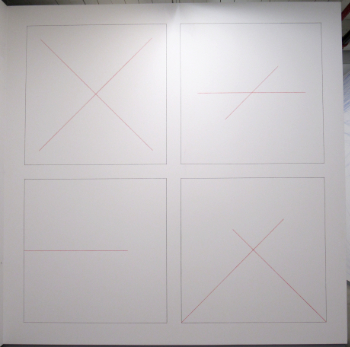
[2.1] In addition to incorporating some of LeWitt’s texts, Shaw’s piece, from an analytical perspective, suggests a compositional interaction with this visual art that extends beyond these texts, including some of the shapes and lines in the wall drawings. The first movement, Allemande, includes references to multiple LeWitt wall drawings. One series of these drawings appears together on the same wall at MASS MoCA, and the opening section of this movement links references to them together: “Each of these drawings explores the concept of finding lines within a square in a different way” (MASS MoCA 2015b). Four drawings compose the entire series, and the first movement contains excerpts from the texts of each one (Example 1; described below as displayed at MASS MoCA and in the example, clockwise from upper left):
- Wall Drawing 160, “A black outlined square with a red diagonal line centered on the axis between the upper left and lower right corners and another red diagonal line centered on the axis between the lower left and upper right corners”
- Wall Drawing 164, “A black outlined square with a red horizontal line centered on the axis between the midpoint of the left side and the midpoint of the right side and a red diagonal line centered on the axis between the lower left and upper right corners”
- Wall Drawing 159, “A black outlined square with a red diagonal line from the lower left corner toward the upper right corner; and another red line from the lower right corner to the upper left”
- Wall Drawing 154, “A black outlined square with a red horizontal line from the midpoint of the left side toward the middle of the right side”
These wall drawings exhibit simple lines rendered in red and black crayon on a white wall, each of which consists of a black box containing red lines (LeWitt 1984, 171).
Example 2. Shaw, Partita, I. Allemande, C.6–D.3, with audio (0:46–1:00)
(click to enlarge and listen)
Example 3. Shaw, Partita, I. Allemande, E.4–F.6, with audio F.1–F.5 (1:19–1:29)
(click to enlarge and listen)
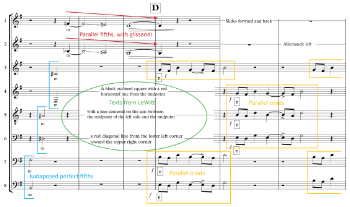
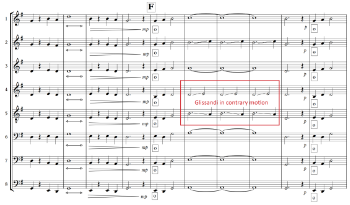
[2.2] Whereas LeWitt specifies lines drawn from points on a wall to create each image, Shaw specifies musical lines that interact with each other to form unified musical ideas. Shaw extracts texts from LeWitt’s instructions for executing wall drawings 154, 164, and 159 in voices 4, 5, and 6, and she combines these overlapping texts with musical lines of voices that form parallel fifths with glissandi and parallel triads, in imitation and with dovetailing (Example 2). By placing these parallel musical lines together with these texts, Shaw associates the texts describing the lines used to form these visual shapes with musical lines.(5) A bit later in the movement, Shaw creates a musical counterpart to LeWitt’s diagonal lines drawn in opposite directions, depicted in wall drawings 159 and 164, through musical lines in contrary motion with glissandi (Example 3). Joshua Saulle extends this analytical correspondence even further: “Partita is . . . about drawing lines—lines connecting musical materials and points in time, yes—but also lines connecting spectral ranges and vocal registers; lines connecting visual art, music, and dance; lines connecting conception, instruction and execution, composer and performers; lines connecting language and music, speech and singing; noise and pitch; lines connecting the larynx, the tongue, and the lips, the chest and the head” (2019, 140).
Example 4. LeWitt, Wall Drawing 289. MASS MoCA
(click to enlarge)
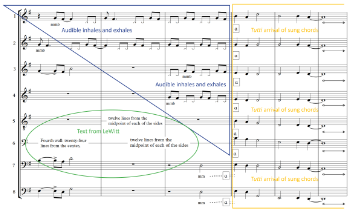
Example 5. Shaw, Partita, I. Allemande, D.4–E.3, with audio (0:58–1:11)
(click to enlarge and listen)
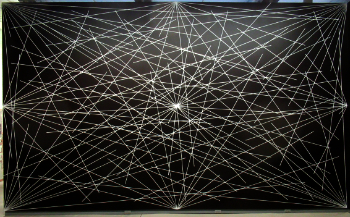
[2.3] LeWitt expands on the basic ideas presented in the four simple wall drawings described previously by making even more elaborate wall drawings that seem to explore these ideas further, still specified by sets of instructions. LeWitt initially conceptualized Wall Drawing 289 (Example 4) “as a four-wall drawing” (MASS MoCA 2015f). He specifies white crayon for the drafter to render these lines, using a black pencil grid on black walls (LeWitt 1984, 187). In the exhibit, LeWitt “chose to present only the fourth wall at MASS MoCA. This wall displays the composite of the instructions for each of the first three walls,” though only the fourth wall is executed at the museum (MASS MoCA 2015f):
A six-inch (15 cm) grid covering each of the four black walls. White lines to points on the grids. 1st wall: 24 lines from the center; 2nd wall: 12 lines from the midpoint of each of the sides; 3rd wall: 12 lines from each corner; 4th wall: 24 lines from the center, 12 lines from the midpoint of each of the sides, 12 lines from each corner. (The length of the lines and their placement are determined by the draftsman.) (LeWitt 1984, 101)
Because only the fourth wall is on display at MASS MoCA, Shaw incorporates texts only from this wall—again connecting the museum itself, not just the associated texts, with her piece (Example 5). In the same manner that LeWitt expands his basic ideas from the simple wall drawings of lines and squares described above, Shaw begins to expand her compositional palette, in her references to additional wall drawings, by including “textured breaths, related to the Inuit throat singing tradition” for the first time (Shaw 2014, v). Subsequently, also for the first time, the passage arrives on a tutti sung section of homophonic, diatonic chords (Reh. E)—a stunning passage of textural and harmonic stability that emerges, in a gathering of momentum, from the disjointed, partly spoken and partly sung, opening section.
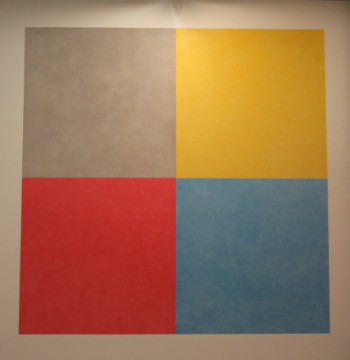
Example 6. LeWitt, Wall Drawing 381. MASS MoCA
(click to enlarge)
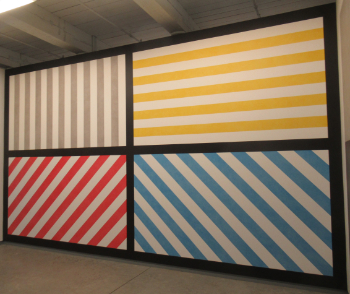
Example 7. LeWitt, Wall Drawing 419. MASS MoCA
(click to enlarge)
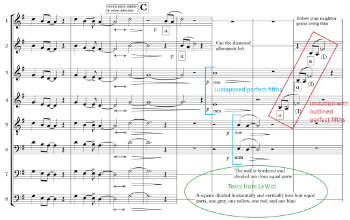
Example 8. Shaw, Partita, I. Allemande, B.5–C.5, with audio (0:39–0:49)
(click to enlarge and listen)
[2.4] Shaw’s first references to the LeWitt wall drawings in the text of Partita do not seem to be fully fleshed out in the piece musically, but they offer clear clues that appear to pertain to her conception of the movement, as well as the entire piece. The text of Wall Drawing 381 (Example 6) appears in voice 8: “A square divided horizontally and vertically into four equal parts, one gray, one yellow, one red and one blue, drawn with color and India ink washes” (MASS MoCA 2015h). This single voice overlaps with the text in voice 7, which begins just after it: “The wall is bordered and divided horizontally and vertically into four equal parts,” from Wall Drawing 419 (Example 7; MASS MoCA 2015i). The words “horizontally and vertically” appear only in voice 8, but apply to both voices of Shaw’s excerpted texts, as these words seem to pass from voice 8 to voice 7 (Example 8). Meanwhile, the pitches move from parallel triads to fragmented perfect fifths, broken up into juxtaposed entrances, analogous to how the colors and shapes of these two wall drawings contrast with each other. As the cadential tutti chord fades, Shaw’s music seems to reflect the parallel bands of colors in LeWitt’s Wall Drawing 419, with its vertical bands of gray and white in the upper left rectangle, horizontal bands of yellow and white in the upper right rectangle, and diagonal bands of red and white and bands of blue and white in the lower rectangles. The drawing expands on a basic idea of parallel bands of colors surrounded by a rectangle with a black border to create a larger rectangle made up of four smaller rectangles, formed in similar ways but with contrasting colors and directions.
[2.5] Similarly, and concurrently with her borrowings from LeWitt’s texts, Shaw quickly expands on the parallel fifth idea through a combination of juxtaposed perfect fifths and imitation with melodic lines that outline perfect fifths (see Example 2 above). As the passage continues, pairs of fifths alternate, and finally the glissandi of parallel fifths overlap with the text of the line drawing. These spans of fifths, occurring in the same passage as the texts from these wall drawings, seem like a musical representation of bands of color. These apparent musical references to shape in LeWitt’s drawings also follow and occur simultaneously with texts drawn from square dancing in the Allemande. This link between shape, in both visual art and dance, furthers Shaw’s projection of a broad community of artists, extending across multiple art forms—music, dance, and visual arts. In performances, many members of Roomful of Teeth (including Shaw) seem to dance in place at their microphones, reflecting the compositional conception of the piece as a suite of dances.
3. Changing Perspective in Physical and Musical Spaces
Example 9. LeWitt, Wall Drawing 305. MASS MoCA
(click to enlarge)
Example 10. LeWitt, Wall Drawing 305. MASS MoCA. Closeup, partial view, showing the distant points now visible as Xs, with detailed textual descriptions of the locations of the points written by the drafter
(click to enlarge)
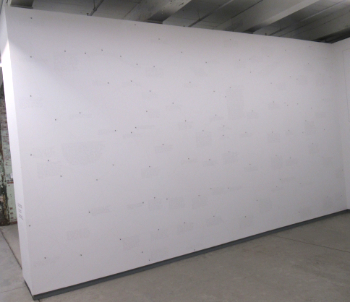
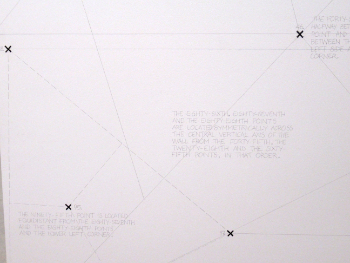
[3.1] Although the middle two movements of Partita do not incorporate texts, the piece achieves a sense of unity by continuing the dance suite form in the movement titles (Sarabande and Courante), by the primarily triadic and diatonic harmonic material, and by the specialized and global vocal techniques. In the fourth movement, Passacaglia, however, Shaw again incorporates texts from LeWitt’s wall drawings on display at MASS MoCA. In this movement Shaw uses texts from LeWitt’s Wall Drawing 305, a massive piece requiring a complicated and detailed production process. However, in this case Shaw does not incorporate the text of LeWitt’s instructions, as with her other textual borrowings; rather, she incorporates texts that appear on the actual drawing. When viewed from a distance, the resulting image looks somewhat like a haphazard arrangement of many individual points (Example 9). However, a closer look reveals the precise process by which the drafter places the points (Example 10). Although the wall drawing contains detailed descriptions of how each point was placed, LeWitt’s directions for this wall drawing are not nearly as specific as the other wall drawings from which Shaw borrows text. His instructions appear to be quite simple: “The location of 100 random specific points. (The locations are determined by the draftsman)” (LeWitt 1984, 104). Yet, in these brief instructions for executing the wall drawing, almost imperceptibly, LeWitt explicitly stipulates that the locations themselves, not just the random points, must be included in the wall drawing. Although this distinction may appear somewhat cryptic, the full description of materials to be used by the drafter, “black pencil description, black crayon points,” clarifies that the drafter must include descriptions of the locations of the points (LeWitt 1984, 188).
[3.2] Accordingly, although LeWitt did not indicate the locations of the specific points, the drafter who executed the drawing displayed at MASS MoCA included the locations in texts (MASS MoCA 2015g). Because the texts are rendered in pencil, they are barely visible from a distance, but they are clear upon closer inspection. For example, as is visible in a closeup view of a portion of the image (Example 10), “The tenth point is located equidistant from the ninth point, the third point and the midpoint of the top side” (MASS MoCA 2015g).
Example 11. Shaw, Partita, IV. Passacaglia. Harmonic sketch of mm. 1–10, with audio (0:00–0:39)

(click to enlarge and listen)
[3.3] Shaw’s passacaglia, the repeated chord succession in the fourth movement, consists primarily of a ten-measure succession of triads that feature chromatic-third relationships between major triads and half-step related neighbor chords. It begins with D major and moves by chromatic third to F major and eventually
Example 12. Shaw, Partita, IV. Passacaglia, B.10b–C.6, with audio (1:38 – 2:00)
(click to enlarge and listen)
Example 13. Shaw, Partita, IV. Passacaglia, D.6–E.4, with audio (2:21–2:42)
(click to enlarge and listen)
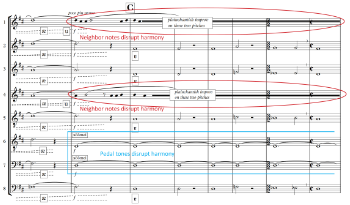
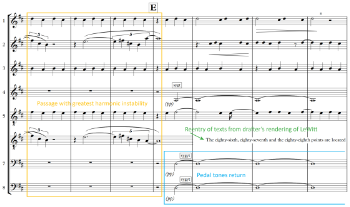
[3.4] The variations of each reiteration of this chord succession in the Passacaglia initially consist of changes in vocal timbre, both between and within each subsection. As the piece continues, although Shaw preserves the harmonic content, the harmonies start to become less stable, as she introduces pedal tones as well as neighbor notes in two of the treble voices (Voices 1 and 2) just before Rehearsal C, in what she calls a “plainchantish improv” (Shaw 2014; Example 12). The rest of the ensemble takes up the neighbor note figures, and the pedal tones drop out, as the motion between neighbor notes becomes more regular. This passage contains the greatest level of harmonic instability in the movement and leads to the first appearance of textual content from the drafter’s rendering of LeWitt’s wall drawing, marked by the return of pedal tones, just after Rehearsal E (Example 13). Meanwhile, the harmonic succession stabilizes with pedal tones now appearing in the lowest treble voice and the basses, Voices 4, 7, and 8. As the other voices gradually take up the spoken textual content from the locations of various points on the wall drawing, the pitch material gradually disappears, resulting in all eight voices simultaneously speaking in a non-synchronous manner.
[3.5] From my analytical perspective, the Passacaglia has, until this point, simulated the effect of a viewer moving from a distant perspective, where the drawing appears only to contain points on a wall (or as pitches forming triads in the chord succession), to a closer and closer viewpoint, where the locations, as texts spoken by the ensemble, begin to become evident. The contrast between the black pencil descriptions and the black crayon points (marked by Xs) enhances this effect through a gradual motion of a viewer of the wall drawing moving toward the wall, and Shaw musically simulates this effect by the pacing of changes to the harmonic succession in the first part of the piece.
[3.6] With this musical effect Shaw also seems to refer back to an earlier textual element from the first movement, Allemande, which Shaw (2014) expresses in the score with a hashtag and a single word in the text of the movement, “#thedetailofthepatternismovement” (Allemande, Reh. G).(6) The use of a hashtag in social media is to emphasize a keyword as a marker to point to ideas related to it (X Help Center, “How to Use Hashtags”). Marking the phrase as a keyword suggests to me that this idea is a key concept in her piece and may apply to the piece as a whole, not just the first movement where it appears in her score. Shaw said that it depicts “the sense of when a specific phrase is recurring in your mind and you are trying to create something at the same time” (quoted in Harper 2020b, 35). This phrase of text, “the detail of the pattern is movement,” derives from Section V of T. S. Eliot’s poem, “Burnt Norton,” the first of his Four Quartets, rather than from LeWitt’s wall drawings (Eliot 1943, 7–8). Shaw remarks on this phrase: “it encourages me to listen more closely, to try to and find some detail or some pattern in something—you’ll start to find it all over the place in nature and in music” (quoted in Harper 2020b, 35). By specifying movement as the key detail of the pattern, from my analytical perspective, Shaw also may be alluding to the movement of a viewer of a LeWitt drawing—as well as the figurative movement of a listener to her piece based on musical pacing, as the text phrases uttered by the vocalists gradually move closer together in the Passacaglia. Furthermore, after first seeing the hashtag, Shaw read and became intimately familiar with the Eliot poem to the point where she said that “it just lived in my mind” (quoted in Harper 2020b, 35).(7)
[3.7] Shaw may have used the hashtag as a reference point to more of the poem than this specific phrase. According to Julia Reibetanz’s (1983) interpretation of Eliot’s poem:
The first half of this section . . . introduces the idea that art may achieve an incarnation of the still point, or as the poet says, “reach / The stillness,” through form. Eliot begins with the obvious point that poetry and music are temporal arts. Motion and time are at their essence . . . . Only by the form can music become more than a succession of sounds and “reach / The stillness,” or poetry become more than speech. (46)
In Partita, with the grand caesura, moving from music to speech in a path toward moving from music to silence, Shaw reaches this stillness in a comparable way to the points in a LeWitt wall drawing—which appear when viewed from a distance only as points, not with their texts, rendering a stillness to the wall drawing. To Reibetanz’s interpretation of the form in music and in poetry, I would add that in this artwork only by the form, achieved through movement in terms of the viewer’s perspective, can a wall drawing become more than the markings on the wall. The blank spaces free of marks on the wall are part of the drawing, and its form develops from the instructions that stipulate the manner of placing the markings and the materials used. In Shaw’s piece, accordingly, the form of the Passacaglia and the patterns that she devised to create this effect through music reach this moment of stillness. In these ways Shaw musically creates the effect of the details that emerge from the wall drawing as the perspective of the viewer moves ever closer to the image to be able to see “the detail of the pattern.” As Saulle similarly explains, in relation both to this piece and LeWitt’s wall drawings: “the connections and relationships that result are evident or mysterious depending on one’s vantage point and focus of attention” (2019, 140).
Example 14. Photograph of the author viewing Sol LeWitt, Wall Drawing 305. MASS MoCA. Referenced by Shaw in Partita, IV. Passacaglia
(click to enlarge)
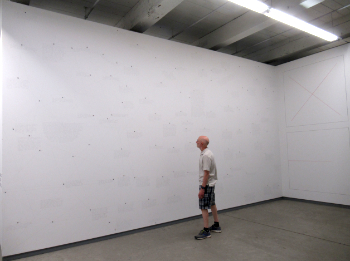
[3.8] Shaw also helps unify the piece, both musically and in conversation with LeWitt’s art, by planting the seed of this idea in the first movement. As with most visual artworks, all of the wall drawings that Shaw references depend on the viewer’s perspective for motion. With only a few simple lines, dots, color strips, and patterns, LeWitt invites the viewer to observe the images from different perspectives. The combination of wall drawings as displayed in MASS MoCA’s extensive retrospective also invites the viewer to interact with the images via motion—from work to work, between adjacent walls, and from section to section within the gallery. The sizes of the wall drawings are substantial, and the viewer can observe the drawings from an extremely close perspective, from a distance, or anywhere in between. The wall drawings referenced in the first and last movements appear on adjacent walls in the same space and can be viewed simultaneously (Example 14). As Shaw’s borrowed text states in the first movement, “the detail of the pattern is movement”—here, between the wall drawings that she references in the first movement and the adjacent wall drawing that she references in the last movement.
[3.9] After the caesura in the Passacaglia, Shaw creates the same listener’s and viewer’s effect by moving in reverse, but at a much faster pace. The perspective of the viewer of Wall Drawing 305, while backing away slowly, gradually shifts from close, where the viewer sees the textual locations of the individual points marked in pencil (Example 10), to distant, where the viewer sees only the points on the wall marked in crayon (Example 9). Shaw’s music imitates such a viewer’s path, beginning from when the listener hears voices speaking the texts of these points and proceeding to where the listener hears only the varied repetitions of the initial chord succession, in accordance with the form of the Passacaglia. This process culminates when all voices—in what Shaw terms a “vocal fry” timbre, a “big fat crescendo,” and a return of singing timbre—simultaneously reach the reappearance of the D major triad that began the movement (Shaw 2014, 44). The metaphor of motion also reflects the motion of dance that is such an important component of this piece.
[3.10] This climax creates a powerful moment of what Crystal Peebles (2020) describes as “joy.” Although other authors often have associated joy with this piece—such as Jeremy Geffen, chair of the Pulitzer jury (quoted in Woolfe 2013), and music critic Justin Davidson (2013), among others—Peebles attributes joy specifically to this point in the music, as the timbre turns from the vocal fry to “a bright jubilant ‘ah’” vowel sound on the arrival of the chord. Shaw uses a belt timbre that relates directly to the vocal fry that precedes it, according to Saulle’s analysis, “by noisily amplifying the vowel’s formants and frequency ranges that will also define the timbre of the belted pitches” (2019, 126).
[3.11] I argue that there is a comparable joy to viewing the points on LeWitt’s wall drawing from a distance, after discovering that they are marked specifically with texts that identify the location of each point—the joy of viewing the entire wall drawing (Example 9) and knowing the precision involved in the locations of these points on the wall, instead of seeing only what may first appear to be a haphazard arrangement of dots. The arrival of this D major triad, especially after the diffuse pitches that lead from the resumption of the spoken text to this moment, draws the ensemble together dramatically. As music critic Joshua Kosman (2017), who also identifies joy in Shaw’s music, observes, “when one of these harmonies hits, especially in the midst of something more eclectic or elusive, it’s like a sudden burst of absolute radiance.”
4. Wall Drawings and Instructions—Partita and Score
[4.1] In addition to texts and visual elements of LeWitt’s wall drawings, broader considerations of Partita seem to reflect other aspects of LeWitt’s drawings—the way the collaboration between the eight singers mirrors the collaborative nature of the wall drawings in their method of construction by artist and drafters, the structure of the wall drawings in comparison to the structure of Shaw’s piece, and the nature of the relationship between composer and performer. LeWitt’s instructions for creating these drawings to be executed by others suggests a collaborative definition of the visual artwork—conceived by the artist and executed by drafters. For example, what does an institution or individual who owns and displays a drawing own? Owning a LeWitt wall drawing includes the right to implement these directions to produce the image, the directions to create the image, as well as the image. As LeWitt indicates, “the explicit plan should accompany the finished wall drawing. They are of equal importance” (1971, 96). Similarly, Shaw’s musical composition begs the question of what constitutes the piece, the score, and perhaps even the music. According to Haefeli (2017), who explores this question, “Shaw confronts several modernist binary oppositions with this piece: she blurs the boundary between composer and performer in a way that is resonant with the experimental performance art tradition as well as the singer-songwriter tradition of the pop world.” Furthermore, Shaw’s prefatory “notes on the score” indicate that “the 2012 recording by Roomful of Teeth can be considered an essential part of the score. Many sounds and gestures cannot be notated in a conventional way . . . . No single document should ever be treated as ultimately prescriptive” (2014, iii). Thus, the score of the piece includes the first recording and the score; yet these documents are insufficient to convey the instructions for rendering the piece fully, just as LeWitt’s detailed instructions are insufficient for executing the drawings (Roomful of Teeth 2012).(8) Shaw relies on the ensemble as an integral part of the composition, just as LeWitt relies on the drafters as integral contributors to the execution of the drawings. According to curator Veronica Roberts, “Sol LeWitt (1928–2007) often likened his role as an artist to that of a composer and his wall drawings to musical scores” (2012, 193). “For LeWitt . . . collaboration with other artists and drafters was an essential part of his practice: a composer requires musicians” (206). On the other hand, Saulle briefly compares LeWitt’s approach to these wall drawings and Shaw’s approach to the musical score, and he chooses the notated score as the location of the “ideal form” of the musical work (2019, 64–68). However, for me the issue is more open in terms of the ways that Shaw’s musical work compares with LeWitt’s approach to the ideal form of the visual artwork.
[4.2] As indicated in MASS MoCA’s explanatory text for LeWitt’s wall drawings at the museum: “The level of specific instruction in these location drawings completes a spectrum from very precise and explicit directions to almost completely open-ended and interpretive descriptions” (MASS MoCA 2015c). LeWitt did not personally execute the wall drawings on display at MASS MoCA: “A team comprising twenty-two senior and experienced assistants who worked with the artist over many years; thirty-three student interns . . .; and thirteen local artists and recent graduates and postgraduates” created the drawings based on the artist’s instructions (MASS MoCA 2015a). LeWitt’s instructions are extremely specific and include the sizes of the squares and lengths of the lines, (sometimes) the width of the lines, and the colors and materials used to produce them—for example, “with a 96" (240 cm) black outlined square and a 72" (180 cm) red line” (1984, 72). However, although “his original solutions to the instructions provide a template for subsequent installations of these drawings, every installation provides the draftsman executing the wall drawing the opportunity to interpret the language for him or herself” (MASS MoCA 2015c). In some ways Shaw treats the musical score in a comparable way to LeWitt’s instructions: whereas LeWitt’s full instructions include details down to the sizes of the lines, Shaw considers her score to be less than “prescriptive,” based on her “notes on the score” (2014, v). As Haefeli (2017) notes, the piece is “situated in a performance community of musicians that become co-creators with Shaw,” and these musicians form a “high-context” community, a term that she borrows from anthropologist Edward Hall (1976), that is familiar enough with the “non-notatable elements,” especially how to produce the variety of vocal timbres that are essential parts of the music.
[4.3] In some respects, LeWitt’s approach to wall drawings is closer to traditional musical scores than to Shaw’s approach to notation in Partita. For LeWitt, “all of the planning and decisions are made beforehand,” as he explains in relation to what he called his “conceptual art” (1967, 80). As art critic and curator Ulrich Loock describes LeWitt’s approach: “The concept for a work is formulated verbally and can thus be communicated to a third party as an instruction for its execution. . . . In many works the description is actually written into the drawing itself. Thus, any misunderstandings of the concept are consciously avoided” (1992, 7). Moreover, “Anyone else is just as capable to execute it as the artist himself” (7). On the other hand, although Shaw provides detailed descriptions along with her notation, fully understanding how the work should be performed requires access to external resources. As she indicates in her “notes on the score” in the preface, “the composer encourages drawing on a variety of sources available with today’s technology to realize this piece with other ensembles in the future” (2014, v).
[4.4] In some other ways a LeWitt wall drawing shares closer parallels with Shaw’s score for Partita. For LeWitt, according to Loock: “The supremacy of the idea helps to define a work unambiguously as well as arbitrarily; the exhaustive execution of the idea perceptibly locks the work into its perfect but also arbitrary system of rules” (1992, 8). Furthermore, in reference to the directions that LeWitt created to execute the wall drawings, Loock exclaimed: “The origin of the work is actually not the idea, which is mere description, a verbal duplication confirming the absolute hermeticity of the work. Thus, it is nothing other than art, and the viewer’s perception of the idea, recognizing the supremacy of the plan, makes of the work nothing but art” (8). In a similar way Shaw’s piece is not the score, but the listener’s perception of the score through its performance, which alone represents the music. Thus, LeWitt’s conception of the wall drawings is more akin to Shaw’s conception of the score than first may be apparent. Artist Michael Harvey’s viewpoint agrees with this understanding of LeWitt’s conception and its relation to music: “The labels are written by LeWitt, the drawings made by operatives. This terse summation is to the drawings what the score is to the music. As the music gives present tense reality to the score, so the drawings realize notations conveyed by the label. In this sense a show of the drawings is similar to a musical performance” (1971, 203). No two performances of Partita are exactly alike, nor precisely match the 2012 recording, which Shaw cites as “an essential part of the score” (2014, iii). Tempos change inevitably, such as in a performance that I attended where the vocalist who began the first movement proceeded at such a brisk pace that he seemed to take the rest of the ensemble by surprise (Bailey Hall, Cornell University, September 14, 2018). And vowel sounds may be placed in slightly different places in the oral cavity, creating nuanced differences in timbre.
[4.5] Shaw’s piece bears a contradiction between the apparent simplicity of the notation and the perceptual richness of the realized sounds. Similarly, in LeWitt’s wall drawings Loock observes a “contradiction . . . between the simplicity of many concepts and the visual complexity of the executed works; basically, it is a contradiction between conception and perceptual realization” (1992, 8). “The precision of verbally formulated plans appears to decrease in the extent to which the visual phenomenon, the Wall Drawing itself, increasingly acquires sensorial complexity” (9). Likewise, with Shaw’s notation, the precision of the score decreases to the extent to which the piece acquires sensorial, or timbral, complexity.
[4.6] In other ways, however, LeWitt’s instructions differ markedly from Shaw’s score. As Harvey explains about LeWitt: “There is no need for reproductions; the real thing may be obtained from a label just as we obtain music from a score” (1971, 205). For Shaw’s piece, however, as for most music, performance is an integral part of the artwork. The sounds of the music become a part of the score, not a byproduct of its interpretation. As Loock notes, “Sol LeWitt’s art exploits those artistic possibilities that mutually subvert the dichotomy of conception and perception and that result from the collapse of this dichotomy” (1992, 9). In the same way Shaw exploits the musical possibilities that subvert the dichotomy of composer and performer, as well as composition and performance, that result from embracing the collapse of this dichotomy.
[4.7] Art historian Jan Debbaut provides another perspective on the wall drawings:
Sol LeWitt gives new and radical shape to the traditional distinction between invention and execution. He uncouples the Idea from the material realization by conceptualizing it in another medium (language) which differs essentially from that used for its embodiment in a drawing. Drawings have the character of sketches or outlines, and in the creative process they are therefore usually situated in the preparatory phase of the work. In Sol LeWitt’s method of working the act of drawing acquires a different momentum; it takes place only at the end of the creative process, so that the ultimate wall drawing becomes a kind of a posteriori sketch which cannot manifest itself until the Idea underlying it has found its own form and content in language. In this way LeWitt evidently makes the execution of a work of art subordinate to its conceptualization. (1984, 15)
From this perspective Shaw’s Partita seems completely opposite from LeWitt’s wall drawings. Shaw’s piece can exist independently as music; we can listen to a performance or hear a recording without having access to the score from which the music was rendered by the ensemble.(9) The execution of the score is not subordinate to its conceptualization. However, the score, as a representation of the creative process, requires the sounds represented by it in an analogous way to how LeWitt’s wall drawings require the rendering of the drawing as well as the text—the image, not just the Idea as represented by LeWitt in language.
Conclusion
[5.1] In Partita for 8 Voices Shaw brings together multiple art forms and spaces. She composed it in a museum, where Roomful of Teeth workshopped it during the compositional process, and where she drew inspiration and textual materials from the visual arts as represented by LeWitt’s wall drawings. In addition to the many similarities and contradictions between LeWitt’s wall drawings and Shaw’s music, consideration of each art form through the analytical lenses explored in this article raises several additional questions: What is a LeWitt wall drawing? Is it the instructions? Is it the drawing on the wall? What is Shaw’s piece? Is it the notations on the score? Is it the performance by Roomful of Teeth? Shaw’s Partita is neither. The listener takes on a similar role as the observer of LeWitt’s wall drawings in the spaces that Shaw occupied when she created the piece at MASS MoCA. It is the viewer’s and listener’s perception of Shaw’s piece, what Loock refers to as “the supremacy of the plan” that generates the impact of the wall drawings and that makes Partita for 8 Voices sing and dance.
Timothy A. Johnson
Ithaca College
tjohnson@ithaca.edu
Works Cited
Bateson, Gregory. 1972. Steps to an Ecology of Mind. University of Chicago Press.
Bernard, Jonathan. 1993. “The Minimalist Aesthetic in the Plastic Arts and in Music.” Perspectives of New Music 31 (3): 86–132. .
—————. 2002. “Feldman’s Painters.” In The New York Schools of Music and Visual Arts: John Cage, Morton Feldman, Edgard Varèse, Willem de Kooning, Jasper Johns, Robert Rauchenberg, ed. Steven Johnson, 173–215. Routledge.
Davidson, Justin. 2013. “An Avant-Garde That’s Easy to Love: Three Heartening Moments from the New-Music Scene.” New York Magazine, November 11. https://nymag.com/arts/classicaldance/classical/reviews/caroline-shaw-partita-2013-11/.
Debbaut, Jan. 1984. “The Words and the Drawings.” In Sol LeWitt Wall Drawings 1968–1984, by Sol LeWitt, ed. Susanna Singer, 15–16. Stedelijk Museum, Van Abbemuseum, and Wadsworth Atheneum.
Dohoney, Ryan. 2019. Saving Abstraction: Morton Feldman, the de Menils, and the Rothko Chapel. Oxford University Press. https://doi.org/10.1093/oso/9780190948573.001.0001.
Eliot, T.S. 1943. Four Quartets. Harcourt, Brace.
Gann, Kyle. 2010. No Such Thing as Silence: John Cage’s 4’33.” Yale University Press.
Haefeli, Sara. 2017. “‘Sounds and Gestures Cannot Be Notated in a Conventional Way’: Indeterminacy and Caroline Shaw’s Partita for 8 Voices.” Paper presented at the Performing Indeterminacy Conference, University of Leeds, UK. June 30–July 2.
—————. 2022. “Music as Communal Practice and the Problem of White Joy in Caroline Shaw’s Partita for 8 Voices.” Contemporary Music Review 41: (2-3): 234–53. https://doi.org/10.1080/07494467.2022.2080457.
Hall, Edward. 1976. Beyond Culture. Anchor Books.
Harper, Joshua. 2020a. “Caroline Shaw’s Use of Renaissance and Baroque Dance Forms in Her Partita for 8 Voices.” DMA diss., Indiana University.
—————. 2020b. “Drawing the Line: Caroline Shaw’s Use of Baroque Dance Forms in Partita for 8 Voices.” The Choral Scholar & American Choral Review 58:3.
Harvey, Michael. 1971 [1984]. “Notes on the Wall Drawings of Sol LeWitt.” In Sol LeWitt Wall Drawings 1968–1984, by Sol LeWitt, ed. Susanna Singer, 15–16. Stedelijk Museum, Van Abbemuseum, and Wadsworth Atheneum.
Hilewicz, Orit. 2018. “Reciprocal Interpretations of Music and Painting: Representation Types in Schuller, Tan, and Davies after Paul Klee.” Music Theory Online 24 (3). https://doi.org/10.30535/mto.24.3.3.
—————. 2021. “Experiencing Spaces through Musical Subjects in Caroline Shaw’s Plan and Elevation (2015) and Morton Feldman’s Rothko Chapel (1971).” Paper presented at the 44th Annual Meeting of the Society for Music Theory, virtual, November 7.
Johnson, Steven. 1994. “Rothko Chapel and Rothko’s Chapel.” Perspectives of New Music 32 (2): 6–53. https://doi.org/10.2307/833598.
—————, ed. 2002. The New York Schools of Music and Visual Arts: Edgard Varèse, Willem De Kooning, Jasper Johns, Robert Rauschenberg. Routledge.
Kosman, Joshua. 2017. “Roomful of Teeth Offers Major Moments of Joy.” SFGATE, April 24. https://www.sfgate.com/music/article/Roomful-of-Teeth-offers-major-moments-of-joy-11095184.php.
LeWitt, Sol. 1967. “Paragraphs on Conceptual Art.” Artforum 5 (10): 79–83.
—————. 1971. “Doing Wall Drawings.” Art Now 3 (2). Reprinted in Sol LeWitt Critical Texts, 95–6. Edited by Adachiara Zevi. Libri de AEIUO, 1994.
—————. 1984. Sol LeWitt Wall Drawings 1968–1984, ed. Susanna Singer. Stedelijk Museum, Van Abbemuseum, and Wadsworth Atheneum.
Loock, Ulrich. 1992. “Wall Drawings by Sol LeWitt.” Preface to Sol LeWitt Wall Drawings 1984–1992, by Sol LeWitt, edited by Susanna Singer, 7–9. 3rd ed. Kunsthalle Bern.
MASS MoCA. 2015a. Sol LeWitt: A Wall Drawing Retrospective. https://massmoca.org/event/sol-lewitt-a-wall-drawing-retrospective/.
—————. 2015b. Wall Drawing 154. https://massmoca.org/event/walldrawing154/.
—————. 2015c. Wall Drawing 159. https://massmoca.org/event/walldrawing159/.
—————. 2015d. Wall Drawing 160. https://massmoca.org/event/walldrawing160/.
—————. 2015e. Wall Drawing 164. https://massmoca.org/event/walldrawing164/.
—————. 2015f. Wall Drawing 289. https://massmoca.org/event/walldrawing289/.
—————. 2015g. Wall Drawing 305. https://massmoca.org/event/walldrawing305/.
—————. 2015h. Wall Drawing 381. https://massmoca.org/event/walldrawing381/.
—————. 2015i. Wall Drawing 419. https://massmoca.org/event/walldrawing419/.
Peebles, Crystal. 2020. “Mimetic Invitation in Shaw’s Partita for 8 Voices.” Society for Music Theory Annual Meeting, virtual, November 14. https://www.youtube.com/watch?v=nB98EIpbKMY.
Reibetanz, Julia Maniates. 1983. A Reading of Eliot’s Four Quartets. UMI Research Press.
Roberts, Veronica. 2012. “‘Like a Musical Score’: Variability and Multiplicity in Sol LeWitt’s 1970s Wall Drawings.” Master Drawings 50 (2): 193–210.
Roomful of Teeth. 2012. New Amsterdam 109058B. Compact Disc.
Saulle, Joshua Hesser. 2019. “Vocal Timbre and Technique in Caroline Shaw’s Partita for 8 Voices.” PhD diss., University of California, Los Angeles.
Shaw, Caroline. 2014. Partita for 8 Voices. For Roomful of Teeth. Reference Score. Caroline Shaw Editions (unpublished).
Vergo, Peter. 2010. The Music of Painting: Music, Modernism and the Visual Arts from the Romantics to John Cage. Phaidon.
Von Maur, Karin, ed. 1985. Vom Klang der Bilder: Die Musik in des Kunst der 20. Jahrhunderts. Prestel.
—————. 1999. The Sound of Painting: Music in Modern Art. Prestel.
Woolfe, Zachary. 2013. “With Pulitzer, She Became a Composer.” The New York Times, April 17. https://www.nytimes.com/2013/04/18/arts/music/caroline-shaw-award-winning-composer.html.
X Help Center. “How to Use Hashtags.” X Help Center. https://help.x.com/en/using-x/how-to-use-hashtags.
Footnotes
* This article expands material initially prepared for a joint presentation on this piece with Sara Haefeli and Crystal Peebles at the Ithaca Music Forum, Ithaca College, 2017. We each developed separate approaches to the music but collaborated on our joint presentation. I thank my former colleagues for inviting me to join them in this work, and for their support and friendship. I also presented continuing development of this work at the Post-1945 Music Analysis Interest Group meeting, Society for Music Theory Annual Meeting, San Antonio, TX, 2018, and the Research in Music Series, University of Massachusetts–Amherst, 2019. I thank those who attended these presentations for their valuable questions and comments. I also thank the MTO reviewers and editors whose feedback, suggestions, and comments on earlier drafts helped me enormously as I shaped this article into its present form.
Return to text
1. Shaw, as a violinist and collaborative string musician, in addition to being a vocalist, is intimately familiar with the Bach violin suites; she performed one of them in part on her senior recital as an undergraduate at Rice University (Harper 2020b, 29).
Return to text
2. Shaw’s movement order is (1) Allemande, (2) Sarabande, (3) Courante, and (4) Passacaglia, and Bach’s order is (1) Allemande, (2) Courante, (3) Sarabande, (4) Giga, and (5) Ciaccona. Shaw puts the Sarabande before the Courante in her Partita, whereas the Bach Partita has them in the opposite order and omits the Giga.
Return to text
3. According to Joshua Harper, “Shaw uses the centuries old dance forms as the structure and backbone” of her composition (2020b, 26). Harper (2020a, 2020b) provides thorough analyses of form, harmony, and principal rhythmic patterns in each movement and explores relationships between the forms of the Baroque dance movements with Shaw’s usage in detail.
Return to text
4. In addition to square dance calls, Shaw interacts with other ideas derived from dance. The constitution of the ensemble of eight singers, grouped in four pairs by voice type, suggests aspects of square dancing with its pairs and groupings of four.
Return to text
5. Although no theory to date supports this interpretation of musical lines as analytically related to physical lines, this idea rests on Shaw’s simultaneous presentation of musical lines with the texts that describe the construction parameters of lines on LeWitt’s wall drawings. The combination of musical and physical lines is familiar from music theorists’ markings of parallel fifths and voice exchanges in voice leading.
Return to text
6. Shaw explained the origin of her use of the hashtag with this text in a personal conversation she had with Joshua Harper: “There is a band called Pattern Is Movement based in Philadelphia, and I followed them on Twitter. I became obsessed with their music. The guy who leads that band, whose Twitter handle is @bearbait, retweeted someone, #thedetailofthepatternismovement, and I had to know what this beautiful, evocative quote was” (quoted in Harper 2020b, 35).
Return to text
7. The last section of Eliot’s poem begins, “Words move, music moves / Only in time.” The repetition inherent in the Passacaglia provides a sense of movement of music and words, as the music moves toward the words, from the harmonic succession to the spoken texts. Subsequently, Eliot continues, “Words, after speech, reach / Into the silence.” In a similar way, Shaw’s simultaneously spoken texts, borrowed from the locations of various points on the wall drawing, lead eventually to a grand caesura [just before Reh. G], where all voices suddenly become silent. Correspondingly, Eliot’s poem continues, “Only by the form, the pattern, / Can words or music reach / The stillness.” Although some readers may feel that I am invoking a paradox of framing by equating textual and musical meanings of silence (Bateson 1972, 187–89), from my analytical viewpoint, Shaw reaches a comparable form of stillness in form or pattern with the silence of the caesura.
Return to text
8. Since making this statement about the score and first recording, Shaw “continues to make edits to the piece” (Harper 2020b, 37). Thus, what constitutes the piece continues to be in flux.
Return to text
9. For most people, of course, when they hear it, the piece exists independently from the score—not just philosophically, but actually.
Return to text
Copyright Statement
Copyright © 2025 by the Society for Music Theory. All rights reserved.
[1] Copyrights for individual items published in Music Theory Online (MTO) are held by their authors. Items appearing in MTO may be saved and stored in electronic or paper form, and may be shared among individuals for purposes of scholarly research or discussion, but may not be republished in any form, electronic or print, without prior, written permission from the author(s), and advance notification of the editors of MTO.
[2] Any redistributed form of items published in MTO must include the following information in a form appropriate to the medium in which the items are to appear:
This item appeared in Music Theory Online in Volume 31, Issue 4 in December 2025. It was authored by Timothy A. Johnson (tjohnson@ithaca.edu), with whose written permission it is reprinted here.
[3] Libraries may archive issues of MTO in electronic or paper form for public access so long as each issue is stored in its entirety, and no access fee is charged. Exceptions to these requirements must be approved in writing by the editors of MTO, who will act in accordance with the decisions of the Society for Music Theory.
This document and all portions thereof are protected by U.S. and international copyright laws. Material contained herein may be copied and/or distributed for research purposes only.

Prepared by Brent Yorgason, Managing Editor
Number of visits:
3571