Weird, Menacing, and Colorful: Bernard Herrmann’s Harmonic Polytonality
Daniel Moreira
KEYWORDS: film music, Bernard Herrmann, polytonality, polychord, auditory scene analysis, timbre
ABSTRACT: Hollywood scoring has contributed to popularizing polychords and polytonal harmonies—i.e., the superimposition of conflicting tonally-resonant, tertian harmonies—by associating these modernist musical techniques with narrative situations involving extreme tension, violence, and the supernatural. There have been relatively few studies on this issue, however, and those that exist do not engage deeply with recent theories of polytonality. In this article, I propose an approach to film music analysis that is more explicitly conversant with the tools of formal music theory, using it to explore elements of harmonic polytonality in Bernard Herrmann’s film music. Using a variety of examples from a large number of film scores, I show that Herrmann’s polyharmonies are associated with two main narrative categories, which I call the “weird” and the “menacing.” These two categories are often inextricably linked, so that harmonic polytonality depicts—and helps establish—the threat, danger, and violence posed by unnatural or “abnormal” characters, objects, and situations, among them psychopaths, sociopaths, extraterrestrials, and supernatural creatures. I argue that Herrmann’s polychords cannot be understood on strictly pitch terms, as their musical and narrative effects are often highly dependent on aspects of timbre and perceived texture. Drawing from theories that posit a blurred line between harmony and timbre in twentieth-century music, I advance an analytical model for Herrmann’s polychords integrating elements of harmony, texture, and timbre. Using this model, I show how Herrmann shapes the degrees of harmonic dissonance, textural fusion, and timbral harshness of his polytonal harmonies so as to calibrate the intensity of their expressive associations.
DOI: 10.30535/mto.31.4.5
Copyright © 2025 Society for Music Theory
1. Polytonality in Hollywood Scoring
[1.1] While significantly influenced by the musical practices of Romanticism and late Romanticism, Hollywood’s film music is far from being stylistically monolithic. Already in the so-called Classical Hollywood Era (roughly from 1930 to 1960), film scores combined elements derived from nineteenth-century European art music—such as chromatic tonal harmony, sweeping orchestration, and leitmotivic construction—with influences from musical theatre and melodrama, jazz, and musical modernism.(1)
[1.2] Taking such eclecticism into account, Frank Lehman (2018) argues that what ultimately defines Hollywood scoring is not a particular set of musical procedures (Romantic or otherwise), but the conjunction of three basic principles shaped by the norms of the Hollywood production system, which together situate the role of music in the context of the film as a whole. These are subordination (“the score’s contingency with respect to the larger filmic text”), immediacy (“the tendency for film music to rely on immediate gestures for expressive impact”), and referentiality (the tendency to emphasize the culturally conditioned expressive connotations of the musical material over its structural attributes) (Lehman 2018, 18–19 and 42–47). One consequence of these principles is that Hollywood composers are not limited to any single idiom or style; rather, they tend to employ a variety of them, provided each helps achieve the desired expressive impact in a given narrative context. For example, modernist dissonances have regularly been admitted in genres like horror, science-fiction, noir, and thrillers, not for their structural or purely musical attributes, but because they tend to elicit associations of extreme tension, violence, and “weirdness” in conformity with the narratives prevalent in those genres (Lehman 2018, 21–22).
[1.3] Despite such variety, most analyses of Hollywood film music—including those that explicitly use the tools of formal music theory—have tended to focus on practices related to Romanticism or late Romanticism. One prominent branch of theory-informed analysis concentrates on the structure and semantics of pantriadic chromatic harmony,(2) adapting theories originally applied to nineteenth-century art music repertoires, including neo-Riemannian theory (Lehman 2018) and other forms of chromatic measurement among consonant triads (Murphy 2014a). Another significant line of inquiry focuses on the relationship between narrative and tonal design, involving the analysis of film-spanning key relationships comparable to those of nineteenth century music and opera (Neumeyer 1998, Rodman 1998, Motazedian 2023).(3)
[1.4] As a result of this trend, the use of modernist idioms in Hollywood scoring has been less thoroughly investigated. Despite analysts’ occasional references to the narrative role of “coloristic” harmony, polytonality, atonality, or serialism in specific films, broader studies of how these idioms operate are still scarce.(4) Such modernist idioms may be statistically less common than pantriadic harmony or other tonal idioms, but they are recurrent and significant enough to merit closer analytical engagement. In this article, I focus on cinematic deployments of dissonant polychordal structures and related techniques involving the layering of various types of conflicting tonal materials, a subset of modernist harmonic practice associated with the music of composers such as Bartók, Ives, Milhaud, Ravel, and Stravinsky. Following the lead of several music theorists, I frame such compositional practices under a broad understanding of the term “polytonality,” while at the same time acknowledging the elusive and contested nature of this concept (as I explain in more detail in section 2).
[1.5] To my knowledge, the only existing academic text entirely devoted to cinematic polytonality is an article written by Jérôme Rossi (2011). Even though the author does not engage much with recent music-theoretical debates on polytonality, the article remains noteworthy. Rossi suggests that polytonality is a widespread phenomenon in cinema, claiming that “the seventh art has contributed to a large extent to popularize the polytonal harmonies”(5) and citing Bernard Herrmann, Jerry Goldsmith, and John Williams as some of the most significant representatives of a “polytonalité populaire.” He argues that “this association between a difficult art idiom and a popular artform is undoubtedly one of the most fascinating aspects of film music,”(6) noting that the narrativization of the polytonal elements in the filmic context makes them “acceptable to untrained ears” (Rossi 2011, 179–80). Rossi then presents a detailed analysis of several cues scored by John Williams (two of which—from War of the Worlds and E.T.—are quoted in Examples 1c and 1e below). He proposes that their polytonal elements are linked with four main types of expression: the “fantastic,” the “melancholic veil,” the “fragility of the instant,” and “danger” (181–99). Even though these categories have been specifically devised in response to Williams’s film scores, they are readily generalizable to other Hollywood composers. I will come back to some of them in my own analyses.
[1.6] A second source of note is an analytic vignette from Erik Heine (2024), which proposes a detailed analysis of the polychordal component of Don Davis’s score for The Matrix (1999). Heine’s contribution appears within an article exploring the applicability of various post-tonal theories to Hollywood scoring, including pitch-class set theory and serial analysis. Building on ideas advanced by Olli Väisälä (1999), Heine proposes an explicit method for measuring the degree of dissonance of a polychord—a method to be discussed in more detail in section 5—demonstrating that more dissonant triadic superimpositions in Davis’s score correlate with heightened narrative tension and situations of greater adversity for the protagonists.
[1.7] Other previous entries on polytonality and polychords in Hollywood scoring are more fragmentary, but still significant. Janina Müller’s (2019) account stresses the musical eclecticism of the classical Hollywood noir genre, showing how elements derived from twentieth-century art music—whole-tone harmonies, quartal chords, polytonality, planing, and novel timbres—were often incorporated in the depiction of darkness and violence, two basic ingredients of the genre. As part of the argument, she analyses examples containing “bitonality” or “polychords” in scores by Adolph Deutsch, Roy Webb, and George Antheil (2019, 65–67, 69, 71, 111 and 116–17). Many scholars, in addition, frequently invoke polytonality in their analyses of particular film scores, notably those of Bernard Herrmann. Royal S. Brown, for example, mentions elements of “bitonality” in the music Herrmann wrote for Hitchcock’s Vertigo (1958) and Psycho (1960), regarding such harmonies as depicting “irrationality” (1994, 161 and 167). Among these, he quotes a polychord used to convey the sense of physical disorientation associated with vertigo in the eponymous Hitchcock film (Example 1a).
[1.8] Recent corpus studies, too, attest to prevalence of polytonal and polychordal elements in Hollywood. The most impressive of these is the Max Steiner Digital Thematic Catalog, an ongoing corpus study project led by Jeff Lyon and Brent Yorgason, “which will incorporate thematic data from all of Steiner’s existing film scores” (Lyon and Yorgason 2021, 1). The results of the project are available online, providing information on 74 film scores to this point.(7) Each cue in the catalogue is associated with a number of tags in different categories. A quick search for the tag “polytonality” yields 11 examples from 7 films, and a search for “polychord” provides 84 results from 21 different movies.(8) Examples 1b and 1d quote two of the excerpts included in the catalog—the former from Steiner’s score for Arsenic and Old Lace, the latter from The Letter. Also worthy of mention is Frank Lehman’s Complete Catalogue of the Themes of Star Wars (2023). For each musical theme in the franchise, the author provides a transcription, along with descriptions of music-analytical content and narrative context. Polychords are featured in eight different themes, including “The Death Star” and variants of the “Imperial March.”
[1.9] This lengthy tradition supports the notion that polytonality has long been part of the harmonic toolkit of Hollywood composers, especially in specific genres. Yet terms such as “polytonality” or “polychords” are often left (nearly) undefined in these studies, leaving many questions unanswered on a more technical level. For example, to what extent is the polytonality audible? Does it require the layering of two (or more) fully-fledged, functional keys, or can it be defined in a less strict sense? How does polytonality relate to other harmonic idioms, including extended tonality and atonality? The structural issues involved in these questions can have important narrative implications in film music.
[1.10] I propose an approach to Hollywood polytonality that engages more directly with music-theoretical discussions of its technical aspects. Rather than attempting a general approach, I will focus on a single composer, Bernard Herrmann, analyzing elements of harmonic polytonality in a large number of his film scores. Moving beyond the near-strict emphasis on pitch that is characteristic of most polytonal theories, I will engage with elements of pure musical design and narrative signification, discussing how they relate to one another. This two-pronged approach will ultimately show that, in order to assess the dramatic signification of Herrmann’s polytonal structures, it is necessary to consider how harmonic, textural, and timbral elements interact.
[1.11] The remainder of the article is divided into six sections. I start in section 2 by reviewing some of the most significant points of recent music-theoretical debates on polytonality. In sections 3 and 4, I present a number of short analytical vignettes, illustrating common elements of structural organization and narrative signification in Herrmann’s polyharmonies. This work serves as a preparation for the theoretical core of this article in sections 5, 6, and 7 where I introduce an analytical model for Herrmann’s polyharmonies, integrating elements of pitch, texture, and timbre.
2. Theories of Polytonality
[2.1] The concept of polytonality has resisted a clear, univocal definition ever since its inception in the early decades of the twentieth century. As chronicled by François de Médicis (2005), by the early 1920s the term had become widespread in the French press, and already in 1921 Jean Deroux complained that even though “much has been written about polytonal music
[2.2] One reason why it has been difficult to reach a consensus in the definition of polytonality is the fact that the term is commonly applied to a wide range of different musical situations, including the superimposition of functional keys, the superimposition of chords (typically triads), and the superimposition of (mostly diatonic) scales or scale fragments (Kaminsky 2004, 237–28; Martins 2019, 50). Furthermore, it is not always clear whether these terms designate phenomena within or outside the scope of polytonality. For instance, superimpositions of triads and common seventh chords have often been described with words like “polychord” and “polyharmony,” which could indicate something outside the proper realm of polytonality, but many authors also refer to “harmonic polytonality” as a synonym for those terms. Likewise, the terms “polymodality” and “polyscalarity” have been applied to superimpositions of conflicting linear layers, but the terms “melodic” or “contrapuntal polytonality” are also commonly used in this context.(11)
[2.3] These ambiguities are related to the broader question of whether “polytonality” should be understood in a strict or a broad sense. According to José Oliveira Martins, the opposition between exclusive/strict and inclusive/loose views of polytonality(12) has been one of the major theoretical tensions shaping the century-old debate around the concept.(13) In his words, strict views “assume the literal or implied manifestation of complete functional keys and associated tonal centers,” while inclusive views “maintain that layers preserve a tonal character, but do not require them to be interpreted as fully activated functional keys” (Martins 2019, 50–51). Polytonality in the inclusive sense involves “the combination of distinct ‘tonally-resonant’ layers,” which can be expressed, for example, as diatonic scales, diatonic scale subsets, or chordal configurations associated with tonal music such as triads or common seventh chords (Martins 2019, 50).
[2.4] In this article, I adopt an inclusive stance, taking “polytonality” as a broad term covering a wide range of different musical situations that are unified by a common strategy of layering conflicting and autonomous “tonally-resonant elements.” The notion of conflict implies a degree of dissonance or “mismatch” among the superimposed layers, and the notion of autonomy indicates that the layers are heard as coexisting without any need of resolution. Superimpositions of triads, for example, can still be regarded as polytonal under this broad definition (even if conventional root progressions are absent from each of the layers), provided the superimposition is to some extent dissonant and the dissonances are conceived as not requiring resolution. As I discuss in more detail in section 5, some triadic superimpositions, such as a polychord combining CM and Am, might be too consonant for a sense of (even broadly understood) polytonality to emerge; the two sonorities would be more easily integrated into a single harmony, such as CMadd6 or Am7.(14) And if one of the triads were heard as subordinate to the other—with its dissonances conceived either as appoggiaturas to or extensions of the base triad—it would yield a sense of tonal resolution or integration contrary to the idea of “polytonality.”(15)
Example 1. Polytonal harmonies in selected Hollywood movies

(click to enlarge)
[2.5] To illustrate the range of applicability of my definition, we can return to the film music excerpts mentioned in section 1.(16) Two of the examples involve harmonic polytonality, that is, the dissonant superimposition of autonomous tonally-resonant harmonies. In one case, we find a relatively simple superimposition of
[2.6] Another common thread in the debate about polytonality concerns the conceptual tension between what Martins (2019, 50) calls “constructionist” and “interpretive” views, the former characterizing “polytonality as the product of compositional craft and procedure,” while the latter focuses on “the analytical and perceptual significance of the layered structure.” This debate relates to the question of whether it is possible to hear two or more tonal structures at the same time or whether polytonality is only a compositional construct with no audible manifestation. According to one critic, “[t]he validity of the theory of polytonality as an explanation of musical structure as it is perceived by the listener has long been disputed
[2.7] The link between auditory stream segregation and polytonality has been noted by Dmitri Tymoczko, who remarks that “many pieces … naturally segregate themselves into independent auditory streams, each of which, if heard in isolation, would suggest a different tonal region” (2002, 84). For Tymoczko, this alone justifies the validity of the polytonal concept, as such “music is polytonal in construction if not actually perceived as such” (2003, 2). He adds two further points that bear on the constructionist/perceptive debate. First, he claims that polytonality would be a useful description of musical structure even if it had no audible implications (just as “a twelve-tone piece is still a twelve-tone piece, whether or not we can audibly grasp its pitch structure” [2003, 2]). Second, he notes that the audibility of polytonality comes in different degrees: in some cases, it is indeed possible to hear two tonal regions or even two functional keys at the same time, even if the clarity of each one of them is significantly clouded—though not completely destroyed—by the superimposition. Even if we are not able to track the separate chords, scales, or pitch centers, the constructed polytonality still produces a particular kind of sound or “crunch,” so that “it may be that we can perceive polytonality without being able to perceive multiple keys as such” (2003, 1–4).
[2.8] In the following sections, I approach elements of harmonic polytonality in Bernard Herrmann’s film music from both a constructionist and interpretative standpoint, discussing how different perceptual implications of the polytonal structures can affect the narrative signification of movie scenes as a whole. I discuss examples from a wide range of Herrmann scores, including many that have not yet received much attention in the literature.
3. Herrmann’s Harmonic Polytonality: Harmonic Structure and Dramatic Signification
[3.1] In an article on Herrmann’s score for The Day the Earth Stood Still (1951), Rebecca Leydon claims that “the use of poly-triads is a hallmark of [Herrmann’s] musical language” (2004, 37). She notes, further, that “Herrmann tends to combine major or minor triads whose roots lie either a minor second or a tritone apart, for maximum contrast,” adding that “[t]riads separated by other intervals tend to be less convincingly bi-tonal” (Leydon 2004, 37). Dissonant polychords combining autonomous triads are, indeed, very common in Herrmann’s scoring, expressing harmonic polytonality in the sense defined above. A few examples from a variety of films can attest to this tendency.
Example 2. Bernard Herrmann, “The Delivery” (It’s Alive, [00:13:26–00:14:07])

(click to enlarge and listen)
[3.2] The score Herrmann wrote in 1974 for Larry Cohen’s horror movie It’s Alive is particularly rich in dissonant polychords. The film tells the story of a couple having their second child; however, shortly after birth, their baby begins killing several people, leaving his parents—and everyone else—horrified. Herrmann writes polychords for many of the film’s most violent, disturbing moments. In an early scene (Example 2), a sustained tritone dyad (C–
Example 3. Bernard Herrmann, “The Scar” (Sisters, [00:15:48–00:16:53])

(click to enlarge and listen)
[3.3] Another film rich in elements of harmonic polytonality is Sisters (1972), directed by Brian de Palma, which is also a horror movie. The first polychords in the film are heard just as an image of physical deformation—a big scar on Danielle’s body—is revealed to the viewer. This happens while Philip and Danielle, who have met earlier in the evening, are starting to make love. The polychords shown in Example 3 create a sense of mystery and suspense, suggesting there is something unusual and secretive about Danielle (later in the movie, we will learn that the scar is from the surgical separation of Danielle from her conjoined twin, Dominique). On a technical level, the polychords combine—again—two registrally distinct and autonomous tritone-related minor triads, but now with softer dynamics and the triadic layers separated through contrasting timbres and rhythms.
Example 4. Bernard Herrmann, “The Giant Crab” (Mysterious Island, [00:29:17–00:29:32])

(click to enlarge and listen)
[3.4] Polytonal structures are less common in Mysterious Island, a 1961 science-fiction adventure film directed by Cy Endfield, but they do appear in some of the most spectacular scenes. After an unsuccessful balloon journey, a group of escaping American Civil War prisoners end up on a remote island populated by supernaturally large and menacing animals. To depict the threat posed by a grotesque, giant crab, Herrmann employs two polyharmonic structures. As shown in Example 4, he first layers a pair of major-seventh related minor-third dyads in the low woodwinds.(20) Occurring literally as the combination of a foreground melodic motive,
Example 5. Bernard Herrmann, “The Grenades” (The Naked and the Dead, [01:26:20–01:26:38])
(click to enlarge and listen)
Example 6. Bernard Herrmann, “The Pass” (The Naked and the Dead, [01:28:54–01:29:17])
(click to enlarge and listen)
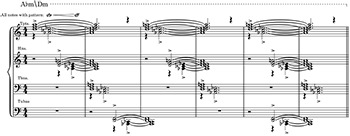
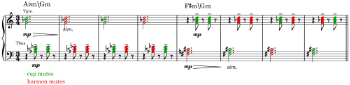
[3.5] Polytonal harmonies are also prominent in The Naked and the Dead, a 1958 World War II movie directed by Raoul Walsh. They appear in the second half of the film, as a group of American soldiers are sent on an extremely dangerous mission to infiltrate Japanese-occupied territory to collect intelligence. Examples 5 and 6 provide excerpts from two cues. In the first one, the
[3.6] While further examples of harmonic polytonality in Herrmann’s film scores will be presented in upcoming sections, the examples discussed so far are sufficient to indicate consistency in terms of dramatic signification. Herrmann’s polytonal harmonies are associated with two main categories that I identify as the “weird” and the “menacing.” Taking standard dictionary definitions of these terms, the “weird” describes something “very strange and unusual, unexpected, or not natural” (Cambridge Dictionary, s.v., “Weird”), while the “menacing” indicates that which is “likely to cause
[3.7] In general, Herrmann’s polyharmonies help to create atmospheres of danger, violence, and doom, which are often associated with characters, objects, or situations portrayed as weird or “abnormal.” The latter include not only supernatural creatures, but also extraterrestrial beings, psychopaths, and sociopaths.(24) In some cases, the polytonal harmonies are associated only with danger and menace, without an explicit sense of weirdness, as in depictions of war. Interestingly, these two broad categories—the weird and the menacing—are closely related to two of Rossi’s polytonal expression types, “le fantastique” and “danger.” The former category is related to the ideas of strangeness and unnaturalness contained in the definition of weirdness; as Rossi notes, “the irruption of the supernatural or the strange on daily life seems to be one of the most characteristic expressive resources of the polytonal language, which is itself based upon the impression of strangeness that arises from the “unnatural” combination of multiple keys” (2011, 181).(25) Regarding the latter category, Rossi writes that “as a language that confronts several keys
[3.8] It is important to stress that polytonality is a special effect in Herrmann’s scoring reserved for extremely tense narrative situations of the kind described above, which are more typical of films belonging to the horror, science-fiction, thriller, or war genres. Even in a bleak horror movie like Sisters, polytonal elements are only introduced when the first weird visual element—Danielle’s scar—is shown. Before that, the harmony accompanying Danielle’s and Philip’s romantic encounter was more tonal and in a more traditionally late Romantic style. In The Naked and the Dead, polychords are only featured in the tensest narrative segment; before and after that, pantriadic chromaticism prevails. And in lighter or more romantic thrillers, polyharmonies are featured only rarely, as in Alfred Hitchcock’s 1964 movie Marnie. In many films of the romance or drama genres, dissonant polychords and other modernist discordances are entirely absent, as in Herrmann’s scores for Jane Eyre (dir. Robert Stevenson, 1944) and Tender is the Night (dir. Henry King, 1962). As many authors have noted, Herrmann combines neo-Romantic and modernist elements in his film music, adjusting their relative proportion according to the generic and narrative contexts involved.(27)
4. Timbre and Color in Herrmann’s Harmonic Polytonality
[4.1] As some of my preceding comments have already suggested, timbre and color play a critical role in Herrmann’s polytonality. Both the musical and narrative effects of Herrmann’s polyharmonies are often highly dependent on the choice of a particular instrumentation, dynamics, and articulation, three factors influencing the perception of timbre. In the case of the
[4.2] There is clear evidence that timbre was important to Herrmann. He always fully orchestrated his scores, claiming that hiring someone else to do so—a common practice in Hollywood at that time—“would be like someone putting color to your paintings” (Smith 1991, 81). From his early days in the 1930s working on the radio, he often selected unusual instrumental combinations to create the desired atmosphere for a given cue.(28) Writing about The Day the Earth Stood Still, where electronic instruments including the theremin and an electric string trio play a central role in depicting the Earth-visiting aliens, E. Todd Fiegel asserts that Herrmann was “first and foremost a musical colorist” (2003, 187).
[4.3] The fact that timbre is relevant in Herrmann’s general approach and in his use of polychords does not, of course, imply that pitch and harmony are irrelevant. After all, if polychords carry negative narrative associations in his and other composers’ film music, this must be due at least in part to their harmonic dissonance. Rather than analyzing harmony or timbre in Herrmann’s polychords, we should analyze them both together. This proposal aligns with recent remarks from some music theorists regarding the interdependency between pitch and timbre. For example, Matthew Zeller advanced a new approach to timbre in the music of the Second Viennese School in a pair of articles published in 2022 and 2023. Drawing upon Schoenberg’s notion of Klangfarbenmelodie, he proposes a broad understanding of timbre as “the totality of a musical tone (or any sound) not including pitch class or duration,” thereby including all characteristics that influence perceived sound quality, such as articulation, loudness, spatial location, and register (2022, [2.3]). He posits that “we must approach the question of timbre and pitch in music with an attitude of ‘both/and, not either/or,” noting that “timbre and pitch are simultaneous, codependent, and symbiotic,” since “every timbre contains pitch, whether definite or indefinite, and every pitch is perceived in a timbre” (2023, [3.1], [1.2]). For this reason, even when analyzing music that elevates the salience of timbre or color as a main structural parameter or as the main means of communication—that is: in the practice he calls “chromophony”—pitch should still be considered.(29)
[4.4] Drawing upon Zeller’s approach, I propose a theoretical and analytical model for Herrmann’s polychords that integrates elements of harmony, texture, and timbre. While it is first necessary to dedicate a separate section to each of these three elements, my overarching goal is to explain how they interact in shaping the overall narrative effect. As I claim, Herrmann adjusts the harmonic, textural, and timbral attributes of his polytonal harmonies so as to calibrate their degree of dissonance or tension and therefore elicit varying degrees of “weirdness” and/or “menace.” The next section begins by examining the pitch element. For the sake of theoretical comprehensiveness I will start by considering the entire set of available triadic superimpositions, some of which might not easily create a sense of polytonality in the terms defined above.
5. An Analytical Model for Herrmann’s Polyharmonies
Part 1—Harmony
Example 7. Some polychords suggesting varying degrees of harmonic tension

(click to enlarge and listen)
[5.1] Not all polychords convey the same degree of harmonic dissonance or tension. For example, the polychord shown in Example 7 (a) sounds more dissonant than (b), as a result of combining two major triads related by semitone rather than whole tone. If we compare (a) and (c), it seems clear, too, that the former polychord sounds more dissonant than the latter, even though they both include the same pitch classes; the greater perceived dissonance of (a) seems to be associated with this polychord’s closer distribution in pitch space. And, finally, (d) will probably sound less dissonant than (a) to most listeners: while (a) is rich in harsh minor ninths, (d) features an equivalent number of somewhat smoother major 7ths.
[5.2] These preliminary observations suggest that a polychord’s perceived dissonance will be affected by the pitch class relations among the superimposed triads, their registral order, and the specific octave position of the individual pitches. Depending on how many and which of the three factors are accounted for or ignored, the chords can be categorized into different types of equivalence classes. For instance, (a), (c), and (d) are equivalent if one ignores registral order and octave position; but if the former element is considered while still disregarding the latter, only (a) and (c) are equivalent. And if we take into account both factors, none of the polychords in Example 7 are equivalent. As I will demonstrate below, different dissonance measures are associated with distinct equivalence classes: some of these measures are sensitive to registral order or octave position, while others are not.
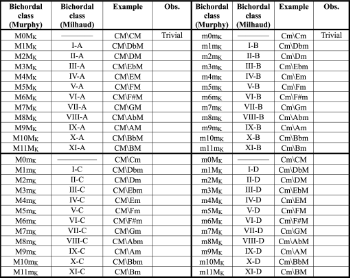
[5.3] I focus on superimpositions of two consonant triads, or “bichords.” In doing so, I draw from Scott Murphy’s (2023) recent work on the taxonomy of triadic progressions, as the problem of conceptualizing equivalence relations for triadic simultaneities is largely similar to measuring successions of two consonant triads. (This point is noted by Murphy, who in the final section of his article suggests the extension and adaptation of his theory to bichords.) Murphy identifies three features, the presence or absence of which determines different classes of equivalence for progressions of two triads: inversion (I); retrograde (R), which considers the temporal order of the two chords; and key change (K), indicating which of the two triads is tonicized. Together, these three elements define what Murphy calls a scope for equivalence relations, comparable to the OPTIC scope that underlies the equivalence relations among pitch sets as theorized by Callender, Quinn, and Tymoczko (2008). Since any of the elements of a particular scope can be independently ignored or accounted for, the IRK scope has a total of 8 (23) possible equivalence relations, just as the OPTIC scope has 32 (25) (Murphy 2023, 147–51).
[5.4] Murphy labels the equivalence relations in the IRK scope as follows: IRK, IR, IK, RK, I, R, K, and ∅ (indicating the absence of I, R, or K equivalence). For example, under R equivalence, temporal order (R) is ignored, while both inversion (I) and tonic placement (K) are accounted for. In this format, the progression from a tonicized AM triad to a non-tonicized Fm triad is equivalent to the retrograde progression from a non-tonicized Fm to a tonicized AM. Both belong to the class M8mR, where the first letter represents the mode of the tonicized triad, the second letter the mode of the non-tonicized triad, the number in the middle the ordered pitch-class interval between the two roots, and R specifies the underlying equivalence type (Murphy 2023, 166–67). Switching key priority (making Fm the tonicized triad) would move us to the class m4MR, regardless of the two triads’ temporal order.
[5.5] Adapting the IRK scope to bichords is relatively straightforward. As Murphy writes, “R could refer to registral or ‘voice’ ordering rather than temporal ordering,” establishing “equivalence classes for polychords that combine two distinct triads”; in other words, “two consonant triads ordered not from earlier to later but from low to high” (2023, 164). I would add that using the K factor with bichords implies a degree of conceptual adaptation as well. I propose that K could refer to a notion of hierarchy within the bichord, as it is conceivable that in a certain musical context one of the superimposed triads might be understood as having more structural weight or priority than the other. While it might be more typical to have the bass triad dominating the bichordal sonority, in principle the opposite situation could also arise.(30)
Example 8. The 48 bichordal classes under K-equivalence
(click to enlarge)
[5.6] Perhaps the most widely cited taxonomy of bichords is the one proposed by Darius Milhaud in his pioneering article on polytonality (Milhaud 1923). As noted by Murphy, in terms of the IRK scope, Milhaud’s classification employs K equivalence. That is, it ignores which of the two superimposed triads might be regarded as having more structural import (just as neo-Riemannian transformations disregard tonal anchoring in triadic successions). At the same time, I and R are accounted for, in the sense that inverting the bichord’s triadic components or swapping its registral components would yield non-equivalent structures. In Example 8, I identify the forty-eight bichordal classes under K equivalence, two of which are trivial (since they specify the superimposition of a given triad with itself). For each class, I provide its designation using both Milhaud’s and Murphy’s nomenclatures, together with one example. In Milhaud’s labeling system, a Roman numeral specifying the registrally-ordered pitch-class interval between the two roots is combined with a letter from A to D indicating the modal arrangement of the superimposed triads. Murphy’s system adopts the format abcK, where a indicates the mode of the low triad, c the mode of the high triad, and b the registrally-ordered pitch-class interval between the two roots; K specifies the underlying equivalence type.
[5.7] Heine (2024) pioneered the adaptation of Murphy’s nomenclature to bichords in his analysis of The Matrix score: for example, he designates the Dm\
[5.8] Of course, K equivalence is not the only one available; as mentioned already, within the IRK scope there are eight possible equivalence classes.(32) I will not explore all of them here, both for reasons of space and because not all of them would be useful in addressing Herrmann’s polychordal practice. Dropping K equivalence, in particular, does not fit my theory since one of the key components of my definition of harmonic polytonality is a lack of internal hierarchy among superimposed triads—that is, the two triads exist as autonomous sonorities without need for resolution (as discussed in [2.4]–[2.5]). Herrmann’s practice reinforces this definition: both triads tend to be equally balanced, whether the fuse into a vertical sonority (as in Example 2, or in mm. 4–6 of Example 4) or are rhythmically separated (as in Examples 3, 5, and 6). The lack of internal hierarchy among the superimposed triads is actually one of the key components of my definition of harmonic polytonality, as it expresses the idea that the two triads coexist as autonomous sonorities without any need of resolution (as discussed in [2.4]–[2.5]).
Example 9. The bichordal classes according to IRK, RK, and K equivalence
(click to enlarge)
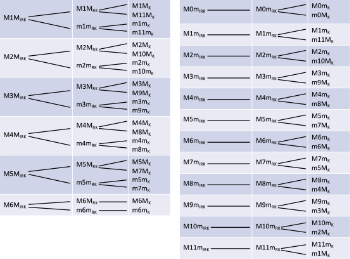
[5.9] Maintaining K equivalence leaves us with three other equivalence classes: IK, RK, and IRK. In Example 9, I show how the 46 non-trivial K-classes merge into 24 and 18 non-trivial RK- and IRK-classes respectively. For example, while the two polychords in Example 6 (
[5.10] Different measures of polychordal dissonance will operate under specific equivalence relations. Two such measures have been proposed by Mark McFarland (2009) and François de Médicis (2009). McFarland’s approach is more quantitative: he calculates a dissonance quotient for a polychord through a weighted sum of its dissonant intervallic components, considering these in interval-class terms (with ic1 as the most dissonant, followed by ic6, and ic2). Médicis (2009), for his part, does not talk explicitly about “dissonance,” but rather about the “degree of contrast” between the two triads as measured by their relative position in the circle of fifths. While both theorists refer to Milhaud’s classification, which operates under K equivalence, their measures follow RK equivalence implicitly, as the registral order of the triads is irrelevant to both.
[5.11] A contrasting method has been advanced by Heine (2024), as he proposes that the degree of dissonance of specific instances of ic1 and ic2 in a polychord differs depending on which note is below and which note is on top. Heine draws both from Olli Väisälä’s (1999) suggestion that registral arrangement impacts the consonant/dissonant status of intervals and harmonies in post-tonal music, as well as from Väisälä’s notion of a registrally ordered interval (ro-interval), an ordered pitch-class interval from a lower to a higher pitch. According to Väisälä, in Schoenberg’s early atonal music, ro-interval 11 (major 7ths and their compounds) frequently works as a consonance, while ro-interval 1 (semitones and their compounds) tends to function as a dissonance. Heine adapts this claim to the context of triadic simultaneities while also treating dissonance as a matter of degree rather than as an on/off phenomenon. Not only does he consider ro1 as more dissonant than ro11, but also ro2 as more dissonant than ro10; he then illustrates how the thus measured degree of “ro-interval dissonance” correlates with narrative tension in Don Davis’s score for The Matrix, with higher dissonance associated with more dangerous situations for the protagonists.
[5.12] Following from the principle that different dissonance measures are useful in different analytic contexts, this article will introduce and combine two: the fifth span (FS) and the sharp-dissonance vector (SDV). The former is derived from Médicis’s idea of the “degree of contrast” of two triads in the circle of fifths, with an underlying RK equivalence. The latter incorporates elements from Heine’s approach but takes a step further in considering the impact of specific pitch intervals in addition to ro-interval contrasts (thus introducing octave non-equivalence, while still keeping K equivalence).(34)
Example 10. Bernard Herrmann, “The Window” (Sisters, [00:28:25–00:29:11])

(click to enlarge and listen)
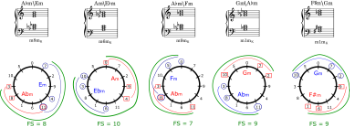
Example 11. Herrmann’s polychords (from “The Window,” Sisters) in the circle of fifths
(click to enlarge)
[5.13] Médicis does not offer an explicit numeric measure of the degree of contrast between two constituent triads. In response, I propose basing this measure on a polychord’s fifth span. FS indicates the minimum number of fifth steps required to cross the regions delineated in the circle of fifths by the polychord’s constituent triads. In order to see how it is calculated, consider Example 10, where I transcribe “The Window,” one of the cues Herrmann wrote for Sisters. This cue features a variety of bichordal classes, which in K equivalence terms can be expressed as m8m, m6m, m9m, and m1m (or in RK terms as m4m, m6m, m3m, and m1m, respectively). Example 11 show a representation of these polychords in the circle of fifths, highlighting the pitch-classes of the upper and lower triads in different colors. For each bichord, I have drawn two smaller semi-circles representing the harmonic region of each of the constituent triads. Note that all triads have a fifth span of 4 steps: in the case of Em, for example, in order to cover the region delineated by E–G–B, one goes from G[7] to D[2], D[2] to A[9], A[9] to E[4], and E[4] to B[11]. I also draw a larger semi-circle (in green) containing the two smaller semicircles in the shortest possible span. In the case of the first polychord, the shortest span is 8 steps: 4 steps from G[7] to B[11], the region delineated by Em, and then 4 more steps from
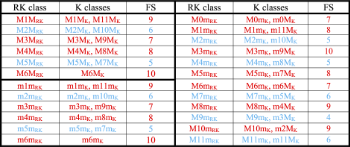
Example 12. The fifth span of all bichords as a measure of harmonic dissonance
(click to enlarge)
[5.14] As noted above, the fifth span measure follows RK equivalence, as it is not sensitive to either a sense of internal hierarchy among the triadic components (K) or their registral order (R). Following this line of reasoning, I present in Example 12 the fifth span for all 24 non-trivial RK classes, while still indicating for ease of reference the corresponding K classes. The table shows that FS varies between a minimum of 4 and a maximum of 10, with bichords having a FS of 7 or more being considered chromatic in the sense that they cannot be contained in a single diatonic region. Conversely, bichords with a FS of 6 or less are diatonic; the former are shown in red, and the latter in blue. These calculations yield two broader claims. First, the polychord’s fifth span is a good indicator not only of the degree of chromaticism of the polychordal combination, but also a reliable way of measuring its harmonic dissonance, as it expresses the degree to which the two triads resist integration in the same diatonic region. And second, chromatic polychords are more conducive to a polytonal effect than diatonic ones, because diatonic proximity favors harmonic integration.
[5.15] As the examples discussed above suggest, Herrmann tends to favor the most dissonant bichords as expressed by their FS—that is, the ones that are more resistant to diatonic integration. In addition, he shows a clear preference for superimpositions of two minor triads. The most common bichordal classes thus seem to be m6mRK (FS=10) and m1mRK (FS=9), the latter most often as m11mK, and more rarely as m1mK.(35) Herrmann superimposes third- or sixth-related triads too, particularly those that involve either one note in common (the so-called “chromatic mediants”(36)) or no notes in common.(37) (While less dissonant than m6mRK and m1mRK, such superimpositions are still chromatic in the sense defined above, i.e., FS>6.) In any case, his typical triadic superimpositions tend not only to lack an internal hierarchy, as noted above; they are also relatively dissonant, this way fulfilling the two conditions of polytonality I introduced in section 2.
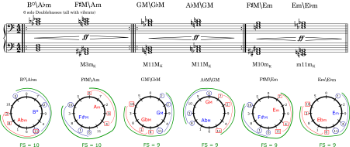
Example 13. Bernard Herrmann, “The Bedroom” (Cape Fear, [00:33:33–00:34:05])
(click to enlarge and listen)
[5.16] Where “The Window” features a variety of polychords, some more dissonant than others (FS ranges from 7 to 10), the excerpt reproduced in Example 13 shows Herrmann employing only the most dissonant ones with FS between 9 and 10. This excerpt comes from his score for Cape Fear (1962), a grisly psychological thriller directed by J. Lee Thompson. The film tells the story of Sam Bowden, an attorney and family man who is stalked by Max Cady, a violent sociopath who blames Bowden for his former conviction and is seeking revenge. While Herrmann’s score is for the most part based on inversionally related motives and harmonies (Schneller 2017, 554–56), it features polychords in some cues. The excerpt in the example scores a scene where Cady rapes a young woman named Diane Taylor; the polychords are heard while Cady moves threateningly towards Diane.(38) Part of the effect of the music’s brutal sound comes from its harmonic organization: it features several extremely chromatic—and hence very dissonant—polychords with a 9- or 10-step fifth span.(39) Clearly, for this gruesome scene, Herrmann sought out the most dissonant bichords available as defined by their FS.
Example 14. Instances of ro1 and ro11 in selected bichords from Sisters (on the left) and Cape Fear (on the right)

(click to enlarge)
[5.17] In one sense, the polychords of “The Window” are more dissonant than those of “The Bedroom.” This is because the cue from Sisters emphasizes ro1 (including semitones and its compounds), while that from Cape Fear emphasizes ro11 (major 7ths and compounds). In the former cue, all polychords include at least one instances of ro1 (and sometimes as many as three), while in the latter only the first and the fifth polychord present one instance thereof. The difference is illustrated in Example 14, which highlights all instances of ro1 and ro11 in two bichords from each of the two excerpts.(40) Obviously, this difference is not captured by the register-insensitive FS method; nevertheless, the effect is clearly audible.(41) But even within a given ro-interval, specific pitch intervals make a difference, too. For example, the first two bichords from “The Window” sound more dissonant than the third, because the former both include one instance of i1 (in both cases between
Example 15. Bernard Herrmann, “The Snake” (The Naked and the Dead, [01:20:00–01:20:18])

(click to enlarge and listen)
[5.18] For another example in which pitch spacing is relevant, consider “The Snake,” the first polytonal cue from the already quoted war movie The Naked and the Dead. As shown in Example 15, one hears Gm\
[5.19] On a musical level, the greater dissonance of the first polychord, Gm\
Example 16. Beating between ic1-related harmonic spectra (with 8 partials each in this abstract example)

(click to enlarge)
[5.20] In brief, while interval-class 1 can be taken as a “sharp dissonance” in general, it will produce different degrees of tension according to its registral disposition and specific pitch realization.(44) The difference between ro1 and ro11 is relevant in a number of post-common-practice repertoires, including not only Schoenberg’s early atonal music, as discussed by Väisälä (1999), but also jazz harmony, where, for example, the minor ninth is generally regarded as more dissonant than the major seventh (Harrison 2016, 60). The contrasting effect of different pitch intervals relates to the phenomenon of sensory discordance or roughness, a particular type of dissonance, psychoacoustic in nature, which is caused by the interference between partials of different spectra beating against each other within the same critical band. As Bregman (1990, 504) explains, “When two partials are too close in frequency for the auditory system to resolve them, it hears the beats (periodic fluctuations in intensity) created by their summation.” Just how close “too close in frequency” is may depend on the auditory system’s “critical band,” the width of which varies according to the frequency region. In general, frequencies separated by only one semitone will tend to produce beating and therefore will be perceived as sensory dissonance. As shown in Example 16, for a given pair of harmonic spectra, the degree of beating associated with semitone-clashing partials will be much greater when the pitch interval between their fundamental frequencies is only one semitone (i1). The interference is attenuated when the pitch interval is i11 or i13; with larger intervals such as i23 or i25, the dissonance is even smaller.(45)
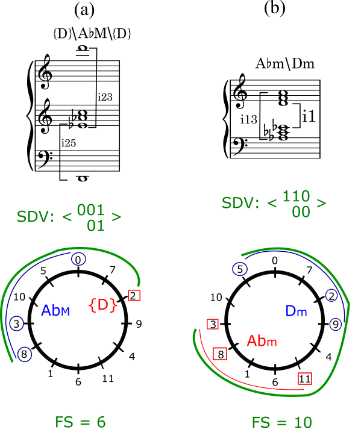
[5.21] With all this in mind, I propose representing the grading of ic1 dissonances in a polyharmony through what I call the sharp-dissonance vector, defined as a series of numbers indicating occurrences of different pitch intervals according to the general format , with instances of ro1 shown in the upper row and instances of ro11 in the lower row. Gradually wider spacings of each ro-interval are shown as we move from left to right. Thus, the letters a, b, and c represent the number of occurrences of i1, i13, and i25 respectively, while d and e indicate the number of occurrences of i11 and i23. Note that b and d (as well as c and e) are vertically aligned in order to suggest their proximity in terms of pitch distance (as in the case of i11 compared to i13). The suspension points indicate that wider pitch intervals could still be considered, even if polychords only rarely employ them. (For ease of reading, I will often drop the suspension points in my analyses.) In general, for a given number of instances of ic1, a polychord will be more dissonant when the sharp-dissonance vector is more concentrated on the upper row and on the left side. The first bichord of Herrmann’s “The Snake,” for example, displays the SDV ; for the remaining ones the vector is , indicating that they are less dissonant.
[5.22] The discussion to this point has identified two complementary ways of conceptualizing and measuring the degree of dissonance of a polyharmony. They can be distinguished according to their underlying equivalence criteria. The fifth span ignores octave position (O), layer priority (K), and registral order (R); the sharp-dissonance vector still ignores layer priority (K), but it considers registral order and octave position, with the former expressed in terms of its two separate rows (one containing instances of ro1, the other of ro11) and the latter individualized in each of the vector’s separate numbers. In practice, both measures can be useful, depending on what an analyst wishes to emphasize about a given polychord. But, as noted earlier, harmony is not the only parameter contributing to dissonance. The next, texture, will be treated in the section to follow.
6. An Analytical Model for Herrmann’s Polyharmonies, Continued
Part 2—Texture
[6.1] In his book Voice Leading: The Science Behind a Musical Art, David Huron (2016) explores the perceptual and cognitive principles that underlie multipart composition. He draws from Alfred Bregman’s (1990) research on auditory scene analysis, a theory that explores how listeners’ brains derive a mental representation of reality from a sensory sound input by grouping incoming acoustic partials into different auditory images and streams that correspond to distinct sound sources. This grouping is influenced by environmental cues, so that, for example, acoustic components beginning synchronously or displaying harmonicity tend to be integrated in a coherent, static auditory image, while persistent sound activities become a dynamic auditory stream. Huron begins by applying these principles to eighteenth-century polyphony, but in the final chapters of the book he explores broader principles of auditory scene setting in other musical contexts and textures, including some that are relevant to how harmonic polytonality is perceived.
Example 17. Igor Stravinsky, “The Shrovetide Fair,” mm. 41–53 (Petrouchka)

(click to enlarge)
[6.2] One of these examples is a well-known passage from Stravinsky’s Petrouchka, reproduced in Example 17. Quoting an analysis of this excerpt by Emilios Cambouropoulos (2008), Huron notes that the music “will be typically heard as two rich streams rather than six independent lines” (2016, 165). This happens because the three upper voices coalesce into a single rich stream—what Huron calls a textural stream—due to their onset synchrony, parallel motion, harmonically related pitches (they form a consonant triad), and close registral distribution; the same applies to the three lower voices. The two three-voice groups remain perceptually distinct because of their oblique or contrary motion and rhythmic differentiation, resulting in the overall formation of two textural streams. In general, onset synchrony, parallel motion, close harmonic relation, close registral position, and homogeneous timbres favor integration in a single textural stream. Segregation of multiple textural streams, in contrast, is favored by onset asynchrony, oblique and contrary motion, heterogeneous timbres, and harmonic and registral distance (Huron 2016, 179).
Example 18. William Schuman, Three-Score Set for piano solo, II, mm. 1–4

(click to enlarge)
Example 19. Igor Stravinsky, “Danses des Adolescentes,” mm. 1–8 (The Rite of Spring)

(click to enlarge)
[6.3] While the Petrouchka example involves counterpoint in triads and is therefore in some sense polychordal, it would be a stretch to call it polytonal, considering how the two textural streams are harmonically integrated in the same diatonic space (G dorian mode).(46) The perceptual principles outlined above can be applied, however, to more explicitly polytonal contexts. Consider the two excerpts reproduced in Examples 18 and 19, the former from a piano composition by William Schuman, the latter from Stravinsky’s The Rite of Spring. The separation into two textural streams is much easier for the listener to achieve in the Schuman example. As noted in Bregman’s analysis of this excerpt, the main elements favoring textural segregation are contrary motion and registral distance between the pitches of the two chordal layers. Within each textural stream, the three notes are bound together by parallel motion, close voicing, and the simple harmonic relationship between the pitches (1990, 517). In the example from The Rite of Spring, all elements but harmony favor textural integration. It is true that the consonant relation among the four lower pitches creates a tight binding between them, separating the
[6.4] Bregman offers Schuman’s passage as one instance of a general principle according to which composers can attenuate the degree of “psychoacoustic dissonance” or “roughness” between two notes by assigning them to different auditory streams. He observes, for example, how Renaissance composers avoided the simultaneous attack of potentially dissonant notes so as to favor their segregation into separate streams, lessening the effect of roughness. Bregman claims that a comparable effect is achieved in the Schuman example, where strong potential dissonances between the notes of the two triadic components are significantly weakened by their segregation into different streams. On the contrary, the more the tones are heard as fused (that is, the more the dissonant notes are heard as belonging to the same auditory stream), the greater the perceived dissonance (Bregman 1990, 502–17). To Bregman’s analysis, I would add that a clear segregation into two or more auditory streams makes it easier for the listener to audibly track the polychord’s separate consonant components, a task made much more difficult when the polychord sounds fused.
[6.5] These principles can help to illuminate an important aspect of Herrmann’s polytonal practice. As suggested above in [4.1], polyharmonic structures heard as a single, fused stream tend to be associated with narrative situations involving a higher degree of “weirdness” and/or “menace” than those where the chordal layers segregate into separate streams. Since the difference between stream segregation or integration is more a matter of degree than categorical opposition (there are different degrees of fusion, just as there are different degrees of segregation), it would be more accurate to rephrase the tendency as follows: the more a polyharmonic structure is heard as a fused stream, the greater the degree of weirdness and menace represented.
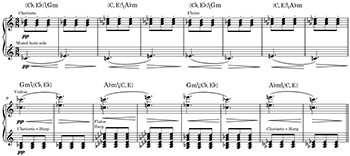
Example 20. Bernard Herrmann, “The House” (North by Northwest, [01:50:44–01:50:57])
(click to enlarge and listen)
[6.6] For an illustration of this tendency, consider “The House” and “The Cliff,” two cues from Herrmann’s score for Hitchcock’s spy thriller North by Northwest. The former accompanies Roger Thornhill’s arrival near the house of spy chief Vandamm, where Thornhill intends to rescue Eve Kendall, a double agent working for the CIA, with whom he is in love (Example 20). The protagonist arrives in secrecy during the night; to represent the dark, suspenseful atmosphere, Herrmann’s mysterious cue starts with the alternation of two polytonal structures: a Gm triad layered on top of a major-third dyad,
Example 21. Bernard Herrmann, “The Cliff” (North by Northwest, [02:08:58–02:09:14])

(click to enlarge and listen)
[6.7] The second cue—“The Cliff”—accompanies the film’s climax. This is a famous moment depicting a dangerous confrontation, as Thornhill and Kendall are pursued across the top of Mount Rushmore. The excerpt shown in Example 21 is heard as one of the evil spies, Leonard, pushes Kendall towards the precipice. It features a sequence of parallel, jarring polychords, nearly all of them of the m11mK class; the sequence ends with an m11MK polychord,
Example 22. Bernard Herrmann, “The Couch” (Sisters, [00:55:12–00:55:19])
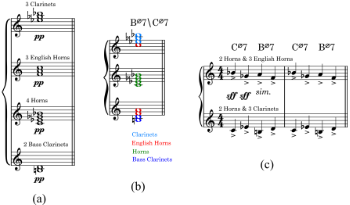
(click to enlarge and listen)
[6.8] In Sisters, Herrmann employs a more subtle textural differentiation, as can be seen by comparing “The Scar,” previously discussed, with “The Couch,” a cue heard much later in the movie. In “The Scar” (Example 3), two clear textural streams result as the two constituent triads are perceptually segregated due to their onset asynchrony and timbral differentiation, attenuating their dissonance. In “The Couch,” Herrmann employs several texturally integrated polychords, alternating between the strings and the woodwinds. Example 22 shows one of these polychords, which occurs synchronously with a shot showing the couch where Philip’s dead body is hidden being moved from the scene of the crime by Danielle (who murdered him) and her ex-husband. The passage’s construction is clearly polytonal. On the one hand, Herrmann superimposes four tonally resonant structures in different instrumental groups: as shown in Example 22(a), the bass clarinets play a minor-third dyad, B–D, the horns play a half-diminished seventh chord with C as the root, the English horns play an F-major triad, and the clarinets play a high
Example 23. Sharp-dissonance vector (SDV) and fifth span (FS) for: (a) the first polychord from “Scar” (b) the polychord from “The Couch”
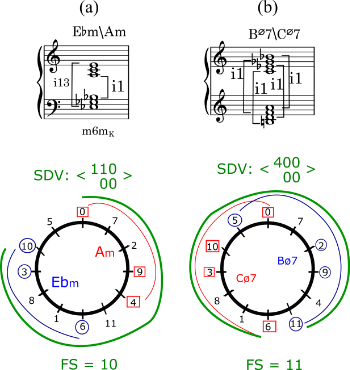
(click to enlarge)
[6.9] The two examples from Sisters diverge in terms of harmonic dissonance as well. Example 23 compares the first polychord from “The Scar” and the polychord from “The Couch.” While both are very chromatic, the former, as a member of m6mK, involves a 10-step fifth span; as for the latter, it involves 11 fifth steps. The difference in terms of the amount and intensity of dissonant pitch intervals is much more evident, however. The polychord from “The Scar” contains one instance of i13 (
[6.10] These examples show how harmonic and textural attributes interact in shaping the degree of dissonance of Herrmann’s polytonal harmonies. In the next section, I consider how a third essential musical element, timbre, also impacts the perception of dissonance and impacts the narrative signification of a polyharmony.
7. An Analytical Model for Herrmann’s Polyharmonies, Continued
Part 3—Timbre
[7.1] As David Blake remarks, “Compared with other musical parameters, the analysis of timbre—that is, the theoretical interest in the quality of sound—is in its relative infancy” (2019, 139). The reasons for the belated development of timbral theory are manifold, having partly to do with the intrinsic difficulties involved in conceptualizing timbre, as a result of its multidimensionality and strong non-linguistic character.(48) Another reason for the relative paucity of timbral research is the long-standing tendency of theory and analysis to focus on written scores, where timbre is normally notated in a less precise manner than parameters like pitch and rhythm. It is thus logical that the recent surge of interest in timbre has coincided with greater theoretical engagement with both sound-based musical objects like performances and recordings as well as with genres such as electroacoustic and popular music, where scores are often nonexistent and timbre is frequently elevated to a central role (Blake 2019, 136–37). Film music is a curious case in this regard: while it often involves written scores, its status as recorded music means that the referential object of analysis is, in a sense, mostly the recorded performance, with all its particularities of timbre and sound quality, as opposed to the written score.
[7.2] The relevance of timbre in Herrmann’s polytonal approach manifests in several different ways. First, as discussed in section 6, timbre influences auditory stream segregation and therefore has an impact on the perception of dissonance. In addition, timbre plays an important role in shaping or clarifying the atmosphere of a scene by giving a more specific narrative connotation to the broader sense of weirdness and/or menace attached to the polytonal structures. In The Naked and the Dead, for example, all polyharmonies are scored for brass instruments, projecting the martial atmosphere with which such instruments are conventionally associated and specifying the sense of danger as being associated with the images of war depicted onscreen (see Examples 5, 6, and 15). In a number of early polytonal cues from Sisters, Herrmann combines the glockenspiel and the vibraphone, recalling the timbre of a music box from childhood; this choice subtly foreshadows the later revelation that the origin of the drama lies in Danielle and Dominique having been born as conjoined twins.(49) In both these two examples and many others, Herrmann plays with the affective and social connotations attached in our culture to different timbres.
[7.3] I would further note, as theorized by Robert Hasegawa (2021), that certain complex harmonic structures—including some polychords—can be heard as a timbre, that is, as composite note entities that have a strong sense of global color and that, to a significant extent, are perceptually indivisible. Conceptualizing timbre “as an emergent property of composite events” rather than a property of single notes exclusively, Hasegawa claims that “timbre emerges from fusion” (2021, 525 and 532). In other words, individual timbres can fuse into more complex, composite sonorities when strong cues favoring perceptual integration are present, leading the listener to mentally group together all sounds as emanations of a single source. This reasoning fits with the experience of fused polyharmonies, such as those reproduced in Examples 4, 15, 21, and 22. As discussed above, acoustic cues like onset synchrony, parallel motion, and relative timbral homogeneity favor the perception of these polychords as integrated sonorities, with a strong sense of global color defined by their pitches and pitch intervals, instrumentation, dynamics, and articulation.(50) While these sonorities are clearly polytonal in construction, their audible effect is more that of a dissonant fused color, working as a hybrid of harmony and timbre.
[7.4] This notion that a polyharmony can have a global timbre or color is relevant to understanding one more way in which Herrmann calibrates the perceived dissonance or tension of a polychord. It involves shaping the global timbral quality of his polyharmonies so that timbres perceived as brighter and/or harsher imply a higher degree of tension and are correspondingly mapped to more negative narrative situations. As Wallmark and Kendall (2021) have summarized, although the experience of timbre is multidimensional and challenging to put into words, brightness and harshness are two of the most common verbal descriptors of timbre. Both involve a cross-modal conceptual metaphor: in the former, “timbre is understood in relationship to the domain of vision, specifically contrasting levels of light”; in the latter, “timbral qualities are understood in terms of the source domain of tactile sensation, with smooth, silky, or velvety on the one end and rough, harsh, or abrasive on the other” (596). The authors further discuss how impressions of brightness and harshness correlate with physical, acoustic dimensions. Wallmark and Kendall cite a number of studies that have identified the relative proportion of high-frequency components in a timbre—often measured by the so-called spectral centroid—as the most significant acoustic correlate of perceived brightness.(51) As for impressions of timbral harshness, they are correlated with the spectral centroid, too, but there are two additional relevant acoustic correlates: inharmonicity (or noisiness) and sensory dissonance (or auditory roughness) (596).
Example 24. Bernard Herrmann: “The Window” (Vertigo, [00:11:05–00:11:13])
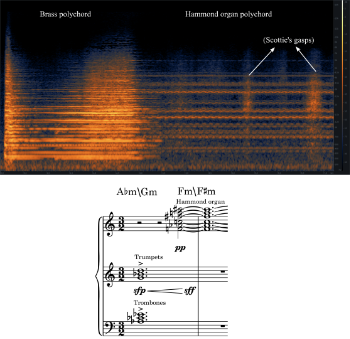
(click to enlarge and listen)
Example 25. Abstract illustration of how a richer acoustic spectrum tends to imply more auditory roughness

(click to enlarge)
[7.5] For an illustration of how these elements operate in Herrmann’s writing, consider Example 24, which shows a transcription and a spectrogram for a short cue from Herrmann’s score to Hitchcock’s Vertigo (1958).(52) As the transcription shows, the cue features two dissonant polychords that are texturally very similar. Both tend to be heard as a single auditory image due to onset synchrony, registral proximity, and timbral homogeneity among their two triadic layers. As members of m11mK and m1mK, both polychords imply a 9-step fifth span, but the first one is harmonically less dissonant than the second, as it includes three instances of ro11 (expressed as i11), in contrast to the same number of occurrences of ro1 (expressed as i13) in the latter. In brief, the sharp-dissonance vector for the first polychord is , while that of the second is . Despite this harmonic dissimilarity, the first polychord sounds much more tense than the second. This is due to their contrasting timbres: the first polychord sounds much brighter and harsher than the second. This perception is linked to the relative prevalence of high-frequency components in the two polychords. The spectrogram shows that the first one features considerable energy above 4000 Hz in the attack and release portions (going up to 7000 Hz), while the second does not go beyond 4000 Hz. The differences in harshness are also related to the fact that the first timbre is much richer than the second; that is, it includes many more harmonics.(53) This is a result of both the instrumentation and the louder dynamics; brass instruments have rich harmonic spectra, while the Hammond organ’s spectrum is much sparser. In addition, playing with louder dynamics, as with the first sonority, implies that more upper partials will be activated. The fact that the brass timbre features more harmonics means that there will be more partials colliding in the same critical band, implying a greater degree of auditory roughness, particularly in the attack and release. As shown schematically in Example 25, a pair of notes related by i11 will produce more auditory roughness (or sensory dissonance) than a pair of notes related by i13 when the timbre of the former is richer than the latter. In this sense, the brass polychord is both harsher and more dissonant, revealing how particular timbral choices (defined by instrumentation and dynamics) can impact perceived dissonance, sometimes even overriding more abstract pitch contrasts.(54)
Example 26. Bernard Herrmann: “The Snake” (The Naked and the Dead, [01:20:04–01:20:09])
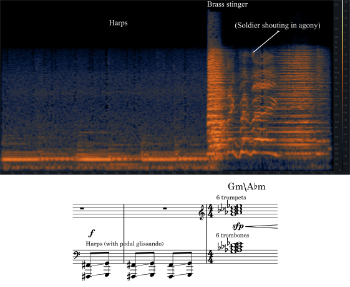
(click to enlarge and listen)
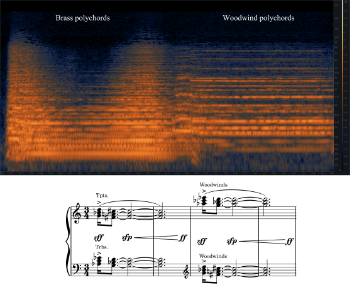
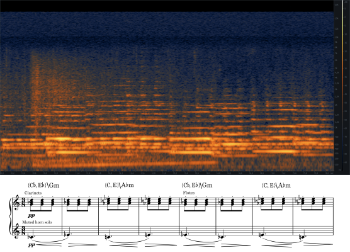
[7.6] Herrmann frequently uses integrated brass polychords featuring sudden fortissimo attacks in his musical “stingers.” As defined by Emilio Audissino, stingers are “sudden dissonant chords that punctuate some shocking revelation or appearance”; he adds that “when we hear a loud and sudden sound we tend to recoil and enter into a defensive and alerted mode … because we register said sudden and violent noise as a potential danger” (2017, 147). In the just-discussed Vertigo cue, for instance, the brass polychord signals the horrified reaction of Scottie, who suffers from severe acrophobia and vertigo, as he looks down from the window of a high floor after climbing a stepladder. A similar effect is explored in “The Snake,” where the sudden attack of a venomous snake is synchronized with an extremely dissonant, cluster-like polychord (see the score in Example 26). The effect is magnified by the powerful timbre of muted trumpets and trombones playing sfp followed by a sharp crescendo. Audiences hear a very bright and rich timbre with a large number of partials clashing in the same critical band, which produces a high degree of auditory roughness (note the sudden contrast between the dark and sparse timbre of the harp and the bright and rich brass polychord in the spectrogram in Example 26). Another example is “The Knife,” from North by Northwest, where a dissonant, integrated brass polychord is again synchronized with a sudden violent event, in this case the killing of a character at the United Nations. As the spectrogram in Example 27 shows, the brass polychord is extremely rich and bright, with intense acoustic energy up to 10000 Hz. (Note also that the woodwind polychord that follows is already sparser, suggesting a clear diminution of timbral tension after the brass stinger.) In contrast to these stingers, when Herrmann wishes to produce more a sense of suspense and sustained tension rather than sudden shock and violence, he tends to employ timbres that are darker, smoother, and more stable. If we compare the spectrogram from “The Knife” (Example 27) with that from the first 8 measures of “The House” (Example 28), it is clear that the global timbre of the latter is darker and more stable, with most of the acoustic energy below 4000 Hz.
Example 27. Bernard Herrmann: “The Knife” (North by Northwest, [00:36:20–00:36:28])
(click to enlarge and listen) | Example 28. Bernard Herrmann: “The House” (North by Northwest, [01:50:44–01:50:51])
(click to enlarge and listen) |
Example 29. Bernard Herrmann: “Klaatu” (The Day the Earth Stood Still, [00:07:57–00:08:38])

(click to enlarge and listen)
Example 30. Bernard Herrmann: “The Ray” (The Day the Earth Stood Still, [00:11:12–00:11:54])

(click to enlarge and listen)
[7.7] For a final example illustrating how harmonic, textural, and timbral elements interact in Herrmann’s polytonal writing, we consider two cues from The Day the Earth Stood Still, a 1951 science-fiction movie directed by Robert Wise. The first cue, “Klaatu,” is heard when a spaceship lands in Washington and the alien of that name is first seen. Featuring an
Example 31. Sharp-dissonance vector (SDV) and fifth span (FS) for: (a) “Klaatu” (b) “The Ray”
(click to enlarge)
[7.8] It might be argued that the polyharmonies associated with Klaatu and Gort are similar, in the sense that they both superimpose tritone-related layers. Just as Herrmann associates the
[7.9] The registral distribution and pitch spacing of the sharp dissonances also help illustrate why Gort’s polychord is more tense than Klaatu’s. As shown in Example 31, both polyharmonies include two instances of interval-class 1, but while in Gort’s case both are expressed as ro1, in Klaatu’s they are distributed as one instance of ro1 and one instance of the less dissonant ro11. Even more significantly, the sharp dissonances appear in Gort’s polychord as a minor second (i1) and a minor ninth (i13), whereas in Klaatu’s they are much more widely spaced (as i23 and i25).(57) The sharp-dissonance vector for Klaatu is , while Gort’s vector is , with the higher concentration in the upper left section of the latter’s vector indicating more tension. The already lesser potential dissonance of “Klaatu” is further attenuated by the fact that the harmonic clashes occur among separate auditory streams. Due to onset asynchrony, timbral heterogeneity, and registral spacing, the listener is likely to hear three different textural streams: the upper-pedal D, the
Example 32. Spectrogram for “The Ray” (corresponding to mm. 1–5 in Example 30)
(click to enlarge and listen)
Example 33. Spectrogram for “Klaatu” (corresponding to mm. 3–7 in Example 29)
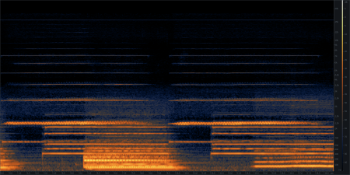
(click to enlarge and listen)
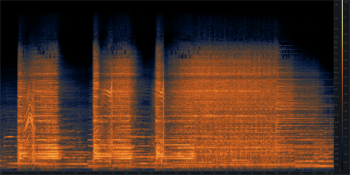
[7.10] Timbre plays a role, too, in differentiating the level of tension of the two polychords, as can be seen by comparing the two spectrograms. Gort’s polychord, shown in Example 32, displays the typical stinger pattern, with an extremely bright and harsh timbre associated with a very rich spectrum featuring intense acoustic energy all the way up to 10000 Hz. This results from combining an sff in the trombones and trumpets (as in “The Snake” and “The Knife”) with other bright instruments, more specifically two Hammond organs and two pianos playing the same polychord, two chimes playing four of the polychord’s six notes, and unpitched percussion, including cymbals, tam-tam, and bass drum (see Example 30). With their inharmonic spectrum, chimes add even more harshness to the timbre; and the unpitched percussion contributes to the same effect of harshness with its broad-band noise (mostly high-frequency noise, in the case of the cymbals). Furthermore, the music as heard in the movie superimposes two different tracks, one from natural performance and the other played artificially in reverse. This double-tracking adds even more richness to the global timbre, making it harsher and noisier. In contrast, as seen in Example 33, Klaatu’s polychord has a much smoother and darker timbre, with a much smaller density of partials and without much acoustic energy above 3000 Hz. This global sonority is produced through an unconventional instrumentation featuring a number of standout timbres. For example, there is a high theremin, with its characteristically pure and sparse, sinewave-like timbre (note the strong frequency around 1200 Hz in the spectrogram, corresponding to the fundamental of D6, with a few, much less intense harmonics above). In addition, there are three cup-muted trumpets playing pianissimo in the middle register, which produce a more delicate, dark timbre, without much energy above 1000 Hz, as well as a low theremin combined with a tam-tam, producing a slightly richer, exclusively low-frequency sonority.
Example 34. A summary of the comparative analysis of “Klaatu” and “The Ray”
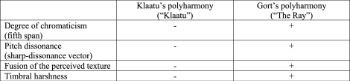
(click to enlarge)
[7.11] My analysis of the foregoing is summarized in Example 34. There, we see how all four parameters under consideration jointly impart higher dissonance or tension on Gort’s polychord, helping to depict the robot as more menacing and weirder than Klaatu. Herein lies the essence of Herrmann’s harmonic polytonality: he shapes the degree of harmonic dissonance, textural fusion, and timbral harshness of a polyharmony so as to calibrate the intensity of the expressive associations attached to this particular type of musical structure—weirdness, menace, and doom.
Conclusion
[8.1] Weirdness, menace, and doom are not the exclusive province of polytonality. Other modernist elements, particularly those associated with clusters, atonality, or serialism, can have similar narrative connotations. In the horror genre, for example, atonal music and post-tonal dissonance in general have often been associated with representations of the “abnormal” and the “monstrous,” two categories closely related to my ideas of “weirdness” and “menace” (Donnelly 2005, 89; Halfyard 2010, 22). It might even be claimed that post-tonal dissonance, writ large, due to its inherent tension and the general public’s unfamiliarity with it, is particularly well-suited to evoke senses of strangeness, threat, or aggression.(58) Unlike other post-tonal idioms, however, polytonality offers the ability to bridge the gap between more familiar, tonal idioms, and extremely dissonant harmonies on the edge of atonality. Polytriadicism, in particular, can be easily linked to pantriadic chromaticism, as both harmonic systems involve combining triads. But even polytriads can sound so fused that the perception of their triadic components is lost, yielding a complex, dissonant sonority without a clear sense of perceived root or pitch center. In such cases, the music may still be polytonal in construction, but the audible effect verges on atonality. For example, in The Day the Earth Stood Still, as noted above, Klaatu’s polyharmony is a verticalization of a previously heard pantriadic chromatic progression, both involving a common D\
[8.2] While I have explored elements of musical design and dramatic signification in the polytonal practice of a single Hollywood composer, Bernard Herrmann, I believe that many of the concepts and methodologies introduced in this article can be applied to film scores of other composers, such as Max Steiner and John Williams. At the very least, this article reinforces Rossi’s intuition that cinema has contributed to bring the highly modernist art-music idiom of polytonality to larger audiences, with Herrmann as one of the masters of this “polytonalité populaire.”
Daniel Moreira
Escola Superior de Música e Artes do Espetáculo
Instituto Politécnico do Porto
Rua da Alegria 503, 4000-045 Porto, Portugal
Centro de Estudos Interdisciplinares (CEIS20)
University of Coimbra
R. Augusto Filipe Simões 33, 3000-457 Coimbra, Portugal
danielmoreira@esmae.ipp.pt
Works Cited
Audissino, Emilio. 2017. Film/Music Analysis: A Film Studies Approach. Palgrave Macmillan. https://doi.org/10.1007/978-3-319-61693-3.
Babbitt, Milton. 1949. “The String Quartets of Bartók.” The Musical Quarterly 35 (3): 377–85. https://doi.org/10.1093/mq/XXXV.3.377.
Bagar, Robert, and Louis Biancolli. 1947. The Concert Companion: A Comprehensive Guide to Symphonic Music. Whittlesey House.
Baker, James. 1993. “Post-Tonal Voice-Leading.” In Models of Musical Analysis: Early Twentieth-Century Music, ed. Jonathan Dunsby, 20–41. Basil Backwell.
Berger, Arthur. 1963. “Problems of Pitch Organization in Stravinsky.” Perspectives of New Music 2 (1): 11–42. https://doi.org/10.2307/832252.
Blake, David. 2019. “Timbre.” In The Oxford Handbook of Critical Concepts in Music Theory, ed. Alexander Rehding and Steven Rings, 136–59. Oxford University Press. https://doi.org/10.1093/oxfordhb/9780190454746.013.21.
Boretz, Benjamin. 1972. “Meta-Variations, Part IV: Analytic Fallout (1).” Perspectives of New Music 11 (1): 146–223. https://doi.org/10.2307/832467.
Bregman, Alfred. 1990. Auditory Scene Analysis: The Perceptual Organization of Sound. The MIT Press. https://doi.org/10.7551/mitpress/1486.001.0001.
Brown, Royal S. 1994. Overtones and Undertones: Reading Film Music. University of California Press. https://doi.org/10.1525/9780520914773.
Cairns, Zachary. 2024. “Whole-Tone Collections and Temporal Dislocation in Film Music.” SMT-V 10 (5). Video, 13:20. https://www.youtube.com/watch?v=E9xNAqXp6Mo.
Callender, Clifton, Ian Quinn, and Dmitri Tymoczko. 2008. “Generalized Voice-Leading Spaces.” Science 320 (5874): 346–48. https://doi.org/10.1126/science.1153021.
Cambouropolos, Emilios. 2008. “Voice and Stream: Perceptual and Computational Modeling of Voice Separation.” Music Perception 26 (1): 75–94. https://doi.org/10.1525/mp.2008.26.1.75.
Cambridge Dictionary. s.v. “Weird.” Accessed March 9, 2025. https://dictionary.cambridge.org/dictionary/english/weird.
Casella, Alfredo. 1924. “Tone-Problems of To-day.” The Musical Quarterly 10 (2): 159–71. Originally published in Italian: “Problemi sonori odierni.” La prora I/1 (febbraio 1924): 5–18. https://doi.org/10.1093/mq/X.2.159.
Chattah, Juan. 2024. “Attuning Serialism: David Shire’s Scores for The Taking of Pelham One Two Three, 2010: The Year We Made Contact, and Zodiac.” In Film Music Analysis: Studying the Score, ed. Frank Lehman, 225–47. Routledge. https://doi.org/10.4324/9781003001171-11.
Cohen, Larry. [1974] 2018. It’s Alive. Blu-Ray Disc. Warner Bros. Home Entertainment.
Cooke, Mervyn. 2008. A History of Film Music. Cambridge University Press. https://doi.org/10.1017/CBO9780511814341.
Corrêa do Lago, Manuel Aranha. 2015. “‘Ad Dissonantiam per Consonantiam’: The Scope and Limits of Darius Milhaud’s System of ‘Polytonalité harmonique’: The Immanent and Poietic Levels (Part 1).” Revista Brasileira de Música 28 (2): 265–304.
—————. 2016. “‘Ad Dissonantiam per Consonantiam’: The Scope and Limits of Darius Milhaud’s System of ‘Polytonalité harmonique’: The Esthesic Level (Part 2).” Revista Brasileira de Música 29 (1): 181–215.
Deroux, Jean. 1921. “La Musique polytonale.” Revue musicale 2/11 (October): 251–57.
Donnelly, Kevin, 2005. The Spectre of Sound: Music in Film and Television. BFI Publishing. https://doi.org/10.5040/9781838711009.
Endfield, Cy. [1961] 2019. Mysterious Island. Blu-Ray Disc. Powerhouse Films Ltd.
Fiegel, E. Todd. 2003. “Bernard Herrmann as Musical Colorist: A Musicodramatic Analysis of His Score for The Day the Earth Stood Still.” Journal of Film Music 1 (2–3): 185–215. https://doi.org/10.1558/jfm.v1i2/3.185.
Fischer, Michel, and Danièle Pistone, eds. 2005. Polytonalité/Polymodalité, Histoire et Actualité. Université de Paris-Sorbonne.
Flinn, Caryl. 1990. “‘The Most Romantic Art of All’: Music in the Classical Hollywood Film.” Cinema Journal 29 (4): 35–50. https://doi.org/10.2307/1225315.
Flinn, Caryl. 1992. Strains of Utopia: Gender, Nostalgia, and Hollywood Film Music. Princeton University Press. https://doi.org/10.1515/9781400820658.
Forte, Allen. 1955. Contemporary Tone Structures. Columbia University Press.
Freud, Sigmund. [1919] 1955. “The Uncanny.” In An Infantile Neurosis and Other Works, The Standard Edition of the Complete Psychological Works of Sigmund Freud, vol. XVII (1917–1919), trans. James Strachey. The Hogarth Press.
Gassi, Vincent. 2019. “The Forbidden Zone, Escaping Earth and Tonality: An Examination of Jerry Goldsmith’s Twelve-Tone Score for The Planet of the Apes.” PhD diss., York University.
Gorbman, Claudia. 1987. Unheard Melodies: Narrative Film Music. University of Indiana Press.
Grey, John M. 1977. “Multidimensional Perceptual Scaling of Musical Timbres.” Journal of the Acoustical Society of America 61: 1270–77. https://doi.org/10.1121/1.381428.
Gut, Serge. 1976. “Polytonalité.” In Science de la musique: Technique, formes, instruments, ed. Marc Honegger, 820–21. Bordas.
Halfyard, Janet K. 2010. “Mischief Afoot: Supernatural Horror-Comedies and the Diabolus in Musica.” In Music in the Horror Film: Listening to Fear, ed. Neil Lerner, 21–37. Routledge.
Harrison, Daniel. 1997. “Bitonality, Pentatonicism, and Diatonicism in a Work by Milhaud.” In Music Theory in Concept and Practice, ed. James Baker, David Beach, and Jonathan Bernard, 393–408. University of Rochester Press.
—————. 2016. Pieces of Tradition: An Analysis of Contemporary Tonal Music. Oxford University Press. https://doi.org/10.1093/acprof:oso/9780190244460.001.0001.
Hasegawa, Robert. 2021. “Timbre as Harmony—Harmony as Timbre.” In The Oxford Handbook of Timbre, ed. Emily I. Dolan and Alexander Rehding, 525–51. Oxford University Press. https://doi.org/10.1093/oxfordhb/9780190637224.013.11.
Heimerdinger, Julia. 2007. Neue Musik im Spielfilm. Pfau.
—————. 2012. “Music and Sound in the Horror Film and Why Some Modern and Avant-garde Music Lends Itself to it so Well.” Seiltanz: Beiträge zur Musik der Gegenwart 4: 4–16.
Heine, Erik. 2018. “Chromatic Mediants and Narrative Context in Film.” Music Analysis 37 (1): 103–32. https://doi.org/10.1111/musa.12106.
—————. 2024. “Post-Tonal Theory and Hollywood Scores: Three Analytical Vignettes.” In Film Music Analysis: Studying the Score, ed. Frank Lehman, 202–24. Routledge. https://doi.org/10.4324/9781003001171-10.
Hindemith, Paul. 1942 [1937]. The Craft of Musical Composition. Translated by Arthur Mendel. Associated Music Publishers.
Hitchcock, Alfred. [1958] 2012. Vertigo. Blu-Ray Disc. Universal Studios.
—————. [1959] 2024. North by Northwest. Blu-Ray Disc. Warner Bros. Entertainment.
Huckvale, David. 2006. James Bernard: Composer to Count Dracula. McFarland & Company.
—————. 2008. Hammer Film Scores and the Musical Avant-garde. McFarland & Company.
Huron, David. 2016. Voice Leading: The Science Behind a Musical Art. The MIT Press. https://doi.org/10.7551/mitpress/9780262034852.001.0001.
Kalinak, Kathryn. 1992. Settling the Score: Music and the Classical Hollywood Film. The University of Wisconsin Press.
Kaminsky, Peter. 2004. “Ravel’s Late Music and the Problem of ‘Polytonality.’” Music Theory Spectrum 26 (2): 237–64. https://doi.org/10.1525/mts.2004.26.2.237.
Koechlin, Charles. 1924. “Évolution de l’harmonie: Période contemporaine, depuis Bizet et César Franck jusqu’à nos jours.” In Encyclopédie de la Musique et dictionnaire du Conservatoire, vol. ii/1, ed. Albert Lavignac and Lionel de la Laurencie, 591–760. Delagrave.
Kopp, David. 2002. Chromatic Transformations in Nineteenth-Century Music. Cambridge University Press. https://doi.org/10.1017/CBO9780511481932.
Lang, Karen Poe. 2023. “The Soundtrack of the ‘Uncanny’: Music and Repetition in Carlos Saura’s Ana y los lobos and Cría cuervos.” In Music, Authorship, Narration, and Art Cinema in Europe: 1940s to 1980s, ed. Michael Baumgartner and Ewelina Boczkowska. Routledge. https://doi.org/10.4324/9781315298337.
Latartara, John. 2012. “The Timbre of Thai Classical Singing.” Asian Music 43 (2): 88–114. https://doi.org/10.1353/amu.2012.0013.
Lavengood, Megan L. 2017. “A New Approach to the Analysis of Timbre.” PhD diss., The City University of New York.
—————. 2020. “The Cultural Significance of Timbre Analysis: A Case Study in 1980s Pop Music, Texture, and Narrative.” Music Theory Online 26 (3). https://doi.org/10.30535/mto.26.3.3.
Lehman, Frank. 2018. Hollywood Harmony: Musical Wonder and the Sound of Cinema. Oxford University Press. https://doi.org/10.1093/oso/9780190606398.001.0001.
—————. 2023. Complete Catalogue of the Musical Themes of Star Wars. Author manuscript. Accessed March 9, 2025. https://franklehman.com/starwars/.
Leydon, Rebecca. 2004. “Hooked on Aetherophonics: The Day the Earth Stood Still.” In Off the Planet: Music, Sound and Science Fiction Cinema, ed. Philip Hayward, 30–41. Indiana University Press. https://doi.org/10.2307/j.ctt2005s0z.4.
Lyon, Jeff, and Brent Yorgason. 2021. Tagging Film Music: A Corpus Study of Max Steiner’s Film Scores. Author manuscript. Accessed March 9, 2025. https://drive.google.com/file/d/1AIu7Ky0iY28GponwyJ1q8525IYFkaap_/view.
Malhaire, Philippe. 2013. Polytonalité: des origines au début du XXIe siècle, exégèse d’une démarche compositionnelle. L’Harmattan.
Martins, José Oliveira. 2015. “Bartók’s Polymodality: The Dasian and Other Affinity Spaces.” Journal of Music Theory 59 (2): 273–320. https://doi.org/10.1215/00222909-3136020.
—————. 2019. “Scalar Dissonance and the Analysis of Polytonal/Modal Mismatch in Twentieth-Century Music.” Musurgia 26 (3): 49–87. https://doi.org/10.3917/musur.193.0049.
McFarland, Mark. 2009. “Dave Brubeck and Polytonal Jazz.” Jazz Perspectives 3 (2): 153–76. https://doi.org/10.1080/17494060903152396.
McLucas, Anne Dhu. 2012. “The Continuity of Melos: Beginnings to the Present Day.” Journal of Film Music 5 (1–2): 15–28. https://doi.org/10.1558/jfm.v5i1-2.15.
McNamee, Ann K. 1985. “Bitonality, Mode, and Interval in the Music of Karol Szymanowski.” Journal of Music Theory 29 (1): 61–84. https://doi.org/10.2307/843371.
Médicis, François de. 2005. “Darius Milhaud and the Debate on Polytonality in the French Press of the 1920s.” Music & Letters 86: 573–91. https://doi.org/10.1093/ml/gci106.
—————. 2009. “Les Choéphores, au-delà du mythe: Perspectives théoriques et analytiques sur la polytonalité harmonique de Darius Milhaud.” Il Saggiatore musicale 16 (2): 245–72. https://www.jstor.org/stable/43030025.
Milhaud, Darius. 1923. “Polytonalité et Atonalité.” Revue Musicale 4 (4): 29–44.
Motazedian, Táhirih. 2023. Key Constellations: Interpreting Tonality in Film. University of California Press. https://doi.org/10.1525/9780520382183.
Müller, Janina. 2019. Musik im Klassischen Film noir. Königshauses & Neumann.
Müller, Janina, and Tobias Plebuch. 2015. “Toward a Prehistory of Film Music: Hans Erdmann’s Score for Nosferatu and the Idea of Modular Form.” Journal of Film Music 6 (1): 31–48. https://doi.org/10.1558/jfm.v6i1.31.
Murphy, Scott. 2014a. “Transformational Theory and the Analysis of Film Music.” In The Oxford Handbook of Film Music Studies, ed. David Neumeyer, 471–99. Oxford University Press. https://doi.org/10.1093/oxfordhb/9780195328493.013.019.
—————. 2014b. “Scoring Loss in Some Recent Popular Film and Television.” Music Theory Spectrum 36 (2): 295–314. https://doi.org/10.1093/mts/mtu014.
—————. 2021. “Abundant Novelty of Antitonic Harmony in the Music of Nikolai Myaskovsky.” In Analytical Approaches to Twentieth-Century Russian Music: Tonality, Modernism, Serialism, ed. Inessa Bazayev and Christopher Segall, 32–53. Routledge. https://doi.org/10.4324/9781003000808-4.
—————. 2023. “An Eightfold Taxonomy of Harmonic Progressions, and Its Application to Triads Related by Major Third and Their Significance in Recent Screen Music.” Journal of Music Theory 67 (1): 141–69. https://doi.org/10.1215/00222909-10232093.
Neumeyer, David. 1995. “Melodrama as a Compositional Recourse in Early Hollywood Sound Cinema.” Current Musicology 57: 61–94.
—————. 1998. “Tonal Design and Narrative in Film Music: Bernard Herrmann’s A Portrait of Hitch and The Trouble with Harry.” Indiana Theory Review 19: 87–123.
Oxford Advanced Learner’s Dictionary. 2000. Edited by Sally Wehmeir. 6th ed. Oxford University Press.
Palma, Brian de. [1972] 2018. Sisters. Blu-Ray Disc. The Criterion Collection.
Rodman, Ronald. 1998. “‘There’s No Place Like Home’: Tonal Closure and Design in The Wizard of Oz.” Indiana Theory Review 19: 125–43.
Rosar, William. 1983. “Music for the Monsters: Universal Pictures’ Horror Film Scores of the Thirties.” Quarterly Journal of the Library of Congress 40 (4): 390–421.
—————. 2003. “Bernard Herrmann: The Beethoven of Film Music?” Journal of Film Music 1 (2–3): 121–51. https://doi.org/10.1558/jfm.v1i2/3.121.
—————. 2009. “Music for Martians: Schillinger’s Two Tonics and Harmony of Fourths in Leith Steven’s Score for War of the Worlds.” Journal of Film Music 1 (4): 395–438. https://doi.org/10.1558/jfm.v1i4.395.
Rossi, Jérôme. 2011. “Les harmonies polytonales dans la musique de films de John Williams.” In Polytonalités, ed. Philippe Malhaire, 179–200. L’Harmattan.
Schneller, Tom. 2017. “Fearful Symmetries: Music as Metaphor in Doppelgänger Films.” In The Routledge Companion to Screen Music and Sound, ed. Miguel Mera, Ronald Sadoff, and Ben Winters, 543–61. Routledge. https://doi.org/10.4324/9781315681047-43.
Schrader, Meghan. 2015. “The Sound of Disability: Music, the Obsessive Avenger, and Eugenics in America.” In Anxiety Muted: American Film Music in a Suburban Age, ed. Stanley C. Pelkey II and Anthony Bushard, 164–87. Oxford University Press. https://doi.org/10.1093/acprof:oso/9780199936151.003.0009
Scorsese, Martin. [1976] 2018. Taxi Driver. Blu-Ray Disc. Sony Pictures Entertainment Iberia.
Smith, Kenneth M. 2018. “Vertigo’s Musical Gaze: Neo-Riemannian Symmetries and Spirals.” Music Analysis 37 (1): 68–102. https://doi.org/10.1111/musa.12109.
Smith, Steven C. 1991. A Heart at Fire’s Center: The Life and Music of Bernard Herrmann. University of California Press.
Thompson, J. Lee. [1962] 2012. Cape Fear. Blu-Ray Disc. Universal Studios.
Tymoczko, Dmitri. 2002. “Stravinsky and the Octatonic: A Reconsideration.” Music Theory Spectrum 24 (1): 68–102. https://doi.org/10.1525/mts.2002.24.1.68.
—————. 2003. “Polytonality and Superimpositions”. Author manuscript. Accessed March 9, 2025. https://dmitri.mycpanel.princeton.edu/polytonality.pdf.
Väisälä, Olli. 1999. “Concepts of Harmony and Prolongation in Schoenberg’s Op. 19/2.” Music Theory Spectrum 21 (2): 230–59. https://doi.org/10.2307/745863.
Van den Toorn, Pieter. 1983. The Music of Igor Stravinsky. Yale University Press.
Walden, Daniel K. S. 2021. “Pitch vs. Timbre.” In The Oxford Handbook of Timbre, ed. Emily I. Dolan and Alexander Rehding, 641–75. Oxford University Press. https://doi.org/10.1093/oxfordhb/9780190637224.013.33.
Wallmark, Zachary, and Roger A. Kendall. 2021. “Describing Sound: The Cognitive Linguistics of Timbre.” In The Oxford Handbook of Timbre, ed. Emily I. Dolan and Alexander Rehding, 579–608. Oxford University Press.
Walsh, Raoul. [1958] 2020. The Naked and the Dead. Blu-Ray Disc. Blackfire Productions SL.
Whitesell, Lloyd. 2006. “Concerto Macabre.” The Musical Quarterly 88 (2): 167–203. https://doi.org/10.1093/musqtl/gdi011.
Wise, Robert. [1951] 2008. The Day the Earth Stood Still. Blu-Ray Disc. Twentieth Century Fox Home Entertainment LLC.
Zeller, Matthew. 2022. “Klangfarbenmelodie in 1911: Timbre’s Functional Roles in Webern’s Opp. 9 and 10.” Music Theory Online 28 (1). https://doi.org/10.30535/mto.28.1.9.
—————. 2023. “Klangfarbenmelodie, Chromophony, and Timbral Function in Arnold Schoenberg’s ‘Farben.’” Music Theory Online 29 (3). https://doi.org/10.30535/mto.29.3.8.
Footnotes
1. A number of influential publications in the field of film music theory have emphasized the dependence of Hollywood scoring on Romantic and late Romantic style, including Gorbman 1987, Flinn 1990, Flinn 1992, and Kalinak 1992. For perspectives underlining the stylistic heterogeneity and eclecticism of Hollywood music, see Lehman 2018 and Müller 2019. On the influence of theater and melodrama of the nineteenth and early twentieth centuries, see Neumeyer 1995, McLucas 2012, and Müller and Plebuch 2015.
Return to text
2. A common idiom in both classical and contemporary Hollywood, pantriadic harmony is characterized by the restriction of the chordal vocabulary to major and minor triads, which frequently appear in chromatic, non-functional relations (Lehman 2018).
Return to text
3. While pantriadic chromaticism and tonal design in film scoring have their origin—or at least clear precedents—in the music of the nineteenth century, they have been adapted, reinvented, and expanded in Hollywood, often yielding genuinely new configurations.
Return to text
4. There have been, however, some significant studies on post-tonal and modernist practices in Hollywood scoring. These comprise approaches to whole-tone harmony in 1930s horror movies (Rosar 1983) and to the more general use of the whole-tone scale as a signifier of dreams, the supernatural, and various types of “temporal dislocations” (Cairns 2024); analyses of quartal chords in crime and science-fiction films (Rosar 2009); and discussions of atonal and serial methods in the film music of James Bernard (Huckvale 2006, 2008), Jerry Goldsmith (Gassi 2019), James Newton Howard (Heine 2024), and David Shire (Chattah 2024).
Return to text
5. “[L]e septième art a contribué dans une large mesure à populariser les harmonies polytonales” (translation mine). While uncommon in English, the term “seventh art” is a well-known synonym for cinema in French (le septième art) and other Romance languages such as Italian (la settima arte), Spanish (el séptimo arte), and Portuguese (a sétima arte).
Return to text
6. “Cette association entre une écriture savante difficile et un art populaire constitue sans aucun doute l’un des aspects les plus fascinants de la musique de films” (translation mine).
Return to text
7. The website can be accessed at https://maxsteinerinstitute.org.
Return to text
8. These are the results as of July 29, 2025. These numbers will likely increase as new films are added to the catalog.
Return to text
9. Such names include Hindemith (1942 [1937], 156), Babbitt (1949, 380), Forte (1955, 137), Berger (1963, 22–23), Boretz (1972, 149), van den Toorn (Van den Toorn 1983, 63–64), and McNamee (1985).
Return to text
10. The main positive reappraisals of polytonality include work of both European and North and South American scholars such as Harrison (1997), Tymoczko (2002, 2003), Kaminsky (2004), Fischer and Pistone (2005), McFarland (2009), Médicis (2009), Malhaire (2013), Corrêa do Lago (2015, 2016), and Martins (2015, 2019). According to Peter Kaminsky, “the inconsistent use of the term polytonality has inhibited an understanding of the music purporting to exemplify it” (2004, 238). For Philippe Malhaire (2013, 15), the first main issue when approaching polytonality “is the existing theoretical and terminological ambiguity, which most often plunges the reader into the biggest confusion” (“[L]e premier grand problème auquel le musicologue doit faire face en abordant la polytonalité, c’est l’ambiguïté théorique et terminologique existante qui la plupart du temps plonge le lecteur dans la confusion la plus totale.”) Finally, Mark McFarland (2009, 153) writes that “polytonality is a term that has yet to be defined to the satisfaction of all, and such agreement will likely never happen.”
Return to text
11. According to Martins (2019, 51), “[t]here is no clear conceptual distinction (both in theoretical terms and in historical usage) between terms such as contrapuntal or melodic polytonality and polymodality.”
Return to text
12. Médicis (2005) and Malhaire (2013) use comparable terms in French, namely “polytonalité au sens strict” and “polytonalité au sens large.”
Return to text
13. Initial theorizations of polytonality, including Milhaud’s, Casella’s, and Koechlin’s, typically favored an inclusive approach, while many critics took the term in the strict sense when claiming that polytonality is logically or perceptually impossible.
Return to text
14. As noted by Malhaire (2013, 71), many of the more consonant triadic superimpositions favor a monotonal hearing, because “the tensions between the notes are not strong enough for the listener to be able to separate the theoretical components” (“les tensions entre les notes ne sont pas suffisantes pour que l’auditeur puisse distinguer les composantes théoriques.”) Along the same lines, Serge Gut observed: “Polytonality is almost always dissonant. Different keys have a stronger plasticity and relief when they collide violently” (1976, 820; quoted in Malhaire 2013, 79). (“La polytonalité est presque toujours dissonante. Les différentes tonalités ont une plastique et un relief plus fort quand elles se heurtent violemment.”)
Return to text
15. The ideas contained in this paragraph are inspired by Martins’s proposal of three contrasting listening strategies that can be applied to superimpositions of tonally-resonant layers. These include “tonal resolution or integration”, where the dissonances contained in one of the layers tend to resolve to a more stable layer, suggesting a sense of extended tonality; “polytonal coexistence, where dissonances in a vertical sonority are conceived to be at rest, requiring no resolution” and suggesting a sense of harmonic polytonality; and “polytonal autonomy,” where dissonances occur between separate linear layers (2019, 56–57). Though Martins reserves the notion of “autonomy” to contrapuntal polytonality (while applying the idea of “coexistence” to harmonic polytonality), I take “autonomy” in a broader sense associated with the lack of resolution tendencies among the chordal layers.
Return to text
16. Example 1a is quoted in Brown 1994, 167; Examples 1b and 1d come from the Max Steiner Digital Thematic Catalog (see https://maxsteinerinstitute.org/instance.php?film_id=10&theme=Knives&cue=Arsenic116 and https://maxsteinerinstitute.org/instance.php?film_id=101&theme=Mrs.+Hammond&variant=Dagger&cue=Letter-91); and Examples 1c and 1e are taken from Rossi 2011, 187 and 184 respectively.
Return to text
17. While it would be unadvised to generalize from such a small sample, it is suggestive that none of the examples features polytonality in the strict sense, aligning with similar tendencies in concert repertoires. According to Médicis (2009, 258), “while the existence of veritable polytonality is not impossible, its manifestations are very rare” (“bien que l’existence de la polytonalité véritable ne soit pas impossible, ses manifestations sont très rares”). He refers to two specific Milhaud compositions as rare instances of such a “veritable” or “strict” polytonality: “Paysandu” (from Saudades do Brasil) and “Les crocus” (from Catalogue de Fleurs).
Return to text
18. Malhaire's remarks are strongly reminiscent of those noting the conditions necessary for auditory stream segregation, which have been discussed from a cognitive and empirical perspective by Alfred Bregman (1990). In section 6, I will explore in greater detail how Bregman's theory of auditory scene analysis can enrich our understanding of the perceptual implications of polytonality.
Return to text
19. Throughout this article, I employ a notation for polychords where their registral disposition is shown through left-to-right order, with the chord on the left in the lower registral position. This system is similar to Heine’s (2024) notation, but instead of a slash, I use a backslash to separate the two chordal components. The backslash more clearly distinguishes my system from standard slash-chord notation in pop and jazz lead sheets, where, for example, Dm/G normally indicates a D minor triad above the bass G. In my notation, in contrast, Dm\
Return to text
20. As I argue below (in section 5), it is useful to consider the direction of the interval between the roots of the two superimposed harmonies, distinguishing polychords separated by a registrally ordered pitch-class interval of 11 semitones (major sevenths and their compounds) from those separated by just one semitone (minor seconds and their compounds).
Return to text
21. The tubas play only the minor third from each of the two triads.
Return to text
22. Some of Herrmann’s polychords cited in this article could be conceived as extended tertian sonorities. This is particularly true of superimpositions of triads whose roots lie a major seventh apart, as in
Return to text
23. As Megan Schrader (2015) notes, postwar horror films often depict disability and deformity as grotesque and repulsive, reflecting the ableist attitudes prevalent in society at the time. As she demonstrates, dissonant music frequently played a key role in reinforcing this effect.
Return to text
24. Herrmann often employed polytonal structures when scoring psychological thrillers and horror movies involving psychopaths or sociopaths as their main characters. The technique is used, for example, in Sisters, Twisted Nerve (1968, dir. Roy Boulting), and Taxi Driver (1976, dir. Martin Scorsese), with dissonant polychords appearing with greater frequency as their psychotic protagonists (Danielle, Martin, and Travis, respectively) become more violent. In Scorsese’s film, for example, dissonant superimpositions of triads and seventh chords are first heard around the middle of the movie. The strident polyharmonies help portray Travis’s descent into psychotic, potentially criminal behavior as he is seen doing heavy physical and gunshot exercise after purchasing an intimidating collection of weapons ([00:57:49–00:58:40] and [01:07:10–01:08:04]). In other cases, psychopaths are portrayed more through other types of dissonant harmony, as in Psycho (1960, dir. Alfred Hitchcock), where Norman’s actions tend to be associated with more explicitly atonal structures, as in the famous cluster-like cue for the shower murder sequence.
Return to text
25. “L’irruption du surnaturel ou de l’étrange dans le quotidien semble être l’une des ressources expressives les plus caractéristiques du langage polytonal, lui-même fondé sur l’impression d’étrangeté dégagée par l’association ‘contre nature’ de plusieurs tonalités” (translation mine). Both Rossi’s category of the “fantastic” and my notion of “weirdness” can be associated with Freud’s concept of the “unheimlich” (or “uncanny”), which he famously defined as “that class of the frightening which leads back to what is known of old and long familiar,” as well as “something which is familiar and old-established in the mind and which has become alienated from it only through the process of repression” (Freud [1919] 1955, 220 and 241). In the case of harmonic polytonality, it might be argued that its basic ingredients—major and minor triads—are entirely familiar or “heimlich” on their own, but they become estranged and repressed through their “weird,” dissonant juxtaposition, generating an uncanny effect. While I do not explore this argument further in this article, there is ample precedent for applying Freud’s concept in film music analysis; for two recent references, see Smith 2018 and Lang 2023.
Return to text
26. In French in the original: “Langage qui confronte plusieurs tonalités
Return to text
27. According to his biographer, Steven C. Smith, Herrmann’s “idiom was that of a Neo-Romantic schooled in the music of the twentieth century” (1991, 4). Lloyd Whitesell (2006, 170), too, claims that Herrmann’s “openness to modernist idioms did not lead him to reject Romantic themes and gestures.” And Herrmann himself stated that, while being “in sympathy with modern idioms,” he would class himself as a “Neo-Romantic” (Bagar and Biancolli 1947, 335). Even though some have hailed Herrmann as an iconoclast who rejected the late Romantic idiom characteristic of Hollywood film music, in practice the Romantic and the modern co-exist and interact in his soundtracks, as they do in the music of other Hollywood composers such as Alfred Newman, Miklós Rósza, or Roy Webb. (See Whitesell 2006, 167–70; Rosar 2003, 128–29; and Cooke 2008, 108–19.)
Return to text
28. In a 1971 interview, Herrmann remarked that “since a film score is only written for one performance, I could never see the logic in making a rule of the standard symphony orchestra. A film score can be made of different fantastic groupings of instruments, as I’ve done throughout my entire career” (quoted in Smith 1991, 78). For the opening of Orson Welles’s Citizen Kane (1941), for example, Herrmann created an ominous, subterranean mood by employing an atypical ensemble of low instruments including 3 bass flutes, 3 bass clarinets, 3 bassoons, and a contrabassoon. In the rejected score for Hitchcock’s Torn Curtain (1966), he matched the brutality of some of the film’s Cold War narrative elements with a powerful, bizarre orchestra dominated by woodwinds and brass and featuring 12 flutes, 16 horns, and 9 trombones.
Return to text
29. Comparable points have been made in other recent contributions. For example, Robert Hasegawa (2021) claims that in many twentieth- and twenty-first-century musical repertoires there is a blurred line between harmony and timbre. In addition, Daniel Walden (2021) discusses the analytical and ethical costs involved in separating pitch from timbre in ethnomusicological debates.
Return to text
30. In an article devoted to Ravel’s late work, Kaminsky (2004) discusses issues of layer hierarchy—between a bass and a treble sonority—in music described as polychordal or polytonal. He proposes that in Ravel’s case at least, one can “assume the structural priority of the bass as a normative tendency,” while acknowledging that “in some contexts, the upper voice(s) may resist that priority and establish a degree of autonomy as a secondary priority; or, more rarely
Return to text
31. The fact that Heine (2024) does not quote Murphy (2023) is likely due to the two works being published too close together for citation to have been possible.
Return to text
32. Murphy (2023, 164) observes that most of these equivalence relations for bichords “remain to be researched or cataloged.” While my contribution may be seen as a first step towards such an endeavor, a more systematic exploration is beyond the scope of this article.
Return to text
33. For more details on the meaning of the prime-form labels for each equivalence type, see the appendix of Murphy’s article (2023, 166–68).
Return to text
34. Murphy (2023, 164) notes that one obvious extension of his IKR-scope theory “would be to move beyond its limitation to three aspects,” for instance by adding “one or more of the four OPTC aspects initially left outside of the IRK scope.”
Return to text
35. The examples discussed in the remainder of this article seem to confirm these tendencies, even if a more explicitly quantitative, statistical study would be required to validate them more formally.
Return to text
36. See Kopp 2002 on chromatic mediants in general, and Heine 2018 on their application in film-music contexts.
Return to text
37. Third-related triads with two notes in common are generally too close or similar to each other to produce a polytonal effect. See paragraph [2.4] and footnote 13 in this regard.
Return to text
38. The same polychords are heard in a later scene, as Nancy, Bowden’s daughter, runs away in terror from Cady. Since we have already heard this musical theme associated with rape, it is frightening and disturbing to hear it again as a child is being chased by the brutal sociopath.
Return to text
39. The first polychord involves the superimposition of a diminished and a minor triad, a combination not considered in the IKR-scope theory I presented. For this reason, I do not offer a specific MnM label for this polychord, but we can still determine its fifth span using the same method, as shown in Example 13.
Return to text
40. In other words, and as implied by Heine 2024 and Väisälä 1999, swapping the triadic components in register would make most of the polychords from “The Window” less dissonant, and most of those from “The Bedroom” more dissonant.
Return to text
41. It might be argued that this difference reflects a general stylistic contrast between the two scores, as it seems fair to say that the Sisters score is globally more dissonant than Cape Fear’s (see Example 22 for another polytonal cue from Sisters emphasizing ro1). This contrast matches the greater brutality of de Palma’s film when compared to Thompson’s, reflecting the trend towards a more liberal display of violence in Hollywood movies as we moved from the 1960s to the 1970s.
Return to text
42. Note that I am excluding the bass from the analysis. While from m. 7 the bass produces an additional element of harmonic dissonance, I find it is still meaningful to concentrate on the polychordal trombone texture, as the bass is perceptually separated because of its different register, rhythm, and instrumentation (tubas and harps).
Return to text
43. Even though the two triads are differentiated by mute type, registral proximity implies that m. 4 is heard as a sort of cluster, so that in this case the polytonality is expressed more in constructive rather than perceptual terms.
Return to text
44. Daniel Harrison (2016, 58–62) identifies ic1 in general as a “sharp” dissonance, and ic2 as a “mild” one. He also claims that abstract interval-classes produce different degrees of tension as they are realized as pitch intervals in specific chordal voicings. This is an important component of his theory of “harmonic fluctuation,” which is mostly applied to tonally extended post-1900 repertoires.
Return to text
45. The degree of beating will depend, of course, on the particular acoustic spectra of the two pitches, which are associated with their timbre. What I show in Example 16 is, in that sense, an abstraction, as I compare two spectra with a similar acoustic structure containing eight partials, but the conclusions would be similar for spectra with fewer or more partials. In general, a wider spacing of ic1 related pitches reduces the likelihood of their partials colliding in the same critical band.
Return to text
46. In other words, there is not much harmonic conflict between the two layers, an essential ingredient of polytonality in the broad sense I defined above as the layering of conflicting tonal elements.
Return to text
47. Interestingly, the motive alternating Cø7 and Bø7 was also heard during the murder scene [00:26:10–00:28:11]. This scene features a chaotic assemblage of superimposed musical elements, creating a sense of mayhem and confusion. The motive with the alternating half-diminished chords is heard throughout the scene, sometimes more in the foreground, other times in the background, and often nearly inaudible, as the different musical elements compete for the listener’s attention in a densely populated, highly reverberating musical texture.
Return to text
48. As Blake (2019, 147) notes, “The world of possible timbres cannot be scaled quantitatively as pitch (waveform frequency), volume (amplitude), or rhythm (time) can.” On timbre’s multidimensionality, see also Grey 1977, Wallmark and Kendall 2021, and Hasegawa 2021 (539). Regarding timbre’s non-linguistic nature, Blake asserts that “the perception of sound quality
Return to text
49. One example is “The Candles,” the cue heard just before the murder, where the glockenspiel and vibraphone start both in the key of E-major but become increasingly more independent until a clear sense of polytonality is achieved [00:25:15–00:26:08].
Return to text
50. In addition, the very fact that these polychords feature six or more tones makes it difficult for most listeners to hear the separate tones. Even those who can do so will still be encouraged to perceive the polyharmony at least partly as a global whole.
Return to text
51. As defined by Lavengood (2020, [1.9]), “spectral centroid measurements
Return to text
52. A spectrogram shows the frequencies of a given acoustic signal as they evolve over time. More specifically, “a spectrogram charts frequency on the y-axis and time on the x-axis, while showing amplitude with changes in color” (Lavengood 2017, 14). Because spectrograms depict the structure of the acoustic signal, while the perception of timbre is dependent on psychoacoustic and cultural factors as well, they are imperfect representations of timbre. While being aware of this limitation, I follow the methodology proposed by John Latartara, who argues that spectrograms “do not show us what we hear, but rather provide acoustic reasons for our musical perceptions” (2012, 92; quoted in Blake 2019, 148). I will thus start with my musical perceptions regarding timbral quality and then use the spectrograms to substantiate them. The spectrograms presented in this article have been created with iZotope RX11 software. In nearly all cases, I have used the sound file from the Blu-Ray or DVD copy of the film cited in the references, so that in addition to music the spectrogram may indicate information about sound effects and dialogue (see the written annotations in the spectrograms); in one case (Example 33), I have used a recording featuring only music, without the sound effects as heard in the movie. All audio examples have been normalized, so that contrasts of amplitude within each example become clearer.
Return to text
53. Here I follow Lavengood’s definition of a sonority as rich or sparse according to the number of partials it contains. In her words, “a sound with many partials is rich, and with few is sparse” (Lavengood 2017, 19).
Return to text
54. My analysis aligns with Hasegawa’s broader claim that “As we start thinking of the timbre of composite events, we will need to change some of our habits in talking about pitch and harmony.” He urges us to “abandon the conception of a note in the abstract, isolated from its timbre and acoustical spectrum,” arguing that “the particular timbres assigned to the notes of an interval or chord may have a profound effect on the composite result,” including its perceived degree of sensory dissonance (Hasegawa 2021, 539).
Return to text
55. The passage reproduced in Example 30 accompanies Gort’s first appearance in the film, as he comes to rescue Klaatu, who has been shot by a human soldier. The harsh
Return to text
56. This relationship was already noted by Leydon 2004 (37).
Return to text
57. In this analysis, I exclude octave doublings in both the bass and treble pedals, considering only the most salient pitch (that played by the theremins) in each register.
Return to text
58. Julia Heimerdinger notes that for most people contemporary art music generates an aversive response “due to its unfamiliarity and strangeness, which results from the deviation from the firmly internalized rules of tonal music” (“Die statistisch vorherrschende aversive Haltung gegenüber Neuer Musik verdankt sich deren Unbekanntheit und Fremdheit, die aus der Abweichung von den fest internalisierten Regeln tonaler Musik resultiert”) (2007, 98). When heard in a horror film, however, such music works “precisely because it triggers negative associations” (“kann der Wert einer Musik sehr hoch geschätzt werden, gerade weil sie negative Assoziationen auslöst”) (101). Such associations assist in portraying the “extreme, uncommon, remote, unpredictable and … aggressive elements” that are typical of horror (2012, 15). While Heimerdinger speaks specifically about the horror genre, the point can be extended to depictions of “uncommon” or “aggressive” elements in other Hollywood genres that similarly deal with unusual or sinister elements.
Return to text
Copyright Statement
Copyright © 2025 by the Society for Music Theory. All rights reserved.
[1] Copyrights for individual items published in Music Theory Online (MTO) are held by their authors. Items appearing in MTO may be saved and stored in electronic or paper form, and may be shared among individuals for purposes of scholarly research or discussion, but may not be republished in any form, electronic or print, without prior, written permission from the author(s), and advance notification of the editors of MTO.
[2] Any redistributed form of items published in MTO must include the following information in a form appropriate to the medium in which the items are to appear:
This item appeared in Music Theory Online in Volume 31, Issue 4 in December 2025. It was authored by Daniel Moreira (danielmoreira@esmae.ipp.pt), with whose written permission it is reprinted here.
[3] Libraries may archive issues of MTO in electronic or paper form for public access so long as each issue is stored in its entirety, and no access fee is charged. Exceptions to these requirements must be approved in writing by the editors of MTO, who will act in accordance with the decisions of the Society for Music Theory.
This document and all portions thereof are protected by U.S. and international copyright laws. Material contained herein may be copied and/or distributed for research purposes only.
Prepared by Andrew Blake, Editorial Assistant
Number of visits:
5763