Against the Monochord: Numbers, String Lengths, and the History of Music Theory*
Caleb Mutch
KEYWORDS: Monochord, instrument, Guido, Boethius, Marchetto, numerology, epistemic thing, history of theory
ABSTRACT: Instruments of music theory are in. A call has been sounded for a “new organology,” and recently conference sessions and articles have been dedicated to the role of instruments in the history of music theory. This research has advanced our understanding of music and its history by illuminating previously overshadowed ways in which musical instruments, in all their physicality, have affected music theorizing. Yet the monochord, I contend, is a counterexample to this corrective movement, since the pertinence of its physicality and practical application have been, if anything, inflated in our understanding of the premodern world. Since any Pythagorean-influenced theory in which larger numbers represent lower pitches can be “updated” by reciprocating the numerical relationships to represent acoustic frequencies, we are tempted to interpret all premodern numerical descriptions of intervals as string lengths on a monochord (and implicitly as frequencies). I critique the centrality of the monochord in modern narratives and question what practical purposes the monochord could have served in the past, reading Guido and Boethius to argue that the instrument was less useful than might be supposed. Next, I analyze two medieval cases of number-based music theory that refute any identification of numbers with the length of a monochord string. I conclude by considering the role of the monochord in recent literature, particularly the relationship between the monochord and Hans-Jörg Rheinberger’s concept of the epistemic thing.
DOI: 10.30535/mto.31.4.6
Copyright © 2025 Society for Music Theory
“So far as practical usage is concerned, this instrument would be the last and feeblest.”
Ptolemy, Harmonics II.12
[0.1] It is an attractive story we tell: “As everyone knows, string- and frequency-ratios are the inverse of each other. Two strings whose lengths are in the ratio 2:3 produce frequencies in the ratio 3:2, the shorter string producing the higher frequency. This inverse relationship is simply a function of the behavior of the string, for the factors of length (that is, wave length) and frequency are so closely related as to be but two aspects of the same phenomenon” (Crocker 1963, 334). It is attractive because it makes historical music theory more relevant. We can tell our students, and ourselves, that all those thousands of pages that premodern theorists dedicate to number ratios are simply describing string lengths, and thereby indirectly signifying musical pitches and intervals. And at the same time, since string lengths are mathematically equivalent to frequencies (mutatis mutandis in the obligatory inversional way), those premodern theorists are also accorded a measure of scientific respectability, since they were operating in the realm of acoustics, discussing the phenomena of frequencies and their relationships with a great deal of specificity.
[0.2] Premodern practices of music theorizing, however, were both more complicated and less familiar than that. Pythagorean-inspired thinkers from Philolaos on held that number undergirds all knowable things (Barker 1989, 36), so they accordingly understood musical sounds to depend on pure numbers. Consequently, the monochord would seem to occupy a pivotal mediating position, as it allows theorists to demonstrate the congruity between the interval that a pair of string segments sounds and the numerical ratio that their lengths constitute, thereby validating the numerical foundations of music. As Alexander Rehding succinctly puts it, the monochord “is a musical instrument that unites musical and mathematical aspects in a single device” (2016b, 260).
[0.3] In recent scholarship, the monochord and its successors have played a starring role in music theory’s “critical organological” turn. Rehding’s two 2016 articles on the subject, various events at and around the 2017 AMS Rochester conference, a global monochord conference at Columbia University that same year, and in 2023, a two-day symposium at Princeton and a three-day conference at Harvard have all demonstrated the value of paying close attention to the materiality of the instruments that have been used over the centuries to manifest and at times subvert music-theoretical ideas. Here, however, I argue the contrary for the monochord: attending to that instrument qua practical object distracts from its more important role as a disembodied symbol of intervallic-rational concord. That is, rather than seeking out the shadow of an actual physical monochord in theory texts, we should instead try to stop our ears against its siren song. For when we bring a monochord with us to our reading of premodern music theory, it can lure us into hearing things that are not actually there.
[0.4] To make this argument, I first offer a reminder that the monochord and operations of string lengths do not, in fact, constitute the foundation of the Western music-theoretical tradition. Next, in order to ascertain what practical purposes the monochord could, and could not, have served, I examine first Guido’s entirely pragmatic claims for the instrument’s value, and then Boethius’s treatment of it as a mathematical entity. Subsequently, I analyze two medieval cases of number-based music theory that refute any identification of numbers with the length of a monochord string. I conclude by considering the role of the monochord in recent literature, in particular Friedrich Kittler’s (2003, 2006) and Alexander Rehding’s (2016a, 2016b) interpretation of the monochord via Hans-Jörg Rheinberger’s (1997) concept of the epistemic thing.
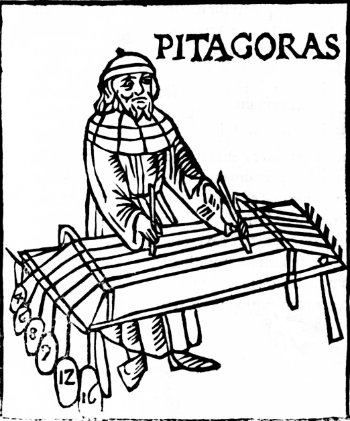
Example 1. Pythagoras, from Franchinus Gaffurius, Theorica musicae (1492, I.8, sig. b6r)
(click to enlarge)
[0.5] And now, to the smithy. In the oldest extant version of the legend of Pythagoras and the hammers, preserved in Nicomachus of Gerasa’s Enchiridion musices (ca. 100 CE), after weighing the blacksmiths’ mallets in the smithy, Pythagoras’s first act is to go home and turn his house into a gigantic lyre:
He fixed a single rod from corner to corner under his roof, so that no variation should arise or even be suspected of arising from the peculiarities of different rods, and hung from it four strings, each of the same material, and consisting of an equal number of strands, and each of equal thickness and twisted to the same extent as each of the others. He then attached a weight to the lower part of each string. And having so contrived it that the length of every string was in all respects absolutely equal, he then plucked strings two at a time in turn, and found the concords previously mentioned, a different concord for each pairing. (Barker 1989, 257)
While the detail of the room-spanning rod is unique to Nicomachus’s version of the story, Boethius likewise relates that Pythagoras returned home and attached weights to strings; only later did he turn “to length and thickness of strings,” thereby finding/founding (invenit) the monochord (Boethius 1989, 19). And the influence of Boethius was such that a millennium later Franchino Gaffurio likewise places Pythagoras’s construction of a weighted-strings instrument first in his narration: “Pythagoras himself, examining by various tests whether the explanation (ratio) of all the consonances consisted in these ratios, fitted to equal strings selected weights of those same numbers and ratios” (Gaffurius 1492, sig. b5v),(1) a scene charmingly depicted in the accompanying woodcut illustration (Example 1).(2)
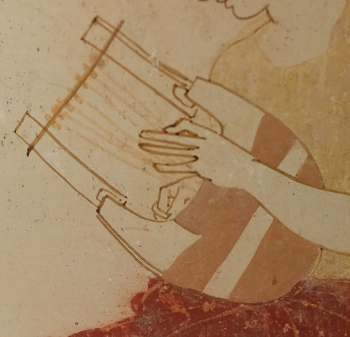
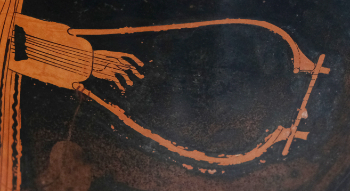
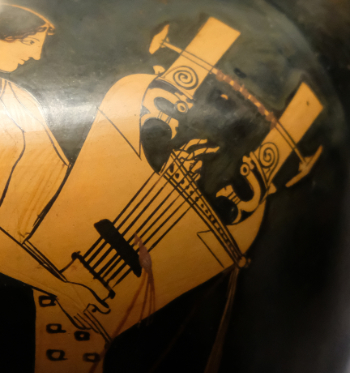
[0.6] This foundational myth of Western music theorizing is mere fiction, of course, since the values of the respective weights must be squared to produce the desired musical intervals.(3) Yet that mismatch between story and reality points to an important fact: ancient Greek musical practice had little use for calculating differences of string length. Stringed instruments such as the phorminx (Example 2), chelys (Example 3), barbiton (Example 4) and kithara (Example 5) were fretless and largely used equal-length strings, relying on differences in tension for tuning.(4) Indeed, as David Creese has emphasized in his book on the monochord (2010), explicit references to string lengths are surprisingly difficult to find in early Greek music theory. The earliest extant one, the Euclidean Sectio canonis, postdates the first discussions of intervals qua ratios by at least a century and a half, and it is not until the period of the Roman Empire that references to the monochord begin to proliferate (Creese 2010, 104, 210–11).(5) As a result, there is good reason to believe that the foundations of Pythagoreanism did not rest on the conceptualization of intervals via string lengths. Rather, numerical ratios were held to be ontologically prior, and those ratios could be found in all kinds of places, even in the smithy and its hammers.
Example 2. The Phorminx (Munich, Staatliche Antikensammlungen; photograph by the author)
(click to enlarge) | Example 3. The Chelys (Munich, Staatliche Antikensammlungen; photograph by the author)
(click to enlarge) |
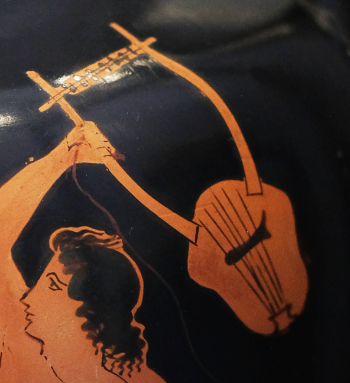
Example 4. The Barbiton (Munich, Staatliche Antikensammlungen; photograph by the author)
(click to enlarge) | Example 5. The Kithara (Munich, Staatliche Antikensammlungen; photograph by the author)
(click to enlarge) |
1. A Practical Monochord?
[1.1] Guido of Arezzo begins his Micrologus with a series of three exhortations: “Let him who seeks our training learn some chants copied in our notation, let him train his hand in the use of the monochord, and let him frequently ponder these rules” (1978, 59). This eminent pedagogue evidently felt that the monochord served an important role in the effective inculcation of music theory. But this raises a crucial question: why did Guido think this was a useful thing for his readers to do? Or, to put it in more general terms, what practical purposes could monochords realistically have served in the music theory education of Guido’s day? There are two main possibilities: (1) to demonstrate the congruence of integer ratios and either only key intervals (e.g., the octave, fifth, and fourth) or all those constituting a complete scale system, and (2) to function as a reference for picking out notes of a melody.(6)
[1.2] The first possibility, demonstration of the interval-ratio relationship, stretches back to antiquity, and activities of this sort may well predate the monochord.(7) When using a monochord to demonstrate this congruence, one need not reproduce every conceivable interval: the more musically important the interval, and the more easily demonstrable the ratios of string segments, the better. Consider this early monochord division by Panaetius the Younger (late second century BCE or later):
When a string has been stretched and the bridge is placed under the halfway point, the whole is concordant with the half at the octave: when it is placed at a quarter of the string the whole is in concord with the three parts at the fourth, and with the quarter at the double octave: when it is placed at the third of the string the whole is in concord with the two parts at the fifth, and with the third at the octave and a fifth: and the tone is in epogdoic ratio [9:8], because the whole makes its special interval in relation to the eight parts. (Barker 1989, 238)
By placing the bridge in just three positions, the five most important concords of Pythagorean theory may all be demonstrated, and a fourth placement (at the string’s ninth part, which Panaetius leaves implicit) generates the 9:8 whole tone. In short, the procedure described is eminently practical: it would be easy to carry out, and doing so would be capable of accomplishing the goal of demonstrating the congruence of audible intervals with visually apparent ratios of string lengths. But would Guido have judged this activity to be worth students “training their hands in the use of the monochord”? A simple one-time display by an instructor would be enough to communicate this relationship clearly; one can hardly imagine Guido exhorting students to practice their monochord technique merely for the purpose of reproducing this simple demonstration themselves.
[1.3] Dividing the monochord to generate complete scales, rather than just the most important intervals, diminishes its demonstrative power. Even were one to take great pains to minimize imperfections in the monochord’s string, bridge shape and placement, and so forth (and there is no evidence that any premodern theorist other than Ptolemy did so), the lengthy procedure necessary for dividing a string into a complete scale means that it is difficult to be confident that the entire process has been carried out with exact precision. Perhaps, then, complete scale divisions would have been useful to compare the differences between different tuning systems or scale types, especially during periods when more than one was in play? Yet during antiquity, especially absent Ptolemy’s strictures, it is difficult to imagine that the small difference between the enharmonic genus’s quarter-tone and the “soft” (malakon) chromatic’s third-tone (not to mention between different shades of the chromatic genus(8)) would have been accurately represented, given imperfections in the crafting of strings, bridges, and measuring compasses. During the early medieval period, the Daseian scale of Musica enchiriadis fame (a system periodic at the perfect fifth) was contending as an alternative to the eventually triumphant diatonic-based gamut; but during that period, when clear comparisons between the two scale systems would have been helpful, theory treatises advocating for the Daseian system rarely included corresponding monochord divisions.(9) Nonetheless, even when only one scale system was in common use, the monochord could still have been employed to play the notes of that system. For instance, this application of the monochord may have been what Guido had in mind when he wrote, “Since it is at the monochord that we best contemplate the notes which are the first foundations of this art, let us see first of all how art, imitating nature, has distributed them thereon” (1955, 91).(10)
[1.4] As for how to divide the monochord to create a complete scale, there existed a spectrum of approaches: some prioritized ease of construction, others ease of comprehensibility, and yet others sought a balance between the two. At one end of the spectrum, that of ease of construction, sits the Micrologus. Not only did Guido exhort his readers to use the instrument, he also saw fit to improve upon previous methods for generating a scalar system through monochord division. He proposes one method, which he touts as being “particularly useful too, since it is both easily learned and, once learned, rarely forgotten” (1978, 60), and then a second, which generates the scale more quickly than preceding methods. To provide a sense of how practical this latter division is, here are the steps Guido prescribes for it:
[1] You make nine steps, that is [equal] segments, from Γ [one end of the string] to the other end. The first step will end at A . . . [2] Likewise, when you divide [the length] from A to the other end into nine parts, the first step will end at B . . . [3] When you divide [the length] from Γ to the other end into quarters, the first step will end on C . . . [4] Of the four similar steps from C to the other end of the string, the first will end on F . . . [5] Of the quarter-length steps from F, the first will end on b-flat, the second on f. (Guido 1978, 60–61)
These five steps alone generate all but two of the notes of Guido’s gamut, and it is easy to obtain the last two (superacute b and d) an octave above already generated notes, that is, “as halfway points of notes similar in sound and the same in letter,” as Guido puts in his first method of monochord division (1978, 60).(11)
[1.5] At the other end of the spectrum, ease of comprehensibility, is the monochord division proposed in Scolica enchiriadis. This division is extremely inefficient, as it requires a separate division operation for every note in its gamut. But this inefficiency has the virtue of providing great clarity: each note of the gamut emerges distinctly, with its proportional relationship to the previous note evident. For instance, the note a whole tone above the whole string’s pitch is generated by removing a ninth part of AZ (the entire string’s span) to form BZ; then a ninth part of BZ is removed to form CZ, a whole tone above BZ. The same procedure is repeated within the system’s other perfect fourths (Scolica enchiriadis 1995, 88). If actual manipulations of a monochord were of any concern to the author, the notes of the upper octave could be found much more easily by taking half the length of BZ, CZ, and so forth. Instead, it appears that the author’s intent is not to propose a set of physical operations that readers would actually execute, but rather to describe the diatonic system in a way the reader will find easy to grasp: each perfect fourth is filled with two whole tones of the ratio 9:8, with a semitone left over.
[1.6] Once a monochord has been divided into a scale, the second candidate for the monochord’s use—learning melodies by using the instrument—presents itself as a possibility. This practice was first described explicitly at the outset of the Odonian Dialogus de musica (ca. 1000 CE), wherein the anonymous author writes:
Student: What is music [theory] (musica)?
Teacher: The knowledge of singing correctly, and the easy path to perfection in singing.
Student: How so?
Teacher: Just as a teacher first shows you all the letters on a tablet, likewise the music theorist (musicus) introduces all the notes of a song on a monochord.([Odo] 1784, 252)(12)
Guido appears to have been thinking of this procedure when he exhorted his readers “to train their hands in the use of the monochord,” and in his later Epistola de ignoto cantu, written after he had invented his famous solmization system, he referred back to this method as “the older and more common procedure,” in which “you sound on the monochord the letters belonging to each neume, and by listening you will be able to learn [an unknown] melody as if from hearing it sung by a teacher” (1998, 216). His invention of solmization, however, led him to reevaluate that monochord-based method of learning:
But this procedure is childish, good indeed for beginners, but very bad for pupils who have made some progress. . . . We do not need to have constant recourse to the voice of a singer or to the sound of some instrument to become acquainted with an unknown melody, so that as if blind we should seem never to go forward without a leader; we need to implant deeply in memory the different qualities of the individual sounds [better: notes] (sonorum) and of all their descents and ascents. You will then have an altogether easy and thoroughly tested method of finding an unknown melody, provided there is someone present to teach the pupil, not merely from a written textbook, but rather by our practice of informal discussion. (Guido 1998, 216–17)
No longer does one learn the notes more easily at the monochord, as in the Micrologus; indeed, now the most effective way for the aspiring musician to learn is viva voce, with no need for “the sound of some instrument.” In the eyes of Guido, one of the most influential pedagogues in the history of music, his new system of solmization far surpassed the practical value of the monochord, and the subsequent widespread adoption of solmization pedagogy indicates broad agreement with that view.
2.“A Mathematical Monochord . . . with Sense Perception Abandoned”
[2.1] In book IV, chapter 5 of his De institutione musica, Boethius finally turns to a topic he had promised his readers several times: the division of the monochord. He begins that procedure by following in the steps of the Sectio canonis, dividing a string into halves, thirds, and so on to generate much of the perfect unmodulating system in the diatonic genus. But Boethius has greater ambitions, as he dedicates the next six chapters to the task of specifying every note in all three genera. Generating the notes of the enharmonic genus via string divisions, however, is a problem, since (to take a representative example), Boethius holds that the ratio between nētē diezeugmenōn and enharmonic tritē hyperbolaiōn is 3,072:2,994, a relationship whose measurement on a monochord would tax the abilities of even a virtuoso on the compasses. It is safe to assume that this is the reason why Boethius abandons the physically reproducible procedure of generating notes via successive divisions of a string into aliquot parts and instead begins to treat the monochord in a way that defies physical reality. Even here, in the midst of Boethius’s partitio monochordi—where the instrumentality of the monochord would seem to be most celebrated—an actual monochord soon becomes more of a hindrance than a help. Instead, what we need is an abstracted version of one—what we, following the sixteenth-century theorist Lodovico Fogliano, might call a mathematical monochord.(13)
Example 6. Boethius’s complete monochord division “in numbers and their ratios”; from a ninth-century copy of De inst. mus. (Paris, Bibliothèque nationale, lat. 13,020, f. 48r)
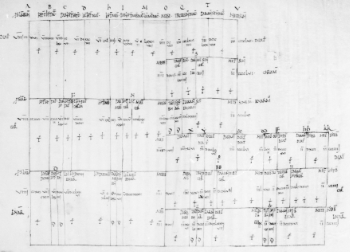
(click to enlarge)
[2.2] Boethius announces these two different approaches to the monochord—division of a string and numerical—right from the start of chapter 5. There he provides a short preface to his monochord division, explaining that “whether the division about to be described is considered [1] in the measurement of a string or [2] in numbers and their ratios, the longer length of string and the greater plurality of numbers will yield lower sounds” (Boethius 1989, 126). The first option, a division considered “in the measurement of a string” (specifically, its aliquot parts), perfectly describes chapter 5’s simple division into solely the diatonic genus. For instance, proslambanomenos is AB, the entire string, while mesē is half of it, DB. The second option, a division considered “in numbers and their ratios,” corresponds to the following six chapters’ monochord division into all three genera: here, proslambanomenos is 9,216, and mesē is 4,608 (Example 6).(14) But what is the real meaning of that 9,216?(15) Does it refer to a string that is 9,216 (unspecified) units long? Surely not to any sounding string on an actual instrument: even if the unit were the size of a millimeter (and it is hard to imagine a meaningfully smaller unit being practical for visual inspection, even disregarding the question of how a millimeter-sized unit could have been accurately measured out 9,000-odd times in Boethius’s day), the resulting length would be over thirty feet!(16) It is more plausible, then, to read Boethius’s 9,216 as having slipped the surly bonds of instrumentality in favor of the superlunary realm of the mathematical example.
[2.3] Indeed, Boethius’s use of language in his monochord division situates this section of his treatise firmly within the Greco-Roman tradition of mathematical inquiry. He begins his account of the three genera by positing: “Therefore let there be a first and largest number, which occupies the place of the proslambanomenos, [namely,] 9,216, and let there be a measure of the whole string, [namely,] from that which is A [i.e. proslambanomenos] up to that which is LL [i.e. nētē hyperbolaiōn]” (1867, 318–19).(17) Notably, the string is not being “extended,” as Bower renders the sentence’s second half (Boethius 1989, 131). Rather, Boethius’s Latin (sitque totius chordae modus) is an example of what Reviel Netz calls a construction formula. “Let there be” (sit—a jussive subjunctive form that renders the Greek ἔστω) anchors a frequently occurring formula in Antique mathematical texts: “ἔστω {any unlettered object formula} {a lettered equivalent},” which Netz translates as “let there be {some object}
[2.4] When we look at other examples of mathematical reasoning in Boethius’s De institutione musica, it becomes clearer what proslambanomenos’s 9,216 enumerates: it counts units. This may seem a trivial observation, but examination of book IV, chapter 2 reveals otherwise. In this chapter Boethius transmits a series of propositions about intervals and ratios that ultimately derives from the Sectio canonis. But whereas the latter work demonstrates the propositions using solely lines (which the treatise both describes textually and depicts diagrammatically), Boethius (or his source) adds an extra demonstration “in numbers” to each: that is, he employs the same pairing of reasoning via the “measurement of a string” and “numbers and their ratios” that he recapitulates in his monochord division. Things get interesting in the third proposition, which states that no superparticular ratio can have a third number (or any number of numbers) inserted between its terms that is in the same ratio to each of them; the musical payoff of this claim is that the whole tone, an interval corresponding to the superparticular ratio 9:8, cannot be divided equally.(18) (These propositions rely on the Greco-Roman division of quantity into two fundamentally different types. The first—known as multitude or discrete quantity—approximates our sense of integer, as it counts multiples of a given unit and cannot be irrational. The second—magnitude or continuous quantity—corresponds to a space or distance that can be divided however one likes, and it can consequently be used to express irrational relationships such as the relation of a diagonal of a square to its base.) In Boethius’s added numerical demonstration, he uses the ratio 3:2 as an example, and reasons that
I subtract 2 from 3; the remainder is unity, and it measures both terms. Thus there will be no number between 2 and 3 which is larger than 2 but smaller than 3, unless unity is divided—which is inconsistent. (Boethius 1989, 118)
If one grants that the unit cannot be divided—and no alternative was envisioned in the Greco-Roman tradition (Klein 1968, 53–54)—then the argument is incontrovertible. Yet the same argument becomes more problematic when transposed to the realm of strings, as it is in Boethius’s first demonstration of the proposition and the original form found in the Sectio canonis. Any line segment can be divided into two parts, so, as Creese has elucidated, proposition 3’s assertion that line segment D is a unit (and is thus indivisible), “shows that the text of the proposition denies the reader a geometrical interpretation of the diagram” (2010, 34). In other words, proposition 3’s argument only works when the diagram’s line segments are understood not as strings, but as segments of the number line: “The kanonion [monochord ruler] was not a geometrical line, but an arithmetical one; all its proportions were to be found in numbers” (49). This also illuminates Boethius’s numerical account of the three genera. Although it is presented as a “division of the monochord,” the putative string (see again Example 6) is an arithmetical line, subject to addition and subtraction, not to division with compasses.
[2.5] Stepping back, what was the purpose of Boethius’s monochord division in “numbers and their ratios,” and what role did the diagram play in that purpose? Despite the fact that Boethius builds up his readers’ expectations for the forthcoming monochord division in prior chapters, when he finally turns to the subject, he is remarkably coy about why he does so. Giving consideration to the culminating monochord division of the Sectio canonis, however, may again shed some light. After an introduction and eighteen propositions concerning intervals and ratios, the author at last comes to the eponymous division. Proposition 19 reads: “To mark out the kanōn according to the so-called immutable systēma,” and immediately thereafter the author launches into defining the monochord rule (and string) and dividing it (Barker 1989, 205). This proposition takes the format of the Euclidean Quod Erat Faciendum (QEF): it is not the more familiar Quod Erat Demonstrandum (QED), that is, something that must be demonstrated (such as, “If two circles cut one another then they will not have the same center” [Euclid, Elements, III.5]); rather, it is something that must be constructed (like “To draw a straight line touching a given circle from a given point” [III.17]).(19) Seen in this light, the argumentative goal of the monochord division is precisely the result of the procedure described by the diagram and text in consort. Note, though, that whereas a geometrical construction (QEF) is usually a mere preliminary, serving as a step in a larger demonstrative project (Creese 2010, 60–61), neither the author of the Sectio canonis nor Boethius put their constructions to any further use.
[2.6] But is there some further use to which these monochord divisions could be put? As we have seen, Boethius’s division in “numbers and their ratios” resists any real-world manifestation, but his division via aliquot parts of a string (and likewise the Sectio canonis’s division) could be realized. Creese claims that “although the process of argumentation in the Sectio canonis is apodeictic [i.e., demonstrative], it is aimed at the construction of a diagram which outlives its apodeictic context (unlike those of Euclid)” (2010, 68). And for what reason does the diagram outlive its context? Because of its potential identity with the monochord ruler:
The canonic division [that concludes the Sectio canonis] . . . is also a map of musical space in which all the pitches from proslambanomenos to nētē hyperbolaiōn are listed in order: a visible order of bridge positions which corresponds to an audible order of pitches. And because musical space is set out proportionally, the diagram is itself a kanonion, which can be fixed under the string of a monochord and used to locate all the notes inscribed on it. It is an instrumental diagram, just as the monochord is a diagrammatic instrument. (67)(20)
This interpretation is eloquent, but it disregards the physical reality of diagrams in favor of their idealization. I take issue not with the difficulty of placing a diagram-containing manuscript below a monochord string (a valid, though superficial critique), but with his claim that “musical space is set out proportionally.” True, the accompanying text provides directions for how to do so, but the creators of the diagrams in most extant copies do not follow those directions.
Example 7. Boethius’s complete monochord division in the “measurement of a string”; from a ninth-century copy of De inst. mus. (Paris, Bibliothèque nationale, lat. 7201, f. 29r)

(click to enlarge)
Example 8. Boethius’s complete monochord division in the “measurement of a string”; from a ninth-century copy of De inst. mus. (Paris, Bibliothèque nationale, lat. 13,020, f. 43r)

(click to enlarge)
[2.7] When it comes to string-based diagrams, proportional space is disregarded even in the simplest of cases, for as André Barbera notes of the Sectio canonis’s early propositions, “the line drawings in the manuscripts generally contain lines of equal length, although they assign appropriate values to these lines, e.g., 8, 4, 2” (1991, 261).(21) Verily, even a cursory consultation of medieval copies of Boethius reveals that the diagrams representing his string-based monochord division do not spatially reproduce the indicated semitone and whole-tone ratios, and furthermore that they are often left incomplete (see Examples 7 and 8 for relatively complete ninth-century copies of the diagram that concludes Boethius’s string-based division in book IV, chapter 5—note that they merely indicate the relative orientations of the letters, not the precise points to which they should correspond). And this should come as little surprise: unless a scribe were making a copy for his or her own use and were attempting to follow every step of the author’s argument, the demands of the copying enterprise would preclude carefully dividing the line many times over with a compass.(22) A close-enough approximation evidently sufficed for monochord diagrams.
[2.8] Before moving on, a few words about Sybille Krämer’s concept of “flattening” are in order. Krämer describes flattening as a cultural technique wherein a part of the three-dimensional world that bears inscription is treated as a plane, without depth (2017, 240). Pertinently for us, she applies this concept in her discussion of the diagrams—including monochord diagrams—found in René Descartes’s Compendium musicae (written in 1618). Positing an epistemic connection with the coordinate geometry system Descartes developed much later in his life, Krämer contends that “the diagrams developed in the Compendium transform audible music into a visual constellation of lines” (2017, 241). Her line-based agenda leads to a distorted reading of the Compendium: Krämer presents Descartes’s treatment of consonance and dissonance as depending on “the distinction between commensurable (“arithmetic”) and incommensurable (“geometric”) line proportions” (242, emphasis added), whereas Descartes’s claim is that commensurable proportions (that is, ratios) are necessary to avoid fatiguing the senses,(23) and he merely presents visual comparison of line segments as examples of this general principle (Descartes 1908, 91–2; 1961, 12).(24)
Example 9. Krämer’s Figures 1 and 2 (2017, 242)
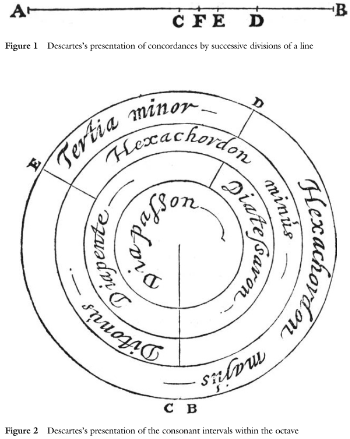
(click to enlarge)
[2.9] Nonetheless, Krämer does call attention to an important feature of Descartes’s treatment of the monochord. To demonstrate how all the consonances are contained by the octave, Descartes details how to divide a string (nervus) and then segments thereof into equal parts (aequalia)(25) to generate the intervals of the octave, fifth, major third, and major whole tone (1908, 101–2; 1961, 20–21) (see the top of Example 9, which reproduces Krämer’s Figures 1 and 2). Descartes’s application of division procedures to a string clearly implies that this diagram represents (is a “flattening” of) a monochord, and that its various segments could be plucked to generate the desired intervals. Yet shortly thereafter Descartes describes what may well be an unprecedented procedure: “Take CB, or one-half of line AB (which encompasses the octave) and bend it into a circle so that point B coincides with point C” (1961, 21).(26) Descartes then divides this circle twice, just as he had the nervus, to effect the perfect fifth, major third, and major sixth, along with their octave complements (see the bottom of Example 9). This diagram is indeed worth celebrating for its innovative use of visual space to make an argument about intervals’ octave complementarity. Oddly, though, neither Krämer nor Descartes makes explicit that this act of circling dissolves the linkage between diagram and sounding body. Once line/string segment CB has been untautened and formed into a circle there is no way to make the string taut, and no longer can any sound be produced. First flattened, then silenced: like Boethius’s 9,216-unit string, it is a monochord able to sound only in the reader’s imagination.
3. Numbers in the Sky
[3.1] As we have seen, one of the few practical uses of the monochord is to demonstrate the congruity of proportions of string lengths with simple intervals, such as the 9:8 ratio with the whole tone. Consequently, Marchetto of Padua might seem on solid ground when he invokes that instrument to support his summarization of the whole tone’s numerical properties, which he claims "to substantiate with the aid of sounding bodies such as the monochord, and others” (1985, 133). Similarly, the anonymous text known as Alia musica states that “all things will be made clearer by means of a compass on a monochord” (Alia musica 1965, 113),(27) a promise that could lead us to expect a traditional account of the concords and their ratio-based correlates. But let us continue opening our eyes to the possibility that physical instruments of music theory may be irrelevant even when monochords are being invoked.
[3.2] Marchetto’s aim in the second book of his Lucidarium is to craft a novel theory of semitones. Instead of the traditional two—the 256:243 limma and the 2,187:2,048 apotome—Marchetto holds that there are four, and he treats the larger ones as straightforward multiples of the smallest (1985, 139–41). Yet he is also evidently aware of the result of the Sectio canonis’s proof (perhaps via Boethius’s translation) that the whole tone cannot be equally divided into an integer-based ratio,(28) which spells trouble for his agenda. Now Marchetto’s simplest solution would have been simply to treat the whole tone as a continuous quantity (that is, a magnitude) and then to divide it geometrically into equal parts of irrational size, iconoclastic though that would be. As Jan Herlinger has noted, “the theorists of Marchetto’s time conceived intervals as proportional divisions of a string, and [Marchetto’s] notion that the whole tone was a divisible [continuous] quantity(29) not only lay outside their conceptual system but violated a fundamental principle of the numerological foundation on which it was built” (1981, 214). Setting aside the first claim—that theorists saw intervals in terms of strings—let’s move on to the second—that Marchetto viewed the whole tone as a continuous quantity, thereby violating arithmetical principles. Although Marchetto certainly does invoke the notion of a divisible continuum, it is striking that he does not divide it into five parts, nor is he even clear that the continuum refers to the whole tone.(30) Indeed, rather than rejecting speculative integer-based thinking in favor of geometric methods, I contend that Marchetto instead dives even deeper into Pythagorean numerology. He abandons fealty to the traditional correlation of intervals with numerical ratios, and instead argues that each of the semitones, and the tone too, is characterized by a number.(31)
[3.3] The linchpin in Marchetto’s argumentative process is the association of the whole tone with the number 9, a point he returns to many times with statements such as “the substance and the nature of that [whole] tone and its total, or formal cause consist in the number 9” (1985, 125).(32) We will return to the issue of how he makes that association, but after he has established it to his satisfaction, he maps his five-part division of the whole tone onto the number 9: “1 is its first part, from 1 to 3 the second, from 3 to 5 the third, from 5 to 7 the fourth, and from 7 to 9 the fifth; and this fifth part is the fifth odd number of the whole 9” (135).
[3.4] I propose that this curious passage is Marchetto’s attempt to avoid running afoul of the impossibility of dividing the whole tone into equal parts. First, the whole tone’s first part, 1, seems to be half the size of its other four parts, resulting in a division of the tone into unequal parts.(33) (The curious formulations of “from 1 to 3,” “from 3 to 5,” and so forth are presumably introduced to emphasize that 1, the unit, is smaller than the other parts.) In fact, Marchetto introduces the quoted passage in precisely these terms: “Now the number 9 can never be divided into equal segments, . . . Therefore the only alternative remaining is that its segments must be unequal, so that 1 is its first part, from 1 to 3 the second . . .” (1985, 133–35). Second, the passage also seems constructed to evade the charge of having divided the whole tone into nine equal parts. I agree with Herlinger that “in the present passage Marchetto deals with numerological considerations, not quantitative measurements” (135), but I think we can be more specific about that numerology. Marchetto rejects the possibility of conceiving the whole tone as a continuum (either between 9 and 8, the terms of the sesquioctave proportion, or between two notes a whole tone apart), which would allow for its geometrical division into irrationally sized equal parts. Each constituent interval is instead equated with an integer, thereby using numerology to attempt to skirt the issue of the whole tone’s divisibility. That is, just as Marchetto claims that the whole tone consists in the number 9, here the smallest part of the semitone, the fifth-tone, consists in the unit. The remaining three semitones are then assigned to the intervening odd numbers: 3, 5, and 7. In sum, Marchetto’s approach in this passage certainly breaks with music-theoretical expectations that number is undergirded by string length, but it does accord with the broader Pythagorean philosophical underpinnings of medieval theory, in which everything is undergirded by number.
[3.5] Despite the problems of equating an interval with an integer, Marchetto is no fool. He is well aware of the traditional correlation between the whole tone and the ratio 9:8; indeed, he apparently dedicates his chapter on “the numbers in which the whole tone is to be constituted” to the task of proving why that is so, building to the entirely conventional conclusion that “the nature and essence of the whole tone consist in the number 9 compared to the number 8” (1985, 131). Although this may seem to invalidate my numerological reading of Marchetto’s text in favor of a traditional “interval = ratio = string lengths” perspective, two complicating factors about Marchetto’s argumentation are worth noting. First, it is incompatible with operations on the monochord, and second, its larger sweep treats the tone’s 9:8 nature as a dead end.
[3.6] Marchetto begins his chapter on the whole tone’s numerical constitution in a fashion that quickly veers from boring to baffling:
It must be known that, according to all writers on music, the whole tone—or its nature—is said to consist in the proportion of the number 9 to the number 8. Why this should be so has not yet been found demonstrated [sic] by those writers. We intend to prove it. (Marchetto 1985, 111–13)
If the monochord is good for anything, surely it is for demonstrating that the whole tone consists in the 9:8 ratio! Yet Marchetto asserts that this correlation has yet to be proven, thereby foreshadowing that he is quite uninterested in using the monochord to support his argument. Instead, his line of reasoning (to put it generously) begins by invoking the view of “all philosophers and doctors in these matters” that “number has as its cause the division of a continuum” (113). The conclusion of his argument’s first stage, namely, that “the perfection of the division of a continuum and its parts lies in the number 9” (123), relies on the primacy of a threefold division of the continuum (a division which in turn is divided by 3 to create the desired 9). Crucially, Marchetto’s justification for the primacy of the number 3 is incompatible with monochord-based operations:
Now if we wish to embrace every division, [the manner] in which the continuum can be divided with the ultimate division—so that it is not reduced—is its division into three parts. For were we to divide it first into four, that would be to divide it into two times two; if into five, into three plus two; if into six, into two times three; and so forth. Thus, such divisions would not be prime, but would be reducible to other divisions. (Marchetto 1985, 115)
This argument is not transferable to operations on a monochord, since it makes little sense to state that a division of a monochord into five parts can be discounted (that is, it is “not prime”) because it is reducible to a division into two parts and then three parts. Although Marchetto later attempts to extrapolate from the conclusions of his argument that the number 9 is primary in order to associate that number with the whole tone by means of an appeal to sounding bodies like the monochord,(34) his argumentation is fundamentally based on ad hoc manipulation of integers via addition and multiplication, not on string lengths.
[3.7] In the next stage of his argument, Marchetto performs analogous operations based on duple division of the continuum to generate the number 8, and thus both terms of the ratio 9:8. “Therefore,” he concludes,
the whole tone that contains [those doubled proportions that consist in the number 8] must exceed them by some amount; but it can exceed them by no more than 1, for the reason already given—that it consists in the number 9. And thus the second and third points are proven: that the nature and essence of the whole tone consist in the number 9 compared to the number 8. (Marchetto 1985, 131)
Marchetto thereby claims to have fulfilled his promise to prove the reason “why” the whole tone consists in the 9:8 ratio. But note that even when he is purportedly demonstrating the whole tone’s 9:8 nature, he rearticulates that “it consists in the number 9.” That is because this latter point is the conclusion he actually needs in service of his larger argument for his new semitones. The sesquioctave ratio has no relevance for what follows, and Marchetto immediately drops it in favor of his numerological agenda of associating the whole tone with the number 9. Thus, even a music-theoretical account that appeals to the monochord and advances an argument that the whole tone is sesquioctave should not be taken at face value: for Marchetto of Padua, what really matters when it comes to the whole tone’s nature is not lengths of string, but the number 9 itself, freed from any material reference or constraint.
[3.8] As another example, let us look at a second work that also represents intervals using single integers: the early-medieval Alia musica. This textually complex treatise, which is a composite of several authors’ works, is best known for its pioneering attempt to reconcile the seven species of the octave and the Greek “ethnic” names for the tonoi with the medieval eight-mode system. It is also distinguished by its idiosyncratic use of numbers to describe the modes. Here is a representative passage discussing the first mode:
Every first mode, he said, which we call Dorian will have either 6 three times in a 2:1 ratio, that is, the octave, such as Rorate Celi desuper; or 5 four times, which is 20, that is, 2 from 8 and 3 from 12 making a perfect fifth in a 3:2 ratio, as is Et nubes pluant iustum, aperiatur; or 7 three times, which is 21, that is, 3 from 9 to 4 from 12, which make a perfect fourth in a 4:3 ratio, as is terra et germinet salvatorem. (Alia musica 1965, 85)(35)
Whereas Marchetto assigns the number 9 to the whole tone, the Alia musica represents the perfect fifth with the number 5 and the fourth with the number 7. Matthew Nace implies that considerations of string lengths may be responsible for this association of integer with interval, observing that “in a musical context, there is a way in which these numbers can, in some sense, represent their intervals, in that these numbers reflect the procedures for demonstrating the intervals abstractly on the monochord” (2020, 341). In fact, slightly before the quoted passage the treatise makes explicit the connection between these numbers and the monochord—which the author refers to as the harmonica regula (harmonic rule[r]): “On the monochord the perfect fourth is measured by 7 (i.e., by 3 and 4), and the perfect by 5 (i.e., by 2 and 3)” (Alia musica 1965, 113).(36)
[3.9] Yet caution is warranted before taking this as an indication of the monochord’s practical import in the eyes of the Alia musica’s authors. For one, any attempt to carry out the division of a length into, for instance, seven equal parts using a compass requires an impractical amount of precision or a potentially numbing amount of trial and error.(37) And for another, this passage invokes the monochord to support a claim that the monochord does not afford. Even if one were to divide a monochord into five or seven equal parts successfully, the most one can demonstrate vis-à-vis the intervals of the perfect fourth and fifth is that they can be produced by string segments with lengths of the ratios 4:3 and 3:2 respectively, as Boethius does in his De institutione musica, book IV, chapter 18. The Alia musica, by contrast, asserts that the perfect fourth and fifth are measured by the numbers 7 and 5. The sum of the numbers 3 and 4 equals 7, but the sum of a string of length 3 and a string of length 4 would generate a pitch a natural seventh (7:4) below one and an octave-plus-septimal-minor-third (7:3) below the other, neither of which have any relation to the perfect fourth. Consequently, no sounding phenomena correspond to the numbers claimed to characterize these intervals, thereby rendering the monochord useless in defense of the claim.(38)
[3.10] The Alia musica does explicitly mention the monochord, and its authors are certainly aware that proportional segments of a monochord’s string generate the concords.(39) Nonetheless, when integers appear in the treatise, corresponding string lengths are not the point. Let’s consider again the quoted text’s muddled approach to numbers (“2 from 8 and 3 from 12” and the like). The authors of the Alia musica have a tendency throughout to describe modally significant intervals not as ratios in simplest terms, such as 3:2 for the fifth, or even in greater terms, such as 36:24, but as multiples of the numbers 6, 8, 9, and 12.(40) (This is done most systematically in the tables that come towards the treatise’s end.) For instance, the fourth tone is described as being constituted of: “12 (twice), 6 (thrice), 8 (thrice), 9 (twice). The perfect fourth [is made] by thrice 6 to thrice 8 and by twice 9 to twice 12, which are 42” (Alia musica 1965, 178).(41) Charles Atkinson implies that these numbers are chosen because they form “a Pythagorean tetraktys” (2009, 180), and they are also the numbers that Boethius attributes to the hammers in his account of the Pythagoras story (1989,
Conclusion: Strings and Epistemic Things
[4.1] Even though the monochord had limited practicality in antique and medieval music theory, it now looms large in how we imagine the music-theoretical past.(43) This may be because reading old texts through the lens of the monochord makes them appear more palatable to modern tastes. As mentioned in the introduction, to view ratios of integers as representing string segments on a monochord allows us to read them as being reciprocally equivalent to frequencies, and thus more scientifically respectable. By way of conclusion, I would like to focus on another use of the monochord to link music theory to rigorous scientific inquiry: one that interprets the monochord as an “epistemic thing.”(44) This Foucault-inspired term was coined by Hans-Jörg Rheinberger (1997) in his study of the epistemology of twentieth-century laboratory science.(45) Epistemic things, which Rheinberger also calls “research objects” and “scientific objects,” are
material entities or processes—physical structures, chemical reactions, biological functions—that constitute the objects of inquiry. As epistemic objects, they present themselves in a characteristic, irreducible vagueness. This vagueness is inevitable because, paradoxically, epistemic things embody what one does not yet know. (Rheinberger 1997, 28)
Uljana Feest, a scholar who worked with Rheinberger, later clarified that this vagueness (or “blurriness,” as she prefers to gloss it) best refers to the fit between the term used for the epistemic thing and the thing itself: “The whole point of the notion of an epistemic thing-term is that the issue of what exactly it refers to has not yet been settled” (2011, 400; emphasis original).(46) A concrete example offered by Rheinberger may help to clarify his concept. In the 1970s, an enzymatic method of DNA sequencing was an epistemic thing par excellence, a goal of intense scientific striving; in the years following its description by Sanger, Nicklen, and Coulson, the procedure was “adopted by the leading DNA laboratories around the world” and “was transformed into a technical object,” a process of transformation that attends to the objects of many scientific breakthroughs (Rheinberger 1997, 29–30, 35).
[4.2] How could this model, which was developed for the biological sciences, be applied to music theorizing? Let us evaluate Rehding’s examples of Vicentino’s archicembalo and Cowell’s rhythmicon. In both cases, a theorist develops a hypothesis that structuring music according to some theoretical principle (a 31-fold division of the octave or precise polyrhythms generating pitches) would result in a desirable way of making music that was impossible at the time. The theorist then collaborates with a technical expert to create a new kind of instrument that is capable of realizing that hypothesized music. In both cases the object of the intellectual striving—the “epistemic thing”—was at first the creation of the new kind of instrument, and then that instrument was converted to a tool used to realize the ultimate object of striving: the ability to make music in a new way. In the first stage, when the epistemic thing was the new (as yet uncreated, nonexistent) instrument, its characteristic “vagueness” or “blurriness” initially pertained to the unknown form that instrument might take; in the second stage, when the new (as yet uncreated, nonexistent) music become the epistemic thing, its vagueness pertained to the unknown sound which that imagined music might make. Rheinberger’s theory accounts well for the potential of the archicembalo and rhythmicon to be both epistemic things and also tools used for finding other epistemic things, as he observes that “whether an object functions as an epistemic or a technical entity depends on the place or ‘node’ it occupies in the experimental context” (1997, 30). It should be emphasized, though, that these instruments were epistemic things in Rheinberger’s sense only before they were constructed: the act of their creation transformed them from epistemic to technical things, their blurriness dissipating as their keyboards were pressed into practice.
[4.3] Yet examining the archicembalo and rhythmicon as epistemic things clarifies that the monochord is not the same kind of entity. Given that it merely comprises a string extended above a ruler, it is hard to picture the invention of the monochord as the object of much intellectual striving, so if the monochord itself ever functioned as an epistemic thing, it would only have been in a trivial sense. Nor do we have reason to believe that the monochord functioned as a technical object in the search for other epistemic things. By the time the monochord entered the music-theoretical record, the knowledge of mathematical ratios and musical intervals that the instrument seems to embody was already long established. Perhaps the best case for the monochord playing a role in a discovery occurred some 1800 years later, when Ramis de Pareia proposed a novel monochord division that created a just-intoned scale. Even here, though, Ramis did not herald this as an intellectual discovery: he simply explained that his monochord division was easier to construct and understand than its predecessors, and neglected to mention that it resulted in non-Pythagorean intervals (1993, 46–48). Indeed, inasmuch as there was an actual object of intonation-based intellectual striving at the time, it would have been a suitable justification for rejecting Pythagorean intonation (since singers were surely already using just intonation in performance). Ramis’s practical division of the monochord did not come close; rather, that goal was achieved via mathematical argumentation by the same Fogliano who spoke of “a mathematical monochord . . . with sense perception abandoned.”(47)
[4.4] The monochord is a different kind of thing, “a magical thing by which mathematics falls into the realm of the senses” (Kittler 2003, 198).(48) In fact, it is so magical that it does not even require the realm of sense to fulfill its purpose. As Rehding says, “For Pythagoreans, the monochord was simply a device whose existence was enough to underline the universal validity of the mathematical ratios that they believed to underlie all worldly phenomena, from the smallest to the largest scale” (2016a, [3.6], emphasis added). That is, the monochord’s instrumentality—the physical usefulness to which an “instruments of music theory” perspective directs our attention—was far less important than the congruence between number and string-generated sound that it symbolized. But even then, Marchetto and the Alia musica remind us that we cannot always assume that numbers are, in fact, congruent with string lengths.(49) Despite the monochord’s potent symbolism, readers of premodern theory texts must resist the temptation to assign every integer they encounter its own imaginary length of string.
[4.5] The monochord’s siren song continues to call. It lures us into imagining the monochord as an instrument of music-theoretical discovery, inclining our ears to hunt out its soft twang above the orderly hum of an idealized modern laboratory.(50) But in the Pythagorean myth the monochord is no tool of discovery: Pythagoras’s initial epiphany occurs amid the din of the smithy, and it is only later that he turns to the monochord, where it is just one instrument among many.(51) Indeed, if anything functions as an epistemic thing in the myth, it is the original hammers themselves, “embodying what one does not yet know.” The actual, historical means by which the pairing of ratio with interval was discovered—the founding instrument of Western music theory—was so immaterial to following generations that they lost track of it in the smithy, its function of discovery eventually imputed to objects that were entirely incapable of manifesting the epiphany that birthed Western music theorizing.
Caleb Mutch
Max Planck Institute for Empirical Aesthetics
caleb.mutch@ae.mpg.de
Works Cited
Adkins, Cecil Dale. 1963. “The Theory and Practice of the Monochord.” PhD diss., State University of Iowa.
Alia musica. 1965. Edited by Jacques Chailley as Alia musica (Traité de musique du IXe siècle): Edition critique commentée avec une introduction sur l'origine de la nomenclature modale pseudo-grecque au Moyen-Age. Centre de documentation universitaire et Société d'édition d'enseignement supérieur réunis.
Atkinson, Charles M. 2009. The Critical Nexus: Tone-System, Mode, and Notation in Early Medieval Music. Oxford University Press. https://doi.org/10.1093/acprof:oso/9780195148886.001.0001.
Barbera, André. 1991. The Euclidean Division of the Canon: Greek and Latin Sources. University of Nebraska Press.
Barker, Andrew. 1989. Greek Musical Writings. Vol. 2. Cambridge University Press. https://doi.org/10.1017/CBO9780511585753.
Blackburn, Bonnie, and Edward Lowinsky, eds. 1991. A Correspondence of Renaissance Musicians. Clarendon Press.
Boethius, Anicius Manlius Severinus. 1867. De institutione musica libri quinque. In Anicii Manlii Torquati Severini Boetii De Institutione Arithmetica . . ., ed. Godofredus Friedlein, 175–371. B. G. Teubner. Trans. as Boethius 1989. https://doi.org/10.3792/chmm/1424377202.
—————. 1989. Fundamentals of Music. Translated by Calvin Bower. Yale University Press.
Burkert, Walter. 1972. Lore and Science in Ancient Pythagoreanism. Translated by Edwin L. Minar, Jr. Harvard University Press.
Corry, Leo. 2013. “Geometry and Arithmetic in the Medieval Traditions of Euclid’s Elements: A View from Book II.” Archive for History of Exact Sciences 67 (6): 637–705. https://doi.org/10.1007/s00407-013-0121-5.
Creese, David E. 2010. The Monochord in Ancient Greek Harmonic Science. Cambridge University Press.
Crocker, Richard L. 1963. “Pythagorean Mathematics and Music.” The Journal of Aesthetics and Art Criticism 22 (2): 189–98 and (3): 325–35.
Descartes, René. 1908. Compendium musicae. In Oeuvres de Descartes, vol. 10, edited by Charles Adam and Paul Tannery, 89–141. L. Cerf.
—————. 1961. Compendium of Music. Translated by Walter Robert. American Institute of Musicology.
Dodds, Michael R. 2024. From Modes to Keys in Early Modern Music Theory. Oxford University Press. https://doi.org/10.1093/oso/9780199338153.001.0001.
Feest, Uljana. 2011. “Remembering (Short-Term) Memory: Oscillations of an Epistemic Thing.” Erkenntnis 75: 391–411. https://doi.org/10.1007/s10670-011-9341-8.
Folianus, Ludovicus. 1529. Ludovici Foliani Mutinensis de musica theorica. Io. Antonius et Fratres de Sabio.
Gaffurius, Franchinus. 1492. Theorica musice Franchini Gafuri Laudensis. Ioannes Petrus de Lomatio.
Gaudentius. 1998. Harmonic Introduction. Translated by Oliver Strunk. In Source Readings in Music History, rev. ed., vol. 1, ed. Oliver Strunk, Leo Treitler, and Thomas J. Mathiesen, 66–85. W. W. Norton.
Guido of Arezzo. 1955. Guidonis Aretini Micrologus. Edited by Joseph Smits van Waesberghe. American Institute of Musicology.
—————. 1978. Micrologus. Translated by Warren Babb. In Hucbald, Guido, and John on Music: Three Medieval Treatises, ed. Claude V. Palisca, 57–83. Yale University Press.
—————. 1998. “Epistle Concerning an Unknown Chant.” Translated by Oliver Strunk, rev. James McKinnon. In Source Readings in Music History, rev. ed., vol. 2, ed. Oliver Strunk, Leo Treitler, and James McKinnon, 104–8. W. W. Norton.
Herlinger, Jan W. 1981. “Marchetto’s Division of the Whole Tone.” Journal of the American Musicological Society 34 (2): 193–216. https://doi.org/10.2307/831346.
Holford-Strevens, Leofranc. 1993. “The Harmonious Pulse.” Classical Quarterly 43 (2): 475–79. https://doi.org/10.1017/S0009838800040015.
Kittler, Friedrich. 2003. “Zahl und Ziffer.” In Bild, Schrift, Zahl, ed. Sybille Krämer and Horst Bredekamp, 193–204. Wilhelm Fink.
—————. 2006. Musik und Mathematik I: Hellas, Teil 1: Aphrodite. Wilhelm Fink.
Klein, Jacob. 1968. Greek Mathematical Thought and the Origin of Algebra. Translated by Eva Braun. The MIT Press.
Krämer, Sybille. 2017. “Flattening as Cultural Technique: Epistemic and Aesthetic Functions of Inscribed Surfaces.” Journal of the American Musicological Society 70 (1): 239–45.
Marchetto of Padua. 1985. The Lucidarium of Marchetto of Padua: A Critical Edition, Translation, and Commentary. Edited and translated by Jan W. Herlinger. University of Chicago Press.
Mellon, Elizabeth A. 2011. “Inscribing Sound: Medieval Remakings of Boethius’s De institutione musica.” PhD diss., University of Pennsylvania.
Meyer, Christian. 1996. Mensura Monochordi: la division du monocorde (IXe–XVe siècles). Klincksieck.
Nace, Matthew R. J. 2020. “The Alia musica and the Carolingian Conception of Mode.” PhD diss., University of Western Ontario.
Netz, Reviel. 1999. The Shaping of Deduction in Greek Mathematics: A Study in Cognitive History. Cambridge University Press. https://doi.org/10.1017/CBO9780511543296.
[Odo]. 1784. Dialogus de musica. In Scriptores ecclesiastici de musica sacra potissimum, vol. 1, ed. Martin Gerbert, 251–64. Typis San-Blasianis.
—————. 1998. Dialogus de musica. Partial translation by Oliver Strunk. Revised by James McKinnon. In Source Readings in Music History, rev. ed., vol. 2, ed. Oliver Strunk, Leo Treitler, and James McKinnon, 88–100. W. W. Norton.
Palisca, Claude V. 1985. Humanism in Italian Renaissance Musical Thought. Yale University Press.
Petrus de Abano. 2022. Expositio problematum Aristotelis (XIX). Edited by Christian Meyer as Pietro d’Abano, Expositio problematum (XIX): Édition, introduction et notes critiques et explicatives. Leuven University Press. https://doi.org/10.2307/j.ctv1ccbg33.
Rahn, Jay. 1998. “Practical Aspects of Marchetto's Tuning.” Music Theory Online 4 (6). https://doi.org/10.30535/mto.4.6.1.
Ramis de Pareia, Bartolomeo. 1993. Musica practica. Translated by Clement A. Miller. American Institute of Musicology, Hänssler-Verlag.
Rehding, Alexander. 2016a. “Instruments of Music Theory.” Music Theory Online 22 (4). https://doi.org/10.30535/mto.22.4.4.
—————. 2016b. “Three Music-Theory Lessons.” Journal of the Royal Musical Association 141 (2): 251–82. https://doi.org/10.1080/02690403.2016.1216025.
Rheinberger, Hans-Jörg. 1997. Toward a History of Epistemic Things. Stanford University Press.
Schmid, Hans, ed. 1981. Musica et scolica enchiriadis, una cum aliquibus tractatulis adiunctis. Bayerischen Akademie der Wissenschaften.
Scolica enchiriadis. 1995. Translated by Raymond Erickson. In Musica enchiriadis and Scolica enchiriadis, ed. Claude V. Palisca, 33–94. Yale University Press.
Stapulensis, Jacobus Faber. 1551. “Politicorum libri octo commentarium.” In Contenta: Politicorum libri octo commentarii, economicorum . . . ff. 2r–122v. Henricus Stephanus.
Footnotes
* I wish to thank David E. Cohen, Andrew Hicks, Carmel Raz, and Alexander Rehding for their generous and productive suggestions.
Return to text
1. “Pythagoras ipse uariis perquirens examinationibus an in his proportionibus omnium consisteret symphoniarum ratio aequis neruis aptauit pondera iisdem numeris & proportionibus sumpta.” Where translations are my own, I have provided the original language.
Return to text
2. Concerning this woodcut panel, Rehding says: “If we did not know that Pythagoras’s emblem was the monochord, it would be hard to recognize the musical instrument . . . The six-string instrument, which Pythagoras plays with two sticks, resembles more a zither-type instrument, such as a psaltery or a hammered dulcimer, than the traditional ancient instrument. Is this really still a monochord?” (2016a, 1.2). It is not. Although, as Rehding notes, the term monochordo was also used to refer to a multi-string instrument (ibid., n3, citing Blackburn and Lowinsky 1991), that instrument had keys (see Blackburn and Lowinsky 1991, letters 15, 30, 46, 57, and 60), so would not be confused with the instrument depicted in Example 1. Gaffurius’s illustration clearly depicts Pythagoras’s weighting of equal-length strings upon first returning home, not his later turn to the monochord, where differences of string length are the deciding factor, rather than string tension.
Return to text
3. For instance, a pairing of 4 kg and 1 kg weights on equal strings would produce an octave (2:1 in string lengths), while 9 kg and 4 kg weights would produce a perfect fifth (3:2).
Return to text
4. David Creese surveys the paltry string-to-ratio affordances of the lyre and harp families of instruments, concluding that “string division is suggested by no instrument available to the Greeks until the arrival of the lute in the late fourth century BC” (2010, 101–2).
Return to text
5. Notably, the first nine propositions of the Sectio canonis refer to “intervals” or “gaps” (diastēmata), not ratios (logoi), leaving ambiguous whether they are addressing relationships between string lengths or pure numbers (see Barker 1989, 194).
Return to text
6. Christian Meyer also points out that certain monochord divisions (namely, those that construct the equivalent of our C-major scale) likely had their origin and continued relevance in the field of instrument construction, since they could be used to calculate the requisite lengths of (equal-diameter) pipes for a pipe organ or requisite weights of metal for bells (1996, xi, lvi–lvii). Yet there is no evidence that considerations of instrument construction figured into Guido’s concept of instruction in the art of musica.
Return to text
7. Demonstrating this interval-ratio relationship in the years before it was widely known could have made quite an impression upon audiences, and there are indications that some early sophists conducted public displays of this sort (Creese 2010, 140–46).
Return to text
8. Concerning the different shades of the chromatic genus, see Aristoxenus’s Elementa harmonica (Barker 1989, 164).
Return to text
9. It is striking that Scolica enchiriadis, one of the most prominent texts to propound the Daseian scale, provides a monochord division that generates the diatonic gamut. Yet Daseian-producing divisions are not unknown: at least two distinct methods of generating the Daseian scale are extant, and at least six textually distinct forms of doing so (Schmid 1981, 233–41; see also Adkins 1963, 139–42).
Return to text
10. “Sed quia voces quae huius artis prima sunt fundamenta, in monochordo melius intuemur, quomodo eas ibidem ars naturam imitata discrevit, primitus videamus.”
Return to text
11. According to Smits van Waesberghe’s critical edition, the best manuscripts of the Micrologus end the monochord division with step five (dividing from F into four parts), thereby omitting superacute b and d (Guido 1955, 100–101). In the remaining manuscripts there are three major textual variants, each of which successfully accounts for those two notes in its own way. In his discussion of this passage, Adkins actually translates from a text corresponding to Smits van Waesberghe’s second family of variants, not the version of the text found in Gerbert’s edition, which Adkins (incorrectly) cites as his source (1963, 163).
Return to text
12. “D. Quid est Musica? M. Veraciter canendi scientia, et facilis ad canendi perfectionem via. D. Quomodo? M. Sicut magister omnes tibi litteras primum ostendit in tabula: ita et musicus omnes cantilenae voces in monochordo insinuat.” My translation. While “omnes cantilenae voces” could indicate “all the sounds of melody” taken in a general sense—as Strunk interprets it ([Odo] 1998, 200–201)—the magister’s response three paragraphs later (“Litterae vel notae . . .”) clarifies that it actually refers to learning the notes of particular songs, such as antiphons and the like.
Return to text
13. “In bare and pure numbers let us establish in a certain manner a mathematical monochord, with reason alone as our guide and sense perception abandoned” (in nudis purisque numeris ratione tantum dirigente: sensu derelicto: mathematicum quodammodo monochordum constituamus) (Folianus 1529, sig. XXXIIIr).
Return to text
14. It should be noted that tables listing the values of every note in a musical system are far less prominent and well worked out in historical texts than one might assume: modern scholars have the tendency to supply such tables even when they are not in extant versions of the text (as in Strunk’s translation of Gaudentius’s Harmonic Introduction [Gaudentius 1998, 76–78]), or to correct errors in surviving tables silently (as in Meyer’s edition of Pietro d’Abano’s Expositio problematum Aristotelis [Petrus 2022, 62–63]).
Return to text
15. Boethius is far from the only theorist to put forward an arithmetic-based account of musical space, as Adkins describes an entire class of “system of string length” monochord divisions (1963, 63–67). Nor is Boethius even the first to match integers to all the notes of the Greater Perfect System using the number 9,216 for proslambanomenos; that strategy seems to originate in Aristides Quintilianus’s De musica (Barker 1989, 497), for which reason Adkins calls this division “the Aristidean numbers” (1963, 65). Furthermore, Thrasyllus notes that one can use the number 10,368 to find all the notes of the diatonic and chromatic genera in the “immutable” system, which combines the Greek Greater and Lesser Perfect Systems, though he does not provide the remaining numbers of the system (Barker 1989, 229).
Return to text
16. Creese speculates that “despite the prevalence of very large division numbers in later harmonic texts, it is likely that monochords were marked with fewer units, and that the bridge positions for intervals like the leimma were approximated (2010, 49). Yet if such approximations were to be carried out, they were left to the ingenuity of the reader (with the usual exception of Ptolemy, who subdivided a 120-unit monochord ruler into Babylonian-style sexagesimal fractions [see Barker 1989, 344–45]).
Return to text
17. “Sit igitur primus quidem numerus maximusque, qui proslambanomeni obtineat locum, VIIII [macron supra lin.].CCXVI. sitque totius chordae modus ab eo, quod est .A., usque ad id, quod est .LL.“ My translation. Cf. trans. by Bower (Boethius 1989, 131).
Return to text
18. Proposition 16 in Sectio canonis makes this explicit, calling back to the reasoning of Proposition 3 in its defense.
Return to text
19. See Creese 2010, 60–68, for an expansive account of the different types of argumentation in Euclid and the Sectio canonis’s demonstrative agenda.
Return to text
20. Contra the real-world usefulness of these diagrams, Netz makes the incisive point that the style of Greek mathematics to which Antique monochord divisions belonged (a belonging marked both by their diagrams and by their use of formulaic mathematical language, as we saw with Boethius) in part served to mark it as a genre of literature for the cultural elite. Furthermore, that style also served to prevent mathematics from being seen as suitable for technical manuals that were characterized merely by their content and that might appeal to a less educated populace (1999, 305–6). Relatedly, he posits (with perhaps some understatement) that “we may assume that most practising musicians did not tune their lyres according to mathematical manuals” (301).
Return to text
21. Barbera also notes a profusion of mistakes and lacunae in extant diagrams of the monochord division laid out in propositions 19 and 20 (1991, 276).
Return to text
22. Elizabeth Mellon argues that we should be skeptical that the same scribe who copied the text also created the sort of complex diagrams encountered in many medieval copies of Boethius’s De institutione musica (2011, 176–77). In the case of these simple line diagrams, however, less skepticism seems in order.
Return to text
23. It should be emphasized that when Descartes introduces the distinction between commensurable and incommensurable proportions, he does not have consonance and dissonance in mind. In fact, the mathematical distinction between those interval qualities is unrelated to that between commensurable and incommensurable line segments, or indeed quantities of any kind.
Return to text
24. The fact that Descartes follows his enunciation of this preliminary principle with a chapter dedicated to the proportionate nature of music’s temporal aspect—and does so without using any line segments at all—goes unmentioned by Krämer. Descartes’ line-free treatment of music’s temporal aspect belies her peroration that “the straight lines, circles, and charts in Descartes’s music theory form a referential system: all musical relations must be input as a necessary step to becoming objects of knowledge” (2017, 244).
Return to text
25. Krämer incorrectly states that Descartes “demonstrates his principles graphically by successively dividing a line segment into two unequal parts—yielding octave, fifth, and then a major third” (2017, 243).
Return to text
26. Circular diagrams had already featured in music-theoretical texts for many generations, as Michael R. Dodds has shown with impressive thoroughness (2024, 247–345). Descartes’s innovation (inter alia) was to identify the circle with a monochord string.
Return to text
27. “omnia in harmonica regula fiunt circino notiora.”
Return to text
28. The course of Marchetto’s argumentation repeatedly avoids dividing the whole tone into equal parts. Furthermore, Marchetto paraphrases the Sectio canonis’s proof for the indivisibility of superparticular ratios, but he replaces “superparticular ratio” with “the number nine”: “Now the number nine [recte: the whole tone, qua a superparticular ratio] can never be divided into equal segments, for there is a unit in it that resists being divided and, consequently, being subdivided” (1985, 133). I agree with Herlinger that the proximate source for this quotation is Macrobius’s late-antique discussion of the whole tone (Marchetto 1985, 133, citing Macrobius, Commentarii in Somnium Scipionis, 2.1.22). Herlinger, though, takes Marchetto’s statement at face value as a descriptor of the qualities of the number nine. By comparing Marchetto’s text with Macrobius’s commentary on the Somnium Scipionis, which it closely resembles, Herlinger emends Marchetto’s text to read “into [two] equal segments,” and later “its [two] segments must be unequal” (133–35). Given that Marchetto’s aim is to demonstrate the division of the whole tone into five segments, these interventions, especially the latter (which immediately precedes the division into five segments), are far from compelling. Interpreting the passage as a slightly garbled form of the Sectio canonis’s argument better accounts for the text as it stands, and for its reliance on the indivisibility of the unit.
Return to text
29. Herlinger here refers to the already mentioned contrast between viewing a musical interval as a ratio of two discrete quantities (i.e., integers) (wherein superparticular intervals such as the whole tone cannot be divided into any number of equal ratios) vs. viewing it as a continuous, quasi-geometrical quantity (wherein division of any quantity into smaller equal-sized quantities is always possible).
Return to text
30. Marchetto never suggests that the two boundaries of the continuum are the notes bounding a whole tone or the terms of the sesquioctave proportion. Instead, Marchetto either leaves the continuum in the realm of abstraction (existing in the pure realm of numerical principle) (1985, 113–21), or seems to assign the continuum’s quality of divisibility to sounding bodies (123).
Return to text
31. This conception of a musical interval being characterized by a single integer appears occasionally in extant sources from Antiquity. The eminent Neopythagorean Iamblichus identified the 4:3 perfect fourth with the number seven (the sum of the ratio’s terms), and the Roman polymath Varro (as preserved by Aulus Gellius) reported that “doctors who make use of music theory” (medicos musicos) did likewise (Holford-Strevens 1993, 475). Conversely, Boethius reports that Philolaos associated the 256:243 semitone (diesis) with the number thirteen (the difference of the ratio’s terms) (Boethius 1989, 96). At least in the case of Philolaos, this association may have been inspired by the somewhat naive numerology of early Pythagorean pebble diagrams (Burkert 1972, 427–34), and to Philolaos’s related postulate that “all things that are known have number.” Herlinger has identified a likely source of the transmission of integer-interval thinking to Marchetto (or to Marchetto’s philosophical informant, a certain Brother Siffante): Macrobius’s widely read commentary on Cicero’s Somnium Scipionis, which includes the statement that the whole tone “consists in the number nine” (Herlinger 1981, 198, 201–2, citing Macrobius, Commentarii in Somnium Scipionis, 2.1.22).
Return to text
32. Herlinger translates “novenarius numerus” as “the number nine,” and likewise with related phrases. I have silently changed his written-out numbers to Arabic numerals (e.g. “the number 9”) to be consistent with my practice in this article.
Return to text
33. Jay Rahn’s valiant attempt to translate Marchetto’s theory of the tone and semitones into a conventionally Neopythagorean account of intervals as integer ratios founders on this quotation. He interprets Marchetto as holding that the five semitones divide the 81:72 (i.e. 9:8) whole tone into the ratios 81:79:77:76:74:72 (1998, [0.6]). In doing so, he weights one of Marchetto’s pronouncements about the properties of numbers (“an odd number is indivisible, containing a unit in its middle”) above Marchetto’s clear indication here that the first of the semitones is smaller than the others.
Return to text
34. “And because the perfection of the division of a continuum and its parts lies in the number nine, in sounding bodies (stringed instruments, for instance) one ninth part sounds different from the next ninth part: the latter goes higher because it contains less of the continuum” (Marchetto 1985, 123).
Return to text
35. “Omnis igitur primus tonus aut ter 6 habet in dupla proportione diapason, ut est Rorate celi desuper, aut quater 5, id est 2 de 8 et 3 de 12 in sesquialtera proportione qui faciunt diapente, quod est 20, ut est et nubes pluant justum, aperiatur; aut ter 7, id est 3 de 9 ad 4 de 12 in sesquitertia proportione, qui faciunt diatessaron, ut est terra et germinet Salvatorem.”
Return to text
36. “diatessaron per 7, id est per 3 et 4, diapente vero per 5, id est per 2 et 3, in harmonica regula mensuratur.” My translation. Chailley’s critical edition of the text, which is cited here, reorders the treatise’s contents to reflect his understanding of the stages of its composition.
Return to text
37. Unless one were learned enough to be aware of the procedure for equal division described in the sixth book of Euclid’s Elements (VI.9)—and only excerpts from the first five books were available in Latin before the twelfth century (Corry 2013, 663–64)—a daunting process is necessary. First, one must guess at an appropriate width-setting for the compass. Then one must swing the compass’s arms across the monochord’s length six times while trying not to change the width-setting accidentally (a task presumably made yet harder with a compass created with premodern technology). If the final swing ends off the mark, then one must repeat the entire procedure again, trying to adjust the compass’s width-setting by precisely one seventh the distance by which one was off. For instance, if one’s guess fell shy by a half inch, then the compass must be adjusted by one fourteenth of an inch; and if that adjustment is not made precisely, an even smaller adjustment would be required after the next test of the width-setting.
Return to text
38. Furthermore, whether a perfect fifth is formed by dividing the monochord string into five or the perfect fourth is formed by dividing it into seven, the musical correlate of the integer in question is the entire string length. To complete the reductio ad absurdum, this results in saying that the perfect fifth and fourth are both “measured by” the same thing, an outcome that the authors of the Alia musica would surely find unsatisfactory.
Return to text
39. Later layers of this composite work adapt Boethius’s letter-based notation for pitches, which was originally set forth in the context of a monochord division (Nace 2020, 316–10).
Return to text
40. For example, the quoted passage says that 5 (the perfect fifth) occurs four times, which is 20. That 20 then is reconceived as the sum of a subset of the 6, 8, 9, 12 series, namely 8 and 12. The author also points out that these two terms contain the numbers 2 and 3 (leaving unstated that each is contained four times—the same number as 5 was said to occur), numbers which correspond to the 3:2 ratio. Nace provides a more thorough accounting of the text’s basic approach, while acknowledging that the pattern he identifies is not consistently followed (2020, 361–63).
Return to text
41. “Quartus tonus est: a 12 (bis); c 6 (ter); b 8 (ter); d 9 (bis). Diatessaron per ter 6 ad ter 8 et per bis 9 ad bis 12 qui sunt 42.” To simplify the presentation, I have omitted the letters a, c, b, d, which Nace observes “may be redundant,” since each letter is consistently paired with the same number (2020, 328; see also 329–30).
Return to text
42. I thank David Cohen for bringing this connection to my attention.
Return to text
43. See, for instance, the aforementioned 2017 “Evening with the Monochord: Global Perspectives in Music, Math, and History” conference at Columbia University.
Return to text
44. The source of this attribution is complicated: Rehding states that Friedrich Kittler “refers to the monochord as an ‘epistemic thing’” (Rehding 2016b, 264), but in support he cites a passage where Kittler actually names the lyre (Leier) (Kittler 2003, 198–99). Three years later Kittler changed the referent, claiming instead that the epistemic thing was the kithara and “mathematizable musical instruments like the kithara” (2006, 250, 254). Yet the string-length manipulations Kittler describes when explaining his claim are incompatible with tension-based instruments like the lyre and kithara, so Rehding’s silent correction to “monochord” is a charitable intervention.
Return to text
45. In describing the goal of his project, Rheinberger explains: “I am aiming at what, in a Foucauldian sense, would be called the ‘archaeology’ of transfer RNA, that is, the analysis of those dispositions and depositions through which the culture of protein synthesis of the 1950s can be reread and reenacted” (1997, 7). Archaeology, he quotes Foucault saying, “‘is the systematic description of a discourse-object.’” Rheinberger continues: “This ‘discourse-object’ is what I call an epistemic thing” (8).
Return to text
46. Feest chooses “blurriness” over “vagueness” on the basis of Rheinberger’s later German version of the book, which employs the term Verschwommenheit in analogous places (2011, 398). Rehding adopts the term “blurriness” from Feest in his summary of Rheinberger (2016b, 264).
Return to text
47. Fogliano starts the second book of his treatise by appealing to the senses, asserting in effect that everyone without a faulty sense of hearing would agree that there are more consonances in heaven and earth than are dreamt of in Pythagoras’s philosophy (Folianus 1529, fol. xiv). Yet invoking the senses as the authority for discarding two millennia of Pythagorean tradition is evidently insufficient, as he proceeds to argue that the justly tuned major and minor thirds belong to the arithmetically respectable class of superparticular ratios, making them worthy consonances, and so forth (ibid.). For more on Fogliano’s theory, see Palisca 1985, 235–44.
Return to text
48. “ein Zauberding, an dem Mathematik ins Reich der Sinne fällt”
Return to text
49. Nor is this phenomenon limited to the medieval period: the association of the perfect fourth with seven and perfect fifth with five reappears in a commentary on Aristotle’s Politics written by one of the Renaissance’s more sophisticated thinkers, Jacobus Faber Stapulensis, where he even attributes it to Plato (Stapulensis 1551, f. 86v [recte 84v])! The context is Aristotle’s discussion (Politics V.12, 1316a) of a notoriously perplexing passage in Plato’s Republic (546b–c) in which Plato addresses the so-called “nuptial number” or “Plato’s number.” In that passage Plato mentions “a foundational epitritos [i.e. 4:3] yoked to the number five” (ἐπίτριτος πυθμὴν πεμπάδι συζυγεὶς), to which Jacobus comments: “Plato understands the foundational epitritos as seven, which when joined with five returns twelve” (“Epitriton pythmena intelligit Plato septenarium: qui quinario copulatus duodenarium restituit”).
Return to text
50. With apologies to Plato, Republic, 531a.
Return to text
51. “[Pythagoras] went on to extend his researches to various kinds of instrument, including beaten pots, auloi, syringes, monochords, trigōna and other like them” (Barker 1989, 258). Between the house-spanning lyre and the beaten pots, the presence of household items in Nicomachus’s version of the story emphasizes the ubiquity of the musical-mathematical properties being described. I thank Alexander Rehding for this incisive observation (personal communication).
Return to text
Copyright Statement
Copyright © 2025 by the Society for Music Theory. All rights reserved.
[1] Copyrights for individual items published in Music Theory Online (MTO) are held by their authors. Items appearing in MTO may be saved and stored in electronic or paper form, and may be shared among individuals for purposes of scholarly research or discussion, but may not be republished in any form, electronic or print, without prior, written permission from the author(s), and advance notification of the editors of MTO.
[2] Any redistributed form of items published in MTO must include the following information in a form appropriate to the medium in which the items are to appear:
This item appeared in Music Theory Online in Volume 31, Issue 4 in December 2025. It was authored by Caleb Mutch (caleb.mutch@ae.mpg.de), with whose written permission it is reprinted here.
[3] Libraries may archive issues of MTO in electronic or paper form for public access so long as each issue is stored in its entirety, and no access fee is charged. Exceptions to these requirements must be approved in writing by the editors of MTO, who will act in accordance with the decisions of the Society for Music Theory.
This document and all portions thereof are protected by U.S. and international copyright laws. Material contained herein may be copied and/or distributed for research purposes only.

Prepared by Lauren Irschick, Editorial Assistant
Number of visits:
4691