Analyzing Unruly Themes: William E. Caplin, Clemens Kühn, and Carl Dahlhaus*
Laurence Sinclair Willis
KEYWORDS: Formenlehre, History of Theory, themes, Classical music, William E. Caplin, Clemens Kühn
ABSTRACT: William E. Caplin’s Classical Form (1998) and Clemens Kühn’s Formenlehre der Musik (1987) provide an instructive comparison for understanding the differences between Anglophone and German-language Formenlehre in the twentieth century. By focusing on the ways that these two theorists—both seemingly in response to their teacher, Carl Dahlhaus, and his “Satz und Periode“ (1978c)—account for themes that are not obviously either periods or sentences, I illustrate how their theoretical apparatus reflects their geographical and academic contexts. Caplin’s theories of thematic hybrids and compound themes demonstrate a rigorous approach to these unruly themes, showing how they are logically constructed out of phrases normally associated with either the period or sentence theme types. Kühn’s earlier theory of thematic Mischungen (mixtures) seeks to accommodate a flexible analytical practice, using periodic balance and sentential energy as heuristics for the analysis of novel themes. By triangulating among Caplin, Kühn, and Dahlhaus, I unpack the differences and controversies between the concepts of thematic hybridity and Mischung. I argue that the two theories reflect and reveal stark contrasts between Caplin’s and Kühn’s temporal Formenlehre frameworks as well as their overall theoretical attitudes. The article concludes with a consideration of some Romantic themes using a mixture of Caplin’s and Kühn’s techniques.
DOI: 10.30535/mto.31.4.8
Copyright © 2025 Society for Music Theory
Introduction
[0.1] This essay compares two rather dissimilar twentieth-century treatises on musical Formenlehre. On the one hand, William E. Caplin’s Classical Form (1998) is a long and formal treatise filled with footnotes, clarifications, citations, and sharply phrased definitions of concepts, terms, and ideas. On the other, Clemens Kühn’s Formenlehre der Musik (1987) is a slight pocketbook that constantly seeks to accommodate a flexible analytical praxis and a less prescribed concept of Formenlehre. Both these theorists were one-time students of Carl Dahlhaus and, as I argue below, sometimes seem to respond directly to aspects of Dahlhaus’s scholarship.(1) Dahlhaus discussed the problematic distinction between sentence and period theme types, and both Caplin and Kühn develop theoretical models that account for themes that fall between this binary. Yet the two near-contemporary theorists’ different geographic and academic situations lead them toward totally opposing modes of argumentation. Caplin makes a strict and, in some ways, rather comprehensive attempt at theorizing musical form for a very narrow repertoire. Caplin relates his strict theorizing to a five-part temporal model, embracing immanent features of the music and syntactic logical construction. In the context of the Schenkerian-dominated field of the Society for Music Theory in the 1980s and 1990s, his Classical Form (1998) claims some of the rigor of the contemporaneous discipline for Formenlehre.(2) In contrast, Kühn’s popular pedagogical text for German-language Hochschulen purposefully broadens its comments so they apply to a wide variety of European musical styles, from tenth-century polyphony to Witold Lutosławski. His Formenlehre der Musik (1987) reflects the impulses of individualism and analytical freedom that were fashionable in German-speaking academia of the 1970s and 1980s. Felix Diergarten describes the differences between the English-speaking and German-speaking Formenlehre traditions, writing that
After the rise of Formenlehre in the nineteenth and early twentieth centuries, theorists in the second half of the twentieth century turned away from the ‘thematic’ and ‘functional’ theories of form for the reasons described (and others) [Diergarten chiefly refers here to the historical turn in music theory that he develops over the course of several previous pages]. This applies above all to the international academic discourse and English-language teaching practice. At German-speaking Hochschulen, a lively and differentiated tradition of Formenlehre has always been able to persist—albeit with notable regional differences.(3) (2012, 43)
This essay aims to describe how Dahlhaus’s two students responded differently to the same theoretical problem. Formenlehre since Arnold Schoenberg had emphasized that there were only two theme types (the sentence and the period), and yet there are clearly many other ways of organizing themes even within the narrow confines of the classical style, and certainly in later music of the Romantic period. In this article, I first make a comparison of the ways that Caplin and Kühn treat Classical themes in the examples they propose for their categorization of problematic themes. I then consider how a complementary practice using both may help furnish the analysis of Romantic themes. The advantage of this approach is, first, to sharpen the distinction between the kinds of observations that each theory encourages, and, second, to suggest where the complementary use of their theories produces what I argue to be the most useful analytical contributions.
[0.2] Caplin’s sustained work on function theory in the 1980s and 1990s represents something of a revival of the genre in the North American sphere following the years dominated by Schenkerianism. Dahlhaus describes the suspicion that existed in the twentieth century toward the kind of systematic theorizing found in Caplin’s treatise, writing that
Distrust of the theory of musical forms grows out of a skepticism both concerning “systematic thinking” and about a Platonizing kind of “conceptual realism” that is thought to lie behind any belief in the reality of the general.(4) (1977b, 20)
In English-language theorizing, long associated with a high regard for and pursuit of systemization, the relatively differentiated nature of the theorizing in German-speaking Formenlehre often goes unremarked upon. Thus, observing the contrast in academic cultures the two theorists worked in serves as a necessary pre-condition for comparing an aspect of their theories that is common to both: the attempt to account for classical themes that do not fit neatly into the binary opposition between the sentence and period theme types. In assembling this account, I demonstrate both the concords and the disagreements between these two theorists’ response to Dahlhaus’s theoretical and historical understanding of theme. Beyond their different geographic locations, I argue, Caplin and Kühn also differ in the kind of temporal thinking they invite: Caplin is ultimately a theorist who is concerned with describing musical organization in three parts, whereas Kühn produces a fundamentally two-part temporal model.
[0.3] Before continuing to the body of this article, I should first comment on what of value I find in Kühn that warrants exploring his analytical work. Aside from the historical interest of the activities of German-language Formenlehre—which represents a distinct and distinctive form of the Schoenbergian tradition that in recent decades has stood outside of the North American revival—I will baldly state my partisan bias toward the theoretic-analytical flexibility afforded by theorists like Kühn. That is not to say that Kühn’s analyses are all exemplary or incontestable. I find, however, that his treatise allows more space than most North American equivalents, such as that of Caplin, for exotic and novel interpretive stances. And this is precisely because Kühn’s work is less systematically worked out. A dissenting voice might ask, is this flexibility truly positive? Could it not be argued that the flexibility of Kühn’s approach rather evidences a kind of incoherence? Again, I admit to a bias toward flexibility as a natural positive for essentially aesthetic reasons. Which is to say, I prefer aesthetic flexibility in analysis partly because it allows us to maintain many more complementary or even contradictory readings of a passage.(5) For all of the benefits of a systematized theoretical procedure like that found in Classical Form (such as pedagogical replicability and the sharpening of style-appropriate expectations), one can sometimes feel that one’s own analysis, developed with care and attention to the particulars of a composition at hand, might be discarded for reasons that are mostly technical and not aesthetic in nature. (This dissatisfaction is, of course, a general one that may be raised against all systematized theories of music.) I hope to demonstrate the value of Kühn’s approach in the final part of this article, where I attempt to combine it with that of Caplin. It is my hope that readers will see how this act opens space for long-excluded but highly insightful commentaries on mid- to late-Romantic music of the Classical tradition.
1. Unruly Themes
[1.1] In his review of Caplin’s Classical Form, Joel Galand (1999, 160) identifies one of Caplin’s “most original” achievements as the establishment of “a typology of intrathematic functions.” Galand describes Caplin’s work in the context of analytical problems posed in Carl Dahlhaus’s essay “Satz und Periode” (1978c), which historically and critically appraises the dual thematic concepts of sentence (Satz) and period (Periode).(6) Caplin studied with Dahlhaus for two years at the Technische Universität Berlin from 1976 to 1978. Throughout his essay, Dahlhaus proposes and critiques various conditions for the analysis of sentences and periods according to historical precedents set by A. B. Marx, Hugo Leichtentritt, and Erwin Stein, among others. Dahlhaus studiously avoids mentioning Schoenberg in his essay. The precise historical antecedents of the concept of the sentence theme type lie beyond the scope of the present essay; however, it is worth stating that, while Dahlhaus emphasizes those theorists mentioned above, the history is substantially more complicated than the picture he paints. For example, Andreas Jacob identifies A. B. Marx as influential on Schoenberg’s general concept of the organic construction of music,(7) yet A. B. Marx’s practices concerning form are quite different from Schoenberg’s. Jacob also cites Johann Christoph Lobe as influential on the way that Schoenberg’s theories are generally rooted in composition.(8) In general, Schoenberg was the most prominent theorist treating the sentence theme type, but the work of Lobe or Marx can hardly account for the subsequent achievement of theorizing of the sentence.
[1.2] It is in parts three and four of “Satz und Periode” that Dahlhaus begins to note how some themes seem to confound the distinctions between sentence and period. He first describes the sentence and period working as ideal types consisting of complexes of features or cues. For example, Dahlhaus describes a period as
a complex of features, all of which can be modified and some of which can even be omitted, but between which there are interactions, so that irregularity on the one hand must be balanced by all the more obvious regularity on the other hand if the period should not disintegrate.(9) (1978b, 21)
Dahlhaus next gives examples of themes that seem to problematize the contrast between the theme types. Elsewhere, Dahlhaus had recently described how the schemata of Formenlehre have become heuristics for approaching individual works:
From one perspective, the philosophical presuppositions and implications of Formenlehre are affected by the collapse of essentialism, the belief in the reality of the general: Schemata, such as that of sonata form, are no longer understood as the epitome of the essential properties of all movements falling under the category of form, but as mere aids for the conceptual approach to the work, like bridges that are broken as soon as the transition to the description of the individuality of the work has been successful.(10) (1977b, 21)
From this it is clear that Dahlhaus saw the binary opposition between sentence and period as working as a heuristic to approach the individuality of a particular theme. This individuality is properly expressed as all the ways that a theme fails to conform strictly to either sentence or period. Caplin devises his theory of thematic hybrids in an altogether different manner; his strategy is to add more categories to address the individuality of musical themes that contradict either the sentence or period theme types.(11)
[1.3] Galand goes on to describe the problem posed by the theme of the Finale of Beethoven’s Sonata in C minor, op. 13, which prompted Dahlhaus to ask whether the motivic scheme of the theme is similar enough to a period to constitute an example of that theme type.(12) Galand (1999, 161) sees Caplin’s theorizing as a refinement that directly addresses these kinds of problems, writing that, “In light of the refinements Caplin introduces in his syntactic theory
[1.4] Clemens Kühn similarly produces a Formenlehre that theorizes aspects of the forerunning scholar’s concerns about challenging themes. Kühn, who studied with Dahlhaus in pursuit of his doctorate in 1977, derives a concept seemingly like Caplin’s thematic hybridity: thematic Mischungen (mixtures). In his 1987 treatise Formenlehre der Musik, Kühn describes musical themes in a way recognizable from a traditional perspective before moving on to describe his concept of Mischung:
The theme types sentence and period are not only shaped by contrasting formal ideas. Important are the frequent cases in which they combine or the superimpose each other. Periodic balance, permeated by motivic energy – sentential urgency, tamed by harmonic strength: In Classical music, that is the rule, not the exception.(14) (1987, 62)
Like Caplin, Kühn theorizes how sentential and periodic features can produce themes combining both ideal types. As we shall see, Caplin and Kühn develop ideas quite distinct from the lines of thought apparent in Dahlhaus’s essay (and presumably teaching), resulting in theoretical concepts that emphasize different aspects of musical organization and structure. Both theorists produce concepts that account for deviations both within eight-measure themes and in conceptually larger themes (Caplin through compound themes, Kühn through the various categories of Mischung). The differences not only evince distinctive approaches to themes that problematize original categories of sentence and period, but also indicate deeper dissimilarities between the two theorists.
2. Caplin’s Hybrid Theme Types and Five-Part Temporality
[2.1] Caplin’s thematic hybrids ultimately derive from the core concept of a five-part temporality. In Caplin’s framework, every musical phrase expresses a formal function which derives, at least in part, from a specific temporal positioning. In the glossary of Classical Form, formal function is defined as “the specific role played by a particular musical passage in the formal organization of a work. It generally expresses temporal sense of beginning, middle, end, before-the-beginning, or after-the-end. More specifically, it can express a wide variety of formal characteristics” (Caplin 1998, 254–55).(15) Every phrase (“Minimally, a four-measure unit”) within a theme carries a temporal function (Caplin 1998, 256). A presentation phrase, for instance, expresses a beginning with its establishment of tonic prolongation and motivic repetition, but also conveys contextual function when appearing at the literal beginning of a theme or phrase. A more complex example of phrase-level temporal function can be found in the continuation phrase, which fuses medial and ending temporal functions within four measures, bringing both the medial function of continuation and the ending function of cadence.
[2.2] This fusion is a feature of Caplin’s theorizing that is easy to overlook. Caplin explicitly derives his concept of formal function from Erwin Ratz, writing in his essay “Funktionale Komponenten im achttaktigen Satz” (1986), that “Erwin Ratz’s ‘functional Formenlehre’ offers the most solid and most enlightening basis for the formal analysis of baroque, classical, and romantic music repertoires.”(16) In the same essay, Caplin makes reference to Dahlhaus’s “Satz und Periode” essay as establishing the concept of the sentence theme type, writing “As Dahlhaus recently showed, the concept ‘sentence’ as a formal category from the eighteenth century to the present has been used in very many ways”(17) (Caplin 1986, 140). In the wider context of this essay, Caplin views Dahlhaus’s work as laying the historical foundation for a further discussion of theme types. Caplin also refers to those theorists that Dahlhaus names, Erwin Stein, Josef Rufer, and Anton Webern, and is clearly aware of various distinctions between sentence and period theme types.(18)
[2.3] Both the presentation and continuation phrases mentioned above are paradigmatically associated with the sentence theme type. (In Classical Form, Caplin devotes two chapters to the theme types sentence and period.) These types are defined in terms of their most common features. A sentence is described as “an eight-measure theme built out of two four-measure phrases” expressing three formal functions: “presentation, continuation, and cadential” (1998, 35). Caplin argues in a footnote to the definition that the theme type was first accurately described by Schoenberg, and, of key importance to my central argument, that Dahlhaus’s “Satz und Periode” continues the tradition established by Schoenberg and his students.(19)
[2.4] A period is “divided into two, four-measure phrases fulfilling antecedent and consequent functions, respectively” (Caplin 1998, 49). These functions are carried by phrases of the same name, antecedent and consequent. As the names imply, the antecedent phrase conveys initiating function, while the consequent phrase conveys ending function. These names for the phrases ultimately derive from the translation of the German phrase names Vordersatz and Nachsatz found in German language writings by Schoenberg, Ratz, Dahlhaus, and earlier historical theorists. In German usage, Vordersatz can apply to the first phrase of a sentence as well as the first phrase of a period, while Nachsatz can similarly refer to any second phrase. In this essay, I will retain the German words in the context of discussions about Dahlhaus’s and Kühn’s theorizing but use antecedent and consequent when referring to Caplin’s periodic phrases. In the development of his theorizing of sentence and period theme types, he presents four phrase types, each distinctively expressing a particular temporal and formal function directly associated with either sentence or period. (Presentation and continuation phrases are associated with the sentence, while antecedent and consequent phrases are associated with the period.)
[2.5] Caplin begins his theorizing of hybrid themes with the claim that the temporal logic of sentential and periodic phrases is ultimately separable from the theme types themselves. The potential for phrases to separate into their units at least partially derives from Caplin’s understanding of formal function, with each phrase carrying a formal function of its own. Regarding independent phrase units, Caplin writes that “Intrathematic functions in general need not be confined to the standard theme-types with which they are conventionally associated (i.e., period, sentence)” (1998, 59). At the the same time that his phrases convey a temporal function through their content, Caplin further explains that “Not all combinations of phrases make up a syntactical arrangement of functions, however: a consequent followed by a presentation, for example, would be functionally illogical” (1998, 59–61). The central role these conditions play in the formation of his hybrid themes confirms, first, that his five-part temporal model (before-the-beginning, beginning, middle, end, after-the-end) acts as the determining factor in the formation of themes and, furthermore, that sentence and period are simply common examples of this syntactic logic. For example, we can see that his so-called hybrid type 1, in which an antecedent phrase is followed by a continuation, producing the correct temporal logic (antecedent = beginning, continuation + cadence = middle and end) that a theme requires. The same can be said of Caplin’s hybrid type 2, in which an antecedent phrase is followed by a phrase comprising an expanded cadential progression.
[2.6] The third and fourth hybrid formulations include a new phrase type unassociated with either sentence or period: the compound basic idea. Caplin’s practical explanation of the compound basic idea is that it includes all the features normally associated with an antecedent except the weak cadence at the end of the four measures. This prompts Caplin to wonder what function should be associated with this phrase. Caplin views this phrase as a kind of higher-level basic idea and observes that some features of a compound basic idea resemble an antecedent (the motivic organization), while others resemble a presentation (the harmonization). In Caplin’s terms, “[t]hus the four-measure phrase itself represents a hybrid of antecedent and presentation functions” (1998, 61). (These formal functions are, of course, both associated with the temporal function of beginning.) Hybrid Type 3 is defined as a compound basic idea + continuation, while Hybrid Type 4 is a compound basic idea + consequent. In allowing for the features of periodic and sentential features to mix in the compound basic idea phrase type, Caplin seems to be responding to Dahlhaus’s observation that a “hierarchy of defining characteristics” emerges from thematic analysis(20) (1978b, 21). Dahlhaus (and Kühn, as we shall see) understands these kinds of characteristics as leading toward analysis of larger thematic types, therefore widening the boundary of the definitions of the sentence and period.
Example 1. Figure 5.1 from Caplin 1998, 63

(click to enlarge)
[2.7] Caplin discusses how the four hybrid types form a continuum between the sentence and period. Example 1, which reproduces Caplin’s Figure 5.1, depicts how each hybrid type is aligned to the two traditional form types. Caplin views themes falling between the two main types as carrying a mixture of the contradictory organization principles of sentence and period. Even though Caplin uses phrases like “somewhat more periodic” or “very much like a sentence,” he treats the differences between sentence and period as primarily cadential(21) (Caplin 1998, 63).
[2.8] As illuminating as Caplin’s definitions are, they nevertheless leave readers with the sense that they are limited, serving only to describe how similar a theme may sound to either a sentence or period. Missing from this description is why sentence and period contradict each other in the first place: what is the essence of being “periodic” versus “sentential?” There are two ways to read into the fact that Caplin does not offer an overarching explanation nor principle on this matter: either 1) there is no underlying opposition between the two theme types, or 2) there is, but we should imagine an explanation, possibly along the lines offered by Ratz.(22)
[2.9] A further aspect of Caplin’s view of hybrid themes stems directly from the division of harmonic progressions into three types: the prolongational, the sequential, and the cadential. He emphasizes the importance of these progression types in his essay, “Teaching Classical Form: Strict Categories vs. Flexible Analyses,” writing, “no harmony textbook of which I am aware differentiates so explicitly between prolongational and cadential progressions. Yet this distinction proves essential to the way in which I establish categories of classical phrase structure” (2013b, 120). Example 1 illustrates this claim: note how the sentence paradigmatically moves from prolongational (supporting the presentation phrase) to sequential (supporting the medial continuation function), fused with cadential (supporting the cadential idea) harmonic progressions. The period type presents a more rounded kind of structure with each half of the theme type paradigmatically ending with a cadential progression following a prolongational progression.
[2.10] Where the hybrid types lie between these two poles depends largely on the kinds of harmonic progressions that Caplin sees underlying each phrase of the theme. Hybrid 3 brings the same kinds of progressions as a sentence theme type. Hybrid 4 is very similar to the periodic harmonic design, lacking only the cadential progression at the end of the first phrase. Hybrids 1 and 2 produce progressions that are not so obviously aligned to either period or sentence. Hybrid 1 contains the cadential progression at the end of the first phrase of a period and the sequential and cadential fusion of progressions of the sentence type. Hybrid 2 is similar to Hybrid 3 with an extra cadence at the end of phrase one, but since Hybrid 3 was closer to the sentence, Hybrid 1 is on the left of Caplin’s Figure 5.1. Hybrid 2 does not include the fusion of the sequential and cadential progressions, but rather features an expanded cadential progression across the entire second phrase. The distinction between medial function and sequential progressions demands special mention: one can find medial function in a sentence without a properly sequential progression when features appear such as increased harmonic rhythm, melodic fragmentation, opening of new harmonic space, etc. Yet the sequential progression is more generally associated with medial function, and whenever sequential progressions appear, medial function is either contextually or inherently invocated.
[2.11] Unlike Caplin, Dahlhaus critically examines the dynamics between the titular sentence and period in his “Satz und Periode” essay, first identifying the characteristics of the two theme types before addressing their essential contradiction. To aid in the description of the two theme types, he cites Erwin Ratz, who writes:
The period (4 + 4) consists of a Vordersatz and a Nachsatz, where the Vordersatz as a rule ends with a half cadence, [and] the Nachsatz begins just like the Vordersatz and ends with a full cadence. The eight-measure sentence, (2 x 2) + 4, consists of a two-measure idea, its repetition, and a four-measure development (Entwicklung), which itself consists of an exposition of a part of the two-measure idea and thus achieves a compression and acceleration of the musical representation.(23) (Ratz [1951] 1973, 21–22).
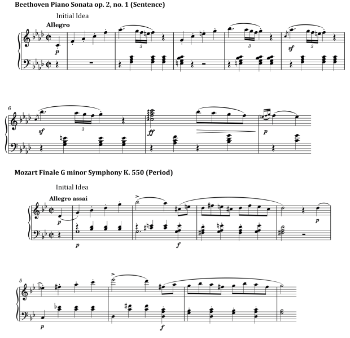
While Dahlhaus at first characterizes Ratz’s theory as reintroducing and reinforcing the contradiction between sentence and period that appeared earlier in A. B. Marx, he later associates Ratz with Erwin Stein and the Schoenberg circle. To this point, Dahlhaus credits Stein with pinpointing the principle underlying the composition of sentences and periods that was left unexplained by Ratz. Dahlhaus cites Stein’s discussion of the first theme of Beethoven’s F-minor sonata (op. 2, no. 1) and the main theme of the Finale of Mozart’s G-minor symphony (K. 550):
The theme of Beethoven’s F minor sonata is a sentence, that of the finale from Mozart’s G minor symphony a simple ternary form. Both examples have the first phrase in common, which in the sentence goes to form a sequence by way of free repetitions, but in the larger form is followed by a sharply contrasting second phrase. This antithesis joins the shapes of two phrases into the longer shape of a four-bar clause. In the sentence, sequences keep the form loose, especially when the phrase is reduced to motif, which is again repeated; thus the rhythmic units of the eight-bar sentence grow shorter (twice two bars and twice one bar), until a cadence to the dominant (of two bars) temporally provides a halt. The first half of the ternary form, on the other hand, is completed by a sequential repetition of the complete four-bar clause. In this instance, the sequence does not loosen the form, but balances its two halves—the antithesis has made the structure sufficiently compact. (Stein 1962, 94–95)
Example 2. Beethoven’s F-minor Sonata op. 2, no. 1, mm. 1–8, and Mozart’s Finale from the G-minor Symphony K. 550, mm. 1–8
(click to enlarge)
These two musical examples are shown in Example 2. Key here is the focus on the repercussions of different organizations of the Vordersatz. Each theme has the same initial idea (Stein’s first phrase). The repetition of this idea in the Beethoven necessitates a continuation phrase, what Ratz describes as compression and acceleration—Verdichtung und Beschleunigung. The contrast in the Vordersatz of the Mozart theme, on the other hand, requires the rounding of the form by a sequential repetition, meaning here a return from the dominant to the tonic. In this way, Stein identifies a single principle underlying the contrast between sentence and period theme types.(24)
[2.12] In explaining how the first three categories of hybrids lend themselves to usage in larger forms, Caplin writes that “With the exception of hybrid 4 (compound basic idea + consequent), the basic idea of a hybrid is stated only once in the theme. This situation is different from both the sentence and the period, in which the basic idea appears twice” (1998, 63). For Caplin, then, the number and nature of appearances of the basic idea in a theme contributes to the phenomenon of thematic redundancy. For example, Caplin discounts the idea of a hybrid constituting a presentation + consequent precisely because of the threefold repetition of the basic idea.(25) This threefold repetition would create a span of music with too many instances of the basic idea and a tonic prolongation encompassing both the presentation and the start of the consequent. While Caplin does not directly recreate the idea that sentence and period derive from the categories of repetition and contrast in the Vordersatz, his attention to the dynamics of the appearances of the basic idea points toward this kind of reasoning.
3. Kühn’s Temporal Concept
[3.1] Unlike Caplin, Kühn’s entire theorizing of classical themes is dependent on the fundamental contrast between sentence and period. He writes:
Sentence and period are based on totally different ways of thinking. The sentence, with motivic sameness or similarity in the Vordersatz, proceeds with ongoing continuation in the Nachsatz. The period, with motivic difference or contrast in the Vordersatz, proceeds with thorough-going correspondence in the Nachsatz.(26) (Kühn 1987, 61)
Here, Kühn (just like Stein) directly identifies the difference between period and sentence as emerging from the same differences between repetition and contrast in the Vordersatz. As we shall see, the distinction Kühn draws between sentential and periodic Vordersätze directly informs his theorizing of thematic Mischung. Before fully broaching the concept of Mischung, however, it is worth outlining more generally the formal/temporal model that underlies Kühn’s Formenlehre.
[3.2] In the first chapter of his book, Kühn identifies five relationship categories that serve as the building blocks of form. These are repetition (Wiederholung), variation (Variante), difference (Verschiedenheit), contrast (Kontrast), and unrelatedness (Beziehungslosigkeit).(27) These categories together are sufficient to account for any kind of musical relationship imaginable between two passages. Kühn calls these categories “form-giving materials” (formgebender Mittel) (Kühn 1987, 13). For Kühn, the various relations between passages are what gives forms their shape. Just as Caplin’s five-part temporal model underlies the logical construction of a theme, Kühn’s categories underlie all the Formenlehre theorizing in his book. These categories may remind the reader of categories established by Rudolf Stephan in his description of form in the Fischer Lexikon Musik of 1957. There Stephan establishes the categories repetition (Wiederholung), contrast (Kontrast), and derivation (Abteiling). Felix Wörner comments that Stephan’s perspective on form emphasizes the consequences of the temporal aspects of musical form.(28) Where Caplin’s conception of musical temporality is explicit, Kühn’s categories are innately, but only implicitly, temporal. In all of Kühn’s categories of relation, it is presupposed that a piece will open with the establishment of some materials, and then a different passage will appear later. Comparison of the passages in terms of x, y, and z then leads to a more precise characterization of the relation. In this way, Kühn’s Formenlehre is based upon a fundamentally two-part temporal model, while Caplin’s expands upon a three-part model.
4. Kühn in Context
[4.1] Placing Kühn in the context of German-language Formenlehre involves first observing the paucity of formal theorizing in that sphere. Most Formenlehre work that was available in the period before Kühn’s short book took the format of introductory and analytical work. Kühn’s treatise fits well into this tradition, as it chiefly concerns analytical practice.(29)
[4.2] Schoenberg aside, the most famous postwar Formenlehre treatise in the German-language sphere is undoubtably Erwin Ratz’s Einführung in die musikalische Formenlehre, first published in 1951. Ratz was a lecturer of musical form and analysis at the Akademie für Musik und darstellende Kunst in Vienna when the book was first published, and he later became Professor in 1957. This text is generally considered to be a broad restatement of Schoenberg’s theory of form, stemming from Ratz’s studies with Schoenberg between 1917 and 1920. This is a misleading characterization, however. There are portions of the book that restate the theories of Schoenberg, such as the first chapter “Typical Form Structures in Beethoven,” which mostly introduces Schoenberg’s theory of thematic types. Yet, even within this chapter, Ratz places more emphasis on the concept of functionality (“formale Funktion”) than found in Schoenberg’s writings. Where the treatise is most distinctive is in the segments that present its main historical argument. In a manner that may seem somewhat ahistorical or old fashioned by today’s standards, Ratz argues that understanding the historical evolution of music revolves around the analysis of form. For example, in the Introduction he details the ways in which the analysis of J. S. Bach’s music serves as a model for the analysis of Beethoven. (He starts with a discussion of various kinds of formal activity in Bach’s Two-voice Inventions, before moving on to the Fugues and then back to the Three-voice Inventions.) It is only after establishing Bach’s formal style that Ratz returns to Beethoven's piano works, particularly the Hammerklavier, and late string quartets. Despite manifesting as a somewhat idiosyncratic approach to analysis and music history—as opposed to an approach rooted more in general and biographical histories—Ratz’s book remains significant for offering a model of viewing music history through the lens of Formenlehre. Similarly, we might find it odd that Beethoven’s late works are meant to be understood via Bach’s Inventions, which seem so stylistically and organizationally dissimilar. As such, the Einführung represents a highwater mark in the belief in the explanatory power and influence of Formenlehre analysis, such that no later German author would ever match Ratz’s confidence in the validity of formal theory. The publication of the third and expanded edition in 1973 was important for both Caplin and Kühn, as it was known to play a role in Dahlhaus’s teaching.
[4.3] Following Ratz, there was a relative scarcity of Formenlehre treatises, and certainly fewer utilizing form as the basis for substantiating historical and structural musical claims. Perhaps the most influential change that followed Ratz was the rise to prominence of historical formal theorists such as Heinrich Koch and Joseph Riepel. This took place in the late 1970s with the publication of Dahlhaus’s intervention “Der rhetorische Formbegriff H. Chr. Kochs und die Theorie der Sonatenform” in 1978a (the same year as his “Satz und Periode” article). This strain of thought was later picked up by Wolfgang Budday in his Grundlagen musikalischer Formen der Wiener Klassik in 1983. Despite the influence of this rediscovery of Koch and Riepel, which persists today in both German-language and Anglophone spheres, Kühn did not take part in this tradition as such. Rather than developing a Kochian theory of form, Kühn’s treatise is organized around analytical heuristics such as logic, balance, and motion.
[4.4] Kühn’s interest in analytical heuristics more closely mirrors a different tradition of German-language Formenlehre. This alternate stream is represented by treatises by Wolfgang Stockmeier and Diether de la Motte. Stockmeier’s Musikalische Formprinzipien (1967), for example, demonstrates some of the confidence in form as a historical document found in Ratz, but is expressed in a rather different analytical nomenclature. First, Stockmeier’s treatise is organized around the various major forms handed down from tradition such as Fugue, Suite, or Sonata. This strategy of organization remains subtly detectable in Kühn’s treatise: within each of Kühn’s large headings, he uses a particular form to exemplify his analytical attitude. Somewhat similarly, Stockmeier writes of formal schemas(30) that,
The concept of “Schema” is at the same time not wholly clear. Through analysis of a particular work one can represent it schematically, that is in overview. In this case, Schema means an overview.(31) (Stockmeier 1967, 9)
While Stockmeier does not denigrate schemas to the same degree as Kühn, both share the view that the schematic reading of musical form is necessarily superficial or only provides an overview. In addition, Stockmeier and Kühn share a practice of exemplifying their ideas with a great many individual cases, and both point chiefly to the individuality of the work.(32)
[4.5] De la Motte’s Musikalische Analyse from 1968 similarly prioritizes the individuality of a work. Reflecting on the influential work of Hugo Leichtentritt (the Musikalische Formenlehre 1911), de la Motte writes that,
Hugo Leichtentritt – and from him originates one of the best Formenlehren – writes in the forward: “A new Rondo must not be made thus, as demonstrated by this or that masterwork. But to show just why each masterwork must be just so and how it is shaped, is what is pursued here.” Such sentences are still valid today, after over 50 years. The decisive question is and remains: Why is each masterwork this way, and how so?(33) (1968, 7)
This statement is crucial for understanding Kühn’s work. De la Motte was one of Kühn’s teachers, and the idea, ultimately originating in Leichtentritt, that Formenlehre should be concerned with describing the individuality of masterworks, is clearly influential in Kühn’s treatise. Kühn writes
The truth itself lies in a close balance between abstract signposts (which are understood as nothing but supra-temporal and supra-personal) and analytical differentiation (which does not lose sight of the larger picture)(34) (1987, 7).
To be clear, the balance to which Kühn refers is also present in de la Motte’s work. Where the two theorists most strongly overlap is in their concerns that theorizing might distract from a flexible analytical practice.
Mischungen
[4.6] Kühn’s theory of Mischungen (mixtures)—yet another example of the theorist’s relish for thematic ambiguity and individuality in themes—originates in his comparison of thematic features of the sentence and period.(35) Kühn suggests four categories of thematic Mischungen: sentence with periodic Vordersatz, period with sentential Halbsätze, “overlayerings,” and “potentiation/escalation.”(36) We can see at the outset that Kühn’s approach is markedly different from that of Caplin: while Kühn responds to many of the same kinds of themes as Caplin, there are occasions where Kühn treats what Caplin would consider a regular theme as manifesting some kind of problematic formation. (Caplin, on the contrary, posits his hybrids as separate theme types that are only related to sentence and period.) More specifically, Kühn opts to integrate features of sentence and period into themes that fulfill one or the other theme type in an overriding fashion. Following from this, the combinations that Kühn proposes provide a more flexible set of interpretive strategies for understanding the fundamental contrast between sentence and period. Below, I introduce each of Kühn’s categories of Mischung alongside Kühn’s analytical examples and also consider how a Caplinian analysis would interpret these same themes.
Sentence with Periodic Vordersatz
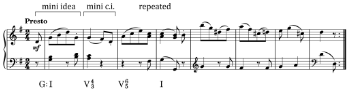
Example 3. The first theme of the Finale of Haydn’s Piano Sonata in G, Hob. XVI/27,
(click to enlarge)
[4.7] Kühn’s first category of Mischung appears on the surface as constituted very much as Caplin’s Hybrid Theme Type 1, antecedent + continuation. This is not a straightforward relationship, however. Kühn introduces the sentence with periodic Vordersatz with the example of the theme from the Finale of Haydn’s Piano Sonata in G, Hob. XVI/27, reproduced in Example 3 with harmonic and formal analytical markings. Kühn says that, according to the analytical system of sentence and period presented just earlier in the chapter, this theme is a sentence. Yet, the theorist emphasizes that the harmonization and motivic organization of the Vordersatz is periodic: here he cites the movement first from tonic to dominant in the first two measures, followed by a “reversal” from dominant to tonic. Similarly, he considers the arpeggiation and the suspension of the basic idea as constituting two miniature, contrasting ideas. As a result, Kühn considers the Vordersatz of this theme as appearing like a half-size period possessing both the harmonic roundedness of the period theme type as well as the typical motivic correspondence between the mini-antecedent and mini-consequent.(37) Here, it is worth pointing out the relative strangeness of Kühn’s analysis for a North American audience. What seems very obviously to be organized as a sentence (an aspect that Kühn recognizes in his prose) is mined for periodic features. In so doing, the mixture he enacts applies not only to spans of organizational time but also to modes of analytical thinking. That is to say, in analyzing this theme both as a sentence (thinking organizationally) and periodically (thinking in terms of minute details), Kühn works to engage the smallest details of this theme, even when they seemingly undermine the larger, explicit organizational point he is attempting to make.
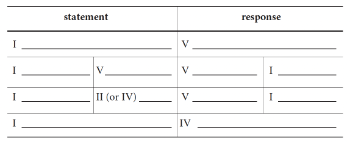
Example 4. Caplin’s (2013a, 42) table of statement response harmonizations
(click to enlarge)
[4.8] As a result of his interest in small details, Kühn freely interweaves features found at different levels of formal organization; for example, those features typically found at the thematic level of a period appear contained within the phrase level of the Vordersatz. In contrast, Caplin’s hybrids strictly observe a congruence of organization level: Caplin’s periodic first phrases are antecedent phrases that would normally initiate a period theme type. In the instance of the Haydn theme that Kühn identifies as an instance of Mischung, Caplin’s analysis would treat it as a straightforward sentence. Caplin and Kühn’s analyses both take into account the harmonization of the Vordersatz: where Kühn deems the harmonization periodic, Caplin describes it as a “statement–response.” In his textbook, Analyzing Classical Form, Caplin describes different harmonization techniques for presentation phrases and produces a table of statement/response harmonizations; these are reproduced in Example 4.(38) Kühn would surely recognize I V, V I (often called a “Chiasmus” in German-language music theory) as an example of periodic harmony but would exclude the other harmonizations from this category of Mischung. Kühn’s analytical example and comments seem to derive from similar comments found in Dahlhaus’s essay “Satz und Periode.” There, Dahlhaus describes how the Vordersatz of the theme of the first movement of Beethoven’s Piano Sonata in C, op. 2, no. 3 represents a period in itself, due to its motivic and harmonic pattern.(39)
[4.9] The essential comparison to be made here between Caplin’s and Kühn’s response to theme types outside of the sentence-and-period framework is that Kühn sees this problem as implicating many more themes than Caplin. Caplin’s preferred response is to minimize this issue and limit it to just those that clearly contravene the syntactic organization of the two main theme types. For Kühn, many more themes could be viewed as taking part in his concept of Mischung. This is a key point of difference between Caplin and Kühn: the two theorists differ in their understanding of the problem at hand. Where Caplin views the problem ultimately as a syntactic issue surrounding the comprehensibility of theme types, Kühn views the problem as determining how we should intermix different modes of analysis. That is, Kühn’s micro-level formal analyses approach motivic analysis, while still sustaining a more conventional formal analysis on the larger dimensions of a piece. While I would not directly advocate for a Kühn-like analysis of themes that I view as fundamentally sentential, it is worth pointing out that these differences in theory exist between theorists like Caplin and Kühn who have somewhat similar Germanic educations.
Period with Sentential Halbsätze
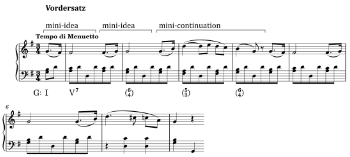
Example 5. The minuet theme from Beethoven’s Piano Sonata in G, op. 49, no. 2, ii, mm. 1–8
(click to enlarge)
[4.10] Like the sentence with periodic Vordersatz, the period with sentential Halbsätze begins with a Vordersatz that imitates a theme type in miniature.(40) The category name refers to the appearance of the motivic organization of a sentence built from one-measure “ideas.”(41) This may produce a period with a (1+1+2) + (2×2) organization, where the Vordersatz ends in a regular half cadence and the Nachsatz exhibits standard consequent motivic correspondence and ends in a full cadence.(42) Kühn presents as an example the minuet theme from Beethoven’s Piano Sonata in G, op. 49, no. 2, ii with harmonic and formal analytical markings; see Example 5. Again, Kühn refers to this theme as an example of one of the main theme types (period) but describes the Vordersatz as a “miniature image”(43) of the sentence type. Caplin’s analysis of the first theme from Mozart’s Piano Sonata in A, K. 331 shares many commonalities with Kühn’s. Like Kühn, for example, Caplin views Mozart’s theme(44) as beginning with a sentence in miniature as the antecedent phrase, noting “The entire antecedent phrase has a miniature sentential design” (1998, 51). Caplin does not see this kind of construction as problematizing either the organization of Mozart’s theme as a period, nor indeed forming an entire category of thematic organization; he argues that “It would be inappropriate, however, to consider this four-measure unit a genuine sentence, since it does not contain sufficient musical content to make up a full eight-measure theme” (Caplin 1998, 51). The way Caplin discounts the miniature theme relies on the more generally held stance that units come in fundamentally two-measure segments.
[4.11] Yet Kühn does not truly argue that the miniature periods and sentences found in the Vordersätze of his first two Mischung examples constitute themes. Instead, these miniature reflections take part in a zone of tension between sentence types within the themes themselves. This claim leads directly back to Kühn’s larger categories of formal relation, in which the sentence is associated with energy and repetition, while the period is associated with balance and contrast. In Kühn’s overarching theoretical project, then, it becomes important to mark instances of combination between these different relational categories. Kühn’s aim is not to imagine theme types that exist outside of the paradigms of sentence and period but rather to demonstrate how periodic balance may be permeated by motivic energy and sentential urgency may be tamed by harmonic strength. We can observe how the different emphases reflect the core analytic temperaments of the two theorists: Caplin demonstrates the unfolding of the logical and syntactic results of his five-part temporal model, whereas Kühn emphasizes the various admixtures of his categories of relation.
Overlayerings
Example 6. The main theme of second movement of Beethoven’s Piano Sonata, op. 2,
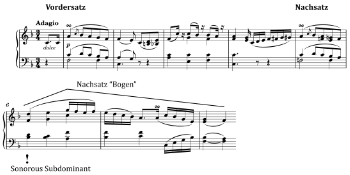
(click to enlarge)
[4.12] Kühn’s final two categories of Mischung are fundamentally different than those discussed above. Where the earlier categories described the miniature reflection of theme types, the latter two involve theme-level intermixture of sentential and periodic organization. The first of these, Overlayerings (Überlagerungen), treats themes that bring features typical of both sentence and period and that ultimately problematize the analysis of the themes themselves. Rather than treating this category as a special case of containment, Kühn interrogates the boundaries between these theme-type categories (i.e., sentence and period). In the main theme of the second movement of Beethoven’s Piano Sonata in F minor, op. 2, no. 1 (Example 6), Kühn first establishes his overriding thematic analysis (“Undoubtably a period”)(45) before explaining all the ways the theme is not obviously a period. First, Kühn describes how the cadential structure and motivic correspondence in the theme create the impression of a period. He then seemingly undermines this analysis through the “single arc” of the Nachsatz and the “sonorous subdominant” (marked in Example 6 with an “!”).(46) Kühn argues that “the roundedness of the period is overlaid with the directness of the sentence.”(47) It seems from this description that the determining factor when identifying the theme type is harmonic, arising ultimately from the cadential design of the theme.
Example 7. Analysis of the second movement of Beethoven’s Piano Sonata, op. 2, no. 1, mm. 1–8, from Caplin 2013a, 116
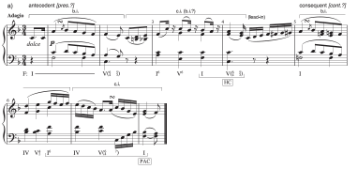
(click to enlarge)
[4.13] Caplin gives an analysis of this same theme in his Analyzing Classical Form (Caplin 2013a, 116–17). Caplin includes this theme in his chapter on hybrid themes, yet places it within two case studies which are examples of cases “that call for individual treatment” (Caplin 2013a, 115). Caplin’s analytical remarks on this theme demonstrate some similarities with Kühn: both see this theme as a period, but both highlight how the theme carries some sentential characteristics. Caplin’s summary explanation of the theme is rather different from that of Kühn, however. Whereas Kühn uses this theme as an example of a larger category of thematic Mischung, Caplin uses it to demonstrate an analytical condition for treating (i.e., composing) difficult themes that exhibit what he calls “cadential redundancy.” Caplin observes, via a recomposition, that if the basic idea had returned in full at the beginning of the consequent, it might have created the impression of a further half cadence. Caplin then argues that Beethoven would naturally discount this as redundant and repetitious, instead preferring a version where the subdominant interrupts at a moment where we might otherwise have heard that half cadence. To signal the kinds of analytical ambiguities in the sentential vs. periodic design of the theme, Caplin places square brackets with secondary analytical material in his formal analysis, as shown in Example 7. It is worth considering the implications of Caplin’s bracketed labels in Example 7. While Kühn is explicit about the degree to which overlayering takes place in this theme, it does seem that Caplin’s labelling implicitly acknowledges many of the same features. Proceeding from the assumption that the antecedent could also be considered a bit like a presentation, the inference is that these two features are layered one over the other. Caplin’s description of the analysis does not make this claim, however. Instead, continuational aspects of the consequent are left as parenthetical and with a question mark.(48)
[4.14] In their treatment of Beethoven’s theme, Caplin and Kühn both reflect Dahlhaus in different ways. Since Dahlhaus expresses that thematic theoretical systems produce problematic analyses when adhered to too strictly,(49) Caplin casts the Beethoven theme outside of the sentence/period binary. Kühn, on the contrary, seems to argue that these kinds of themes are not truly problematic at all, but rather reflect the Classical urge for combining different categories of relation. Put plainly, Caplin follows Dahlhaus’s lead in describing some themes as liminal cases;(50) Kühn, in contrast, produces a set of categories to account for the ways that period and sentence interact in some themes, developing this aspect of Dahlhaus’s application of thematic heuristics to formal analysis.
Escalation/Potentiation
Example 8. The first eight measures of the 16-measure theme of the third movement of Mozart’s Violin Concerto in A, K. 219
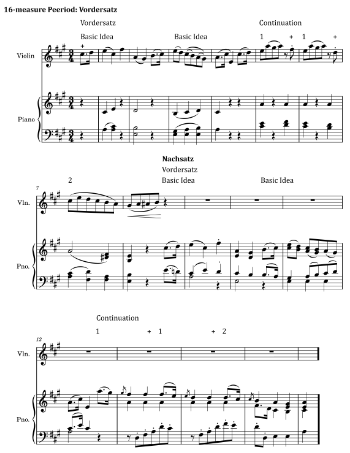
(click to enlarge)
[4.15] The last of Kühn’s categories, escalation/potentiation (Potenzierung), seems roughly analogous to Caplin’s concept of compound theme.(51) This category of Mischung includes those themes that are constructed to encompass sixteen normal, or real, measures.(52) In discussing the example of the theme of the third movement of Mozart’s Violin Concerto in A, K. 219, Kühn starts by identifying the higher-level theme type as a sixteen-measure period, shown in Example 8. The theorist notes that the two halves of the period are organized as sentences (mm. 1–8 and mm. 9–16) but further argues that the sentences themselves are constructed in ways captured by his earlier categories of Mischung. Kühn argues that the Vordersatz of each sentence projects harmonic periodicity; this is the exchange between tonic and dominant that Caplin would describe as a statement-response harmonization. The Nachsätze of the two sentences are motivically constructed in a sentential manner with 1+1+2 organization. Kühn explains that this multilayered formal situation is not new but rather reflects his earlier categories.(53)
[4.16] Kühn concludes his comments on the category of escalation/potentiation (and on Mischungen, in general) by returning to his description of the principle of Mischung. He notes that in escalation/potentiation “the reciprocal stimulation of the restful period and the continually moving sentence justifies the wonderful inner balance: rest is set in motion, movement is absorbed by rest.”(54) Again, Kühn’s manner of speaking regarding Mischung is reflected to a degree in Caplin’s comments on compound themes. Caplin categorizes compound periods according to the organization of their eight-measure antecedents. His categories include antecedent = presentation + continuation (i.e., a sentence); antecedent = compound basic idea + continuation (i.e., Hybrid Type 3); and antecedent + continuation (i.e., Hybrid Type 1). While Caplin does not treat the implications of lower-level organizations contrasting the higher-level, compound organization, he does acknowledge that compound themes combine sentential and periodic features.(55) Similarly, although Caplin never explicitly discusses the musical effect of the combination of contrasting theme types in compound themes, his theorizing and categorization highlights the multiple levels of thematic organization inherent to them. The escalation/potentiation category presents the closest accord between Caplin and Kühn, with each highlighting the ways that larger themes are made of smaller theme types concatenated to produce a wider effect.
[4.18] Moving now to the next level, the comparisons made above, concerning the ways that Kühn and Caplin theorize problematic themes, again reveal a key difference in their response to the same issue. Caplin thinks syntactically, while Kühn works with various parameters in his analytical technique. That is, one of the controlling factors in Caplin’s analysis is the strict delineation of musical time: ideas come in two-measure units, themes cannot be only four measures long, and compound themes have to be considered as their own separate category. Kühn, in contrast, believes formal units remain organizationally viable even when composed of mixed time spans. In his approach, thematic organization that occurs over short spans of music is worthy of discussion, motivic and harmonic analysis work together to create novel readings of conventional themes, and deploying potentiation/escalation mediates the logical flow between the spans of musical organization. In a nutshell, Kühn is a theorist more interested in the minute, intra-measure organization of a composition than Caplin, who takes more interest in syntactic and temporal organization.
5. Further Considerations of Complementary Analytical Praxis
[5.1] Perhaps the most apt way to start a direct comparison between these two theoretical endeavors is to interrogate some themes with both methods, delineating which features of a passage each method emphasizes. The themes I will treat come from the Romantic repertoire between the 1820s and 1870s. The reasoning here is that these themes provide opportunities for both categorizing these theories and pushing them beyond their classical models, better clarifying the full properties of both.(56) The themes discussed in this section all present complications for Classical style formal analysis. All first movement main themes, they are taken from Beethoven’s String Quartet in F, op. 135 (1826); Robert Schumann’s Fantasiestücke, op. 73, no. 1 (1849); and Brahms’s String Quartet in A minor, op. 51, no. 2 (1873).
Example 9. Main theme from Beethoven’s String Quartet in F major, op. 135, movement i
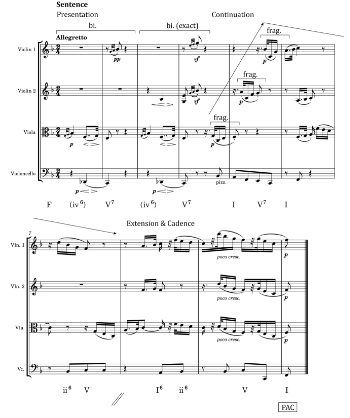
(click to enlarge)
[5.2] The puckish main theme of the first movement of Beethoven’s last F-major string quartet is undoubtably a sentence from a Schoenbergian point of view, and both Caplin and Kühn would surely agree with that assessment. Indeed, it would not even qualify as an instance of a hybrid form in Caplin’s theory. Where the two might disagree is on how much weight should be given to the specific formulation of the continuation phrase. Example 9 shows the theme analyzed in a recreated Caplinian method that also incorporates some adapted analytical techniques from Kühn.
[5.3] Caplin might treat this theme as an instance of a sentence with cadential evasion at mm. 7–8, followed by a strong cadential progression leading to a perfect authentic cadence in m. 10. Kühn would likely pay closer attention to some of the micro-level organization of the continuation; for example, he might highlight the fragmentation that starts in m. 4 and then reaches up in register before a seeming relaxation back down toward the first attempt at cadence. While nothing in Caplin strictly forbids noticing this kind of arch organization (which I hear as something like the Nachsatz “Bogen” pointed out in Example 6), his methodology generally places greater emphasis on the bass voice and the approach toward cadence. This is both a strength of Caplin’s theory and something of a drawback. On the one hand, the organizing power of the bass voice means that much of the larger thematic organization of a work becomes clear. On the other, Kühn’s practice lays bare other critical compositional details, such as how the fragments of the continuation are organized and how they expand motivically on the opening viola and ’cello descending semitone gestures. These findings, in turn, can play a remarkable role in shaping the formal analysis. Indeed, Kühn might argue that the Nachsatz of this theme is a rather unusual instance of a sentential Halbsatz, with the ascending fragments constituting something like a mini presentation and what follows a kind of half-size continuation. To be sure, this is nowhere as clear cut an example as that found in Example 8. Yet, Kühn’s practical approach to analysis leaves room for these kinds of speculations.
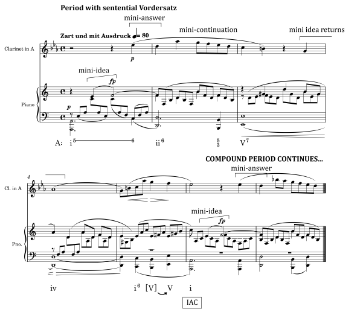
Example 10. The opening measures of the first movement of Robert Schumann’s Fantasiestücke, op. 73, analyzed with an adapted version of Kühn’s method and pertinent Roman numerals
(click to enlarge)
[5.4] We next consider Schmann’s Fantasiestücke, op. 73, a roving and fantasy-like piece, as one might expect of the mid-Romantic period. Example 10 reproduces the first few measures of the first movement, which end with a cadence in the home key of A minor before the return of the basic idea. On the face of it, this kind of compound periodic theme should be easy to parse via the Schoenbergian method. The initial idea is answered by a motivically related idea leading to a cadence. We can hear these two parts of the first part of the theme as something like a periodic pair: the initial idea lands on the dominant with scale degree three in the clarinet, and then we are led by further bass action to an imperfect authentic cadence in m. 6.(57) So far, all of this seems to follow typical, Classical organization. Yet, the second half of the compound theme drifts toward a cadence on the subdominant key, D minor. The irregularity of this kind of thematic construction is emblematic of some quite novel compositional impulses from this later period compared to the Classical, in this case: the idea of the false repetition transition combined with a generally much larger degree of license.
[5.5] So, given that the grander shape of this theme might be something Caplin views as irregular or nonconventional from a Classical point of view, how might we augment this perspective with Kühn’s heuristics? We first pay close attention to motivic parallelisms. There is an answer/response between the piano and clarinet, marked in Example 10, which Kühn might view as organizing the opening phrase in a sentential manner. Kühn might also reflect on the concealed sentential urgency, which moves the harmony away from the tonic after the first IAC. The arrival on the subdominant leads next toward chromatic motion that helps further loosen the sense of key (just after the later cadence to D minor in the example), and this, too, perhaps vindicates this idea that latent energy lurks under the surface of the theme. One could imagine a performance of this theme that is gentle but that also projects a certain degree of terse energy, and in this way we could envisage a way of bringing forth the expression (Ausdruck) that Schumann requests. Caplin’s method, it seems, as Romantic practice moves further from Classical convention, increasingly invites theoretical adjustments. In contrast, far fewer adjustments are necessary for Kühn’s more flexible method: his concept of Mischung helps us pay attention to the ways that themes like Schumann’s are unique and how they are organized on the most minute levels.
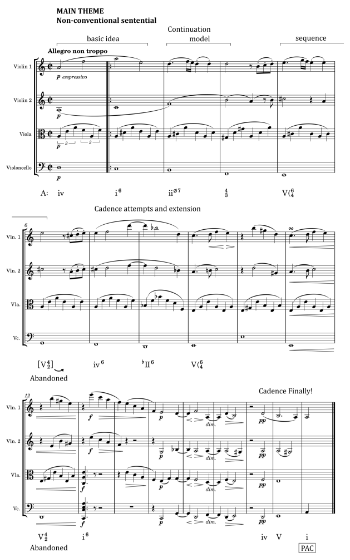
Example 11. The theme of the first movement of Brahms’s String Quartet in A minor, op. 51, no. 2, analyzed with an adapted version of Kühn’s and Caplin’s methods
(click to enlarge)
[5.6] The final Romantic example, Brahms’s String Quartet in A minor, op. 51, no. 2 from 1873, builds upon the loosening of organizational convention seen in the previous two examples (Example 11). As I shall argue, there are two ways to approach this theme: one is to follow the progression of the cadences, and the second is to follow how the passage’s “sentential urgency” is manifested. The first thing to point out is that, in Caplin’s method, this theme would have to be considered as a nonconventional theme type. Simply put, the basic idea is not repeated, and there is no return of the basic idea in a periodic organization; therefore, this must be a non-conventional theme, since it starts with a phrase that Caplin does not recognize as syntactically valid.(58) A compatible aspect of this theme with Caplin’s theory is the succession of two abandoned dominants, the first appearing in m. 6 with the arrival of the dominant to the subdominant, and the other in m. 12 with the bass stepping down toward
[5.7] There are two ways that Kühn’s approach might productively be folded into this analysis. The first stems from the recognition that this is a fundamentally sententially organized theme, despite its missing repetition of the basic idea. The model-sequence technique that follows the initial basic idea (which might be immediately mistaken for a contrasting idea), followed by the variation of the model starting in m. 6, again lends the theme the sentential urgency seen earlier. Second, and at the same time, Kühn might also point to the large-scale harmonic motion: starting with the tonic, m. 5 initiates a long passage that might be heard to fundamentally prolong the dominant that leads to cadential abandonment in m. 12. As such, there is some degree to which we might think of this theme as a kind of Overlayering: with the periodic exchange of tonic and dominant harmony combined with clearly sentential motivic features. I suspect that many readers might find this an unusual interpretation and might blanch at any attempt to impute periodic design on such a sentential theme. Yet, the benefit of this observation is that we can place these elements (sentential and periodic organization) in dialogue with one another.(59)
[5.8] Ultimately, I find the practices of Caplin and Kühn on the whole to be complementary. The chief difference between Caplin’s and Kühn’s response to problematic themes is one of emphasis. Caplin emphasizes the ways in which themes syntactically cohere, whereas Kühn focuses his attention on small-scale relationships that are more obviously sentential or periodic. Yet such surface level concurrence and complementarity obscure rather deep disagreements between the theorists on some of the most core aspects of formal theorizing: the disposition of time and relation. Kühn’s view of musical shaping and context (“Formgebung und Zusammenhang”) proposes that form derives from the contexts created by his five categories of relation (Repetition, Variation, Difference, Contrast, and Unrelatedness). In this way, Kühn claims that form and context derive not from the inherent properties of a given passage, but rather from the various ways in which passages relate to one another in contemplation. We only know a posteriori that we have heard one of these categories. In this way, Kühn prioritizes comparison and retrospective judgement as the most important aspects of musical listening.
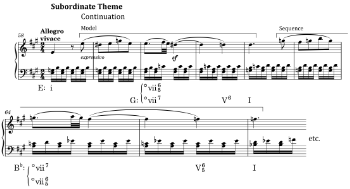
Example 12. The start of subordinate theme from the first movement of Beethoven’s Piano Sonata in A, op. 2, no. 2, mm. 58–66
(click to enlarge)
[5.9] Caplin’s model of syntax and temporality stands in stark contrast to that of Kühn. A passage conveys its temporal positioning within his five-part model as an inherent property of its content, with context playing an ultimately subsidiary role. Consider that a presentation phrase acts as an initiation not only because it comes at the start of something, but as a result of its prolongational progression and repetition of the basic idea. For Caplin, a continuation phrase is not a continuation phrase on the basis of the liquidation of presentation materials (though Caplin might note this feature) but rather due to sequential harmonies, fragmentation, and harmonic rhythm. According to Caplin’s theory, when listening, we should hear that a continuation has begun right from the establishment of its harmonic path. Indeed, when a theme begins with a continuation, we should immediately understand the medial function of the passage despite its position at the start of a theme, as in the subordinate theme of the first movement of Beethoven’s Piano Sonata in A, op. 2, no. 2, shown in Example 12. In this way, Caplin’s theory emphasizes a different aspect of musical listening than Kühn’s theory: immediacy and the initial impact of passages on a listener. Because the two theorists emphasize different aspects of musical listening, Kühn’s and Caplin’s temporalities contradict each other. The two theorists develop the context of a musical passage in completely different mental faculties: Caplin argues we immediately perceive temporality (and formal function), while Kühn argues that we create it in contemplation.
[5.10] I started this essay by noting the great differences in style between Anglophone and German-language Formenlehre traditions, even within the restricted world of Schoenbergian Formenlehre. As a partial rapprochement between these spheres (and as a step towards sharing knowledge and expanding our conceptualization of Formenlehre), I recommend that theorists unfamiliar with Kühn’s methodology and analytical attitude acquaint themselves with his manner of analyzing music as a supplement to those stricter theoretical methods that are more prevalent in North America. Particularly in the work of Kühn’s one-time teacher Diether de la Motte, we can find an analytical approach that interacts with musical works to discover what is individual about them. While more overtly theoretical approaches to Formenlehre help to shape our intuitions for musical styles, supplementing such theoretical endeavors with a mantra of individuality can help us investigate works more closely, whether they be the old workhorses of the classroom, or new repertoire that we feel will engage our students in a different way.
Laurence Sinclair Willis
Musik und Kunst Privatuniversität der Stadt Wien
MUK Privatuniversität
Bräunerstraße 5
1010 Vienna, Austria
l.willis@muk.ac.at
Works Cited
Agawu, Kofi. 1987. “Concepts of Closure and Chopin’s Opus 28.” Music Theory Spectrum 9 (1): 1–17. https://doi.org/10.2307/746116.
Aldwell, Edward, and Carl Schachter. 1989. Harmony and Voice Leading. 2nd ed. Harcourt Brace Jovanovich.
Aristotle. 1984. The Complete Works of Aristotle: The Revised Oxford Translation. Vol. 2. Edited by Jonathan Barnes. Princeton University Press.
BaileyShea, Matthew. 2004. “Beyond the Beethoven Model: Sentence Types and Limits.” Current Musicology 77: 5–33. https://doi.org/10.7916/cm.v0i77.5033.
Budday, Wolfgang. 1983. Grundlagen musikalischer Formen der Wiener Klassik. Bärenreiter.
Caplin, William E. 1986. “Funktionale Komponenten im achttaktigen Satz.” Zeitschrift für Musiktheorie 1 (3): 239–60.
—————. 1994. “Hybrid Themes: Toward a Refinement in the Classification of Classical Theme Types.” Beethoven Forum 3: 151–65.
—————. 1998. Classical Form: A Theory of Formal Functions for the Instrumental Music of Haydn, Mozart, and Beethoven. Oxford University Press. https://doi.org/10.1093/oso/9780195104806.001.0001.
—————. 2010. “What are Formal Functions?” In Musical Form, Forms, & Formenlehre: Three Methodological Reflections, ed. Pieter Bergé, 21–40. Leuven University Press. https://doi.org/10.2307/j.ctt9qf01v.5.
—————. 2013a. Analyzing Classical Form: An Approach for the Classroom. Oxford University Press.
—————. 2013b. “Teaching Classical Form: Strict Categories vs. Flexible Analyses.” Dutch Journal of Music Theory 18 (3): 119–35.
—————. 2015. “Harmony and Cadence in Gjerdingen’s ‘Prinner.’” In What is a Cadence? Theoretical and Analytical Perspectives on Cadences in the Classical Repertoire, ed. Markus Neuwirth and Pieter Bergé, 17–58. Leuven University Press. https://doi.org/10.2307/j.ctt14jxt45.4.
—————. 2024. Cadence: A Study of Closure in Tonal Music. Oxford University Press. https://doi.org/10.1093/oso/9780190056445.001.0001.
Dahlhaus, Carl. 1965. “Form.” In Darmstädter Beiträge zur Neuen Musik 10: 41–49.
—————. 1969a. “Formprinzipien in Wagners Ring des Nibelungen.” In Beiträge zur Geschichte der Oper (Studien zur Musik des 19. Jahrhunderts 15), ed. Heinz Becker, 95–129. Regensburg.
—————. 1969b. “Plädoyer für eine romantische Kategorie — Der Begriff des Kunstwerks in der neusten Musik.” Neue Zeitschrift für Musik 80: 18–22.
—————. 1973. “Ist die formale Analyse veraltet?” Neue Zeitschrift für Musik 134: 406.
—————. 1974. “Form und Motive in Mahlers Neunter Symphonie.” Neue Zeitschrift für Musik 135: 296–99.
—————. 1977a. “Musikalische Form als Transformation. Bemerkungen zur Beethoven-Interpretation.” In Beethoven Jahrbuch 1973/77 ed. Martin Schmidt, 27–36. Beethovenhaus Bonn.
—————. 1977b. “Zur Theorie der musikalischen Form.” Archiv für Musikwissenschaft 34: 20–37. https://doi.org/10.2307/930734.
—————. 1978a. “Der rhetorische Formbegriff H. Chr. Kochs und die Theorie der Sonatenform.” Archiv für Musikwissenschaft 35 (3): 155–77. https://doi.org/10.2307/930814.
—————. 1978b. “Formenlehre und Gattungstradition bei A. B. Marx.” In Festschrift Heinrich Sievers zum 70. Geburtstag, ed. Richard Jakoby, 29–35. Tutzing.
—————. 1978c. “Satz und Periode: zur Theorie der musikalischen Syntax.” Zeitschrift für Musiktheorie 9 (2): 16–26.
—————. 1978d. “Die Sonatenform bei Schubert. Der erste Satz des G-Dur-Quartetts.” Musica 32: 125–30.
—————. 1979a. “Formprobleme in Schuberts frühen Steichquartetten.” In Schubert-Kongreß Wien 1978 Bericht, ed. Otto Brusatti, 191–97. Akademische Druck- und Verlagsanstalt.
—————. 1979b. “Liszts Faust-Symphonie und die Krise der symphonischen Form.” In Über Symphonien. Beiträge zu einer musikalischen Gattung (Festschrift Walter Wiora zum 70. Geburtstag), ed. Christoph-Hellmut Mahling, 129–39. Tutzing.
—————. 1980a. “Zur Formidee in Beethovens d-Moll Sonate opus 31,2.” Die Musikforschung 33: 310–12. https://doi.org/10.52412/mf.1980.H3.1692.
—————. 1980b. “Zur Typologie der Opernformen.” Die Musikforschung 33: 402–3. https://doi.org/10.52412/mf.1980.H3.
—————. 1986. “Zur Theorie der Sonatenexposition.” Musica 40: 511–13.
de la Motte, Diether. 1968. Musikalische Analyse mit kritischen Anmerkungen von Carl Dahlhaus. Bärenreiter.
Diergarten, Felix. 2012. “Jedem Ohre klingend”: Formprinzipen in Haydns Sinfonieexpositionen. Laaber Verlag.
Galand, Joel. 1999. “‘Formenlehre’ Revived.” Gamut 13: 143–200.
Hepokoski, James, and Warren Darcy. 2006. Elements of Sonata Theory: Norms, Types, and Deformations in the Late-Eighteenth-Century Sonata. New York: Oxford University Press. https://doi.org/10.1093/acprof:oso/9780195146400.001.0001.
Horton, Julian, 2022. “First-Theme Syntax in Brahms’s Sonata Form.” In Rethinking Brahms, ed. Nicole Grimes and Reuben Phillips, 195–288. Oxford University Press. https://doi.org/10.1093/oso/9780197541739.003.0011.
Korsyn, Kevin. 1993. “Review: Brahms Research and Aesthetic Ideology.” Music Analysis 12 (1): 89–103. https://doi.org/10.2307/854077.
Kühn, Clemens. 1987. Formenlehre der Musik. Bärenreiter.
Jacob, Andreas. 2005. Grundbegriffe der Musiktheorie Arnold Schönbergs. Georg Olms.
Lewin, David. 1986. “Music Theory, Phenomenology, and Modes of Perception.” Music Perception 3/4: 327–92. https://doi.org/10.2307/40285344.
—————. 1990. “Brahms, His Past, and Modes of Music Theory.” In Brahms Studies: Analytical and Historical Perspectives, ed. George S. Bozarth, 13–28. Clarendon Press.
Martin, Nathan John, and Steven Vande Moortele. 2014. “Formal Functions and Retrospective Reinterpretation in the First Movement of Schubert’s String Quintet.” Music Analysis 33 (2): 130–155. https://doi.org/10.1111/musa.12025.
Ratz, Erwin. [1951] 1973. Einführung in die Musikalische Formenlehre: Über Formprinzipien in den Inventionen und Fugen J. S. Bachs und ihre Bedeutung für die Kompositionstechnik Beethovens. 3rd ed. Universal Edition.
Richards, Mark. 2011. “Viennese Classicism and the Sentential Idea: Broadening the Sentence Paradigm.” Theory and Practice 36: 179–224.
Riemann, Hugo. [1905] 1910. Grundriß der Kompositionslehre. 3rd ed. Max Hesses Verlag.
Rohringer, Stefan. 2016. “Prolegomena zu einer Systematik der syntaktischen Formen ‘Satz’ und ‘Periode’ 1. Teil: Carl Dahlhaus und die Schönbergschule.” Zeitschrift der Gesellschaft für Musik Theorie: 155–291. https://doi.org/10.31751/866.
Schachter, Carl. 1985. “Either/Or.” In Schenker Studies, ed. Heidi Siegel, 165–79. Cambridge University Press.
Schmalfeldt, Janet. 1995. “Form as the Process of Becoming: The Beethoven-Hegelian Tradition and the Tempest Sonata.” Beethoven Forum 4: 37–71.
—————. 2017. In the Process of Becoming: Analytic and Philosophical Perspectives on Form in Early Nineteenth-Century Music. Oxford University Press.
Schoenberg, Arnold. 1967. Grundlagen der musikalischen Komposition. Universal Edition. English edition published 1970 as Fundamentals of Musical Composition, Faber and Faber.
—————. 1995. Stil und Gedanke. Ed. Ivan Vojtech. Fischer Taschenbuch Verlag. English edition published 1984 as Style and Idea, edited by Leonard Stein, University of California Press.
—————. 2018. Arnold Schönberg: Sämtliche Schriften: kritische Gesamtausgabe II. Lehrwerke 6. Fragment gebliebene Lehrwerke I: Der musikalische Gedanke. Edited by Hartmut Krones. Universal Edition. English edition published 1995 as The Musical Idea and the Logic, Technique, and Art of its Presentation, edited by Patricia Carpenter and Severine Neff, Indiana University Press.
Stein, Erwin. 1962. Form and Performance. Knopf.
Stephan, Rudolf. 1957. “Form.” In Fischer Lexikon Musik, vol. 5, ed. Rudolf Stephan, 52–54. Fischer Bucherei.
Stockmeier, Wolfgang. 1967. Musikalische Formprinzipien: Formenlehre. Laaber Verlag.
Wörner, Felix. 2022. Konzeptualisierung von Form in Musik: Aspekte von Formvorstellungen tonaler Musik vom 19. bis zum 21. Jahrhundert. Schwabe Verlag. https://doi.org/10.24894/978-3-7965-4528-3.
Footnotes
* The research that led to this paper was funded by the Fonds zur Förderung der wissenschaftlichen Forschung, FWF in Austria as the ESPRIT project “Postwar Germanic and Anglophone Formenlehre.” The mentor for this project is Christian Utz, to whom I wish to extend my gratitude.
Return to text
1. I know of no evidence of personal contact between Caplin and Kühn.
Return to text
2. Felix Wörner (2022, 55) concurs with this assessment, arguing that North American theory disparaged the foreground of a musical composition including form.
Return to text
3. „Nach dem Aufstieg der Formenlehre im 19. und frühen 20. Jahrhundert wendeten sich in der zweiten Hälfte des 20. Jahrhunderts aus den geschilderten (und anderen) Gründen Theoretiker von den ‚thematischen‘ und ‚funktionalen‘ Formtheorien ab. Dies gilt vor allem für den internationalen akademischen Diskurs und die englischsprachige Lehrpraxis, an den deutschsprachigen Musikhochschulen hat sich – wenngleich mit bemerkenswerten regionalen Differenzen – eine lebendige und differenzierte Formenlehretradition stets halten können.“ All translations are those of the author.
Return to text
4. „Das Mißtrauen gegen die musikalische Formenlehre erwächst aus einer Skepsis gegenüber dem ‚Systemdenken‘ und gegenüber platonisierendem ‚Begriffsrealismus‘, den man hinter der Überzeugung von der Substanzialität des Generellen argwöhnt.“
Return to text
5. Of course, there has been a trend of ambiguity/multiple readings in North American scholarship, such as Carl Schachter’s “Either/Or” (1985) or David Lewin’s “Music Theory, Phenomenology, and Modes of Perception” (1986).
Return to text
6. While Galand only refers to this single essay of Dahlhaus, the scholar produced many texts related to musical form in the period before Galand’s review of Caplin’s treatise. See Dahlhaus 1965; 1969a; 1973; 1974; 1977a; 1977b; 1978a; 1978b; 1978c; 1978d; 1979a; 1979b; 1980a; 1980b; and 1986. In “Zur Theorie der musikalischen Form” (1977b), published around a year before “Satz und Periode,” Dahlhaus sets out his aesthetic perspective on Formenlehre, and I later quote from this essay when noting aspects of the scholar’s view of Formenlehre. In general, however, I concentrate on the relationship between Caplin’s and Kühn’s theorizing of “unruly” themes and Dahlhaus’s “Satz und Periode” essay.
Return to text
7. Jacob 2005 (61) discusses the origin of Schoenberg’s organic view of form.
Return to text
8. Jacob 2005 (62) pin-points Lobe as an important inspiration for Schoenberg’s Kompositionslehre approach.
Return to text
9. „ein Komplex von Merkmalen, die zwar sämtlich modifizierbar sind und zum Teil sogar ausfallen können, zwischen denen jedoch Wechselwirkungen bestehen, so daß Irregularität auf der einen Seite durch um so sinnfälligere Regelmäßigkeit auf der anderen ausgeglichen werden muß, wenn die Periode nicht zerfallen soll.”
Return to text
10. „Vom Zerfall des Essentialismus, des Glaubens an die Substantzialität des Generellen, sind einerseits die philosophischen Voraussetzungen und Implikationen der Theorie musikalischer Formen betroffen: Schemata wie das der Sonatenform werden nicht mehr als Inbegriff der wesentlichen Eigenschaften sämtlicher unter die Formkategorie fallender Sätze aufgefaßt, sondern als bloße Hilfsmittel zur begrifflichen Annäherung an das Werk, gleichsam als Brücken, die man abbricht, sobald der Übergang zur Beschreibung der Individualität des Werkes geglückt ist.“
Return to text
11. Dahlhaus (1978b, 20–22) develops these analyses of difficult themes in part three of his essay, and Caplin first described the concept of a thematic hybrid in Caplin 1994. His earlier essay on the formal functions in eight-measure themes does not develop the concept of the hybrid theme; it rather focuses on the formal functions associated with the sentence (1986). In this essay, Caplin refers to a theme with an antecedent followed by a continuation but does not develop the idea into an entire theory of hybrid themes, though he does refer to “Mischformen” (mixed forms) for themes that do not obviously fit into that category as well as the compound basic idea (1986, 247–48).
Return to text
12. „Genügt die Ähnlichkeit von Vordersatzangang und Nachsatzende das Scheme a b c a, wie es dem Rondothema aus Beethovens c-moll-Sonate opus 13 zugrundeliegt – um eine Periode zu konstituieren?“ [“Is the similarity between the beginning of the Vordersatz and the end of the Nachsatz the scheme a b c a, as is the basis of the rondo theme from Beethoven’s C minor Sonata opus 13, enough to constitute a period?”] (Dahlhaus 1978b, 21).
Return to text
13. One should be aware that Dahlhaus was not the only scholar to point out that the binary between sentence and period does not account for all themes. For example, Erwin Ratz writes the following in his Einführung in die Musikalische Formenlehre, a text that Caplin studied closely: “The two types of period and sentence described are, so to speak, clearly definable borderline cases of opposite character. In practice, of course, we will often come across cases that cannot be clearly assigned to one type or the other.” [„In den beiden beschriebenen Typen der Periode und des Satzes handelt es sich sozusagen um eindeutig bestimmbare Grenzfälle entgegengesetzten Charakters. In der Praxis werden wir natürlich häufig auch Fällen begegnen, die nicht eindeutig dem einen oder dem anderen Typus zuzurechnen sind“] (Ratz 1951, 24).
Return to text
14. „Satz und Periode prägen nicht nur gegensätzliche Formideen aus. Bezeichnend sind gerade jene Fälle, in denen sie zusammentreten oder einander überlagern. Periodisches Gleichgewicht, von motivischer Energie durchzogen – satzartiges Drängen, von harmonischen Kräften gezähmt: Das ist in Klassik die Regel, nicht die Ausnahme.“
Return to text
15. This temporal framework extends the work of Kofi Agawu (1987), whose original paradigm invoked only the beginning, middle, and end. Both Agawu and Caplin draw on Schenkerian harmonic theory to establish their temporal theories in different ways: Agawu’s work is more clearly invested in reductive Schenkerian techniques, whereas Caplin’s Schenkerian harmonic theory seems to build directly from the harmony textbook written by Aldwell and Schachter (1989), known to be used in first year McGill University theory programs. The much older ancestor of this idea, of course, is Aristotle’s dictum that a whole is that which consists of a beginning, middle, and end, found in the Poetics (1984, 2321). Agawu and Caplin apply this framework to musical function.
Return to text
16. „bietet die ‚funktionelle Formenlehre‘ von Erwin Ratz die solideste und erhellendste Grundlage für die formale Analyse des barocken, klassischen und romantischen Musikrepertoires“ (Caplin 1986, 239). At this early stage in the development of Caplin’s formal functions, he refers mainly to the organizational principles of the sentence, as opposed to the beginning–middle–end paradigm that would later be established in Classical Form.
Return to text
17. „Wie Dahlhaus kürzlich gezeigt hat, ist der Begriff ‚Satz‘ als Formkategorie vom 18. Jahrhundert bis zur Gegenwart in sehr unterschiedlicher Weise gebraucht worden.“
Return to text
18. Schoenberg’s Grundlagen der musikalischen Komposition had already appeared in 1967, some years before Dahlhaus’s critical appraisal of the history of the sentence and period theme types. Schoenberg, however, does not theorize why the sentence and period contrast, writing instead descriptively that “the distinction between a sentence and a period lies in the treatment of the second phrase, and the continuation after it.” [„Der Unterschied zwischen einem Satz und einer Periode liegt in der Behandlung der zweiten Phrase und deren Forsetzung“] (Schoenberg 1967, 21). More generally, Schoenberg distinguishes between the formal level of the theme types, arguing that the sentence exists on a higher formal level because it includes immediate development of the basic idea (Schoenberg 1967, 31). This concept does not appear in Dahlhaus’s essay.
Return to text
19. See Caplin 1998 (263, n1).
Return to text
20. „Andererseits zeichnet sich insofern eine Hierarchie der Bestimmungsmerkmale ab
Return to text
21. In Classical Form, Caplin writes that “Formal unities can express varying degrees of cadential closure
Return to text
22. I am indebted to one of the anonymous reviewers for the prompt to consider this aspect of Caplin’s writing.
Return to text
23. „Die Periode (4 + 4) besteht aus einem Vordersatz und einem Nachsatz, wobei der Vordersatz in der Regel auf einem Halbschluß endigt, der Nachsatz so wie der Vordersatz beginnt und mit einem Ganzschluß endigt. Der achttaktige Satz, (2x2)+4, besteht aus einem Zweitakter, seiner Wiederholung und einer viertaktigen Entwicklung, deren Wesen darin besteht, daß ein Teil der im Zweitakter exponierten Motive fallen, gelassen und so eine Verdichtung und Beschleunigung der musikalischen Darstellung erzielt wird.“
Return to text
24. Stein’s explanation of the singular difference between sentence and period theme types is reminiscent of Hugo Riemann’s injunction that “similarity of measure motives forces differentiation, articulates dissimilarity of measure motives forces fusion and connects.” [„Ähnlichkeit der Taktmotive zwingt zur Unterscheidung, gliedert, Unähnlichkeit der Taktmotive zwingt zur Verschmelzung, verbindet“] (Riemann [1905] 1910, 31).
Return to text
25. When Caplin does encounter three-fold repetitions of the basic idea, it is either in the context of substantial thematic loosening, such as in the subordinate theme (see Caplin 1998, 98, which shows three repetitions in the subordinate theme of the first movement of Mozart’s Piano Sonata in D, K. 576, all grouped to form an extended presentation phrase), or in “nonconventional” themes (though none of Caplin’s examples show this kind of organization; see Caplin 2013a, 288–97).
Return to text
26. „Satz und Periode beruhen also auf ganz unterschiedlichen Denkweisen. Dem Satz, mit motivisch Gleichem oder Ähnlichem im Vordersatz, geht es im Nachsatz um weiterstrebende Fortführung. Der Periode, mit motivisch Anderem oder Gegensätzlichem im Vordersatz, geht es im Nachsatz um ergänzende Entsprechung.“
Return to text
27. Kühn 1987 sets out these five categories in the chapter “Formgebung und Zusammenhang” (Form Shaping and Context).
Return to text
28. „Rudolf Stephan betont in seiner sehr viel knapperen Bestimmung
Return to text
29. All of these circumstances are, of course, entangled with the posthumous publication history of Schoenberg’s writings from his death in 1949 to the more recent publication of the Gedanken manuscript in 2018. Since the writings of Schoenberg are adequately explained elsewhere, I will constrain my comments to less well-known authors.
Return to text
30. Schema here is not to be confused with the schemas of topic theory, but rather as used in its more general sense.
Return to text
31. „Der Begriff “Schema” ist ebenfalls nicht ganz eindeutig. Man kann bei der Analyse eines bestimmten Werkes dieses schematisch, d.h. in einer Übersicht, darstellen. In diesem Falle bedeutet Schema soviel wie Übersicht.”
Return to text
32. Many North Americans share this exemplifying style, using several examples to demonstrate a given theoretical point like their German-language counterparts. (See Caplin’s work, or indeed the concept of dialogic form in Hepokoski and Darcy 2006.) Stockmeier and Kühn place even more emphasis on individuality than found in North American theorizing in general, even in Sonata Theory.
Return to text
33. „Hugo Leichtentritt – und von ihm stammt eine der bestern Formenlehren – schrieb im Vorwort: ‚Ein neues Rondo muß nicht so gemacht sein, wie es dies oder jenes Meisterstück ausweist. Aber warum jenes Meisterstück gerade so sein muß, wie es gestaltet ist, dies zu zeigen, wird hier versucht.‘ Solche Sätze gelten auch heute noch, nach über 50 Jahren. Die entscheidende Frage ist und bleibt: Warum ist jenes Meisterwerk gerade so, wie es ist?”
Return to text
34. „Die Wirklichkeit selbst legt einen Ausgleich nahe zwischen abstrahierenden Wegweisern (die sich nichts als überzeitlich und überpersönlich verstehen) und analytischer Differenzierung (die Übergreifendes nicht aus dem Auge verliert).”
Return to text
35. Though this is, notably, the same starting point as Caplin’s later theory of hybrids, the theories diverge sharply in the application of this fundamental method. Considering that Dahlhaus describes the differences and distinction between sentence and period at length in “Satz und Periode,” and setting forth those features most associated with the two theme types, we might presume that both Kühn and Caplin’s approaches would stem from their shared teacher. In his introduction of the idea of Mischung, Kühn explains that there are “frequent cases of combination or superposition” of sentence and period. These are instances of the periodic balance and harmonic strength combining interdependently with motivic energy and sentential urgency.
Return to text
36. The German names for these are “Satz mit periodischem Vordersatz,” “Periode mit satzartigen Halbsätzen,” “Überlagerungen,“ and “Potenzierung,” which may mean either potentiation or escalation. Potentiation makes clear that the periodic and sentential elements of the theme work together, while escalation suggests the growing scale of such themes, which last sixteen measures.
Return to text
37. Although Kühn does not acknowledge the possibility, it seems plausible that one could apply this category of Mischung to much larger constructions that Caplin would analyze as compound themes. For example, if this theme was developed into a 16-measure compound theme, the compound Vordersatz would indeed appear like a reflection of the period theme type. This kind of thematic construction could be related to the sentence with periodic presentation as theorized in Martin and Van Moortele 2014 (152 fn19). Analogously, Kühn’s other category (Period with Sentential Halbsätze) could be applied to larger constructions. A consistent reading of such themes within Kühn’s framework would view these themes as instances of Potenzierung.
Return to text
38. This is Figure 2.2 in the chapter introducing the sentence theme type (Caplin 2013a, 42).
Return to text
39. Dahlhaus (1978c, 21) notes not only the same kinds of feature that Kühn relates in his Formenlehre, but also that this kind of analytical remark dates to A. B. Marx.
Return to text
40. Kühn’s use of the term “Halbsätze” presupposes that either the Vorder- or the Nachsatz could feature sentential organization, though his chief example features a sentential Vordersatz.
Return to text
41. We can find a similar description of the arrangement of Halbsätze in Hugo Riemann’s Formenlehre where his “Halbsatztypus AB: 1+1+2” is comparable with Kühn’s sentential Vordersatz. The key difference is that Riemann’s type is constructed entirely from variations on the main motive, whereas mm. 3–4 of Beethoven’s Sonata in G, op. 49, no. 2, movement ii theme is more than a simple variation. See Riemann [1905] 1910 (22ff).
Return to text
42. This kind of organization in Vordersätze has been identified since Heinrich Christoph Koch: Wolfgang Budday describes how initial phrases can come in one of two 1+1+2 organizations: “These two one-measure elements that open the movement can correspond to each other in the form of both repetition and resetting: 1/1-2, 1V1-2.” [„Diese Beiden, den Satz eröffnenden Eintaktglieder können sich sowohl in Form der Wiederholung als auch der Versetzung entsprechen: 1/1-2, 1V1-2“] (Budday 1983, 68).
Return to text
43. „verkleinertes Abbild“ (Kühn 1987, 63).
Return to text
44. Indeed, Kühn gives this same theme as an extra example of this category of Mischung.
Return to text
45. „Unzweifelhaft eine Periode“ (Kühn 1987, 64).
Return to text
46. „in einem Bogen ausschwingt“ and „die klangerfüllte Subdominante“ (Kühn 1987, 64).
Return to text
47. „Die Rundung der Periode, wird überlagert von der Gerichtetheit des Satzes“ (Kühn 1987, 64).
Return to text
48. A further analysis of this theme might view it as an instance of what Matthew BailyShea (2004, 11) calls a “sentence with dissolving third statement,” where the third statement of the basic idea dissolves into the continuation phrase. While this analysis would highlight the repetitive nature of the returning basic idea (m. 1, 3, and 5) it would cut completely across the harmonic analysis of the theme and downplay the half cadence at m. 4.
Return to text
49. „Anderseits wäre es realitätsfremd, die Kriterien zu eng zu fassen.“ [“On the other hand, it would be foreign to reality to hold to the criteria too narrowly] (Dahlhaus 1978b, 18).
Return to text
50. This is what Dahlhaus calls a “Grenzfall” (Dahlhaus 1978b, 21).
Return to text
51. The reason for the twofold translation of Kühn’s term is the secondary meaning of Potenzierung in German. While in English potentiation refers to the constructive interference of medicines (an apt metaphor in this context, as we shall see), in German, the first meaning of the word is to make something higher: one synonym may be “erhöhen.” To capture this discrepancy between the languages, I make use of the double term, which also captures the dual process of higher-level organization and the potentiation of sentence and period theme types.
Return to text
52. What Kühn notes is that the essential feature escalation/potentiation is how examples embrace larger areas (“große Fläche”) of music.
Return to text
53. „Das syntaktische Ineinander dieses Beispiels ist prinzipiell – siehe (2) und (1) – nicht neu.“ [“The syntactic entwinement of this example is in principle not new – see (2) and (1).”] (Kühn 1987, 64).
Return to text
54. „die wechselseitige Stimulation von in sich ruhender Periode und weiterführendem Satz begründet dabei den wunderbaren inneren Ausgleich: Ruhe wird in Bewegung versetz, Bewegung durch Ruhe aufgefangen
Return to text
55. At the beginning of chapter 5 of Classical Form, Caplin explains why he discusses hybrid themes and compound themes in the same chapter, writing that “these compound themes are dealt with here because they also typically combine form-functional traits of the sentence and period” (Caplin 1998, 59).
Return to text
56. It is worth pointing out that attempts to broaden Caplin’s theory toward Romantic repertoire have been underway for a long time, including the transatlantic project involving Steven Vande Mortele (University of Toronto), Julian Horton (University of Durham), and Benedict Taylor (University of Edinburgh): “Theorizing Sonata Form in European Concert Music, 1815–1914,” funded by the SSHRC and AHRC funding councils.
Return to text
57. This bass motion is best understood as a Prinner schema leading to an IAC, something Caplin discusses in his chapter on the topic (Caplin 2015; 2024, 85).
Return to text
58. Julian Horton (2022) describes this string quartet as starting with only one basic idea in his chapter “First-Theme Syntax in Brahms’s Sonata Forms” in Rethinking Brahms 2022. In Table 10.3, the piece is included as an example of basic idea initiating function. We might also consider this as an example of what Mark Richards calls a mono-fold sentence type (Richards 2011, 189).
Return to text
59. This is much the same kind of reasoning that David Lewin (1990) invited in his analysis of the main theme of the first movement of Brahms’s String Quartet in C minor, op. 51, No. 1. While Lewin’s analysis has received searching criticism from Kevin Korsyn (1993), remarking on Lewin’s urge for coherent analytical results, what I propose here is less overtly historically founded and intended to be treated more heuristically for pedagogical purposes.
Return to text
Copyright Statement
Copyright © 2025 by the Society for Music Theory. All rights reserved.
[1] Copyrights for individual items published in Music Theory Online (MTO) are held by their authors. Items appearing in MTO may be saved and stored in electronic or paper form, and may be shared among individuals for purposes of scholarly research or discussion, but may not be republished in any form, electronic or print, without prior, written permission from the author(s), and advance notification of the editors of MTO.
[2] Any redistributed form of items published in MTO must include the following information in a form appropriate to the medium in which the items are to appear:
This item appeared in Music Theory Online in Volume 31, Issue 4 in December 2025. It was authored by Laurence Sinclair Willis (l.willis@muk.ac.at), with whose written permission it is reprinted here.
[3] Libraries may archive issues of MTO in electronic or paper form for public access so long as each issue is stored in its entirety, and no access fee is charged. Exceptions to these requirements must be approved in writing by the editors of MTO, who will act in accordance with the decisions of the Society for Music Theory.
This document and all portions thereof are protected by U.S. and international copyright laws. Material contained herein may be copied and/or distributed for research purposes only.

Prepared by NAME, TITLE
Number of visits:
4008