The Semiotics of Glissandi in Video Games
Jeremy W. Smith
KEYWORDS: semiotics, glissandi, ludomusicology, video games, interactivity
ABSTRACT: This article discusses how and why glissandi are commonly used in video game music and sound effects, arguing that composers and sound designers use the glissando’s long-standing semiotic traditions to help the player understand the gameworld and the game’s story. Glissandi are signs that contribute to a player’s understanding of the game by making connections between their musical meaning (created through pitch instability and directionality) and the meaning of in-game events, settings, or narratives. For example, a short ascending glissando can signify a character like Mario jumping on screen. The examples come from a list of over sixty instances of glissandi in video games compiled by the author, with games from various time periods, consoles/platforms, and genres represented. Taken together, the examples suggest there are four primary semiotic categories of glissandi in video games, signifying: 1) in-game movement or status, 2) humor, usually through ironic juxtaposition, 3) horror and suspense, and 4) the paranormal or futuristic.
The introduction and first section explain a framework for semiotics in video games, then precisely define glissandi and similar techniques. Next, the article provides a semiotic history of glissandi in various musical contexts (from Western common-practice music to music in films, TV, and video games) and discusses how glissandi have been neglected in traditional Western music theory because of their instability. Subsequent sections analyze examples from each of the four semiotic categories of glissandi in video games, using videos of the author’s gameplay, supplemented with various types of analytical diagrams such as transcriptions, spectrograms, and DAW recreations.
DOI: 10.30535/mto.32.1.8
Copyright © 2026 Society for Music Theory
Introduction
[0.1] The glissando is a musical technique that has unique semiotic potential. Glissandi (pitch slides, defined more precisely in [1.1]) are used in numerous repertoires, including Western common-practice music, musical theater, music for film and television, as well as many global music traditions with various tuning systems.(1) The pitch instability of glissandi can mean different things in different contexts, but in general they afford gestural interpretation: ascending or descending pitch gestures can have powerful meanings that tap into our shared human psychology (Plank 2021, 288–89). This article discusses how and why glissandi are used in video game music and sound effects, arguing that composers use the glissando’s long-standing semiotic traditions to help the player understand the gameworld and the game’s story.
[0.2] Kristine Jørgensen defines gameworlds as “virtual places and simulated spaces that can be traversed, explored, and interacted with in different ways depending on the particular game” (2017, 75). They are “environments for play built around the logics of games” (75). Gameworlds are also ecologies, and “informational systems where the ecology offers a number of signs that enable meaningful gameplay” (75, emphasis mine). In other words, video games are designed with the intention of players understanding signs (whether visual, auditory, or tactile) that will help them enjoy the game and play it successfully. As Iain Hart puts it, the gameplay experience is a “negotiation of communication” between the player and the game (2024, 792). The goal of this negotiation is “a successful transference of the meaning of a set of signs such that the same idea is shared between two minds” (793). Hart describes three types of signs at work in video game audio: “musical signs” (such as those related to rhythm, tempo, chord progressions, etc.), “configurative signs” (those related to gameplay, such as the timing differences that result when a looped track stops based on gameplay progress), and “personal signs” (those related to player preferences; 791–92).(2)
[0.3] In video games, glissandi are signs that contribute to a player’s understanding of the game by making connections between musical meaning (created through pitch instability and directionality) and the meaning of in-game events, settings, or narratives. Sometimes the semiotics are simple, as when a short ascending glissando signifies a character like Mario or Sonic jumping on screen. In cases like these, “sound is an index of the interactions that happen in the environment—constantly responding to the player’s actions” (Jørgensen 2017, 76).(3) The glissando signifies what is occurring within the game, but also provides pseudo-tactile feedback to the player, acknowledging that they pressed a specific button.(4) In other scenarios the semiotics of glissandi in video games are symbolic, relying on contextual traditions from film music. For example, an ascending string glissando on a dissonant cluster chord can signify suspense in a horror game, and “otherworldly” pitch slides on a theremin can symbolize something paranormal in a science-fiction game.
[0.4] Many types of video game audio feature glissandi, including character sounds (associated with actions by a player-character or other characters in the game), environmental sounds such as a wind sound effect, and “game system-generated” audio such as player status sounds or musical underscore (Roux-Girard 2010, 199). Glissandi also occur in cues (pieces) of various musical styles. These include tonal music with clear melodies and functional harmony (e.g. “classical” or jazz styles), post-tonal music with dissonant harmony and unclear meter, as well as pop music of various kinds (e.g. rock music with guitar slides or EDM with gestural risers). The semiotic potential of specific glissandi depends on musical context—a glissando is just one sign among many in a short time span—but it is noteworthy how glissandi can support a player’s comprehension of a game in all these musical styles.(5)
[0.5] Examples in this article come out of games from various time periods, consoles/platforms, and genres, including platformer, role-playing game (RPG), shooter, survival horror, action-adventure, and rhythm games. The examples discussed come from a list of over sixty specific examples of glissandi in more than fifty different video games, found through analytical play, composer’s manuals, online fan discussion, my own teaching, other scholarly literature, and personal discussions with others. Sections 3–6 of this article analyze examples using videos of the author’s gameplay, supplemented with various types of analytical diagrams such as transcriptions, spectrograms, and DAW recreations.
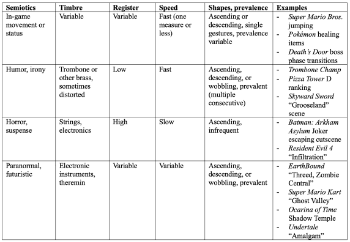
[0.6] The examples suggest there are four semiotic categories that are constructed by the specific characteristics of the glissandi, the broader context, and what the glissandi primarily signify: 1) in-game movement or status, 2) humor, usually through ironic juxtaposition, 3) horror and suspense, 4) the paranormal or futuristic. These semiotic categories are neither exhaustive nor mutually exclusive; rather, they represent the most common ways composers use glissandi for musical meaning in video games. The last three types indicate something about the transgressive power of glissandi, with pitch instability representing something unstable or unusual, which might be humorous, horrifying, or eerie and unfamiliar. As shown in Example 1, specific timbres, registers, speeds, and/or glissando shapes are often associated with each of these categories. There are important differences between the four categories, but the common thread between them suggests something noteworthy about the semiotic potentials and affordances of glissandi, which have historically been used in various musical traditions.
Example 1. Table summarizing compositional trends of glissandi in video games for each of the four primary semiotic categories
(click to enlarge)
[0.7] The next section of this article provides a more precise definition of glissandi and similar techniques. Following this, section 2 gives a historical overview of the glissando’s symbolic meaning in various musical contexts and discusses how glissandi have been neglected in traditional Western music theory because of their instability. Subsequent sections (3–6) analyze examples from each of the four semiotic categories of glissandi in video games, connecting the examples to historical and theoretical concepts.
1. Definitions of Glissandi and Related Techniques
[1.1] There are two main types of glissandi: continuous and discrete. For the purposes of this article, I am focusing on continuous glissandi, which are gestural pitch slides or bends that noticeably move in between pitches of the Western chromatic scale (or, as necessary, any other culturally defined scale system).(6) In some contexts this is called the portamento technique (particularly for vocalists and string players), and some musicians still distinguish between continuous glissandi and portamento, saying that portamento is a performance technique of sliding between two pitches, whereas glissandi are composed, “self-contained gestures” that are part of the musical structure (Leech-Wilkinson 2006, 237). Discrete glissandi, such as those that might be played on a piano or harp, differ in their use of fast, directional pitch gestures using distinct notes within a scale (rather than also navigating the spaces between). Although there are similarities between continuous and discrete glissandi, the differences are important. There is something about the transgression of the quantized pitch system that provides unique semiotic potential for humor, horror, and the paranormal. Discrete glissandi do exist in video game music (Atkinson 2019, [15], [17]), but when a composer or sound designer chooses to incorporate a continuous glissando, it is significant because it represents a higher degree of pitch instability.
[1.2] Two other techniques of pitch manipulation are similar to glissandi, but not quite the same. The first is short, slight pitch slides (subtle scoops or falls leading into or away from a distinct pitch), which are generally used as nuances for expressive performance practice, particularly for singers (Leech-Wilkinson 2006, 236–37). Although this is somewhat related to glissando techniques, I will not be discussing it in this study. I will, however, explore the wobble technique, in which pitches slide up and down quickly and repeatedly, like an extreme form of vibrato. This is not exactly a glissando, but pitch wobbles are used in similar ways to continuous glissandi in multimedia music. They often signify humor, with something in the story being comically out of place (just as the pitches are out of place between notes of the scale). They can also signify something out of place in a scary or uncanny way. Some examples of this will be discussed later in the article.(7)
[1.3] There are also other gestural techniques that do not involve pitch. These include crescendos, accelerations, filter sweeps or other timbral effects, and stereo panning changes or other spatial effects. All of these techniques, and continuous glissandi, can be grouped together under the term “continuous processes” (Smith 2021), since they involve continuous (rather than discrete) gestural movement. “Continuous processes” is a useful heuristic because at times, it is difficult to distinguish between different types of these gestures; for example, is a filter sweep on white noise a glissando with indefinite pitch? This article will mostly discuss glissandi, but at times other gestures or techniques will be considered when relevant to the analysis.
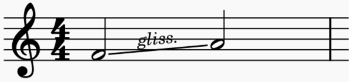
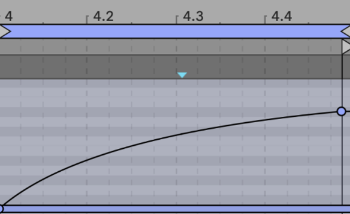
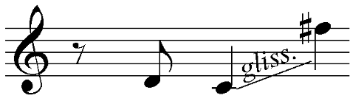
[1.4] Glissandi are difficult to notate and discuss precisely, at least using the traditional tools of music theory that put pitches into a quantized state. Example 2 demonstrates a common way of showing glissandi using traditional staff notation, but this format does not give any indication of the intended speed or slope (rate of change) for the glissando. Some video game music may use this type of notation for musicians that record soundtracks, but most music in video games is not solely reliant on staff notation, because digital tools have long been used to control the pitches in game scores. Today’s composers and sound designers can use software to precisely shape pitches, for example by dragging automation curves like the one in Example 3. This article uses various types of visual diagrams to represent the music in different ways.
Example 2. A common way of indicating a glissando in traditional staff notation
(click to enlarge) | Example 3. Automation curve made by the author in Ableton Live 11
(click to enlarge) |
2. The Semiotic History of Glissandi
[2.1] This section traces the semiotic history of glissandi, from Western common-practice music to early-twentieth-century band and circus music, to music in films, TV, and video games. As a musical technique, glissandi have probably been around for the entirety of music history, but since a complete history of glissandi is beyond the scope of this article, I will start by discussing the common-practice period. Due to their instability and seeming lack of control, glissandi in common-practice performances (frequently called portamento in this context) are often associated with human emotions (Leech-Wilkinson 2006, 236). In his book A History of Emotion in Western Music, Michael Spitzer says that portamento can represent many emotions (2020, 176, 379), but that one of the most common is disgust: “Portamento is disgusting because it slides across our categorical perception of pitch; the materiality of sound exceeds the discrete pitch categories in which we normally box it. This is one reason why the trombone is such an effective scatological or salacious instrument (see Verdi’s Falstaff)” (2020, 139). The surrounding context for this quotation is an analysis of Haydn’s “Joke” quartet in
[2.2] During the common-practice period continuous pitch slides were primarily associated with vocal performance practice (Leech-Wilkinson 2006, 233–34) and strings, especially the violin (Herbert 2010, 3). In the late-nineteenth and early-twentieth centuries, however, glissandi started to be used on the slide trombone, first as a “quasi-musical effect” in popular and lighthearted forms of entertainment such as the circus, then in the “classical orchestral” tradition (Herbert 2010, 3–6). The trombone glissando was also frequently used in popular band music of the time, when the technique was often called a “smear” (Prouty 2022, 390). “Smear solos” were a common feature of minstrel shows in early-twentieth-century America (Herbert 2010, 6). Trombone glissandi were also an important part of early jazz performance practice in the first few decades of the twentieth century (Prouty 2022, 389).
[2.3] Glissandi were used in early film music as well. They often directly correlated with specific events on screen, creating audiovisual congruity (Brown 1994, 107; Mazey 2023, 553; Platte 2023, 484). Sometimes this occurred as part of “mickey-mousing,” which is “the split-second synchronizing of musical and visual action” (Brown 1994, 16). Mickey-mousing often relies on what Juan Chattah calls the LINEARITY schema, with the “[PITCH FREQUENCY] IS [MOTION IN VERTICAL SPACE] conceptual metaphor” being particularly common (2023, 37). Furthermore, classic cartoons often used slide whistles or trombones to signify action or violence in a light-hearted, humorous way (Goldmark 2005, 64–67). Film music of the 1950s and 60s was also highly influential in associating certain types of glissandi with horror or the paranormal. Specifically, ascending glissandi in violins came to represent suspense and fear (Brown 1994, 174), while repeated glissandi in the theremin often represented eerie figures such as ghosts (Mera 2002, 104). The semiotic techniques described in this paragraph persist today in many films, TV shows, and video games, but the interactivity of games adds another dimension.
[2.4] The history of glissandi in video games specifically traces back to the capabilities, and limitations, of early game technology. Music for early video games (in the 1970s and 80s) often imitated early film music by using short snippets of common-practice pieces (Lerner 2013). Unlike film music, however, video game music relied on electronic instruments from the start. While composition was subject to certain technological limitations (such as relatively few sound channels), the reliance on synthesis allowed for innovative techniques like rapid arpeggios, which shaped the compositional style of video game music in general (Collins 2007; Newman 2021, 26). This also led to prominent use of glissandi, for example created through the SID chip in the Commodore 64 (Newman 2021, 26). Perhaps picking up on mid-century film-music conventions, early game composers often used the electronic timbres for glissandi to signify science-fiction or paranormal story elements. Juan Pablo Fernández-Cortés notes that on the original Nintendo Entertainment System (NES) glissandi were typically used “for the sounds of laser guns firing or flying saucers” (2021, 23).
[2.5] Today’s video game composers and sound designers have a much wider timbral palette at their disposal, and they can precisely shape glissandi using more sophisticated technology. For example, they can use physical or virtual knobs, sliders, and automation curves like the one in Example 3 to make continuous gestures sound exactly the way they want. Yet the way game composers typically use glissandi still relies on the semiotic history outlined in this section. The following sections of the article present analytical case studies, showing how the semiotic potential of glissandi is used in video game music and sound effects to support interactivity and the player’s understanding of the gameworld.
3. Glissandi Signifying In-Game Movement or Status
[3.1] As explained in the Introduction, after surveying over sixty distinct examples of glissandi in more than fifty different video games, I have found that composers and sound designers primarily use them in four semiotic categories. Each of these categories is generally associated with specific timbres, registers, speeds, and glissando shapes or directions, as shown in Example 1. The first category involves glissandi signifying in-game movement (e.g. jumping) or status (e.g. health increasing). These glissandi are usually short sound effects. They are often associated with player actions, and they are individual gestures, separate from the surrounding musical context. Many of them function as earcons, not to be confused with auditory icons. Both are types of sound effects that help users understand what a computer system or video game is doing, but auditory icons “capitalize on a relatively intuitive connection between a naturalistic sound and the action or object it represents,” whereas earcons are “constructed of pitches and/or rhythms” such as “brief tones or motives” and have abstract meaning that is learned by the user through the interactive process (Medina-Gray 2021, 180–81).(8)
[3.2] The glissandi in this category also participate in kinesonic synchresis. Michel Chion coined the term synchresis, and he describes it as “the spontaneous and irresistible weld produced between a particular sound event and a particular visual event when they occur at the same time” (2019, 64). KC Collins adapted Chion’s concept for video games, arguing that “interactive sound in games is kinesonically synchretic: sounds are fused not to image but to action” and “sounds are commonly used as feedback to acknowledge an event” (2013, 32).(9)
[3.3] There are three subtypes within this first category of glissandi. The first subtype uses mickey-mousing to signal in-game movement (usually a change in height) of a character or object. The second subtype uses glissandi to communicate the in-game status (such as health or energy) of a player or their equipment. Glissandi of the third subtype signal a transition to a new game state. From a production and design point of view, a “game state” corresponds to a specific mode of gameplay or set of circumstances, such as when the player is in a certain level, exploring freely, or battling an enemy (Kellman 2020, 20). Game states that last for an indefinite amount of time usually have their own musical cue that loops. An example of a glissando in this subtype would be one that signals a transition to a new in-game area.
[3.4] A classic example of the first subtype (mickey-mousing) is how ascending glissandi represent increasing height when Mario jumps in Super Mario Bros. (1985), as demonstrated by Zach Whalen (2004). Whalen discussed this effect in the original game, but this phenomenon occurs throughout many other games in the series as well.(10) Example 4 shows some of the author’s gameplay from Super Mario Bros. 3 (1988), and a transcription of the jumping sound (the rhythmic values and last pitch are approximated). The sound effect is the same as in the original Super Mario Bros., except that in the original game, the effect is one octave higher when Mario is small, signifying another aspect of physicality (Whalen 2004). Ascending glissandi also represent jumping in various games from the Sonic franchise, including the original Sonic the Hedgehog (1991), uniting the rival characters in at least one way. All these examples are earcons, because they are pitched sound effects that help players understand gameplay, with the relationship between signifier and signified being metaphorical and contextual (not based on real-world sounds of jumping).
Example 4. Video and accompanying transcription of the author’s gameplay from Super Mario Bros. 3 (1988, played on the Nintendo Switch virtual console), demonstrating ascending glissandi for Mario’s jump sound
(click to enlarge and watch video)
[3.5] The relationship between the harmonic context of the musical underscore and the pitch of glissando sound effects is also an avenue for analytical exploration. It is worth noting that the pitch-class D’s shown in Example 4 fit diatonically with the background music in C major. Elizabeth Medina-Gray (2019) studies such relationships between musical modules in video games, analyzing degrees of modular smoothness or disjunction. For the level played in Example 4, she might say that the glissandi’s persistence on the supertonic creates a good chance for modular smoothness or only slight disjunction, because the supertonic creates only a “soft dissonance” with most chords in the piece (frequently tonic or subdominant chords), and is consonant with the dominant chord (as heard at 0:02) (Medina-Gray 2019, [28–29]). Most of the music for this game (Super Mario Bros. 3) uses functional harmonic progressions in C major or closely related keys, so there will be a similar probability of smoothness or slight disjunction when Mario jumps throughout the game. If the glissandi were on the tonic pitch, however, there would be too much smoothness between the layers, such that the music and sound effects would often blend perceptually and not be distinctive enough to maintain player attention (Plank 2021, 290–91).
[3.6] Descending glissandi can also be used as earcons that represent in-game height. Another aspect of many games in the Super Mario series is the flagpole at the end of each level. The higher the character lands on the flagpole, the higher score a player will get. As Mario slides down the pole, typically a flag slides up to the top (though in some games or levels the flag slides down along with Mario). In the original Super Mario Bros., both Mario and the flag slide down the pole, but this is accompanied by an ascending glissando, correlating with the movement of the digits representing the score earned for how high the character landed on the pole. In most subsequent games, however, there is a descending glissando, correlating with the movement of Mario (see Example 5).(11) Perhaps the change was made in an attempt to increase the player’s sense of connection with their character, by correlating the meaning of the sound with the playable character. A similar example from a different franchise is when a descending glissando represents fruit falling from a tree in Animal Crossing: New Horizons (2020). There are also countless other examples of ascending or descending glissandi representing movement in vertical space in similar ways, such as a descending glissando when Link falls down a hole in The Legend of Zelda: Ocarina of Time (1998). These instances rely on the LINEARITY schema described earlier (Chattah 2023, 37).
Example 5. Video and accompanying transcription of the author’s gameplay from Super Mario Maker 2 (2019), showing completion of a user-generated level using the graphics from Super Mario 3D World

(click to enlarge and watch video)
[3.7] The glissandi in this first subtype use mickey-mousing, a technique which originated in film scoring. However, they also highlight the interactive nature of video games. In his discussion of the jumping glissando and other sound effects in Super Mario Bros., Tim Summers states: “Such synchronized musical responsiveness rewards player interaction and, in reacting to the player’s actions, apparently plays with the gamer” (2016, 193, emphasis in original). This is the essence of kinesonic synchresis as described by Collins, and it helps players understand the gameworld.
[3.8] Another common way glissando sound effects are used in games is to indicate the in-game status of a player or their equipment, such as a change in a character’s health or energy level (Fernández-Cortés 2021, 22). For these instances, ascending glissandi are earcons representing something increasing or getting better, and descending glissandi are earcons representing something decreasing or getting worse (from a gameplay point of view). Ascending glissandi for health increases are often heard in the Pokémon franchise, specifically when an item is used to heal one of the player’s Pokémon. Example 6 shows some of the author’s gameplay of Pokémon Sword (2019), along with a transcription of the healing sound effect with approximate rhythmic values.(12) Furthermore, ascending glissandi are sometimes used to indicate a character’s equipment recharging, such as in the Halo series when a player charges their plasma rifle or shield.
Example 6. Video and accompanying transcription of the author’s gameplay from Pokémon Sword (2019), demonstrating ascending glissandi for the healing items of “revive” and “potion”
(click to enlarge and watch video)
[3.9] The third subtype of glissandi in this category are those that signal a transition to a new game state. In these cases, the directional pitch slide, in between discrete pitches, correlates with the change between different game states. For example, a glissando can signify a transition to a new level or scene within the game. Like the first subtype of mickey-mousing, this technique has its origins in film music, which often uses musical gestures to indicate transitions between scenes , but the unique aspect in video games is that the player controls when the transition occurs.
[3.10] In the game Death’s Door (2021), a glissando combines with a crescendo to mark the transition between phases of the Frog King boss fight. Once the player lands enough attacks in the first phase, the game transitions to the more difficult second phase, which is marked musically by the introduction of orchestral instruments. The specific techniques used for this transition are helpfully explained in a video made by the game’s composer David Fenn (2021). As soon as the last in-game hit/attack of phase one happens, orchestral drums come in, and a glissando as well as crescendo starts (in the video, Fenn just calls it a crescendo). The glissando ascends approximately two octaves on a dissonant string chord, with a variable interval and length of time based on when exactly the final attack happened. Visually, the glissando correlates with the bubbles when the Frog King is in the water. Following this, there is a spoken grunting sound when the frog jumps out of the water, which acts as an anacrusis to the downbeat of phase two when loud orchestral instruments come in. The way this transition unfolds is reminiscent of buildup-drop techniques in electronic dance music (EDM), particularly because of the anacrustic jump sound (Smith 2021, [3.11]). Although the glissando in this scene does not represent a specific action like jumping or healing, and it is not an earcon because it only happens once in the game, it still belongs in this semiotic category because it signifies a change in the game’s status, and the player finishing the first phase of the boss fight.
[3.11] The semiotic potential of the glissando sound effects in this category primarily relies on “configurative signs” (Hart 2024, 791). These are signs that can only be understood because of the specific in-game context, rather than “musical signs” such as a fast tempo being energetic or a long tonic arrival being restful, which are embedded in the musical structure, though still culturally contextual. It could be argued that the ascents and descents in the glissandi signify something on their own, but whether ascending glissandi signify jumping, healing, or something else depends on configurative signs within the game. Regardless, these gestural sound effects provide signals that can help players understand the game and be successful at it.
4. Humorous Glissandi
[4.1] The second semiotic category of glissandi in video games is humor. Glissandi in this category primarily signify something funny, usually through irony or parody. Theories of humor suggest that it is caused by violation of expectations (Mera 2002, 91). Yet, as David Huron says, “not all violations of expectation lead to laughter” (Huron 2006, 287). Other factors play a role, including the “magnitude of violated expectation” (287) and the sociocultural context (288). Through his study of Peter Schikele’s performances, Huron identifies nine techniques for musical humor. The ones most relevant to this article are “incongruous sounds,” “mixed genres,” “incompetence cues,” and “incongruous quotation” (284–86). In these situations, humor arises from something being not quite right or out of place, which fits with the instability of glissandi.
[4.2] The examples I will discuss in this section all use glissandi within the context of tonal music (broadly construed), and most involve the unique timbre of the trombone. These two characteristics are humorous because of semiotic history dating back to Western common-practice music. Firstly, the tonal setting is important because in this context the glissandi go against the “keyboardification” essential to the epistemology of tonal music (Dolan 2012, 7). Secondly, recall that in common-practice music Spitzer claims the trombone is a “scatological or salacious instrument” due to its ability to slide between discrete pitches (2020, 139). This association made its way into film and video game scores too; Miguel Mera argues the trombone is one of several “funny” instruments that are used as “jokers” in film music (2002, 102). The examples in this section show that video game composers are continuing this semiotic history while also tying the glissandi to the interactive aspects of video games.
[4.3] One game that demonstrates this is the rhythm action game Trombone Champ (2022). When it was initially released Trombone Champ went viral, with multitudes of people laughing at its musical gameplay. In the game players use a mouse or motion controls to play as an avatar trombonist, aiming to match the pitch and rhythm with the scrolling score. Video Example 1 shows some of the author’s performance of “Eine Kleine Nachtmusik” (the trap remix).
Video Example 1. Excerpt of the author’s gameplay from Trombone Champ, the level “Eine Kleine”
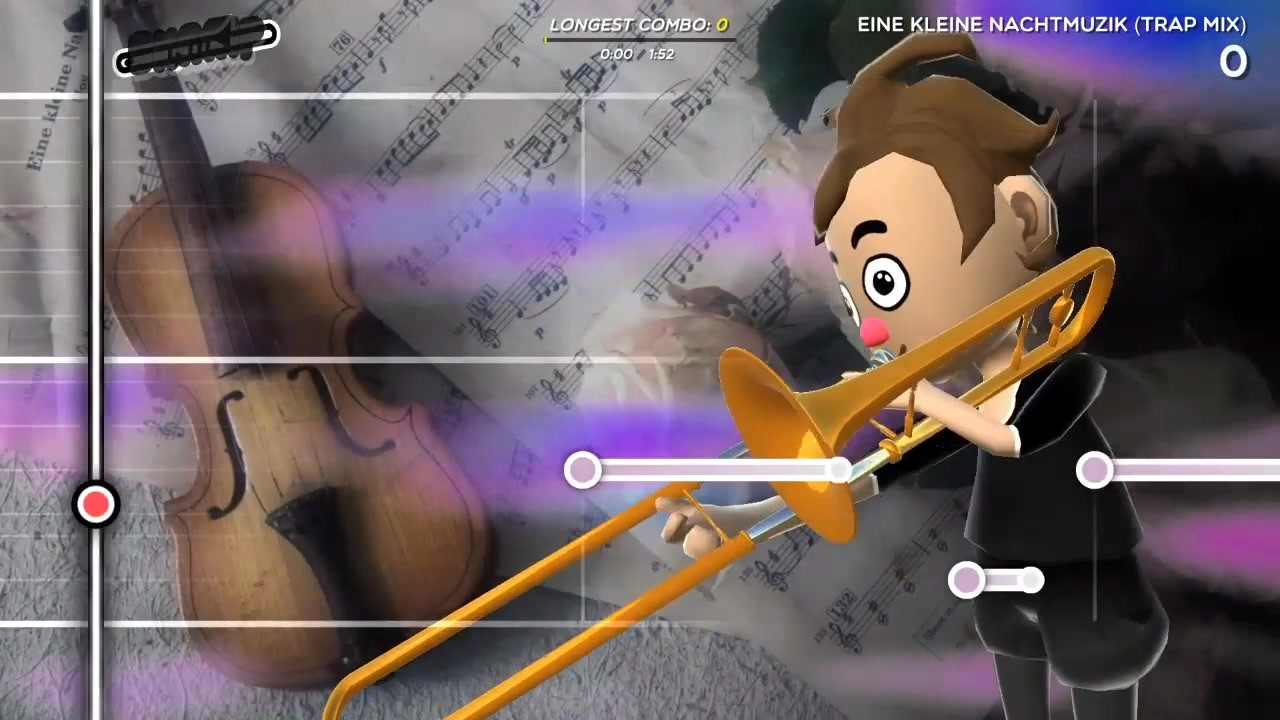
(click to watch video)
[4.4] Trombone Champ’s creator Dan Vecchitto purposely designed the game to be as humorous as possible, saying “My ethos for this game was: if it’s a funny idea, do it” (Dinsdale 2022). Many components of the game contribute to its humor, such as its avatar animations, its jokes displayed on loading screens, and its unlockable cards that mostly describe parts of the trombone, performance techniques, or composers for trombone. Notably, one of the unlockable cards defines the glissando, and another describes the slide of the instrument, saying: “This is the funny part of the trombone that goes in and out. Note goes up, note goes down. Without this, you don’t have a trombone
[4.5] The music in the game is arguably humorous because of ironic juxtaposition. Specifically, Trombone Champ’s music exhibits the second element of musical irony outlined by John Sawyer, “a contradiction, dilemma or incongruity between the two meanings” (Sawyer 1999, 532).(13) Most of the game’s repertoire is common-practice Western music, or well-known songs like “Happy Birthday.” This repertoire from the public domain comes with cultural associations and expectations. Humor is created through the contrast between those expectations and the music presented in the game. For example, some levels of the game (such as the one in Video Example 1) combine classical music with pop drumbeats, creating humor through “mixed genres” (Huron 2006, 284). Classical music is also expected to be precise and polished, but the high difficulty of Trombone Champ, and the many glissandi added to its scrolling scores, makes this almost impossible to achieve, creating humor through “incompetence cues” (Huron 2006, 286). This brings the “superiority theory” of humor into play, which says that that the person laughing has an “an enjoyable feeling of superiority to the object of amusement” (Lintott 2016, 347). Players of Trombone Champ may initially feel that this silly game is beneath them, but the high difficulty level results in the player becoming the butt of the joke. This may be felt particularly strongly if the player considers themself a musician.
[4.6] A similar example is the association between the trombone and the character Lanky Kong in Donkey Kong 64 (1999).(14) In the game, each of the different player-characters uses a musical instrument for one of their abilities, and Lanky’s instrument is the trombone. The music he plays prominently features glissandi, and the song “DK Rap” (which plays when starting up the game) features trombone glissandi during the segment about Lanky. The sliding pitch movements map well onto the character’s physical flexibility, but the lyrics about him in the “DK Rap” also suggest a connection between the trombone and something lacking in grace. The full lyrics are: “He has no style, he has no grace. This Kong has a funny face! He can handstand when he needs to, and stretch his arms out, just for you. Inflate himself just like a balloon. This crazy Kong just digs this tune!”
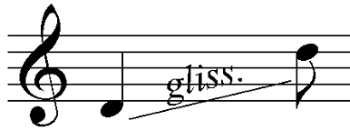
[4.7] Another game that uses glissandi for ironic juxtaposition is the indie game Pizza Tower (2023). This highly acclaimed two-dimensional platformer’s soundtrack, by first-time game composers Mr. Sauceman and ClascyJitto, uses various styles such as jazz, funk, rock, and house music. Glissandi are mostly absent from the game’s score, but they feature prominently in one particular aspect. Each time a player completes a level, they get a rank based on their performance. The music for achieving a D rank (the worst possible rank) contains many glissandi, while the music for higher ranks contains none. This is demonstrated in a compilation video with the audio and visuals for each rank (SPAZZ! 2023). Example 7 shows a transcription of all the ranking cues, and Example 8 shows a DAW recreation of the glissandi with an automation curve, reflecting the likely method of creation.(15) Example 8 is still imprecise, because the slope of the curve is more variable than shown here (I do not have access to the composer’s files), but this type of visual is a more accurate representation of the continuous pitch movement than the discrete, quantized notation of Example 7.
Example 7. Transcription of the ranking music from Pizza Tower (2023)
(click to enlarge) | Example 8. DAW recreation of the glissandi for the end of the D-rank music in Pizza Tower (created using Ableton Live 11)
(click to enlarge) |
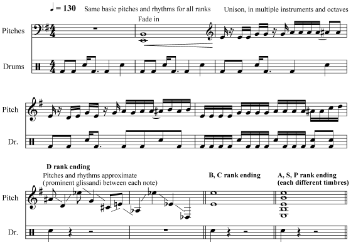
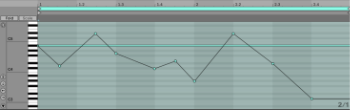
[4.8] Although the music for the D-rank is not as overtly humorous as Trombone Champ, the glissandi still make the music silly and lighthearted. They contrast with the stable pitches preceding them and deny the expectation of resolution to the tonic of E minor. Indeed, as shown in Example 7, the perceived boundary pitches the composer chose for the glissandi bear no resemblance to tonally important pitches in the established key. As with the Trombone Champ example, the glissandi in Pizza Tower create musical humor through “incompetence cues” (Huron 2006, 286), which signify to the player that they did not perform well. This gives the impression of the game laughing at or poking fun at the player.
[4.9] Humor is also frequently signified through pitch wobbles. As discussed previously, wobbles may not technically be examples of glissandi, but there are not hard boundaries between the two concepts. Wobbles could be considered particularly fast glissandi, or just an exaggerated version of vibrato, but they at least fall under the same broad category of techniques as glissandi because the pitch continuously slides in and around the discrete pitches of the scale. In many games of the well-known Mario Kart series, pitch wobbles are used humorously for the lightning effect. When a player’s character gets hit by lightning, they become smaller and slower, but the music also changes to indicate something negative in a light-hearted way. Specifically, an extreme vibrato effect is applied so that each note sounds wobbly.
[4.10] Example 9 shows an example of a character getting hit by the lightning item on the “Mario Kart Stadium” level from Mario Kart 8 Deluxe (2017), along with a transcription and a DAW recreation highlighting the change between the musical states before and after the lightning strike.(16) When the lightning effect is applied, each pitch wobble has a three-semitone range, meaning the interval from the bottom to the top of the wobble/wave is three semitones. As far as I can tell, this is true for all cases in this game. The rate of the wobble/vibrato seems to be approximately one eighth note for a complete cycle (from the start of the note to the return of the initial pitch), though it is not precisely quantized to the metric grid of the music. Note lengths always stay the same, whether the lightning effect is applied or not, so the wobble effect is more noticeable for long notes and hardly present for staccato notes. As with the Pizza Tower D-rank example, the wobbly pitch for the lightning effect signifies something humorous by transgressing discrete pitch boundaries and seeming out of place, in contrast to the tonal music that typically accompanies the fun races.
Example 9. Video of the author’s gameplay for “Mario Kart Stadium” from Mario Kart 8 Deluxe (2017), along with a transcription of the melody and DAW recreation of mm. 3–4 in the transcription, approximating the pitch wobbles
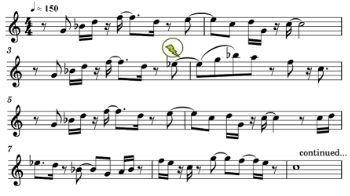
(click to enlarge, view the rest, and watch video)
[4.11] Each of the games discussed in this section so far could be described as lighthearted and silly, with very few serious story elements. However, glissandi or pitch wobbles can also be used for humorous moments in longer games with more serious and complex plots. For example, in The Legend of Zelda: Skyward Sword (2011), when the protagonist Link’s childhood bully Groose first encounters the surface world, he decides to call it Grooseland, showing his penchant for arrogance (see Example 10). The music transforms Groose’s theme to make it more humorous, slowing down the normal vibrato and expanding its pitch range to a comically wide level. In the absence of any audible dialogue, this wobbling technique has vast semiotic weight. It almost seems as if the game designers want Link (and the player) to sarcastically roll their eyes. The pitch wobbles are a sign made by the composer, meant to be interpreted by the player so that that they identify with Link’s bemusement.
Example 10. Video and accompanying transcription of the author’s gameplay for the “Grooseland” cutscene from The Legend of Zelda: Skyward Sword (2011, played on 2021 HD remake)
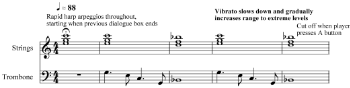
(click to enlarge and watch video)
5. Horror and Suspense
[5.1] Another semiotic category of glissandi in video games relates to horror. Specifically, this category signifies tension and suspense, as opposed to the eerie or uncanny, which will be discussed in the next section of the article. Glissandi for horror are very different than those used for humor. Generally, they are in games that are purportedly more serious, or for older intended audiences, including (but not limited to) those in the survival horror genre. In horror games the music often lacks clear melodies, forming instead just one part of an ambient soundscape, perhaps with some dissonant harmonies or driving rhythm when the player faces enemies. Occasionally, however, there will be salient pitch gestures such as glissandi. Composers typically use slow, ascending glissandi, often on string instruments in a high register, to try and create feelings of horror or suspense in players. The use of salient gestures rather than clear melodies is part of a broader compositional practice in horror games, in which music and sound effects are crucial signifiers for a player’s understanding of the game because visual details are often obscured (Roux-Girard 2010, 192–93).
[5.2] String instruments playing dissonant chords in a high register have long been associated with scary things. A famous example in film music is the shower scene from Psycho (1960). Glissandi in this category usually take those dissonant chords and ascend continuously to create even more tension. This is frequently heard in movie trailers, too. An example featuring several ascending glissandi is a trailer for The Inheritance (Brugués dir. 2024). Video game composers have inherited many aspects of film scoring and often employ this technique for suspenseful scenes in games (Kellman 2020, 63). This is especially common during “cutscenes,” which show narrative developments when players are not in control of the character(s). Players are often highly invested during cutscenes, however, because they can learn crucial plot details. During cutscenes, composers have the freedom to precisely time long glissandi, creating tension that is released at specific moments.
[5.3] One clear example comes from the action-adventure game Batman: Arkham Asylum (2009). Example 11 shows part of a cutscene near the beginning of the game when the Joker villain escapes. Glissandi in the high strings pervade this scene, signifying tension and instability leading up to the escape. At first, they are in the background of the texture (the “mix”), with the low-brass melody in the foreground. This melody also contributes to the tension of the scene due to its pitch structure (an octatonic subset), metric structure, timbre, and articulation style. Right before the climax of the scene the glissandi come out of the musical background and crescendo, followed by a loud “stinger” chord. The Joker then headbutts a guard and takes control of the situation, while a new melody starts with the full orchestra in octaves at a faster tempo. A spectrogram of the scene is also presented in Example 11, with the ascending glissandi showing up clearly (particularly in the middle) because of their high register.(17)
Example 11. Video of the author’s gameplay from a cutscene during Batman: Arkham Asylum (2009), along with a transcription of the low-brass melody and a spectrogram of the video

(click to enlarge, view the rest, and watch video)
[5.4] The music in this scene creates suspense by signaling something malicious before it even happens, correlating with Batman’s expressed skepticism: “He surrendered almost without a fight. I don’t like it.” Players may consciously or unconsciously pick up on these musical signals, but suspense is created because the timing of the scene is uncertain. When composers use long, drawn-out glissandi in this way during cutscenes, they create suspense by controlling the timing so that it is unclear when the climactic moment—marked by the end of the glissandi and a loud chord—will happen. This is part of a broader compositional style for horror games, characterized by anticipation and uncertainty (Roux-Girard 2010, 203–5).
[5.5] Similar techniques can also be used outside of cutscenes. Ascending glissandi can still signify horror or suspense when embedded into background music (underscore) for various game levels. This often happens in the Batman: Arkham game series, and another example can be found in one of the most well-known survival horror games, Resident Evil 4 (2005). The Resident Evil franchise is known for its terrifying creatures, and this game is no exception (Fernández-Cortés 2021, 31). Ascending glissandi play an important role in “Infiltration,” a piece from the game’s soundtrack that plays when the protagonist Leon infiltrates certain areas such as “The Island.”(18) The track loops as necessary when the player is initially exploring the island, with the glissandi contributing to a dark, foreboding atmosphere. During the battle sequences on the island, the music changes to a faster, more energetic track with prominent hand drums.
[5.6] Example 12 shows a spectrogram from the beginning of “Infiltration” and includes an audio excerpt. This piece mostly lacks clear melodies, instead using melodic fragments, a bass drone, ambient sound effects, and driving rhythms in the percussion. The glissandi in the high-register strings are just one element of the complex texture, but they add to the horror communicated by the piece due to their semiotic history in film music. Like the Batman: Arkham Asylum example, the glissandi in “Infiltration” occur on dissonant chords, so that the dissonance is maintained throughout the gesture. Another similarity is that the interval of ascent for each glissando is small (approximately two or three semitones), and they are drawn out over several seconds, meaning that the slope of each one is not very steep compared to glissandi in other semiotic categories.
Example 12. Spectrogram and audio excerpt from “Infiltration” on the Resident Evil 4 original soundtrack (2005)
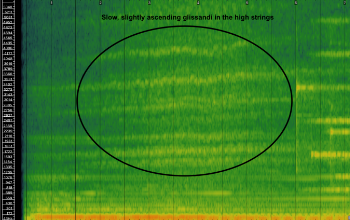
(click to enlarge and listen)
[5.7] The glissandi studied in this section signify horror and suspense for many reasons that involve both “musical signs” and “configurative signs” (Hart 2024, 791). In addition to their dissonant sonorities and surrounding musical context, they ascend in pitch, have a high register, and are often foregrounded in the mix. Studies in music cognition show these are all tension-inducing musical characteristics (Huron 2006, 326; Plank 2021, 286–87). These examples of glissandi being used for horror are quite different from those used for humor discussed earlier. Yet for both humor and horror the glissandi contribute to the player’s understanding of the game by indicating something uncomfortable, unstable, or out of place.
6. The Paranormal
[6.1] In some contexts, however, glissandi signify something else by not being out of place. Some types of games or levels have many glissandi that seamlessly fit into an electronic-music style, which in media is usually associated with the paranormal, supernatural, or futuristic. Again, we can make a connection between video games and film scores, with electronic glissandi being associated with the paranormal or science fiction in both media. In film music, electronic instruments (particularly the theremin) have often been linked with aliens and ghosts since at least the 1950s (Mera 2002, 104). One of the most influential films in this regard is The Day the Earth Stood Still (1951), which features many glissandi on the theremin in Bernard Herrmann’s score. Yet this association in video game music is also partially due to technological limitations in early games, and their legacy in game scoring. As mentioned previously in the semiotic history section, early video game audio in the 1970s and ’80s depended upon synthesized electronic sounds. Game designers often used glissandi with those electronic timbres to indicate something paranormal or futuristic such as “laser guns firing or flying saucers” (Fernández-Cortés 2021, 23).
[6.2] Most of the examples in this section are arguably examples of the ombra topic.(19) Ombra is Italian for shade or shadow, and the ombra topic represents something supernatural in a way that is eerie, mysterious, and unsettling (McClelland 2014, 279–80; Ayers 2024, 314). Although these pieces do not exhibit all of the characteristics Clive McClelland identified in his analysis of ombra in classical operas (for example a slow tempo), they do meet some of the criteria (such as dissonant chromatic harmony) and provide the same aesthetic atmosphere. These examples also highlight the slippery nature of the third and fourth semiotic categories of glissandi. The pieces are all associated with the paranormal in their games, and they use glissandi in a way that is more aligned with eeriness than suspense (repeated glissandi rather than individual ascending gestures), yet they also incorporate aspects of horror due to elements of uncertainty.
[6.3] Electronic glissandi permeate the soundtrack of EarthBound, a sci-fi RPG released for the Super Nintendo in 1994. They are particularly salient in the music for the city of Threed, which has been infested by zombies. The beginning of the track is transcribed in Example 13. The initial glissandi (mm. 1–2), which signify sirens through resemblance (iconicity), ascend approximately a perfect fifth (the precise pitches are difficult to describe) over a quartal chord, D–G–C. Rhythmically, it seems as if the glissando layer uses eighth-note triplets or quintuplets due to the electronic tremolo effect. These glissandi ascend for the entire duration of a half note, with no significant “landing place” at the end. The subsequent glissandi (mm. 3–6) are clearer in pitch and rhythm, ascending in octaves and landing on a stable pitch for the second half of the measure. The other layers in the texture have a tonal center of C, with secondary emphasis on
Example 13. Transcription and audio excerpt of “Threed, Zombie Central” from EarthBound (1994)
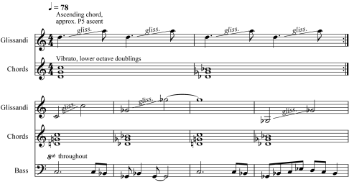
(click to enlarge and listen)
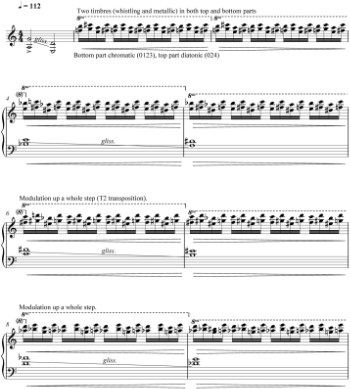
[6.4] An example specifically associated with ghosts comes from the “Ghost Valley” level in Super Mario Kart (1992). This piece is from the original game in the Mario Kart series on the Super Nintendo. It is similar to the Ghost House theme from Super Mario World (1990), and it would later be remade for Mario Kart Wii (2008). Example 14 shows a transcription for the first section of the track. This cue has many descending glissandi on dissonant harmonic intervals such as minor sevenths and tritones. Starting in m. 4, each glissando lasts for slightly longer than a whole note and settles into its new pitch after a semitone slide. Each one also corresponds with a crescendo and diminuendo, in tandem with the sixteenth notes above.
Example 14. Transcription and audio excerpt of the “Ghost Valley” music from Super Mario Kart (1992)
(click to enlarge and listen)
[6.5] The top staff in Example 14 shows high sixteenth notes that add a sense of urgency to this music for a racetrack. The top layer shown is a diatonic subset (a pitch-class set with (024) prime form), which could be heard as ––– in isolation. This contrasts with the bottom layer, a chromatic subset (a pitch-class set with (0123) prime form). Both layers are doubled with two timbres, a whistling sound and a metallic sound like a glockenspiel. The relationship among mm. 4–5, 6–7, and 8–9 also adds to the expressive nature of the cue. Specifically, each two-measure segment is a whole step higher than the previous one (a T2 transposition), in a manner reminiscent of what Robert Bailey describes as “expressive tonality” in Richard Wagner’s music (Bribitzer-Stull 2006, 322). In this cue for “Ghost Valley,” the glissandi contribute to the “spooky” nature of the music, which works well in a lighthearted setting (as opposed to a horror game). Other ghost levels in Mario Kart games (and Mario games in general) use related techniques for a similar effect. For example, “Twisted Mansion” in Mario Kart 8 uses pitch wobbles in a synthesized theremin layer that has the primary melody.
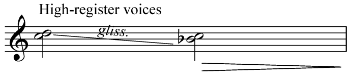
[6.6] Another common way of signifying the paranormal in multimedia contexts is with “ghostly voices.” These voices often just sing vowel sounds, and frequently slide between pitches using glissandi. One cue that features many glissandi in this style is the music for the Shadow Temple in The Legend of Zelda: Ocarina of Time (1998). Example 15 shows a short clip of the author’s gameplay, along with a transcription of the high-register voices at 0:12 and 0:23 in the video. This music has a thin texture, with only ambient sounds, light drums, and the synthesized ghostly voices. There are low-register and high-register voices, which generally alternate during the piece and often feature glissandi. The glissandi are usually only descending but sometimes descending then ascending. Both the low-register and high-register voices have multiple layers that move in parallel motion. There is also a sound effect with an ascending glissando at 0:20 in the video. The Temple of Time music from this same game also uses the “ghostly voices” sound, but for a melody with clear, stable pitches. This shows that the synthesized choral timbre is not always associated with the paranormal, though it does have an uncanny, mysterious sound, which pairs well with glissandi to indicate something otherworldly.
Example 15. Video and accompanying transcription of the high-register voices (0:12 and 0:23) in the author’s gameplay from The Legend of Zelda: Ocarina of Time (1998, played on the Nintendo Switch virtual console version)
(click to enlarge and listen)
[6.7] All the examples discussed in this section so far are from games released in the 1990s. During this time period, audio technology for video games was still somewhat limited, primarily relying on MIDI sounds (Fritsch 2013). More recent games have a greater variety of electronic sounds at their disposal, and this is reflected in how the paranormal or futuristic are signified too. Some games continue the tradition of using theremin or “ghostly voice” timbres for this purpose, including Undertale (2015), Celeste (2018), and Hades (2020). However, many sci-fi games in the twenty-first century (for example the Half-Life series) signify the paranormal or futuristic using electronic dance music (EDM). This reflects not only greater technological capabilities and memory capacity compared with twentieth-century games, but also the increased popularity of EDM and digital production tools for pop music in the twenty-first century (Brøvig-Hanssen and Danielsen 2016). As relates to this article, glissandi are a common technique employed in EDM, through the use of knobs, sliders, or automation curves (Smith 2021).
[6.8] Some video games use EDM in a fairly neutral way semiotically, such that it does not signify something extramusical. For example, the Sound Voltex series of rhythm games allows players to turn knobs and press buttons like a DJ. In the context of musical performance, the glissandi simply signify EDM itself, through a standard performance technique. When EDM is used in games that are not otherwise saturated with it, however, it is often associated with the futuristic or paranormal, particularly during battles or chase scenes involving enemies. For example, in Undertale, which was heavily inspired by EarthBound, the piece “Amalgam” from the soundtrack occurs when encountering a new enemy type, “amalgamates,” near the end of the “true pacifist route.”(20) The amalgamates are highly unusual in the game, demonstrating paranormal abilities and characteristics compared to other monsters; they are invincible and do not disappear in the usual way. “Amalgam” uses ascending glissandi frequently in its second half, with examples at 0:48 and 0:58. As with the examples from EarthBound and Super Mario Kart discussed in this section, the repeated glissandi fit seamlessly into the electronic style, rather than standing out as one-off gestures. This section has shown that glissandi are often an important part of music that signifies something paranormal, which is to say beyond human capability or “out of this world.”
7. Conclusion
[7.1] This article has investigated the functions of glissandi in video games, arguing that they help players understand the gameworld and the game’s story by drawing on long-standing semiotic associations to correlate musical meaning with in-game events, settings, or narratives. Based on the examples analyzed (and many others I have found),(21) most glissandi in video games can be placed in at least one of these four semiotic categories, primarily signifying: 1) in-game movement or status, 2) humor, usually through ironic juxtaposition, 3) horror and suspense, 4) the paranormal or futuristic. The examples that inform this theory come from a variety of games spanning multiple decades, consoles/platforms, and game genres.
[7.2] There are, however, many more games to be studied, and it would be worthwhile to investigate the semiotics of glissandi for more games, particularly those developed in non-Western countries other than Japan. The ideas in this article are based on interpretations of glissandi from a Western perspective, with pitches in between notes of the chromatic scale and a tuning standard of equal temperament. Many other scales and tuning systems exist, though, and some of them inform the musical compositions and performances used in certain games or levels. Some pitch movements that I interpret as glissandi may not be interpreted as such by practitioners of various global music traditions used in game scores, and this should be acknowledged when analyzing music from those traditions. One piece that could be analyzed for future research is “Jungles of Gongaga” from the soundtrack of Final Fantasy VII: Rebirth (2024), which seems to incorporate glissandi into a mix of Western and non-Western elements. I welcome further research into the role of continuous pitch movements in music from many repertoires and performance traditions around the globe.
[7.3] In the initial stages of this research project, the hypothesis was that glissandi are often used in video games to communicate humor or horror. This turned out to be true, but over the course of more than sixty examples, I also discovered other compositional trends. Recall Example 1, which presents a summary relating to the four primary semiotic categories. Glissandi that signify in-game movement or status do not have characteristic timbres or registers, but they are relatively fast (one measure or less), are single gestures, and can be either ascending or descending. Since they are usually sound effects, their prevalence in the game varies for each individual play session. Glissandi used for humor are often associated with brass instruments in a low register, particularly trombone. They are fast, are frequent, and can be any shape, but often include both ascending and descending parts, sometimes as a wobble effect. When used for horror or suspense, glissandi are usually only ascending and slowly drawn out in the high-register strings. They are relatively infrequent (not prevalent), saved for special moments to heighten tension. Finally, glissandi used to indicate something paranormal or futuristic use distinctly electronic timbres and are prevalent, though they can have variable register, speed, and shape.
[7.4] Notably, some examples fall under multiple semiotic categories. The ascending glissando signifying the boss-phase transition in Death’s Door is related to game status, but it also has most of the characteristics associated with the horror category. It does occur relatively fast, however, and unlike most glissandi for horror or suspense, it serves as a sound effect rather than something embedded into the musical score. Trombone Champ features many glissandi throughout gameplay, with humor being their primary purpose as explained by the game’s creator, but they also are directly correlated to in-game movement. There is also some overlap between the horror and paranormal categories (as discussed above), but the differences are significant enough to make the analytical categories distinct.
[7.5] Finally, there are also some game-soundtrack glissandi (or at least, short pitch scoops, bends, or wobbles) that do not fit clearly into any of the four primary semiotic categories. Some of these, such as the ones in “Slinger’s Song” from Bastion (2011), involve slides on a steel guitar or resonator guitar. This piece is played in a style reminiscent of the “Spaghetti Western” topic (Chattah 2023, 106), which fits the broader, cowboy-inspired themes of the game. Perhaps there is another semiotic category to be studied here, although I did not find many examples of this phenomenon. The four primary categories outlined in this article still provide a useful overview of the way glissandi typically function in video game music. The categories are often utilized such that the glissandi are signs made by the game’s composers or designers, with the goal of strengthening interactivity, helping players understand the game, and making players feel more connected with the gameworld and story.
[7.6] Ultimately the theoretical approach in this article is a heuristic one, generalizing characteristics of glissandi that are commonly associated with different in-game functions, narratives, or characterizations. It would be worthwhile to study each of these semiotic categories individually, but the common thread between them, namely the use of glissandi, is one important aspect to consider when analyzing musical meaning in video games. Timbre and register, as well as harmonic context and rhythm, are relevant, but they are not the only signifiers going on here. There is something about the pitch instability of glissandi that provides a unique contribution to the video game player’s experience.
Jeremy W. Smith
The Ohio State University
Timashev Family Music Building
1900 College Rd., Columbus, OH 43210
smith.15851@osu.edu
Works Cited
Agawu, Kofi. 2009. Music as Discourse: Semiotic Adventures in Romantic Music. Oxford University Press. https://doi.org/10.1093/acprof:oso/9780195370249.001.0001.
Atkinson, Sean E. 2019. “Soaring Through the Sky: Topics and Tropes in Video Game Music.” Music Theory Online 25 (2). https://doi.org/10.30535/mto.25.2.1.
Ayers, William R. 2024. “How Video Game Music Plays Us: Musical Topics, Modularity, and Compulsion Loops.” In The Oxford Handbook of Video Game Music and Sound, ed. William Gibbons and Mark Grimshaw-Aagaard, 308–25. Oxford University Press. https://doi.org/10.1093/oxfordhb/9780197556160.013.11.
Bribitzer-Stull, Matthew. 2006. “The End of ‘Die Feen’ and Wagner’s Beginnings: Multiple Approaches to an Early Example of Double-Tonic Complex, Associative Theme and Wagnerian Form.” Music Analysis 25 (3): 315–40. https://doi.org/10.1111/j.1468-2249.2006.00245.x.
Brøvig-Hanssen, Ragnhild, and Anne Danielsen. 2016. Digital Signatures: The Impact of Digitization on Popular Music Sound. MIT Press. https://doi.org/10.7551/mitpress/10192.001.0001.
Brown, Royal S. 1994. Overtones and Undertones: Reading Film Music. University of California Press. https://doi.org/10.1525/9780520914773.
Brugués, dir. 2024. The Inheritance, Trailer #1. Paul Schiff Productions. https://www.youtube.com/watch?v=ga3I1_dQEQU.
Chattah, Juan. 2023. Film Music: Cognition to Interpretation. Routledge. https://doi.org/10.4324/9780429504457.
Chion, Michel. 2019. Audio-Vision: Sound on Screen. 2nd English ed. Translated by Claudia Gorbman. Columbia University Press. https://doi.org/10.7312/chio18588.
Collins, Karen. 2007. “In the Loop: Creativity and Constraint in 8-Bit Video Game Audio.” twentieth-century music 4 (2): 209–27. https://doi.org/10.1017/S1478572208000510.
—————. 2013. Playing with Sound: A Theory of Interacting with Sound and Music in Video Games. MIT Press. https://doi.org/10.7551/mitpress/9442.001.0001.
Cook, Karen M. 2023. “Playing with Fire (and Other Natural Disasters): The Sounds of Climate Change in Sid Meier’s Civilization VI: Gathering Storm.” Music and the Moving Image 16 (3): 43–58. https://doi.org/10.5406/19407610.16.3.04.
Dinsdale, Ryan. 2022. “How Trombone Champ Evolved from an Inside Joke to a Viral Success.” IGN, September 30. https://www.ign.com/articles/trombone-champ-husband-and-and-wife-joke-this-years-funniest-game.
Dolan, Emily. 2012. “Toward a Musicology of Interfaces.” Keyboard Perspectives 5: 1–12.
Fenn, David, dir. 2021. “Death’s Door—Frog King Transitions Walkthrough.” YouTube video, 1:46. https://www.youtube.com/watch?v=PHs-qXDNb6Y.
Fernández-Cortés, Juan Pablo. 2021. “Ludomusicology: Normalizing the Study of Video Game Music.” Translated by Karen M. Cook. Journal of Sound and Music in Games 2 (4): 13–35. https://doi.org/10.1525/jsmg.2021.2.4.13.
Fritsch, Melanie. 2013. “History of Video Game Music.” In Music and Game: Perspectives on a Popular Alliance, ed. Peter Moormann, 11–40. Musik Und Medien. Springer. http://dx.doi.org/10.1007/978-3-531-18913-0.
Gibbons, William. 2011. “Wrap Your Troubles in Dreams: Popular Music, Narrative, and Dystopia in Bioshock.” Game Studies 11 (3). https://gamestudies.org/1103/articles/gibbons
Goldmark, Daniel. 2005. Tunes for ’Toons: Music and the Hollywood Cartoon. University of California Press. https://doi.org/10.1525/california/9780520236172.001.0001.
Grimshaw-Aagaard, Mark. 2024. “The Importance of Sound to the Formation of Presence.” In The Oxford Handbook of Video Game Music and Sound, ed. William Gibbons and Mark Grimshaw-Aagaard, 916–28. Oxford University Press. https://doi.org/10.1093/oxfordhb/9780197556160.013.13.
Hart, Iain. 2024. “Semiotics and the Negotiation of Musical Communication in Video Game Music: An Imprecise and Beautiful Art.” In The Oxford Handbook of Video Game Music and Sound, ed. William Gibbons and Mark Grimshaw-Aagaard, 787–800. Oxford University Press. https://doi.org/10.1093/oxfordhb/9780197556160.013.14.
Hatten, Robert. 2014. “The Troping of Topics in Mozart’s Instrumental Works.” In The Oxford Handbook of Topic Theory, ed. Danuta Mirka, 514–36. Oxford University Press. https://doi.org/10.1093/oxfordhb/9780199841578.013.0020.
Haubursin, Christophe. 2017. The Sound Illusion That Makes Dunkirk so Intense. Vox. Last modified March 5, 2018. https://www.vox.com/videos/2017/7/26/16033868/dunkirk-soundtrack-shepard-tone.
Herbert, Trevor. 2010. “Trombone Glissando: A Case Study in Continuity and Change in Brass Instrument Performance Idioms.” Historic Brass Society Journal 22: 1–18.
Huron, David Brian. 2006. Sweet Anticipation: Music and the Psychology of Expectation. MIT Press. https://doi.org/10.7551/mitpress/6575.001.0001.
Jørgensen, Kristine. 2017. “Emphatic and Ecological Sounds in Gameworld Interfaces.” In The Routledge Companion to Screen Music and Sound, ed. Miguel Mera, Ronald Sadoff, and Ben Winters, 72–84. Routledge. https://doi.org/10.4324/9781315681047-7.
Kellman, Noah. 2020. The Game Music Handbook: A Practical Guide to Crafting an Unforgettable Musical Soundscape. Oxford University Press.
Lavengood, Megan, and Evan Williams. 2023. “The Common Cold: Using Computational Musicology to Define the Winter Topic in Video Game Music.” Music Theory Online 29 (1). https://doi.org/10.30535/mto.29.1.2.
Leech-Wilkinson, Daniel J. 2006. “Portamento and Musical Meaning.” Journal of Musicological Research 25 (3–4): 233–61. https://doi.org/10.1080/01411890600859412.
Lerner, Neil. 2013. “The Origins of Musical Style in Video Games, 1977–1983.” In The Oxford Handbook of Film Music Studies, ed. David Neumeyer, 319–48. Oxford University Press. https://doi.org/10.1093/oxfordhb/9780195328493.013.015.
Lintott, Sheila. 2016. “Superiority in Humor Theory.” The Journal of Aesthetics and Art Criticism 74 (4): 347–58. https://doi.org/10.1111/jaac.12321.
Mazey, Paul. 2023. “Music For Low Comedy and High Romance: Malcolm Arnold’s Score for Hobson’s Choice (David Lean, 1954).” In The Palgrave Handbook of Music in Comedy Cinema, ed. Emilio Audissino and Emile Wennekes, 547–61. Springer International Publishing. https://doi.org/10.1007/978-3-031-33422-1_32.
McClelland, Clive. 2014. “Ombra and Tempesta.” In The Oxford Handbook of Topic Theory, ed. Danuta Mirka, 279–300. Oxford University Press. https://doi.org/10.1093/oxfordhb/9780199841578.013.0011.
McGookin, David, and Stephen Brewster. 2011. “Earcons.” In The Sonification Handbook, ed. Thomas Hermann, Andy Hunt, and John G. Neuhoff, 339–62. Logos Verlag.
Medina-Gray, Elizabeth. 2019. “Analyzing Modular Smoothness in Video Game Music.” Music Theory Online 25 (3). https://doi.org/10.30535/mto.25.3.2.
—————. 2021. “Interacting with Soundscapes: Music, Sound Effects and Dialogue in Video Games.” In The Cambridge Companion to Video Game Music, ed. Melanie Fritsch and Tim Summers, 176–92. Cambridge University Press. https://doi.org/10.1017/9781108670289.013.
Mera, Miguel. 2002. “Is Funny Music Funny? Contexts and Case Studies of Film Music Humor.” Journal of Popular Music Studies 14 (2): 91–113. https://doi.org/10.1111/j.1533-1598.2002.tb00039.x.
Moseley, Roger. 2016. Keys to Play: Music as a Ludic Medium from Apollo to Nintendo. University of California Press.
Mursic, Rebecca A., Bernhard E. Riecke, Deborah Apthorp, and Stephen Palmisano. 2017. “The Shepard–Risset Glissando: Music That Moves You.” Experimental Brain Research 235 (10): 3111–27. https://doi.org/10.1007/s00221-017-5033-1.
Nattiez, Jean-Jacques. 1990. Music and Discourse: Toward a Semiology of Music. Translated by Carolyn Abbate. Princeton University Press.
Newman, James. 2021. “Before Red Book: Early Video Game Music and Technology.” In The Cambridge Companion to Video Game Music, ed. Melanie Fritsch and Tim Summers, 12–32. Cambridge University Press. https://doi.org/10.1017/9781108670289.003.
Oden, Chelsea. 2024. “Timbre in Film Music: Making Magic Through Tone Color.” In Film Music Analysis: Studying the Score, ed. Frank Lehman, 1–19. Routledge. https://doi.org/10.4324/9781003001171-1.
Plank, Dana. 2021. “Audio and the Experience of Gaming: A Cognitive-Emotional Approach to Video Game Sound.” In The Cambridge Companion to Video Game Music, ed. Melanie Fritsch and Tim Summers, 284–301. Cambridge University Press. https://doi.org/10.1017/9781108670289.018.
Platte, Nathan. 2023. “Music for Tricksters and Music as Trickster in the Classical Hollywood Score.” In The Palgrave Handbook of Music in Comedy Cinema, ed. Emilio Audissino and Emile Wennekes, 481–96. Springer International Publishing. https://doi.org/10.1007/978-3-031-33422-1_28.
Prouty, Ken. 2022. “Smears, Laughs, and Barnyard Hokum: Early Jazz Trombone and the Problem of Novelty.” American Music 40 (3): 388–413. https://doi.org/10.5406/19452349.40.3.07.
Roux-Girard, Guillaume. 2010. “Listening to Fear: A Study of Sound in Horror Computer Games.” In Game Sound Technology and Player Interaction: Concepts and Developments, ed. Mark Grimshaw, 192–212. IGI Global.
Sawyer, John E. 1999. “Irony and Borrowing in Handel’s ‘Agrippina’.” Music & Letters 80 (4): 531–59. https://doi.org/10.1093/ml/80.4.531.
Smith, Jeremy W. 2021. “The Functions of Continuous Processes in Contemporary Electronic Dance Music.” Music Theory Online 27 (2). https://doi.org/10.30535/mto.27.2.7.
SPAZZ!. 2023. “pizza tower all rank animations but with smooth transitions.” YouTube video, 1:12. https://www.youtube.com/watch?v=gr3MdZKrM78.
Spitzer, Michael. 2020. A History of Emotion in Western Music: A Thousand Years from Chant to Pop. Oxford University Press. https://doi.org/10.1093/oso/9780190061753.001.0001.
Summers, Tim. 2016. Understanding Video Game Music. Cambridge University Press. https://doi.org/10.1017/CBO9781316337851.
Typhlosion4President. 2020. “Evolution of Mario Hitting the Top of the Flagpole (1985–2020)”. YouTube video, 6:39. https://www.youtube.com/watch?v=nS0EKolTQxI.
Van Elferen, Isabella. 2016. “Analyzing Game Musical Immersion: The ALI Model.” In Ludomusicology: Approaches to Video Game Music, ed. Michiel Kamp, Tim Summers, and Mark Sweeney, 32–52. Equinox Publishing.
Whalen, Zach. 2004. “Play Along—An Approach to Videogame Music.” Game Studies 4 (1). http://gamestudies.org/0401/whalen/?ref=SeksDE.com.
Wishart, Trevor. 1996. On Sonic Art. Edited by Simon Emmerson. Contemporary Music Studies. Harwood. https://doi.org/10.4324/9781315077895.
Yee, Thomas B. 2025. “(Re)Packaging Japanese Musical Identity in Ghost of Tsushima, Genshin Impact and Ōkami.” In Music, Sound and Identity in Video Games, ed. Lidia López Gómez, 91–112. Palgrave Macmillan.
Footnotes
1. For example, Japanese gagaku music frequently uses pitch slides on wind instruments, and Chinese music of various kinds often uses pitch slides on the erhu. For more on gagaku and Japanese musical identity in video games, see Yee (2025).
Return to text
2. Hart also describes two “semiotic domains” at work in video game music: “the first encompassing the composer’s initial composition of the music, and the second the player’s instantiation and experience of the music during interactive gameplay“ (Hart 2024, 789). This is similar to how Jean-Jacques Nattiez (using terms from Jean Molino) discusses the “poietic” (creative) and “esthesic” (receptive) dimensions of music in his foundational book Music and Discourse: Toward a Semiology of Music, although Nattiez also includes a “neutral level” of the music to make a tripartition (Nattiez 1990, 12).
Return to text
3. In this sentence, “index” is based on the Peircean tradition of semiotics, in which signs can generally be categorized as an icon, index, or symbol. An icon is a sign that “resembles what it signifies,” an index is a sign that “indicates a cause–effect relationship,” and a symbol is “a type of sign whose meaning is arbitrary and relies on a predefined cultural context” (Oden 2024, 7). The three types of signs are often interpreted to be on a spectrum, with icons, indexes, and symbols having “progressively less obvious or pre-existing relationship[s] between the signifier and signified” (McGookin and Brewster 2011, 351). In other words, icons are the most literal (Agawu 2009, 301).
Return to text
4. This type of feedback to the player is an example of kinesonic synchresis (Collins 2013, 32–35), explained more in [3.2].
Return to text
5. Glissandi may also contribute to a player’s “immersion” in a game, but this is hard to measure. The connection between glissandi and a player understanding the game is clearer and more likely. For more on immersion and “presence” see Van Elferen (2016) and Grimshaw-Aagaard (2024).
Return to text
6. The use of “noticeably” in this sentence highlights the importance of aural perception. In some contexts, particularly with electronic music, glissandi can be discrete visually but aurally perceived as continuous. There are also borderline cases.
Return to text
7. Another related concept is Shepard tones, which seem to ascend or descend infinitely (Mursic et al. 2017, 3113). The ascent or descent is usually discrete, but can sometimes be continuous, in which case the term Shepard–Risset glissando is used (Mursic et al. 2017, 3113). Shepard tones are used in many film scores, and a well-known example from video games is the music for the endless staircase in Super Mario 64 (Haubursin 2017). Thank you to fellow attendees at conferences for pointing out this connection to me.
Return to text
8. For an analysis of earcons in Civilization VI: Gathering Storm see (Cook 2023).
Return to text
9. Collins originally published work under the first name of Karen, which I keep for the Works Cited list, but I note that now she prefers the name KC.
Return to text
10. For a demonstration of the Mario jumping sound effect in many games, see https://www.tiktok.com/@nintendoenthusiast/video/7278008136873676062?is_from_webapp=1&sender_device=pc (accessed December 6, 2025).
Return to text
11. This video (Typhlosion4President 2020) shows the evolution of the flagpole sound effect in various Super Mario games. https://www.youtube.com/watch?v=nS0EKolTQxI (accessed December 6, 2025). Interestingly, Super Mario World (1990) does not feature a traditional flagpole, but still uses glissandi to signify a level being completed. First there are descending glissandi when the character touches the goal, then there is a “course clear!” jingle, followed by a final sound effect of glissandi quickly descending then ascending. Thank you to an anonymous peer reviewer for bringing this example to my attention.
Return to text
12. The rhythm of the healing item sound effect will be perceived differently depending on how it fits with the tempo of the musical underscore. In this case, the underscore is relatively slow and is reminiscent of Claude Debussy’s “Sunken Cathedral” prelude.
Return to text
13. Sawyer’s theories of musical irony were also discussed in William Gibbons’ article about the ironic soundtrack of the game BioShock (Gibbons 2011).
Return to text
14. Thank you to an anonymous peer reviewer for bringing this example to my attention.
Return to text
15. Example 8 was created in Ableton Live 11, using the “note expression” envelope. I assumed a linear slope between each of the discrete pitches I heard, though it is more complicated in the actual audio.
Return to text
16. This level and its music also appear on the original Mario Kart 8 (2014, released for the Wii U). The game also includes audio changes for other environmental effects relating to the player-character, such as a low-pass filter when the character is underwater (which is a common technique in contemporary video games).
Return to text
17. Spectrograms for this article were created with Sonic Visualizer.
Return to text
18. The version of “Infiltration” for the game’s 2023 remake uses glissandi much less than the original version. The remake version has more ambient sound effects with a greater variety of timbres.
Return to text
19. The combination of several musical signs into a regularly occurring group can result in a musical topic, which Robert Hatten defines as a “familiar style type with easily recognizable musical features” that can be “imported, without losing its identity, into different contexts” (Hatten 2014, 514, emphasis in original). Two examples of topics commonly featured in video game music are the soaring topic and the winter topic (Atkinson 2019; Lavengood and Williams 2023).
Return to text
20. There are several ways to play Undertale. The true pacifist route involves the player not killing any monsters but instead chatting or otherwise interacting with them until they give up the battle.
Return to text
21. Some other examples from recent video games include: 1) for in-game movement, the sound representing the rocket charge meter (and the timing of the intended button holding) in the “Space” level of the rhythm game Melatonin, 2) for humor, the trombone glissandi in the Goron City theme from The Legend of Zelda: Breath of the Wild and Tears of the Kingdom, 3) for horror, “Mother of All Storms,” played during mini-boss fights in The Summit region from Hades II, 4) for the paranormal, “Black Knife,” played during the battle with the Roaring Knight in Deltarune Chapter 3.
Return to text
Copyright Statement
Copyright © 2026 by the Society for Music Theory. All rights reserved.
[1] Copyrights for individual items published in Music Theory Online (MTO) are held by their authors. Items appearing in MTO may be saved and stored in electronic or paper form, and may be shared among individuals for purposes of scholarly research or discussion, but may not be republished in any form, electronic or print, without prior, written permission from the author(s), and advance notification of the editors of MTO.
[2] Any redistributed form of items published in MTO must include the following information in a form appropriate to the medium in which the items are to appear:
This item appeared in Music Theory Online in Volume 32, Issue 1 in March 2026. It was authored by Jeremy W. Smith (smith.15851@osu.edu), with whose written permission it is reprinted here.
[3] Libraries may archive issues of MTO in electronic or paper form for public access so long as each issue is stored in its entirety, and no access fee is charged. Exceptions to these requirements must be approved in writing by the editors of MTO, who will act in accordance with the decisions of the Society for Music Theory.
This document and all portions thereof are protected by U.S. and international copyright laws. Material contained herein may be copied and/or distributed for research purposes only.

Prepared by Amy King, Editorial Assistant
Number of visits:
3757