Genre Topics as Narrative in Yoasobi’s “Idol” (2023)*
Noriko Manabe
KEYWORDS: topics, genre, anime, J-pop, hip hop, singer-songwriter, Eurobeat
ABSTRACT: This article illustrates the use of topics as narrative devices in popular music through a case study of Yoasobi's “Idol” (2023), Japan’s most globally successful song in sixty years. As the opening theme for the anime Oshi no ko, it tells the tragic story of Ai, a pop idol who is murdered by a stalking fan. Taking Mirka’s definition of topics as styles taken out of their context to use in another, I demonstrate how “Idol” evokes the topics of rap, trap, dark chorus, idol pop, singer-songwriter, and Eurobeat—each with its own social associations and well-known songs—within the host genre of J-pop to produce a multifaceted narrative. I begin with a close analysis of texture (Moore 2012, Lavengood 2020), melody, and harmony to identify the topics. The conventions of trap—orchestral hits, TR-808 bass, triplets, shifting rhyme placement, and intonational patterns—signal internal darkness, though a cute delivery subverts that darkness. Plaintive, leaping melodies with chromatic harmonies on piano recall female singer-songwriters like Yūming and Aiko and their nods to emotional truth. Common idol-pop elements—the half-time pre-chorus with cheering otaku, the unprepared upward modulations—evoke fan culture, while the Eurobeat chorus recalls the bright timbres, hedonism, and social unease of the late 1990s to early 2000s, when Ai’s life is set. This strategic topic-mixing and its evocation of social memory tell a story of the imagery and toxicity inherent in the entertainment industry. This case study illustrates the potential for topics in studies of narrative and cultural critique in popular music.
DOI: 10.30535/mto.32.3.4
Copyright © 2026 Society for Music Theory
1. Introduction
[1.1] Yoasobi, composed of singer Ikura and producer Ayase, are among Japan’s most recognizable breakout artists of the 2020s, having clocked a string of hits since “Yoru ni kakeru” (Racing into the Night, 2019) became a viral hit in the early weeks of the Covid lockdown. “Idol,” their biggest hit, was not only the no. 1 song of 2023 on Billboard Japan Hot 100
[1.2] Leonard Ratner (1980) first used the word “topics” to describe recurring musical patterns in eighteenth-century music, or “subjects for musical discourse.” He referred to two categories of topics: types, or “fully worked-out” genres like minuets and other dances; and styles, or “figures and progressions within a piece,” such as military and hunt music, singing style, and learned style (9). These latter styles are identified by melodic or textural features, which may recall standalone genres (e.g., church music for the learned style, 23). He also saw social context embedded into topics, noting their origins from worship, dance, life of the lower classes, and other circumstances (9). Wye Allanbrook expands on this idea of topics as social indicators, showing how Mozart’s operas bring musical narratives to life by conjuring the associations connected with certain types and styles. For example, the interplay of the aristocratic minuet, rough peasant allemande, and bourgeois contredanse in the Finale of Act I in Don Giovanni embodied the social hierarchies in play in the opera and in society in Mozart’s time, when the emerging middle class was threatening the established order (Allanbrook 1983, 286)
[1.3] While topic theory has traditionally been associated with its original eighteenth-century contexts, recent works have shown that topic theory can be applied to music of the past one hundred years. Johanna Frymoyer (2017) and James Donaldson (2024) have considered topics in the music of the twentieth century and beyond, examining how degrees of topical realization vary and how topics emerge or dissolve across multiple appearances. Frymoyer (2025) has argued for an embodied approach to the formation of topics: “Topical categories are formed when a particular constellation of features in the musical environment of a work imitate movement types that are collectively identifiable, useful, and meaningful within a usage community” (110). Expanding on Danuta Mirka’s assertion that styles and genres are indexically associated with affects and social contexts (Mirka 2014, 28)
[1.4] Topic theory has also been applied to popular music. William Echard (2017) examines topic theory in psychedelic rock, examining meaning-making through base styles (like folk) inflected with donor styles (like Indian classical music). Several works address topics in video games: Atkinson (2019) describes the soaring topic as “a trope [in Hatten’s sense] combining elements of the martial, transcendence, machines, and the supernatural” [9]; Thomas Yee (2020) notes the combining of sacred-music elements with battle themes set in the rock topic to form the god-slaying trope; Megan Lavengood and Evan Williams (2023) identify topical clusters in videogame music through co-occurring musical characteristics, such as the "winter topic.” Several other works in popular music concern genre or stylistic references in ways that resonate with topic theory. Drawing from Hatten (1985)’s theory of intertextuality, Mark Spicer (2009) analyzes strategic intertextuality (referencing specific works) in Beatles songs like “All You Need Is Love,” versus stylistic intertextuality (adopting style features without specific references) in the Police, which used reggae and punk as home styles while also conjuring jazz, prog, synth pop, baroque lament, and music hall. He defines style as “a musical world that is defined by a family of specific musical devices”—i.e., “a collection of topics”—while a topic is an individual device that could evoke the essence of a style (Spicer 2010, 126–27). Taylor Myers (2017) describes genre modulations within a song, marked by musical parameters including instrumentation, timbre, vocal effects, and meter; she draws from Philip Tagg’s idea of the genre synecdoche, which imports other styles into a home style (Tagg 2012, 522–24). These approaches demonstrate that topic theory and its adjacent methodologies have the relevance and flexibility to address contemporary popular musics, many of which operate in multimodal media contexts.
[1.5] Since Ratner’s original essay, the idea of the “topic” has been expanded to encompass melodic figures (e.g., sigh motive), affects (amoroso; Agawu [1991] 2014, 30), accompaniment patterns (Alberti bass; Agawu [2009] 2014, 60–62), harmonic schemata (cadences), and meters (
[1.6] Anime music is a quintessential example of a multimedia cultural form. Japanese corporations collaborate to construct anime in a so-called “media mix” of intersecting media franchises distributed into Japanese and international contexts
[1.7] This article illustrates the use of topics as narrative devices in Yoasobi’s “Idol” as a case study in topics in popular music. Taking Mirka’s consideration of topics as musical genres placed into contexts different from their original ones, I demonstrate how the evocation of rap, trap, dark chorus, idol pop, singer-songwriter, and Eurobeat—each with its own conventions, associations, and well-known songs—produces a multifaceted narrative. For the purposes of this article, I will follow Ratner (1980) in considering genres to be “fully worked-out” types, while styles include compositional elements that evoke them, with “the distinction between types [i.e., genres] and styles [being] flexible” (9)
2. Yoasobi and the Oshi no ko story
[2.1] Yoasobi was formed in 2019 when vocaloi
[2.2] Ayase wrote the first drafts of “Idol” a year and a half before the anime premiered and well before he was commissioned to write it. He had discovered the manga series Oshi no ko on his own; inspired, he wrote a vocaloid song about it, where the protagonist was a fighter, like Chun Li in the videogame Street Fighter: “[The protagonist is] a battle girl who is the strongest and most invincible in fights, but she also has some kind of darkness inside her” (Ueda 2023).
[2.3] Indeed, Oshi no ko has a dark side. This fictional story is about the children of Ai, a legendary idol in an all-girl group. In Japan, idols are pop stars, typically in their teens or twenties, that thrive on the intense devotion of fans cultivated through meet-and-greets, fan clubs, constant shows, and media exposure. They project an image of cute innocence, making them objects of male fantasy (Aoyagi 2005; Galbraith and Karlin 2019). They hence avoid being seen on dates. When AKB4
[2.4] The first book of the Oshi no ko manga series (and the first episode in the anime series) tells the story of Ai. She is a teenager running away from an orphanage when the president of a small artists’ agency scouts her to be an idol. As the daughter of a single mother who abandoned her, Ai—whose name (アイ) is a homonym for “love” (愛)— has never known love. The agent convinces her that it is fine to lie in the entertainment industry, where idols routinely proclaim “love” to their fans, and that if she keeps singing “I love you,” the lie might turn into a truth. Wishing to experience love, Ai pursues a career as an idol, trying to love her fans and hoping that one day she would find love. Her star power immediately surfaces, and she becomes the center (lead singer) in the girl idol group B-Komachi.
[2.5] At the opening of the manga, the obstetrician Gorō discovers Ai through his terminally ill patient Sarina and becomes a devoted fan himself. Suddenly, Ai appears at his hospital in a remote village, pregnant with twins and seeking to avoid being discovered. (In real life, a Japanese idol giving birth out of wedlock at age sixteen would be a major scandal that would not only end her career but also destroy her artists’ agency.) Gorō and Ai develop rapport as he looks after her health. He is killed by a fan stalking Ai. Her twins, Aqua and Ruby, are born respectively as reincarnations of Gorō and Sarina, who retain memories of their past lives. The children’s existence and their father are kept secret while Ai achieves increasing success. The day of her triumphant concert in Tokyo Dome, she is stabbed to death in front of her children. Aqua realizes that Ai’s murderer is the same stalker that killed Gorō, and that only an accomplice close to Ai could have leaked her tightly guarded whereabouts. He surmises that his father must be the accomplice and that he is a figure in the entertainment industry; Aqua thus cultivates a career in entertainment in order to identify him and seek revenge. The series thereafter focuses on Ai’s children, specifically Aqua’s quest for revenge and Ruby’s quest to be an idol like her mother. But the main characters—Aqua, Ruby, Kamiki Hikaru (their father), and Nino (a B-Komachi member and accomplice)—continue to be obsessed with Ai throughout the series. No longer living, she remains an object of mystery and obsession—a receptacle into which people project their desires and fears. The persistence of her aura is a metacommentary on the idol industry.
[2.6] Indeed, the manga is notable for its depiction of the entertainment industry—how young idols are recruited, paid little, and sexually harassed; how jealousy and toxicity fester in the work environment; how fans worship their idols in ways that project fantasy and deny the idols’ humanity; and how cultivating this fandom goes hand-in-hand with the potential for stalking and violence. Ikura was surprised at how realistically it depicted the two sides of the entertainment industry—one in the limelight, the other in the shadows (Billboard Japan 2023; St. Michel 2023). Ayase added, “I wanted to express the light and darkness that swirls around the people in the Japanese entertainment industry
[2.7] Given that Ai forms the emotional core for the series about whom the characters obsess, Ayase made the theme song about her, even though the series centers on Aqua (Akasaka and Yokoyari 2024, 152). He said:
I went to meet with Akasaka, and I made a request to change the point of view of the story. I really wanted Ai to be the protagonist. However, talking with Akasaka, I came to understand that what makes Ai the ultimate idol is that nobody can know her true essence. The common ground we reached was the short story that’s been released, which is based on Ai and the events surrounding her as she’s seen by a fellow member of B-Komachi. . . If the opening theme song was always one about what Ai was thinking when she was alive, what happened to her, and her love for Aqua and Ruby, [then] people would never forget about Ai, and she would become a legend (Billboard Japan 2023).
[2.8] Akasaka’s short story “45510” opens with a former B-Komachi member (presumably Nino) discovering a video recording of a livestream by Ai, a legendary idol who had died sixteen years previously (Akasaka 2023)
3. A topical analysis of “Idol”
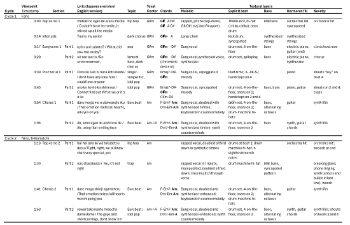
[3.1] Deriving its storyline from “45510,” the first book of the manga, and the first episode of the anime series, “Idol” is structured as three verse-chorus cycles representing Ai from different points of view (outlined in Example 1): first, the fans’ view of her; second, Nino’s view; and third, Ai’s own view. Each cycle has multiple sections that are delineated through different genre-topics, evoked by texture, vocal style, timbre, tempo, and groove. The genres’ associations with a particular mood, social class, or histories add affective resonance to Ai’s story. The rapped verses tell each narrator’s true feelings, especially their dark sides. The sung pre-chorus, in singer-songwriter style, presents Ai in emotional confession. The chorus, in maximalist Eurobeat, represents the idol in performative excess and the superficial brightness of her image. These genre-topics act not merely as stylistic references, but as narrative devices that recall cultural associations of that genre and its famous performers and songs.
Example 1. Form, texture, and topics in “Idol”
(click to enlarge and see the rest)
[3.2] Example 1 shows each cycle and section (as delineated by lyric, harmony, and texture) and the topic it invokes. The textural analysis uses Allan Moore’s taxonomy of four layers in popular music (the explicit beat layer, typically drums; the functional bass layer; the melodic layer, which includes primary and secondary melodic lines; and the harmonic filler layer). In addition, it considers the novelty layer, which Megan Lavengood describes as sounds that resist blending with the ensemble and instead stand out, often due to their timbre (Moore 2012, Chapter 2; Lavengood 2020). I have included in the novelty layer those standout timbres (in italics) that also fulfill other functions. Evoking these genre-topics, with their differing cultural implications, add affective resonance to Ai’s story.
First cycle
First rap verse
[3.3] The rap which opens the first cycle addresses Ai’s essence; paralleling “45510,” it comments on how she enraptures the media with her smile and how her evasion of any revelatory questions adds to her mysteriousness, making her fans ever more curious about her. It culminates in declaring Ai a “genius idol.”
[3.4] Rap has a dual image in Japan. On the one hand, it is seen as a cool, stylish, and fun genre of popular music; it has been adopted by entertainers like Itō Seiko in the 1980s
Audio Example 1. Afrika Bambaataa and Soulsonic Force, “Planet Rock” (1982), 0:33–0:39
Audio Example 2. Kendrick Lamar and Skrillex, “HUMBLE. (SKRILLEX REMIX)” (2017), 0:51–0:58
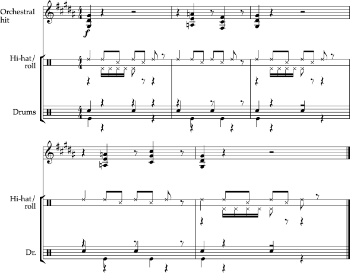
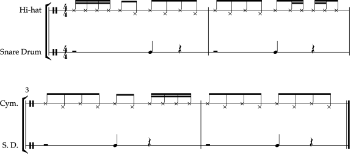
[3.5] The texture connects this opening rap (0:00–0:14, heard in Example 6 below) to the history of rap. The sparse instrumentation and the dry, eighth-note chick-chick sound of hi-hats generated by a TR-808 drum machine signal trap as an inspiration (Example 2). Compare, for instance, the opening percussive texture with Ghostemane’s “Mercury Retrograde” (2017) (Example 3)
Example 2. “Idol,” percussion on opening rap (0:00)
(click to enlarge and listen) | Example 3. Ghostemane, “Mercury Retrograde” (2017), percussion, 0:20–0:26
(click to enlarge and listen) |
Example 4. Ghostemane, “Mercury Retrograde,” rap, 0:30–0:33

(click to enlarge, see the rest, and listen)
Example 5. Kendrick Lamar, “Humble,” rap, 2:09–2:12

(click to enlarge, see the rest, and listen)
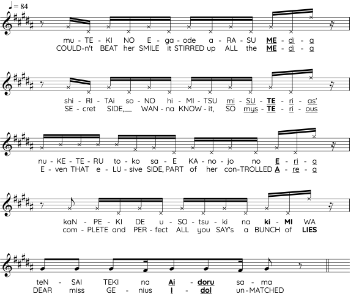
[3.6] Ayase, who is a trap fan, said that “For the rap part, I’d originally thought of it as being really hardcore, but Ikura’s not a rapper, so we tried a few different approaches and realized that the best approach wouldn’t be to try to imitate real hip-hop, but instead to make the cutest rap ever” (Billboard Japan 2023; Nagahata 2024). Ikura raps in this burikko (exaggeratedly cute) way in the opening, which is apt for reflecting the fans’ imagining of Ai in the first verse. True to trap style, she raps in the alternating high-pitch/low-pitch pattern that Ghostemane does in “Mercury Retrograde” (Example 4) and Kendrick Lamar in “Humble” (2017; Example 5)
Example 6. Opening rap verse, Yoasobi’s “Idol,” 0:00–0:15 (transcribed at ♩ = 84 for comparison with Ghostamene and Lamar examples; English is taken from Yoasobi’s official English version)
(click to enlarge, see the rest, and listen)
[3.7] Example 6 shows the first rap verse, with the transliterated Japanese lyrics and the official English lyrics; the higher-pitched morae in Japanese are in CAPS, while the emphasized word in the line is in BOLD. Unlike the English examples, where strong and weak syllables alternate to match changing pitches, the accents of the Japanese words in “Idol” don’t have a consistent pattern. Nonetheless, Ikura raps in the up-down pitch pattern of trap artists as shown above, so that her pitch patterns sometimes deviate from the accents of the words. Ikura exaggerates this deviation between pitch and accent patterns at the end of the measure, when she throws the last mora (which is unaccented) into a high whistle range. These deviations from correct Japanese can be seen as cute in idol culture, where such gestures and imperfections entice fans to support the idol so that she could improve and grow. The effect is illustrative of genre importations in J-pop, where the musical parameters signal a particular genre—here, “rap”—but with Japanese and J-pop elements inserted to hybridize the imported genre and shift its associations.
[3.8] This verse has the characteristics of rhyme and assonance common to Japanese rap. The first three lines end with the matching vowels e-i-a: “me-di-a,” “mi-su-te-ri-as’,
Choral interlude
Audio Example 3. “Idol,” dark chorus interlude, 0:14–0:17
Audio Example 4. Sawano Hiroyuki, “Attack on Titan,” original soundtrack album (2013, 0:15–0:32)
Audio Example 5. Linked Horizon, “Shinzō o sasageyō!”, Attack on Titan, Season 2 opening theme (2017, 1:14–1:27)
[3.9] The rap verse is followed by two measures of a large chorus singing “You’re my savior, you’re my saving grace” (0:14–0:17, Audio Example 3), which bookends the song. This foreboding, full-choral texture in minor key and quasi-religious tone, which is reminiscent of “O Fortuna” in Carl Orff’s Carmina Burana, constitutes what I will call the “dark chorus” topic. This topic occurs in many anime, such as “Attack on Titan” on the original soundtrack album (Audio Example 4) or the opening theme to the second season of the television anime (Audio Example 5)
First sung verse
[3.10] This brief choral flourish is followed by a four-phrase sung verse (0:17–0:39) that only occurs in this first cycle. This section fits with Nazaré’s conception of the typical verse of an opening theme, with sparser texture allowing for lyrics that introduce the main characters (Nazaré Rodríguez 2023, 2025). In “Idol,” the lyrics of this verse are practically direct quotes from “44510,” with the first two phrases describing how Ai keeps dodging simple questions about what she eats or reads, and where she goes to have fun. Set as musical sentences, the melody of these phrases is in the minyō pentatonic scale (
[3.11] In “45510,” Nino surmises that Ai’s evasiveness surrounds her with an aura of mystery, which only draws the fans in closer as they try to find out more about her. The second part of the sung verse (0:29–0:38) paraphrases this idea, saying that fans are attracted to secrets that look like they might be revealed but are not, in the same way that bees are attracted to honey. The last phrase of the sung verse returns to the fans’ Q&A, asking what type of guy she likes, another quote from “45510.” These last two phrases, set as two musical sentences in a parallel period, are underlined by a chromatic descent in the bass that conjures the lament topic, amplified by the dark chorus. They contrast with the home genre of J-pop, with its high-energy vocals and synthesizer fills, to lend an underlying sense of foreboding against the flashy, upbeat surface. The consequent ends in a perfect authentic cadence as the fans demand a firm answer from Ai.
Pre-chorus
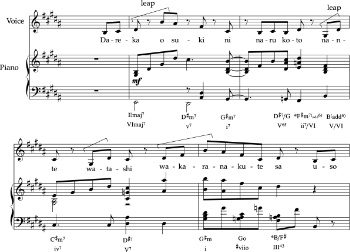
Example 7. “Idol,” first pre-chorus, voice and piano, 0:40-0:47
(click to enlarge and listen)
[3.12] Ai responds, “I don’t know what it means to love someone,” in another quote from “45510” (0:39–47, Example 7). This line is highlighted by a significantly reduced texture, foregrounding Ikura’s voice as she purposefully sings like a cute idol to piano accompaniment (Billboard Japan 2024). Her voice leaps plaintively to B4 on the words “suki” (love) and “wakaran[ai]” (don’t understand), hinting at an underlying pathos, while the chords Emaj7 and the progression
Example 8. “Hikōkigumo” (Vapor Trail, 1973, 0:55-1:06)
(click to enlarge and listen) | Example 9. Aiko, “Sōshisō ai” (Mutual Love, 2024, 0:00–0:21)
(click to enlarge and listen) |
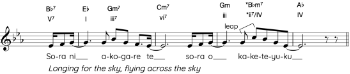
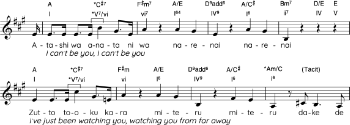
[3.13] Ai’s revelations are fleeting as she is drowned out by the idol-pop topic
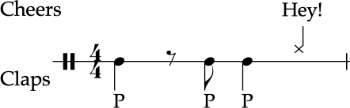
Example 10. PPPH pattern
(click to enlarge)
[3.14] Another aspect of the idol-pop topic is fans’ coordinated chants. Since the 1970s, otagei, or coordinated chanting and dancing by fans to encourage idols, has been common during an idol’s performance
[3.15] Musically, Ai’s response sounds headed for a cadence on the tonic (
Chorus
[3.16] The chorus (0:54–1:17) represents Ai in performance. Sung from the fan’s perspective, the lyrics exult Ai as the perfect idol, who steals everyone’s heart and the likes of whom will never appear again. This idealization of Ai as an unsurpassable idol is a notion that the villains in the manga try to uphold by killing, or attempting to kill, anyone who threatens to surpass her. The last line—“those eyes and those words, even if lies, are the perfect ai”—makes a pun out of the homonyms “eye,” Ai (the character), ai (love), and the first two morae of a-i-do-ru (idol). A perfect authentic cadence—further highlighted by the Picardy third ending on A major—gives firm grounding to this encapsulation of the fans’ view of Ai.
[3.17] The music incorporates some musical hallmarks that have characterized idol-pop choruses since the 1990s. Stirring up excitement, it begins with a direct half-step upward modulation (to A minor), a common feature of popular music (e.g., Beyoncé, “Love on Top,” 2011). Such a modulation from pre-chorus to chorus is also a common characteristic of idol pop; in AKB48’s “Shonichi” (2010), for instance, the key abruptly moves from G-flat to G at this same point in the form (1:06)
[3.18] But perhaps Eurobeat is the best description for this chorus. Eurobeat was first coined in 1985 in the British magazine Record Mirror to refer to Hi-NRG-type, fast-paced music, such as that produced by Mike Stock, Matt Aitken, and Pete Waterman (known as Stock Aitken Waterman, SAW, or the Hit Factory) and featuring artists like Dead or Alive, among others
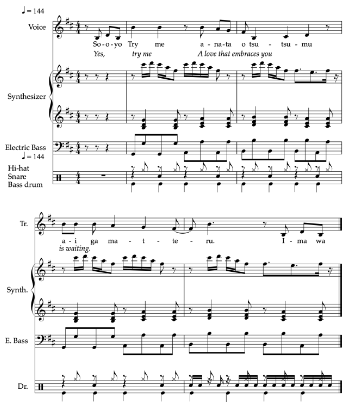
Example 11. Amuro Namie with Supermonkeys, “Try Me—Watashi o shinjite” (1995), chorus, 1:08–1:15
(click to enlarge and listen)
[3.19] The typical musical characteristics of Eurobeat can be illustrated through Amuro Namie’s breakout hit, “Try Me—Watashi o shinjite” (1995), a cover of Lolita’s “Try Me,” both produced by Italian producer Dave Rodgers (b. Giancarlo Pasquini; Example 11)
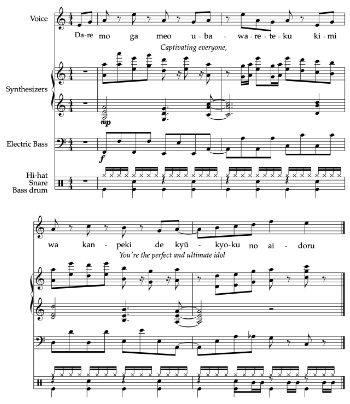
Example 12. “Idol,” chorus, 0:55–1:01
(click to enlarge and listen)
[3.20] The chorus of “Idol” (0:55–1:01, Example 12) contains many of these characteristics that mark the Eurobeat topic: fast tempo at 168 bpm, four-on-the-floor bass drums with a snare on backbeats and a busy hi-hat, a bass in alternating octaves, a fast melodic synthesizer line in bright timbre, and chords on another synthesizer, filling out the electronic, maximalist texture. The form is also similar, with two 2-measure phrases forming a four-measure antecedent, followed by a consequent. While not the full Aeolian progression, the chords outline its beginning and end points, with the first bass note on (on an Fmaj7 chord) moving to in the next measure. It creditably evokes the Eurobeat topic, taking on its mood of shiny performative decadence—the bright light of the entertainment industry that Ayase was seeking to depict. A perfect authentic cadence, on a Picardy third, grounds the end of the chorus and the fans’ view of Ai.
Second cycle
Second rap verse
[3.21] The second cycle is in the voice of a B-Komachi member, presumably Nino, who is deeply jealous of Ai. In “45510,” she says that she hated Ai because she was always at the center, while other members were relegated to being backup dancers; she admits that without Ai, B-Komachi would never have been so popular, but it was impossible not to hate Ai when she enjoyed such favoritism. The opening rap verse begins as Nino seems to be responding sarcastically to management: “Yes, yes, she is special
[3.22] As she declares, “[Our success] is not entirely because of her,” the rapped vocal goes into relentless triplets, backed by a booming TR-808 bass. This texture puts Nino’s verse squarely in the trap subtopic. Trap, which takes its name from sites of drug dealing, emerged in the South in the 1990s with lyrics about crime in poor neighborhoods (Drake 2025). While trap rose to widespread popularity with Migos and others by the early 2010s and has since been adopted by Beyoncé, Bad Bunny, and other mainstream artists, it retains an edgy image in Japan—the province of hardcore working-class rap groups like Bad Hop, which hails from an industrial neighborhood in Kawasaki
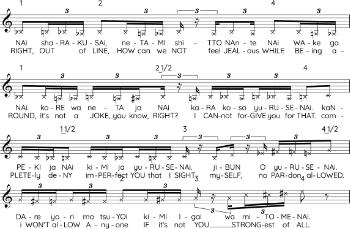
Example 13. “Idol,” second rap verse (1:29) (transcribed at q = 84 for comparison with Ghostamene and Lamar examples; English lyrics from Yoasobi’s official English version of “Idol”)
(click to enlarge and listen)
[3.23] As shown in Example 13, Nino’s triplet flow is built around repetition of the word “nai” (no) and its rhymes; however, these rhymes are placed irregularly, on beats 1, 2, 4, 1, 2.5, 4, 1.5, 3, 4.5, 3, and 4. These varying placements create a dizzying whirlwind as “nai” and its rhymes, which are verbally stressed, land on different beats—a common technique in Japanese trap. The sense of confusion and tension is compounded by the doubling of the vocals in major thirds, the thickening texture from a simple low bass to electronic swoosh effects, and the rising pitch of the vocalist, which illustrates Nino whipping herself into a frenzy. The wordplay also adds to the intensity: two words for jealousy, netami and shitto, are used to underline this concept (and shitto sounds like the English curse word), while netami and neta (evidence) repeat initial morae. The combination of wordplay and the trap topic paint a powerful picture of a conflicted personality spiraling into madness.
Second chorus
[3.24] “45510” reveals Nino’s worship of Ai as an “idol” (偶像, in the religious sense) that existed within the fans’ hearts, including Nino herself, as she declares, “[Ai was] someone who doesn't rely on anyone, is uninhibited, solitary, strong, and has never regretted anything, invincible, the strongest, and one of a kind” (Akasaka 2023). The second chorus (1:41–2:04), again in the Eurobeat topic, makes Nino’s idolizing of Ai explicit; she declares Ai to be “an idol that everyone worships, the strongest and most invincible idol.” This chorus has a second part (1:53) in which Nino implores Ai to hide her weaknesses and remain unique, which, to her, must be the real Ai (again playing with the double meaning of the word with “love”). The idol-pop topic reenters in the form of the fans’ shouts, punctuating the offbeats and reinforcing Nino’s imagined version of Ai in performance.
Third cycle
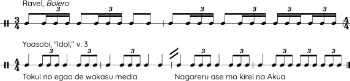
Example 14. Snare in Ravel’s Bolero vs. “Idol,” third verse (2:05, 2:18)
(click to enlarge and listen)
[3.25] The third cycle opens with Ai’s own rap (2:05–2:31), in which she confesses that her career is built on the lie that she loves her fans, and that she has been hiding Aqua and Ruby’s existence. She is hanging on to her desire for happiness as both an idol and a mother, which the idol industry regards as impossible. In contrast with the sparse trap texture of Nino’s verse, Ai’s texture is dramatically orchestral. Relentless triplets on the snare, reminiscent of Ravel’s “Bolero” (Example 14) as well as Nino’s rap, evoke an oppressive march, leading toward her inevitable tragedy. The tempo is slowed down from a half-note value of 84 bpm to 76 bpm, allowing one to hear her words more clearly. Like Nino’s rap verse, Ai’s voice spirals upward in pitch, giving a sense of increasing desperation and madness. There is wordplay in her use of the word mabuta (eyelid): it evokes the expression mabuta no haha, which refers to a mother who has died or gone away and only remains in the child’s memory, foreshadowing what Ai becomes for her children. She also likens herself to the Virgin Mary, conjuring Ai’s position as an object of worship as well as an endurer of personal sacrifice; the religious reference is corroborated by the re-entry of the dark chorus topic. As Ai repeatedly says in the manga, lies are a form of love to her; she finishes the rap by declaring lies to be the ultimate expression of ai (this time meaning love, as indicated by the kanji 愛 on the lyric sheet). Her line is followed by a tag line on synthesizer (2:30), reminiscent of a game motif signaling the death of a character, in another foreshadowing.
[3.26] The singer-songwriter pre-chorus is then reprised, with Ai returning to her comment from the first pre-chorus that she’s never loved anyone or been loved by anyone. Accompanied without percussion by a solo piano playing chromatic chords and sung with a natural, less-processed voice, it reproduces the singer-songwriter topic and its ring of sincerity, this time uninterrupted by the otaku cheers. Unusually, the music modulates a half-step down (perhaps embodying Ai’s slippery nature) as Ai declares that one day, her lies will become truth. These lyrics quote the aforementioned point in the manga, in which the president of Ichigo Productions recruits Ai by saying that being an idol might enable her to find love, an outcome she desperately desires. This time, the pre-chorus ends on a perfect authentic cadence, on a Picardy third, harmonically grounding the words that follow—“shinjiteru” (I believe it, 2:43), produced to a distant, otherworldly vocal timbre.
[3.27] For the last iteration of the chorus (2:44–3:14), the excitement (and Eurobeat topic) is reignited in stages. First, the music modulates up a whole step to B-flat minor, the tempo returns to the original speed, and the four-on-the-floor drums come back, as Ai declares her true hope that one day, she’ll have it all. In the next phrase when she says she wants to love everyone, the full Eurobeat texture returns as Ai is depicted in performance—and in the music video, performing as herself for the first time rather than as her bunny avatar. The texture intensifies further in the next phrase as the Real Akiba Boyz’s otaku cheers re-enter. In the post-chorus (3:08), whose lyrics quote the scene of Ai’s death, she sings the same Eurobeat melody accompanied by the solo piano texture of the singer-songwriter topic; this blend between the performer’s melody and the confessional topic blurs the boundary between Ai’s stage persona and her authentic self. When she tells her children that she loves them, the instruments drop out so that a single piano chord adorns “aishiteru” (I love you), highlighting these words as truth. An outro (3:15) in the Eurobeat topic follows, with a return of the dark chorus topic (3:26) singing, “You’re my savior” capping off the song.
4. Conclusion
[4.1] “Idol” demonstrates how genre-topics can create layered narratives in popular music. Each topical shift changes perspective, emotional register, and perceptions of truth. While the starting point is stereotypical genre associations drawing from Japan’s pop-culture history, the genre-topics combine with vocal style, melody, harmony, and timbre to complicate them. The three rapped verses promise realness (via the rap topic), but the vocal delivery—colored by cute gestures, electronically distorted timbres, or instrumentation—conjures other topics that change the meanings of those verses. Indeed, topics interact: the sincerity of the singer-songwriter topic is drowned out by the idol-pop topic of cheering otaku fans. Topics evoke past artists and times: the Eurobeat choruses recall the 1990s, the socioeconomic unease that then prevailed, and the psychological escape that idols, dance music, and clubs provided; it also recalls Morning Musume’s “Love Machine,” an idol version of Eurobeat that became popular during that time, when Ai’s life is set. Indeed, to listen to “Idol” is to engage in a tour of popular music from the 1980s to the present and reflect on the social memories of these musics and artists. This storytelling through topics thus allows for multilayered commentary on idols and idol music, expressing in sound the bright, dark, and heartfelt aspects of the entertainment industry. It may also explain the song's global success, as even listeners who don't understand Japanese can follow aspects of the narrative through these genre shifts. While non-Japanese listeners may be unfamiliar with specific Japanese cultural contexts, genres such as rap, singer-songwriter, and EDM are sufficiently globalized to have conventional associations—many of which are also replicated in the music of popular anime. Meanwhile, listeners familiar with Japanese cultural contexts are treated to an even more abundant set of sociohistorical associations.
[4.2] This analysis points to the potential for applying topics to studies of meaning-making in popular music. Future work might explore how other contemporary artists use genre-mixing for narrative purposes, or how musical metacommentary functions in other cultural contexts. Anime music would be a prime candidate, given its genre-omnivorous nature. Genre references are also common in rock and hip hop. Additionally, the unprecedented global popularity of “Idol” illustrates how streaming and global accessibility are broadening the audience for Japanese popular music, engaging international audiences despite (or because of) the music’s Japanese cultural elements. Further study along these lines could shed light on the degree of common understanding of genre-topics among artists and among audiences, and their portability across cultures and times.
Noriko Manabe
Indiana University Bloomington
Jacobs School of Music
200 S Eagleson Ave.
Bloomington IN 47405-7002
nmanabe@iu.edu
Works Cited
Agawu, V. Kofi. [1991] 2014. Playing with Signs: A Semiotic Interpretation of Classic Music. Princeton University Press. Originally published in 1991 by Princeton University Press. https://doi.org/10.1515/9781400861835.
—————. [2009] 2014. Music As Discourse: Semiotic Adventures in Romantic Music. Oxford University Press. Originally published in 2009 by Oxford University Press. https://doi.org/10.1093/acprof:oso/9780195370249.001.0001.
Akasaka Aka. 2023. “赤坂アカ書き下ろし小説『45510』.” 週刊ヤングジャンプ公式サイト. Accessed January 12, 2025. https://youngjump.jp/oshinoko/novel_45510/novel_01.html.
Akasaka Aka and Yokoyari Mengo. 2024. 『【推しの子】』TVアニメ第1期公式ガイドブック First Report. Shūei-sha.
Allanbrook, Wye Jamison. 1983. Rhythmic Gesture in Mozart: Le Nozze di Figaro and Don Giovanni. University of Chicago Press. https://doi.org/10.7208/chicago/9780226437712.001.0001.
Allanbrook, Wye Jamison. 2014. The Secular Commedia: Comic Mimesis in Late Eighteenth-Century Music, ed. Mary Ann Smart and Richard Taruskin. University of California Press.
Aoyagi, Hiroshi. 2005. Islands of Eight Million Smiles: Idol Performance and Symbolic Production in Contemporary Japan. Harvard University Asia Center. https://doi.org/10.1163/9781684174188.
Aoyagi, Hiroshi, Patrick W. Galbraith, and Mateja Kovacic. 2021. Idology in Transcultural Perspective: Anthropological Investigations of Popular Idolatry. Palgrave Macmillan. https://doi.org/10.1007/978-3-030-82677-2.
Armstrong, Andrew Barton. 2019. 24 Bars to Kill: Hip Hop, Aspiration, and Japan’s Social Margins. Berghahn. https://doi.org/10.2307/j.ctv287sg0x.
Atkinson, Sean E. 2019. “Soaring Through the Sky: Topics and Tropes in Video Game Music.” Music Theory Online 25 (2). https://doi.org/10.30535/mto.25.2.1.
Billboard Japan. 2023. “YOASOBI Discusses the Creation of Chart-Topping Hit ‘Idol’ & Performing Live: Interview.” Billboard (blog), July 5. https://www.billboard.com/music/music-news/yoasobi-interview-idol-tour-1235367129/.
Billboard Japan. 2024. “5 Years of YOASOBI: A Look Back at the Duo’s Unprecedented Rise to J-Pop Superstardom.” Billboard (blog), October 25. https://www.billboard.com/music/music-news/yoasobi-five-year-anniversary-1235811590/.
Bridges, Rose. 2017. Yoko Kanno’s Cowboy Bebop Soundtrack. Bloomsbury. https://doi.org/10.5040/9781501325885.
Bridges, Rose, and Brooke McCorkle Okazaki. Forthcoming. “Anime Title Songs: A History.” In The Oxford Handbook of Music in Television, ed. Ronald Rodman, James Deaville, Jessica Getman, and Brooke McCorkle Okazaki.
Cumming, Naomi. 1999. “Musical Signs and Subjectivity: Peircean Reflections.” Transactions of the Charles S. Peirce Society 35 (3): 437–74.
Donaldson, James. 2024. “Kaleidoscopic Topics in the Music of György Ligeti and Thomas Adès.” Music Theory Online 30 (2). https://doi.org/10.30535/mto.30.2.2.
Drake, David. 2025. “Real Trap Sh*t? The Commodification of Southern Rap’s Drug-Fueled Subgenre.” Complex (website), September 8. https://www.complex.com/music/a/david-drake/real-trap-sht-the-commodification-of-southern-raps-drug-fueled-subgenre.
Echard, William. 2017. Psychedelic Popular Music: A History Through Musical Topic Theory. Musical Meaning and Interpretation. Indiana University Press. https://doi.org/10.2307/j.ctt1zxxzgx.
Ezaki Ayatake. 2023. “《第3夜》YOASOBI「アイドル」をDig!” 江﨑文武のBorderless Music Dig! NHK. August 10. https://www.nhk.jp/p/rs/R7V6MMNYMK/blog/bl/pRz6kploQR/bp/paVAzyBww8/. Accessed December 21, 2024.
Frith, Simon. 1989. “Euro Pop.” Cultural Studies 3 (2): 166–72. https://doi.org/10.1080/09502388900490111.
Frymoyer, Johanna. 2017. “The Musical Topic in the Twentieth Century: A Case Study of Schoenberg’s Ironic Waltzes.” Music Theory Spectrum 39 (1): 83–108. https://doi.org/10.1093/mts/mtx004.
—————. 2025. Modernist Movements: Listening for Topics in Schoenberg and Stravinsky. Oxford University Press. https://doi.org/10.1093/9780197641378.001.0001.
Galbraith, Patrick W., and Jason G. Karlin. 2019. AKB48. Bloomsbury Publishing. https://doi.org/10.5040/9781501341144.
Hatten, Robert S. 1985. “The Place of Intertextuality in Music Studies.” The American Journal of Semiotics 3 (4): 69–82. https://doi.org/10.5840/ajs1985345.
—————. 1994a. Musical Meaning in Beethoven: Markedness, Correlation, and Interpretation. Indiana University Press. https://doi.org/10.2979/3489.0.
—————. 1994b. “A Peircean Perspective on the Growth of Markedness and Musical Meaning.” In Peirce and Value Theory on Peircean Ethics and Aesthetics, ed. Herman Parret, 347–58. John Benjamins Publishing Company.
—————. 2014. “The Troping of Topics in Mozart’s Instrumental Works.” In The Oxford Handbook of Topic Theory, ed. Danuta Mirka, 514–36. Oxford University Press. https://doi.org/10.1093/oxfordhb/9780199841578.013.0020.
—————. 2025. “On Musical Topics and Tropes: Definitions, History, Theoretical Amplifications, Pedagogical Applications, and Extensions.” Res Facta Nova. Teksty o Muzyce Współczesnej, January 29, 9–22. https://doi.org/10.14746/rfn.2023.24.1.
Hentschel, Frank, and Gunter Kreutz. 2021. “The Perception of Musical Expression in the Nineteenth Century: The Case of the Glorifying Hymnic*.” Music & Science 4. https://doi.org/10.1177/20592043211012396.
Holt, Fabian. 2003. “Genre Formation in Popular Music.” Musik & Forskning 28: 77–96.
Holt, Fabian. 2007. Genre in Popular Music. The University of Chicago Press. https://doi.org/10.7208/chicago/9780226350400.001.0001.
Johnson, Thomas. 2018. “Analyzing Genre in Post-Millennial Popular Music.” PhD diss., CUNY Graduate Center.
Kitaba Hideyuki, and Anita Drexler. 2024. “Tool Kits / 3: A Short Outlook of Anison from 1963 to the 21st Century.” In The Palgrave Handbook of Music and Sound in Japanese Animation, ed. Marco Pellitteri, 45–66. Springer Nature Singapore. https://doi.org/10.1007/978-981-97-0429-3_3.
Laing, Dave. 2001. “Stock, Aitken and Waterman.” Grove Music Online. Oxford University Press. Accessed November 25, 2025. https://doi.org/10.1093/gmo/9781561592630.article.47729.
Lavengood, Megan L. 2020. “The Cultural Significance of Timbre Analysis: A Case Study in 1980s Pop Music, Texture, and Narrative.” Music Theory Online 26 (3). https://doi.org/10.30535/mto.26.3.3.
Lavengood, Megan, and Evan Williams. 2023. “The Common Cold: Using Computational Musicology to Define the Winter Topic in Video Game Music.” Music Theory Online 29 (1). https://doi.org/10.30535/mto.29.1.2.
Lehtonen, Lasse. 2022. Yuming’s The 14th Moon. 33-1/3 Japan series. Edited by Noriko Manabe. Bloomsbury Publishing.
Manabe, Noriko. 2009. “Western Music in Japan: The Evolution of Styles in Children’s Songs, Hip-Hop, and Other Genres.” PhD diss., CUNY Graduate Center.
—————. 2013a. “Straight Outta Ichimiya: The Appeal of a Rural Japanese Rapper.” The Asia-Pacific Journal 11 (5/1). https://apjjf.org/2013/11/5/noriko-manabe/3889/article.
—————. 2013b. “Representing Japan: ‘National’ Style among Japanese Hip-Hop DJs.” Popular Music 32 (Special Issue 01): 35–50. https://doi.org/10.1017/S0261143012000530.
—————. 2024. “Japanese Rap: A History of Style.” In Handbook of Japanese Music in the Modern Era, ed. Henry Johnson, 423–38. Handbook of Oriental Studies, V: Japan, No. 18. Brill. https://doi.org/10.1163/9789004687172_027.
—————. 2025. “Awich: A New Era for Japanese Women Rappers.” American Music Review 53: 47–55.
Miles, Corey J. 2023. Vibe: The Sound and Feeling of Black Life in the American South. University Press of Mississippi. https://doi.org/10.14325/mississippi/9781496847287.001.0001.
Mirka, Danuta. 2014. “Introduction.” In The Oxford Handbook of Topic Theory, ed. Danuta Mirka, 1–57. Oxford University Press. https://doi.org/10.1093/oxfordhb/9780199841578.013.002.
Moore, Allan F. 2001. “Categorical Conventions in Music Discourse: Style and Genre.” Music and Letters 82 (3): 432–42. https://doi.org/10.1093/ml/82.3.432.
—————. 2012. Song Means: Analyzing and Interpreting Recorded Popular Song. Ashgate.
Myers, Taylor. 2017. “Genre Modulation as Sectional Divider.” In Popular Music Studies Today: Proceedings of the International Association for the Study of Popular Music 2017, ed. Julia Merrill, 235–41. Springer VS. https://doi.org/10.1007/978-3-658-17740-9_24.
Nagahata Hiroaki. 2024. “Jポップを世界へ、‘いま’と向き合うYOASOBIが語った「アイドル」に込めた想い.” Pen, January.
Nazaré Rodríguez, Tania F. 2023. “The Anime Sound: An Analytical and Semiotic Study of Contemporary Anime Music.” MA thesis, McGill University.
Nazaré, Tan. 2025. “The Anime OP(ening): A Corpus Study of Anison.” Paper presented at Society for Music Theory Annual Conference, Minneapolis, November 8.
Pascall, Robert. 2001. “Style.” In Grove Music Online. Oxford University Press. https://doi.org/10.1093/gmo/9781561592630.article.27041.
Peirce, Charles S. 1955. Philosophical Writings of Peirce. Edited by Justus Buchler. Dover Publications.
Ratner, Leonard G. 1980. Classic Music: Expression, Form and Style. Schirmer Books.
Samson, Jim. 2001. “Genre.” In Grove Music Online. Oxford University Press. https://doi.org/10.1093/gmo/9781561592630.article.40599.
St. Michel, Patrick. 2023. “With ‘Idol,’ Yoasobi Pens a New Chapter in J-Pop’s Story.” Japan Times, June 30.
Spicer, Mark. 2009. “Strategic Intertextuality in Three of John Lennon’s Late Beatles Songs.” Gamut: Online Journal of the Music Theory Society of the Mid-Atlantic 2 (1): 347–76. https://doi.org/10.7290/gamutg2jt.
—————. 2010. “‘Reggatta de Blanc’: Analyzing Style in the Music of the Police.” In Sounding out Pop: Analytical Essays in Popular Music, ed. Mark Spicer and John Rudolph Covach, 124–53. University of Michigan Press.
Steinberg, Marc. 2012. Anime’s Media Mix: Franchising Toys and Characters in Japan. University of Minnesota Press.
Tagg, Philip. 2012. Music’s Meanings: A Modern Musicology for Non-Musos. Mass Media Music Scholars’ Press.
Turino, Thomas. 1999. “Signs of Imagination, Identity, and Experience: A Peircian Semiotic Theory for Music.” Ethnomusicology 43 (2): 221–55. https://doi.org/10.2307/852734.
Turino, Thomas. 2014. “Peircean Thought As Core Theory For A Phenomenological Ethnomusicology.” Ethnomusicology 58 (2): 185–221. https://doi.org/10.5406/ethnomusicology.58.2.0185.
Ueda Takuto. 2023. “<インタビュー>YOASOBIが語る「アイドル」誕生秘話、完璧で究極な‘アイ’への想い.” Billboard Japan. https://www.billboard-japan.com/special/detail/3968.
Wajima, Yūsuke. 2022. “Japanese Disco as Pseudo-International Music.” In Global Dance Cultures in the 1970s and 1980s: Disco Heterotopias, ed. Flora Pitrolo and Marko Zubak, 73–87. Palgrave Macmillan. https://doi.org/10.1007/978-3-030-91995-5_5.
Yamada, Keisuke. 2017. Supercell’s Supercell Featuring Hatsune Miku. Bloomsbury. https://doi.org/10.5040/9781501325953.
Yee, Thomas B. 2020. “Battle Hymn of the God-Slayers: Troping Rock and Sacred Music Topics in Xenoblade Chronicles.” Journal of Sound and Music in Games 1 (1): 2–19.
Footnotes
* This material was originally presented at the Timbre and Orchestration in Popular Song Conference at McGill University in June 2025, the Music Theory Colloquium at Indiana University, and the annual conference of the Society for Music Theory in Minneapolis in November 2025. My colleague, James Donaldson, kindly read the manuscript and assigned it for discussion in his graduate seminar. John Peterson and Kimberly Loeffert reviewed a short version of the essay for an undergraduate audience. I am very grateful to the organizers and participants in these events, Prof. Donaldson, the students in his seminar, Profs. Peterson and Leoffert, and the peer reviewers for their helpful and insightful commentary.
Return to text
1. Yoasobi, “Aidoru,” 2023, https://open.spotify.com/track/7ovUcF5uHTBRzUpB6ZOmvt?si=0465761f32ff43b1. A version in English, “Idol,” can be found here: https://open.spotify.com/track/1zVsw1SqQKgtzE4aqmE8nE?si=d1d4448c6f1b41f2. The official video is at https://youtu.be/ZRtdQ81jPUQ?si=_0h-mB8OzMveB1pJ.
Return to text
2. Anime is a style of animation originating from Japan in the early twentieth century. It first achieved global success through director Tezuka Osamu’s Astro Boy (1963–66) and became increasingly appreciated for its artistry through anime films like Akira (Ōtomo Katsuhiro, 1988), Cowboy Bebop (Watanabe Shin’ichirō, 1998), and Spirited Away (Miyazaki Hayao, 2001).
Return to text
3. See Kitaba and Drexler 2024, Bridges and McCorkle Okazaki forthcoming, and Nazaré Rodríguez 2023.
Return to text
4. Ratner (1980, 9) characterizes contredanse as a dance in low style, in contrast with minuet in high style and gigue in middle style. Despite this difference, both he and Allanbrook show dances as indications of the social order.
Return to text
5. “Index” refers to Charles Peirce’s second trichotomy of how a sign relates to an object, which can be as an icon (similarity), index (coincidence, as in smoke and fire), and symbol (conventionalized rule). See Pierce 1955. For musical applications of Peirce, see Hatten 1994b, Cumming 1999, and Turino 1999 and 2014, among others.
Return to text
6. See Steinberg 2012 for an analysis of the anime media mix.
Return to text
7. Mirka (2014, 1) also interprets Ratner’s type as equivalent to genres. Writers contrasting genre against style have described the former as defined by social context and the latter as a product of the composer. This distinction can be seen by comparing the Grove Music articles on “genre” (Samson 2001) and “style” (Pascall 2001). In reviewing scholars’ uses of these terms, Allan Moore (2001) defines style as “manner of articulation of musical gestures,” while genre “refers to the identity and context of those gestures”; genre is “socially constrained,” while style involves “technical features and appropriability” (441). As Thomas Johnson (2018, 26–29) points out, however, keeping these terms truly separate proves murky even for Moore himself.
Return to text
8. Manga are a form of Japanese comics dating back to premodern eras. In contemporary times, franchises like Oshi no ko are first serialized in weekly manga magazines like Weekly Young Jump, then resold as a series of individual comic books (tankōbon) of about 200 pages each. They often form the basis for anime, as is the case with Oshi no ko.
Return to text
9. Vocaloids are voice-synthesizer software. In Japan, they are often marketed as avatars like Hatsune Miku, who presents as a girl with a high-pitched voice and long green hair. Hatsune Miku has attracted a culture of vocaloid producers and has been featured in live concerts as a hologram. See Yamada (2017) for background on vocaloid culture.
Return to text
10. AKB48 is Japan’s most successful idol-pop group, consisting of as many as 100 women, having sold over 70 million records and had over 54 number-one hits on the Oricon weekly singles charts. Their CDs are sold with premiums, such as tickets to meet-and-greets and ballots for “elections” for the favorite AKB48 idol, causing devoted fans to buy multiple copies of the same CD. Galbraith and Karlin 2019 details this “economy of affect.”
Return to text
11. Japanese names are given family-name first, per Japanese practice.
Return to text
12. The title comes from the shared password for the blog, formed from the flip-phone codes for the first hiragana-letter in the names of each B-Komachi member.
Return to text
13. Itō Seikō & TINNIE PUNX, “Tokyo Bronx” (1986), posted Apr 27, 2008 by KOENJIROCKLIFE, YouTube, 1:53, https://youtu.be/bLf1kxTTiY4. For background, see Manabe 2024.
Return to text
14. Nujabes ft. Shing02, “Samurai Champloo Opening: Battlecry,” posted Jan 12, 2016 by Crunchyroll, YouTube, 1:29, https://youtu.be/Eq6EYcpWB_c
Return to text
15. “Creepy Nuts「Bling-Bang-Bang-Born」×TV Anime「マッシュル-MASHLE-」Collaboration Music Video,” posted March 3, 2024 by Creepy Nuts, YouTube, 2:52, https://youtu.be/mLW35YMzELE.
Return to text
16. Morning Musume, “Jealousy Jealousy,” performance from Hina Fest at Makuhari Messe, Tokyo, March 25–26, 2017, posted July 28, 2017, by Pokupoku, YouTube, 4:36, https://youtu.be/LGyWm9Xhqpw. The rap occurs in the bridge, 1:31–1:58.
Return to text
17. For example, see Shingo Nishinari, “Ill Nishinari-Geek Remix” (2007); Anarchy, “Growth” (2006; see Armstrong 2019 for context); Kohh, “Dirt Boys ft. Dutch Montana, Loota” (2015; see Manabe 2024); Awich, “Queendom (Prod. Chaki Zulu)” (2022; see Manabe 2025); Dengaryū ft. Stillichimiya, “Yabē ikioi de sugē moriagaru” (2012; see Manabe 2013b).
Return to text
18. Ghostemane, “Mercury Retrograde,” 2017, https://open.spotify.com/track/0UKzG4fJ1LXf6DInew5vcV. The similarity with this track is pointed out in Ezaki 2023.
Return to text
19. Kendrick Lamar and Skrillex, “Humble—Skrillex Remix,” 2017, https://open.spotify.com/track/65ES1qwOB577ZnTkizMXJJ
Return to text
20. Kendrick Lamar, “Humble,” 2017, https://open.spotify.com/track/7KXjTSCq5nL1LoYtL7XAwS
In this article, I have transcribed rapped parts in 5-stave notation with the aim of showing pitch contour and approximate central pitches. The pitch transcription was determined by my ear and pitch data from the linguistic software program Praat. Given that frequencies slide in most syllables and often sit between the pitches of conventional tempered tunings, the transcriptions are meant to be descriptive approximations rather than exact pitches.
Return to text
21. A mora in Japanese is the shortest prosodic unit, corresponding to a vowel (e.g., a), a consonant and a vowel (ka), the nasal N, or a double consonant (which creates a space, as in it’s hot today). Morae are all pronounced with the same duration. Long vowels (ō or oo) or double vowels (ai) are pronounced as two morae. For example, Tōkyō is pronounced as four morae: “To-o-kyo-o.”
Return to text
22. The comma after “misuterias” is in place of the final -u, which has been truncated. The romanized spelling would normally be “misuteriasu.”
Return to text
23. This dark-chorus topic is different from the glorifying hymnic identified by Hentschel and Kreutz (2021). The glorifying hymnic is in a major key; the dark chorus is in minor mode.
Return to text
24. For example, [サウンドトラック] 悪役のテーマでよく聞く、ダークな合唱音楽を探してる、posted May 1, 2018, https://www.reddit.com/r/anime/comments/8g4o4x/soundtrack_looking_for_dark_choir_music_like_you/.
Return to text
25. For a study on the religious overtones of pop idols, see the first two chapters of Aoyagi et al. 2021.
Return to text
26. For an explanation of Japanese children’s songs in Western style, see Manabe 2009, Chapters 2 and 3.
Return to text
27. For a description of this genre as seen in the social context of second-wave feminism in Japan in the 1970s, see Lehtonen (2022).
Return to text
28. While the home genre of this song is idol pop, I believe it is useful to refer to its more explicitly idol-pop parts as being in the idol-pop topic, as the song cycles through so many genre-topics.
Return to text
29. FSee Matsuda Seiko’s 1983 performance of “Aoi Sangoshō” (1:14), from Seikoland Budokan Live ’83, 2024, https://www.youtube.com/watch?v=AgwDwech6YM) and AKB48’s performance of “Heavy Rotation” (1:14), 【MV Full】ヘビーローテーション / AKB48 [公式], 2023, https://www.youtube.com/watch?v=unau6nthttg.)
Return to text
30. In addition to “Aoi Sangoshō” and “Heavy Rotation” above, see fans cheering Matsuda Seiko in 1983. 松田聖子 天国のキッス(SEC親衛隊 + 字幕付き)Seiko Matsuda, 2019, https://www.youtube.com/watch?v=uu2x1Z0XY6U.
Return to text
31. AKB48, ”初日,” Spotify, 2010, https://open.spotify.com/track/3VLkCzrhrfhlcdgZS2dHlT
Return to text
32. Hi-NRG is an uptempo electronic dance music genre of the 1970s and 80s that features octave-alternating bass lines. It is seen as a precursor to Eurobeat, and its famous songs include Dead or Alive’s “You Spin Me ‘Round (Like a Record)” (1984). SAW are also known for their mass-audience hits by Rick Astley (“Never Gonna Give You Up,” 1987) and Kylie Minogue (“I Should Be So Lucky,” 1988). See Laing 2001.
Return to text
33. 長山洋子, 「ヴィーナス」, 1986, uploaded by Nagakawa Yōko on June 18, 2024, YouTube, 03:38. https://www.youtube.com/watch?v=lmcALrI7i8k. BaBe, “Give Me Up,” 1987, uploaded by BaBeFun on Janaury 29, 2010, YouTube, 4:09, https://youtu.be/0A2Ffi7O0FU Ranking information on Oricon, https://www.oricon.co.jp/prof/237041/rank/single/ and https://www.oricon.co.jp/prof/3247/rank/single/.
Return to text
34. Morning Musume, “Love Machine,” 1999, posted by Morning Musume on October 15, 2010, YouTube, 5:26, https://youtu.be/6A7j6eryPV4.
Return to text
35. The bubble economy was a period of high asset-price inflation in Japan from about 1985–1991. It resulted from the Plaza Accord of 1985, in which Japan, France, West Germany, and the United Kingdom agreed to let the US dollar depreciate against their currencies. By 1988, the yen had nearly doubled against the dollar, hurting Japan’s export industries. The Bank of Japan (BoJ, equivalent of the US Federal Reserve) reacted by dramatically lowering interest rates, triggering extreme inflation in real estate and stock prices. By 1989, the value of the land around the Imperial Palace in Tokyo was worth more than the entire state of California. The bubble burst when the BoJ began raising interest rates in December 1989, eventually leading to the collapse of several banks and brokerage firms. Japan entered a thirty-year period of low growth and deflation, from which it only emerged in the 2020s. The Nikkei stock index did not return to its 1989 levels until 2024.
Return to text
36. Para para dance is a dance that originated from Tokyo discos in the late 1980s and became associated with Eurobeat in the 1990s. It features choreographed upper-body movements. It inspired Konami’s dance game, Para Para Paradise.
Return to text
37. Amuro Namie with Supermonkeys, “Try Me - Watashi o shinjite,” originally released on Original Tracks vol. 1, Eastworld, 1996, https://youtu.be/J8GDzEgGphU.
Return to text
38. For a representative video, see Bad Hop, “Kawasaki Drift,” posted by Bad Hop on April 5, 2018, YouTube, 4:39, https://youtu.be/I4t8Fuk-SCQ
Return to text
In this article, I have transcribed rapped parts in 5-stave notation with the aim of showing pitch contour and approximate central pitches. The pitch transcription was determined by my ear and pitch data from the linguistic software program Praat. Given that frequencies slide in most syllables and often sit between the pitches of conventional tempered tunings, the transcriptions are meant to be descriptive approximations rather than exact pitches.
Copyright Statement
Copyright © 2026 by the Society for Music Theory. All rights reserved.
[1] Copyrights for individual items published in Music Theory Online (MTO) are held by their authors. Items appearing in MTO may be saved and stored in electronic or paper form, and may be shared among individuals for purposes of scholarly research or discussion, but may not be republished in any form, electronic or print, without prior, written permission from the author(s), and advance notification of the editors of MTO.
[2] Any redistributed form of items published in MTO must include the following information in a form appropriate to the medium in which the items are to appear:
This item appeared in Music Theory Online in Volume 32, Issue 3 in September 2026. It was authored by Noriko Manabe (nmanabe@iu.edu), with whose written permission it is reprinted here.
[3] Libraries may archive issues of MTO in electronic or paper form for public access so long as each issue is stored in its entirety, and no access fee is charged. Exceptions to these requirements must be approved in writing by the editors of MTO, who will act in accordance with the decisions of the Society for Music Theory.
This document and all portions thereof are protected by U.S. and international copyright laws. Material contained herein may be copied and/or distributed for research purposes only.

Prepared by Andrew Blake, Managing Editor
Number of visits:
586