Theoretical/Theological Revelations: Reflections on Three Songs from G.E.M.’s Revelation
Xieyi (Abby) Zhang
KEYWORDS: G.E.M., Mandopop, popular music, East Asian music, music and religion, form, timbre, narrative
ABSTRACT: This article provides analytical interpretations of three songs from the 2022 album, Revelation (启示录), by G.E.M. (邓紫棋), which has received some attention as an explicitly Christian album released in mainland China and other Chinese-speaking Southeast Asian countries. The analyses take an interdisciplinary approach, blending music-theoretical topics of musical form, vocal timbre, and narrativity with Christian-theological perspectives on lamentations, free will, and eschatology to probe how musical features play a role in driving the album’s narrative. This approach serves both to establish Revelation as a demonstration of the lived and written theological traditions in Hong Kong and to aid listeners in apprehending a larger, spiritual narrative across songs of the album.
DOI: 10.30535/mto.31.1.6
Copyright © 2025 Society for Music Theory
Introduction
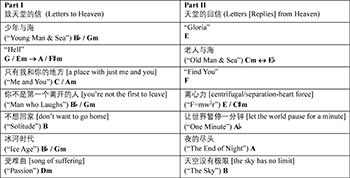
Example 1. Summary of the structure of G.E.M., Revelation
(click to enlarge)
[0.1] In the months of August and September 2022, Hong Kong-raised Chinese pop singer G.E.M. (邓紫棋) released an overtly Christian-themed narrative concept album entitled Revelation (启示录).(1) As shown in Example 1, the album comes in two parts and features two characters: a protagonist and her God. In the first part, the protagonist laments to God about various events that have happened in her life and God’s lack of response, whereas in the second part, God responds to each lamentation. In the months since this album’s release, G.E.M. has continued to perform the same songs as part of numerous televised concerts in mainland China and collaborated on various cover songs with other East and Southeast Asian musicians; she has even translated the entire album into Spanish for her growing South American audience.
[0.2] The last point, in particular, demonstrates the artist’s growing popularity in countries outside of the Chinese-speaking regions of East and Southeast Asia. Specifically, G.E.M. has gained a reputation, especially in the global West, for her boldness of faith in releasing an explicitly Christian album in mainland China. Many news articles and online publications use the lyrics and music video for the first song released from the album, “Gloria,” as a launching point for discussions, noting the name of the song, the mosaic image of parting waters in its music video, and the depiction of love as patient and containing no fear, in apparent reference to 1 John 4:18.(2)
[0.3] In addition to the album’s novel, evangelistic framing, a close reading of the album reveals artistic, deeply emotional, and culturally significant aspects of the work. In many cases, analytical insights lend support to deeper theological perspectives than what is typically described in interviews. The act of releasing the album, even apart from the theological messages contained therein, constitutes a living-out of the theological beliefs commonly discussed among Hong Kong Christians, and its contents, likewise, resemble a written musical-theological treatise that, with the help of musical features common in post-millennial pop music, convey biblical messages of suffering and triumph.
[0.4] In this article, I analyze the musical features of three songs from the album and demonstrate how these analytical perspectives help to highlight the theological concepts depicted within. I begin by situating the release of the album within the context of Hong Kong’s Christian theology. Then, I proceed to analyze three songs from the album that evoke a specific religious concept within Christianity. The opening song of the album, “Old Man & Sea” (少年与海), uses an accumulative texture and manipulation of G.E.M.’s vocal timbre throughout to illustrate the centrality and role of lamentation and, subsequently, God’s attention to such prayer. The eleventh song of the album, “F=mw2r” (离心力), offers a statement on free will and the agency of the believer. Finally, the album’s penultimate song, “The End of Night” (夜的尽头) is shown to interact with a terminal climax to provide an eschatological view—or a view related to end-of-time theology—of God’s promise.
1. G.E.M. and Christianity in Hong Kong: Theological Particularities of Revelation
[1.1] G.E.M. grew up and attended Christian schools in Hong Kong, a special administrative region of China. In order to understand G.E.M.’s Christian faith and the album’s theological particularities, it is thus important to understand some aspects of Hong Kong’s local Christian theology. In the scholarly literature on Christian theology in Hong Kong, authors frequently cite two common themes. The first is an emphasis on applications from Western theological literature; the other is called “lived theology,” or a theology that “finds expression not just in theological treatises and explicit statements of faith but also in individual and communal religious practices and in the lived experience of individuals and groups within the Christian faith community” (Brandner 2023, 167).
[1.2] The introduction of Christianity and Christian missionaries to Hong Kong alongside the British-colonial government has yielded a theology that is heavily dependent on the global West. Even in recent scholarship, works by theologians such as Ann Gillian Chu (2023) and Huen Wai Yan (2021) have yielded a theology influenced by their Western counterparts such as Stanley Hauerwas and Miroslav Volf. Chu notes, in particular, that this Western-influenced theology can sometimes be misunderstood by Hong Kong Christians and such misunderstandings can—and often do—yield a practice of Christianity that is withdrawn from the practical issues in the
[1.3] Yet despite the observations of societal non-engagement made by Chu and others, the lived theology of Hong Kong Christians has recently been engaged directly with Hong Kong at large. In this lived theological practice, the most persistent issue of focus lies with Hong Kong’s political interactions with mainland China. This concern has been ever-present since the handover of the port city from the United Kingdom to China in 1997 and has evolved as the years went on. Most recently, events such as the “Occupy Central with Love and Peace” movement in 2014, as well as the protests in response to the extradition bill of 2019 and the subsequent national security legislation of 2020, have pushed several local churches to respond directly to these issues.(4)
[1.4] These responses, however, are far from monolithic. While a variety of differing opinions exist, Chu and Perry (2023) argue that these attitudes can be roughly categorized into “pro-establishment” and “pro-democracy” theological perspectives. These opposing theological stances reflect different ideologies, are composed of different age groups and population demographics, and seek different results; however, both are formed by drawing from interpretations of the Bible.(5) The “pro-establishment” perspective emphasizes submission to worldly governments, however imperfect said government may be; those adopting this perspective tend to see evangelizing through their workplace as an important part of living out the faith. This latter point relates to “pro-establishment” theology’s views on building a strong working relationship with Beijing, which this perspective interprets as a crucial step in evangelizing to the people of mainland China. The “pro-democracy” stance, on the other hand, carries a stronger focus on justice and resistance to corrupt governments. This latter theology, which emphasizes biblical themes of crying out for justice, draws from elements of liberation theology.
[1.5] A centrally important issue at the heart of such “pro-establishment” and “pro-democracy” debates is the understanding that Hong Kong occupies a precarious space that lies somewhere in between colonialism, postcolonialism, and recolonialism. On the one hand, the push to separate Hong Kong from its colonial past operates as a central argument in the “pro-establishment” push for stronger ties with Beijing: to resist Beijing’s influence is to cling to a Western influence that has dominated Hong Kong for the past century. On the other, “pro-democracy” advocates point out that mainland China’s appropriation of postcolonial ideologies constitutes a form of recolonialism, in which Hong Kong is now forcibly taken over by yet another hegemonic power with the intent of erasing their cultural identity through a homogenous view of being Chinese. This tension further captures the nuances of the interaction between East and West at play in this space.
[1.6] G.E.M.’s own lived-theological stance incorporates aspects of both theological stances. Her affiliation with and expressed sympathies to the people of Hong Kong have led to some pushback from the Chinese government in Beijing and reflects some aspect of the “pro-democracy” movement’s push for freedom. Conversely, that she is a popular artist in mainland China with general approval from both the government and the population, and that Revelation is released in the country to billions of potential listeners, is indicative that the evangelizing aspect of “pro-establishment” theology is being lived out in the release of this album.(6)
[1.7] While the album constitutes a living out of Hong Kong’s Christian theology, it also functions as a written theological treatise of sorts, with its theological arguments evoked not only by the text, but also by musical elements within the album. This intersection between lived and written theologies stands as an example in which the former does not exist as a complement to, but rather produces, the latter. G.E.M.’s interpretation of Christian concepts within the album can, in the context of Hong Kong’s Christianity, be understood similarly as those by Chu (2023), Yan (2021), and other theologians and pastors in Hong Kong. To explain: she takes Christian concepts formalized in the West and creates her own form of Sino-Christian theology by capturing them within the context of a popular music album, written largely in Mandarin Chinese and released to a Chinese audience. The resulting collection, which lies at the intersections of lived and written theology, captures—both through G.E.M.’s practices and the music’s narratives—the cultural interactions between the East and West that are emblematic of both Hong Kong at large and in its Christian beliefs.
2. Methodology for Analyzing Mandarin Chinese Popular Music
[2.1] In this section, I outline the methodological reasoning for my analyses of the songs on this album. Analysis of Chinese vocal music has, to be sure, received plenty of attention in recent years, notably by scholars such as Nancy Rao (2017), Yu Wang (2023), Yiyi Gao (2023), Daniel Wu (2023), and Nathan Lam (2024). Much of this work, however, concerns traditional or folk genres of Chinese music, leaving analysis of popular Mandarin Chinese music as an underexplored area of Chinese music-theoretical research.(7) Far beyond a difference in genre, traditional and popular Chinese musics diverge in terms of musical features and poetic lyrical content. Musically, the styles of traditional and cultivated musical genres often pose a challenge to Western-analytical frameworks; authors examining these musical genres often take Chinese theoretical treatises as a starting point for their analyses. Chinese popular music, on the other hand, draws significantly more from the global West. Much like G.E.M.’s theological framework, so too are her musical styles influenced by Western musical traits regarding terms of pitch content, form, and vocal timbre.
[2.2] Whereas the case for lyrical usage in Mandarin popular music is somewhat more nuanced than the abovementioned musical features (as Mandarin lyrics cannot entirely draw from Western lyrical features) a notable contrast with traditional musical genres remains. As Wu (2023) and others noted, these traditional genres of Chinese music are sung in historical or regional dialects that are unintelligible to much of the present-day audience without the use of subtitles. Popular music, in contrast, has a focus on textual clarity, ease of understanding for most Chinese audiences, and features heavy use of Chinese–English bilingualism. While this disposition toward lyrical content does not entirely rely on Western pop-music features, several elements are nevertheless influenced by the latter. As such, my analytical methodology will draw primarily from the existing literature on Western popular music. Where necessary, however, I will provide my own commentary on how these approaches may be adapted to address the uniquely Chinese aspects of G.E.M.’s popular music.
[2.3] The lyrical analysis will be informed by Matthew BaileyShea’s (2021) work while also borrowing from observations of Chinese poetic form made by Michael Fuller (2017).(8) Some structural features of the text will factor into the analysis of this album with particular frequency: these include the syllable count, the caesura placement of each line of text, and the rhyme pattern of the lines. In Chinese writing, each syllable constitutes one character. Because of this one-to-one relationship between character and syllable count, Chinese poetry uses the syllable as its fundamental metrical unit and, as such, syllable numbers frequently generate poetic meter (Fuller 2017, 26). In most cases with traditional poetry, poetic meter manifests as lines containing either the same or similar number(s) of syllables.
[2.4] Unlike in Western poetry, in which techniques like enjambment can be used to create lines that do not always correspond to its grammatical units, Chinese poetic lines almost exclusively express complete grammatical units (Fuller 2017, 22). Enjambments, while not entirely unseen, are rare, and only understood as such when the poem’s meter has already been thoroughly established through numerous prior iterations of the same syllabic pattern. In addition to line breaks, the lines of Chinese poetry often contain within themselves regular rhetorical breaks called caesurae. In contrast to a line break, which separates one full grammatical unit from another, a caesura creates a lower-level unit of formal organization by consistently appearing at the same spot in each line, engendering a rhetorical pause as directed by the inflections of Chinese speech. In the case of song lyrics, a caesura can be supported and emphasized, or conversely minimized, by musical phrase-rhythmic elements. This study will use a space to indicate the location of a caesura in the Chinese and a vertical line in the English translation.(9)
[2.5] In Chinese poetry, the couplet appears particularly frequently and functions as a fundamental unit that lies in between the line and the stanza (Fuller 2017, 29–31). Longer stanzas such as quatrains and octets are generally created by chaining together multiple couplets. In a couplet, two lines either combine to express one full sentence, or two individual sentences are unified by a parallelism in the choice of Chinese characters.(10) The former situation may appear as somewhat of an exception to the rule that a line of Chinese poetry must express a full thought; however, in cases where two lines of a couplet are used to express one complete sentence, the first line must still contain a complete clause within the full two-line sentence. In modern-day transcriptions, wherein punctuation marks are added to the text, the first line of the couplet often concludes with a comma or colon, while the second line closes with a period.(11) As such, each line completes a grammatical unit, even if that grammatical unit is not always a sentence.
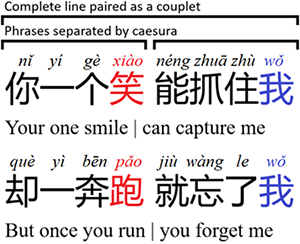
Example 2. Poetic structure from “F=mw2r,” demonstrating the effect of a couplet within a couplet
(click to enlarge)
[2.6] G.E.M.’s lyrics utilize all of these techniques. In the songs of Revelation, G.E.M. frequently combines the couplet with a single caesura in the middle of each line, creating in effect a pseudo-couplet within a couplet. This lyrical structure is reinforced through rhyme pattern. Unlike in traditional Chinese poetry, where, according to Fuller (2017, 29–31), rhymes only consistently appear at the end of lines and in some cases at the end of the couplet, G.E.M.’s lyrics close all lines and most caesurae with rhyming syllables. In the excerpt given in Example 2, which comes from the eleventh song of the album, the rhyming syllables found at all caesurae and line-endings contribute to the effect of a small pseudo-couplet within a larger true couplet. The primary difference between the two levels is that a caesura does not punctuate a complete thought, whereas each line gives at least a complete clause.
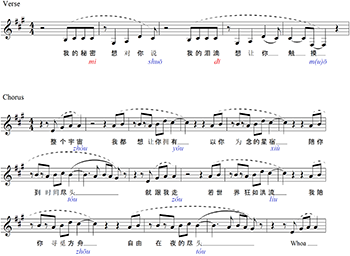
Example 3. Rhyme pattern and melodic construction in “The End of Night,” verse and chorus
(click to enlarge and listen)
[2.7] This poetic structure and rhyming pattern can be found in most song lyrics in the album, with exceptions usually occurring to highlight specific narrative features. In some instances, the caesura’s rhyming syllables are the same as those at the end of the line, creating an “aa” rhyme scheme; at other times they differ, resulting in an “ab” scheme. The former situation creates uniformity as all half-lines end on the same rhyming syllable, but it also emphasizes the parallelism between caesurae and line endings by using the same rhyming syllable at every break. The latter, while offering a greater level of contrast between the two halves of each line, in effect of emphasizes the complete line as a whole unit. For an illustration of this phenomenon, see Example 3, which provides the lyrical excerpts from the penultimate song’s verse and chorus. In the verse, the two halves of each line exemplify an “ab” rhyme scheme, whereas the chorus features an “aa” scheme. This differing rhyme scheme alters the phrases’ compositional choices. As the example demonstrates, the verse underemphasizes the caesura, opting instead for continuous melodies that span each entire lyrical line, whereas the disjunct percussiveness of the “aa” rhyme scheme coincides with an emphasis on the half-lines created by the caesura.
[2.8] In addition to the sonic aspects of the lyrics, the expression of the addresser–addressee relationship will play heavily into these analyses. Questions such as, “Who is talking?” and, “To whom is the addresser talking?” offer important analytical insight into understanding lyrical content. The identity of the main addresser on this album is relatively straightforward: in the first half, the protagonist writes seven letters to heaven, whereas in the second half, heaven responds. This means that the first seven songs of the album contain songs written from the perspective of the protagonist, while songs from the latter half portray songs written from the perspective of
[2.9] Many of the most intriguing musical elements of the album arise from the nonstandard organization of sonic elements. Several songs deploy ambiguous formal features, which frequently serve programmatic effects. One example of such an evocative formal technique is the use of inconclusive formal sections to create ambiguous endings. A number of others feature atypical instrumentation, and manipulations of G.E.M.’s vocal timbre.(14) Within China and other Chinese-speaking countries, G.E.M. is well known for her wide vocal range and powerful sound. In this album, G.E.M. employs three distinct vocal production techniques that can generally be described as a modal sound, a head voice, and a belting voice accompanied by varying degrees of vocal strain.(15) The modal voice is characterized by little to no tension in the vocal folds and is the only one of the three frequently sung in the middle of G.E.M.’s vocal tessitura. Occasionally, this production style is accompanied by touches of breathy phonation at the ends of musical phrases. The head voice occupies a higher register and, as the name suggests, is characterized by sympathetic vibrations (or resonances) felt in the head. This vocal production uses light breath support with minimal tension in the body. (Like the modal voice, this means of production is accompanied by touches of breathiness throughout, especially at phrase endings.) The belting voice occupies a similar register to the head voice but differs in the use of full body support and increased tension throughout the body, especially in the area around the vocal folds.
[2.10] The vocal production techniques used in the album carry relatively consistent expressive roles and bear some correlation with the characters being portrayed in the concept album’s narrative. The head voice is most frequently used in the album’s first half and often depicts sadness, vulnerability, and introspection. These associations are likely due to the head voice’s lighter breath support and its touches of breathiness, both of which give a sense of intimacy and closeness. The modal voice is often used to depict God’s voice. Its mid-tessitura range and low tension help to evoke reassurance and comfort. The belting voice is the most varied in its usage, but commonly depicts moments of emotional intensity and is regularly paired with a dramatic, direct form of lyrical address.
3. Prayers of Petition: Centrality of Lamentation in “Young Man & Sea (少年与海)”
[3.1] The first and most central concept explored in the album is that of suffering and lamentation. In contrast to the normative American theological practice in which lamentation is often a peripheral aspect of Christian worship, G.E.M.’s Revelation gives lamentation a central position in the album.(16) The first part, titled “Letters to Heaven,” is replete with the lamentations of a character who is frustrated with God’s inattention to the events of her life. In formatting the album this way, G.E.M. highlights an aspect of theology that has gained traction in the East. Complementing the Christian concept of sin, East Asian theologians (particularly Korean scholars) have emphasized the concept of han, a term “used to describe the depths of human suffering” (Park 1993, 15).(17) More specifically, han exists to counter sin, which “has been oriented almost exclusively to sinners. Christianity has been preoccupied with the well-being of sinners/oppressors and has devoted little attention to their victims” (Park 1993, 72). Han, by contrast, focuses on the victims of sin and unpacks the consequences of the trauma dealt against them.(18)
[3.2] The role of han is especially prominent in Revelation’s first half. The opening song is “Young Man [Youth] & Sea.”(19) While most lamentations on the album come solely from the perspective of the lamenter, the opening song offers a unique portrayal of the relationship between the main character and God, in that God responds in the second half. This song, as well as several others in the first half of the album, can be understood as both G.E.M.’s attempts to put words to suffering and an artistic representation of the protagonist’s attempts to do the same. Scholars such as Dorothee Sölle (1975, 75), Patrick Miller (2005, 17), Elaine Scarry (1985), and Kristine Rankka (1998, 14–18) have pointed out the difficulty of this endeavor, both realistically and artistically: suffering, by its nature, breaks down and resists language.(20) In this song, this destruction of and resistance to language is made evident both textually and musically. Throughout the song, the text becomes transformed, fragmented and rebuilt, as the protagonist comes to terms with the extent of her suffering. Likewise, musical layers are accumulated, broken down, and reaccumulated throughout the track as the protagonist undergoes these emotional stages.
Example 4. Lyrics and English translation of “Young Man & Sea,” with bolded characters indicating rhymes

(click to enlarge)
[3.3] Example 4 reproduces the lyrics of “Young Man & Sea” along with an English translation.(21) Several textural features are immediately noteworthy. The song uses a single stanza of text across all strophes. This single stanza of text offers perhaps the most irregular instance of the couplet structure outlined in Example 2 above, given its highly uneven syllabic composition: the first three couplets each contain a pentasyllabic first line with a caesura after the first syllable, answered by a second line that contains nine syllables with a caesura after the fourth. This consistent alternation between five and nine syllables creates a limping effect that is often used in lament poems of Old-Testament scripture, such as in the book of Lamentations, where the unevenness of the couplets is interpreted as a manifestation of the author’s struggles.(22) The final couplet breaks down the previous metrical pattern further. On one hand, these final lines can be heard as a couplet composed of a pentasyllabic and a hexasyllabic line. This shortening of the poetic meter evokes a sense of breakdown in the protagonist’s thoughts. More boldly, one could argue that these final two lines no longer form a couplet, but rather are separated into two independent lines: whereas the previous couplets are organized syntactically into a single sentence whose lines are separated by a comma, the final lines both contain independent questions with minimal parallelism. By the final lines, the protagonist is no longer able to articulate the full poetic form, and her sentences become shorter utterances. At this point, thought and coherence both become undone.
[3.4] The lyrics literally question what the purpose of love is, if it has led to the han-filled state in which the speaker now finds herself. Curiously, the mode of address is not entirely clear in this song. Although it is not immediately evident whether the character is reflecting to herself or directing these questions to another, the singer’s vocal timbre, as suggested earlier, provides additional context that hints at the song’s form of address. In this case, the changing musical context across the span of the song suggests that the mode of address changes from lyrical self-reflection to implied outward address.
[3.5] That the musical elements suggest a progression from lyrical self-reflection to implied outward address aligns with a deeper, critical narrative process intimated by both Miller and Scarry, in which words of pain become words of prayer. In the same way that Scarry’s pain causes a reversion into pre-language, she states that, “conversely, to be present when a person moves up out of that pre-language and projects the facts of sentience into speech is almost to have been permitted to be present at the birth of language itself” (1985, 6). Throughout the song, we witness the musical portrayal of Scarry’s destruction and rebirth of language to and from the “pre-language of cries and groans.” Using the same text, the speaker goes through several stages: groaning, reflection, breaking down, and finally closing with outward petition, or what Amos Yong (2011, 44) calls “active prayer,” which “highlights both the agency involved in our response to unjust suffering and simultaneously the hope that we put in the redemptive work of God.” Like the lyrics, the form of the opening song follows the protagonist’s process as her initial pre-language of cries and groans becomes verbalized internal reflection. Following this, we witness a reversion back into pre-language, before finally manifesting as outward and active words of prayer.
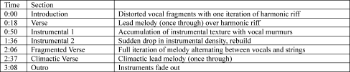
Example 5. Formal outline of “Young Man & Sea”
(click to enlarge)
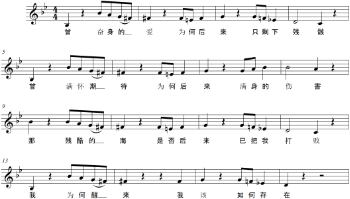
Example 6. Transcription of main melody from “Young Man & Sea”
(click to enlarge and listen)
[3.6] Example 5 provides a formal outline of the song. The song opens with an introduction replete with vocal whispers: an initial, breathy, non-verbal utterance of the human voice that evokes the shattered pre-language of the protagonist’s current state. Soon after, the opening statement of the lyrics begins. Example 6 provides a transcription of this melody.(23) The transcription illustrates a generally descending contour that fluctuates between the keys of G minor and
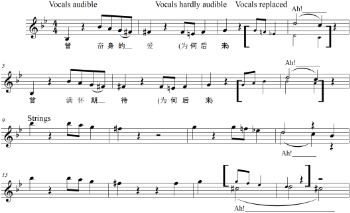
Example 7. Transcription of fragmented melody from “Young Man & Sea,” 2:06–2:37
(click to enlarge and listen)
[3.7] Following the initial utterance of the lyrical stanza, the vocal part cuts out entirely, and various instrumental sections follow in 0:50–2:05 with fragments of the opening melody, now voiceless and textless. These fragmented entrances adopt an accumulative strategy that culminates in the attempt at the verse in 2:06, where the texted melody is heard again, albeit in the background, heard through plenty of reverb, and stated in a fragmented form; see Example 7. Here, the speaker states only the first line of each couplet, in which the melody articulates only the initial descending tetrachord. These first two lines contain text describing a more idyllic past; at the exact moment each line of text begins to describe the harshness of reality, the protagonist’s words break down. The protagonist’s thoughts are clear, until she must describe the end state of her suffering. By the second half of the stanza, even these words prove to be too much, as violins enter to finish the now voiceless melody.
[3.8] Finally, in 2:37, the speaker reiterates the lyric stanza in full, in the same form as Example 6: language is reborn from the destructive aftermath of cries and groans. This time, the vocal timbre changes to a belting voice and is supported by full instrumentation, suggesting that these same lines are no longer meant to be interpreted as an internal reflection, but are now outwardly expressed as real, non-rhetorical questions for an addressee. It is here that the same words of pain from the outset have transformed into words of prayer directed toward the protagonist’s God.
[3.9] At the same time, however, the breathiness that was present from the song’s outset becomes more prominent, even as the belting timbre is used. The breathiness manifests itself in the first three couplets of this climactic strophe through G.E.M.’s heavy breathing at each poetic caesura. In the final, truncated couplet, both the opening and closing syllables of each subline are delivered in a breathy tone. This is the only time in the album that G.E.M. mixes a breathy phonation with a belting delivery. The breathiness contrasts against the emotional impact of the belting voice and offers a timbral reversion to the song’s opening, suggesting that, even though the protagonist has progressed into words of prayer, the pain from the opening remains and, eventually, overtakes the protagonist once again. Following this climactic iteration, a long instrumental section is heard as the musical layers slowly fade out. Even after the entire song, language is absent; this opening letter to heaven leaves the protagonist full of unanswered questions.
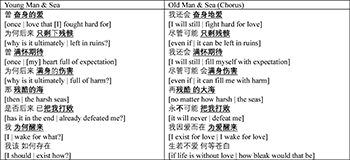
[3.10] Several commentators have probed the issue of closure in prayers of lamentation, with many authors observing one of two trends. Some suggest that the prose of lament need not conclude with any sense of hope.(25) In these prayers, God does not respond, and the petitioner may dwell in a state of suffering at the end of the lament instead of being forced onto some happier, but arguably less legitimate, state. Others, however, point to lamentations that do ultimately close out in hope and reassurance, as though the subject of the prayer has somehow found the hopeful response in the process of praying.(26) The current interpretation views this lamentation as falling somewhere between these two extremes. In the context of the song, the protagonist’s God is silent, and the petitioner is left with unanswered questions; the song closes with a prolonged instrumental section that again recalls the destroyed language that persisted for much of the song. In the context of the album, however, a response is forthcoming in the song “Old Man & Sea” from Part II of the album. Songs in this part of the album are almost exclusively from the perspective of God speaking to the protagonist. In “Old Man & Sea,” the speaker addresses each one of the protagonist’s questions by directly quoting words used by the latter in “Young Man & Sea.”
Example 8. Comparison of lyrics in “Young Man & Sea” and “Old Man & Sea”
(click to enlarge)
[3.11] Example 8 gives the lyrics of the chorus from “Old Man & Sea” next to those of “Young Man & Sea,” using bold and underlined Chinese characters to demonstrate the intertextual quotations between the two songs. In addition to providing direct responses to the protagonist’s questions, the melodic and harmonic trajectories of the latter song also depict an act of deliverance by reversing the path taken in the former. In contrast to the descending melody of the lament, this response song features an ascending melody. Harmonically, “Old Man & Sea” opens in C minor; however, it eventually progresses to an
[3.12] One last important thing to keep in mind about this interpretation is that it emphasizes the promise of this new reality over the presence of the reality itself, given both what is heard in the text and what appears musically. Textually, the speaker (here understood to be God) likens love to waves on a shore: even in moments when it is not present, it promises to return. This suggestion alludes to the possibility that the protagonist’s absent feeling of love, though being addressed now, has not returned yet. Musically, this possibility is made clearer through the realization of the tonal partnership between C minor and
4. Believer’s Agency: Free Will in “F=mw2r (离心力)”
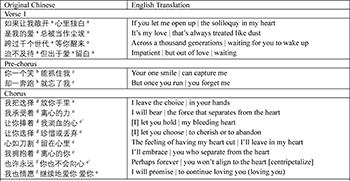
Example 9. Lyrics and English translation of “F=mw2r,” with letters indicating rhyming characters
(click to enlarge and see the rest)
[4.1] The song “F=mw2r” presents a marked contrast from the songs in the second half of the album. The Chinese name of the song, meaning, “centrifugal force,” is a play on words: the characters used for this term translate literally as, “separation-heart-force.” This wordplay is complemented by the mathematical portion of the title, which is the physics equation for the same phenomenon. Musically, it is the only song in the second part of the album to feature prominently a minor-key tonic, creating a departure from the peace and comfort that God’s presence and attentiveness have thus far imparted. The narrative reason behind this tone shift is made evident in the lyrics of the song, which are given in Example 9. As these lyrics demonstrate, the speaker, now God, is describing the forces keeping the protagonist apart and presenting the latter with a choice: the protagonist is given the freedom to leave or follow, even if the choice of leaving will cause the speaker grief.
Example 10. Formal outline of “F=mw2r”
(click to enlarge)
Example 11. Transcription of opening instrumental pattern from “F=mw2r”
(click to enlarge and listen)
Example 12. Transcription of “F=mw2r,” 0:13–0:29
(click to enlarge and listen)
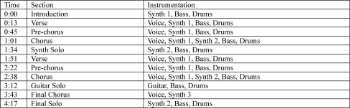
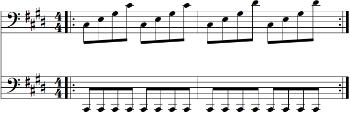
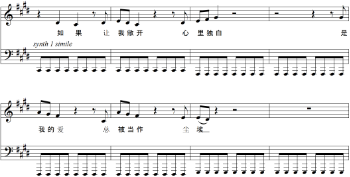
[4.2] The formal outline of “F=mw2r” is given in Example 10. This song takes on a standard rotational verse-chorus form and features instrumental retransitions following each verse-chorus unit.(27) The musical depiction of separation is conveyed across several musical domains, including pitch content, sonic layering, and vowel brightness, suggesting the numerous binary (split) decisions the protagonist faces. The song opens with a low sonic profile, in the form of the bass riff that occupies much of the opening soundscape, which is coupled with a timbrally dark synthesizer riff and percussive instruments (Example 11). Guitar and other sounds from the harmonic layer—those that often fill out the middle ranges—are notably lacking. G.E.M.’s breathy, intimate, modal-register singing of the opening verse provides the first instance of registral contrast to this low sound profile (Example 12).
Example 13. Pitch syllable diagram of verse from “F=mw2r,” showing contrasting contours of melody and bass in the verse
(click to enlarge)
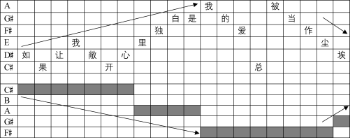
[4.3] As if to emphasize the registral contrast between G.E.M.’s vocals and the bass riff, the bass and melody exhibit predominantly contrary motion. Example 13 illustrates this arrangement in terms of BaileyShea’s (2021) pitch syllable diagrams . The melody ascends against a descending bass, melodically portraying the separation force to which the title alludes. Toward the end of the verse, the melody falls as the bass edges back up to
[4.4] Textually, the speaker is heard acknowledging feelings of being abandoned by the protagonist. In complement to the songs of the album’s first part, in which the protagonist described the han experienced in her life, God now expresses what Park (1993, 120–21) refers to as divine han, or the possibility that God may be wounded by the actions of humans. In Christian theology, topics of free will and the problem of evil are closely intertwined; free will is, by several models, the most compelling explanation for the existence of evil.(28) As such, this text on free will also offers an “Augustinian” theodicy on the reasoning for the protagonist’s suffering.(29) In the opening verse, God is heard stating that the protagonist often forgets her God and instead runs away on her own. It is fair to infer, then, that this act of running is what yields the problems in her life. The protagonist’s God is suggesting here that, by abandoning the same God, the protagonist ultimately leads to suffering in her life.
[4.5] Lyrically, this verse is organized as a quatrain with decasyllabic lines and caesurae placed just off-center, creating couplets whose constituent lines alternately contain 6–4 syllables in the first line and 4–6 syllables in the second. The caesura and final close of each line share the same rhyming sound, resulting in a matching “aa” rhyme scheme. In addition to emphasizing the ends of each half phrase, this rhyme scheme projects a limping meter similar to that heard in the opening song. Unlike “Young Man & Sea,” however, this limping meter is created through an off-centered caesura placement within a line, rather than through independent lines of differing lengths. The limping meter is here further emphasized in the vocal rhythms, where, as Example 12 shows, a lengthy pause is heard between each line of text. Here, like in the opening song, the voice dwells on struggles that are present. Only this time, that speaker is not a human protagonist, but rather God.
Example 14. Transcription of “F=mw2r,” 1:01–1:34
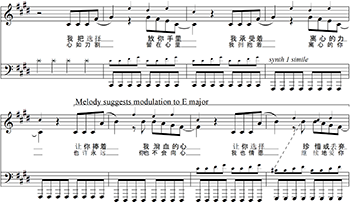
(click to enlarge and listen)
Example 15. Pitch syllable diagram of chorus from G.E.M., “F=mw2r,” showing contrasting contours of melody and bass in the verse
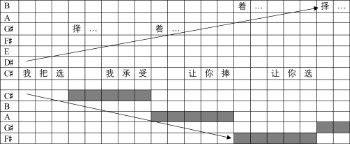
(click to enlarge)
[4.6] With the onset of the chorus, more musical features evoke the split choices that God offers the protagonist, directly reflecting the lyrics’ focus on choices and consequences. Example 14 illustrates the musical layers at play in this section. First, a novelty layer in the form of a brighter synth timbre provides a high-register hook to accompany G.E.M.’s vocals, further emphasizing the contrast between high and low registers in the overall sound.(30) Similarly, the melodic profile demonstrates a more drastic depiction of separation. Whereas in the verse the melody moved to and by step, the chorus’s melody leaps directly to and (Example 15), further heightening the contrary motion away from the center of the melody.
[4.7] The poetic form of the chorus also changes in two ways, both of which suggest an acceleration in poetic meter. First, the text is reshaped into octasyllabic lines which subdivide into symmetrical four-syllable halves. In contrast to the uneven meter of the verse, this smoother symmetrical layout suggests that the speaker has now come to accept the current circumstances. Second, the internal close now carries a contrasting “ab” rhyme scheme. As Example 9 demonstrates, the first half of each line ends on a dark schwa “-e”; the second half, conversely, ends on a bright “-i.”(31) This juxtaposition contrasts with the verse, in which all phrases concluded on the same vowel. At the same time, the melody begins to modulate (independently of the bass) to the relative major at the end of each half of the chorus. This modulation not only creates a registral separation between the bass and vocals, but also a harmonic-melodic divorce that operates on the level of keys. The latter, highlighted by the juxtaposition between
Example 16. Transcription of instrumental solo from “F=mw2r,” 1:34–1:51
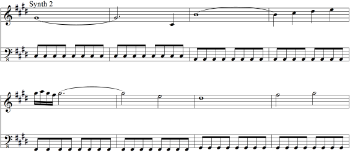
(click to enlarge and listen)
Example 17. Transcription of instrumental solo from “F=mw2r,” 3:12–3:43
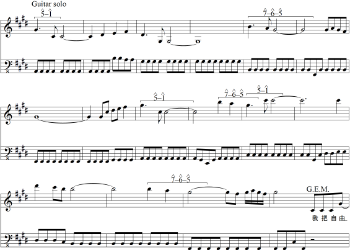
(click to enlarge and listen)
Example 18. Transcription of instrumental solo from “Hell,” 2:25–2:47
(click to enlarge and listen)
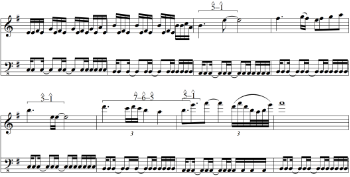
[4.8] Musical events play out largely the same way in the second verse-chorus unit. This time, the verse illustrates the speaker’s foreknowledge of the events in the protagonist’s life. Here, references to darkness, seclusion, and nights in the lyrics further paint the images conveyed by the bass and contrasted by the lead vocals. An instrumental solo is heard following both choruses: the new synth line introduced in the opening chorus leads into a synth solo following the same chorus (Example 16), whereas a guitar solo is heard following the second chorus (Example 17). The last time a synth solo was heard in the album was in the song “Hell” (Example 18). Notably, the solo in “Hell” bears several similarities to the current solos. It shares a similar timbral profile of a bright synthesizer contrasted against a pulsing bass with the solo of Example 16 and shares several melodic features with that in Example 17, such as the frequent leaps from up to , as well as the leaps up to followed by stepwise motion down to .
[4.9] These intertextual references, again, musically suggest choice. The protagonist may either follow God’s voice, or she may follow the synthesizer back to the sound of the situation described in “Hell.” At this point, from the context of the lyrics and music, it is clear the protagonist herself is aware of this choice.
[4.10] Following the guitar solo, the final chorus begins with a thin texture consisting only of a piano riff. The ever-present bass that has played since the song’s outset seems to have finally given into the brighter timbral profile of the other instruments, having moved up the octave and switched out its persistent eighth-note pattern for sustained whole notes. In much the same way that the end of the chorus offered a theme of ascension, this final chorus now expands upon that upward motion by brightening the sound of the chorus in its entirety. Ironically, the overall brightening is also contrasted by altering the final chorus text to reflect darker vowels in the first half of each line. Following this final chorus, the same synthesizer solo enters over a renewed bass line to bring the song to a close.
[4.11] In addition to the theodicy discussed earlier, the portrayal of the protagonist’s freedom of choice reveals several particularities about the depiction of God in the album.(33) This song reframes some common ideas about the Christian God’s omnipotence and omniscience in order to emphasize the believer’s agency and the divine han that God experiences (cf. Park 1993, 126). Rather than portraying God as an all-powerful and all-knowing deity, this song depicts God through what Heath White (2020, 14–18) calls a “risk-taking” model, whereby God either does not know what would happen in offering the protagonist this choice (open theism), or has foreknowledge of what will happen but does not intervene (simple foreknowledge). While Plantinga (1974, 164–95) has demonstrated a logical account of God and the existence of evil using the free will defense, these arguments are not always consistently applied across other characteristics that are generally considered Godly. David Hunt and Linda Zagzebski (2022) demonstrate, for example, that this free will account of God often implies at some level that other Godly qualities such as infallibility are at least downplayed.
[4.12] In this song, the God of the story is portrayed as not knowing or not being able to control what the protagonist will ultimately do. From a narrative perspective, that God is fashioned as a character, as opposed to an omniscient narrator, is highly significant. In the final chorus, the speaker offers the protagonist a choice yet again. Although the pulsing bass—the instrumentation that has musically portrayed the darkness in the protagonist’s heart—has dropped out for this final chorus, the text still does not offer any explicit indication that the protagonist has committed to following God, or that the speaking God is aware of this decision, either.
[4.13] This emphasis on freedom over determinism inverts the listener’s perception of how God and the protagonist have interacted with one another: the same acts of suffering that once led the protagonist to see her God as neglectful and callous are now used to emphasize the same God’s benevolence, love, and suffering. The free-will offering given by God carries potential for great loss, not only for the protagonist, but also for God. In portraying the protagonist’s relationship to God in this way, the narrative somewhat downplays the latter’s omniscient and omnipotent qualities. At the same time, this portrayal of benevolence and self-sacrifice also comes with an illustration of God’s patience and restraint. Despite the visceral images depicted, G.E.M.’s vocal delivery never fully retains the emotive belting range. Each time she gets close to this delivery, she restrains herself and returns down to the modal register. Even as God bears the consequences of the protagonist’s actions, we hear, if anything, restraint rather than emotion in G.E.M.’s voice.
[4.14] The return of the bass in the final post-chorus instrumental section is further indication of the multitude of possible outcomes following a choice to have faith or not presents. The song ends with the synthesizer on the tonally ambiguous
5. The Eternal Promise: Eschatology and “The End of Night (夜的尽头)”
Example 19. Lyrics and English translation of “The End of Night,” with letters indicating rhyming characters
(click to enlarge and see the rest)
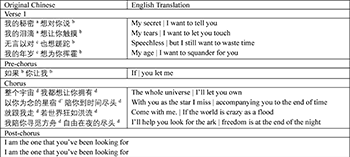
[5.1] The issue of choice extends to the penultimate song of the album, when the speaker once again broaches the topic. This time, however, the addresser shifts the emphasis on the promises God makes to the protagonist, should she choose to accept God’s invitation. The lyrics are provided in Example 19. These lyrics, like those in “F=mw2r,” utilize the linear structure described in Example 2 above. The uneven-meter effect heard in both previous songs returns; however, it is minimized both in the poetic structure and in the musical delivery of the lyrics. G.E.M.’s timbre is now the belting voice that she largely avoided in “F=mw2r,” demonstrating that the protagonist has now abandoned the calm, restrained demeanor in favor of a more emotionally passionate form of delivery. The God of the album is once again pursuing the protagonist, entreating her with promises of eternal freedom and an end to past trauma. In this penultimate song, musical and textual elements are used to enhance eschatological aspects of a now much more explicit Christian salvation.
Example 20. Formal outline of “The End of Night”
(click to enlarge)
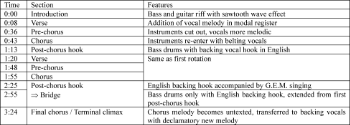
[5.2] Example 20 provides a formal outline of the music. The song deploys a unique formal feature that lies somewhere in between a standard compound verse-chorus form and a terminally climactic form, which results in part from changing the final chorus melody into an untexted hook in the song’s final section.(34) Two studies, one by Andrew Moenning (2023) and one by me (2019), have noted narrative connections between terminally climactic forms and depictions of eternity and the afterlife; both concentrate on the progression into new material to signal a sense of moving on. In this case, however, the situation is somewhat more nuanced. While the melody of the final section is the same as the chorus melody, its return as an untexted vocal hook imparts a sense of newness—almost to the point of unrecognizability—to the melody. This returning melody in a new setting, coupled with the final three lines of the chorus over entirely new music, suggests a formal section that has features of both a final chorus and a terminal climax.
[5.3] The initial chorus enters at 0:43 and resembles a standard chorus in many ways. The one somewhat unusual feature about this section is the persistence of the “four-on-the-floor” bass-drum pattern that has been present since the track’s outset. Whereas its use in the verse suggests a buildup to the oncoming chorus, its persistence here hints that this section, despite being a local climax, has not completed the song’s teleological trajectory.(35) Upon the conclusion of the chorus, a post-chorus is heard with G.E.M.’s head voice on a brief melodic hook in English. Soon after, the second verse enters, which, much like the first verse, builds into the chorus at 1:55. This time, two changes are heard in the post-chorus hook. First, in addition to the English text, G.E.M. overlays improvisational lines, the lyrics of which articulate that to follow the speaker of the song (God) is to find everlasting freedom.
[5.4] The second post-chorus hook eventually fuses into bridge material. At 2:55, several accompanimental features drop out, save for the still-persistent “four-on-the-floor” bass drum and a continuation of the repeated English hook, which becomes the new bridge melody (“I am the way, the truth, the light that you’ve been looking for.”) This new line paraphrases John 14:6, thereby adding a Christological undertone to the interpretation by both a) making it explicit that following the God of the album is analogous to following the Jesus described in the new-testament book of John, while also b) putting the entire album in dialogue with events described in the synoptic gospels.(36)
Example 21. Transcription of “The End of Night” showing the initial, fully texted choruses, 0:43–1:13
(click to enlarge and listen)
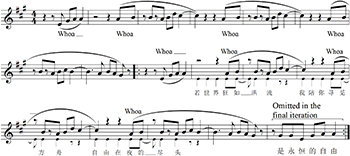
Example 22. Transcription of “The End of Night” showing the final untexted version of the chorus, 3:24–4:41
(click to enlarge and listen)
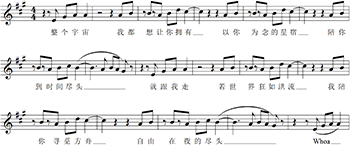
[5.5] At 3:24, all previous musical elements drop out, and the untexted vocal hook of the chorus enters, replacing lyrics of the chorus melody—lyrics in which God promises the protagonist the universe and to accompany her until the end of time—with textless syllables. Examples 21 and 22 provide transcriptions of the chorus melody, both in its original iteration (Example 21) and the textless version (Example 22). As the example demonstrates, the latter omits all text, save for the final line, in which the speaker proclaims, “it is everlasting freedom.” Curiously, the lyrics that once described this freedom are now missing. Meanwhile, the portions of text preserved from the original chorus take on a new, striking melody. Melodically, it sheds the rhythmically and melodically intricate hooks for a monotonous and rhythmically simple declamation of the text. This shift of musical delivery underscores the new text’s poetic meter, which is now devoid of any limping effect seen throughout the songs analyzed in this essay.
[5.6] This mostly untexted hook repeats until the end of the song, but cuts off just before the final, texted line. Due to this cutoff, the song now ends without lyrics on a melodic segment that has thus far served a medial formal function, producing a sense of lyrical and melodic inconclusiveness (see Example 22). This melodic and textual openness finds further corroboration in the still-persistent “four-on-the-floor” pattern established since the song’s outset, here accompanied by the same pattern on the snare drum and sixteenth-note patterns on the hi-hat. This drum pattern, coupled with the lyrical and melodic content, continues to emphasizes that, even at this point, the song has not entirely arrived at its destination.
[5.7] Both musical observations on inconclusiveness lead to a similar and equally curious point about the song’s placement within the album: this eschatological rumination is placed not as the final, but rather the penultimate, track of the album. This striking decision might be interpreted along the lines of Trevor Hart’s (2010, 262–75) assertion that eschatology is fascinated with penultimate things, or with transitional periods between the present and the new creation.(37) Here, the ultimate realm of God’s new creation is never revealed in the song, for it deals with “what lies in principle beyond the range of any historical human experience, and thus beyond the normal working reach of the words and concepts we use to make sense of that experience” (Hart 2010, 263). Instead, G.E.M.’s story focuses on the promise of this eventual future. Much like the terminal climax that builds to nowhere, we are promised an eventual freedom but are not yet allowed to see it.
[5.8] The context of the promised outcome affords the untexted hook yet another layer of meaning. At the same time that this hook embodies the promise made to the protagonist in previous choruses, the ultimate shape of the future is not known. It may be, in other words, that the melody is left untexted because there is simply nothing to say. This untexted vocal hook here projects an ambiguity that literally leaves aspects of the eschaton to the listeners’ imaginations. Issues such as heaven, hell, purgatory, and other, more contested, eschatological topics are left out of the discussion.(38) In the previous choruses, the protagonist is promised eternal freedom. What, exactly, that freedom looks like is yet to be seen and, therefore, yet to be described. All that remains is G.E.M. proclaiming at the end of each iteration, “it is everlasting freedom,” even though the descriptions of this freedom now only manifest as a mysterious textless melody. It is likewise in this context that, when the final note is sung on the open-sounding
Conclusion
[6.1] The last song of the album turns away from hypotheticals and returns to a more familiar—and possibly therefore more relatable—conclusion from the protagonist’s perspective. This final change in addresser transfers the agency back to the protagonist and gives her the last word, possibly emphasizing yet again the central role of human free will to navigate the sphere of God’s ordinance.(39) As I have recently provided a detailed analysis of this last track elsewhere, in Zhang 2024 (144–50), it will not be necessary to dwell much on it here. As a summary, the protagonist has seemingly accepted her God’s invitation and, consequently, been delivered out of her initial situation. Along the way, the protagonist curiously references God’s foresight, providing added nuance to the free-will themes of “F=mw2r.” The ultimate state of the eschaton, as alluded to in “The End of Night” is left unknown, but the protagonist’s current state of mind is unequivocally portrayed in the final song of the album.
[6.2] The musical parallels between the first and penultimate songs of the album are likewise worthy of being mentioned. Untexted melodies are used in both, but to rather different ends. In “Young Man & Sea,” the textless—and in many settings, voiceless—music is meant to depict a destruction of language, augmenting the lament narrative by highlighting the protagonist’s troubled, speechless state. In the penultimate song, by contrast, this same device, now set to textless voices, projects both formally an ambiguous interaction with terminal climaxes and narratively evokes a description of the ineffable. In sum, each refers in their own way to eternity.
[6.3] G.E.M.’s Christian album offers more than a collection of songs, providing an intriguing launching point for reflection on several perspectives of theological discourse. Whereas on the one hand, the album demonstrates a living-out of evangelical practices reflective of pro-establishment lived theology in Hong Kong, its contents also exist as a theological treatise on several aspects of G.E.M.’s Christian beliefs. This paper has shown the interaction between music-theoretical concepts and perspectives on lamentation, free will, and eschatology; however, many more musical and religious themes reside within the album. In the end, through the balancing of these acts, G.E.M. has created an album in which the final product is replete with Christian elements to those who look and listen for them.
Xieyi (Abby) Zhang
Haas Howell Building 724
Georgia State University
33 Gilmer Street SE
Atlanta, GA 30303
xzhang90@gsu.edu
Works Cited
Bailey, Wilma, and Christina Bucher. 2015. Lamentations, Song of Songs. Herald Press.
BaileyShea, Matthew. 2021. Lines and Lyrics: An Introduction to Poetry and Song. Yale University Press. https://doi.org/10.12987/9780300262735.
Begbie, Jeremy. 2000. Music, Theology, and Time. Cambridge University Press. https://doi.org/10.1017/CBO9780511840142.
Billboard China. 2022. “G.E.M. on Finding Divine Inspiration for ‘Revelation’ Album: ‘I Write Letters to Heaven & They Write Back.’” Billboard, October 12, 2022. Accessed January 15, 2023. https://www.billboard.com/music/music-news/gem-interview-billboard-china-cover-story-translated-english-revelation-1235155039/.
Bonhoeffer, Dietrich. 2015 [1949]. Ethics. Translated by Reichard Krauss, Charles C. West, and Douglas W. Scott. Fortress Press.
Brandner, Tobias. 2023. Christians in the City of Hong Kong: Chinese Christianity in Asia’s World. Bloomsbury. https://doi.org/10.5040/9781350269125.
Brown, Sally. 2005. “When Lament Shapes the Sermon.” In Lament: Reclaiming Practices in Pulpit, Pew, and Public Square, ed. Ally Brown and Patrick Miller, 27–37. Westminster John Knox Press.
Burns, Lori. 2016. “The Concept Album as Visual–Sonic–textual Spectacle: The Transmedial Storyworld of Coldplay’s Mylo Xyloto.” IASPM Journal 6 (2): 91–116. https://doi.org/10.5429/2079-3871(2016)v6i2.6en.
Burns, Lori, and Patric Armstrong. 2021. “Structuring Subjectivity: Pain of Salvation’s The Perfect Element: Part I (2000).” Metal Music Studies 7 (3): 357–82. https://doi.org/10.1386/mms_00055_1.
Chu, Ann Gillian. 2023. “Stanley Hauerwas and ‘Chan Tai-man’: An Analysis of Hong Kong Laypeople’s Lived Theology and Hong Kong Theologians’ Engagement with Stanley Hauerwas’s Political Theology from a Practical Theology Perspective.” Practical Theology 16 (2): 262–76. https://doi.org/10.1080/1756073X.2023.2179277.
Chu, Ann Gillian, and John Perry. 2023. “‘If the Gospel We Preach Disregards Human Rights, I Would Rather Not Preach This Gospel’: Towards a Lived Theology of Hong Kong Churches.” Theology Today 79 (4): 422–34. https://doi.org/10.1177/00405736221132861.
Daverio, John. 1997. Robert Schumann: Herald of a “New Poetic Age.” Oxford University Press. https://doi.org/10.1093/oso/9780195091809.001.0001.
De Clercq, Trevor. 2021. “The Logic of Six-Based Minor for Harmonic Analyses of Popular Music.” Music Theory Online 27 (4). https://doi.org/10.30535/mto.27.4.4.
Duff, Nancy. 2005. “Recovering Lamentation as a Practice in the Church.” In Lament: Reclaiming Practices in Pulpit, Pew, and Public Square, ed. Ally Brown and Patrick Miller, 3–14. Westminster John Knox Press.
Elicker, Martina. 2001. “Concept Albums: Song Cycles in Popular Music.” In Word and Music Studies: Essays on the Song Cycle and on Defining the Field, ed. Walter Bernhard and Werner Wolf, 27–48. Editions Rodopi. https://doi.org/10.1163/9789004488748_014.
Fuller, Michael. 2017. An Introduction to Chinese Poetry: From the Canon of Poetry to the Lyrics of the Song Dynasty. Harvard University Press. https://doi.org/10.1163/9781684175833.
Gao, Yiyi. 2023. “Understanding Metric Flexibility and Performance Practice in Chinese Traditional Singing.” Paper presented at the Annual Meeting of the Society for Music Theory, Denver, CO, November.
Geary, David. 2024. “Formal Functions of Drum Patterns in Post-Millennial Pop Songs, 2012–2021.” Music Theory Online 30 (2). https://doi.org/10.30535/mto.30.2.3.
Gross, Nancy Lammers. 2005. “The Shepherd’s Song: A Sermon.” In Lament: Reclaiming Practices in Pulpit, Pew, and Public Square, ed. Ally Brown and Patrick Miller, 38–44. Westminster John Knox Press.
Hart, Trevor. 2010. “Eschatology.” In The Oxford Handbook of Evangelical Theology, ed. Gerald McDermott, 262–75. Oxford University Press.
Hasker, William. 2011. “Divine Knowledge and Human Freedom.” In The Oxford Handbook of Free Will, 2nd ed., ed. Robert Kane, 39–56. Oxford University Press.
Heidemann, Kate. 2016. “A System for Describing Vocal Timbre in Popular Music.” Music Theory Online 22 (1). https://doi.org/10.30535/mto.22.1.2.
Hunt, David, and Linda Zagzebski. 2022. “Foreknowledge and Free Will.” The Stanford Encyclopedia of Philosophy, ed. Edward N. Zalta. https://plato.stanford.edu/archives/sum2022/entries/free-will-foreknowledge/.
Kaminsky, Peter. 1992. “The Pop Album as Song Cycle: Paul Simon’s ‘Still Crazy After All These Years.’” College Music Society Symposium 32: 38–54.
Kwok, Pui-lan, and Francis Ching-wah Yip, ed. 2021. The Hong Kong Protests and Political Theology. Rowman & Littlefield. https://doi.org/10.5771/9781538148723.
Lam, Nathan. 2024. “Pentatonic Xuangong 旋宮 Transformations in Chinese Music.” Music Theory Online 30 (1). https://doi.org/10.30535/mto.30.1.5.
Lambert, Philip. 2021. “Brian Wilson’s Song Cycles.” Rock Music Studies 8 (3): 215–43. https://doi.org/10.1080/19401159.2021.1983992.
Lavengood, Megan. 2020. “The Cultural Significance of Timbre Analysis: A Case Study in 1980s Pop Music, Texture, and Narrative.” Music Theory Online 26 (3). https://doi.org/10.30535/mto.26.3.3.
Letts, Marianne. 2010. Radiohead and the Resistant Concept Album: How to Disappear Completely. Indiana University Press.
Mackie, J.L. 1955. “Evil and Omnipotence.” Mind 64 (254): 200–212.
Malawey, Victoria. 2020. A Blaze of Light in Every Word: Analyzing the Popular Singing Voice. Oxford University Press. https://doi.org/10.1093/oso/9780190052201.001.0001.
Merlini, Mattia. 2021. “The Second Death of Concept Albums: World-Building and Unification Strategies in the Age of Streaming.” Interdisciplinary Studies in Musicology 21: 57–73. https://doi.org/10.14746/ism.2021.21.4.
Miller, Patrick. 2005. “Heaven’s Prayers: The Lament as Christian Prayer.” In Lament: Reclaiming Practices in Pulpit, Pew, and Public Square, ed. Ally Brown and Patrick Miller, 15–26. Westminster John Knox Press.
Moenning, Andrew. 2023. “Terminally Climactic Form and the Evocation of the Afterlife in the Music of Thrice.” Paper presented at the Annual Meeting of the Society for Christian Scholarship in Music, Durham, NC, March.
Moore, Allan. 2001. Rock: The Primary Text. 2nd ed. Ashgate.
Nobile, Drew. 2015. “Counterpoint in Rock Music: Unpacking the ‘Melodic-Harmonic Divorce.’” Music Theory Spectrum 37 (2): 189–203. https://doi.org/10.1093/mts/mtv019.
—————. 2020. “Double-Tonic Complexes in Rock Music.” Music Theory Spectrum 42 (2): 207–26. https://doi.org/10.1093/mts/mtaa003.
O’Callaghan, Paul. 2011. Christ Our Hope: An Introduction to Eschatology. The Catholic University of America Press. https://doi.org/10.2307/j.ctt3fgq3j.
Osborn, Brad. 2013. “Subverting the Verse-Chorus Paradigm: Terminally Climactic Forms in Recent Rock Music.” Music Theory Spectrum 35 (1): 23–47. https://doi.org/10.1525/mts.2013.35.1.23.
—————. 2023. “Formal Functions and Rotations in Top-40 EDM.” Intégral 36: 35–54.
Park, Andrew Sung. 1993. The Wounded Heart of God: The Asian Concept of Han and the Christian Doctrine of Sin. Abingdon Press.
Peres, Asaf. 2016. “The Sonic Dimension as Dramatic Driver in 21st-Century Pop Music.” PhD diss., University of Michigan.
Plantinga, Alvin. 1974. The Nature of Necessity. Oxford University Press.
Rah, Soong-Chan. 2015. Prophetic Lament: A Call for Justice in Troubled Times. InterVarsity Press.
Rankka, Kristine. 1998. Women and the Value of Suffering: An Aw(e)ful Rowing Toward God. The Liturgical Press.
Rao, Nancy. 2017. Chinatown Opera Theater in North America: The Transformation of Chinese Music into American Music in the Early Twentieth Century. University of Illinois Press.
Salters, R. B. 2010. Lamentations: A Critical and Exegetical Summary. T&T Clark International. https://doi.org/10.5040/9781472556233.
Scarry, Elaine. 1985. The Body in Pain: The Making and Unmaking of the World. Oxford University Press.
Shute, Gareth. 2013. Concept Albums. Investigations Publishing.
Snelgrove, John, Natalie Chan, and Hui Kar Yan Alison. 2021. “Why Hong Kong Millennial Christians Switch from Chinese Local Churches to International Churches: A Qualitative Study.” Missiology: An International Review 49 (4): 32–47. https://doi.org/10.1177/00918296211019006.
Sölle, Dorothee. 1975. Suffering. Translated by Everett Kalin. Fortress Press.
Speak, Daniel. 2017. “Free Will and the Problem of Evil.” In The Routledge Companion to Free Will, ed. Kevin Timpe, Meghan Griffith, and Neil Levy, 489–99. Routledge.
Spicer, Mark. 2004. “(Ac)Cumulative Form in Pop-Rock Music.” Popular Music 1 (1): 29–64. https://doi.org/10.1017/S1478572204000052.
Stimeling, Travis. 2011. “‘Phrases and Stages, Circles and Cycles’: Willie Nelson and the Concept Album.” Popular Music 30 (3): 389–408. https://doi.org/10.1017/S0261143011000213.
Temperley, David. 2007. “The Melodic-Harmonic Divorce in Rock.” Popular Music 17 (1): 323–42. https://doi.org/10.1017/S0261143007001249.
Wang, Yu. 2023. “Philosophizing Time in Sinitic Opera.” Music Theory Online 29 (3). https://doi.org/10.30535/mto.29.3.7.
White, Heath. 2020. Fate and Free Will: A Defense of Theological Determinism. University of Notre Dame Press. https://doi.org/10.2307/j.ctv19m64rf.
Wu, Daniel. 2023. “Expanding Music Literacy: Chinese Kunqü Opera Stage–Speech Tone Contour Transformation in Yao Chen’s Pipa Plays Opera (2013).” Paper presented at the Annual Meeting of the Society for Music Theory, Denver, CO, November.
Yan, Huen Wai. 2021. “Miroslav Volf’s Theology of Embrace, Vernacular Cosmopolitanism, and the Disappearance of Hong Kong Identity.” Practical Theology 15 (3): 219–31. https://doi.org/10.1080/1756073X.2021.2009623.
Yong, Amos. 2011. The Bible, Disability, and the Church: A New Vision of the People of God. William B. Eerdmans Publishing Company.
Zhang, Xieyi (Abby). 2019. “‘Your Peace Will Meet Me There’: Resolution Overflow, Open Eschatologies, and the ‘Terminal Bridge’ in Contemporary Christian Worship Music.” Paper presented at the Annual Meeting of the Society for Christian Scholarship in Music, Toronto, ON, February.
—————. 2024. “Formal Ruin and Formal Accumulation: Analysis of Two Songs from G.E.M.’s Revelation.” Indiana Theory Review 40: 133–54.
Footnotes
1. Analyses and discussions of the concept album have had a lengthy history; see, for example, Lambert 2021, Elicker 2001, Letts 2010, Shute 2013, Burns 2016, Burns and Armstrong 2021, Kaminsky 1992, Stimeling 2011, and Merlini 2021. Most of these scholars interrogate concept albums produced by artists in the global West from the late twentieth century. Of these studies, Letts’s (2010, 22–23) terminology of the narrative concept accord well with the album Revelation. (Note, however, the details of Letts’s taxonomies beyond the narrative become somewhat ambiguous, given the release of the album in the digital streaming age.) As Merlini (2021) discusses, while the digital streaming age’s prioritization of singles and curated playlists have not entirely killed off the concept album, it has necessitated new marketing and narrative strategies for their understanding as such. Of the four methods that Merlini outlines, Revelation incorporates at least the first two: the use of transmedial concepts and intertextual hints. The album was released not all at once on streaming platforms, but rather as a series of music videos, released between August and September 2022, that form a mini drama series with an overarching plot and is marketed as a musical series (音乐连续剧). The release of these music videos is also preceded by several cinematic-styled trailers posted to all streaming platforms that would see the music videos’ eventual release. Additionally, at least four songs within the album contain references to musical and lyrical material from other songs in the album. While the musical and lyrical elements might only imply a narrative, the transmedial aspects of the album make explicit the plot and characters, and even does so through non-chronological narrative techniques by altering the release order of the music videos from the album track order.
Return to text
2. See G.E.M.’s interview in Billboard China (2022) as an example of her boldness of faith. The passage quoted in the song’s lyrics is as follows: “There is no fear in love, but perfect love casts out fear; for fear has to do with punishment, and whoever fears has not reached perfection in love” (1 John 4:18 [New Revised Standard Version Updated Edition]).
Return to text
3. See Chu 2023 (270–73). See also similar perspectives from Brandner 2023 (167–72) and Snelgrove et al. 2021 (341–42).
Return to text
4. On this issue, see Pui-lan Kwok and Francis Ching-wah Yip 2021.
Return to text
5. Specifically, both submission and resistance draw influence from writings by and around Paul. Submission arguments draw from Romans 13:5, in which Paul advises the Christians in Rome to submit to their leaders. Resistance arguments often look to Paul in Acts 16, in which he is shown to evangelize across the Roman world, despite the prohibition on such acts. It is likely that the “pro-establishment” theology constitutes what Chu (2023) suggests is a misinterpretation of the concept of submission; he argues that Paul’s exhortations more likely speak to a submission to the consequences for resistance.
Return to text
6. While the likeness to pro-establishment theology of this and the artist’s other Christian-evangelical acts are discussed, it nonetheless raises bigger questions of how these same acts are being perceived and handled by the mainland-Chinese government. Her frequent appearances on mainland-Chinese television channels and regular performances of songs from this album is indication that there is at least some level of acceptance of her religious views. That being said, the subtle, sometimes even disguised, presentation indicates that some moderation in the statement of the same ideas is required for an album such as this to be acceptable in mainland China.
Return to text
7. Lam 2024 includes a discussion of Cantonese popular music. However, given the differences between Cantonese and Mandarin, much of what is said here nevertheless applies.
Return to text
8. Fuller’s analysis applies primarily to ancient and classical styles of Chinese poetry. However, given that poems (shi) of the Tang dynasty and song lyrics (ci) of the Song dynasty remain some of the most well-known genres of Chinese poetry, many of Fuller’s (2017) descriptions remain useful tools for approaching the structural contents of these lyrics.
Return to text
9. All translations are made by the author and are done in a more literal way so as to preserve the caesurae.
Return to text
10. In traditional poetry, a stricter parallelism is created by each character within a line semantically complementing, in some way, the matching character in the couplet’s other line. In other words, the first character in both lines must bear some semantic relation to one another (e.g. “tall” and “short,” or “tall” and “long”), as well as the second character in each line, and the third, etc. for all characters in both lines of the couplet. While this poetic tradition remains alive today in many settings, the strict character-to-character parallelism is loosened somewhat in modern-day song lyrics. Nevertheless, the idea of joining lines by parallelism remains.
Return to text
11. The typesetting conventions of the couplet are somewhat flexible. Whereas some styles publish couplets as two lines, others publish the same as a single line separated by a space or comma.
Return to text
12. The final song is the exceptional case here. It gives the protagonist the final word to process what has transpired.
Return to text
13. BaileyShea (2021, 126–45) discusses address and their levels of intimacy. Similarly, Daverio 1997 uses the terms “lyric” and “dramatic” to describe similar forms of address.
Return to text
14. On analyses of instrumentation and timbre, see Moore 2001 (35–41), Spicer 2004 (29–64), and Lavengood 2020.
Return to text
15. My descriptors of vocal production are informed by Heidemann 2016 and Malawey 2020 (94–125).
Return to text
16. For more on this view of American theological practice, see Duff 2005 (3–14) and Rah 2015.
Return to text
17. This Korean-theological concept is relevant to Hong Kong’s theological context in several ways. First, the word han is derived from the Chinese word 恨, meaning “to hate.” Second, discussions of han frequently revolve around social injustice due to war and colonialism, the latter of which is especially pertinent in Hong Kong’s history.
Return to text
18. Park 1993 (15–67) has devoted extensive attention to the various causes and effects of han.
Return to text
19. The English title suggests a masculine-gendered protagonist, while the Chinese title suggests something more gender neutral.
Return to text
20. According to Miller (2005, 17) one of Scarry’s central claims is that “it is difficult to give language to pain, that pain is language shattering.” Similarly, Scarry (1985, 6) claims that, “to witness the moment when pain causes a reversion to the pre-language of cries and groans is to witness the destruction of language.”
Return to text
21. Rhyming syllables in the Chinese lyrics are highlighted using bold characters for this table.
Return to text
22. See, for example, R. B. Salters 2010 (17).
Return to text
23. All transcriptions are the author’s own.
Return to text
24. The fluctuation between relative major and minor modes is a common phenomenon in popular music and has been discussed by numerous scholars such as Drew Nobile (2020, 207–26), and Trevor de Clercq (2021). Both argue that the so-called “choice” between major and minor tonics is somewhat of a false choice, and that popular music employing these harmonic progressions exhibit more of a “tonal partnership” (Nobile 2020, 207). De Clercq’s discussion of the six-based minor offers a practical solution for analyzing these relationships without implying a modulation in the classical sense. Whereas Nobile prefers to avoid Roman numeral analyses or to include two rows of Roman numerals, de Clercq suggests an approach whereby vi is understood as the minor tonic. My analyses adopt Nobile’s approach for two reasons. First, issues of harmonic function to any tonic do not play a large role in current discussions. Second, while de Clercq’s use of the six-based minor is compelling for pieces within his analytical corpus, they are somewhat less relevant here. If anything, G.E.M.’s minor-mode songs are more heavily minor than not, possibly suggesting, if anything, a three-based major analysis.
Return to text
25. See, for example, Peres 2016, Bailey and Bucher 2015, and Duff 2005 (8).
Return to text
26. See Brown 2005 (28–29). See also the description of Psalm 22, often quoted as a locus classicus of this prayer structure, in Miller 2005 (19–20) and Gross 2005 (38–44).
Return to text
27. On the use of rotational principles in popular song form, see Osborn 2023 (35–54).
Return to text
28. The free will defense is a contemporary theodicy that is most frequently attributed to the discussion in Plantinga 1974 (164–95). In the chapter, Plantinga utilizes the free will defense as an alternative to J.L. Mackie’s (1955) assertion that the existence of evil is incompatible with an omnipotent and benevolent God. Notably, Plantinga’s aim in this chapter is primarily not to argue in favor of any of these ideas, but rather simply to prove that the logic he lays out is a possible justification, thereby disproving the necessity of Mackie’s claims. Nevertheless, subsequent scholars have taken Plantinga’s arguments as a launching point for these discussions. For a summary of free will and the problem of evil in contemporary discourse, see Speak 2017 (489).
Return to text
29. The “Augustinian” theodicy is a relatively common one and has been adopted, in part or in full, by several scholars and Christian writers. Its origin with Augustine, however, is somewhat contested. For a summary of this model, see Rankka 1998 (38–39).
Return to text
30. On the novelty layer, see Lavengood 2020.
Return to text
31. In Mandarin Pinyin, the “-e” vowel produces a schwa sound, like the vowel in the word “the.” The “-i” vowel produces a sound like the vowel in “sea.”
Return to text
32. For more on the concept of melodic-harmonic divorce, see Temperley 2007 (323–42) and Nobile 2015 (189–203).
Return to text
33. The topic of free will is a larger topic with a scope broader than theological perspectives. For a summary of theological perspectives on free will, see White 2020 (14–18). For a philosophical exploration of free will, its noted paradoxes with God’s qualities, and a summary of the attempts to address them, see Hasker 2011 (39–56), and Hunt and Zagzebski 2022.
Return to text
34. See Osborn 2013 (23–47) for discussion of the terminally climactic form.
Return to text
35. For more on the formal functions of drum patterns, see Geary 2024. While Geary does not explicitly link the “four-on-the-floor” pattern to the role of buildup, this use is noted in other sources, such as Peres 2016.
Return to text
36. “I am the way and the truth and the life” (John 14:6 [NRSVUE]). This translation is taken from the new revised standard version, although virtually all translations of this passage are nearly identical. On Christological framings of Christian eschatology, see O’Callaghan 2011.
Return to text
37. Similar concepts have been used by theologians such as Bonhoeffer 2015 [1949] (81–103). Likewise, Begbie 2000 (123–27) has commented on the eschatological significance of musical openness in musical pieces.
Return to text
38. To be sure, “Hell” is a song in the album. However, this invocation of the concept carries few eschatological implications. Instead, its use is meant as a hyperbolic expression of the protagonist’s frustrations. Concepts of heaven and hell as they relate to the eschaton are almost entirely absent in the album.
Return to text
39. Notably, the final song’s lyrics reference God’s foresight in seeing the protagonist’s current state. This reference, in combination with the emphases on the free will of the protagonist, points to an interpretation akin to White’s simple foreknowledge model, mentioned above.
Return to text
Copyright Statement
Copyright © 2025 by the Society for Music Theory. All rights reserved.
[1] Copyrights for individual items published in Music Theory Online (MTO) are held by their authors. Items appearing in MTO may be saved and stored in electronic or paper form, and may be shared among individuals for purposes of scholarly research or discussion, but may not be republished in any form, electronic or print, without prior, written permission from the author(s), and advance notification of the editors of MTO.
[2] Any redistributed form of items published in MTO must include the following information in a form appropriate to the medium in which the items are to appear:
This item appeared in Music Theory Online in Volume 31, Issue 1 in March 2025. It was authored by Xieyi (Abby) Zhang (xzhang90@gsu.edu), with whose written permission it is reprinted here.
[3] Libraries may archive issues of MTO in electronic or paper form for public access so long as each issue is stored in its entirety, and no access fee is charged. Exceptions to these requirements must be approved in writing by the editors of MTO, who will act in accordance with the decisions of the Society for Music Theory.
This document and all portions thereof are protected by U.S. and international copyright laws. Material contained herein may be copied and/or distributed for research purposes only.

Prepared by Andrew Eason, Senior Editorial Assistant