Review of The Practice of Popular Music: Understanding Harmony, Rhythm, Melody, and Form in Commercial Songwriting by Trevor de Clercq (Routledge, 2025)
Drew Nobile
DOI: 10.30535/mto.31.4.11
Copyright © 2025 Society for Music Theory
Introduction
[0.1] Popular music has been a central repertoire in music-theoretical scholarship for at least a decade and a half. Yet despite numerous discussions and publications on bringing popular music into the undergraduate core, music theory textbooks have been slow to incorporate popular songs into their pedagogical approaches. Of the seven most-used theory textbooks,(1) only one includes any significant discussion of popular music, namely Clendinning and Marvin’s The Musician’s Guide to Theory and Analysis (2025). That said, in the past ten years or so, several new textbooks have been popping up that integrate popular music more centrally, including Kevin Holm-Hudson’s Music Theory Remixed (2016), Jennifer Snodgrass’s Contemporary Musicianship (2020), and the forthcoming Music Theory Matters by Brad Osborn and Christine Boone.(2) These textbooks present popular music alongside common-practice music throughout, generally aiming to cover many of the same concepts one would find in a standard classically oriented book with additions, omissions, and modifications to account for popular styles. These books empower instructors to take a broad approach to their curriculum, one that speaks to classical pianists and budding DJs alike and one that helps dismantle some of the “hidden curriculum” implying that Western art music is artistically superior to other repertoires (Palfy and Gilson 2018).
[0.2] This is not the approach Trevor de Clercq takes in his new textbook The Practice of Popular Music: Understanding Harmony, Rhythm, Melody, and Form in Commercial Songwriting. Instead of integrating popular and classical styles, de Clercq’s book discusses only popular music—specifically “commercial songwriting,” which de Clercq defines as recorded music, mostly since 1965, “that is (or was) popular in Western English-language speaking countries” (xiii). In publishing this book, de Clercq is following through on a 2019 polemic calling for us all to adopt “a music theory curriculum for the 99%,” the 99% referring to popular music’s estimated share of music listenership in the US. In that essay, de Clercq specifically calls out the side-by-side approaches mentioned above, arguing that “the integrated (or stylistically neutral) approach will never be a sufficient or adequate solution to the diversity issues facing our field” and proposing “instead that the entire first year of music theory coursework should be situated completely within popular music” (2019a, par. 4). The Practice of Popular Music presents a comprehensive curriculum for precisely that year of coursework, assuming no prior music theory knowledge or music literacy from its students and guiding them from basic concepts through advanced topics such as sequences, applied chords, and metric modulation. There’s no mention of figured-bass symbols or four-part writing, nor are there Roman numerals or even notes on a staff (see below for more on that), but there are discussions of the blues, tresillos and double tresillos, sus4 chords, postchoruses, and other standard popular-music idioms.
[0.3] In this way, The Practice of Popular Music is as much a theoretical argument as a pedagogical tool. The book is written very well, and the concepts are explained clearly, so students will be well-served in a course using it as its text. But the book also speaks to theory teachers of all types, offering a new perspective on how to treat popular music in the undergraduate curriculum. Through the book’s 64 chapters, de Clercq shows us ways to shed the baggage of classical theory without losing rigor or curricular integrity. In addition to pop-centered takes on fundamental concepts such as rhythm, scales, intervals, and chords, de Clercq translates a number of recent concepts from music theory scholarship into undergraduate-friendly language. Some of this material is drawn from his own work, such as six-based minor (2021) and the harmonic-bass divorce (2019b), and some comes from others, such as absent tonics (Spicer 2017), the double-tonic complex (Nobile 2020), and terminal climaxes (renamed the “superchorus”; Osborn 2013). A pop-only first-year curriculum might not be right for every school—and de Clercq’s approach is not the only way to structure such a curriculum—but for the first time we have a blueprint for what such a curriculum might look like, a viable alternative to the classically focused curriculum present in most existing textbooks.
Notable features
Nashville numbers
Example 1. The Nashville number system

(click to enlarge and see the rest)
[1.1] To the surprise of no one acquainted with de Clercq’s pedagogically oriented publications (2019c, 2021), The Practice of Popular Music eschews Roman numerals in favor of Nashville numbers for chord labeling (Example 1).(3) For the uninitiated, Nashville numbers are essentially lead-sheet chord symbols whose note names are replaced with Arabic numerals indicating scale degrees (see Example 1a). Nashville numbers allow students to think of chords in the context of a key without having to learn a new numbering system (how long does it take your students to stop mixing up “vi” and “iv”?) or master figured bass symbols (do you also sing “765-4342” to the tune of Tommy Tutone’s “867-5309”?). Once students learn the basics of Nashville numbers for individual chords, they can pretty quickly make Nashville number charts of complete songs, similar to Example 1b. In The Practice of Popular Music, Nashville number charts are the main tool for harmonic analysis, replacing the Roman numerals under a score characteristic of traditional textbooks.
[1.2] I have been using Nashville numbers in my undergraduate popular music analysis course for years now—entirely because of reading de Clercq’s articles—and I find it hard to envision any remaining arguments against using them in such settings. Now that The Practice of Popular Music exists, instructors have a complete guide to their use, and therefore even fewer excuses to avoid them in pop-oriented courses. Roman numerals, of course, are not going away in classically based curricula, and instructors excerpting The Practice of Popular Music for shorter pop units within more traditional core courses might need to spend a class period or two introducing Nashville numbers before assigning chapters. But in my experience, it’s pretty easy to switch between the two systems, and the pedagogical benefits of introducing both outweigh the slight time cost.
Lack of staff notation
[1.3] De Clercq takes what some may consider a bold step by using no staff-based music notation in The Practice of Popular Music. (The book does use standard rhythmic notation in various ways, but never places notes on a staff.) De Clercq explains this decision in the preface:
Most popular musicians, even if they can read traditional staff notation, do not typically read staff notation when playing or improvising, and I would guess many (if not most) successful popular musicians cannot fluently read staff notation. As a result, setting all of the musical examples in staff notation seemed like it would create an unnecessary barrier to understanding the concepts. (xiv)
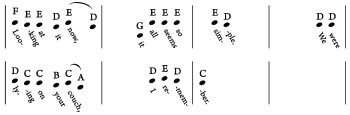
Example 2. Various melodic notation styles found in The Practice of Popular Music
(click to enlarge and see the rest)
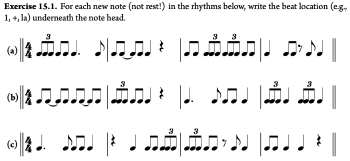
Example 3. Practice exercises in rhythmic chapters generally involve notation (Exercise 15.1, p. 107)
(click to enlarge)
I very much buy this argument, and indeed I use no staff notation in my own popular music analysis course. However, the fact remains that it’s hard for a written text to discuss or analyze melodies without notating them in some way. De Clercq does not settle on a single method for melodic notation, instead employing “a variety of custom notation formats for musical events” (xiv), many of which are shown in Example 2. This ad hoc approach is fine if the students are only reading these notations, as they’re all pretty comprehensible as presented, but there is little guidance for instructors or students on how they might use any of these notation systems in homework exercises, songwriting projects, or any other musical activities. (While it’s true that “popular musicians
Aural Skills
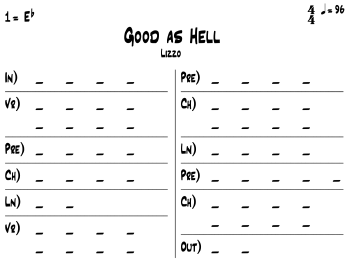
Example 4. Scaffolding for creating Nashville number charts by ear begins with drummer’s charts (a), showing hypermetrical structure and formal sections, and then incorporates harmonic rhythm (b)
(click to enlarge and see the rest)
[1.4] Undergraduate musicianship curricula typically separate aural skills and written theory—whether they are separate classes or covered on separate days of the same class—with the latter centered largely on score-based analysis and notated exercises. Most current textbooks that incorporate popular music theory adopt some version of this approach, usually by providing transcriptions of pop songs for the student to analyze (e.g., Holm-Hudson 2016, Snodgrass 2020). By contrast, The Practice of Popular Music assumes—rightly—that students are working from a recording alone, and therefore the book integrates aural skills and written skills such that the boundaries between them begin to melt. This integration is most developed in the rhythmic domain; de Clercq discusses rhythmic syllables (using the “1 e + a” system) and incorporates both sight-singing and dictation/transcription exercises in the rhythmic chapters alongside notation-based content. (Good examples are Chapters 15 and 26, pp. 103–7 and 177–82.) De Clercq also nicely scaffolds the skill of creating Nashville number charts by ear (Example 4): first, students create “drummer’s charts” (organizing measures into hypermeasures and formal sections, as shown in Example 4a), then they add in the harmonic rhythm (Example 4b), and finally fill in the specific chords themselves (starting with songs that include only root-position 1, 4, 5, and 6m chords and building from there). As I will discuss more below, melodic aural skills are less overtly developed in the book, and an instructor wishing to incorporate these skills will have to create supplementary melodic singing and transcription exercises. (De Clercq does admit that “the emphasis of the book in general is heavier on conceptual [‘written’] knowledge than aural skills” [xv].) All that said, it is possible to use this textbook for a combined aural and written theory sequence, without needing a separate aural skills book or course.
Adoption considerations
What kind of instructor is this book for?
[2.1] One possible barrier for instructors considering adopting The Practice of Popular Music is its relative lack of supporting materials. There is no workbook, for one, and while the text does include several “practice exercises” in each chapter, these exercises are minimal and do not address every topic presented in the chapters themselves. De Clercq has created a companion website (popmusicpractice.com) with some online resources, which at the moment are his own syllabi, lesson plans, and homework assignments for his two-semester sequence at Middle Tennessee State University. (The homework assignments are all short text files, mostly comprising links to exercises from musictheory.net.) These materials are certainly helpful, and I imagine they will be continuously updated over time. Still, instructors will need to do a lot of their own work creating active learning materials, assignments, projects, and other materials geared toward their particular course. As a result, this book will best suit instructors who are already somewhat acquainted with popular music and popular music theory. I don’t necessarily mean only music theorists; a jazz guitarist or songwriter teaching in a commercial music program, for example, would do great with this book. But a classically trained composer or pianist—or music theorist, for that matter—with little experience in popular styles might wish the book had a few more ready-made assignments and exercises.
What kind of class is this book for?
[2.2] The textbook is written to accompany a year-long course sequence taken in students’ first year as music majors. Despite de Clercq’s belief that all music programs should begin with a popular-music-focused sequence like this (2019a), at the moment such sequences are generally found only in commercial music programs. Indeed, the book clearly has commercial music students in mind, covering the theoretical concepts most relevant to audio engineers, studio musicians, and songwriters, and omitting the score-reading and notation-based analytical skills necessary for classically oriented students. I believe the textbook would also work well in a liberal-arts curriculum, where students would begin their theory studies with a popular-music focus and then branch out as needed—possibly in a non-sequenced, “modular” curriculum (Lavengood 2019)—in their upper-level coursework.
[2.3] The textbook is flexible enough to be used in other ways as well, though, including within traditional, classically oriented curricula. For example, instructors teaching a stand-alone popular music analysis course that comes after one or two traditional theory courses can skip the fundamentals-oriented chapters and organize the course around the pop-specific chapters (most of which are in the book’s second half, and most of which can be extracted and/or reordered individually to create a bespoke curriculum). Instructors instead hoping to incorporate some short pop units within a broader core theory course could excerpt sets of chapters on individual topics. For instance, a two-week unit on popular song form could use Chapters 4 (“Song Form”), 8 (“Transition Sections”), 32 (“Ending Sections”), 38 (“Verse-Chorus Templates”), and 45 (“Other Song Forms”); or an aural-skills unit on rhythm in popular music could use Chapters 10 (“Syncopation”), 20 (“Drum Feels in
Summary of the book
[3.1] The book is divided neatly into eight parts of eight chapters each, with each chapter seemingly intended to be covered in one class period.(4) This layout contrasts with that of most theory textbooks, which generally expect each chapter to cover one or two weeks’ worth of material. The result of these shorter chapters is that the topics bounce around quite a bit—a given week might cover minor-mode chords on Monday (Chapter 21), large intervals on Wednesday (Chapter 22), and shuffle and swing rhythms on Friday (Chapter 23), as de Clercq does around halfway through his Fall course. I can see a benefit to that, as students can continuously develop their skills in all areas, but there might be a danger of whiplash if an instructor does not keep each thread active while covering the others.
[3.2] The first two parts, comprising Chapters 1–16, cover mostly topics that one would expect in any traditional music theory fundamentals course, with a couple of pop-oriented exceptions. Chapters 1–8 hit the basics: beats, bars, notes, major scales, small intervals, etc., introduced quickly but in a way that is accessible to students with no music theory or music-reading background. Without the burden of introducing staff notation for pitch, these topics can fly by. (Chapters 1 and 6 do introduce rhythmic notation down to the eighth note.) De Clercq takes an ear-first approach to these topics, for example starting students off by tapping beats and humming tonic before mentioning any notation or note names. Alongside these basic topics, de Clercq includes two chapters on song form: Chapter 4 discusses verses, choruses, bridges, solos, intros, and outros, and Chapter 8 introduces links (transitions between sections) and prechoruses, as well as drummer’s charts, phrases, and hypermeasures. It’s refreshing to see form appear this early on, allowing students to engage with complete songs from the very beginning of the course. The drummer’s charts in particular—which show each song section’s length and hypermetrical structure (see Example 4a above)—can have students analyzing full songs entirely by ear in their first few weeks of class (though I personally would plan more than just one class period for Chapter 8).
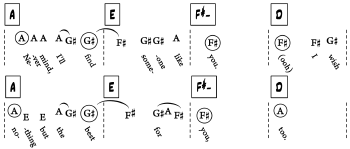
Example 5. De Clercq’s example of a “melodic skeleton” for the chorus (1:31) of Adele’s “Someone Like You” (2011)
(click to enlarge)
[3.3] The second part, Chapters 9–16, introduces harmony. By the end of these chapters, students are beginning to aurally identify major-mode chord progressions with root-position 1, 4, 5, and 6m chords (a.k.a. tonic, subdominant, dominant, and submediant triads). The study of rhythm continues as well, with chapters on eighth-note syncopation and triplets. The last chapter of this part, Chapter 16, stands out a bit. Titled “Melodic-Harmonic Organization,” it introduces two concepts that seem more advanced than their placement implies. The first is “melodic skeletons,” which are essentially middleground reductions of a vocal melody; Example 5 shows the book’s sole example of a melodic skeleton (the circled notes are the skeleton). This example is intuitive, but I have trouble imagining first-term students grasping the concept enough to analyze melodic skeletons on their own, and de Clercq offers only a vague definition—the skeleton comprises the “notes I think are most structurally important” (109, emphasis original)—to guide them. Melodic skeletons are then barely mentioned for the remainder of the book, making me wonder why the topic is introduced here at all. The chapter’s second concept is the “melodic-harmonic divorce,” a familiar topic in music-theoretical scholarship (Temperley 2007; Nobile 2015) but a likely head-scratcher for students just barely acquainted with the concept of chord tone. The chapter closes by introducing the major pentatonic scale. Notably, the chapter’s practice exercises deal exclusively with major pentatonic scales and do not mention melodic skeletons or the melodic-harmonic divorce. These topics are certainly interesting, and students would probably enjoy hearing about them, but without the tools to actively engage with them—and without later development of the topics—they seem out of place, and I imagine many instructors will choose to skip them altogether.
[3.4] Parts III and IV, comprising Chapters 17–32, finish up what we would categorize as “fundamentals,” but now the book’s pop orientation becomes more overt. The main topic of Part III (Chapters 17–24) is the minor mode, which de Clercq frames through his own theory that minor keys divide into two types, “relative” and “parallel,” which generally correspond to what theorists would call “Aeolian” and “(tonal) minor” (de Clercq 2021). Practically speaking, the main difference between these two is that relative minor keys are analyzed using “six-based minor” (where the minor tonic is 6m, such that chords have the same Nashville numbers as in the relative major), while parallel minor keys are analyzed using “one-based minor” (where the minor tonic is 1m). De Clercq does not go very deep into the more theoretical difference between these types of minor, essentially allowing students to freely choose which to use in their analyses. (He does suggest that songs with the minor tonic’s [raised] leading tone are best interpreted in a parallel minor key [134]). Alongside the discussion of relative and parallel minor, which continues into Part IV, students are exposed to drum feels (the backbeat, double-time, and half time), shuffle and swing, cross-rhythms (tresillo and double tresillo), inverted chords, and seventh chords, with the book’s first half ending, fittingly, with a chapter on ending sections (refrains, tags, postchoruses, “superchoruses,” and codas).
[3.5] The book’s second half is less sequentially organized, instead offering mostly stand-alone chapters, allowing instructors to mix and match or reorder as needed. Parts V and VI include chapters on phrase structure, added-tone and suspended chords, syncopated sixteenth notes, modal mixture, and the blues, as well as some deeper explorations of pop song form. De Clercq introduces some advanced pop topics as well, such as Mark Spicer’s (2017) concepts of absent, emergent, and fragile tonics, which are summarized in Chapter 40, and ends Part VI with two chapters on modes. Theorists do not all agree on how to approach modality in popular music (see, e.g., Biamonte 2010, Clement 2013, Osborn 2017), and de Clercq’s approach is decidedly in the “modes are inflections of major or minor keys” camp, describing modal content as “fleeting” (rather than, say, identifying songs as “in Lydian” or “in Dorian”). But de Clercq offers a novel way of thinking about modes in relation to his concept of “relative minor keys” and six-based minor: he pairs modes that are in a relative relationship, relating Dorian’s raised to Lydian’s raised and relating Mixolydian’s lowered to Phrygian’s lowered . (In six-based minor, the former two would both be “
[3.6] The last two parts delve into chromatic harmony. Here, appropriately, the main source for chromatic topics is not theories of 19th-century Romantic music but instead jazz theory. De Clercq does a nice job incorporating the basic jazz concepts most relevant to commercial popular music, including ninth, eleventh, and thirteenth chords (Chapters 52), altered chords (Chapter 55), and tritone substitution (Chapter 62). Students also learn about applied dominants in Chapter 49 and applied predominants (aka “two of” and “four of” chords) in Chapter 58. The Nashville number system does not indicate applied chords as such—a V7/V chord is simply labeled 27—and the book occasionally gets knotted up in language like “the 6 chord is the 5 of the 2m chord” (347). This is the first and only place where Roman numerals might actually make things easier, although it certainly wouldn’t make sense to switch to Roman numerals just for these few chapters. Given that applied chords are a common stumbling block for students, these chapters might require some extra care on the part of the instructor to avoid confusion. The book concludes with two final chapters on tonal and metric modulation, offering brief introductions to these topics to reflect their relative scarcity in the popular repertoire.
Omissions and quibbles
[4.1] The Practice of Popular Music offers an impressive survey of the four domains indicated in its subtitle—harmony, rhythm, melody, and form—as applied to the commercial songwriting repertoire. Some may wonder, though, why de Clercq limits the curriculum to those four domains. Of course, not every textbook can, or even should, treat every aspect of popular music theory, and the more holistic an approach becomes the less it can go in depth in any individual area. Early in the book’s preface, de Clercq acknowledges two musical domains that are not included in the book: lyrics and timbre. While recognizing that both are especially relevant to popular music analysis, de Clercq argues, not altogether unreasonably, that those domains are best covered outside of music theory courses (and de Clercq does suggest some texts instructors can consult if they want to incorporate them) (xii). This position is perfectly defensible, but in taking it de Clercq might be missing an opportunity to expand our ideas about what topics—not only what repertoires—are at home in an undergraduate theory curriculum. Our curricular emphasis on harmony, rhythm, melody, and form comes right out of the European classical tradition—and, as Richard Cohn (2015) has argued, rhythm is decidedly the lowest-ranking member of that quartet—and a curriculum built around popular music is a ripe place to question our focus on those four elements. (See, for instance, John Covach’s idea of a “fundamental revision” to music theory curricula [2020, 334], which involves not only decentering classical music but also “broadening the range of topics engaged in instruction” to include groove, texture, timbre and placement, and improvisation.)
[4.2] In addition, some instructors might be surprised at the book’s lack of any instruction in songwriting. The book is for the most part an analytical and conceptual text: students engage with theoretical concepts in the abstract and then apply that knowledge to describe aspects of recorded popular songs. But there is little guidance for students who want to create their own songs, nor do any of the “practice exercises” ask students to write chord progressions, record drumbeats, set some given lyrics into a verse–chorus structure, etc. Music theory pedagogues have long understood that model composition exercises can be the best tools for grasping theoretical concepts; melody harmonization, original chord progression composition, and the classic “minuet composition project” have been mainstays of core courses for generations. Instructors can, of course, supplement the existing chapters with songwriting projects or smaller exercises, but this requires an instructor confident enough in their own songwriting abilities to explain and assess such practices. Furthermore, since popular songs are generally “written” by being recorded or performed, rather than notated on paper, it is hard to teach songwriting without also teaching some basic audio engineering and/or performance skills. (The Practice of Popular Music does incorporate keyboard playing in its exercises and discussions, and instructors could build upon those skills to ask students to perform and/or record original material.)
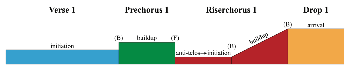
Example 6. An energy diagram of a song’s form identifies each section’s teleological function (initiation, buildup, arrival, etc.) in addition to its formal label (verse, chorus, etc.)
(click to enlarge)
[4.3] I have one other minor quibble, which is that the book’s treatment of form seems more surface-level than its treatment of its other three domains. De Clercq covers form in Chapters 4, 8, 32, 38, and 45—only around 8% of the 64 chapters, and none in the last two parts—all but one of which are aimed at getting students to label sections or forms correctly (e.g., “verse” or “AABA form”). Chapter 38 is the one exception, presenting John Covach’s (2005) distinction between “simple” verse–chorus form (same chord progression in verse and chorus) and “contrasting” verse–chorus form (different chord progressions). This chapter prompts students to start thinking about how sections relate and how each section’s content affects how we hear the song as a whole. But that thread is not developed beyond that one chapter, and I think students would benefit from thinking about, say, whether sections begin on or off tonic, end with or without a cadence, contain a looped or directional progression, etc. Moving beyond harmonic aspects of form, students might further identify sections as “initiation,” “buildup,” or “arrival” functions (as in, e.g., Adams 2019, Nobile 2022, or Osborn 2023) and/or make energy diagrams such as that shown in Example 6 (from Geary 2024; see also Barna 2020 and Schwitzgebel 2025). They could then engage with de Clercq’s own ideas about ambiguity to discuss formal “blends” (2017) or discuss the relationship between thematic layouts such as statement–restatement–departure–conclusion and verse–prechorus–chorus structures (as in, e.g., Summach 2011). All of this type of advanced work on form would slot in nicely alongside some of the book’s advanced harmony and rhythm topics in Chapters 49–64.
Conclusion
[5.1] Music theory needs this textbook. Despite the field’s embrace of popular music in the scholarly literature and the appearance of popular songs in textbooks and curricula, we have never had a true alternative to the classically focused methods that have always defined our undergraduate courses. The Practice of Popular Music finally provides such an alternative. We now know what it could look like to have a rigorous, sequenced, and scalable theory curriculum entirely based around popular music. There are obviously some schools for which such a curriculum would be inappropriate, and there are other schools with commercial music programs that have already developed their own popular music-oriented curricula. But I imagine that many programs who want to incorporate popular music are still figuring out how to do so—and The Practice of Popular Music now provides an invaluable resource to guide them.
[5.2] Furthermore, The Practice of Popular Music is an excellent textbook. The material is presented clearly and concisely, the repertoire is varied and fresh, and the topics are comprehensive and well-sequenced. De Clercq’s experience with and knowledge of both music-theoretical scholarship and the commercial music industry shines throughout the book, grounding the theoretical concepts in real-world practice and overtly showing the students the day-to-day relevance of music theory (which theory classes often struggle to do!). Of course, the book’s approach is not the only one—even for pop-centered classes in commercial music programs—and I hope that we see other pop-oriented textbooks arrive in the coming years that complement and expand upon de Clercq’s model. In the meantime, The Practice of Popular Music represents a vital expansion of our pedagogical bookshelf, a forward-looking curriculum that will be an integral part of our field’s continued evolution.
Drew Nobile
University of Oregon School of Music and Dance
961 E 18th Ave.
Eugene, OR 97403
dnobile@uoregon.edu
Works Cited
Adams, Kyle. 2019. “Musical Texture and Formal Instability in Post-Millennial Popular Music: Two Case Studies.” Intégral 33: 33–45.
Aldwell, Edward, Carl Schachter, and Allen Cadwallader. 2019. Harmony and Voice Leading, fifth edition. Cengage.
Barna, Alyssa. 2020. “The Dance Chorus in Recent Top-40 Music.” SMT-V 6.4. https://doi.org/10.30535/smtv.6.4.
Benward, Bruce, and Marilyn Saker. 2021. Music in Theory and Practice, Volume 1, tenth edition. McGraw Hill.
Biamonte, Nicole. 2010. “Triadic Modal and Pentatonic Patterns in Rock Music.” Music Theory Spectrum 32 (2): 95–110.
Burstein, Poundie, and Joseph Straus. 2025. Concise Introduction to Tonal Harmony, third edition. W.W. Norton.
Clement, Brett. 2013. “Modal Tonicization in Rock: The Special Case of the Lydian Scale.” Gamut 6 (1). https://doi.org/10.7290/gamutm0rf.
Clendinning, Jane, and Elizabeth West Marvin. 2025. The Musician’s Guide to Theory and Analysis, fourth edition. W.W. Norton.
Cohn, Richard. 2015. “Why We Don’t Teach Meter, And Why We Should.” Journal of Music Theory Pedagogy 29. https://doi.org/10.71156/2994-7073.1175.
Covach, John. 2005. “Form in Rock Music: A Primer.” In Engaging Music: Essays in Musical Analysis, ed. Deborah Stein, 65–76. Oxford University Press.
—————. 2020. “Popular Music in the Theory Classroom.” In The Routledge Companion to Music Theory Pedagogy, ed. Leigh van Handel, 331–39. Routledge.
de Clercq, Trevor. 2017. “Embracing Ambiguity in the Analysis of Form in Pop/Rock Music, 1982–1991.” Music Theory Online 23 (3). https://doi.org/10.30535/mto.23.3.4.
—————. 2019a. “A Music Theory Curriculum for the 99%.” Engaging Students: Essays in Music Pedagogy 7. https://doi.org/10.18061/es.v7i0.7359.
—————. 2019b. “The Harmonic-Bass Divorce in Rock.” Music Theory Spectrum 41 (2): 271–84.
—————. 2019c. “The Nashville Number System: A Framework for Teaching Harmony in Popular Music.” Journal of Music Theory Pedagogy 33: 3–28.
—————. 2021. “The Logic of Six-Based Minor for Analyses of Harmony in Popular Music.” Music Theory Online 27 (4).
Ewell, Philip. 2021. “Music Theory and the White Racial Frame.” Music Theory Online 26 (2).
Holm-Hudson, Kevin. 2016. Music Theory Remixed. Oxford University Press.
Geary, David. 2024. “Formal Functions of Drum Patterns in Post-Millennial Pop Songs, 2012–2021.” Music Theory Online 30 (2).
Gotham, Mark, Kyle Gullings, Chelsey Hamm, Bryn Hughes, Brian Jarvis, Megan Lavengood, and John Peterson. 2021. Open Music Theory, version 2. https://viva.pressbooks.pub/openmusictheory/.
Kostka, Stephen, and Byron Almén. 2024. Tonal Harmony, ninth edition. McGraw Hill.
Laitz, Steven. 2023. The Complete Musician: An Integrated Approach to Theory, Analysis, and Listening, fifth edition. Oxford University Press.
Lavengood, Megan. 2019. “Bespoke Music Theory: A Modular Core Curriculum Designed for Audio Engineers, Classical Violinists, and Everyone in Between.” Engaging Students: Essays in Music Pedagogy 7. https://doi.org/10.18061/es.v7i0.7362.
McCandless, Greg, and Daniel McIntyre. 2025. The Craft of Contemporary Commercial Music, second edition. Routledge.
Nobile, Drew. 2015. “Counterpoint in Rock Music: Unpacking the ‘Melodic-Harmonic Divorce.’” Music Theory Spectrum 37 (2): 189–203.
—————. 2020. “Double-Tonic Complexes in Rock Music.” Music Theory Spectrum 42 (2): 207–26.
—————. 2022. “Teleology in Verse–Prechorus–Chorus Form, 1965–2020.” Music Theory Online 28 (3). https://mtosmt.org/issues/mto.22.28.3/mto.22.28.3.nobile.html.
Osborn, Brad, and Christine Boone. Forthcoming. Music Theory Matters. Oxford University Press.
Osborn, Brad. 2013. “Subverting the Verse–Chorus Paradigm: Terminally Climactic Forms in Recent Rock Music.” Music Theory Spectrum 35 (1): 23–47.
—————. 2017. “Rock Harmony Reconsidered: Tonal, Modal and Contrapuntal Voice-Leading Systems in Radiohead.” Music Analysis 36 (1): 59–93.
—————. 2023. “Formal Functions and Rotations in Top-40 EDM.” Intégral 36.
Palfy, Cora, and Eric Gilson. 2018. “The Hidden Curriculum in the Music Theory Classroom.” Journal of Music Theory Pedagogy 32. https://doi.org/10.71156/2994-7073.1194.
Roig-Francoli, Miguel. 2020. Harmony in Context, third edition. McGraw Hill.
Schwitzgebel, Emily. 2025. “‘Cueing’ Your Playlist: Texture and Teleology in Post-Millennial Pop.” Music Theory Online 31 (1).
Snodgrass, Jennifer. 2020. Contemporary Musicianship: Analysis and the Artist, second edition. Oxford University Press.
Spicer, Mark. 2017. “Fragile, Emergent, and Absent Tonics in Pop and Rock Songs.” Music Theory Online 23 (2).
Summach, Jay. 2011. “The Structure, Function, and Genesis of the Prechorus.” Music Theory Online 17 (3). https://doi.org/10.30535/mto.17.3.2.
Temperley, David. 2007. “The Melodic-Harmonic ‘Divorce’ in Rock.” Popular Music 26 (2): 323–42.
Footnotes
1. Market data comes from Philip Ewell (2021), who in turn cites a 2019 conversation with Justin Hoffman of Oxford University Press. Things may have changed a bit since then, but at the time Ewell/Hoffman estimate that these seven textbooks accounted for around 96% of the total market. The textbooks are (citing their most recent editions): Kostka and Almén 2024; Clendinning and Marvin 2025; Benward and Saker 2021; Burstein and Straus 2025; Laitz 2023; Aldwell, Schachter, and Cadwallader 2019; and Roig-Francoli 2020.
Return to text
2. Two other texts worth mentioning here are the online resource Open Music Theory (Gotham et al. 2021), an open-source textbook written by several music theorists that includes a large section on popular music, and McCandless and McIntyre’s The Craft of Contemporary Commercial Music (2025), which covers basic theory concepts alongside audio-engineering and songwriting skills.
Return to text
3. De Clercq introduces Roman numerals alongside Nashville numbers in Chapter 13 but then uses Nashville numbers exclusively for the remainder of the book.
Return to text
4. The syllabi for de Clercq’s courses posted on the companion website show, for the most part, one chapter per class period on a MWF meeting schedule, with homework assignments accompanying most chapters as well.
Return to text
Copyright Statement
Copyright © 2025 by the Society for Music Theory. All rights reserved.
[1] Copyrights for individual items published in Music Theory Online (MTO) are held by their authors. Items appearing in MTO may be saved and stored in electronic or paper form, and may be shared among individuals for purposes of scholarly research or discussion, but may not be republished in any form, electronic or print, without prior, written permission from the author(s), and advance notification of the editors of MTO.
[2] Any redistributed form of items published in MTO must include the following information in a form appropriate to the medium in which the items are to appear:
This item appeared in Music Theory Online in Volume 31, Issue 4 in December 2025. It was authored by Drew Nobile (dnobile@uoregon.edu), with whose written permission it is reprinted here.
[3] Libraries may archive issues of MTO in electronic or paper form for public access so long as each issue is stored in its entirety, and no access fee is charged. Exceptions to these requirements must be approved in writing by the editors of MTO, who will act in accordance with the decisions of the Society for Music Theory.
This document and all portions thereof are protected by U.S. and international copyright laws. Material contained herein may be copied and/or distributed for research purposes only.

Prepared by Amy King, Editorial Assistant
Number of visits:
4489