Structural and Rhetorical Closure in 1970s Rock Songs
Nick Braae
KEYWORDS: Form, Harmony, Closure, Rock Music, Pink Floyd, Interpretation, Narrative
ABSTRACT: Several music theorists have analyzed the introductions to popular songs. Robin Attas (2015, 275) notes their importance as a “site for first impressions”; Mark Spicer (2004, 33) likens an “accumulative” beginning to a song as akin to “assembling the pieces of an aural jigsaw puzzle.” This article addresses the less-explored area of how songs end. Drawing on and adapting theories from classical music contexts (notably, Caplin 2024 and Agawu 1988), I identify a range of “closing markers” (Heetderks 2020) from the pre-1990s pop-rock repertoire. These markers are then categorized as “structural” or “rhetorical” (Hyland 2009): the former relates to devices that bring about a sense of musical completion; the latter relates to devices that signal a musical ending. In doing so, I establish a novel framework for analyzing the different ways in which closure is articulated or resisted in popular music contexts. This model is applied to a selection of songs from the 1970s classic rock repertoire. In particular, I explore how an interpretation of a song’s lyrical narrative might be shaped by the deployment or avoidance of closing markers. The analytical sketches are divided according to the “congruence” or varied forms of “incongruence” between the closing markers. In the final analytical section, I use Pink Floyd’s Dark Side of the Moon as a multi-song case study. The album is widely regarded to project a singular and seamless listening experience. I argue that individual songs avoid complete closure until the album’s close, which thus reinforces the sense of musical motion from beginning to end. I conclude the article with several potential pathways for further analysis of closure in popular songs.
DOI: 10.30535/mto.32.1.2
Copyright © 2026 Society for Music Theory
Introduction
[1.1] In recent years, a number of popular-music theorists have examined song structure through a temporal lens—that is, the distinct manner in which songs unfold in time. Drew F. Nobile’s book Form as Harmony in Rock Music (2020b) exemplifies this turn, documenting the interdependent relationships between melodic-harmonic trajectories and form in popular songs. The trend is also evident in the numerous articles that examine idiosyncratic structuring techniques at play in the songs of various artists and genres. A varied but far from exhaustive selection of these articles include Victoria Malawey’s exploration of stasis and oscillation in Björk’s Medúlla (2010); Robert Fink’s illumination of rhythmic teleologies in soul and Motown music (2011); and Scott J. Hanenberg’s exploration of the relationship between modulations and narrative in rock tracks (2016).
[1.2] Within this area of inquiry, several theorists have taken a particular interest in the openings of songs. Mark Spicer’s (2004) exploration of accumulative and cumulative form in popular music is an important forerunner. Citing a range of examples, Spicer distinguishes between the two archetypes: the “accumulative” addition of textural layers (broadly speaking) to one another within a section, often the introduction or first verse; and the “cumulative” addition of textural layers across a full song (Spicer 2004; see also, Malawey 2011).(1) Robin Attas (2015) is equally concerned with form-through-time, but directs this attention towards the buildup introduction in popular songs. This work addresses the subtle and nuanced processes of accumulation, particularly as it occurs in the opening bars of groove-based music.” She opens her article by stating: “Musical introductions are a site for first impressions. Over just a few seconds, the music
[1.3] The initial sonic moments are important for setting listeners’ expectations and for sparking the journey that will follow. Song endings may not hold this same perceptual significance, yet they invite analytical attention insofar as their distinct treatment of musical parameters shape how this journey concludes—and, indeed, what the nature of that conclusion is. Several theorists have identified different types of codas and closing sections in segments of the popular-music repertoire. Osborn’s “terminally climactic” form (2013) is perhaps the best known within music theory circles, referring to a final section (found most notably in post-millennial rock) that features new musical material and represents the climactic moment of the song. Spicer’s aforementioned cumulative form includes examples in which multiple melodic threads from the song are brought together in a “climactic final section,” exemplified by Chumbawamba’s “Tub-Thumping” (2004, 58–61). Other examples of bespoke terminology include the “infinity” trope (Samarotto 2012) and the “denouement coda” (Braae 2019). These concepts prove useful for labelling such unconventional or distinct end sections or tropes but offer less of a model to address ending sections more generally. That is, how to understand song endings that do not fit the formal archetypes above? And how to interpret different sequences of concluding musical events that occur in the popular music repertoire? It is these analytical questions with which my article directly engages by way of developing a new model of closure in popular songs. While introductions are a space for bringing the listener into the metaphorical world of a song, endings are the point where we, as listeners, depart from that world, where we leave characters and stories behind. Thus, alongside the analytical aim of illuminating the nature of musical endings in a selection of popular songs, I seek to demonstrate how compositional choices in these moments can shape and inform our interpretation of song lyrics, personas, and narratives.
Closure and Popular Songs
[2.1] The notion of closure informs these analytical aims. Kofi Agawu defines closure as the “procedures of endings” within a given piece of music or song (Agawu 1988, 2)—it thus speaks to the matter of how songs end. William Caplin further understands closure as a particular quality of music, one that indicates to a listener that “some process in time [
- The difference between “ending” and “cessation of activity”: the former implies a sense of completion, the latter refers to non-continuation;
- The identification of “general mechanisms of closure”: that is, those musical features that enact the process of closing and/or signal an endpoint to a listener;
- A distinction between linearity and circularity: the former invokes progression towards a goal, the latter invokes completion through a return to a starting point;
- A distinction between “experiences of closure that reside in-time or out-of-time”: that is, the difference between identifying discrete moments that enact closure and recognizing closure as a process occurring over a longer (and undefined) temporal span (such as the final third of a work).
[2.2] In a popular music context, numerous authors have addressed closure, explicitly and obliquely, but with sporadic degrees of theorization. It is evident, though, that Caplin’s observations resonate with work in this sphere. Regarding the Beatles’ “Hey Jude,” Walter Everett (2001, [9]) critiqued Sean Cubitt’s (1984, 210) reading of the song: “he has mistakenly sought the final tonic in the very final sound of a cold-ending surface, rather than at the conclusion of the deeper structure, where it appears quite boldly,” an argument that resonates with the distinction between “ending” and “cessation of activity” (2001, [9]). Elsewhere, Mark Spicer writes on song-form archetypes: “a bridge necessarily begins with some kind of harmonic swerve away from the preceding material and typically culminates in a big V chord
[2.3] These examples, alongside Caplin’s summary, point to two important implications for analysts. The first is that the opposing conceptions of closure should not be treated as “either/or” propositions. There is no implication, for instance, that examples evoking circularity are any more or less complete than those that unfold more linearly; rather, they represent different experiences of completion. Indeed, in some instances, it may be possible to interpret both forms of closure simultaneously. In a deft analysis of Chicago’s “You’re the Inspiration,” Adam Ricci (2000, 145–46) shows how the final “pump-up” modulation, coming after a series of complex changes of tonal center, can be read as a harmonic arrival (following an established pattern) while also alluding to the closing of an underlying tonal cycle. In such cases, it is less important whether one interpretation takes precedence, so much as understanding how these contrasting forms of closure are articulated.
[2.4] From Ricci’s analysis—and the focus on “pump-up” modulations—we are alerted to a second implication: the “mechanisms” of closure, the musical characteristics that give rise to the sense of completion, are intertwined with genre norms and conventions.(3) So much is clear from Stroud’s analysis: the melodic hook of the “anthem-type postchorus” takes on a closing function because of the musical context in which it occurs. Moreover, this particular realization of closure—coming from the aforementioned structural pattern and dynamic between song sections—is idiosyncratic to 2010s pop. A robust model for closure in popular songs must therefore be grounded in the conventions and patterns of that repertoire, if not a specific subset of this broader genre.
[2.5] The work of other popular-music analysts is useful for gathering a collection of relevant conventions. Alongside cyclical formal and harmonic patterns (from Spicer and Ricci), David Temperley identifies cadences to the tonic as providing smaller-scale tonal closure to Verse–Chorus Units of a song (Temperley 2018, 184). In the three examples he provides, it is worth noting that the concluding tonic harmony also coincides with the melodic line arriving on the tonic note, which may reinforce the feeling closure. Elsewhere, Temperley spotlights songs with a “grand” plagal cadence as the final musical event—Led Zeppelin’s “Whole Lotta Love” and AC/DC’s “Back in Black” are examples par excellence (Temperley 2011, [5.1–5.4]). In these cases, the sense of cadential closure is heightened through other musical gestures, such as a stop-time passage or a fermata. Brad Osborn notes the similar role that a climactic “gesture” might play in achieving closure in through-composed songs (Osborn 2011, [25]). These observations align with what Robert Hatten refers to as “expressive” closure, whereby other “thematized elements, such as rhythm, dynamics, articulation, pacing, texture, gestures, topics, tropes, and even formal genres and styles serve to ‘dramatize’ the underlying tonal closure” (Hatten 2014, [2]).
[2.6] We are quickly seeing that closure is a “multifaceted phenomenon” (Caplin 2024, 9). Indeed, Nobile (2020b, 34–35) notes that while a cadence requires formal and harmonic closure, formal closure may be achieved in other musical domains: rhythmic via phrase completion; thematic via the completion of a motivic process (e.g. an “srdc” unit); lyrical via the completion of a grammatical unit (e.g. a sentence) or an idea; and melodic via the completion of a line to . As he demonstrates through several examples, closure in certain domains (e.g. melodic) are not necessarily contingent on closure in other domains (e.g. harmonic). In a study of 1960s popular music, David Heetderks (2020) lists seven “closing markers”—pertaining to lyrics, rhythmic placement, melodic pitch, and harmonic progression”each of which shapes sectional cadences. Heetderks’s markers reinforce what the other authors mentioned above have identified as providing closure in popular songs, such as melodic and harmonic movement to the tonic; the markers also illuminate features that are specific to popular songs, such as the completion of a lyrical utterance. Crucially, none of these markers are posited as more important than others; rather, “the more markers occur in combination, the stronger the impression of closure” (Heetderks 2020, 7–8). This echoes Kofi Agawu, who regards closure as “the sum total of all the tendencies to close that occur in the composition, whether or not these are actually fulfilled” (Agawu 1988, 4; italics are original). Indeed, as Agawu highlights in the context of Chopin’s Piano Preludes, Op. 28, and as Heetderks does in relation to 1960s pop songs, analytical interest lies precisely in how this totality of tendencies is actualized—that is to say, which musical parameters contribute to closure and to what extent.
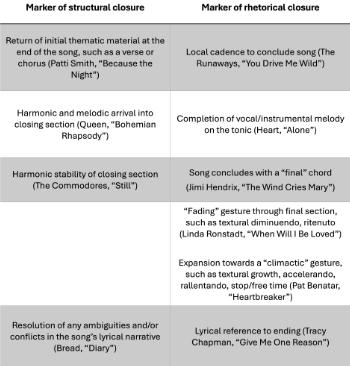
[2.7] Drawing on the studies cited above, I have devised a list of “markers” associated with closure in popular songs. These are presented in Example 1. This synthesized collection of devices provides a framework for understanding how closure quality might be realized or negated. I have further adopted categorical terminology from Anne Hyland (2009), drawing a distinction between “structural” and “rhetorical” markers. It should be evident that any distinction is imposed ex post-facto on musical features by the analyst. Some examples will, therefore, appear to blur this distinction: an impression of harmonic stability (structural) may be informed by a cadence at the song’s conclusion (rhetorical).(4) It is less pertinent to speak of either structural or rhetorical closure, than to recognize how multiple features are operating congruently to bring about closure. The benefit of these categories is that they allow one to observe instances of “parametric incongruence”—that is, “moments where one parameter is suggestive of closure [
Example 1. Musical markers of structural and rhetorical closure
(click to enlarge)
[2.8] The earlier dichotomies on closure, drawn from Caplin (2024), can help to further contextualize the distinction between “structural” and “rhetorical” categories. To start, the “structural” markers align well with the impression of “ending”; they pertain to musical features that create a sense of overarching completion across the course of the song, whether linear (“arriving” at the final point) or circular (“returning” to earlier material). Conversely, the “rhetorical” markers emphasize the “cessation” of the song, akin to musical punctuation that signals there is nothing more to follow. The two categories can also be broadly distinguished by temporality. To use Caplin’s language, the rhetorical markers, in essence, “reside” at a specific point “in time”: the final chord, the last note of the melody, the phrase during which the texture thins, and so forth. The structural markers are evidently connected to precise moments as well—when the chorus returns, the point at which a lyrical narrative is resolved—but they are relatively processual in nature. That is, the “returning” quality of a final chorus (providing structural closure) is contingent upon both a chorus appearing earlier and the presence of contrasting musical events (e.g. bridge). From Caplin and Mark Anson-Cartwright (2007, 3–4), this form of closure resides “out of time” insofar as it is not confined to a singular location. Closure, here, is rather tied to multiple musical events taking place over a longer timeframe and without precise temporal boundaries.(5)
[2.9] Two further explanatory notes are warranted. First, I have provided an example for each marker, drawn broadly from pre-1990s mainstream popular music. These examples are provided not to entrench a theory of closure for this (very) broad musical category so much as to highlight the types of closing mechanisms that are pertinent in this popular music context. I have avoided citing songs that sit more in the worlds of funk and other dance-influenced styles. Writing on the former, Anne Danielsen convincingly argues that funk songs often resist the markers of closure identified, but may exhibit other forms of small-scale closure via the cyclical and shifting nature of the groove (Danielsen 2006; see also Fink 2011). Accordingly, a study of closure in funk and related styles would require its own careful and bespoke attention to the devices that foster this quality. The examples I have cited here provide a working foundation for the scope of my analysis, discussed shortly.
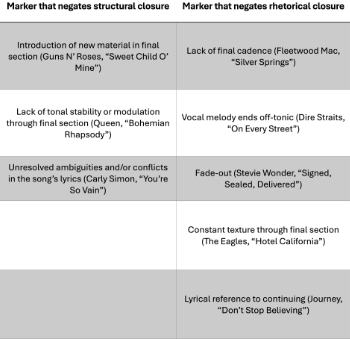
[2.10] Second, Example 2 can be read in tandem with Example 1. Example 2 presents musical devices that may negate a sense of closure, either in its structural or rhetorical form. One can consider these markers as broadly oppositional to those of Example 1, often with a sense of openness (e.g. lack of resolution) and/or continuation (e.g. a fade out). Queen’s “Bohemian Rhapsody” is listed in both tables and will receive greater analytical attention below. Its presentation here illuminates the possibility of contrary markers of closure operating simultaneously, which, in turn, makes them ripe for further investigation.
Example 2. Musical markers that negate structural and rhetorical closure
(click to enlarge)
[2.11] This leads to the focal point of my analysis. In the following three sections, I address a range of songs belonging to a subset of the pre-1990s pop-rock world—specifically, 1970s classic rock, overlapping with what has been variously described as “corporate rock” (Covach 2003) or “prog lite” (Holm-Hudson 2005). These labels refer to Anglo-American rock bands who demonstrated a progressive impulse (as evident through longer-form songs, attention to unfurling lyrical narratives and/or a more expansive harmonic vocabulary), but remained within the broad realm of mainstream popular songs.(6) It is perhaps not the case that the treatment of closure is the defining feature of music from this stylistic world; nonetheless, I suggest that the artists were writing songs that lent themselves to exploration and experimentation in such a way. I begin with Billy Joel’s “Piano Man,” an example of “parametric congruence” whereby closure is established in both structural and rhetorical domains. I subsequently move towards examples that seem to deliberately evoke ambiguity or uncertainty via contrasting closing devices. In each instance, I consider how the nature of the song’s ending contributes to an interpretation of the lyrical or musical narrative. In the final analytical section, I shift to the nearby world of mainstream progressive rock, exploring how contrasting approaches to closure shape the musical progression through Pink Floyd’s 1973 album The Dark Side of the Moon. The wide range of analytical exemplars allows this model of closure to be tested thoroughly. It also allows for the emergence of potential avenues and springboards for later analytical work, a handful of which I will note in this article’s conclusion.
Parametric Congruence: Structural and Rhetorical Closure
[3.1] Billy Joel’s “Piano Man” is an excellent example of structural and rhetorical closing devices operating in tandem. The song presents a series of vignettes from the perspective of the titular character, looking out at the motley bar crowd on a Saturday night. All of the patrons dream of something more, but are stuck in their downcast social context. The song’s musical materials are relatively simple: at its heart is a sixteen-bar section, which Nobile (2020b 40–41) maps neatly onto a classical period structure. The sixteen bars divide into two eight-bar phrases: the antecedent (bars 1–8) has a diatonic descending bass line moving one note per bar from the tonic C to D, before ending on a dominant harmony; the consequent (bars 9–16) descends from C to F, before closing with an authentic cadence in the sixth and seventh bars. In the two phrases, the melodic shapes are fundamentally identical: descending from to (antecedent) and to (consequent). Nobile describes this overall melodic-harmonic structure in terms of a “first-pass/second-pass relationship”—twice through the same material, with an “inconclusive” ending (first pass) and a stronger ending (second pass).
[3.2] These melodic and harmonic patterns provide the material for the verses, choruses, and much of the instrumental link and tag passages. In each of these sections, the pattern receives slightly different textural and registral treatment: in the instrumental passages (link and tag), Joel plays a variation of the melody on the harmonica; in the “Low Verse,” Joel sings in the octave around middle C, before shifting an octave higher for the “High Verse” and chorus sections. The link and tag passages mostly utilize only the second half of the 16-bar pattern, the cadence of which overlaps with a different four-bar phrase. In the link passages, we hear tonic and subdominant harmonies (over a tonic pedal) for two bars each, which, in tandem with the swelling accordion texture, drives the song towards the next verse passage up the octave. In the tag passages, Joel prolongs the tonic harmony with a short progression over a tonic pedal (I–IV–V–IV–I–ii7). It is the prechorus phrase that provides the greatest musical contrast within the song. This 12-bar phrase begins on the submediant harmony, features another descending bass pattern, and leads to a four-bar dominant chord, at which point the bass descends by step from , marching towards the tonic of the next chorus or verse.
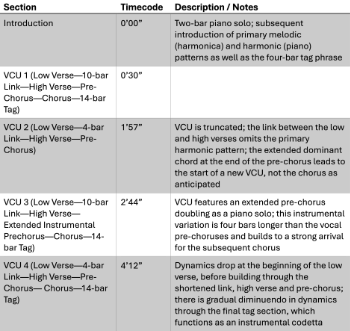
[3.3] As shown in Example 3, the song’s overarching structure can be understood as four sectional groups, using Temperley’s (2018) Verse–Chorus Unit (VCU) nomenclature.(7) While there are subtle variations among iterations of the VCU, each presents a relatively consistent sequence of the passages identified above. From a closure perspective, there is a strong sense of cyclical completion in various areas: each VCU comes back to the primary 16-bar pattern after a short departure in the prechorus; within the 16-bar pattern, the accompaniment always returns back to the tonic chord; and even in the instrumental tag, the ascending voice-leading away from the tonic (heard in the right hand of Joel’s piano part) is balanced by a descent back to its starting point. At a structural level, the prechorus in the third VCU—Joel’s piano solo—stands out for its sense of departure. In part, this is because Joel offers new melodic patterns in his right hand; and in part, because of its extended time away from the primary pattern (even if only an extra eight bars). It sets the song up for a grand reprise of the chorus, which duly occurs. The final VCU slips back to the softer dynamic level at its outset (as expected), before a final build into the higher register verse and subsequent chorus. We can note that alongside the octave leap in the higher verse, Joel’s singing becomes more animated—there is a slight timbral growl and he slides into the higher pitches on “piano” and “sounds.” At the conclusion of the chorus, the song’s energy starts to gently fade: there is a final instrumental tag, a diminuendo, and a ritardando, and the song finally comes to rest on the tonic.
Example 3. Billy Joel, “Piano Man,” structural overview
(click to enlarge)
[3.4] These features strongly enact closure from both structural and rhetorical perspectives. The slight detour of the piano solo is countered by the return of the chorus. The start of the fourth VCU then brings us in a lyrical full circle—the opening line, “It’s a pretty big crowd for a Saturday” echoes the first line of the song, “It’s nine o’clock on a Saturday.” We have effectively traversed the collection of characters and are now back to observations about the environment, with just enough time for a final singalong chorus. The sense that we have reached the end is then gesturally amplified through the concluding instrumental tag. This congruence of closing markers, alongside the highly cyclical nature of the structural closure, may give us further insight into the narrator, the barroom setting and its characters. At no point in the song is there any reference to what might happen in the future (beyond John’s fanciful acting ambitions); moreover, the narrator offers little about his own life and dreams. And that may well be the point. Next week, the patrons will return, drink the same drinks, tell the same stories, and sing the same songs; and the piano man will be there helping them to “feel alright.” With its emphasis on cyclical closure, “Piano Man” does not leave any musical thread hanging and nor does it offer a sense of progression: the song structurally embodies the overarching and definitive stasis of the lives of Paul, John, the waitress, and, yes, the “Piano Man.” Yet in its gentle rhetorical closure, it brings, perhaps, a sense of peaceful acceptance about the situation these characters find themselves in. It may appear somewhat downtrodden from the outside, but “Piano Man” is the story of their lives—full stop.
Structural Closure; Rhetorical Fades
[4.1] Straightforward as it may be, “Piano Man” illuminates how the presence of certain closing devices informs a reading of the song lyrics. From here, I turn to examples that offer divergences between structural and rhetorical features, albeit with the same focus on their interpretative impact. As alluded to by Everett (2001, [9]), the fadeout in popular songs allows for some disruption between structural closure and open rhetorical gestures. I highlight here two examples that rely on this divergence to emphasize lyrical themes. “Thunder Road” is the opening track on Bruce Springsteen’s 1975 album Born to Run. Often considered the singer-songwriter’s magnum opus (see, for instance, Taub 2022; Hiatt et al. 2018), the album’s tracks detail the lives of young people from working-class backgrounds in small-town America. Implied throughout these stories is a sentiment of feeling trapped in one’s existence. The characters frequently find an escape from this dreary world in their after-dark activities—driving the boardwalks, meeting in the shadows of alleyways—but they also dream of something more. “Thunder Road” encapsulates this ambition. This song’s narrator speaks about and to Mary, the object of his desire, and wills her to join him on the road and (presumably) in life. He admits he is a less-than-perfect candidate—“I’m no hero, that’s understood”—but he implores her to take a chance.
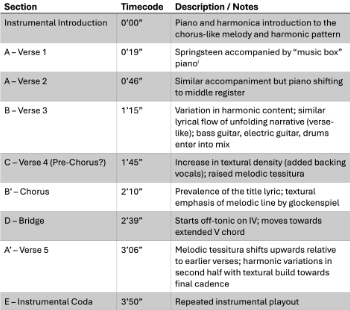
[4.2] Structurally, the song is unusual in its particular sequencing of sections (Example 4). There are also strong hints of what Trevor de Clercq has described as formal “blends,” whereby we can identify different “section roles” within the one passage (de Clercq 2017, [3.8]; see also [4.1–4.11]). Aside from the title line being heard several times in close succession, none of the sections present the same lyrical content; rather the story unfolds in almost free-form verse, its openness mirroring the expanses of highway that the characters seek. Musically, there is repetition of harmonic and melodic material, but in an unconventional order: AABCB′DA′E.(8) The early A sections are characteristic of verses and the D section is closest to a bridge (starting off-tonic and winding to a big dominant chord); yet only the B′ section sounds like a chorus, by virtue of the “Thunder Road” lyric and the initial culmination of textural elements. Furthermore, in this section, the band settles into its full groove and the glockenspiel doubles Springsteen’s vocal melody, emphasizing its structural importance.
Example 4. Bruce Springsteen, “Thunder Road,” structural overview
(click to enlarge)
[4.3] In “blending” the archetypal features of chorus and bridge sections with verses, there is an overall effect of constant unwinding of the musical and lyrical narrative. There is equally a sense of building throughout the song, in part through the accumulation of textural components in the early sections and in part through the gradual elevation of melodic register. When the verse returns after the bridge (“There were ghosts
[4.4] The moment I have just described is not, however, the end of the song. What follows is a glorious instrumental coda featuring the full E Street Band (Example 5). Clarence Clemmons enters on tenor saxophone, leading a melodic line that is doubled in octaves on piano and glockenspiel. The initial gesture repeats three times, each time rising from to ; after the third iteration, there is a gradual stepwise descent to in the eighth measure. This opening fragment—in particular, the rise through notes of the tonic triad—echoes the melody heard in the introduction (on piano and harmonica) and as sung by Springsteen in the chorus-like section. The harmonic material also reprises aspects of the chorus pattern, though in simplified form (only I, IV and V are deployed): there is a move from tonic to subdominant by the fourth bar, before landing on an emphatic dominant in the eighth bar. Adding to these features the consistent triplet rhythm of the melody, the coda has a triumphant and fanfare-like character, which is further emphasized by the dotted rhythms in Roy Bittan’s piano part on the repeat of the eight-bar phrase.
Example 5. Bruce Springsteen, “Thunder Road,” coda, melody and piano
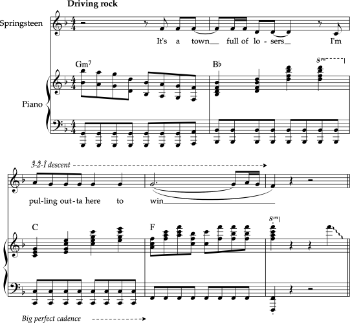
(click to enlarge and see the rest)
[4.5] Following the winding and evolving journey of the song, the coda serves as the highpoint, as if the song breaks through into a new musical and narrative plane. “Thunder Road” thus reaches a point of structural closure, which is one of arrival, rather than return. This is articulated through the assertive words of the narrator, the emphatic gestures of the cadential phrase in Verse 5, the increased textural density moving into the coda, the direct simplicity of the new chord progression, and the transformation of the earlier thematic material into a bold melodic statement. Set against these markers of structural closure are the open rhetorical markers of the coda. Its harmonic progression, leading towards V, necessitates continuation, which duly occurs. Notwithstanding a variation the second time round (the cadential IV–V is extended), the coda repeats before slowly fading out through the fourth iteration. The divergence between structural and rhetorical closure is highly appropriate in this context: the finality of the structural markers speaks to the resolute determination of the narrator; the openness of the rhetorical markers reflects the allure of the journey that awaits him and Mary. As Clemmons and Bittan lead the band through the coda, it is like a musical analogue of the characters driving down Thunder Road, off into the sunset together.
[4.6] Recorded two years later, bearing the same “wall-of-sound” aesthetic, and featuring two of the same musicians (Bittan on piano and drummer Max Weinberg), Meat Loaf’s “Paradise by the Dashboard Light” exhibits a similar divorce between structural and rhetorical closure. The nine-minute duet is presented as a memory, the two singers looking back on the fumbling forays into romance as 17-year-olds. The setting, characters and plot are established in the opening verse and refrain sections, but the narrative starts to advance at the midpoint (Female Verse at 4:28 in Example 6). Just as the pair are about to consummate their relationship “by the dashboard light,” the woman (sung by Ellen Foley) stops proceedings. She repeatedly asks, “Do you love me?,” “Will you love me forever?,” and similar questions. Coming after the funky bridge, the shift to chugging electric guitars provides a rhythmic impetus that matches the heightened urgency of the lyrical narrative. She poses her question—“Will you love me forever?”—and comes to rest on the D-major tonic. Two measures on the dominant build anticipation for his response. The male narrator offers his take, in the same key, but with a half-time groove, perhaps indicating his desire to keep the situation relaxed. “Let me sleep on it,” he intones over and over. She jumps in again, the rhythm guitar’s eighth notes returning to the mix. As she concludes this set of questions, there is a 10-measure dominant chord and she prods him further, “What’s it gonna be, boy?” (Audio Example 1). Again, he offers the same answer, but the registral expansion of the melody evokes his growing frustration. This sentiment is mirrored in chord movement—rather than concluding on the tonic as per the first occurrence of this section, the phrase resists closure, with bass, guitars, and piano hammering away on the dominant (6:40). The building tension is clearly felt by both characters; rather than waiting for him to finish, the female character takes over the singing, demanding ever more forcefully that he make his decision now.
Example 6. Meat Loaf, “Paradise by the Dashboard Light,” structural overview
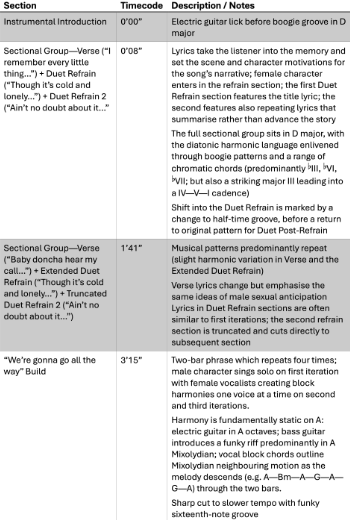
(click to enlarge)
Audio Example 1. Meat Loaf, “Paradise by the Dashboard Light,” build between male and female characters towards narrative climax
Audio Example 2. Meat Loaf, “Paradise by the Dashboard Light,” coda and fade
[4.7] As this section nears its end (6:51), the song builds again. The pair trade lines—“Let me sleep on it / Will you love me forever?”—up a semitone over a static and chugging
[4.8] Where rhetorical openness conveyed a sense of infinite possibility for the couple in Springsteen’s song, here it represents the pair’s sentence to a long and dreary existence with one another. Crucial to this formulation is the divergence, again, between structural and rhetorical closing devices: the fade-out communicates the everlasting struggle of the two characters, but it requires the contrasting certainty of structural closure to draw out the narrative contrast. Much as we are in little doubt about the journey ahead for the pair on “Thunder Road,” in “Paradise by the Dashboard Light,” it is clear that our young lovers will be stuck living with the consequences of their actions all those years ago.
Rhetorical Conclusions; Structural Openness
[5.1] I now turn to the final section of Queen’s “Bohemian Rhapsody,” an excellent example that leaves aspects of the structural narrative open, but counters this with closing rhetorical gestures. Succeeded by the instrumental national anthem (“God Save the Queen”), “Bohemian Rhapsody” is the final song on the album A Night at the Opera (1975). The six-minute, stylistically sprawling track was an unlikely hit from the album and helped to propel the band to huge commercial success. As I have previously argued (Braae 2015; see also, Boss 2016), “Bohemian Rhapsody” is notable for its through-composed form (with only the verse section repeating) and its striking tonal relationships: the verses slip between
[5.2] The journey-like nature of “Bohemian Rhapsody” also draws attention to its ending. Example 7 presents the coda, picking up from the final bars of the hard rock section. Here, Freddie Mercury plays an ascending cadenza-like figure in octaves on the piano, rising above sustained
Example 7. Queen, “Bohemian Rhapsody,” coda
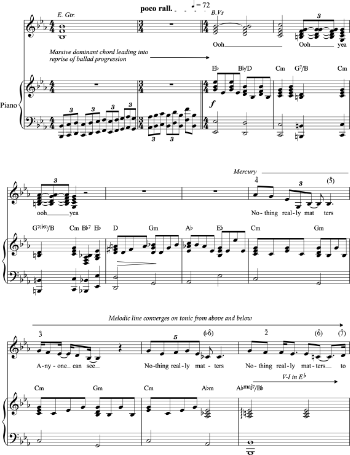
(click to enlarge, see the rest, and listen)
[5.3] If “Bohemian Rhapsody” ended here, one would likely hear a strong convergence of rhetorical and structural closing gestures. The melodic and harmonic arrivals are supported by the clear perfect cadences, textural diminuendo and the apparent completion lyrical narrative, Mercury-as-singer coming to accept his fate. It is not to be, however. The ensuing chords may initially appear to embellish the
Closure and Multi-Song Trajectories: Pink Floyd’s Dark Side of the Moon
[6.1] Queen’s treatment of closing devices in “Bohemian Rhapsody” is not an isolated example within their output. In my 2021 study (Braae 2021, 77–92) I analyzed the band’s approach to closure in early career songs with large-scale forms. “Bohemian Rhapsody” aligns with tracks from prior albums (e.g. “My Fairy King” [1973], “The March of the Black Queen” [1974]) in its divergent structural and rhetorical closing processes. I then argued that “Millionaire Waltz” from 1976 is notable for its formal and stylistic similarities with “Bohemian Rhapsody,” but is distinguished by its congruence of closing markers, an observation that informs historiographical conclusions regarding the first phase of the band’s career. There are, accordingly, insights to be drawn from patterns of closing markers across multiple songs. In this final analytical section, I further pursue such a line of thinking, considering how approaches to closure shape the musical relationships between tracks on Pink Floyd’s concept album, Dark Side of the Moon (1973).
[6.2] Dark Side of the Moon stands as a preeminent example of the 1970s concept album genre. Not only was it one of the most commercially successful examples of the form, but also, as Kevin Holm-Hudson (2006, 70) argues, it evokes a “multidimensional unity” that links the tracks into coherent listening experience. In a compelling analysis of the album, Shaugn O’Donnell (2006) argues that musical unity is embedded in melodic-harmonic structures at foreground, middleground and background levels. This plays out via recurring melodic motifs and chord patterns; the steady emergence of D major as the underlying tonic of the album, reaching its tonal apotheosis in the penultimate track, “Brain Damage”; and a prolonged melodic arch in this key that “generates a continual sense of forward motion, even across the boundaries of the discrete songs” (O’Donnell 2006, 101). Holm-Hudson’s study of the linking devices between tracks complements O’Donnell’s findings. Blending music theory and film editing terminology, he maps the cuts and dissolves between songs while also highlighting instances of “tonal” or “temporal” segues that preserve elements of musical continuity through transitions (see, in particular, Holm-Hudson 2006, 82–84). The model of closure, put forward in this article, offers a valuable third perspective on the movement through Dark Side of Moon. That is, in further examining the trajectory of individual songs—and, in particular the manner in which they move towards an ending—we develop richer insight into how the album projects musical motion from start to finish.
[6.3] Example 8(9) presents an overview of Dark Side of the Moon, with annotations pertaining to the tracks’ formal components and arrangement, the attendant treatment of structural and rhetorical closing markers, and a summarizing label of overall closure. What should be immediately evident is the general lack of total congruence between structural and rhetorical closing markers; this certainly resonates with the aforementioned analyses that foreground musical continuity through Dark Side of the Moon. Indeed, I would argue that once the album begins, it does not reach a complete state of rest until its end. Yet this straightforward conclusion overlooks the musical ebbs, flows and pauses along this pathway; moreover, it does not account for the nature of the musical progression within or across songs. This, to me, is the more intriguing analytical thread to pull; it is also one, as I shall explore here, which is connected to the nuanced interrelationships between formal and harmonic patterns and the divergent closing markers of songs.
Example 8. Pink Floyd, Dark Side of the Moon, structural and closure summary
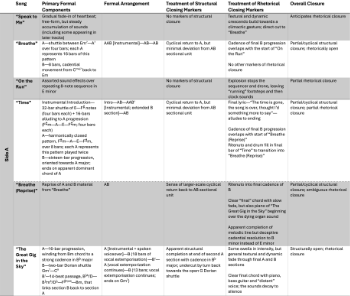
(click to enlarge and see the rest)
[6.4] I will begin by looking at six tracks—“Breathe,” “Time,” “Breathe (Reprise),” “Us and Them,” “Any Colour You Like,” and “Brian Damage”— all of which reveal shared formal patterns. Each song is primarily built around two contrasting sections. The A section is harmonically confined, whether relying on a chord shuttle (“Breathe”), a tonic pedal (e.g. “Us and Them”) or a closed loop (“Time”); the B section offers more harmonic motion, often beginning off-tonic and moving towards a cadence of some form. From this formal foundation, the A and B sections are then grouped into a repeating sectional unit—AB or AAB. Although there are subtle variations in how this sectional repetition unfolds across the album—see, for instance, the extended instrumental passages of “Time”—the relationship between the A and B sections fosters a common structural trajectory within these songs. That is, the relative harmonic stasis of A gives way to the movement of the B sections, which, in turn, builds anticipation for a return to A. With each successive iteration of a sectional unit, therefore, there is a small-scale sense of closure because the song has cycled back to the start of the pattern.
[6.5] Notable, though, is the lack of further musical material that would break the repetition of the larger sectional unit. In “Time,” “Us and Them” and “Brain Damage,” the instrumental solos offer some contrast. We might hear the ensuing vocal sectional unit as articulating a slightly more emphatic recapitulation of the cycle—returning to the A material and to the voices. Fundamentally, though, in the tracks mentioned thus far, once the sectional units have been established, there are few structural details that indicate an endpoint, as opposed to a restart. “Breathe” exemplifies this observation. After two vocal iterations of AB, the song simply cuts across the sectional bar line into “On the Run.” There is no musically inherent indication as to why the AB sectional unit repeats only once and not twice or three times or more. The same applies for the other songs cited thus far: they each end on the final bar of the B section, thus reaching the conclusion of their sectional cycles; but, structurally, with no real deviation from this sectional unit, there is nothing to project an overarching sense of structural closure. With these points in mind, I have labelled these initial examples as exhibiting “partial/cyclical structural closure” (as opposed to “structurally open”). This recognizes the small-scale closure that is set up by reaching the cadence point of the B section at the end of the song; as well as, in some cases, the mildly heightened sense of return after an instrumental section. It means that listening through these tracks, we are seemingly in a constant state of motion towards completion and perhaps a state of anticipation as to what the next restart will bring.
[6.6] It also means that rhetorical closing markers take a significant role in snapping the songs out their structural loops—that is, we might rely on a gesture to signal, “this is the last cycle!” That each song ends at the cadence of the B section evokes the possibility that the subsequent bar might bring a “final” chord. Example 8 shows a variety of other rhetorical markers being deployed through the final B section—whether a ritenuto (“Time” and “Breathe (Reprise)”), a lyric evoking finality of sorts (“Time” and “Us and Them”), or a thinning of texture (“Any Colour You Like”). Additionally, “Time” and “Brain Damage” have a drum fill in the final bar. Such a gesture typically indicates continuation (Temperley 2018), which is the case here—but it is continuation to the next track and thus, simultaneously, the fill marks the closing of the current track. With the exception of “Breathe (Reprise),” the markers do not bring about an overt quality of rhetorical closure—in terms of bringing the music to a stop—so much as emphasizing or foreshadowing the impending conclusion of the song.
[6.7] For this reason, I have used “partial” and “anticipates” as qualifiers in Example 8. Much like the cyclic treatment of structural closure evoked “completion with continuation,” in these instances the treatment of rhetorical markers indicate “moving on” or moving towards a high point, but not necessarily rest. In this light, the rhetorical openness of “Breathe” is perhaps less notable—it follows the same general ending patterns as the other tracks, but with fewer markers of the impending transition (Audio Example 3). This general approach to rhetorical closure also resonates with the non-song tracks “Speak to Me” and “On the Run.” While sitting in a soundscape/sound effect world, both use rhetorical sonic gestures to move on. The former has a textural crescendo that appears to be building towards a climactic moment. As it transpires, the realization of this climax is the snap into “Breathe” and thus we can subsequently hear “Speak to Me” functioning as a large-scale anacrusis into the first “song.” “On the Run” has an explosion sound effect that suddenly halts the open-ended synthesizer pattern. After hearing footsteps move across the stereo image, the introduction of clock sounds primes us for the shift into “Time” (Audio Example 4).
Audio Example 3. Pink Floyd, Dark Side of the Moon, transition between “Breathe” and “On the Run”
Audio Example 4. Pink Floyd, Dark Side of the Moon, concluding explosion of “On the Run”
[6.8] If the structural patterns foster ongoing motion through the album, the idiosyncratic deployment of rhetorical closing markers (alongside cinematic cuts) enhance this flow. In highlighting an imminent ending—even if briefly through a one-measure drum fill—the rhetorical gestures heighten anticipation for a new musical event, which is then realized with the shift onwards to the next song. In “Speak to Me,” the increase of textural density gives the impression of speeding towards the climax, before relaxing at the start of “Breathe.” By comparison, “Time” literally (tempo) and figuratively (lyrics) winds down as it moves into “Breathe (Reprise).” Either way, the rhetorical closing markers both support the underlying onwards structural movement, while varying the pace of the album around these song junctures—in essence, they shape the musical transitions to allow for a metaphorical breath, before the next phase of the journey begins.
[6.9] There remain four tracks which deviate from the patterns of structural and rhetorical closure identified thus far. Compared with the aforementioned songs, “Money” is economical in its musical materials—I hear the track as building from a single, repeating B-minor blues unit, with sectional variations in length, time signature, riff patterns, and textural layout (e.g., vocal vs. instrumental solos). There remain, however, structural parallels with other tracks. On the one hand, the blues form ensures there is internal motion towards a section-ending cadence. At a higher structural level, the final A section enacts a further impression of cyclicity: the multiple guitar solos are all in
[6.10] With the fade out, “Money” still enacts continuity; compared with other tracks, it simply lacks the markers that might activate the onwards transition. “Breathe (Reprise)” and “The Great Gig in the Sky,” closing Side A, stand out because they end with final chords, a form of rhetorical closure hitherto unencountered on the album, and one that brings the musical flow closer to a temporary standstill. As noted above, “Breathe (Reprise)” enacts the same structural patterns as many other songs, reaching its conclusion at the end of the B section. Based on previous iterations of the material (from “Breathe”), one might reasonably expect the chromatically-inflected cadential progression at the end of the B section (D7(
Audio Example 5. Pink Floyd, Dark Side of the Moon, ending of “Breathe (Reprise)” and transition into “The Great Gig in the Sky”
[6.11] Such a perception is validated when the organ of “Breathe (Reprise)” slowly crossfades into the broken piano chords (also B minor) of the next song (Audio Example 6)—as if to think, “A-ha, there was more to come!” From a closure perspective, it is this track, “The Great Gig in the Sky,” that I find the most interesting on Dark Side of the Moon. Rhetorically, many closing markers are present: there is a steady decline in textural density through the second half of the song; Clare Torry’s vocal utterances become sparser and distant within the reverberant recorded environment; there is a subtle ritenuto in the last bars; and the final Gm7 chord, heard on the piano and bass guitar, decays into silence.(10) As the final track on Side A (and thus, in original LP form, requiring the record to be turned over subsequently), it is logical that we reach this rhetorical pause, like the Act 1 curtain coming down; but this also raises the question as to whether and how there remains any openness that necessitates movement into Side B.
Audio Example 6. Pink Floyd, Dark Side of the Moon, ending of “Eclipse”
[6.12] “The Great Gig in the Sky” is intriguing in that it utilizes almost the same structural ingredients as most other tracks—notwithstanding a short linking phrase that appears in the middle of the song, there is one harmonically static section (built on a Gm7C9 shuttle) and one section with a winding progression towards
[6.13] This structural flip has a significant effect on the trajectory of the track. The opening A section appears to reach a point of initial rest in
[6.14] Again, we might consider a hypothetical ending on the last measure of the second A section, coming to rest on
[6.15] Side B of Dark Side of the Moon finishes with “Eclipse.” The song’s reliance on a single musical phrase means there is a limited sense of structural trajectory or closure. The passacaglia-like form and harmonic progression, alongside the intoned melody (sitting predominantly around ), give “Eclipse” its “hypnotic” and “churning” quality (Mills 2006, 172)—sitting in an eternal present that continues to unfurl with each phrase repetition. If there is little melodic or harmonic development within the song, we might recognize that the lyrics of “Eclipse,” especially the final line, encapsulate and tie together the themes of the whole album. These combined features underscore the song’s function as a coda to album (see O’Donnell 2006, 99); it does not open any new structural avenues, so much as punctuate and conclude the motion that has been unfolding through the previous tracks. This said, the track is also defined by its textural growth throughout the track; in turn, this expansion of sonic energy gives rise to the clarity of rhetorical closing gestures that bring this quasi-spiritual experience (and the album) to an end. Where “Breathe (Reprise)” and “The Great Gig in the Sky” paused the album’s flow with interrupted cadences and an open-ended chord shuttle, in “Eclipse,” there is a climactic ritenuto, an altered perfect cadence, and a resolute final tonic chord. For good measure, at the end of the “song,” the heartbeat returns, echoing its appearance as the opening sound of the album (Audio Example 6). The ending of “Eclipse” presents, in short, the strongest articulation of closure on Dark Side of the Moon.
[6.16] Having covered each track of the album, we can see the full picture as to how the deployment (or omission) of closing markers shapes the musical flow through Dark Side of the Moon. This is summarized in Example 9, which indicates the type of motion that is projected from song to song via the varying forms of closure. As indicated above, many of the tracks simultaneously convey structural completion and continuation via their cyclic forms; with limited rhetorical markers, this facilitates an onwards flow into the subsequent number. “Money” differs, but only by degree—rather than shifting purposefully into “Us and Them,” it meanders its way towards a crossfade. On Side A, “Breathe (Reprise)” and “The Great Gig in the Sky” provide some contrast to this persistent musical flow, but do so in a manner that pauses momentum without indicating completion. Indeed, any impressions of finality do not occur until “Eclipse” with its grand rhetorical conclusion to the album.
Example 9. Pink Floyd, Dark Side of the Moon, Summary of closure and album flow
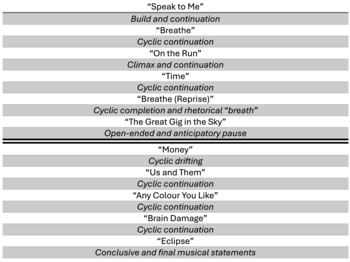
(click to enlarge)
[6.17] At a basic level, my observations support the points made by Holm-Hudson and O’Donnell regarding the album’s projection of unity and progression. They also lend nuance to mapping this experiential journey. The cuts and crossfades may create an obvious feeling of continuity, but equally, we can hear them as devices that work in tandem with the cyclic formal characteristics and rhetorical closing markers of each song—it is not simply a case of two tracks being spliced together, so much as multiple musical features working concurrently to lead the listener towards the seamless connections. Similarly, while the underlying harmonic directionality speaks to a trajectory from beginning to end, the variations in closure shape variations in musical pacing at key junctures on this pathway. The linear motion is imbued with its own ebbs and flows, pausing towards the end of side A, drifting lazily at the start of Side B, before marching towards its ending. The analysis of closing markers—and separating the structural devices from the rhetorical gestures—thus provides richer analytical insights into the relationships between songs. Authors have frequently been motivated by cohesion of Dark Side of the Moon (as discussed Holm-Hudson 2006; O’Donnell 2006; see also, Mills 2006; Womack 2006); as I have carefully demonstrated, the treatment of closure is yet another related feature of the album’s distinct and unified construction, allowing musical trajectories to further emerge from song to song.
Concluding Thoughts and Open Avenues
[7.1] I will enact my own form of divergent closure in this final section—that is, bringing the current discussion to a conclusion, while also opening avenues for future analytical enquiry. My analytical model demonstrated that, as relating to subsets of 1970s popular music repertoire, closure is articulated through multiple musical parameters and with varying degrees and types of congruence. Drawing a distinction between “structural” and “rhetorical” markers facilitates a deeper understanding of the closing processes within individual songs, which, in turn, may add interpretative nuance to a reading of lyrical context. This method can be extended outwards, focusing on multiple songs and the relationships that are formed through the articulation of closure. Here, there are two pathways: analyzing songs that are explicitly forged into a singular connection (as explored with Pink Floyd); or analyzing songs that are implicitly connected (as alluded to with Queen and their 1970s long-form tracks).
[7.2] Regarding the former pathway, concept albums, regardless of era, would seem to be ripe for investigation; indeed, there are likely intriguing conclusions to be drawn as to how closure shapes the flow of concept albums from different eras of popular music history—what are the shared resonances and differences between, say, Jethro Tull’s A Passion Play (1973) and Taylor Swift’s Reputation (2017)? Regarding the latter pathway, we may be able to identify aspects of closure as being fundamental to an artist’s idiolect or distinct musical style. But it may also open intriguing interpretative threads in cases where an artist recapitulates narrative themes or characters across their output; here, an analyst may adopt Moore’s “intentionally associative” mode of listening whereby one track “suggests thinking about another” (Moore 2012, 286; see also 286–300). Let me offer a very brief case study sketch along these lines, drawing on my earlier discussion of “Thunder Road.”
[7.3] Springsteen himself has commented on imagined connections across his songs. Vis-à-vis Born to Run (1975), he writes, “At record’s end, our lovers from ‘Thunder Road’ have had their early hard-won optimism severely tested by the streets of my noir city” (Springsteen 2016, 221). It is not made overt, lyrically or otherwise, that the characters of, say, “Born to Run” or “Jungleland” or “Backstreets” are the same people as “Thunder Road,” but we are encouraged to hear them as occupying a similar narrative world. Jumping forward five years to the eponymous track from The River (1980), Springsteen-as-narrator makes reference to the character “Mary,” while also noting that he conceived songs from this album as the “logical extension of the characters I’d studied” on his 1978 album, Darkness of the Edge of Town (Springsteen 2016, 278). Again, the connections are not explicitly mentioned, but such comments and similarities of lyrical themes invite one to hear an ongoing story, from Born to Run through to “The River,” via “Darkness on the Edge of Town.”
[7.4] What is notable in this respect is the loss of promise and hope for these characters; to my ears, this is echoed in the shifting patterns of closure across these songs. On the major tracks bookending the two sides of Born to Run (the four mentioned above), structural closure is strongly articulated; notwithstanding the infinite openness of “Thunder Road,” one also hears well-defined rhetorical closure. This emphatic closing congruence lends the tracks an air of authenticity (Moore 2002)—defiantly stating that this what life is like for these people. Moving onto “Darkness on the Edge of Town,” which now hints at the characters’ struggles, there is partial structural closure, in a cyclical sense, and a lack of rhetorical closing markers—our characters are now starting to drift through a repetitive churn of life. “The River” negates structural closure even further, primarily via its repetitive four-chord patterns and “double-tonic complex” (Nobile 2020a), which resists a sense of harmonic grounding.(11) This is matched by a rhetorical fade: at the end of the song, Springsteen sings a wordless melody over the repeating chorus progression and “The River” fades from view. There is no progression, no reaching of a goal, and no implication of change: the congruent lack of closing markers embodies the dissipation of hope for Springsteen’s characters.
[7.5] Needless to say, this analytical vignette offers only a cursory glance at relevant details, but it again alludes to the fruit that may be borne from investigating closure and closing markers across multiple songs, whether in the context of a concept album, an artist’s style or “associative” interpretations. What the sketch also entrenches is the context-dependent nature of interpreting closing markers—here, for instance, one’s reading of Springsteen’s later songs is informed by expectations and norms set up in the earlier tracks. Looking more broadly at my analysis in this article, the musical devices that I have cited and the conclusions I have drawn are relevant to the world of 1970s rock (and its mainstream progressive cousin). There remains, therefore, work to be done on how closure is articulated in music from other eras. Such findings will themselves be intimately connected to the attendant norms of harmonic, melodic, formal and textural processes. And it is on this note that I wish to end with a final provocation.
[7.6] From 1998, Semisonic’s “Closing Time” is literally about an ending (though with the allure of a “new beginning”). Notwithstanding an instrumental section that briefly changes harmonic tack and ushers in a rousing guitar solo, the song is formally repetitive and built over a four-chord loop, G–D–Am–C (a variation on the "axis" progression; see Richards 2017). Analyzing the stylistic development of verse-prechorus-chorus forms, Nobile (2022, [3.1]–[3.6], in particular) highlights an evolution in the conventional structural journeys of post-1991 popular songs, such that the teleological impetus through this form may stem as much from changes in texture, timbre and vocality, as much as harmonic and melodic processes. “Closing Time” aligns with this trend, with choruses principally defined by their sonic expansion (namely, introduction of multiple distorted electric guitars). This design, in turn, impacts the nature of the song’s closure: “Closing Time” indeed “closes,” but it does so almost entirely through a textural trajectory in the final part of the song: a drop and build into the last chorus, followed by a brief instrumental section, and then a textural fade and ritenuto into the final refrain. The attendant norms of this style suggest that the rhetorical gestures may have overtaken structural gestures as the primary markers of closure. This categorical distinction and analytical model may assist music theorists in continuing to illuminate and tease out such stylistic developments and build upon our understanding not only of how songs grab a listener’s attention and but, equally, how they take their leave and end.
Nick Braae
Waikato Institute of Technology
Hamilton, New Zealand
Nick.Braae@wintec.ac.nz
Works Cited
Agawu, Kofi. 1988. “Concepts of Closure and Chopin’s Opus 28.” Music Theory Spectrum 9 (1): 1–17. https://doi.org/10.1525/mts.1987.9.1.02a00010.
Anson-Cartwright, Mark. 2007. “Concepts of Closure in Tonal Music: A Critical Study.” Theory and Practice 32: 1–17.
Attas, Robin. 2015. “Form as Process: The Buildup Introduction in Popular Music.” Music Theory Spectrum 37 (2): 275–96. https://doi.org/10.1093/mts/mtv020.
Boss, Jack. 2016. “Little High, Little Low: Hidden Repetition, Long-Range Contour, and Classical Form in Queen’s ‘Bohemian Rhapsody’.” In Form as Process in Music, 1300–2014: An Analytic Sampler, ed. Jack Boss, Heather Holmquest, Hussell Knight, Inés Thiebaut, and Brent Yorgason, 227–54. Cambridge Scholars Publishing.
Braae, Nick. 2015. “Sonic Patterns and Compositional Strategies in Queen’s ‘Bohemian Rhapsody.’” Twentieth-Century Music 12 (2): 173–96. https://doi.org/10.1017/S147857221500002X.
—————. 2019. “Linearity in Popular Songs.” In On Popular Music and Its Unruly Entanglements, ed. Nick Braae and Kai Arne Hansen, 83–99. Palgrave Macmillan. https://doi.org/10.1007/978-3-030-18099-7_5.
—————. 2021. Rock and Rhapsodies: The Music of Queen. Oxford University Press. https://doi.org/10.1093/oso/9780197526736.001.0001.
Caplin, William. 2024. Cadence: A Study of Closure in Tonal Music. Oxford University Press. https://doi.org/10.1093/oso/9780190056445.001.0001.
Covach, John. 2003. “Pangs of History in Late 1970s New-Wave Rock.” In Analyzing Popular Music, ed. Allan F. Moore, 173–95. Cambridge University Press. https://doi.org/10.1017/CBO9780511482014.009.
—————. 2007. “The Hippie Aesthetic: Cultural Positioning and Musical Ambition in Early Progressive Rock.” Philomusica Online: Composition and Experimentation in British Rock: 1966-1976. Accessed 10 December 2019.
Cubitt, Sean. 1984. “‘Maybellene’: Meaning and the Listening Subject.” Popular Music 4 (Performers and Audiences): 207–24. https://doi.org/10.1017/S0261143000006231.
Danielsen, Anne. 2006. Presence and Pleasure: The Funk Grooves of James Brown and Parliament. Wesleyan University Press. https://doi.org/10.1353/book.125990.
de Clercq, Trevor. 2017. “Embracing Ambiguity in the Analysis of Form in Pop/Rock Music, 1982–1991.” Music Theory Online 23 (3). https://doi.org/10.30535/mto.23.3.4.
de Clercq, Trevor. 2021. “The Logic of Six-Based Minor for Harmonic Analyses of Popular Music.” Music Theory Online 27 (4). https://doi.org/10.30535/mto.27.4.4.
Doll, Christopher. 2017. Hearing Harmony: Towards a Tonal Theory for the Rock Era. University of Michigan Press. https://doi.org/10.3998/mpub.3079295.
Eng, Clare Sher Ling. 2019. “The Problem of Closure in Neo-Tonal Music.” Music Theory Spectrum 41 (2): 285–304. https://doi.org/10.1093/mts/mtz007.
Everett, Walter. 2001. Review of Reading Pop: Approaches to Textual Analysis in Popular Music, edited by Richard Middleton (Oxford University Press, 2000). Music Theory Online 7 (6). https://doi.org/10.30535/mto.7.6.2.
—————. 2007. “Beyond the Palace: Casing the Promised Land.” Interdisciplinary Literary Studies 9 (1): 81–94.
Fink, Robert. 2011. “Goal-Directed Soul? Analyzing Rhythmic Teleology in African American Popular Music.” Journal of the American Musicological Society 64 (1): 179–238. https://doi.org/10.1525/jams.2011.64.1.179.
Hanenberg, Scott J. 2016. “Rock Modulation and Narrative.” Music Theory Online 22 (2). https://doi.org/10.30535/mto.22.2.2.
Hatten, Robert S. 1987. “Aspects of Dramatic Closure in Beethoven: A Semiotic Perspective on Music Analysis via Strategies of Dramatic Conflict.” Semiotica 66 (1–3): 197–210.
—————. 2014. “Performing Expressive Closure in Structurally Open Contexts: Chopin’s Prelude in A minor and the Last Two Dances of Schumann’s Davidsbündlertänze.” Music Theory Online 20 (4). https://doi.org/10.30535/mto.20.4.5.
Heetderks, David. 2020. “Play with Closing Markers: Cadential Multivalence in 1960s Prechoruses and Related Schemas.” Music Theory Spectrum 42 (1): 1–23. https://doi.org/10.1093/mts/mtz023.
Hiatt, Brian, David Browne, David Fricke, Jon Dolan, Thomas Walsh, Simon Vozick-Levinson, Patrick Doyle, Andy Greene, Will Hermes, and Rob Sheffield. 2018. “The 100 Greatest Springsteen Songs.” Rolling Stone, December 11. Accessed May 12th, 2025. https://www.rollingstone.com/music/music-lists/100-greatest-bruce-springsteen-songs-of-all-time-32486/
Holm-Hudson, Kevin. 2005. “‘Come Sail Away’ and the Commodification of ‘Prog Lite.’” American Music 23 (3): 377–94. https://doi.org/10.2307/4153059.
—————. 2006. “‘Worked out within the Grooves’: The Sound and Structure of The Dark Side of the Moon.” In ‘Speak to Me’: The Legacy of Pink Floyd’s Dark Side of the Moon, ed. Russell Reising, 69–86. Ashgate. https://doi.org/10.4324/9781351218146-6.
Hyland, Anne M. 2009. “Rhetorical Closure in the First Movement of Schubert’s Quartet in C Major, D. 46: A Dialogue with Deformation.” Music Analysis 28 (1): 111–42. https://doi.org/10.1111/j.1468-2249.2010.00296.x.
Malawey, Victoria. 2010. “Harmonic Stasis and Oscillation in Björk’s Medúlla.” Music Theory Online 16 (1). https://doi.org/10.30535/mto.16.1.3.
Malawey, Victoria. 2011. “Musical Emergence in Björk’s Medúlla.” Journal of the Royal Music Association 136 (1): 141–80. https://doi.org/10.1080/02690403.2011.562717.
McCreless, Patrick. 1991. “The Hermeneutic Sentence and Other Literary Models for Tonal Closure.” Indiana Theory Review 12 (Spring and Fall): 35–73.
Meyer, Leonard B. 1956. Emotion and Meaning in Music. The University of Chicago Press.
—————. 1989. Style and Music: Theory, History, and Ideology. The University of Chicago Press.
Mills, Peter. 2006. “The Whole of the Moon: ‘Brain Damage,’ ‘Eclipse,’ and the Mythic Narrative of Pink Floyd.” In ‘Speak to Me’: The Legacy of Pink Floyd’s Dark Side of the Moon, ed. Russell Reising, 158–76. Ashgate. https://doi.org/10.4324/9781351218146-11.
Moore, Allan. 2002. “Authenticity as Authentication.” Popular Music 21 (2): 209–23. https://doi.org/10.1017/S0261143002002131.
Moore, Allan F. 2012. Song Means: Analysing and Interpreting Recorded Popular Song. Ashgate.
Nobile, Drew F. 2020a. “Double-Tonic Complexes in Rock Music.” Music Theory Spectrum 42 (2): 207–26. https://doi.org/10.1093/mts/mtaa003.
—————. 2020b. Form as Harmony in Rock Music. Oxford University Press. https://doi.org/10.1093/oso/9780190948351.001.0001.
—————. 2022. “Teleology in Verse–Prechorus–Chorus Form, 1965–2020.” Music Theory Online 28 (3). https://doi.org/10.30535/mto.28.3.8.
O’Donnell, Shaugn. 2006. “‘On the Path’: Tracing Tonal Coherence in The Dark Side of the Moon.” In ‘Speak to Me’: The Legacy of Pink Floyd’s Dark Side of the Moon, ed. Russell Reising, 87–103. Ashgate. https://doi.org/10.4324/9781351218146-7.
Osborn, Brad. 2011. “Understanding Through-Composition in Post-Rock, Math-Metal, and other Post-Millenial Rock Genres.” Music Theory Online 17 (3). https://doi.org/10.30535/mto.17.3.4.
—————. 2013. “Subverting the Verse-Chorus Paradigm: Terminally Climactic Forms in Recent Rock Music.” Music Theory Spectrum 35 (1): 23–47. https://doi.org/10.1525/mts.2013.35.1.23.
Palmer, John R. 2015. “Lost in the City: Yes’s ‘Heart of the Sunrise’ and the Expansion of Musical Expression in Rock.” Popular Music 34 (3): 408–31. https://doi.org/10.1017/S0261143015000343.
Ricci, Adam. 2000. “A “Hard Habit to Break”: The Integration of Harmonic Cycles and Voice-Leading Structure in Two Songs by Chicago.” Indiana Theory Review 21: 129–46.
Richards, Mark. 2017. “Tonal Ambiguity in Popular Music’s Axis Progressions.” Music Theory Online 23 (3). https://doi.org/10.30535/mto.23.3.6.
Samarotto, Frank. 2012. “The Trope of Expectancy/Infinity in the Music of the Beatles and Others.” Paper presented at the Annual Meeting of the Society for Music Theory, Louisiana.
Sheinbaum, John J. 2024. “Movin’ Out on Thunder Road: Images of Ambition, Escape, Authenticity in Billy Joel and Bruce Springsteen.” In “We Didn’t Start the Fire”: Billy Joel and Popular Music Studies, ed. Joshua S. Duchan and Ryan Paul Bañagale, 29–45. Lexington Books. https://doi.org/10.5040/9781666982329.ch-2.
Smith, Kenneth. 2011. “Skryabin’s Revolving Harmonies, Lacanian Desire, and Riemannian Funktionstheorie.” Twentieth-Century Music 7 (2): 167–94. https://doi.org/10.1017/S1478572211000156.
Spicer, Mark. 2004. “(Ac)cumulative Form in Pop-Rock Music.” Twentieth-Century Music 1 (1): 29–64. https://doi.org/10.1017/S1478572204000052.
—————. 2008. “Large-Scale Strategy and Compositional Design in the Early Music of Genesis.” In Expression in Pop-Rock Music: Critical and Analytical Essays, ed. Walter Everett, 313–44. Routledge.
Spicer, Mark. 2011. “(Per)Form in(g) Rock: A Response.” Music Theory Online 17 (3). https://doi.org/10.30535/mto.17.3.9.
Spicer, Mark. 2017. “Fragile, Emergent, and Absent Tonics in Pop and Rock Songs.” Music Theory Online 23 (2). https://doi.org/10.30535/mto.23.2.2.
Springsteen, Bruce. 2016. Born to Run. Simon & Schuster.
Stroud, Cara. 2022. “Codetta and Anthem Postchorus Types in Top-40 Pop from 2010 to 2015.” Music Theory Online 28 (2). https://doi.org/10.30535/mto.28.2.9.
Taub, Matthew. 2022. “Bruce Springsteen: Every Album Ranked in Order of Greatness”. NME, November 8. Accessed May 12th, 2025. https://www.nme.com/features/bruce-springsteen-albums-ranked-2808825
Temperley, David. 2011. “The Cadential IV in Rock.” Music Theory Online 17 (1). https://doi.org/10.30535/mto.17.1.8.
Temperley, David. 2018. The Musical Language of Rock. Oxford University Press. https://doi.org/10.1093/oso/9780190653774.001.0001.
Womack, Kenneth. 2006. “Pink Floyd’s Levinasian Ethics: Reading The Dark Side of the Moon’s Philosophical Architecture.” In ‘Speak to Me’: The Legacy of Pink Floyd’s Dark Side of the Moon, ed. Russell Reising, 177–86. Ashgate. https://doi.org/10.4324/9781351218146-12.
Footnotes
1. Spicer’s identification of “emergent” tonics can be read in the same light, albeit focusing on this processual feature in a strictly harmonic context (Spicer 2017).
Return to text
2. The studies cited by Caplin are Meyer (1956, 1989); Agawu (1988); Hatten (1987); McCreless (1991); and Anson-Cartwright (2007). Other useful points of reference on the subject include Smith (2011); Hatten (2014); Eng (2019).
Return to text
3. We can take this observation a step further and note that the prevalence of musical patterns may well lend themselves to certain forms of closure in a specific genre context. Caplin hypothesizes, for instance, that in the eighteenth century, musical closure typically took the form of goal attainment, compared with the circular aesthetic of the nineteenth century (2024, 4).
Return to text
4. In classifying cadences as markers of rhetorical (rather than structural) closure, I am drawing on the work of other popular-music theorists who define and analyze them in straightforward terms as phrase- and section-ending gestures (Temperley 2018, 60–63; see also Heetderks 2020). That is to say, the cadence carries reduced structural weight than is identified in classical music contexts by Hyland and Agawu. This is not to deny the potential for a cadence to take a highly active role in animating and emphasising aspects of structural closure, as is the case in, say, “Thunder Road,” discussed in this article; rather the harmonic gesture, in and of itself, serves as a localized indicator of “ending” (i.e. rhetorical closure).
Return to text
5. By this, I mean that, as listeners, we cannot always pinpoint exactly where the process of closure starts—is it when we first hear the chorus? When we first establish that the musical content is, in fact, the chorus? When the bridge begins and we anticipate returning to familiar material? On the possibility of such ambiguity, Anson-Cartwright notes that there may be an awareness “at all times” that the piece will “eventually come to an end,” but “it is up to the listener (or analyst) to distinguish, where appropriate, between closural and non-closural events or tendencies” (Anson-Cartwright 2007, 4).
Return to text
6. For more on the nature of rock music of this era and its extended treatment of song conventions, see, for instance, Moore (2012); Covach (2007); Spicer (2008); Palmer (2015).
Return to text
7. The second VCU is slightly varied insofar as the prechorus does not lead to the anticipated chorus; however, in starting the third VCU, we still hear a return to the same melodic and harmonic material.
Return to text
8. John Sheinbaum describes the C and A’ sections as “a (with a distinctive part of b).” While his labelling differs slightly from mine, he similarly foregrounds the song’s “radical” structure and “evolutionary” variations in musical material as it unfolds (Sheinbaum 2024, 36–37).
Return to text
9. I have used a dotted line between “Time” and “Breathe (Reprise)” to indicate that the pair are grouped as a single song in the album track-listing, but there is a clear transition from the song material of the former to the latter. It is for this reason that I prefer to refer to two separate tracks, each of which presents its own closing strategies. Since 2005, “The Great Gig in the Sky” has been co-credited to Pink Floyd and Clare Torry, the female singer whose vocals are the primary melodic content of the song.
Return to text
10. Sharp listeners will note the slight pitch bend in the piano chord as the sound decays. One can find much speculation on internet forums as to the cause and purpose (or lack thereof) of this sonic quirk. One interpretation, in this context, might be that it contributes to a lingering sense of openness that necessitates the onwards trajectory to Side B of the album. That said, I don’t hear this as disrupting the general impression of rhetorical closure that is fostered through multiple other parameters. I am grateful to a reviewer for drawing attention to this feature.
Return to text
11. De Clercq (2021) and Doll (2017) would also be relevant in this context.
Return to text
Copyright Statement
Copyright © 2026 by the Society for Music Theory. All rights reserved.
[1] Copyrights for individual items published in Music Theory Online (MTO) are held by their authors. Items appearing in MTO may be saved and stored in electronic or paper form, and may be shared among individuals for purposes of scholarly research or discussion, but may not be republished in any form, electronic or print, without prior, written permission from the author(s), and advance notification of the editors of MTO.
[2] Any redistributed form of items published in MTO must include the following information in a form appropriate to the medium in which the items are to appear:
This item appeared in Music Theory Online in Volume 32, Issue 1 in March 2026. It was authored by Nick Braae (Nick.Braae@wintec.ac.nz), with whose written permission it is reprinted here.
[3] Libraries may archive issues of MTO in electronic or paper form for public access so long as each issue is stored in its entirety, and no access fee is charged. Exceptions to these requirements must be approved in writing by the editors of MTO, who will act in accordance with the decisions of the Society for Music Theory.
This document and all portions thereof are protected by U.S. and international copyright laws. Material contained herein may be copied and/or distributed for research purposes only.

Prepared by Andrew Blake, Senior Editorial Assistant
Number of visits:
4189