A Context-Sensitive Analysis of the Pre-Dominant Function
Jenine L. Brown, Daphne Tan, Victoria Boerner, and Yeonju Lindsey Lee
KEYWORDS: pre-dominant, harmonic function, chord frequency, Mozart piano sonatas, sonata form, pre-dominant power up
ABSTRACT: Although the pre-dominant function is a key concept in music theory, its role in relation to formal context is not well understood. Further, while descriptions of pre-dominant chords as “strong” or “effective” can readily be found, the source of these claims has not yet been investigated empirically. In this article, we examine the pre-dominant function and the concept of pre-dominant strength through the lens of chord frequency within formal contexts. We catalogued chords approaching the dominant harmony (V) in the sonata-form movements of Mozart’s piano sonatas, a ubiquitous repertoire in theory textbooks. Using this newly created dataset, we examine frequencies of chords that appear prior to the dominant and test whether these frequencies differ by formal location. We propose a theory of pre-dominant strength as tied to cadential dominants and share data on chord successions within the pre-dominant function. Finally, we discuss differences between approaches to V in expositions and recapitulations, highlighting harmonic amplifications that we term “pre-dominant power ups.” Throughout, we illustrate that strong pre-dominant harmonies, especially rare ones, are perceptual markers of formal location at various levels within sonata form.
DOI: 10.30535/mto.32.1.3
Copyright © 2026 Society for Music Theory
1. Introduction
[1.1] Despite the many novel developments in North American music theory over the last century, harmonic function remains a mainstay in research and pedagogy. It is almost axiomatic in theories of 18th- and 19th-century Western tonal music that harmonies are grouped into three functions: tonic, pre-dominant, and dominant.(1) As the authors of Open Music Theory write, “the function of a chord concerns the notes that belong to it (its internal characteristics), the chords that tend to precede and follow it, and where it tends to be employed in the course of a musical phrase” (Shaffer, Hughes, and Moseley 2014, “Harmonic functions”). Yet among these three functional categories, the pre-dominant is notable for encompassing a range of chords that do not share a unified set of internal characteristics but rather vary widely in scale degrees, chord quality, and cardinality. Indeed, when it comes to the pre-dominant function, some music theorists stress its syntactical placement as “dominant preparation,” to the exclusion of other factors.(2) Our study provides a systematic investigation of the pre-dominant function, which we first operationalize as “chords occurring before the dominant.”
[1.2] It is not only membership in the pre-dominant function that has received much theoretical debate; syntax within the function has also been described in different ways. Some theorists invoke the frequency of certain patterns to explain chord succession, though usually without reference to precise data about specific repertoires. For example, claims such as “before proceeding to V, IV may be followed by ii6 (the reverse—ii6 followed by IV—is far less common)” (Burstein and Straus 2016, 149) often appear in pedagogical texts, and frequency is also referenced in descriptions of approaches to V in schema theory (Byros 2012) and form theory (Caplin 2024). Other explanations for pre-dominant syntax rest on impressions of chord strength, effectiveness, and intensity. For example, when describing augmented sixth chords, Clendinning and Marvin write, “Occasionally, composers will write all three types [of augmented sixth chords] in quick succession to intensify motion to the dominant at a cadence—usually in the order Italian, French, German” (Clendinning and Marvin 2016, p. 686, emphasis added). And among his reasons why the supertonic is an “effective pre-dominant,” Laitz writes that “the progression ii–V–I is often set to –– in the soprano, versus the less dynamic –– when IV functions as the pre-dominant” (2008, 283).” Thus, the syntactical ordering of chords within the pre-dominant function involves several different factors.
[1.3] Moreover, a relationship between pre-dominant function and large-scale form has been suggested but not fully explored in theoretical writings. In his influential study of classical form, William Caplin posits that the pre-dominant is a “fundamental harmonic function” within a “complete cadential progression” (1998, 27; rephrased in Caplin 2013, 4), a refinement of Leonard Meyer’s observation: “I cannot satisfactorily explain why the progression from subdominant to dominant specifies a tonal center. … It is enough to recognize that the progression does perform this function” (1989, 275). More recently, Caplin describes differing approaches to the dominant depending on cadence type (2024, 104). Beyond the phrase level, however, the role of the pre-dominant is underexplored, including in sources that address sonata form, such as textbooks (Laitz 2012; Burstein and Straus 2016; Kostka, Payne, and Almén 2018; Clendinning and Marvin 2021), corpus studies (Sears 2016), and treatises on sonata form (Rosen 1988; Caplin 1998; Hepokoski and Darcy 2006; Greenberg 2022). Further, while pre-dominant chords are regularly spotlighted in harmony texts, their contextual placement within complete works is rarely discussed. For instance, Burstein and Straus’s claim that “in eighteenth-century music, augmented sixth chords frequently precede the dominant harmonies of climactic cadences” (2016, 288) is suggestive of a connection between harmonic function and form, as is Clendinning and Marvin’s observation that these chords “are usually positioned to emphasize the arrival of a particularly significant dominant harmony” (2021, 588); in both cases, examples of such moments are left for the student to discover. There seems, then, to be general agreement that the pre-dominant function differs from one location to the next within specific musical forms, yet this observation remains at the level of intuition.
[1.4] The present study addresses existing ambiguities in the literature on the pre-dominant function through a systematic and context-sensitive exploration of approaches to the dominant by cadence type and locations within sonata form. This particular repertoire was selected because it has been (and currently remains) ubiquitous in North American theory pedagogy.(3) That is, we reckoned that theoretical writings about syntactical orderings implicitly refer to this canonical repertoire. Further, in the sizable body of literature on Mozart’s style (including Rosen 1988; Solomon 1995; Ivanovitch 2011; and Burnham 2012), we note an absence of generalized discussions about the role of the pre-dominant in relation to formal procedures. Our study addresses this lacuna by investigating the interaction of pre-dominant frequency and sonata form within a single corpus of music, laying the foundation for future comparative studies. To our knowledge, our dataset is the first to combine harmonic approaches to the dominant along with their relationship to cadences and formal locations. We employed an expert-annotated approach, which allows for the consideration of various textures that are ubiquitous in Mozart’s piano sonatas.(4)
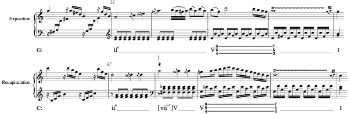
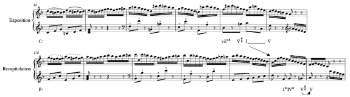
Example 1. Pre-dominant power up in Mozart, Piano Sonata, K. 545/i (last PAC of exposition/recapitulation).
(click to enlarge)
[1.5] We use our dataset to address three interrelated contextual issues: qualitative feelings of strength, syntax within the pre-dominant, and the role of the pre-dominant in closure and large-scale form. Two passages from Mozart’s K. 545/i, a staple composition found in music theory texts, serve to illustrate these issues (see Example 1).(5) In the exposition, a ii6 chord initiates the PAC at the end of the subordinate theme, while in the recapitulation, ii6–[vii°7]V appears at the analogous location.(6) Our study offers empirical support for the familiar claims that the pre-dominant is most utilized at such form-defining cadences, that diatonic chords precede chromatic ones before the dominant, and that the particular pre-dominant chords in Example 1 are relatively “stronger” or more “attracted” to the dominant than others. Comparing across expositions and recapitulations, moreover, reveals that the insertion of the chromatic chord found in the recapitulation of K. 545/i is common in Mozart––a move we call the “pre-dominant power up”; more than “ornamental changes” (Caplin 2013, 482), pre-dominant power ups are critical for magnifying tonal closure. Further, chromatic chords such as [vii°7]V and the augmented sixth chords occur infrequently in this dataset; such “rare pre-dominants” are reserved for form-defining cadences, and this close association between harmony and form, we suggest, might account for the overrepresentation of these chords in pedagogical texts (as described in White 2021).
[1.6] In what follows, we provide the first empirical exploration of approaches to dominant harmony, contributing to a better understanding of the pre-dominant function. Section 2 describes the dataset we created to examine the pre-dominant function. In section 3, we focus on the frequency of chords immediately preceding the dominant, illustrating that chords in that syntactical location vary based on cadence type and inter-thematic formal functions. Here, we suggest that chord frequency, combined with formal location, accounts for why some chords (and not others) are nominally pre-dominant, and we propose an empirical basis for a “strong pre-dominant” (Clendinning and Marvin 2021, 276; Peterson 2021). We also consider a possible relationship between the frequency of individual harmonies and their perceived attraction to the subsequent dominant harmony, relying on experimental data (Brown, Tan, and Baker 2021). In section 4, we investigate the syntax of multiple harmonies before the dominant and test theoretical claims about “intensification” within the pre-dominant function. Section 5 offers case studies of “rare” pre-dominants; we argue that they have perceptual and form-defining significance. Finally, section 6 considers approaches to the dominant in corresponding locations of the exposition and recapitulation, wherein we propose that pre-dominant power ups in recapitulations strengthen sonata closure and contribute to long-range perceptions of chordal strength (or attraction) to the dominant by listeners familiar with the repertoire.
2. The dataset
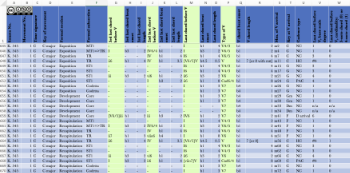
Example 2. An excerpt of the dataset. Rows contain all dominant harmonies along with the three chords preceding each dominant in K. 545/i.
(click to enlarge)
[2.1] To facilitate our study of the pre-dominant function, we created a dataset containing expert annotations of harmonic approaches to every dominant chord in all 22 sonata-allegro movements of Mozart’s piano sonatas (16 first movements and 6 third movements).(7) The dataset tracks the three chords heard before every dominant chord in the selected repertoire, as well as the cadential status and formal location of the dominant chord. Our approach to harmonic syntax was decidedly bottom-up: we catalogued all harmonies appearing before the dominant, regardless of their categorization in pedagogical texts. We also collected the temporal profile of all chords, including their onset and duration; the analysis of this temporal data is beyond the scope of the present article and would be a fruitful avenue for future research.(8) The full dataset can be downloaded from https://doi.org/10.17605/OSF.IO/7PA6M, and a published data report, which describes the data creation process and annotation standard in greater detail, can be found in Brown, Tan, and Lin (2023). A snapshot of the dataset for all dominants within K. 545/i appears in Example 2. Three analysts created the dataset, with one providing an initial version while the other two reviewed the entire dataset three times each. During each round of review, discrepancies in interpretation were discussed between all analysts; some discrepancies led us to refine analytical methodologies and to revisit earlier analyses to ensure that the correct analytical method was applied consistently across the entire dataset (see Brown, Tan, and Lin 2023 for more detail).
[2.2] The dataset is formatted as an Excel table, enabling users to filter or sort data easily by column headers. Each row is structured around a single instance of dominant harmony, which is operationalized as any inversion of V (triad), any inversion of V7, and the cadential 6/4.(9) A total of 1,129 dominants in the dataset were identified; these are displayed in Column P, in light green. In the header of this column, and in the remainder of this article, we use “V” as a shorthand for all dominant harmony types. Columns S and T provide, respectively, the measure number and local key of the dominant harmony. Column V shows the bass scale degree before the dominant.
[2.3] Columns M, J, and G, also in light green, display up to three harmonies preceding each V. In this article, we will refer to these columns as “V-1” (column M), “V-2” (column J), and “V-3” (column G), such that reading the harmonies from left to right on the spreadsheet follows their temporal appearance in the music. The V-1 notation means that it occurs directly before the dominant (one chord before the dominant), whereas V-2 is two chords before V, etc. A dash (“-”) appears in these columns when the harmony before V belongs to a previous phrase or is itself a dominant harmony, which would then appear in the previous row; in other words, dashes indicate that fewer than three chords separate two instances of dominant harmony.(10)
[2.4] Columns A through E provide large-scale identifiers from cues in the score: Köchel and movement numbers, time signature of the movement, key of the movement, and large-scale formal functions (exposition, development, recapitulation). Column F lists themes, theme-like units, and post-cadential units that operate at a lower level of the formal hierarchy. The theoretical basis for these formal categories is Caplin (1998; 2013), which recognizes the possibility of multiple main themes (MT1, MT2, etc.) and subordinate themes (ST) forming MT and ST groups, where subsections of themes are separated by a cadence.(11) Caplin (1998; 2013) also provides the theoretical basis for the analysis of cadence types, shown in column U. Along with the three standard possibilities for cadences—perfect authentic cadence (PAC), imperfect authentic cadence (IAC), half cadence (HC)—we identify abandoned cadences (AC), deceptive cadences (DC), and evaded cadences (EC).(12) Further, we indicate “dominant arrival” (D arrival) when dominant harmony signals the end of a formal unit, but the final chord appears in inversion, contains a chordal seventh, is not preceded by a harmonic progression, or there is noncongruence between the harmonic arrival and the melodic-motivic arrival (Caplin 1998; 2013). In our analysis, we follow Caplin’s (1998) definition of PAC, IAC, and HC with the stipulation that they contain a root-position dominant (or cadential 6/4). Finally, when a dominant harmony does not participate in any of these scenarios, an entry of “no cadence” (NC) appears in the dataset.
[2.5] Deciding whether a harmonic event is or is not a cadence and if so, what type, can sometimes be less than straightforward (cf. Neuwirth and Bergé 2015). To address this, we compared our cadence annotations to two published datasets on the Mozart piano sonatas. First is the list of HCs in Martin and Pedneault-Deslauriers’s (2015) article on “Mozartean Half Cadences”; our analyses matched in all but one case.(13) We also compared our cadence annotations with those of Hentschel, Neuwirth, and Rohrmeier (2021), focusing only on K. 279/i and found partial agreement with their analyses. That is, we identified twelve cadences in the movement, while Hentschel, Neuwirth, and Rohrmeier identified twenty. For example, they analyze the V occurring in m. 3 as participating in a PAC, but we call this moment an NC, as we contend that it occurs too soon within the main theme. Similarly, they label mm. 33, 35, and 37 as PACs, but we assert that these measures follow the formal end of the subordinate theme and belong to post-cadential codettas (Caplin 1998; Clendinning and Marvin 2021). Ultimately, comparisons to these other datasets prompted us to think carefully about our analytical decisions but did not result in changes to our analyses.(14)
[2.6] Turning back to K. 545/i (excerpted in Example 1), corresponding corpus annotations for the musical passages from can be found in Example 2. Row 652 contains the final dominant within the PAC that concludes the exposition’s subordinate theme, where columns J and M illustrate that the harmonies preceding the arrival of the cadential 6/4 in m. 24 are a I-ii6 progression. Since all appearances of V receive their own row, the V6 on the downbeat of m. 21 is in row 651. Later, row 668 contains the analogous passage in the recapitulation. This row contains the dominant that brings the subordinate theme to a cadence, with columns G, J, and M showing the harmonies heard before the cadential 6/4: I, followed by ii6 then [vii°7]V.
3. Analysis of V-1
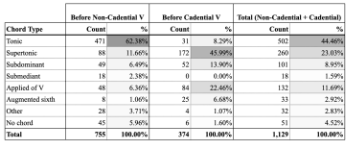
Example 3. Frequency and percentages of V-1 based upon whether the chord is or is not at a cadence. (“Other” includes iii, vii°,
(click to enlarge)
[3.1] In this section, we present empirical data that suggest that the chord occurring directly before V varies by formal location. The observations we offer are not exhaustive, and we encourage readers to download the dataset to test their own hypotheses. Example 3 illustrates that chords appearing in V-1 (column M, the position immediately preceding the dominant) differ depending on whether the dominant is at a cadence. The most frequent type of harmony in V-1 is tonic (I, I6, i, i6), which occurs 44.46% of the time. At a cadence, however, the most frequent harmony before V is the supertonic (specifically ii6). This finding supports Caplin’s claim that “[m]any harmony texts suggest that the subdominant triad leads most typically to the dominant. An examination of the classical literature reveals, however, that the supertonic triad in first inversion (II6) is the more characteristic pre-dominant” (1998, 24; similar statements can be found in 2024, 23 and 58). More generally, a comparison of the leftmost two columns of Example 3 confirms that the distribution of chords differs significantly depending on whether the dominant is at a cadence (Χ2(7, N = 1129) = 416.10, p < .001, test assumptions met).
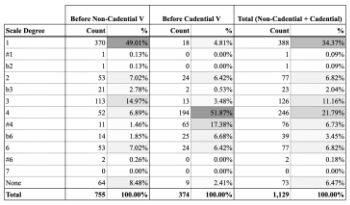
Example 4. Frequency and percentages of bass scale degrees in V-1 based upon whether the chord is or is not at a cadence.
(click to enlarge)
[3.2] Example 4 explores the frequency of bass scale degrees occurring before all dominants in the dataset. At a cadence, and
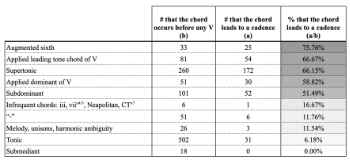
Example 5. Chord types before V in the dataset along with their frequency at various locations, arranged by how often they lead to a cadence (rightmost column).
(click to enlarge)
[3.3] Returning to Example 3, one might use these data to suggest that the pre-dominant function can be defined as chords that occur most frequently before a cadential V. This would lead us to conclude, however, that tonic chords (comprising 8.29% of V-1 chords at a cadence, shown in the middle column of Example 3) are more representative of the pre-dominant function than an augmented sixth chord (comprising 6.68% of V-1 chords at a cadence). This would contradict common theoretical understandings: the tonic chord is not generally understood as a pre-dominant, let alone a strong representative of that concept. However, instead of considering chord’s overall frequency at a cadential V we might instead measure the extent to which a V-1 chord predicts a cadence, and use this to define the pre-dominant function. Example 5 presents the data from Example 3 in a slightly different way, this time illustrating the percentage with which a V-1 chord leads to a cadential V. Now, the augmented sixth receives the highest percentage. That is, when an augmented sixth appears in V-1, it leads to a cadence 75.76% of the time. There are five V-1 chord categories that result in a cadence at least 50% of the time (from most to least frequent): augmented sixths, applied leading-tone chord of V, supertonic, applied dominant of V, and subdominant; all of these are nominally “pre-dominants” as understood by music theorists and are most representative of the function. Other chord categories, such as tonic, do not often lead to a cadential V.(15)
[3.4] The top five rows in Example 5 list the chords that are often referred to as pre-dominant in theoretical discourse; our data suggest that what theorists describe as a pre-dominant is a chord that, more often than not, leads directly to a cadential dominant. For example, Aldwell and Schachter write that “IV, ii, and their derivatives” are “particularly well suited to lead into and intensify the dominant harmony” (2003, 126, emphasis original). Moreover, we also note that the percentages in Example 5 reveal a hierarchy, whereby some chords lead to a cadential V less frequently (e.g., subdominants) and others are reliable signals of impending cadential closure (augmented sixths). Returning to the distinction that many authors propose between “strong” pre-dominants and weaker ones (Clendinning and Marvin 2021, 276; Peterson 2021), we suggest that the likelihood with which a chord leads to a cadential V is a compelling factor for the definition of a strong pre-dominant and provides an empirical basis for this range of strength.
[3.5] Examples 3 and 5 can also be used to better understand the submediant, a chord that is often described in textbooks as both a pre-pre-dominant (e.g., Laitz 2012, 269; Burstein and Straus 2016, 187) and a tonic substitute. Other textbook authors (Clendinning and Marvin 2021, 307) and musically trained study participants in White (2023, 168) categorized the submediant as a pre-dominant. Example 3 illustrates, however, that the submediant never occurs in V-1 at a cadence. This finding either provides empirical evidence for Caplin’s stance that the submediant is not a pre-dominant harmony (2013, 10), or that the submediant, at least in this particular dataset, is an extremely weak pre-dominant, never leading to a cadential dominant.
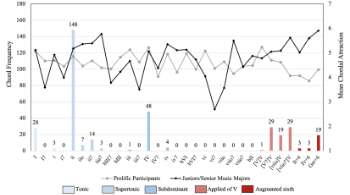
Example 6. Raw counts of chords in V-1 at a cadence (y-axis, left) for the 31 rated chords (x-axis) in Brown, Tan, and Baker (2021), with perceptual ratings (1–7 scale) superimposed (y-axis, right).
(click to enlarge)
[3.6] Let us bring the foregoing observations into dialogue with the perceptual findings from Brown, Tan, and Baker (2021). There, participants heard 31 trials, each consisting of a four-event Shepard-tone sequence: a tonic note, some variable chord, the dominant triad, and then the tonic note, where the variable chord was a harmony other than V(7). Participants rated the level of attraction of the V-1 chord to the dominant chord on a scale from 1 to 7, with 7 being most attracted. The chords heard as V-1 ranged from tonic to an augmented sixth chord; these 31 chords are on the x-axis of Example 6. This example also includes mean ratings for each of the chords by two groups of participants: junior/senior music majors from the Peabody Conservatory of the Johns Hopkins University (shown with the black diamonds in the example) and a group of participants with little musical training (from the online recruitment platform Prolific.co, shown with grey circles). Chord attraction ratings from the nonmusician participants are generally flatter, whereas ratings from the music students are more varied. The experiment found that musicians’ ratings tend to correspond to textbook descriptions of pre-dominant chords: lower ratings were given to tonic and mediant, whereas higher ratings correspond to chords such as ii and augmented sixths. Further exploration from the musicians’ responses revealed that semitonal voice leading between a chord and the subsequent dominant, and presence of and , led to higher attraction ratings.
[3.7] To explore the relationship between frequencies of chords before V in our dataset and attraction ratings of chords before V from the experiment, we performed Spearman rank correlations (hereafter referred to as “correlations”).(16) For the junior/senior musician participants, the correlation between attraction ratings and the number of times that the chord leads to a cadential V is .655 (p < .001); these data can be observed in Example 6. This suggests that even when listening to an abstract chord sequence, music students seem to be using internalized knowledge of classical music (perhaps even a “Mozartian template”), including the likelihood of a given chord leading to a cadential dominant, to inform their perceptions of chordal attraction to V. It seems that the musician participants have learned, implicitly or otherwise, syntactical regularities from this repertoire that is highly represented in textbooks (e.g., Saffran et al. 1999; White 2021). In contrast, the correlation between chord attraction ratings by nonmusicians and the frequency with which each of these chords moves to a cadential V is low and nonsignificant (ρ = .221, p = .255). Nonmusicians’ judgments of the attraction of chords as they move to V are not informed by chord frequencies in the Mozart dataset, and they may have been responding with another musical style in mind altogether (Vuvan and Hughes 2019).(17)
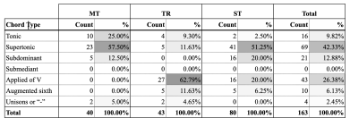
Example 7. Chord types in V-1 at the cadences ending main themes (MT1 and MT2), transitions (TR), and subordinate themes (ST1, ST2, and ST3) in both expositions and recapitulations.
(click to enlarge)
[3.8] Finally, since [3.1] found that the V-1 chord differs depending on whether V belongs to a cadential progression, we speculated that such approaches might also vary by the location of these cadences within larger forms. The dataset allows us to study the approach to V in various locations within sonata form. Example 7 illustrates broad categories of chords in the V-1 position at the cadential close of main themes (MT1 and MT2), transitions (TR), and subordinate themes (ST1, ST2, ST3), combining both expositions and recapitulations. Importantly, there is a complete lack of chromatic chords in V-1 (applied of V and augmented sixths) at the end of main themes.(18) Instead, the most frequent V-1 at the end of MTs and STs is the diatonic supertonic chord, which is consistent with our finding that the supertonic is the most frequent type of V-1 before cadential dominants overall (see [3.1]). In contrast, we see that at the final cadence of the transition, chromatic chords (primarily applied of V chords) are used most frequently in V-1.(19) Despite their overall infrequency in the corpus, these chromatic chords serve as strong aural markers of the medial caesura.(20) This usage also might, in turn, contribute to musicians’ perceptions of chordal attraction to V that was observed in Brown, Tan, and Baker (2021).
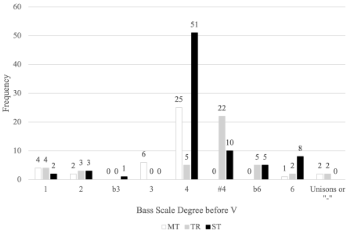
Example 8. Bass scale degrees that occur in V-1 at all cadences ending main themes (MT1 and MT2), transitions (TR), and subordinate themes (ST1, ST2, and ST3) in both expositions and recapitulations.
(click to enlarge)
[3.9] Turning to an analysis of bass notes in V-1 at cadences ending MT, TR, and ST, is overwhelmingly the bass scale degree prior to at the end of main and subordinate themes, occurring in 76 of 120 cadences (see Example 8). Thus, the supertonic that commonly appears in V-1 at the end of MT and ST is often in first inversion. In contrast,
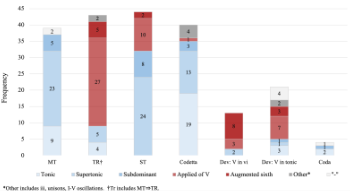
Example 9. Chord types in V-1 at section-ending cadences in sonata form. For the main theme (MT), transition (TR), and subordinate theme (ST), the final V-1 chord was counted in the last section-ending cadence for these themes in the exposition and recapitulations. For codettas and coda, V-1 before the final V is counted. For the development, the V-1 chord before the final cadence in the submediant key (when present) and tonic key were counted.
(click to enlarge)
[3.10] Example 9 provides an analysis of harmonic approaches to the final dominant at primary formal markers within sonata form, now illustrating V-1 at section-ending cadences of MT, TR, ST, and also codettas, developments, and codas.(21) It echoes similar findings in Example 7: the MT never ends with any chromatic chords in V-1; the supertonic is most frequent in V-1 at the end of the MT and ST; and applied of V chords are most frequent in V-1 at the end of the TR. It additionally shows several other connections between specific harmonies and formal zones. At the end of codettas and codas, for instance, the tonic chord is most frequent in V-1. Turning to the development section, the cadence on V at the end of the development in the tonic key is most often preceded by an applied chord of V.(22) However, in developmental passages moving to the submediant key, the most normative chord prior to the submediant’s dominant is the augmented sixth chord, despite its rarity in the dataset overall (constituting only 2.92% of all V-1 chords in the dataset). The concentration of augmented sixth chords at this moment suggests a possible connection between these chords and their role in development sections, although larger datasets are needed to explore this further; it may also be that this finding is limited specifically to Mozart’s piano sonatas. Still, the rightmost column of Example 5 reminds us that the augmented sixth points to a cadence at a higher percentage than any other chord type, suggesting a source for the theoretical interest often given to these chords (Harrison 1995). Section 5 of this article further investigates these infrequent (“rare”) pre-dominants.
4. Examining two-chord successions before V
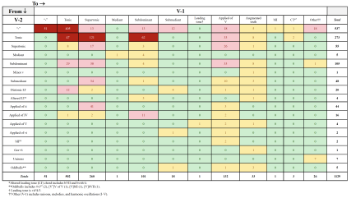
Example 10. (A) Heatmap illustrating the frequency of transitions from the chord occurring two chords before V (“V-2” on the y-axis) to one chord before V (“V-1” on the x-axis) in the dataset. (B) Heatmap illustrating the frequency of transitions at cadences from V-2 (y-axis) to V-1 (x-axis) in the dataset.
(click to enlarge and see the rest in a new tab)
[4.1] Let us now widen our focus to explore transitional frequencies of the two chords occurring before V, that is, from V-2 (column J) to V-1 (column M). This helps us to learn about the syntax of multi-chord approaches to V and to investigate an empirical basis for claims made by theorists about the intensification that occurs within the pre-dominant area. In this section, we continue to explore the notion of strong and weak pre-dominants, now based on chord ordering. Example 10a displays a heatmap showing the raw frequency of all chord transitions from V-2 to V-1 in the entire dataset, illustrating how often two chords occur together before all 1129 dominants.(23) Recall that tonic is the most frequent chord in the V-1 position; consistent with this finding, Example 10a illustrates that the most common approach to any V in the dataset involves tonic. Among the most frequent are “-” to the tonic chord (n = 405), tonic to supertonic (n = 121), tonic to subdominant (n = 62), and tonic to tonic (n = 47); as a reminder, “-” in the dataset means that the chord in that position belonged to a previous row or phrase.(24) The heatmap in Example 10b now focuses on the frequency of V-2 to V-1 transitions at cadential progressions alone. The most frequent successions prior to the 374 cadential dominants are tonic→supertonic (n = 93), tonic→subdominant (n = 45), and subdominant→applied of V (n = 25).(25) As discussed in section 3, the most common V-1 chord at a cadence is the supertonic. Example 10b builds upon this to illustrate that the chords most frequently preceding the supertonic are tonic, submediant, and then subdominant, in that order.
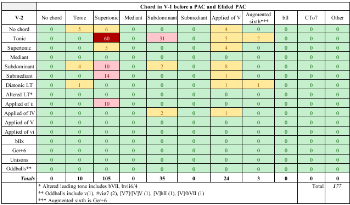
Example 11. Heatmap organized by cadence type, illustrating progressions between all V-2 (y-axis) to V-1 (x-axis) chords.
(click to enlarge and see the rest in a new tab)
[4.2] Building on findings of V-1 chords before various cadences described in section [3.9], Example 11 shows that the V-2 to V-1 approaches to the dominant also differ by cadence type. In particular, the most common two-chord approach to V before a PAC (and elided PAC) is tonic→supertonic (n = 60), with tonic→subdominant as the second-most common (n = 31). In contrast, HCs and non-cadential arrivals on the dominant (D arrivals) are most frequently approached by supertonic→applied of V (n = 19) or subdominant→applied of V (n = 16). Thus, textbook descriptions of pre-dominant expansions (Laitz 2008, 540, 545; Clendinning and Marvin 2021, 403) reflect Mozart’s default strategy when approaching HCs and D arrivals but not when approaching a PAC—a detail that is not explicitly addressed in these texts.
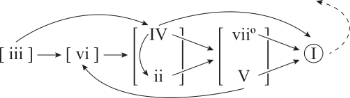
Example 12. A reproduction of frequent chord progressions in the major mode as illustrated in the Kostka and Payne textbook (2009, 111).
(click to enlarge)
[4.3] We can also use findings from the dataset to test specific claims about pre-dominant expansions found in theory textbooks. One oft-repeated claim involves the chords IV and ii, for which the diagram in Kostka and Payne (2009, 111), with a solid arrow directed from IV to ii, is emblematic; see Example 12. In [1.2] we noted Burstein and Straus’s similar observation, which is echoed both by Laitz, “the goal-oriented melodic motion in the succession IV–ii(6) is very common” but “the weaker motion of ii–IV is not” (2008, 291), and Clendinning and Marvin, “when two strong predominant harmonies appear in succession before moving to V, they do so in a descending-third root progression: IV to ii (and not the other way around)” (2021, 276). While the specific rationale for why ii follows IV differs in these texts, our data support the assertion that IV–ii(6) is much more common than the reverse. As shown in Examples 10a and 10b, subdominant chords lead to supertonic chords 30 times, while supertonic chords lead to subdominant chords a mere 3 times (and never at a cadence). Example 11 also illustrates that the location of the subdominant→supertonic progression is mediated by cadence type. That is, the progression is more frequent at authentic progressions (12/200 = 6.00%) than at half cadences and D arrivals (4/130 = 3.08%) and is even less common at non-cadential dominants (9/751 = 1.20%).
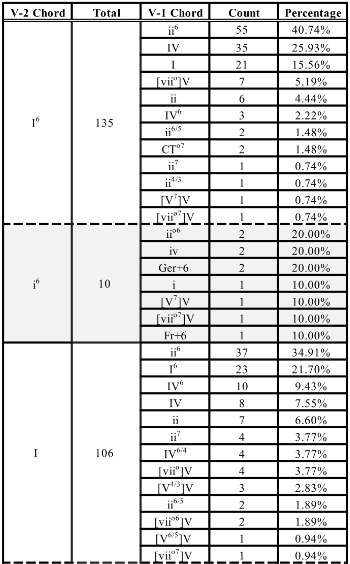
[4.4] Descriptions of pre-dominant “expansions” (Clendinning and Marvin 2021, 307) or “complexes” (Laitz 2008, 290–291) of multiple non-tonic chords leading to V often imbue the V-1 position with qualities of strength and attraction. Clendinning and Marvin, for instance, suggest that “the most common role for V7/V or V/V in the basic phrase is to replace or follow a predominant-function harmony […] You could think of V7/V as a supercharged ii7” (2021, 403, emphasis added). They also write that the Neapolitan sixth and augmented sixth chords “characteristically share the same position in the basic phrase: as chromatic predominant chords that intensify motion to V” (2021, 577). Our findings provide empirical support for this impression: diatonic chords often described as being pre-dominant in function (e.g., IV, ii) move to a chromatic chord (i.e., applied of V, augmented sixth) 96 times in the dataset, and never in the reverse order.(26) This suggests a diatonic-to-chromatic pre-dominant chord schema that could be more explicit in textbook guidelines of pre-dominant expansions and is not captured within the well-known chord-succession diagram in Example 12 from Kostka and Payne (2009, 111).
Example 13. The seven most frequent V-2 chords (first leftmost column) and their minor-mode counterparts if present in the dataset (in grey), followed by subsequent V-1 frequencies (third column). All chords in V-2 are presented in descending order of frequency, based on major-mode appearances. All chords in V-1 are presented in descending order of frequency.
(click to enlarge and see the rest in a new tab)
[4.5] Clendinning and Marvin’s observation about applied dominants as supercharged pre-dominants that follow diatonic pre-dominants is related to Caplin’s claim that within cadential progressions, “the most frequently employed embellishment of pre-dominant function appears over
[4.6] The dataset can also be used to support additional claims in schema theory. For example, Vasili Byros (2012) discusses the le-sol-fi-sol schema in detail, describing it as having “attraction to the dominant” (292), exhibiting “cadential function” (295), and occurring in “highly charged, dominant-orientated situations” (297). Byros shows that the progression leads to an HC 62% of the time in his corpus (as opposed to a PAC 18% of the time), and we found similar evidence that the schema typically leads to an HC (70% of the time in our dataset). Like Byros (297), we also observed these appearances at form-defining events within sonata form, primarily at the medial caesura and within retransition passages. Such appearances of the schema at these particular moments support Byros’ argument that the schema has a strong key-defining profile (314), as it is designed to prepare one’s ear for the new tonic in the section that follows.
[4.7] Finally, we can test the claim that vi in the V-2 position often leads to IV, ii6, or
5. Case studies of “rare” pre-dominants
[5.1] Earlier, we proposed that strong pre-dominants are those that most likely lead to a cadential dominant (Example 5), and that musicians have internalized these frequencies (Example 6). As mentioned above ([3.10]), the strongest type of pre-dominant, the augmented sixth, occurs infrequently in the dataset, making up only 2.92% of all chords in the V-1 position (Example 3) and only 6.68% of chords before cadences. And yet, these chromatic sonorities are the recipient of much theoretical attention (Harrison 1995) and pedagogical emphasis, including dedicated chapters in many music theory textbooks (Laitz 2008; Kostka and Payne 2009; Burstein and Straus 2016; Clendinning and Marvin 2021). Indeed, White (2021) finds that augmented sixth chords are disproportionately overrepresented in pedagogical texts in comparison to their frequency in the repertoire (as queried in the Yale-Classical Archives Corpus). With White’s and our findings in mind, this section explores the significance of these chords and proposes a “rare pre-dominant hypothesis.” Inspired by Richmond Browne’s “rare-interval hypothesis” (1981), which suggests that rare intervals such as the semitone and tritone have significant perceptual weight for listeners of tonal music, we speculate that relatively less-frequent pre-dominants like augmented sixths are particularly salient for classically trained musicians because they reliably occur at form-defining moments. Our “rare pre-dominant hypothesis” argues that these chords are perceived as strong not only because of the likelihood with which they will lead to a cadence (Example 5), but also because of their orienting role in sonata form. This, in turn, could be the source of the overrepresentation of such chords in theoretical and pedagogical discourse. In this section, we explore the possible association of the rare pre-dominants
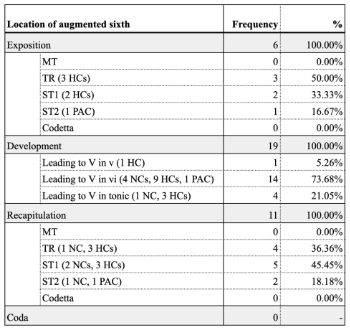
Example 14. Location and frequency of all 36 augmented sixth chords in the dataset (in V-3, V-2, and V-1 positions).
(click to enlarge)
[5.2] As shown in Example 14, there are just 36 instances of augmented sixth chords (It+6, Fr+6, and Ger+6) in the entire dataset (with the vast majority, 33 out of 36, occurring in the V-1 position). Augmented sixths occur 6 times in the exposition (always in TR or ST, never in MT or Codetta), 19 times in the development, and 11 times in the recapitulation (also always in TR or ST, never in MT or Codetta). We found that while the augmented sixth is infrequent as a V-1 harmony, it is often tied to a specific formal role, occurring mostly at D arrivals or HCs that signal the arrival of new keys (i.e., closing the TR or development). Moreover, the augmented sixth is often found prior to the arrival of V in vi within development sections. That is, of the 20 major-mode movements in our dataset, 13 have a goal of V in the key of vi within the development (before the D arrival in the tonic key that leads to the recapitulation), and an augmented sixth chord is found approaching V of vi in all but three of them.(27) While David Beach (1994) has noted similarities of the developments in K. 280/i and K. 332/i, including that both feature arrivals in V of vi that are preceded by an augmented sixth, our systematic study suggests that this association between the augmented sixth chord and the arrival of V in vi within the development extends far beyond these two F major sonatas, illustrating a more predictable role for this chord than has previously been discussed in theoretical literature.(28) Returning to the quotes in [1.3], our findings clarify why augmented sixth chords are thought to be reserved for “climactic cadences” (Burstein and Straus 2016, 288) and “particularly significant dominant harmonies” (Clendinning and Marvin 2021, 588), specifying the locations of those special moments. Further, that there are more augmented sixth chords in recapitulations than expositions (Example 14) may contribute to a long-range perceptual schema whereby the augmented sixth is a signal of the impending end of the movement.
[5.3] Turning to the connection between augmented sixth chords and cadences, we also observe that these chords frequently point to an HC, as 24 of its 36 instances are prior to an HC (the other appearances of augmented sixths in the dataset occur 9 times at an NC, and just 3 times at a PAC). Looking specifically at the V-1 position, a binomial test suggests that while the augmented sixth only makes up 2.92% of chords before all Vs in the dataset (N = 33, K = 1129), it is concentrated before dominants within half cadences (N = 22, K = 111, proportion = 19.82%, p < .001), making it a reliable predictor of an HC. Interestingly, while textbooks claim that the Ger+6 should resolve to the cadential 6/4, only 4 of these 25 chords do so.(29) The other 21 move directly to V(7). Perhaps this direct motion to V(7) serves to make the dominant arrival more declamatory. In sum, these data can bring new understandings to the augmented sixth (and the German augmented sixth in particular): the most common augmented sixth chord in the dataset is the Ger+6, which most often leads directly to V at an HC (and not a cadential 6/4), and its most frequent formal location is at the end of the development section marking the cadence in the key of vi. These findings also provide one possible empirical source for why the music students in Brown, Tan, and Baker (2021) rated the Ger+6 in particular as the harmony most attracted to V.
[5.4] The Neapolitan chord is even rarer than the augmented sixth chord, occurring just 3 times in the dataset. Each occurrence, however, involves an important V arrival: once in V-1 in the development of K. 570/i (before the arrival of V of vi in m. 95), and twice in the V-2 position, where it is followed by an applied dominant of V (one instance is in K. 284/i, before the development’s V pedal starting in m. 70, and the other is in K. 457/i, approaching V in m. 126 of the recapitulation’s last cadence in TR). These latter two occurrences support the abstract examples of the Neapolitan moving to an applied dominant of V in Clendinning and Marvin (2021, 579) and Kostka and Payne (2009, 382). While few in number, these occurrences from the dataset suggest a possible formal and rhetorical role for the Neapolitan chord that might be more prominent in other repertoires.
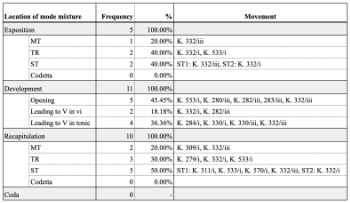
Example 15. Location and frequency of mode mixture in the dataset.
(click to enlarge)
[5.5] Finally, mode-mixture chords are also infrequent in the dataset but seem to be reserved for rhetorical emphasis connected with the pre-dominant function. For example, in a chapter on mode mixture, Laitz writes, “Once you introduce modal mixture, continue its use until you reach the dominant function. This is because
6. The Pre-Dominant Power Up
[6.1] Theorists of sonata form have discussed a tendency for recapitulations to become more chromatic relative to expositions (Rosen 1988; Hepokoski and Darcy 2006), and the previous section noted a modest increase of augmented sixth (Example 14) and mode mixture chords (Example 15) in recapitulations. Looking more broadly at the dataset, we note that while 13.54% of V-1 chords in the exposition are chromatic, this increases to 18.68% in the recapitulation. A small portion of this growth is due to an increase of mode mixture (e.g., minor tonic is borrowed in 6 instances in the exposition and 10 in the recapitulation), where some of these new, recapitulatory minor tonics within major-mode compositions occur in passages Hepokoski and Darcy describe as “lights out” (2006, 235), such as the surprising shift from major to its parallel minor in a recapitulation’s MT (e.g., K. 309/i, m. 101). However, we also found that most of this new chromaticism in recapitulations is due to the rise of applied dominants and applied leading-tone chords: there are 50 of these chords in V-1 in the exposition and 67 in the recapitulation. Thus, our observation of the rise of this chromaticism is distinctly different from the tendency for recapitulations to move to IV and related “flat” keys (Rosen 1988, 289; Hepokoski and Darcy 2006, 265).
[6.2] Recall from section [1.5] and Example 1 our introduction to the “pre-dominant (PD) power up,” whereby a weaker chord before V from the exposition of K. 545/i is replaced with a stronger one (as defined by the hierarchy in Example 5) at the analogous moment in the recapitulation. While Caplin (2013, 482) also observes this intensification in the movement, no study has yet tracked long-range pre-dominant power ups from one section to its analogous section in a corpus of music. In response, we discovered that in 14 of the 22 movements in our dataset, pre-dominant chords from the exposition were intensified in some way in the recapitulation. We also noted other means of destabilization of an expositional harmony (e.g., through a change of inversion in the recapitulation).(31) Thus, we can define a pre-dominant power up more broadly as an intensification of a chord (or series of chords) before V in the recapitulation in relation to the analogous moment in the exposition; PD power ups include replacement of a diatonic harmony with a chromatic one (ii6 in the exposition becoming [
[6.3] Example 16 illustrates an example of a PD power up that occurs prior to the final V at the end of the TR in the exposition and recapitulation from K. 533/i; here,
Example 16. A pre-dominant power up in Mozart, Piano Sonata, K. 533/i (end of TR).
(click to enlarge) | Example 17. A pre-dominant power up with added measures in the recapitulation in Mozart, Piano Sonata, K. 332/iii (end of TR).
(click to enlarge) |
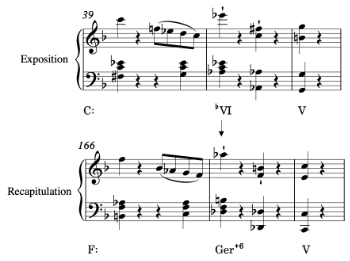
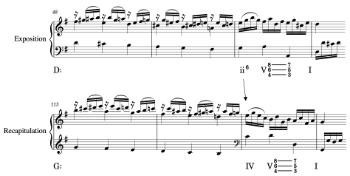
Example 18. A pre-dominant power down in Mozart, Piano Sonata, K. 283/i (last PAC of exposition/recapitulation).
(click to enlarge)
[6.4] In contrast, we found only three instances of recapitulatory de-intensifications or “pre-dominant power downs” in the Mozart dataset. In K. 333/i, the V in m. 151 (recapitulation) is preceded by
[6.5] The table found in the Appendix summarizes all 29 power ups and power downs in approaches to V that were found in the dataset when comparing analogous passages in expositions and recapitulations. On average, the changes in recapitulations modify just one chord (M = 1.34 chords) from the exposition, and 20 of the 29 modifications affect at least the V-1 chord (rather than just V-2 or V-3). Twenty-one of the 29 modifications involve no added/deleted measures between exposition to recapitulation, allowing for a direct comparison of the harmonies. We suggest that PD power ups may be internalized by listeners familiar with Mozart’s sonatas, contributing to a long-range chordal-attraction schema. We note that our study of power ups does not include novel or completely recomposed passages inserted into recapitulations, of which we found 25; our study of power ups refers solely to changes in harmonies for similar passages in the exposition and recapitulation (what Hepokoski and Darcy call “correspondence measures,” 2006, 239).(33)
[6.6] Of the 26 excerpts with PD power ups listed in the Appendix, 22 occur at a cadence, suggesting that these are deliberate modifications at form-defining moments in the recapitulation. None of the power ups occur in the MT, 10 occur in the TR, 14 in ST, and two in the Codetta. Further, 9 of the 10 PD power ups in the TR happen immediately before the final V: these modifications to the pre-dominant function set the stage for this important structural moment. Similarly, of the 14 PD power ups occurring in the ST, 10 are at the PAC coinciding with the final cadence ending ST, providing emphasis to the moment of the movement’s essential structural closure (described as “the most significant event” within any sonata; Hepokoski and Darcy 2006, 232). These PD power ups occur almost exclusively at cadences and usually at the end of TR and ST, in passages that carry form-defining roles. Such regularity may serve to amplify power ups for listeners, as recognizable and even predictable markers of formal location. This elucidates yet another close connection between the pre-dominant harmonic function and form in the Mozart piano sonata movements.
[6.7] The Appendix also illustrates that 9 of the 10 PD power ups in the TR involve the substitution of a diatonic chord for a chromatic chord. For example, in K. 310/i, vi–ii6 (m. 16) becomes [V6]iv–iv (m. 97), and in K. 570/i, V7–vi (m. 35) becomes [vii°7]vi–vi (m. 165). Likewise, half of the 12 PD power ups in ST involve the addition of a chromatic chord, such as Ger+6 replacing ii6 (K. 311/i), [
[6.8] While the table in the Appendix offers a relatively small sample of PD power ups from a circumscribed dataset, it nevertheless suggests a novel way of understanding harmonic syntax within the pre-dominant function, and in turn, introduces long-range attraction schemas for pre-dominant chords to V that may be acquired implicitly by those familiar with this repertoire. A larger exploration of the PD power up may reveal similar intensifications of chords before V in other formal types containing a reprise, such as da capo arias and ternary movements, and in works by composers other than Mozart. As just one example, a PD power up can be observed in Friedrich Seitz’s Violin Concerto No. 5, third movement, where the
[6.9] Thinking of the PD power up as a schema places it in dialogue with other schemata involving approaches to V. For example, Byros (2012, 333, fn33) writes, “That composers understood the le-sol-fi stage of the schema as functionally synonymous with an augmented sixth is evident in their interchangeable use of the le-sol-fi-sol and augmented 6–V schemata. In sonata-form movements and other rounded-binary structures, composers would substitute one schema for the other in articulating a half cadence” (bolded emphasis added). Byros then illustrates an example from Beethoven’s Fourth Piano Concerto, first movement, where the le-sol-fi-sol schema is used in the exposition (with [vii°7]V as V-1 in m. 110 just before the medial caesura), and this schema is replaced by a Ger+6 in m. 280 at the corresponding section in the recapitulation. We note that this is an example of a PD power up. Thus, this replacement is not merely an interchangeable use of the two approaches to V, as Byros suggests, but a rhetorical strategy for tonal closure in the recapitulation.
[6.10] The PD power up may be another factor influencing chord attraction ratings by the trained musicians in Brown, Tan, and Baker (2021). By noticing these small changes of PD intensification from expositions to recapitulations, listeners familiar with the classical style may acquire knowledge of PD strength and develop expectations for power ups to occur in the recapitulation. The PD power up would seem to be implicitly learned as listeners compare approaches to V between expositions and recapitulations.(34) The correlation between frequency and chord attraction ratings by musician participants in this experiment is additionally suggestive of what Byros (2012) and Gjerdingen (1991) describe as cross-historical learning of schemata. Byros writes, “In so far as eighteenth-century affordances are still available through the conservation of the repertoire, it is conceivable that modern listeners may acquire knowledge structures that are analogous to those of their ancestors from two centuries ago” (Byros 2012, 235). As one example of this, the PD power up identified within the concerto by Seitz, mentioned above, was written in the year 1900, implying that this schema was known at some level to composers beyond the Classical era.
Section 7: Conclusion
[7.1] The pre-dominant function is a widely used concept in North American music theory: a harmonic category touted as important for the affective quality of a phrase—e.g., phrases “include a predominant harmony to heighten the sense of trajectory toward closure” (Peterson 2021)—and one that is referenced beyond the confines of classical style (Snodgrass 2015; Nobile 2016). Yet the pre-dominant function remains underdefined in relation to frequency, repertoire, musical form, and even chord membership. This study is the first systematic exploration of chords preceding V, offering an understanding of chord frequency in relation to formal context and empirical sources for the notion of pre-dominant strength. Our results suggest that in Mozart’s sonata-allegro movements for piano, chords designated as pre-dominants in theory textbooks carry predictive information as signals of cadential closure at various formal locations. Chords differ before V depending on whether they are at a cadence, and different cadence types have their own pre-dominant profiles. For example, the cadence ending a main theme is always preceded by a diatonic pre-dominant chord (and never a chromatic one). We contend that such contextual information could be incorporated into music theory pedagogy more explicitly.
[7.2] This study is also the first to explore existing claims made about the pre-dominant function from an empirical basis, and we assert new theories surrounding it, each related to pre-dominant strength:
- We argue that pre-dominant strength is not based simply on frequency, but is more specifically a function of how often a chord is predictive of a cadence. Indeed, in [3.3] we put forth a way to measure and hierarchize pre-dominant chordal strength and offered evidence that trained musicians have internalized this hierarchy.
- Moreover, we assert that these stronger pre-dominants are often reserved for particular events, marking them for consciousness. Proposing a “rare pre-dominant hypothesis,” we suggest that the theoretical significance of certain chromatic chords before V has more to do with their status as signifiers of form-defining cadences (such as the medial caesura) rather than their overall frequency. That is, we found that although augmented sixth chords are rare in the dataset overall, they are heard most frequently prior to the dominant that occurs in the false retransition (Spitzer 1996)—V of vi within the development—suggesting a more predictable role for this chord than has been discussed in theoretical literature.
- We elucidate a phenomenon that we call the “pre-dominant power up” where approaches to V are modified between analogous sections of the exposition and recapitulation and illustrate that these changes often involve incorporating a stronger pre-dominant to amplify tonal closure in the movement.
The new insights into the pre-dominant function in this article may be of interest to researchers studying sonata theory, music theory pedagogy, and music cognition.
[7.3] Finally, we emphasize that this study should serve as a proof of concept. It is unsurprising that many findings were consistent with textbook claims, as we selected the Mozart sonata-allegro movements because of their ubiquity in North American undergraduate curricula; indeed, they may very well be the unstated benchmark for the generalized harmonic guidelines in music theory textbooks. Our dataset, while sizeable in some ways, is also limited in scope, and while findings are suggestive for how pre-dominants have traditionally been taught, we caution against broader generalizations about the pre-dominant function, as it may be genre- or composer-specific (Tymoczko 2011; White 2014; Nobile 2016). Yet, we believe that some of the offerings herein not only provide a basis for harmonic guidelines in theory texts but also suggest a methodology for determining pre-dominant strength, examining chord ordering within the function, and studying concepts such as the rare pre-dominant and pre-dominant power up; this methodology can be used to gain a better understanding of the function in other datasets. As music theory instructors look to introduce a greater variety of music into the classroom, guidelines offered about harmonic function must surely not remain static. Thus, our dataset and the trends it contains will be most meaningful in conversation with similarly structured datasets for other repertoires and genres. This, in turn, will help shape a more nuanced, context-sensitive understanding of chordal syntax.
Funding
This research was supported in part by a University of Toronto Excellence Award for VB, supervised by DT, and a Johns Hopkins University Catalyst Award for JB to support YLL’s contribution.
Acknowledgements
We wish to thank MTO’s editorial team, the anonymous reviewers, and Chris White, who also served as a peer reviewer, for their keen suggestions for revision.
Author Contribution Statement
This article is the culmination of an eight-year collaboration between JB and DT on this topic. JB and DT jointly conceived of this study and worked together with VB on early hypothesis testing and visualizations; JB and DT contributed equally to writing earlier drafts. JB took the lead on the final manuscript, which was edited by DT. YLL and JB contributed to data analysis. All four authors created examples and provided comments on the final manuscript.
Jenine L. Brown
The Peabody Conservatory of the Johns Hopkins University
1 East Mount Vernon Place
Baltimore, MD 21202
Jenine@jhu.edu
Daphne Tan
University of Toronto
80 Queen's Park
Toronto, ON M5S 2C5
daphne.tan@utoronto.ca
Victoria Boerner
University of Toronto
80 Queen's Park
Toronto, ON M5S 2C5
v.boerner@utoronto.ca
Yeonju Lindsey Lee
The Peabody Conservatory of the Johns Hopkins University
1 East Mount Vernon Place
Baltimore, MD 21202
ylee237@alumni.jh.edu
Appendix
Table of the 29 pre-dominant power ups and power downs in the dataset. Modifications from exposition to recapitulation are highlighted in blue.
Works Cited
Aldwell, Edward, and Carl Schachter. 2003. Harmony and Voice Leading. 3rd ed. Wadsworth Publishing.
Beach, David. 1983. “A Recurring Pattern in Mozart’s ‘Music.’” Journal of Music Theory 27 (1): 1–29. https://www.jstor.org/stable/843558.
—————. 1994. “The Initial Movements of Mozart’s Piano Sonatas K. 280 and K. 332: Some Striking Similarities.” Intégral 8: 125–46. http://www.jstor.org/stable/40213957.
Brown, Jenine L., Daphne Tan, and David J. Baker. 2021. “The Perceptual Attraction of Pre-dominant Chords.” Music Perception 39 (1): 21–40. https://doi.org/10.1525/MP.2021.39.1.21.
Brown, Jenine L., Daphne Tan, and Michelle Lin. 2023. “An Analytical Dataset of Approaches to V in Mozart.” Empirical Musicology Review 16 (2): 341–50. https://doi.org/10.18061/emr.v16i2.8511.
Browne, Richmond. 1981. “Tonal Implications of the Diatonic Set.” In Theory Only 5 (6-7): 3–21.
Burgoyne, John A. 2011. “Stochastic Processes & Database-driven Musicology.” PhD diss., McGill University. https://escholarship.mcgill.ca/concern/theses/d217qt98k.
Burnham, Scott. 2012. Mozart’s Grace. Princeton University Press. https://doi.org/10.1515/9781400845118.
Burstein, L. Poundie, and Joseph N. Straus. 2016. Concise Introduction to Tonal Harmony. W. W. Norton.
Byros, Vasili. 2012. “Meyer’s Anvil: Revisiting the Schema Concept.” Music Analysis 31 (3): 273–346. https://doi.org/10.1111/j.1468-2249.2012.00344.x.
Caplin, William E. 1998. Classical Form: A Theory of Formal Functions for the Instrumental Music of Haydn, Mozart, and Beethoven. Oxford University Press. https://doi.org/10.1093/oso/9780195104806.001.0001.
—————. 2005. “On the Relation of Musical Topoi to Formal Function.” Eighteenth-Century Music 2 (1): 113–24. https://doi.org/10.1017/S1478570605000278.
—————. 2013. Analyzing Classical Form: An Approach for the Classroom. Oxford University Press.
—————. 2024. Cadence: A Study of Closure in Tonal Music. Oxford University Press. https://doi.org/10.1093/oso/9780190056445.001.0001.
Chiu, Matt, and Derek J. Myler. 2021. “The Common-Practice Cadence Corpus.” https://mattchiu.com/Datasets/Common-Practice-Cadence-Corpus.
Clendinning, Jane P., and Elizabeth W. Marvin. 2016. The Musician’s Guide to Theory and Analysis. 3rd ed. W. W. Norton.
—————. 2021. The Musician’s Guide to Theory and Analysis. 4th ed. W. W. Norton.
Cuthbert, Michael S., and Christopher Ariza. 2010. “Music21: A Toolkit for Computer-aided Musicology and Symbolic Music Data.” In Proceedings of the 11th Conference of the International Society for Music Information Retrieval (ISMIR), ed. J. Stephen Downie and Remco C. Veltkamp, 637–42. ISMIR. https://doi.org/10.5281/zenodo.1416114.
de Clercq, Trevor. 2015. “A Model for Scale-degree Reinterpretation: Melodic Structure, Modulation, and Cadence Choice in the Chorale Harmonizations of J. S. Bach.” Empirical Musicology Review 10 (3): 188–206. https://doi.org/10.18061/emr.v10i3.4334.
de Clercq, Trevor, and David Temperley. 2011. “A Corpus Analysis of Rock Harmony.” Popular Music 30 (1): 47–70. https://doi.org/10.1017/S026114301000067X.
Devaney, Johanna, Claire Arthur, Nathaniel Condit-Schultz, and Kirsten Nisula. 2015. “Theme and Variation Encodings with Roman Numerals (TAVERN): A New Data Set for Symbolic Music Analysis.” In Proceedings of the 16th Conference of the International Society for Music Information Retrieval (ISMIR), ed. Meinard Müller and Frans Wiering, 728–34. ISMIR. https://doi.org/10.5281/zenodo.1417497.
Duane, Ben. 2019a. “Melodic Patterns and Tonal Cadences: Bayesian Learning of Cadential Categories from Contrapuntal Information.” Journal of New Music Research 48 (3): 197–216. https://doi.org/10.1080/09298215.2019.1607396.
—————. 2019b. “The Development-Ending Dominant and the Late Cadence in vi: Changing Norms in the Sonatas of Haydn, Mozart and Beethoven.” Music Analysis 38 (3): 387–420. https://doi.org/10.1111/musa.12117.
Duane, Ben, and Joseph Jakubowski. 2018. “Harmonic Clusters and Tonal Cadences: Bayesian Learning Without Chords Identification.” Journal of New Music Research 47 (2): 143–65. https://doi.org/10.1080/09298215.2017.1410181.
Ewell, Philip. 2020. “Music Theory and the White Racial Frame.” Music Theory Online 26 (2). https://doi.org/10.30535/mto.26.2.4.
Forte, Allen. 1962. Tonal Harmony in Concept and Practice. 1st ed. Yale University Press.
—————. 1979. Tonal Harmony in Concept and Practice. 3rd ed. Holt, Rinehart and Winston.
Gjerdingen, Robert O. 1991. “Defining a Prototypical Utterance.” Psychomusicology 10 (2): 127–39. https://doi.org/10.1037/h0094137.
—————. 2007. Music in the Galant Style: Being an Essay on Various Schemata Characteristic of Eighteenth-Century Music. Oxford University Press. https://doi.org/10.1093/oso/9780195313710.001.0001.
Greenberg, Yoel. 2022. How Sonata Forms: A Bottom-Up Approach to Musical Form. Oxford University Press. https://doi.org/10.1093/oso/9780197526286.001.0001.
Guck, Marion A. 1978. “The Functional Relations of Chords: A Theory of Musical Intuitions.” In Theory Only 4 (6): 29–42.
Harrison, Daniel. 1994. Harmonic Function in Chromatic Music: A Renewed Dualist Theory and an Account of its Precedents. University of Chicago Press.
—————. 1995. “Supplement to the Theory of Augmented-Sixth Chords.” Music Theory Spectrum 17 (2): 170–95. https://doi.org/10.2307/745870.
Hentschel, Johannes, Markus Neuwirth, and Martin Rohrmeier. 2021. “The Annotated Mozart Sonatas: Score, Harmony, and Cadence.” Transactions of the International Society for Music Information Retrieval 4 (1): 67–80. https://doi.org/10.5334/tismir.63.
Hepokoski, James, and Warren Darcy. 2006. Elements of Sonata Theory. Oxford University Press. https://doi.org/10.1093/acprof:oso/9780195146400.001.0001.
Ivanovitch, Roman. 2011. “Mozart’s Art of Retransition.” Music Analysis 30 (1): 1–36. https://doi.org/10.1111/j.1468-2249.2011.00305.x.
Kamien, Roger, and Naphtali Wagner. 1997. “Bridge Themes within a Chromaticized Voice Exchange in Mozart Expositions.” Music Theory Spectrum 19 (1): 1–12. https://doi.org/10.2307/745996.
Kostka, Stefan M., and Dorothy Payne. 2009. Tonal Harmony, with an Introduction to Twentieth-century Music. 6th ed. McGraw-Hill.
Kostka, Stefan M., Dorothy Payne, and Byron Almén. 2018. Tonal Harmony, with an Introduction to Twentieth-Century Music. 8th ed. McGraw-Hill.
Lahdelma, Imre, and Tuomas Eerola. 2016a. “Single Chords Convey Distinct Emotional Qualities to Both Naïve and Expert Listeners.” Psychology of Music 44 (1): 37–54. https://doi.org/10.1177/0305735614552006.
—————. 2016b. “Mild Dissonance Preferred Over Consonance in Single Chord Perception.” i-Perception: 1–21. https://doi.org/10.1177/2041669516655812.
Laitz, Steven G. 2008. The Complete Musician: An Integrated Approach to Tonal Theory, Analysis, and Listening. 2nd ed. Oxford University Press.
—————. 2012. The Complete Musician: An Integrated Approach to Tonal Theory, Analysis, and Listening. 3rd ed. Oxford University Press.
Martin, Nathan J., and Julie Pedneault-Deslauriers. 2015. “The Mozartean Half Cadence.” In What is a Cadence? Theoretical and Analytical Perspectives on Cadences in the Classical Repertoire, ed. Markus Neuwirth and Pieter Bergé, 185–213. Leuven University Press. https://doi.org/10.2307/j.ctt14jxt45.9.
Meyer, Leonard. 1956. Emotion and Meaning in Music. University of Chicago Press.
—————. (1967) 1994. Music, the Arts, and Ideas. University of Chicago Press. https://doi.org/10.7208/chicago/9780226521442.001.0001.
—————. 1989. Style and Music. University of Pennsylvania Press.
Moss, Fabian C., Markus Neuwirth, Daniel Harasim, and Martin Rohrmeier. 2019. “Statistical Characteristics of Tonal Harmony: A Corpus Study of Beethoven’s String Quartets.” PLoS ONE 14 (6): e0217242. https://doi.org/10.1371/journal.pone.0217242.
Narmour, Eugene. 1999. “Hierarchical Expectation and Musical Style.” In The Psychology of Music, ed. Diana Deutsch, 441–72. Academic Press.
Neuwirth, Marcus, and Pieter Bergé. 2015. What is a Cadence? Theoretical and Analytical Perspectives on Cadences in the Classical Repertoire. Leuven University Press. https://doi.org/10.2307/j.ctt14jxt45.
Nobile, Drew. 2016. “Harmonic Function in Rock Music: A Syntactical Approach.” Journal of Music Theory 60 (2): 149–80. https://doi.org/10.1215/00222909-3651838.
Peterson, John. 2021. “Introduction to Harmony, Cadences, and Phrase Endings.” In Mark Gotham, Kyle Gullings, Chelsey Hamm, Bryn Hughes, Brian Jarvis, Megan Lavengood, and John Peterson (Authors), Erin K. Maher (Ed.), Open Music Theory, version 2, (Chapter 4). VIVA Pressbooks. http://openmusictheory.com/.
Quinn, Ian, and Panayotis Mavromatis. 2011. “Voice Leading and Harmonic Function in Two Chorale Corpora.” In Mathematics and Computation in Music, ed. Carlos Agon, 230–40. Springer. https://doi.org/10.1007/978-3-642-21590-2_18.
Raz, Omer, Dror Chawin, and Uri B. Rom. 2021. “The Mozart Expositional Punctuation Corpus: A Dataset of Interthematic Cadences in Mozart’s Sonata-Allegro Exposition.” Empirical Musicology Review 16 (1). https://doi.org/10.18061/emr.v16i1.7648.
Rohrmeier, Martin, and Ian Cross. 2008. “Statistical Properties of Tonal Harmony in Bach’s Chorales.” In Proceedings of the 10th International Conference on Music Perception and Cognition, ed. Ken’ichi Miyazaki, Yuzuru Hiraga, Mayumi Adachi, Yoshitaka Nakajima, and Minoru Tsuzaki, 619–27. Sapporo, Japan.
Rosen, Charles. 1988. Sonata Forms. W. W. Norton.
Saffran, Jennifer R., Elizabeth K. Johnson, Richard N. Aslin, and Elissa L. Newport. 1999. “Statistical Learning of Tone Sequences by Human Infants and Adults.” Cognition 70 (1): 27–52. https://doi.org/10.1016/S0010-0277(98)00075-4.
Schwitzgebel, Emily, and Christopher Wm. White. 2021. “Effects of Chord Inversion and Bass Patterns on Harmonic Expectancy in Musicians.” Music Perception 39 (1): 42–62. https://doi.org/10.1525/mp.2021.39.1.41.
Sears, David R. W. 2016. “The Classical Cadence as a Closing Schema: Learning, Memory, and Perception.” PhD diss., McGill University.
Shaffer, Kris, Bryn Hughes, and Brian Moseley. 2014. Open Music Theory. Edited by Kris Shaffer and Robin Wharton. Hybrid Pedagogy Publishing. http://openmusictheory.github.io/.
Snodgrass, Jennifer S. 2015. Contemporary Musicianship: Analysis and the Artist. 1st ed. Oxford University Press.
Solomon, Maynard. 1995. Mozart: A Life. HarperCollins.
Spitzer, Michael. 1996. “The Retransition as Sign: Listener-Orientated Approaches to Tonal Closure in Haydn’s Sonata-Form Movements.” Journal of the Royal Musical Association 121 (1): 11–45. https://www.jstor.org/stable/766394.
Tan, Daphne, and Jenine L. Brown. 2023. “Duration and Metric Placement of Harmonic Functions.” In The Proceedings of the 17th International Conference on Music Perception and Cognition and the 7th Conference of the Asia-Pacific Society for the Cognitive Sciences of Music, ed. Minoru Tsuzaki, Makiko Sadakata, Shimpei Ikegami, Toshie Matsui, Masahiro Okano, and Haruka Shoda, 191–94.
Tymoczko, Dmitri. 2003. “Function Theories: A Statistical Approach.” Musurgia 10 (3-4): 35–64.
—————. 2010. “Local Harmonic Grammar in Western Classical Music.” https://dmitri.mycpanel.princeton.edu/mozart.pdf.
—————. 2011. A Geometry of Music: Harmony and Counterpoint in the Extended Common Practice. Oxford University Press.
Vuvan, Dominique T., and Bryn Hughes. 2019. “Musical Style Affects the Strength of Harmonic Expectancy.” Music & Science 2 (2): 1–9. https://doi.org/10.1177/2059204318816066.
White, Christopher W. 2014. “Changing Styles, Changing Corpora, Changing Tonal Melodies.” Music Perception 33 (3): 244–53. https://doi.org/10.1525/mp.2014.31.3.244.
—————. 2021. “Some Aspects of Pedagogical Corpora.” Empirical Musicology Review 16 (1). https://doi.org/10.18061/emr.v16i1.7785.
—————. 2023. The Music in the Data: Corpus Analysis, Music Analysis, and Tonal Traditions. Routledge. https://doi.org/10.4324/9781003285663.
White, Christopher W., and Ian Quinn. 2016. “The Yale-Classical Archives Corpus.” Empirical Musicology Review 11 (1): 50–58. https://doi.org/10.18061/emr.v11i1.4958.
—————. 2018. “Chord Context and Harmonic Function in Tonal Music.” Music Theory Spectrum 40 (2): 314–37. https://doi.org/10.1093/mts/mty021.
Footnotes
1. For a history of the term “pre-dominant,” see White and Quinn (2018, 314–16) and Brown, Tan, and Baker (2021, 21–23).
Return to text
2. The term “dominant preparation” can be traced to Forte (1962) and Guck (1978). More recently, Caplin writes, “pre-dominant harmonies (sometimes referred to as ‘dominant preparation’ harmonies or even more generically as ‘subdominant’ harmonies) include a wide variety of formations whose principal function is to progress to dominant” (2024, 23n72). Nobile (2016) and White and Quinn (2018) adopt similar views on the importance of location in their explorations of harmonic function.
Return to text
3. Ewell (2020) provides a list of the seven most popular textbooks in North America, with Clendinning and Marvin (2016) and Kostka, Payne, and Almén (2018) occupying 54% of the market share. We surveyed these two texts and found that Mozart’s piano sonatas appear on the greatest number of pages, tied only with the Bach chorales.
Return to text
4. Over the past two decades, many scholars have created large datasets for the systematic investigation of chord frequency and chord transitions in various classical and popular music repertoires. Other datasets with expert annotations include the McGill Billboard Project (Burgoyne 2011), Rolling Stone Corpus (de Clercq and Temperley 2011), the TAVERN corpus of theme and variation movements (Devaney et al. 2011), and the Annotated Beethoven Corpus (Moss et al. 2019). Expert annotations have also been employed for the dedicated study of cadences, including those in Mozart piano sonatas (Martin and Pedneault-Deslauriers 2015, only half cadences) and Mozart sonata-allegro expositions (Raz, Chawin, and Rom 2021); Bach chorales (de Clercq 2015); Haydn sonata-form string quartets (Sears 2016); first-movement string quartet expositions by Haydn, Mozart, and Beethoven (Duane 2019a; Duane and Jakubowski 2018); and in common-practice music more broadly (Chiu and Myler 2021). The Annotated Mozart Sonata corpus (Hentschel, Neuwirth, and Rohrmeier 2021) also includes cadence labels, but does not contain additional formal analysis. Scholars have also employed computer-assisted methods to create databases for the purpose of studying harmonic syntax. Using these tools, many have focused upon the Bach chorales (e.g., Quinn and Mavromatis 2011; Rohrmeier and Cross 2008; Tymoczko 2003, 2010). Leveraging the music analysis library music21 (Cuthbert and Ariza 2010), White and Quinn (2016) capture pitch simultaneities (“salami slices”) for thousands of MIDI files on classicalarchives.com, which includes the Mozart piano sonatas, to create (and analyze) a large database, called the Yale-Classical Archives Corpus. Notably, few such computer-assisted analyses include information about formal structure.
Return to text
5. For instance, within the hundreds of musical examples in Clendinning and Marvin (2021), no work is discussed more frequently than K. 545 (which is tied with Bach’s D minor invention); indeed, the first four measures of K. 545/i are the first example in the textbook.
Return to text
6. Throughout this article and in our dataset, we use square brackets to denote applied chords (reserving slashes for indicating inversions of chords). This is an encoding relic of our corpus’s format, as Excel has limited text formatting options within individual cells.
Return to text
7. We analyzed outer movements only and excluded slow movements, as slow movements “differ fundamentally in their proportions and internal organization from fast ones” (Raz, Chawin, and Rom 2021, describing their own dataset; see also Rosen 1988). Twenty of the 22 movements in the dataset were composed in a major mode and just two in minor. We acknowledge that approaches to V may differ slightly in works that vary by mode; future research may explore this possibility further.
Return to text
8. An initial exploration of the role of chord length and onset in relation to the pre-dominant function can be found in Tan and Brown 2023.
Return to text
9. We acknowledge that the understandings and theories we assert on the pre-dominant in this article are necessarily linked to our initial decision to only consider chords before V(7) and the cadential 6/4 as “dominant,” as opposed to also tracking chords before viio, a harmony also containing the leading tone, for example, but argued to be a “weaker” dominant (Clendinning and Marvin 2021, A-56) and one with “conflicting functional tendencies” (Harrison 1994, 65).
Return to text
10. Fewer and fewer non-V harmonies occur as the temporal distance from V increases. Future research could explore the rare instances in which V is preceded by more than three non-V harmonies.
Return to text
11. In the dataset, the terms “core” and “pre-core” are borrowed from Caplin but employed in a more general way. That is, we define the “core” as a passage in the development that is harmonically unstable, features sequential repetition and greater rhythmic activity, and usually has V as the harmonic goal (half cadence or dominant arrival); this can be preceded by a “pre-core” that is “generally more relaxed” and may involve complete or incomplete thematic units (Caplin 1998, 147). We note that Caplin suggests other organizational possibilities for the development section, including “pseudo-core,” “transition-like unit,” and “subordinate themelike unit” (1998, 155–157). For simplicity, these options were coded as “core” in the dataset; future research could explore approaches to V within these more nuanced categories. A comparison of harmonic activity in cores and pre-cores is outside the scope of this article.
Return to text
12. Additionally, an “elided PAC” was used to identify a PAC that coincided simultaneously with the beginning of a new formal unit.
Return to text
13. Martin and Pedneault-Deslauriers identify a half cadence in K. 570/i, m. 22, whereas we treated V as part of a brief motion to vi (i.e., NC).
Return to text
14. The distinction between modulation and tonicization can also be debated. In our dataset, a modulation to a new local tonic required a cadence. As an example, the passage CM–DM6–GM would be analyzed as a tonicized half cadence in C major (Clendinning and Marvin 2021, 402–3) rather than as a modulation to V (G), given that the D major chord is not in root position (Caplin 1998).
Return to text
15. We acknowledge that there is some nuance lost by using chord categories that collapse inversions in Examples 3 and 5. Some initial observations can be provided here. Before collapsing all applied dominants of V into the category “Applied dominant of V,” for example, we noted that [
Return to text
16. Spearman’s rank correlations were employed instead of Pearson’s, as frequency data were observed to be not normal using a Shapiro-Wilk test. These correlations have been used in other studies to compare corpus statistics with behavioral response data (e.g., Schwitzgebel and White 2021).
Return to text
17. We observe similar findings when comparing attraction ratings of the 31 chords with how often they appear as V-1 in the entire dataset (not just at a cadence): for junior/senior music majors, the correlation is ρ = .586 (p < .001), and for the Prolific participants, the correlation is ρ = .309 (p < .091).
Return to text
18. We use the term “applied of V” chords to encompass all V(7)/V and viio(7)/V chords and their inversions.
Return to text
19. Kamien and Wagner (1997) argue that the overall motion in an exposition from the tonic key to a chromatic pre-dominant (e.g., [viio7]V or augmented sixth) to V in the new key of V is born out of a chromatic voice exchange (cf. page 3 of their article). While they do not share any examples from the piano sonatas, the analysis of our dataset supports their description of this long-range syntax in the expositions of four of Mozart’s other works: “An applied chord, such as an applied diminished-seventh chord, often leads into the [dominant in the new key] at the end of the bridge” (1997, 1).
Return to text
20. We conducted a binomial test to determine whether the frequency of chromatic chords (applied of V and augmented sixth) is disproportionately higher at the end of TR sections. Before all endings of MT, TR, and ST, applied of V and augmented sixth chords occur 53 times out of the 163 cadences ending in these sections (making up 32.52% of V-1 at these cadences). At specifically TR, however, these chords occur in V-1 32 times out of 43 TR cadences (now 74.42%); this is significantly more than expected (p < .001).
Return to text
21. Whereas Example 7 shared V-1 chords prior to the end of all MTs and STs within the dataset (e.g., ST1, ST2, ST3), Example 9 tabulates only V-1 chords at final cadences of the last MT and ST within MT and ST groups. Thus, if a movement contains ST1 and ST2, the cadences ending ST1 and ST2 are included in Examples 7 and 8, but only the cadence ending ST2 is included in Example 9.
Return to text
22. Ivanovitch (2011) illustrates various types of retransitions in Mozart’s developments; we speculate that there may be a connection between retransition types and common pre-dominant harmonies preceding the D arrival.
Return to text
23. A brief primer on reading the heatmap: Chord successions that happen often are in red, followed by successions that happen less often are in pink then yellow. Chord successions that never occur are shown in green. The row and column headers represent chord roots, encompassing all inversions of triads and seventh chords, and unless otherwise stated, both major and minor modes. If we want to know how often the submediant goes to the supertonic, for example, we first find submediant within the leftmost column under “V-2” and then scroll right to find “supertonic” on the top row, revealing that submediant→supertonic occurs before V 34 times out of the total 1129 dominants in the dataset.
Return to text
24. The heatmap collapses all inversions. Future research might take inversion into account; for instance, not captured in this heatmap is that tonic in root position (V-2) moves to tonic in first inversion (V-1) 23 of these 47 occurrences.
Return to text
25. The finding that frequencies of chords differ at cadences was statistically significant. Using a binomial test, we found that the tonic→supertonic progression is indeed significantly more frequent at cadences, occurring 93 times out of the 374 cadential progressions (24.87%), but only 121 times out of the 1129 total dominants (10.72%), p < .001.
Return to text
26. For this calculation, we counted these chords in V-2 to V-1 and also V-3 to V-1 if V-2 was a passing 6/4.
Return to text
27. Movements reaching V of vi in the development within our dataset are K. 279/iii, K. 280/i, K. 280/iii, K. 281/i, K. 282/iii, K. 283/iii, K. 309/i, K. 311/i, K. 332/i, K. 333/i, K. 533/i, K. 570/i, and K. 576/i. Of these, the only movements without an augmented sixth before the V of vi are K. 281/i, K. 282/iii, and K. 309/i.
Return to text
28. Beach (1983) also lists developments containing III
Return to text
29. For example, Laitz states that “the Ger6/5 [...] should move first to a cadential 6/4 in order to offset the parallel fifths that would occur with a direct move to V” (2008, 681). Similarly, Clendinning and Marvin write, “the Gr+6 usually resolves to an embellished V6/4-5/3 rather than directly to V” (2021, 586). These data also contradict Caplin’s claim that “The German augmented sixth creates parallel fifths when resolving to a dominant triad, so this ‘nationality’ is used less frequently in HCs than in ACs, where it typically resolves at first to a cadential six-four” (2024, 104n153).
Return to text
30. While Caplin (1998, 163 and 165) discusses the frequent use of flat scale degrees in recapitulatory main themes and transitions (“regions that introduce chromatically lowered scale-degrees, such as the subdominant, the lowered mediant, the lowered submediant, and the Neapolitan,” p. 163), our data suggest that this is also a frequent modification to subordinate themes.
Return to text
31. Lahdelma and Eerola (2016a, 2016b) found that participants perceived an increase in energy and tension from root position chords through first inversion to second inversion. For this reason, we also treated chords in subsequent inversions (e.g., root to 6/5, 4/3 to 4/2) as PD power ups.
Return to text
32. We thank an anonymous reviewer for pointing this out in Example 18.
Return to text
33. Of the 25 novel passages unique to recapitulations, 19 occur in the ST (and two in MT1, two in TR, and two in Codettas). In these excerpts, chromatic pre-dominant chords seem to occupy a disproportionally high number of approaches as the chord directly prior to V (10/25 = 40%). An example of a novel section occurs in Mozart’s K. 279/i, recapitulation. When comparing the cadence ending the TR in the exposition at m. 16, V is approached by
Return to text
34. Byros’s work (incorporating the theories of Narmour and Meyer) is influential in this argument. He writes: “Expectation, as suggested above, is an indication of a schema-based process: ‘Knowledge of style enables listeners to recognize similarity between percept [‘sound stimulus’, in Meyer’s terms (1956)] and memory[,] and thus to map learned, top-down expectations ... . Listeners [therefore] construct stylistic expectations that are remarkably specific, surprisingly complex, and incredibly detailed’ (Narmour 1999, p. 441). Meyer anticipated this argument in Emotion and Meaning in Music, by proposing that we form expectations because we organise new musical experiences according to past experience: ‘we organize our experience and hence our expectations ... in terms of our memories of earlier relevant musical experiences’ (Meyer 1956, p. 88). Expectation results from the activation of a schema as an evaluative recognition device” (Byros 2012, 310).
Return to text
Copyright Statement
Copyright © 2026 by the Society for Music Theory. All rights reserved.
[1] Copyrights for individual items published in Music Theory Online (MTO) are held by their authors. Items appearing in MTO may be saved and stored in electronic or paper form, and may be shared among individuals for purposes of scholarly research or discussion, but may not be republished in any form, electronic or print, without prior, written permission from the author(s), and advance notification of the editors of MTO.
[2] Any redistributed form of items published in MTO must include the following information in a form appropriate to the medium in which the items are to appear:
This item appeared in Music Theory Online in Volume 32, Issue 1 in March 2026. It was authored by Jenine L. Brown (Jenine@jhu.edu), Daphne Tan (daphne.tan@utoronto.ca), Victoria Boerner (v.boerner@utoronto.ca), and Yeonju Lindsey Lee (ylee237@alumni.jh.edu), with whose written permission it is reprinted here.
[3] Libraries may archive issues of MTO in electronic or paper form for public access so long as each issue is stored in its entirety, and no access fee is charged. Exceptions to these requirements must be approved in writing by the editors of MTO, who will act in accordance with the decisions of the Society for Music Theory.
This document and all portions thereof are protected by U.S. and international copyright laws. Material contained herein may be copied and/or distributed for research purposes only.

Prepared by Lauren Irschick, Editorial Assistant
Number of visits:
3522