Musical Distance, Anticipation, and Character Development in Kaija Saariaho’s Opera L’Amour de loin
Gabrielle Choma and Jack Boss
KEYWORDS: Saariaho, L’Amour de loin, spectralism, post-spectralism, opera, harmonic field analysis
ABSTRACT: Kaija Saariaho’s 2000 opera L’Amour de loin has received worldwide praise and acknowledgement for its masterful storytelling and breathtaking sonic setting. The score employs Saariaho’s idiosyncratic post-spectralist compositional style with an emphasis on the cerebral experience of sound. Saariaho’s preliminary sketches for this work demonstrate that she assigned unique harmonies, timbres, and other musical characteristics to her three main characters: Clémence, Jaufré, and the Pilgrim. This study uses these drafts to track the changes in harmonic fields as they relate to character development, specifically concerning Clémence, the Countess of Tripoli. We suggest that Saariaho conscientiously planned the projection of Clémence’s character through harmonic progressions, expressing these character changes as they relate to three types of distance—physical, temporal, and anticipatory. Observing these changes provides some clarity to the otherwise vague ending of this opera.
DOI: 10.30535/mto.32.1.4
Copyright © 2026 Society for Music Theory
1. Introduction
[1.1] On August 15th 2000, L’Amour de loin, with music by Kaija Saariaho (1952–2023) and libretto by Amin Maalouf, premiered at the Salzburg Festival in Austria. Since then, this opera has enjoyed worldwide success and numerous international stagings, including a 2016 performance at the New York Metropolitan Opera.(1) Saariaho’s music often invites deeply reflective engagement from its listeners. While harmonic, rhythmic, and melodic complexity is characteristic of her music, that complexity also leads to questions about how meaning is created in her work. This article seeks to explore these questions, focusing on how harmony and pitch as written for the character Clémence, particularly their “markedness through opposition” (Hatten 1994) and their participation in long-range interpolation processes, contribute to Clémence’s narrative and emotional depth.
Background on Saariaho and L’Amour
[1.2] Saariaho is widely known for her unique and dazzling musical style, described as “lush but ominous” (Woolfe 2023), and “spellbindingly beautiful” (Mälkki 2023). These effects are obtained through detailed score writing and careful manipulation of timbre. While her music is often associated with the genres of spectralism and post-spectralism, these labels cannot fully capture the breadth of her stylistic influences and compositional techniques.(2) For instance, L’Amour de loin has a discernible and surprisingly simple approach to harmony; it is derived from pre-designed chords that are carefully constructed with intervallic tensions and releases. The chords that represent Clémence’s thoughts and feelings of anticipation create harmonic strains that “look forward” to resolutions that never appear, thus potentially mimicking conventional dominant or pre-dominant sonorities of tonal music. Although not a single harmony in this opera can be labeled neatly with a chord symbol—much less a Roman numeral—the structure of these tangibly tense harmonies leaves the listeners on the edge of their seat, chewing their fingernails and crying along with Clémence.
[1.3] Many operas of the eighteenth and nineteenth centuries share L’Amour’s themes (such as love, death, and religion), but in Saariaho and Maalouf’s setting, the librettist and composer scale down the action and drama into a humble narrative. To begin with, the opera is based on the vida of Jaufré Rudel, which Chaytor summarizes as follows:(3)
Jaufré Rudel, Prince of Blaye, was a very noble man. And he fell in love with the Countess of Tripoli, without having seen her, because of the great goodness and courtliness which he heard tell of her from the pilgrims who came from Antioch. And he wrote many good songs about her, with good melodies and poor words. And because of his desire, he took the cross and set sail to go see her. But in the ship he fell very ill, to the point where those who were with him thought he was dead. However, they got him—a dead man, as they thought—to Tripoli, to an inn. And it was made known to the Countess, and she came to his bedside, and took him in her arms. And he knew she was the Countess, and recovered sight and smell, and praised God because He had kept him alive until he had seen her. And so he died in the arms of the lady. And she had him buried with honor in the Temple at Tripoli. Then, the same day, she became a nun because of the grief which she felt for him and for his death. (Chaytor 1912)
[1.4] This atypically tragic ending sets the stage for our analysis. Although there are numerous themes and commentaries to be found in Maalouf’s libretto, our essay will primarily concern itself with Saariaho’s musical setting and how it reflects the theme of distance. The opera is unique by turning the tradition of courtly love on its head to tell the story from the woman’s perspective. Therefore, we mainly analyze Clémence’s character and music, although consideration of the other characters will at times enrich our understanding.
[1.5] In Jaufré’s vida, Clémence remains a nameless beautiful woman who exists as a projection of Jaufré’s desires. His naval journey to Tripoli to meet her, then, is presented as heroic, even if he does so under the false guise of a Crusader. Within the tradition of Western Classical opera which outlines the heroic journey, it is easy to imagine a setting of this story that spotlights Jaufré and his perils: how he longs for and desires this nameless, foreign, noble, pious woman. Saariaho and Maalouf’s setting asks us to consider a different framing. To begin with, despite historical evidence that this Countess was named Hodierna, the authors granted her the name of Clémence, suggesting characteristic qualities of mercifulness and mildness, which she surprisingly rejects at the end of the opera. Further, their setting highlights Jaufré’s death as sudden and tragic. His suffering is not prolonged, nor is his reflection on his mortality dramatic or epic, robbing his passing moments of the grand quality often associated with the death of the protagonist. On the other hand, Saariaho and Maalouf dedicate two tableaus to Clémence’s grief following Jaufré’s death. This dedication to Clémence’s grief is significant in that it portrays her agency to experience unique emotions unimpeded by the desires of her male love interest, which the vida fails to do by only briefly referencing her entrance into a convent.(4) For these reasons, our work will focus on Clémence, as we find her to be the “true” main character of this story.
Harmonies, Distances, and Interpolations
[1.6] From the title of the opera to its settings and surprising ending, the theme of distance is omnipresent. We suggest three types of distance that are musically significant in this opera: physical distance, temporal distance, and anticipatory distance. The first refers to geographic distance—the literal distance between Blaye and Tripoli. The second, temporal distance, refers to the musical divide between the opera’s historical setting and its modern musical arrangement. As noted previously, the opera was inspired by the vida of Jaufré Rudel, a real historical figure from the 12th century. In the opera, Saariaho loosely applies some 12th century musical techniques, filtered by her own musical style. At the same time, she also departs from some of her previous post-modern compositional conventions. The marriage between these two styles results in a metaphysical temporal musical distance that at times sounds more modern and at times more ancient. Third, and most importantly, anticipatory distance refers to the distance between expectation and reality. For example, at the mere mention of a virtuous woman who lives far away, Jaufré is overwhelmed by his imagination and instead begins to write a song about his ideal woman. This creates a distance between the imaginary woman he expects and the real Clémence. But Clémence herself also falls victim to this style of thinking: one can determine that Clémence is in love more with the idea of a man from her homeland who writes flattering music about her than with the man himself. When Jaufré arrives on the shores of Tripoli, Clémence says to herself, in disillusionment: “So, he arrived. The madman! He did not want to remain a distant shadow.”(5) This distance between both characters’ desired realities and the actual outcome exacerbates the internal struggles of the characters and drives the story and music forward.
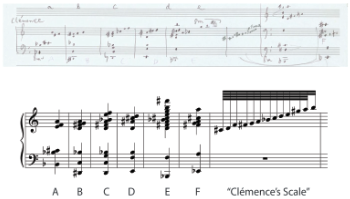
[1.7] Our article will primarily explore this last category, anticipatory distance. Anticipatory distance may, at first, seem difficult to associate with musical elements, but careful tracking of Saariaho’s early sketches reveals associations between certain sentiments, such as longing, and certain harmonies.. She assigns specific sonorities to represent her characters and their interiority in ways reminiscent of Wagnerian leitmotifs. Example 1 shows Saariaho’s sketch for the six sonorities associated with various aspects of Clémence’s character, moods, and inner life, with a transcription below.(6) It is notable that these sonorities resemble the spacing of harmonic series, with large intervals (in the case of chord E, a perfect 12th from
Example 1. Clémence’s six basic sonorities, labelled A–F, with a transcription below for ease of reading. Original manuscript from Kaija Saariaho Collection, Paul Sacher Foundation, Basel; first published in Calico 2019, reproduced by permission of the Paul Sacher Foundation. The scale in the middle of the draft has been moved to the right of the transcription.
(click to enlarge and listen)
[1.8] By means of harmonic field analysis, that is, reducing parts of the opera’s texture to different voicings of the above six chords, we can identify how these chords are used in the music, observing how they change and with what dramaturgical events they are associated. This approach, described by Paul Nauert (2003) as the collection of unordered pitches in fixed positions, preserves register, so octave equivalence rarely occurs. Scholars such as Lambright (2008) have applied this method to Saariaho’s work to illuminate how she organizes harmonies against other musical elements such as timbre and texture. We will be focusing on the voices and acoustic instruments of the orchestra, as represented by the published piano–vocal score (Saariaho, Maalouf, and Brown 2010), although Clémence’s chords also serve as filters to produce the layer of electronic sounds in the opera (as explained in detail in Battier and Nouno 2003). An example of a harmonic field associating with a dramaturgical event is Clémence’s Chord E, which regularly appears when Clémence is discussing her homesickness for France, creating an aural association between a sentiment and a chord. Changes are then made to these chords to represent changes in her character.
[1.9] These small harmonic changes often highlight Clémence’s feelings and attitudes towards her distant lover and can therefore be associated with anticipatory distance. The example of harmonic interpolation discussed in the previous paragraph is one of the simplest and slowest-moving interpolations in L’Amour de loin: adding a single pitch-class and allowing it to remain in the texture over time. We will also consider more surface-oriented interpolation processes that affect other parameters, such as rhythm and dynamics, and which portray other kinds of distance (such as Clémence’s longing for her distant homeland and mother). These are similar to the processes that play out over a few measures illustrated by Landon Morrison (2021; 2022), and they coordinate with the illustrations Saariaho gives in her own writings of short-term interpolation processes. They make gradual changes over time to the “value” of one parameter, or sometimes to several parameters’ values simultaneously (see, for example, Saariaho 1987, 124–26).
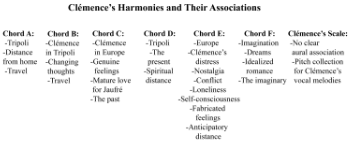
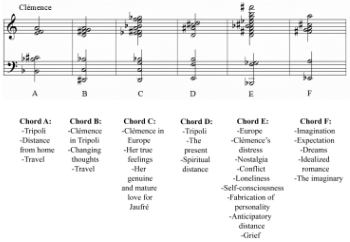
[1.10] Through harmonic fields, one can track how Clémence’s six chords progress through the opera and find consistent connections between the story on stage and the sounds that accompany it. For example, whenever a tableau set in Tripoli begins, such as Act 3, Tableau 2, chord A will occupy most of the preliminary music. This chord aurally establishes the geographical setting of Tripoli together with the staging. Then Chord C begins to arpeggiate as Clémence enters the scene, associating her physical presence with that chord. When tracking these patterns over the course of the opera, the following associations, shown in Example 2, become clear.
Example 2. Clémence’s six basic sonorities, with various associations projected during the opera
(click to enlarge)
[1.11] Saariaho derived these six harmonies from what we are calling “Clémence’s scale” sketched in the middle of her drafts (but placed at the end in our transcription in Example 1). Clémence’s scale itself contains 11 of the 12 pitch classes and resembles a hexatonic scale near its bottom (pcs <1, 2, 5, 6>), which morphs into an octatonic scale in the middle (<6, 7, 9, 10, 0>). Chord A, a subset of the scale, belongs to set-class 5-22 (01478). It signifies Clémence’s present location in Tripoli, far from her home in France. Chord B adds
[1.12] Chords C and D are also pitch-class subsets of Clémence’s scale. Chord C plays one of the most important roles in portraying Clémence’s sentiments. It forms set-class 8-22 (0123568T), but in its harmonic-series-like spacing, elements of a D dominant-13th chord are especially prominent in the bass tetrachord (<2, 0, 7, T>) and middle voices (<2, 6, 9>). As an extended dominant chord (which hardly ever resolves to tonic, however), Chord C is well-suited to portray Clémence’s homesickness as well as her anticipation of a relationship with Jaufré while not expecting it to come to fruition. Chord D forms 6-Z13 (014678), an octatonic subset. Since octatonic pitch collections have been associated throughout 20th-century music history with the foreign or other-worldly (Stravinsky’s Firebird comes to mind), this chord’s connection with Tripoli and the present in Saariaho’s opera coincides with Tripoli and the present being in their own world, as if on their own planet, outside of Jaufré’s.
[1.13] Chord E is one of the most important harmonic fields for portraying Clémence’s thoughts and feelings. As Example 2 shows, this chord signifies Clémence’s distress at being far from home, her nostalgia, her loneliness, and her internal conflicts engendered by her growing affection for Jaufré. Its set class is 9-11 (01235679T), but its most prominent pitches at the bottom and middle of the chord are the
2. Prior Scholarship on Saariaho and L’Amour
[2.1] Among the sources that were particularly helpful for our study is Saariaho’s own article “Timbre and Harmony: Interpolations of Timbral Structures” (Saariaho 1987). In this article, Saariaho uses several of her own works from the 1980s, such as Laconisme de l’aile (1982), Sah den Vögeln (1981), Im Traume (1980), Vers Le Blanc (1982), Verblendungen (1982–4), and Jardin Secret (1984–5), to demonstrate her musical processes and discuss how the computer plays a role in her compositions. Saariaho further details her principles of harmonic motion, emphasizing the significance of intervals and intervallic relationships in her harmonic progressions. While she does not explicitly use the term “harmonic field analysis,” as described by Nauert (2003), her own concepts of “harmonic evolution” and interpolation resonate with our analytical approach. Since there is very little functional harmony in L’Amour de loin (though one can argue there are quasi-tonal centers that are established through pedal points at extreme registers), a sense of progression, as well as tension and release, are manipulated through an idiomatic method. To Saariaho, part of this method is achieved through adjusting the vertical intervals that create the chord.
[2.2] Pirkko Moisala’s Kaija Saariaho (2009) remains one of the most detailed biographical sources on the composer, tracing the evolution of her artistic voice through both personal experience and compositional practice. Her discussions of Saariaho’s mature style provide essential context on the psychological and musical dimensions of works like L’Amour de loin, offering valuable insight into how Saariaho’s aesthetics of distance and longing manifest musically.
Studies of L’Amour de loin
[2.3] In examining the Clémence chords A–F, we also acknowledge the perspectives of Battier and Nouno (2003) and their explanations of how these chords are used in L’Amour, specifically in the electronic accompaniment. Here, Saariaho uses the electronics to enhance and transform the harmonic structures associated with each character, creating a field of sound that “hovers” around these characters when they appear on stage. Battier and Nouno describe how the electronic accompaniment takes a given chord and emphasizes certain qualities of the sound—such as specific frequency ranges, to add an element of depth to the acoustic accompaniment. The electronics act as an extension of the orchestra, providing sonic alterations that color the music. This, in turn, emphasizes thematic elements of the opera such as longing and distance. For example, where longing is represented in the libretto, the electronics may take the respective chord occurring in the orchestra and blur the harmonic spectrum together, enveloping the audience in a dream-like soundscape, audibly different from other moments in the opera. Although Battier and Nouno’s analysis centers on the electronic aspects of these harmonic structures, their insights into Saariaho’s approach also inform our understanding of these drafted chords in the orchestral accompaniment. This provides a nuanced view of how Saariaho conceives of her harmonies, which we will explore with an emphasis on the acoustic accompaniment.
[2.4] Spencer Lambright’s dissertation on L’Amour de loin (Lambright 2008) was a crucial addition to the current research on this piece. This dissertation takes a holistic look at the first two acts of this opera. Lambright uses harmonic field analysis to observe changes in harmony and is primarily concerned with how the soundscapes associated with each character are demonstrated in harmonic changes and processes. Our work goes beyond this by considering the entire opera’s harmonic development, as well as mapping harmonic changes onto dramaturgical events. This provides an extra layer of musical significance for the harmonic analysis, providing an answer to the question “How do Saariaho’s harmonic choices contribute to this tale?”
[2.6] Similarly, Joy Calico (2019) has done extensive research into the primary sketches and drafts of the opera. She explores how these sources relate to the rewriting of part of Clémence’s vocal lines to suit different soprano ranges. Calico’s article is primarily concerned with intervallic and harmonic analysis as it applies to the performance of Clémence’s role, but it also delves deep into the initial sketches of the opera and how these lead to the ultimate conception of the opera, including how it is staged today.
[2.7] Finally, Amy Lynn Prickett’s DMA document (2017) examines Saariaho’s path to her New York Metropolitan Opera premiere. Prickett offers another analysis of Saariaho’s musical style, drawing heavily from Saariaho’s 1987 article, and ties this information into her analysis of color, texture, and motifs in the opera. Her research tracks these motifs and observes how they change and where they appear, as well as other musical elements such as changes in style and changes in orchestration. Prickett’s primary concern in her analysis is to observe ways that Saariaho’s opera is similar to the masterworks of the 17th- and 18th centuries. Furthermore, Prickett pays careful attention to the lineage of Saariaho’s works and explores the path Saariaho took from IRCAM to the Met. Though Prickett’s observations are helpful for understanding the conception of this work and its history, our work will primarily concern itself with decoding and understanding Saariaho’s dramaturgical harmonic language.
[2.8] Liisamaija Hautsalo’s brief introduction to L’Amour (2006) discusses a number of musical and historical traditions that inspire the opera. It connects the vocal writing of L’Amour to Saariaho’s earlier vocal works, and shows how it echoes various formal and topical conventions of classical and romantic opera. The courtly love tradition, religious allegory, and the issues facing the alien in a foreign land are also considered as influences. Finally, Hautsalo suggests functional tonality as a way to understand deeper levels of chord progression in the opera, a different perspective from the one we will take later when discussing short passages in which tonality’s expectations are set up, then denied.
Reference works on musical meaning
[2.9] The topic of musical meaning has been central to many authors and analytical approaches, and it also provides a backdrop for our interpretations of how chord progressions and the introduction of foreign pitches reinforce the text and the action on stage. Kofi Agawu’s Playing with Signs (1991) is a seminal work that bridges the studies of semiotics and music theory, exploring how musical works communicate meaning through culturally embedded codes. While Agawu’s work provides an excellent foundation for understanding the construction of musical meaning through these signs, our analysis of Clémence’s harmonies in L’Amour de loin extends this framework by examining how meaning emerges from specific associative elements within Saariaho’s opera. Unlike Agawu’s emphasis on semiotic systems, we explore how Clémence communicates her character’s internal and external worlds through layered musical associations, illuminating how harmonic, timbral, and textural elements reflect her internal dramaturgical themes of distance and longing.
[2.10] Finally, we will also make a reference to Robert Hatten’s (1994) central idea that the juxtaposition of musical opposites can correlate with an opposition in meaning and lead to a hermeneutic interpretation. In the case of L’Amour, we encounter a number of chords and pitches that are unexpected or contradictory in their context and become “marked” thereby. Hatten’s approach helps to understand these “marked” phenomena in terms of text-painting, or as supporting action on stage.
3. Analysis
Case Study 1: Act 2 Tableau 1
[3.1] The remainder of our article will provide detailed analyses of three passages from L’Amour, showing how certain harmonic fields, particularly Chords C and E, and the addition of foreign pitch classes to them, represent the anticipation that Clémence feels towards Jaufré—i.e., anticipatory distance—and the ways in which his death at the opera’s end permanently changes her outlook. The first analysis comes from Act 2, Tableau 1, where the Pilgrim has just arrived in Tripoli and is speaking with Clémence. She asks him where the docked ship came from, to which the Pilgrim responds that he himself was on it and they just arrived from a voyage that went through Marseille and Blaye. Clémence notices the irony of the Pilgrim’s desire to leave his homeland while she is stuck in a foreign land and desperately wants to return to France. This moment is key for understanding Clémence’s character, emotions, and motivations in this opera: she is homesick. This homesickness results from Clémence’s unique experiences of geographical distance (separated from France, in Tripoli) and temporal distance (longing for her childhood). Also, it directly impacts her unique experience of anticipatory distance, as we will find out soon, since Jaufré’s songs remind Clémence of France. She uses his songs to mentally return home and relieve her homesickness. Saariaho is keen to this characterization and expresses it musically by creating consistent dramaturgical associations with each harmony.
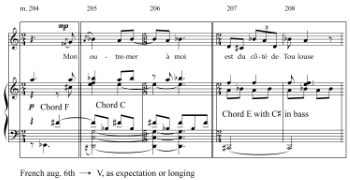
[3.2] Beginning in m. 204, the bass plays a low
Example 3. Saariaho, L’Amour de loin, Act 2, mm. 204–8
(click to enlarge and listen)
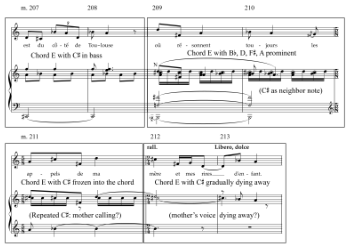
[3.3] Following Chords F and C, the music changes to Clémence’s Chord E as the bass descends a step to
Example 4. Saariaho, L’Amour de loin, Act 2, mm. 207–13
(click to enlarge and listen)
[3.4] Chords C and E both represent Clémence reminiscing and yearning for her childhood, but in this moment, Chord C has to do more with her current state of regret or remorse, and Chord E with her nostalgic, past-oriented dreams of home. As she passes from the phrase “my other sea” to “the coast of Toulouse,” shown in Example 4, Saariaho’s harmonies pass from Chord C to Chord E, as if to portray the physical distance from Tripoli to Toulouse, and the temporal distance from the 12th-century present to Clémence’s childhood, through the failed resolution to G minor and the opposition that brings about. But the C and E chords have a prominent {
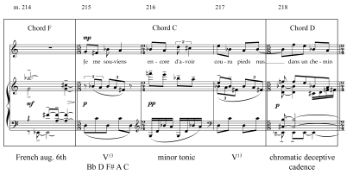
[3.5] The chord progression of mm. 204–12 repeats—with one important change—in mm. 214–21, part of which is shown in Example 5. Chord F returns in m. 214 (with a lingering
Example 5. Saariaho, L’Amour de loin, Act 2, mm. 214–18
(click to enlarge and listen)
[3.6] Importantly, we do not conceive of this section, or any section in this opera, as being in G minor, nor do we posit that the harmony in this opera acts analogously to functional harmony, at least not for more than a few chords. Rather, we suggest that harmonic oppositions that can be characterized in terms of tonal relationships correlate with oppositions in expressive meaning; particularly the opposition between being able to return home and not being able. Though we reference tonal expectations in describing this procedure, Saariaho’s Clémence chords behave according to Western harmonic function only rarely.
Case Study 2: Act 3 Tableau 2
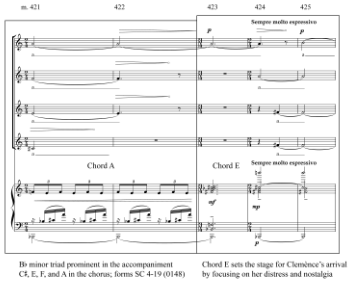
[3.7] Case study 2 comes from Act 3, Tableau 2, where Clémence is on a walk around the city. She turns her back towards the city and faces the ocean. As this scene is establishing itself, shown in Example 6, the orchestra gently arpeggiates Chord A above a
Example 6. Saariaho, L’Amour de loin, Act 3, mm. 421–25
(click to enlarge and listen)
[3.8] Then in m. 423, right before Clémence begins singing, the orchestra shifts with an abrupt rhythmic change to the E chord, setting the stage for her arrival and placing the focus on her nostalgia and distress over her love from afar through opposition and well-established patterns of chord association. Clémence then recites a new stanza—the third of Rudel’s poem, to herself, in ancient Occitan. This recitation is different from her previous performance of the stanzas in Act 2. The melody is nearly identical, but the accompaniment has changed substantially.
[3.9] The changes to the accompaniment, shown in Example 7, highlight Clémence’s emotional struggles in an almost Wagnerian way. Prior to this in the opera, and at the beginning of this scene, the E chord had consisted of the notes {
Example 7. Saariaho, L’Amour de loin, Act 3, mm. 426–30
(click to enlarge and listen) | Example 8. Jaufré’s Chord A
(click to enlarge and listen) |
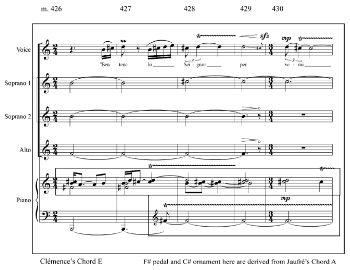
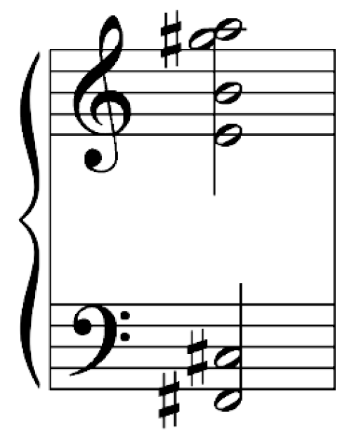
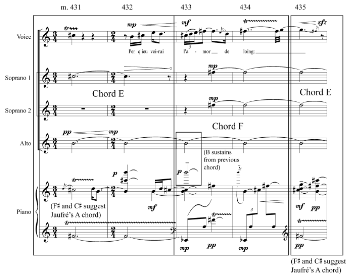
[3.10] A few measures later, illustrated by Example 9, Clémence proceeds to sing the words “By [God’s] grace I shall see my distant love.” The words “l’amor de loing” in mm. 433–34 appear above a chord with
Example 9. Saariaho, L’Amour de loin, Act 3, mm. 431–35
(click to enlarge and listen)
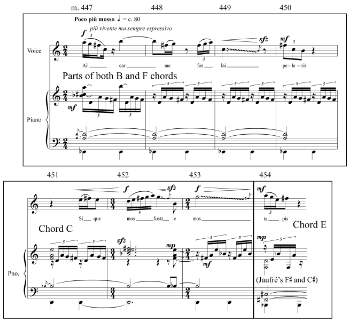
[3.11] Afterwards, at m. 444, Clémence sings the Occitan word “loing” (far away) in the phrase “My ills are doubled since [he] is so far away,” and, appropriately, the chord pivots to chord D. As shown in Example 2 above, chord D is generally associated with Tripoli and the present, so the harmonic progression is literally illustrating Clémence’s physical distance from Jaufré. However, the pitches
Example 10. Saariaho, L’Amour de loin, Act 3, mm. 447–54
(click to enlarge and listen)
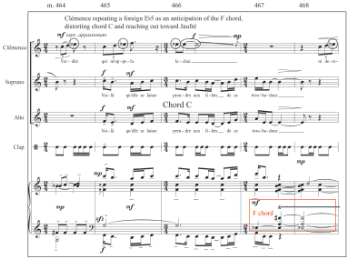
[3.12] In m. 464, shown in Example 11, Clémence intensifies her attempt to reach out to Jaufré by bringing the pitch class
Example 11. Saariaho, L’Amour de loin, Act 3, mm. 464–74
(click to enlarge, see the rest, and listen)
[3.13] The
[3.14] The timing of the appearance of
Look, look as she lets herself be caught in the net of this troubadour. She sings his songs, she feels flattered. But what good can come from love from afar? Neither good company, nor soft embraces, nor marriages, nor land, nor children. What good can come from love from afar? It will only estrange her from those who want her hand in marriage: the prince of Antioch, the old Count of Édesse. (Whispered) And also, people say, people say the son of the emperor. . .
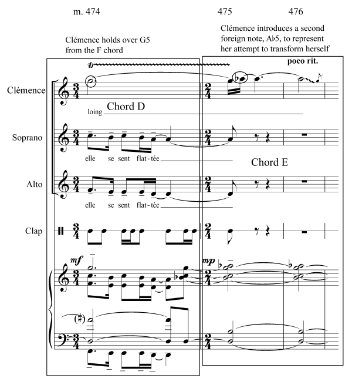
This shows that even the citizens of Tripoli can sense that perhaps Clémence is allowing herself to be not only self-indulgent in this romance, but also deceived, as they mention the high-ranking men that want Clémence’s hand in marriage. In addition to this distorted
Example 12. Saariaho, L’Amour de loin, Act 3, mm. 474–76
(click to enlarge and listen)
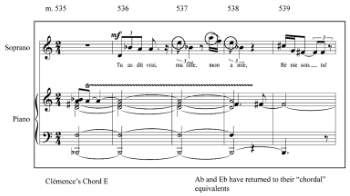
[3.15] It is significant that both the
Example 13. Saariaho, L’Amour de loin, Act 3, mm. 535–39
(click to enlarge and listen)
[3.16] The subsequent scene, shown in Example 14, is critical for Clémence, as it fully develops her feelings about her relationship with Jaufré and adds to the characterization of Clémence’s unique type of anticipatory distance. In this scene, we will find that Clémence engages in anticipatory distance by allowing herself to daydream about a romance with Jaufré solely because he adores her and reminds her of her childhood, even if she understands that this romance is near impossible. At this moment, the chorus does not hold back their confusion and critical thought about Clémence. They have this to ask her:
Because you, Countess, do you not suffer? Do you not suffer from being so far from who you love? From not being able to tell from his expression if he still desires you? Do you not suffer from not even knowing what his expression looks like? Do you not suffer from not being able to close your eyes, feeling his arms around you and resting on his chest? Do you not suffer from never, never feeling his breath on your skin?
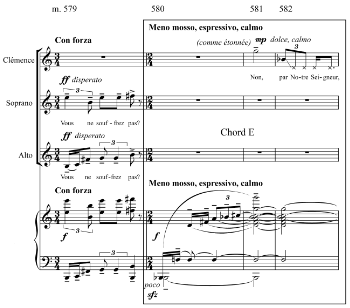
The chorus seems quite concerned about how Clémence can feel romantic fulfillment without her lover’s physical presence. Following this barrage of questions is a moment of silence from the characters in m. 580, as the orchestra builds Clémence’s E chord, associated with conflict and distress within her. Once it is built, the chord is sustained as she responds: “No, by the grace of God, I do not suffer.” The orchestra then forms Clémence’s C chord in m. 585, signifying expectation and anticipation (through its prominent D-dominant-13 elements), sustains it, and follows it with the forward-pointing F chord, heightening the anticipation. Clémence is continuing her thought here with “Maybe one day I will suffer, but, by the grace of God, no, I do not suffer at all,” but her words belie a strong anticipation for her ideal, imagined relationship. An element of foreshadowing irony is suggested here, as indeed she does suffer later in the opera when Jaufré passes away in her arms, then subsequently curses God for their unfortunate fate.
Example 14. Saariaho, L’Amour de loin, Act 3, mm. 579–90
(click to enlarge, see the rest, and listen)
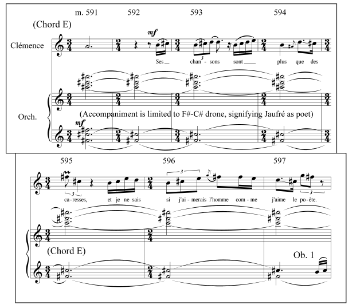
[3.17] She goes on to explain in mm. 591–97, shown in Example 15, why she is not currently suffering. She says: “His songs are more than hugs, and I don’t know if I would love the man more than I love the poet.” The accompaniment again subverts the usual harmonic expectations of Chords C and F by returning to Chord E, but does not present the full chord, instead maintaining the drone
Example 15. Saariaho, L’Amour de loin, Act 3, mm. 591–600, showing the Rudel quotation in m. 598 after Clémence sings “His songs are more than hugs, and I don’t know if I would love the man like I love the poet.”
(click to enlarge, see the rest, and listen)
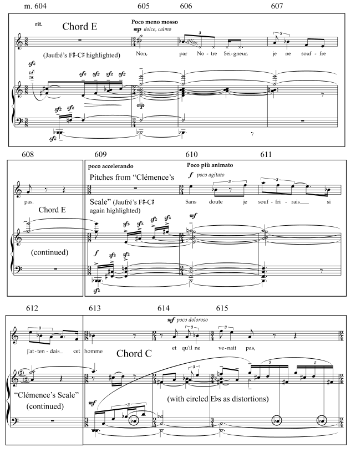
[3.18] Following this quotation, Clémence resumes, “I don’t know if I would love his voice as much as I love his music.” Then, in m. 604, portrayed in Example 16, we hear a measure of the orchestra building Chord E with sforzandi on every note. As a signifier for distress, Chord E gives the lie to her subsequent statement: “No, by the grace of God, I do not suffer.” Measure 609 is very similar to the prior interlude, but with pitches taken from what we have called “Clémence’s scale.” The next phrase beginning in m. 610 reads “Without a doubt, I would be suffering if I were waiting for this man.” Chord C follows in m. 613, even though there is not the same measure of pause as before. As she sings “
[3.19] In this regard, Clémence embodies the thematic question Saariaho herself posed on a NPR interview about the Met debut: “Do we really love another person, or do we love our idea of love?” (Lunden 2016). It is clear here that Clémence is in love with her idea of love, much more so than she is in love with the man himself. She confirms this idea in her next phrase (mm. 619–37): “Knowing that in a different country a man thinks of me makes me feel close to the land of my childhood. I am the other ocean of the poet, and the poet is my other ocean.” In this moment, Clémence admits that she loves being in love with Jaufré because his songs soothe her devastating nostalgia. The distorted Chord-C accompaniment shifts to Chord A, turning the focus back to the physical distance between them. She also references the “other ocean” again, this time meaning Jaufré. This shows a dramatic progression from Act II, when Clémence considered Toulouse to be her other ocean. Here, she is finding relief for her loneliness not in memories of home, but in Jaufré. In mm. 619–30, Chord A alternates with Chord B, and rhythmic interpolations make the oscillation more obvious: running 16ths grouped irregularly for Chord A and 16ths against eighth-note triplets for Chord B. A third foreign pitch,
Example 16. Saariaho, L’Amour de loin, Act 3, mm. 604–38, demonstrating the presence of the distorted C and E chords
(click to enlarge, see the rest, and listen)
Case Study 3: Act 5 Tableau 4
[3.20] The opera’s final tableau portrays an intriguing conclusion to Clémence’s character development, focusing on her resolution to join a convent following Jaufré’s death. The opening directions say: “As if she were already in a convent, Clémence kneels to pray, first in silence, then out loud, turned towards the inert corpse of her lover who acts as an altar, so that we do not know if she is praying to him or God, against whom she revolted. Especially since her words are vague.” In this tableau, Clémence again inserts
[3.21] The pitch
Example 17. Saariaho, L’Amour de loin, Act 5, mm. 718–36
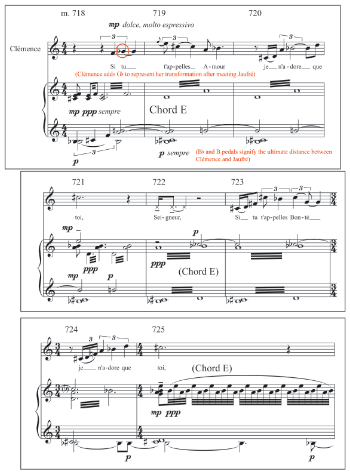
(click to enlarge, see the rest, and listen)
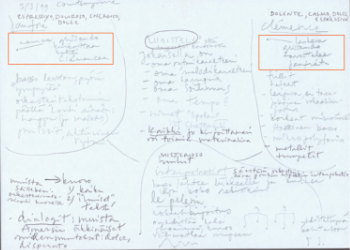
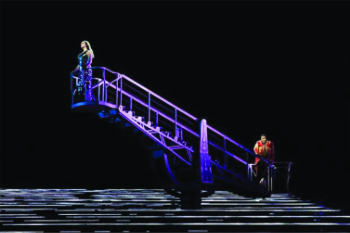
[3.22] Though Saariaho makes it clear that the ambiguity about whom Clémence is addressing is purposeful, our reading of this scene makes a strong case for the addressee of this prayer being Jaufré, not God. The first reason for our conclusion is Clémence’s ornamentation. As shown in Example 18, Clémence was assigned downwards-bending glissandi in Saariaho’s sketches as part of her characteristic ornamentations, whereas Jaufré was assigned upwards-reaching glissandi. The text in the red box at the upper left of Example 18 reads “ascending glissando reaching out towards Clémence” (for Jaufré) and the one in the red box at the upper right hand corner reads “descending glissando seeking Jaufré” (for Clémence). This portrays an aspect of the opera’s setting, which normally places Clémence on top of a balcony, and Jaufré at ground level, therefore he must look up towards her, and she must look downwards at him (see Example 19).
Example 18. Saariaho’s page of musical characteristics associated with Jaufré, Clémence, and the Pilgrim. Under “Jaufré” on the left, one can see that Saariaho has drawn an ascending line with the word “glissando” next to it; under “Clémence” on the right, she has drawn a descending line, again with the word “glissando.”
(click to enlarge) | Example 19. Clémence standing at the top of the stairs, Jaufré at the bottom. Still picture from the Metropolitan Opera production of L’Amour de loin, December 2016. https://www.youtube.com/watch?v=XkhaI6Nv-8Y
(click to enlarge) |
[3.23] Here, in this final tableau, these ornamentations do not change, except for one peculiar moment. In m. 734, Clémence says “My prayer lifts itself towards you
Example 20. Saariaho, L’Amour de loin, Act 5, mm. 734–36
(click to enlarge and listen) | Example 21. Saariaho, L’Amour de loin, Act 5, mm. 748–53, with
(click to enlarge and listen) |
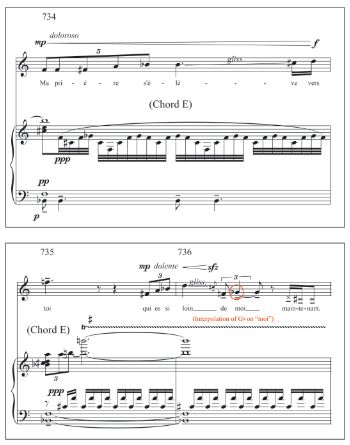
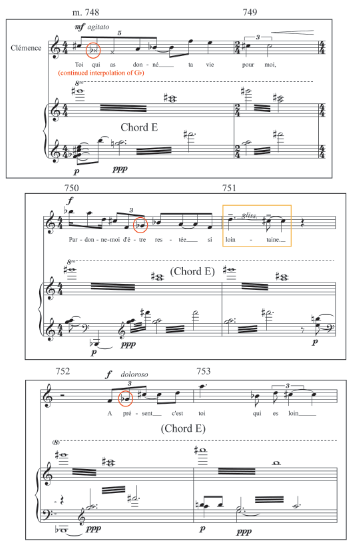
[3.24] In addition to this, another reason for believing that Clémence is addressing Jaufré rather than God here is the ambiguous attitude towards religion expressed throughout the entire opera. As early as Act 2, Clémence alluded to her faith being hollow and forced, as opposed to genuine. She sings to herself:
If this troubadour knew me, would he have sung about me with such fervor? Would he have sung to me if he knew the depths of my soul? “Beautiful without the arrogance of beauty,” he said. . . Beautiful? Yet I look around me constantly to make sure that there is not a woman that is more beautiful than me! “Noble, without the arrogance of nobility?” But I covet the lands of the West and East, as if providence were indebted to me! “Pious without the arrogance of piety?” But I walk to mass wearing my finest gowns, only to kneel in the church with my soul completely empty!
Her revolt against God is, therefore, the culmination of this religious doubt. Her purposeful vagueness in the prayer may have the intent of pacifying the chorus, who, in the previous tableau, lashed out against her for daring to challenge God. This, however, does not answer the question as to why she would choose to dedicate her life to God if she held such resentment for her fate. Though there is no definitive answer to this, one may briefly reference Rudel’s vida and Clémence’s rage in the prior tableau to discover that Jaufré travelled while posing as a Crusader, when his true intent was to see Clémence. Perhaps Clémence herself is “pretending” to be devoted to God while having different intentions at heart, in a parallel way. Considering that her choice to join a convent clearly came from a place of self-punishment and grief, this may indeed be a possible reading of this conclusion.
[3.25] Though far from a happy ending, Saariaho provides immense depth to Clémence’s character and insights as to what Clémence is feeling and thinking through masterful orchestration. There is no doubt that Clémence’s grief is genuine: the homogenous harmonization using Chord E through the final tableau demonstrates a purposefully stationary accompaniment that shows Clémence’s grief through registral and textural interpolation processes. As the tableau nears its end at m. 762 with the words “And now it’s you, a distant love,” Saariaho places B6 at the upper extreme of the E chord and
[3.26] Through this final tableau, Clémence’s Chord E develops into its final form for this opera, a chord that contains the pitches {
Example 22. Final chord association chart for Clémence at the end of the opera
(click to enlarge)
4. Conclusion
[4.1] Through a detailed analysis of the tableaus in which Clémence appears, we note that L’Amour de loin uses harmonic fields and their progressions to project the development of the plot as well as Clémence’s character. Saariaho designed six chords to be associated with Clémence, and two of these (Chords C and E) associate with Clémence as a character directly. Drawing from Saariaho’s spectralist roots, the opera makes miniscule, and even inaudible, additions to these two characteristic Clémence chords and transforms them as part of its most gradual interpolation process over the course of two hours. It also uses subversion of harmonic expectation in the case of Chords F and C to correlate with Clémence’s unfulfilled expectations, portraying anticipatory distance. In this way, Saariaho put her slow and meditative post-spectralist compositional style to a dramatic use, brilliantly portraying the unfolding of events.
[4.2] Though our harmonic analysis does not provide a solid conclusion as to whether Clémence was genuine in her dedication to God, or if she was praying to Jaufré in the final tableau, we believe that Saariaho purposefully blurred the boundary between the spiritual and the sexual.(11) In our reading of the dramatic themes and irony in this opera, we find an ending where Clémence is addressing Jaufré instead of God more appropriate; however, just as Rudel’s vida leaves unresolved the fate of Clémence after Jaufré’s death, the opera concludes with a similar indeterminacy.
[4.3] Our work’s focus on Clémence allows for a more nuanced understanding of how Saariaho spotlights her. However, there is still much more to be done regarding the portrayals of the Pilgrim and Jaufré, and underlying commentary to be made regarding their own unique characterizations. There are still many questions regarding Jaufré’s portrayal as either a hero or anti-hero, in relation to the courtly love tradition. Given that Jaufré is assigned five sonorities, much in the same way that Clémence is assigned six, we may speculate that various interpolation processes occur in Jaufré’s sonorities as well.
[4.4] Similarly, there is much left to do in the way of understanding the Pilgrim’s role in the opera. Though he serves an undeniably transitory role as somewhat of a matchmaker between the two main characters, signified by the assignment of the Pilgrim’s male character to a mezzo-soprano (normally a woman), there is an air of omniscience and mystery in the Pilgrim’s character that begs for deeper understanding. Furthermore, there may be more unexplored remnants of Saariaho’s post-spectralist roots in the Pilgrim’s part, as he is the only character associated with microtones, and therefore, there may be spectral transformations in the Pilgrim’s music that mimic some of the well-known slow, static processes of the Parisienne spectral school of the 1980s.
[4.5] There is still plenty to be discovered about gender roles and the ways that Saariaho applies them in L’Amour de loin. Indeed, our harmonic analysis of Clémence’s music alludes to the overarching theme of gender roles, particularly how they relate to courtly love. A more detailed reading that would emphasize gender norms in opera, and how Saariaho either conforms to or parodies these norms, would undoubtedly be useful. Additionally, this would provide further understanding into how she approached the writing of Clémence’s character: for instance, Saariaho has expressed that she feels connected to Clémence, particularly in that she herself was young when she emigrated from Finland. There is certainly room to explore how Saariaho treats and writes music for her female main characters spanning throughout her opera career, beginning with Clémence, then the character Adriana, from her second opera Adriana Mater (2005), Émilie from Émilie (2008), then finally the multiple female characters in her last opera, Innocence (2021). There is no question regarding the importance of Saariaho’s female characters, and a reading into these settings would be quite revealing in how she elucidates this importance.
[4.6] Kaija Saariaho is regarded as a pluralistic master of compelling orchestration, dazzling musical timbres, and breathtaking live performances. Her unique compositional style encompasses elements from post-spectralism, in combination with a keen and unique interest in the audience’s perception and auditory/visual experience of her music, often proving to be more important to her than the music itself. Her works provide a new and modern perspective on composition and present a crossroads between compositional idiosyncrasy and audience appreciation. Though it’s certainly true that L’Amour de loin is rich and thought-provoking on its own, the messages and themes of the opera are easy to grasp and digest in part due to Saariaho’s captivating and intuitive composition that reinforces the narrative and drama.
Gabrielle Choma
University of Oregon
School of Music and Dance
961 E 18th Ave.
Eugene, OR 97403
gchoma@uoregon.edu
Jack Boss
University of Oregon
School of Music and Dance
961 E 18th Ave.
Eugene, OR 97403
jfboss@uoregon.edu
Works Cited
Agawu, Kofi. 1991. Playing with Signs: A Semiotic Interpretation of Classic Music. Princeton University Press. https://doi.org/10.1515/9781400861835.
Battier, Marc, and Gilbert Nouno. 2003. “L’électronique dans l’opéra de Kaija Saariaho, L’Amour de Loin.“ Musurgia 10 (2): 51–59.
Calico, Joy H. 2019. “Composing Clémence in L’Amour de Loin.” Contemporary Music Review 38 (3–4): 389–417. https://doi.org/10.1080/07494467.2019.1596639.
Cross, Jonathan. 2018. “Introduction: Spectral Thinking.” Twentieth-Century Music 15 (1): 3–9.
Chaytor, Henry John. 1912. The Troubadours. The University Press.
Dufourt, Hugues. 1979. “Musique spectrale.” Musique, pouvoir, écriture: 289–290.
Grisey, Gérard, and Joshua Fineberg. 2000. “Did you say spectral?” Contemporary music review 19 (3): 1–3.
Hatten, Robert. 1994. Musical Meaning in Beethoven: Markedness, Correlation, and Interpretation. Indiana University Press. https://doi.org/10.2979/3489.0.
Hautsalo, Liisamaija. 2006. “Kaija Saariaho’s Opera L’amour de loin: Themes, Stylistic Features and the Idea of Foreignness.” In Tarasti, Eero, ed. Music and the Arts II. Proceedings from ICMS 7. International Semiotics Institute, 859–66.
Lambright, Spencer N. 2008. “L’Amour de Loin and the Vocal Works of Kaija Saariaho.” PhD diss., Cornell University.
Lunden, Jeff. 2016. “‘Half of Humanity Has Something to Say’: Composer Kaija Saariaho On Her Met Debut.” NPR Music. December 3. https://www.npr.org/sections/deceptivecadence/2016/12/03/503986298/half-of-humanity-has-something-to-say-composer-kaija-saariaho-on-her-met-debut.
Mälkki, Susanna. 2023. “Kaija Saariaho’s Luminous Music Was a Personal Invitation.” New York Times, June 4. https://www.nytimes.com/2023/06/04/arts/music/kaija-saariaho-composer.html
McClary, Susan. 2012. Desire and Pleasure in Seventeenth-Century Music. University of California Press. https://doi.org/10.1525/california/9780520247345.001.0001.
Moisala, Pirkko. 2009. Kaija Saariaho. University of Illinois Press.
Morrison, Landon. 2021. “Encoding Post-Spectral Sound: Kaija Saariaho’s Early Electronic Music at IRCAM, 1982–87.” Music Theory Online 27 (3). https://doi.org/10.30535/mto.27.3.10.
—————. 2022. “On the Horizon of Digital Technics in Kaija Saariaho’s IO and Nymphéa.” Archival Notes: Source Studies in Twentieth- and Twenty-First-Century Music 7: 109–39.
Nauert, Paul. 2003. “Field Notes: A Study of Fixed-Pitch Formations.” Perspectives of New Music: 180–239.
Prickett, Amy. 2017. “Kaija Saariaho’s path to the Met: the merger of conventional and unconventional musical devices in L’amour de Loin.” PhD diss., University of Alabama.
Ratner, Leonard. 1980. Classic Music: Expression, Form, and Style. Schirmer.
Saariaho, Kaija. 1987. “Timbre and Harmony: Interpolations of Timbral Structures.” Contemporary Music Review 2 (1): 93–133. https://doi.org/10.1080/07494468708567055.
Saariaho, Kaija, Amin Maalouf, and Christopher Brown. 2010. L’Amour De Loin [Love from Afar]: Opera in Five Acts. Vocal Score. Chester Music.
Woolfe, Zachary. 2023. “Kaija Saariaho: 11 Essential Works.” New York Times, June 2. https://www.nytimes.com/2023/06/02/arts/music/kaija-saariaho-music-playlist.html.
Footnotes
1. This historic performance made Saariaho the second woman ever to have her opera performed by the Met, and the event was streamed online in Spring 2020 as part of the Met’s on-demand program during the 2020 lockdowns. The first woman to have her work performed by the Met was Ethel Smyth, whose work, Der Wald, was performed in 1903, over 100 years prior to L’Amour.
Return to text
2. The phrase and genre “spectral music” has evolved significantly since its use by Hughes Dufourt in 1979. According to Dufourt, as well as Grisey (2000)—who preferred the term “liminal music”—spectralism is less a traditional genre defined by specific melodic, harmonic, or timbral parameters and more an attitude or approach toward composition. This approach interrogates the space in between musical dimensions: timbre and harmony, rhythm and pitch, pitch and noise, and so forth. Since the 1980s, the term has come to be associated with music that engages deeply with the act of listening, blends multiplate parameters simultaneously, and cultivates a sense of temporal suspension or timelessness. “Post-spectralism” is even more difficult to define, but generally refers to composers who adopt a similar attitude toward sound and perception a generation after the flagship spectralists active at IRCAM in the 1980s (see Cross 2018 for an in-depth exploration of the use of this term). In these ways, Saariaho is both a spectralist and a post-spectralist, as she was active at the IRCAM in the 1980s, but maintained this liminal attitude towards music throughout her career, well into the 2000s. However, we find that both genre labels inadequately capture the pluralistic nature of her style. For the purposes of this study, we will loosely refer to her as a post-spectralist, in acknowledgement of her time at the IRCAM and her persistent interest in the blending of musical parameters and the liminal space between sound and noise.
Return to text
3. The term “vida” connotes a brief prose biography of a troubadour, usually included in chansonniers to introduce a poet’s work.
Return to text
4. Surely, this made some audience goers uneasy, as they were not used to the portrayal of raw, tragic, and “ugly” female emotion in media. In Pirkko Moisala’s biography on Saariaho (2009, 4), she mentions music critic Wolfgang Sandner’s reaction to the opera, saying that it was “
Return to text
5. All translations are done by the author (Choma).
Return to text
6. The intervening chord between E and F, after “Clémence’s scale,” is where Saariaho drafted her “basic sonority,” a chord consisting of the notes [
Return to text
7. Saariaho’s 1987 article itself does not display the IANA transcriptions of the cello sounds she refers to, only giving a description of them and notation necessary for producing them: “the rich and noisy sounds of the cello obtained by increasing the pressure of the bow to produce a multiphonic sound. The transitions between such sounds also attracted my attention
Return to text
8. From here through the remainder of the article, we will refer to the
Return to text
9. Though these two notes sound similarly (or slightly differently dependent on the performer), it is clear from our observations that Saariaho treats these two pitches as separate entities. While this sudden interpolation may not be audible to audience members, this choice is clearly purposeful, perhaps signifying an invisible (rather, inaudible) change occurring within Clémence.
Return to text
10. There are two existing versions of L’Amour de loin: the original 2001 version, where Clémence is written for a coloratura soprano, and a revised edition created in 2005 for vocalist Dawn Upshaw. This revised edition contains exactly the same orchestration, but with Clémence’s melodies written lower to accommodate Upshaw’s request to Saariaho for a version of Clémence that would not be so straining on her voice. See Calico (2019) for an in-depth analysis of how these changes were made. This lower transposition maintains the same melodic content—all pitches are still derived from Clémence’s A–F chords, and intervallic content is preserved as much as possible. Despite the fact that there are changes in the pitch content between the higher- and lower-tessitura versions,
Return to text
11. See McClary 2012 for a more in-depth discussion on this topic.
Return to text
Copyright Statement
Copyright © 2026 by the Society for Music Theory. All rights reserved.
[1] Copyrights for individual items published in Music Theory Online (MTO) are held by their authors. Items appearing in MTO may be saved and stored in electronic or paper form, and may be shared among individuals for purposes of scholarly research or discussion, but may not be republished in any form, electronic or print, without prior, written permission from the author(s), and advance notification of the editors of MTO.
[2] Any redistributed form of items published in MTO must include the following information in a form appropriate to the medium in which the items are to appear:
This item appeared in Music Theory Online in Volume 32, Issue 1 in March 2026. It was authored by Gabrielle Choma (gchoma@uoregon.edu) and Jack Boss (jfboss@uoregon.edu), with whose written permission it is reprinted here.
[3] Libraries may archive issues of MTO in electronic or paper form for public access so long as each issue is stored in its entirety, and no access fee is charged. Exceptions to these requirements must be approved in writing by the editors of MTO, who will act in accordance with the decisions of the Society for Music Theory.
This document and all portions thereof are protected by U.S. and international copyright laws. Material contained herein may be copied and/or distributed for research purposes only.

Prepared by Amy King, Editorial Assistant
Number of visits:
1796