Compositional Pluralism in Roger Sessions’s Second Symphony
David Hier
KEYWORDS: Roger Sessions, Neoclassicism, Atonality, Schoenberg, Stravinsky
ABSTRACT: Roger Sessions’s music of the late 1930s and 1940s poses challenges to analysts because it does not adhere to one compositional system. The initial influence of Stravinskian neoclassicism on Sessions’s music has been well documented by theorists and historians. It is also well known that Schoenberg’s influence on Sessions grew as his music became more harmonically and contrapuntally complex during this period. Sessions’s Second Symphony is emblematic of his style from the time. Its pluralistic blending of Stravinskian and Schoenbergian influences requires that the analyst employ multiple analytical frameworks, some of which may contradict each other. I begin by summarizing harmonic, contrapuntal, and motivic techniques Sessions employs in the symphony that are drawn (though not exclusively) from Stravinskian and Schoenbergian practice. I continue by analyzing two representative passages from the symphony’s first movement in greater depth to explore how these techniques are manifested in the work. I conclude by considering the reinforcing and contradictory results of the analysis, and I reflect on the importance of pluralistic analysis when examining modernist music of the 20th century.
DOI: 10.30535/mto.32.1.5
Copyright © 2026 Society for Music Theory
1. Introduction and Background
[1.1] Roger Sessions (1896–1985) occupies a singular position in American music: he was a Pulitzer-prize winning doyen who taught at Princeton, Berkeley, Harvard, and Juilliard, whose music evolved from a conservative strain of neoclassicism to what would become a conservative strain of dodecaphony, before vanishing almost entirely from the concert and dramatic stages. Sessions is remembered these days, perhaps, more as a teacher of a young generation of composers whose music departed quickly and profoundly from Sessions’s own, than as a composer in his own right. Nevertheless, his music reflects the schisms, conflicts, and eventual reconciliations that dominated musical thinking and practice in the first half of the 20th century. And in its belated synthesis of seemingly opposing idioms, Sessions’s music has much to tell us, not only about neoclassicism, atonality, and serialism, but about American music-making in the wartime and post-war periods.
[1.2] The first movement of his Symphony No. 2 in D minor, begun during World War II and completed in 1946, is an especially illuminating example of Sessions’s unique synthesis of Stravinskian and Schoenbergian compositional principles that is also a culmination of his tonal period, and the beginning of his compositional maturation. In what follows, I will begin by placing the work in the context of Sessions’s career and American music of the time, and by delineating structural principles in Sessions’s work loosely derived from earlier influences. My analysis of two representative passages from the work will draw out its pluralistic features, and my conclusion will synthesize my analytical remarks into a fuller understanding of the work and the possibilities it opens for music making and analysis, today.
[1.3] By the mid-1940s, Sessions’s compositional aesthetic was in a process of metamorphosis. His earlier works combined the influence of Stravinsky with the more “American” school of Copland, Bloch, and Thompson. Andrea Olmsted (2008, 208) cites Nadia Boulanger’s approval of Sessions’s neoclassical First Symphony, and Frederick Prausnitz (2002, 176–77) cites Sessions’s approving characterization of Stravinsky’s music as evincing a “new sobriety” and a “new inwardness” that developed from purely musical ideas. As these authors note, Sessions’s music increasingly became dominated by chromatic, highly dissonant melodies and harmonies, however. The unpredictable rhythms of the earlier pieces, with their additive and subtractive rhythms inherited from Stravinsky, had yielded to rounder, more predictable, almost neo-romantic shapes, perhaps to compensate for the music’s growing harmonic complexity.
[1.4] Sessions’s musical evolution and the eventual confrontation in his music between neoclassical, expressionist, and serial impulses were, however, a long time coming. And while he initially objected to Schoenberg’s compositional style, Sessions later claimed that the older composer had come to have a deep impact on his work. In assessing the state of music in the middle of the century, Sessions proposed a challenge for his and younger generations:
For many years now, it has been the rule to regard Stravinsky and Schoenberg as representing two contradictory, even irreconcilable, poles of contemporary music. Various adjectives are applied in this sense—Stravinsky: objective, diatonic, linear, volatile, rhythmically oriented in the direction of bodily gesture, etc.; Schoenberg: subjective, chromatic, essentially “vertical” (!), scholastic, addicted to the rhythms of speech and possibly song.. . . Such distinctions are unlikely to loom so large in the future, if only because the composers of the generations succeeding Stravinsky and Schoenberg (and especially the most independent among them) are in a very real sense the heirs of both. (1979, 382)
In the mid-1940s, Sessions began, in his inimitable way, to meet this challenge and to accept his artistic inheritance with the composition of, among other works, his Second Symphony. In his discussion of new music, Sessions writes: “This really is the key to the understanding of contemporary music. What the listener needs is familiarity with the language—sufficient familiarity to be able to respond to tones, melodies, harmoni[es] and rhythms it contains” (1979, 170). Part of the difficulty of “familiarizing” oneself with Sessions’s mature compositional language is its derivation from musical languages often seen as contradictory. Entering Sessions’s musical world requires familiarity with already abstruse, modernist musical languages, and the flexibility of mind to delight in the absence of rigid, even dogmatic adherence to compositional and aesthetic rules. And often, the music combines different structuring principles simultaneously, making it difficult to uncover a consistent compositional logic.
[1.5] The goal of my analysis is to reveal variegated and sometimes conflicting compositional tendencies in Sessions’s music, and by extension, to advocate for analyses of early 20th-century music that prize theoretical pluralism. In arguing that features of Sessions’s symphony are drawn from “Stravinskian” and “Schoenbergian” compositional principles, I do not intend to reduce either composer to a discrete list of stylistic techniques—many of these techniques are common to composers besides Stravinsky and Schoenberg and to each other, and the two composers’ music is much richer than my small list of descriptors—or to argue that Sessions was influenced by only those two composers, but rather to illustrate how Sessions’s music combines aesthetic positions that inarguably dominated the 20th century’s first half, and to demonstrate how an appeal to multiple analytical frameworks simultaneously illuminates the music’s own modernist contradictions.(1) My approach to analyzing Sessions’s music recalls Kofi Agawu’s remarks about Stravinsky: “The tendency nowadays is to find consistency, not [analytical] conflicts. . . .But what of consistent conflicts? Could these not contribute positively to the development of a theory for Stravinsky’s music?” (1989, 162), My approach also resonates with Peter van den Toorn’s advocacy for “a splintered account of this kind—eclectic or multifaceted would be the positive slant” which the music “would seem to demand” (1996, 399). Sessions’s music, like that of many other early 20th-century composers, speaks in an assembled language that is pluralistic and sometimes contradictory. My analysis reflects this.
2. Stravinskian Inheritance and Schoenbergian Acquisition
[2.1] Before examining two key passages from Sessions’s symphony, I will define some of the techniques upon which Sessions draws, and consider their origins or employments by Stravinsky and Schoenberg, the two composers who, according to Sessions himself, had outsized influence on his music. From Stravinsky, Sessions borrows the use of: a) a signature chord; b) bi-quintal polytonal structure and layering; and c) tonal evocation. From Schoenberg, Sessions learned the use of: d) atonal cadential structures; e) motivic-harmonic structures; and f) developing variation. The six features I describe are not unique to Stravinsky or Schoenberg, but they are techniques pioneered or associated with the two, as shown below.
2.1 Signature Chord (or Gesture)
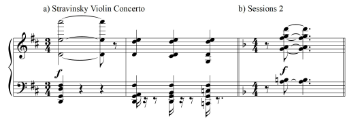
Example 1. Comparison of signature chords in Stravinsky’s Violin Concerto and Sessions’s Second Symphony
(click to enlarge)
[2.2] Special chords with harmonic and motivic properties abound frequently in the music of Stravinsky.(2) Stravinsky’s Violin Concerto, for instance, features a recurring chord in each of its movements that has motivic, harmonic, and formal importance. Sessions often composed similarly. Prausnitz describes, for example, a dissonant chord in the second movement of Sessions’s First Piano Sonata as “a chord that provided motivic inspiration, large-scale harmonic rationale, and even its own logical, if unusual, placing in the completed work” (2002, 95). A comparison of highlighted chords from Stravinsky’s Violin Concerto and Sessions’s Second Symphony is provided in Example 1. Stravinsky’s chord is characterized by the wide spacing but bright sound of the concordant (027) trichord in the violin and the crunchier spacing of the more discordant (015) trichord in the lower pizzicato strings, and by its
[2.3] Sessions’s signature chord similarly offers paths for development and it influences the musical materials found throughout the work in different ways. Andrew Imbrie notes that “Among the unifying points of reference [in the movement] must also be counted a particular chord. . .The chord is not identical in structure each time it appears, but always it is associated with an upbeat gesture and contains either two or three two-note clusters (usually of a whole step), each cluster being separated from the next by the space of either a perfect fifth or a minor sixth” (1972, 26–27). Like Stravinsky’s chord, Sessions’s contains the “tonic” D-minor triad in addition to G and B, which are neighbor tones to A sounding simultaneously with it. The chord is also, in a manner recalling, perhaps, Robert Mayrhofer’s theory of tonal symmetry, symmetrical around D (Thomson 2010), which confers upon D a weak sense of centricity. Though the two composers handle their chords differently, both chords are sonically characteristic, and foreshadow possible tonal(-evocative) and non-tonal elaborations: subversions of tonal-functional conventions, the generation of melodic material from the chords’ intervals, etc. Throughout the work, Sessions’s symphony frequently contains triads or sevenths obscured by the sounding of what would conventionally be understood as non-chord tones, while the whole-tone groupings of the chords, as hinted at by Imbrie above, form important melodic fragments and newer chords throughout the entire movement.
2.2 Bi-Quintal Structure and Layering
[2.4] Joseph Straus argues that a great deal of Stravinsky’s music contains “two structural fifths separated by some interval”—a scheme he refers to as a “bi-quintal” model of harmony (2014, 2). In his earlier work, Straus describes a tonal axis when the fifths together form a referential seventh sonority (1982, 265), but in his later work, bi-quintal structures whose fifths are a semitone apart arise also, for example in his analyses of The Rite of Spring and Jeu de Cartes (2014, 14 and 21).(3) The fifths may be articulated as polytonal chords and/or as the source for melodic ideas, and the scalar filling in of these fifths or fourths may have structural implications for the work as a whole through what Straus calls “pattern-completion” (1982, 283). The structural fifths may also change throughout a passage, suggesting a quasi-modulation.
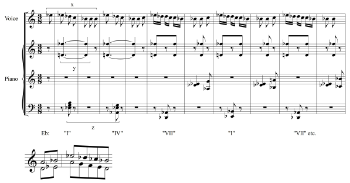
Example 2. Stravinsky, Pribaoutki, measures 1–10; Straus’s analysis—bi-quintal structure and three layers
(click to enlarge)
[2.5] Straus analyzes the second movement of Stravinsky’s Pribaoutki, the beginning of which is provided in Example 2. He argues that the melody spans a perfect fourth,
[2.6] In addition to its bi-quintal structure, the second movement of Pribaoutki contains three layers: the fourth-outlining melody, x; the accompanying dyad, y; and the punctuating chords, z. Each layer produces a different perspective on
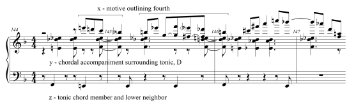
Example 3. Sessions, Symphony No. 2 in D minor, measures 144–47: three textual layers
(click to enlarge)
[2.7] Many passages in Sessions’s symphony pay homage to Stravinsky’s layering technique. The recapitulation of the second subject of the symphony, provided in Example 3, echoes Pribaoutki to a high degree. Again, there are three layers: x, a flowing melody in eighth notes; y, an accompaniment of sustained pitches; and z, punctuating attacks in the bass. Like in Pribaoutki, z includes a neighbor motion that alternates between F and E. Layer y surrounds the tonic D with
[2.8] The similarities between the two pieces are obvious, but the differences are significant, too. Whereas Stravinsky’s piece contains many exact repetitions and a sudden shift from one texture to another, Sessions’s immediately begins developing—that is, the melody repeats with transposition and interpolated pitches, and the accompaniment also transposes and its intervals change. Sessions’s rhythms are irregular and difficult to predict, reflecting Stravinsky’s additive and subtractive rhythms.(4) The z layer begins with attacks every two quarter notes, but the interval shortens in measure 145 to only three, and then three-and-a-half in measure 146. Layer y’s attacks alternate at first between durations of two or three eighths, but later similarly change less predictably. And Sessions’s melody spans an augmented fourth, not a perfect one. The influence of Stravinsky is clear, but the restless, developmental quality departs from the Stravinskian ostinato model. Finally, it is only with the melody’s last two eighth notes that D minor is articulated. Sessions’s loosening of Stravinskian techniques will inform the more detailed analysis of extended passages below: bi-quintal structures will transpose and develop more quickly and the (bi)tonal effects of the layering will be less obvious.
2.3 Tonal Evocation
[2.9] Sessions’s feelings about tonality in 20th-century music are laid bare in his discussion with Edward Cone:
I think really the point is, is tonality the basis of the structure of the piece? But I object to the absolute distinction that some people make between tonal and nontonal music. I don’t think that there is a clear distinction. You can say that such and such a piece by Haydn is tonal and that such and such a piece by Schoenberg or Webern is not tonal; but there are an awful lot of pieces between! Where does one thing end and where does the other begin? What real sense does this distinction make, except for the fact that you can talk about certain music in terms of keys, and that you can learn a very great deal about these pieces if you do talk about them in terms of keys? You can’t talk about certain other pieces in terms of keys and learn much about them. In other words, I think these are useful classifications and only their utility or nonutility is the criterion of their validity. (1966, 41–42)
Certainly, Sessions’s Second Symphony lies, according to his assessment, “between” common-practice tonality and atonality. Like much other 20th-century music, Sessions’s symphony is not thoroughly tonal—tonality is not “the basis of the structure of the piece”—in the common-practice sense, in which we perceive a piece’s tonal functions from its beginning until its end. Instead, Sessions’s music evokes tonality. Tonal evocations arise (even in atonal music) whenever a tonic is, however briefly, implied musically through numerous possible and often innovatory techniques.(5) In most post-tonal pieces that evoke tonality, some other structural logic predominates, or, in especially pluralistic pieces like Sessions’s, it is the confluence of a variety of structural principles that provides the rich if characteristically contradictory logical foundation for the piece. Thomas Johnson offers passages in post-tonal repertories that allude to tonality through the presence of “tonal figurae like triads, metric consonance, parsimonious part-writing, and pitch centricity” (2017, [3.3]). Johnson argues that these specially marked passages function as a topic in a wide variety of 20th-century music. Sessions’s use of key signatures suggests that he understands at least something about the symphony to engage with common-practice tonality. And as Johnson suggests, there are many figures in the symphony, like stepwise voice-leading, brief appearances of triads, and diatonic arpeggiations and scalar passages, that evoke tonality.
[2.10] In his analysis of Sessions’s Second Symphony, Imbrie writes: “The use of conventional key-signatures continues through the Second Symphony and a little beyond; and the aural sense of key is often still present, albeit in attenuated form. Sometimes. . .one has the impression of a tension between possible interpretations; at other times the orientation to a single tonality is clearly evident
[2.11] Stravinsky’s neoclassical works rely partly upon our understanding of his Cubist-like manipulation of conventional contrapuntal and harmonic materials. Maureen Carr (2014) compellingly compares Stravinsky’s pieces composed after The Rite to Russian Cubist and Futurist artists, and compares David Burlink’s Neomorphism with Stravinsky’s “embarking on his path to neoclassicism using similar techniques of superimposition and juxtaposition” (23). Jonathan Cross’s (1998) insightful comparison of Picasso and Stravinsky similarly links Picasso’s cubist blocks with Stravinskian form. Donald Traut appeals to “the role of displacement” in Stravinsky’s music—the unconventional non-chord tones that seem to simultaneously and paradoxically suggest a tonal progression while cancelling it (2000, 71). Daniel Harrison likewise describes “wrong-note music—a technique characterized by nudging the ‘notes’ out of expected paths of continuation,” but argues that in more chromatic environments the resulting irony is “difficult if not impossible to employ” (2016, 139).
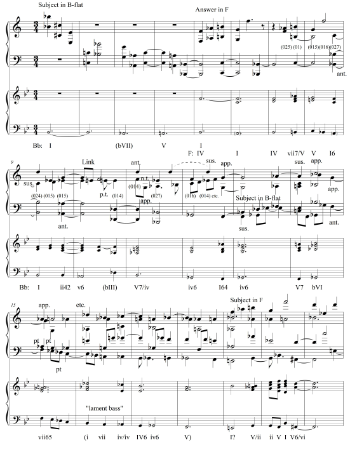
Example 4. Implied tonal harmonies in the fugal interlude from Stravinsky’s Orpheus
(click to enlarge and see the rest)
[2.12] Consider the fugal interlude from Stravinsky’s Orpheus, which was composed contemporaneously with Sessions’s Second Symphony (a reduction is provided in Example 4). The musical surface provides a large number of different sonorities—(025), (015), (016), (014), etc.—without any obvious pattern, and triads and sevenths—(037) and (0258)—appear but rarely. Nevertheless, we discern a succession of implied triads and sevenths—chords familiar to us from the Classical period—that function in
2.4 Atonal Cadential Structures
[2.13] When Sessions pointed out to Schoenberg that he heard a latent D minor in the opening to the latter’s Fourth Quartet, Schoenberg responded by emphasizing more abstract pitch relationships than tonal hierarchies and common-practice syntax (Sessions 1979, 365). The elusive logic of Schoenberg’s music must also have appealed to Sessions, about which he wrote:
It is not easy concretely to demonstrate [in Schoenberg’s post-tonal music]. . . a new tonal principle, powerfully binding like the old but embracing all possible relationships within the chromatic scale. As far as I know, no adequate study of Schoenberg’s work in its harmonic and tonal aspects—aspects which lie deeper than the twelve-tone system or the individual sonority, and guide the ear of the listener in his real apprehension of the music. (1979, 365, my emphasis)
More recent studies of harmony in Schoenberg’s atonal music focus on the form-building role of voice leading. I apply my approach to analyzing Schoenberg’s atonal cadential structures to Sessions’s music.
[2.14] One such Schoenbergian tactic is what I’ve previously described as “chromatic cadences” (“cadence” in the Riemannian sense as opposed to a harmonic-contrapuntal ending device). In my proposed chromatic cadence, a pair of principally unidirectional structural voices, often found in the outer voices and formed from the local crests or troughs of the voice’s contour (i.e., each successive highest or lowest point in the melody) span the entire phrase, and converge or diverge in pitch space. The structural voices begin with linear semitone motion(s), progress through larger intervals, to whole-tone motion(s), and end again with semitone motion(s) (Hier 2023).(8) This “chromatic” or atonal cadence is not unique to Schoenberg’s music— it can be found in music by many composers in the first half of the 20th century—but it is a defining harmonic and contrapuntal feature of his early forays into atonality. Cadences vary in their degrees of closure: those that end with semitone motion are “closed”—analogous form-functionally (if not entirely in musical effect!) to a tonal authentic cadence—and those that end without it are “open”—similarly analogous to a half cadence. Incomplete cadences arise when portions of the cadence are missing: if the opening semitone motion in one of the structural voices is missing, as will be seen in the analyses below, I deem the cadence “incomplete”—analogous to auxiliary or evaded cadences in tonal music.
[2.15] Sessions adopts the same voice-leading technique to punctuate endings of phrases and sections, though the symphony being a highly pluralist work, the chromatic cadence is often supported or contradicted by the presence of other closing gestures, tonally evocative or otherwise. Notably, many passages in the symphony do not end with closed cadences, or contain semitone motion in subordinate voices that do not produce phrase-spanning lines, indicating the marked nature of these gestures when they do arise.
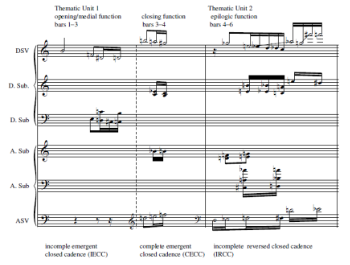
Example 5. Analysis of Schoenberg, op. 19, measures 1–6 from Hier 2023: closure in atonal music
(click to enlarge)
[2.16] Example 5 provides a reproduction of my analysis of a passage from Schoenberg, op. 19, no. 1 (Hier 2023). The open noteheads are structural pitches, and the closed ones are subordinate voices that trace the same or similar voice leadings to the structural voices, reinforcing them and thickening the texture (in addition to playing many other musical roles). In measures 1–3, the descending structural voice (DSV) is formed from the troughs of the top voice’s melody since it descends. In measures 4–6, the lowest voice forms the ascending structural voice (ASV) and the crests of its rising line are indicated with open noteheads. The structural voices themselves contain lines—notated with closed noteheads—that are “subsumed” into the broader structure, like tonicizations in a non-modulating tonal phrase. Here, cadences that end with semitone motion in both voices are stronger and more complete than those that do not. Sessions’s symphony, as we shall see below, frequently contains similar voice-leading structures at important formal articulations, suggesting that chromatic voice leading is a formally significant feature of his compositional style.
2.5 Motivic-Harmonic Structures
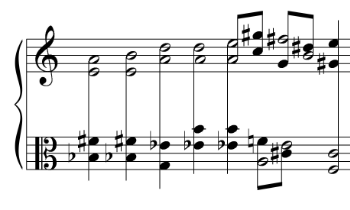
Example 6. David Lewin’s analysis of the chorale from Schoenberg’s op. 11, no. 2
(click to enlarge)
[2.17] The integration of harmony and motivic structure is by no means limited to Schoenberg’s music, but Schoenberg’s early attempts to subordinate at first tonal, and then non-tonal harmony to motivic relationships are well attested to by theorists including Ethan Haimo (1997). David Lewin’s (1994) well-known analysis of Schoenberg’s op. 11, no. 2 with Klumpenhouwer networks illustrates the motivic-harmonic thinking in select, short passages by Schoenberg. Example 6 reproduces Lewin’s analysis of Schoenberg’s chorale. The varied chords share structural principles: they are all combinations of perfect fourths (open noteheads) and major thirds (closed noteheads). The chords can themselves be arranged to form a superstructure, or a “progression of progressions” as Lewin calls it (92), with the same transformational relationships as those of the chords. Repetition of the transformational structures of the chords on multiple levels provides the music with a motivic logic, since motives are defined by repetition. Lewin reconsiders the chorale by parsing it its chords as combinations of (026) and a lone pitch. The new networks yield a similarly recursive superstructure that in turn allows Lewin to provide multiple motivic frameworks, what he calls “modes” (96) for his analysis of the complete piece.
[2.18] Sessions’s symphony frequently includes similar harmonic building procedures. Chorale-like chord progressions are assembled from the combinations of repeating intervals that mirror each other. The repeating intervals are sometimes delineated by timbral or registral differences, but they need not be. The result is a varied palette of chords related by prominent intervals that define the piece’s signature chord.
2.6 Developing Variation
Example 7. Jack Boss’s analysis of a melody’s tetrachordal motives from Schoenberg’s op. 22, no. 1, “Seraphita”

(click to enlarge)
[2.19] Imbrie argues convincingly that “the effect of Schoenberg’s influence on Sessions during the 1930s and 1940s manifested itself in a general heightening of chromatic content, and a bolder differentiation of character among simultaneously sounding parts. This sharpening competition of the musical elements gave rise to a texture whose complexity often rivals Schoenberg’s own. Motivic reiteration becomes less insistent, and the vestiges of ostinato become even more subject to modelling and variation” (1972, 25). In short, Imbrie identifies the process of “developing variation” in Sessions’s melodic writing in conjunction with a weakening of tonal implication and an increase in chromatic contention. Jack Boss (1992) shows this process in a selection of Schoenberg’s atonal music, illustrating how “motivic particles”—i.e. intervals—assemble and reassemble in a constant dance.(9) Example 7 reproduces Boss’s analysis of a short vocal passage from Schoenberg’s op. 22, no. 1. Boss argues that overlapping tetrachords containing primarily semitones, whole tones, and minor thirds undergo a process of continual variation. The resulting melody contains few obvious repetitions, but nevertheless sounds unified, since it contains only a limited number of intervals. Sessions similarly constructs flowing melodies from a limited number of intervals.
3. Analysis of Two Representative Passages from the Symphony
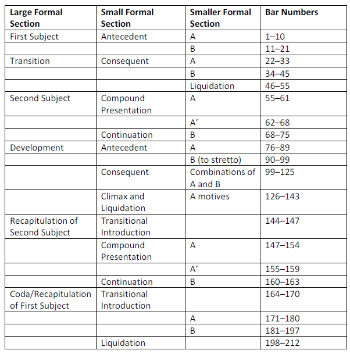
[3.1] Sessions’s Second Symphony was composed during the Second World War and was dedicated to the memory of F.D.R. The symphony is a transitional work between Sessions’s earlier neoclassical works, like the First Symphony, First Piano Sonata, and Violin Concerto, and later, loosely dodecaphonic works. It follows the conventional four-movement scheme. The first movement is in a relatively traditional sonata-allegro form, an overview of which is provided in Example 8. The development section functions as a varied reprise of the exposition with an even larger climax that segues into the recapitulation of the second subject. Finally, the last part of the piece functions as both a coda and a further recapitulation of the first subject. Thus, the movement adheres to what Timothy L. Jackson (1996) describes as a reversed (or “tragic”) sonata-form outline, in which the order of the subjects is reversed in the recapitulation. The movement’s thematic and harmonic materials are well integrated and derive, in large part, from the opening signature chord, discussed above. Example 9 provides a brief survey of the exposition’s principal thematic material. While Olmstead (1985, 78) notes that the opening cascade of pitches in the violin forms a tone-row (with
Example 8. Form of the first movement of Sessions’s Second Symphony (tragic/reversed sonata form)
(click to enlarge) | Example 9. The first movement’s principal thematic material
(click to enlarge) |
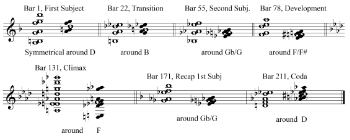
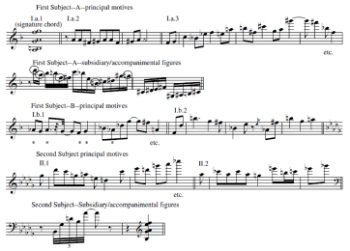
Example 10. Other appearances appearances of the signature chord in Sessions’s Second Symphony
(click to enlarge)
[3.2] Example 10 provides the signature chord and gesture in some of its various guises throughout the work. Unlike Stravinsky’s Concerto, subsequent statements of Sessions’s chord-gesture largely retain its orchestration and metrical placement, but alter its constituent intervals, suggesting already an approach less given to exact repetition. The transition’s signature chord shifts the symmetrical axis to B and brings its orbiting pitches a semitone closer to produce a whole-tone collection. The second subject’s chord is diatonic to
[3.3] Below, I examine two larger, representative passages from the first movement using analytical techniques elaborated above.
3.1 The First Subject (measures 1–22)
[3.4] The first subject of Sessions’s Second Symphony combines the techniques listed above so well that, in conjunction with the overwhelming effect of the music’s discordance and bombast, it can be difficult to make sense of what is happening. Appealing to the techniques will allow us to identify competing and sometimes contradictory structural principles.
3.1.1 Tonal Evocation
[3.5] Following Schenker ([1926] 1996) and Imbrie (1962), we can imagine a harmonic-contrapuntal foundation for the first subject of Sessions’s Second Symphony. The tonal evocations presented below vary in their degrees of strength, so I advise the reader to consider them not only as audible relationships. And having established Sessions’s inclusive relationship with tonality, the structures possibly reflect precompositional design, too.(10) Measures 5–9 of the A section are provided in Example 11. The music contains among the symphony’s clearer and more thorough evocations of tonality, so it is easier to sense “what Sessions may have had in mind.” Example 12 provides a tonal-evocative and motivic analysis of the passage’s melody. Note that the melody’s first emphases on F and A, followed by an emphasis on
Example 11. Tonal evocations in the first subject of Sessions’s Symphony No. 2, measures 5–10
(click to enlarge) | Example 12. Tonal-evocative and motivic analysis of the first subject’s melody
(click to enlarge) |
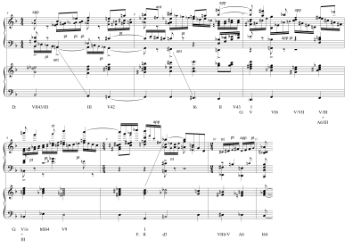
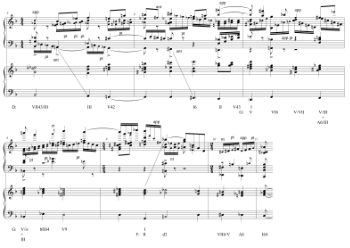
[3.6] Of course, my tonal interpretation is only one possible interpretation among many. A few divergences in the analysis of non-chord tones produces different chords and functions: the second beat of measure 6 could be interpreted as an
[3.7] While hearing the tonal evocations may be difficult, they are crucial for our understanding of the music. As in much 20th-century music, a compositional foundation for the music may not be audible in its totality in the finished product, but it influences greatly what we do hear and also how we interpret the work: by including key signatures and extended gestures that evoke tonality, Sessions asks us to understand his symphony as a member of the tonal-symphonic tradition—tonality as topic, perhaps, following Johnson (2017). Sessions’s neoclassically derived distortions of tonal procedure links his music aesthetically to Stravinsky. Tonality in the symphony functions as a guiding principle that shapes the stepwise outlines of melodies, basslines, and inner voices, and produces occasionally conventional chords like triads and sevenths, but the piece is not tonal in the common-practice sense of the word: it is one starting point among others that shaped the piece’s composition and shapes our interpretation of it.
3.1.2 Bitonality/Biquintal Structure and Layering
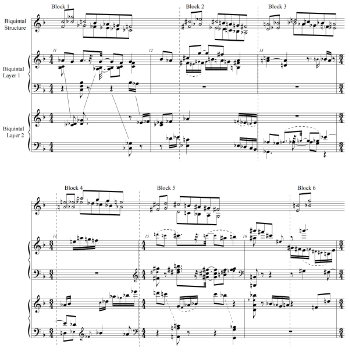
Example 13. Bi-quintal structure of the first subject’s second phrase
(click to enlarge and see the rest)
[3.8] Example 13 provides a biquintal analysis of the first subject’s B section, with the sounding music divided between two layers, each of which corresponds to one of the structural fourth/fifths.(12) The music in layer 1 contains pitches drawn from the first structural fifth, filled in with stepwise motion, and the music in layer 2 contains pitches drawn from the second structural fifth. In some cases, music belonging to one voice or part of the texture moves from staff to staff, indicated by the solid lines and resulting in an absence of rests. Small noteheads indicate loose “non-structural tones,” usually neighbors or passing tones to the pitches that form the structural fifths. I divide the passage’s loose sentential structure into seven blocks, each of which contains a pair of structural fifths. The fifths are perceptible most clearly in the form of stepwise, principally diatonic fragments that group together registrally: in blocks 1 and 5, for example, the upper voices belong to one fifth, while the lower voices belong to another, while in block 6, the outer voices belong to one fifth, while the inner voices belong to another, etc. In some cases, the prevalence of one fifth, like
[3.9] Sessions’s use of bi-quintal/bitonal structures inherited from Stravinsky differs from Stravinsky’s in the speed with which they “modulate.” In other words, longer, relatively static passages defined by structural fifths arise in much of Stravinsky’s music, but Sessions’s more restlessly developmental language results in frequent changes of structural fifths. The rapid change of clashing diatonic collections recalls Ronald Henderson’s remark that “the Second [Symphony] does not allow for aural perception of a stable key center for any duration longer than five or six measures” (1974, 319)—in fact, the duration is often significantly shorter than that.
[3.10] Returning to Example 13, in block 1, the melody outlines
i) Atonal Cadential Structures
[3.11] In addition to evoking tonality and bitonality, the symphony’s first subject contains atonal cadential structures. Following Hier (2023), the A section contains three sections defined by textural and thematic changes—those already proposed in the form diagram above. In measures 1–5, Sessions introduces the signature chord and the first, ostinato-like theme in the piece, which is separated by the next phrase with a pause in the melody. While the texture changes in measure 3, we have not heard enough of the melody to support a phrase division at this point. In measure 6, the texture changes as the trumpet enters with a new theme, the trombones introduce a longer, registrally stable bassline, and new accompanimental voices thicken the music. Finally, the entrance of a new theme and a brand new, more homophonic texture in measure 11, suggests yet a new phrase, that continues until the large pause at the end of measure 21.
Example 14. Atonal voice-leading analysis of measures 5–10: incomplete closed cadence
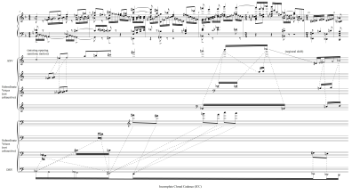
(click to enlarge)
[3.12] Example 14 provides a more detailed analysis of the passage’s structural voices and subordinate counterpoint. The top and bottom staves of the analysis of the reduced score in Example 14 provide the two structural voices—notated primarily with open noteheads—that span the entire phrase and gradually diverge from each other throughout the passage. When taking only the troughs of the bass’s contour, the descending structural voice (DSV) progresses from
[3.13] The inner voices form subordinate-voice fragments that thicken the texture but which do not form phrase-spanning structural lines. The analysis provides some of these subordinate voices but is not exhaustive. While the bass initially falls by semitone, the tenor voice in measure 6 introduces two similar falling semitone motions:
Example 15. Atonal voice-leading reductions of the first subject’s B section: incomplete closed cadence
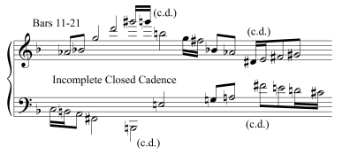
(click to enlarge)
[3.14] Example 15 provides a simpler reduction of only the structural voices for the first subject’s B section, measures 11–21 (see Example 12 for the reduced score). It contains structural voices that change direction (“c.d.” in the example) several times, and an incomplete closed cadence, since the lower voice begins with semitone motion and ends with liquidated material that progresses from whole-tone to semitone motion,
ii) Developing Variation
[3.15] Returning to Example 12, the melody throughout exhibits a Schoenbergian developing variation, in which the thematic totality results from a succession of related motive-forms. The motive contains a first motive, x, containing rising major second and perfect fourth, (+2, +5). Subsequent statements of the motive permute the intervallic relationships. A secondary motive, y, inverts the rising contour and introduces a new interval, the falling sixth. The melody is also, however, the result of transposing major seconds: {F4, G4}, {C5,
[3.16] The B section presents a more obvious, sentence-like “theme,” defined by its intervallic and almost jazzy syncopated rhythmic content. The theme, too, is derived from earlier material: its first measure derives quite clearly from motive I.a.2. Measure 12 is derived from measures 6–7: like in those measures, the melody contains motivic dyads, {
3.2 The Second Subject (measures 55–75)
[3.17] Where tonal and bitonal structures featured somewhat prominently in my analysis of the first subject, especially in my analysis of its harmony, and the melody was defined by relatively loose motivic relationships (i.e., the melody-building roles of motivic particles in a manner echoing Schoenberg’s developing variation), my analysis of the second subject describes the passage’s harmony in motivic terms, and its melody as evoking tonality and bitonality more weakly.
3.2.1 Tonal Evocations
Example 16. Weak tonal evocations in the second subject’s melody
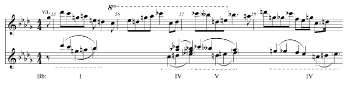
(click to enlarge)
[3.18] Sessions provides the second subject with a
Example 17. Two-staff reduction of the second subject’s continuation phrase, measures 65–75
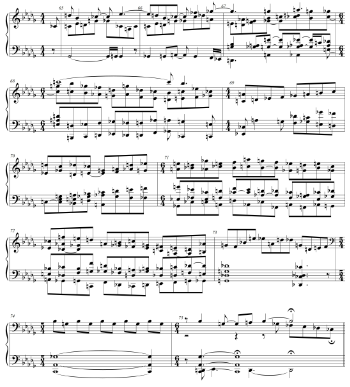
(click to enlarge)
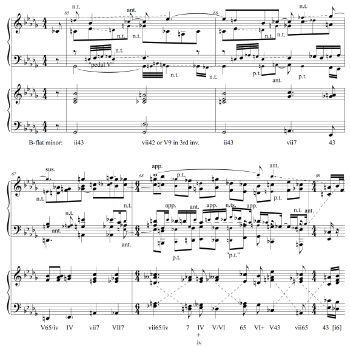
[3.19] Example 17 provides a two-staff reduction of the second subject’s continuation phrase. The final English-horn melody in the second subject provides the missing resolutions noted in Example 15 when it rises G–A–
Example 18. Tonal evocation in the second subject’s continuation phrase, measures 65–69
(click to enlarge)
[3.20] But the first part of the continuation phrase also weakly evokes
[3.21] As in Example 11, one can imagine other tonal interpretations for the passage: the ascending fourth D–G in measure 65 coupled with the resolution of the bass from
3.2.2 Motivic Harmonic Structure
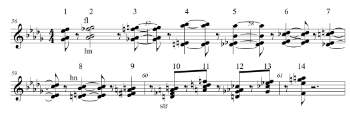
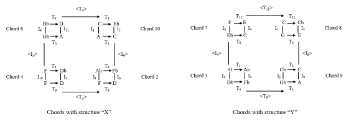
[3.22] Example 19 provides the chordal accompaniment to the second subject’s first large phrase. The passage contains 14 chords derived from the piece’s signature chord’s constituent major seconds. Since the chords are defined by shifting pairs of major seconds, their relationships to one another are well captured by Klumpenhouwer networks. Example 20 provides an analysis of the first four chords and their recursive larger structure. The structure of chord 3 is blown up to form the superstructure of the first four chords. Chords 5 and 9 mark the endings of both halves of the four-measure phrase, while chord 10 begins the varied restatement of the four-measure phrase, and functions as a transition from the first phrase to the second. Chords 6–10 (omitting 9) form a hypernetwork that is positively isographic with the first hypernetwork and is related by ⟨T4⟩. The quasi-cadential chords 5 and 9 also relate by ⟨T4⟩. The hyper transformations reinforce the repeated basic-idea-like foundation of the second subject’s construction.
Example 19. Chordal accompaniment to the second subject’s presentation phrase, measures 56–61
(click to enlarge) | Example 20. Chordal structure of the second subject’s accompaniment, measures 56–61
(click to enlarge) |
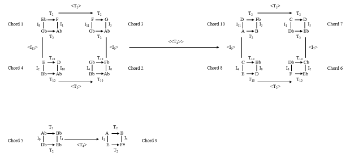
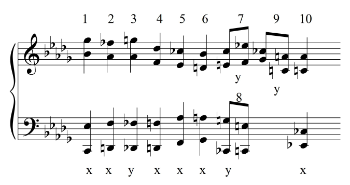
[3.23] The beginning of the large continuation phrase’s chorale is similarly structured around two interweaving K-nets. Example 21 provides the K-net structure of measure 68 to the downbeat of measure 69. The chorale contains two different chord structures, labelled x and y in the example. Example 22 provides hypernetworks for the chords. The chords with structure x group into a hypernetwork which contains chords 2 and 4, which are separated by a y-type chord, and chords 6 and 10, which are also separated by y-type chords. Inversional hyper-transformations connect chords 1 to 2, ⟨I7⟩, chords 4 to 5, ⟨I2⟩, and chords 5 to 6, ⟨I3⟩. While neither hypernetwork shares precisely the same structure as one of its constituent networks, we can still hear shift in the chorale from networks of one type to networks of another. The progression from chords with structure x to y and back to x also provides a call-and-response logic to the chorale that echoes the repeated basic-idea-like design described above. The second subject’s contrast with the first is thus not only affective and textural, but also structural: it offers a calm, highly uniform grouping of chords in place of the sprawling bitonality and displaced tonal functions of the earlier music.
Example 21. Two different chord structures in the chorale, measure 68
(click to enlarge) | Example 22. Hypernetwork of the chorale’s chords, measure 68
(click to enlarge) |
3.2.3 Atonal Cadential Techniques
Example 23. Atonal voice-leading structure of the second subject’s continuation phrase, measures 65–69: incomplete closed cadence
(click to enlarge)
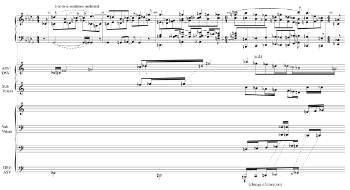
[3.24] Example 23 provides a reduction of the structural counterpoint in measures 65–69. The top structural voice is the faster-moving inner voice beginning with
Example 24. Atonal voice-leading structure of the second subject’s continuation phrase, measures 69–75: incomplete closed cadence
(click to enlarge)
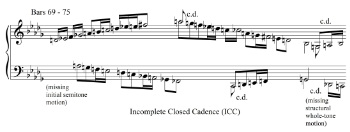
[3.25] The texture changes in measure 69 as the brass and winds take over the chorale and the strings add a quicksilver accompaniment. Example 24 provides a simpler reduction of the structural counterpoint in measures 69–75. The new phrase resembles the first, though somewhat thickened: the melody first gradually rises from D4 to A5, before changing direction and falling down to G3, at which point it changes direction again and rises to
iv) Developing Variation
[3.26] The extended continuation phrase, measures 65–75, culminates in a homorhythmic chorale containing four-note melodic fragments in four or five voices, but most audibly in the top voice. The resulting four- and five-pitch sonorities are difficult to analyze from conventional tonal or set-theoretical perspectives since their discordance precludes an obvious relation to tonic, and the chords differ from one another in their intervallic content. The sonorities’ vertical dimension is less important in my view than its horizontal one, which is captured harmonically/contrapuntally by my analysis of its structural voices and cadence, but which is also captured nicely by an analysis of its motivic derivation.
Example 25. Developing variation in the second subject’s continuation phrase
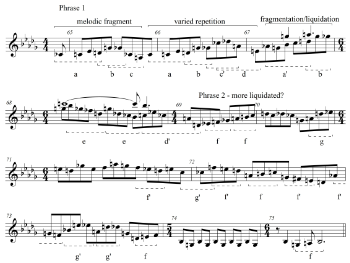
(click to enlarge)
[3.27] The long, arching melodies’ similarity to the excerpt from Schoenberg’s “Seraphita” cited above suggests that it has similar constructive principles. Example 25 provides an analysis of the melody. Unlike Boss, who charts every trichordal grouping, I examine the prominence of specific motivic particles, or intervals classes, and melodic changes in direction. The melody from measure 65 to the downbeat of 74 contains all six interval classes, but these occur a different number of times: ic1 occurs 26 times, ic2 27 times, ic3 seven times, ic4 eight times, ic5 15 times, and ic6 six times. The prominence of ic2 grows beginning in measure 68 as the prominence of ic5 wanes. Tallying the number of melodic moves in the same direction illuminates its serpentine construction: it contains segments in which there is only one motion in a given direction before a change in direction 18 times, two motions in a given direction 13 times, three motions in a given direction seven times, four motions in a given direction four times, and seven motions in a given direction one time. The result is a largely unpredictable melody, but one which clearly favors stepwise motion and frequent reversals of direction.
[3.28] It is better, perhaps, not to speak of it containing discrete, easily recognizable and distinctive “motives,” but of its developing variation arising from its unpredictability, and from loose motivic associations we make while listening to it, though these are buried within the broader melody and not necessarily emphasized by the melody metrically, or in terms of its contour. The first phrase contains varied repetitions of a small number of pitch cells, a, b, and c. Measure 68 brings the first phrase to a close, introduces a falling contour (as discussed above in my analysis of the atonal cadential structure), and introduces a new falling motive, e. The second phrase contains fewer obvious repetitions, but melodic fragment (+2, +1) and its inversion (-2, -1)—labelled f—become more prominent, as do permutations of (016)—labelled g. Cell f derives, of course, from motive I.a.1 in measure 3 of the piece and is, perhaps, the piece’s most recognizable motive, so the predominance of cell f in the melody anticipates the development section’s return to motivic material from the first subject. Overall, the melody is held together by its rhythmic regularity and the internal repetition of closely related motive-forms.
4. Synthesis—Pluralism and Tradition
[4.1] My analysis of the exposition’s two subjects reveals, if only partially, the symphony’s rich compositional foundations. The symphony combines, often within the same short passage, influences from Stravinsky—the use of a signature chord, tonal evocation through displacement, and bi-quintal melodic and harmonic structures—and Schoenberg—atonal cadential structures, motivic-harmonic structures, and developing variation. The first movement is not unified through the exclusive use of a melodic-harmonic structuring technique, in the way that common-practice-tonal or dodecaphonic principles shape much of a piece’s pitch material. Invoking one analytical technology does not suffice to capture the music’s eclecticism. We must accept that no analytical technology, approach, or perspective will provide, by itself, a compelling picture of the piece’s musical structures: a passage is only partly clarified by an appeal to latent (bi)tonal evocations, atonal cadential structures, and motivic relationships, among other principles. The interaction of the approaches also distorts each individual approach: the restlessness of developing variation is at odds with the more static nature of Stravinskian bi-quintal structures, such that their combination produces frequent biquintal modulations that obscure any underlying bitonality; atonal cadential structures that suggest a high degree of closure conflict with tonal evocations that only weakly suggest tonal closure, creating analytical confusion regarding a passage’s formal function; a transformational analysis of a passage’s chords belies its melody’s tonal evocations; and so on.
[4.2] Robert P. Morgan argues that musical modernism contains “the unprecedented stylistic, technical, and expressive variety of the music of the modern age—in short. . .‘linguistic plurality.’” Morgan argues that “despite the numerous attempts that have been and continue to be made to offer a systematic account” of modernist music, it “defies rational comprehension” (1984, 458). While Sessions’s “linguistically pluralist” music might defy facile systematization, it is held together, not by adherence to one structural principle, but through its clear stylistic and generic inheritance. The movement’s adherence to sonata form situates the work within the history of the symphonic repertory, and, as a result, the music comes with certain generic expectations: received formal design, contrasting themes and affects, a developmental dialectic, etc. As a symphony, the work is expected to have a seriousness or at least weightiness, reflected in its wartime composition, its memorialization of F.D.R., and its somewhat conventional teleology: from the struggle of its opening D-minor movement through the elegiac
[4.3] Sessions was well aware of the need to reconcile tradition and stylistic innovation even if the result lacked the perspicuous background-foreground relationships described by Morgan (1984, 451). Sessions argued that:
Definition and classification of styles is an indispensable phase in our understanding of the past, both distant and immediate, and in the process which we call tradition. But tradition on the other hand, can be considered vital only in so far as it includes a vivid awareness, as well as understanding, of the living process of style itself. Possibly, the underlying distinction. . .and the understanding of the distinction, is of the utmost moment for the effective survival of the arts, of culture, perhaps of civilization. . .For styles. . .decay and degenerate if their vitalizing elements are forgotten, and even if they are not constantly renewed by fresh blood and by evolution. (1979, 101)
It is a cruel historical irony that Sessions married elements of early-20th-century musical practice into a unified whole just as the purists of post-war serialism began their cultural ascent. The music of this younger generation, which Sessions would only superficially follow in his loose adoption of the twelve-tone system, dispensed largely with both the traditionalist elements retained in early modernism, and also with the pluralism that enabled composers to mix common-practice tonality, modality, chromaticism, atonality, etc. in favor of a sometimes stultifying if impressively novel international universalism founded on firm, explicit compositional principles. This, perhaps, explains his music’s sudden irrelevance in the post-war era. To quote Philip Clark: “[Sessions] was unfashionable before anyone knew who he was” (2016).
[4.4] At the same time, Sessions’s music remained too difficult for general audiences. Andrea Olmstead surveys the reception of Sessions’s major compositions in his later years: “Both the audience—the composer barely got two bows—and critical reaction [to the Third Symphony] was mostly negative” (2008, 320), “reactions [to Montezuma] were almost unanimously negative” (1985, 136), and “printed reaction to the premiere [of the Eighth Symphony] ranged from outright dislike to the kind of enthusiasm that reviewers feel they should express” (1985, 151). [4.5]Yet, our own time now marks a salubrious return to pluralism. The work of other American symphonists of the 1940s— William Grant Still, Aaron Copland, Walter Piston, Howard Hanson, and Roy Harris among others—whose personal vocabularies combined traditionalist and modernist elements are returning not only to the concert hall but to the academic journal. If Sessions still remains difficult for amateur and seasoned listeners alike, those among us who enjoy and value his music can leverage this pluralist impulse to bring this music the attention it deserves. Doing so requires that we shed the need for dogmatic systematization in favor of locating the pluralist idioms that in unique combination form Sessions’s singularly expressive if macaronic language.
David Hier
Oklahoma State University
Greenwood School of Music
Stillwater, OK 74074
david.hier@okstate.edu
Works Cited
Agawu, Kofi. 1989. “Stravinsky’s Mass and Stravinsky Analysis.” Music Theory Spectrum 11 (2): 139–63. https://doi.org/10.2307/745933.
Boss, Jack. 1992. “Schoenberg’s Op. 22 Radio Talk and Developing Variation in Atonal Music.” Music Theory Spectrum 14 (2): 125–49. https://doi.org/10.2307/746104.
Carr, Maureen A. 2007. Review of The Stravinsky Legacy by Jonathan Cross. Music Theory Spectrum 29 (1): 126–34. https://doi.org/10.1525/mts.2007.29.1.126
—————. 2014. After the Rite: Stravinsky’s Path to Neoclassicism (1914–1925). Oxford University Press. https://doi.org/10.1093/acprof:oso/9780199742936.001.0001.
Carter, Elliott. 1986. “Roger Sessions: A Commemorative Tribute.” Tempo 156: 4–6. https://doi.org/10.1017/S0040298200022051.
Clark, Phillip. 2016. Review of Sessions Music for Violin and Piano. Gramophone.
Cone, Edward, and Roger Sessions. 1966. “Conversation with Roger Sessions.” Perspectives of New Music 4 (2): 29–46. https://doi.org/10.2307/832211.
Cross, Jonathan. 1998. The Stravinsky Legacy. Cambridge University Press.
Haimo, Ethan. 1997. “Schoenberg and the Origins of Atonality.” In Constructive Dissonance, ed. Juliane Brand and Christopher Hailey, 71–84. University of California Press.
Harrison, Daniel. 2016. Pieces of Tradition: An Analysis of Contemporary Tonal Music. Oxford: Oxford University Press.
Henderson, Ronald Duane. 1974. “Tonality in the Pre-Serial Instrumental Music of Roger Sessions.” PhD diss., University of Rochester, Eastman School of Music.
Hier, David. 2023. “Chromatic Function in Schoenberg’s Little Piano Piece, op. 19, no. 1.” Music Theory Online 29 (3). https://doi.org/10.30535/mto.29.3.3.
Imbrie, Andrew. 1962. “Roger Sessions: In Honor of His Sixty-Fifth Birthday.” Perspectives of New Music 1 (1): 117–47. https://doi.org/10.2307/832182.
—————. 1972. “The Symphonies of Roger Sessions.” Tempo 103: 24–32. https://doi.org/10.1017/S0040298200057119.
Jackson, Timothy L. 1996. “The Tragic Reversed Recapitulation in the German Classical Tradition.” Journal of Music Theory 40 (1): 61–111. https://doi.org/10.2307/843923.
Johnson, Thomas. 2017. “Tonality as Topic: Opening a World of Analysis for Early Twentieth-Century Modernist Music.” Music Theory Online 23 (4). https://doi.org/10.30535/mto.23.4.7.
Kaminsky, Peter. 2004. “Ravel’s Late Music and the Problem of ‘Polytonality.’” Music Theory Spectrum 26 (2): 237–64. https://doi.org/10.1525/mts.2004.26.2.237.
Kielian-Gilbert, Marianne. 1987. “The Rhythms of Form: Correspondence and Analogy in Stravinsky’s Designs.” Music Theory Spectrum 9: 42–66. https://doi.org/10.2307/746118.
Lewin, David. 1994. “A Tutorial on Klumpenhouwer Networks, Using the Chorale in Schoenberg’s Opus 11, No. 2” Journal of Music Theory 38 (1): 79–101. https://doi.org/10.2307/843828.
Morgan, Robert P. 1984. “Secret Languages: The Roots of Musical Modernism.” Critical Inquiry 10 (3): 442–61. https://doi.org/10.1086/448257.
Mueller, Peter M. 2017. “Toward a Theory of Formal Functions in Stravinsky’s Neoclassical Keyboard Works.” PhD diss., University of Arizona.
Newton, Neil. 2014. “An Aspect of Functional Harmony in Schoenberg’s Early Post-Tonal Music.” Music Analysis 33 (1): 1–31. https://doi.org/10.1111/musa.12018.
Olmstead, Andrea. 1985. Roger Sessions and His Music. UMI Research Press.
—————. 2008. Roger Sessions: A Biography. Routledge.
Prausnitz, Frederik. 2002. Roger Sessions: How a “Difficult” Composer Got That Way. Oxford University Press. https://doi.org/10.1093/oso/9780195108927.001.0001.
Reti, Rudolph. 1958. Tonality, Atonality, Pantonality. Rockliff Publishing Corporation.
Schenker, Heinrich. (1926) 1996. The Masterwork in Music Volume 2. Edited by William Drabkin. Translated by John Rothgeb. Cambridge University Press.
Sessions, Roger. 1979. Roger Sessions on Music: Collected Essays. Edited by Edward T. Cone. Princeton University Press.
Straus, Joseph. 1982. “Stravinsky’s Tonal Axis.” Journal of Music Theory 26 (2): 261–90. https://doi.org/10.2307/843423.
—————. 1987. “The Problem of Prolongation in Post-Tonal Music.” Journal of Music Theory 31 (1): 1–21. https://doi.org/10.2307/843544.
—————. 2014. “Harmony and Voice Leading in the Music of Stravinsky.” Music Theory Spectrum 36 (1): 1–33. https://doi.org/10.1093/mts/mtu008.
Templin, Aaron 2014. “The Structure and Syntax of Stravinsky’s Neoclassical Cadential Language.” PhD diss., University of Arizona.
Thomson, Sten. 2010. “Robert Mayrhofer’s Theory of Harmony.” MA thesis, University of Alberta.
Traut, Donald G. 2000. “Revisiting Stravinsky’s Concerto.” Theory and Practice 25: 65–86.
van den Toorn, Peter C. 1996. “What’s in a Motive? Schoenberg and Schenker Reconsidered.” Journal of Musicology 14 (3): 370–99. https://doi.org/10.2307/764062.
Footnotes
1. Elliott Carter notes that: “Roger Sessions can perhaps be considered one of the very last composers to have formed his outlook in the pre-first-world-war time and to have held to the standards of that period—as Stravinsky, Bartok, and Schoenberg” (1986, 4). Carter’s somewhat backhanded compliment also speaks to Sessions’s post-WWII anachronism—he was seen as a member of the old guard who was out of step with contemporary musical developments that had far surpassed his self-professed “difficulty.”
Return to text
2. Maureen Carr (2007) for instance refers to well-known chords like the “Petrushka chord,” as well as “emblematic chords” (131) that, though lacking names, play similar roles in other works.
Return to text
3. Straus also cites the formal role of the tonal axis: “[the tonal axis sonority] must function in the piece as a referential sonority. It must occur prominently as a discrete harmony within the piece, particularly in cadential situations. It must be the essential harmonic generator of the piece; other harmonies derive from and relate to it” (1982, 265). The theorist’s desire is clearly born of the desire to produce a new but functionally equivalent “chord of nature” (or artifice, perhaps) for 20th-century music. I am not sure that Sessions’s signature chord, which is a ninth sonority, rises to such demands, but, as will be shown below, the chord clearly has an influential part to play in the symphony.
Return to text
4. For more on Stravinsky’s rhythmic devices, see Kielian-Gilbert 1987.
Return to text
5. Straus (1987) similarly notes the common “allusion” to aspects of tonal organization in much post-tonal music. Straus advocates for the centrality of “associational” coherence in this large repertory and for the paramount importance of “carefully organized large spans” of music (19), and while I disagree that “large spans” are singularly important, it is clear that the combination of tonal and non-tonal structuring principles defines much of this music. More recently, Daniel Harrison’s (2016) exhaustive study of tonal techniques in 20th- and 21st-century music illustrate numerous ways in which composers engage with common-practice tonality, which “survived and flourished, in suitably adapted forms” (9). Sessions’s symphony is less obviously “tonal” than many of the examples Harrison examines since it is rarely diatonic and tertian harmonies only rarely appear. Nevertheless, it does employ some techniques Harrison discusses including the use of colored triads (107), polychords (109), and “wrong-note” music common to many neoclassical composers including Stravinsky, Prokofiev, and Shostakovich (139).
Return to text
6. For more on cadences in Stravinsky’s music see Templin (2014) and Mueller (2017). Templin considers the means by which Stravinsky deviates from common-practice cadential norms, while Mueller categorizes endings according to counterpoint. Mueller’s “contrapuntal endings” recall my atonal cadence described below in the contrapuntal divergence/convergence, but without the same emphasis on melodic intervals.
Return to text
7. For a greater investigation and expansion of Schenker’s analysis of Stravinsky, see Traut 2000.
Return to text
8. Andrew Imbrie (1962) identifies similar concluding, chromatic voice leading in Sessions’s String Quintet, which is, in other respects, largely serial. These chromatic cadences are vestiges of principles of chromatic harmony that survived the adoption of serial procedures. Similar cadences can be found in Schoenberg’s twelve-tone music, as well as in more pluralist works of other mid-century composers.
Return to text
9. Boss, strictly speaking, does not see motivic development in Schoenberg’s op. 22 the way I describe it above: “Variation in atonal music, like variation in tonal music, ‘develops’ in the sense that it creates successions that increase and decrease in remoteness. We can use the same criteria in ‘Seraphita’ for judging the relative remoteness of motive-forms that we use in tonal music” (1992, 135). The problem with this line of reasoning is that, unlike in his tonal music or some other atonal works, Schoenberg rarely provides music that is intended to form the piece’s characteristic motive or theme in op. 22, and without the ability to appeal to cadential devices like those described by Hier (2023), it is difficult to distinguish between genuinely motivic and non-motivic, conventional, or stock material.
Return to text
10. Imbrie’s (1962) analysis of the Violin Concerto uncovers a long melodic line whose gradual stepwise rise is habitually thwarted by the insertion of pitches foreign to B minor and the functional harmony implied by the other diatonic pitches. He argues that the much of the piece’s opening prolongs an implied II chord with a voice exchange,
Return to text
11. This sort of tonal ambiguity is not new to Sessions’s music: the E-minor String Quartet of 1936, for example, flits between E minor,
Return to text
12. While many of Straus’s (2014) biquintal structures are divided into melody and chordal accompaniment, a number of his analysis (e.g. his examples 10, 14, and 18) that investigate more contrapuntal music contain linear expressions of both fifths. Since Sessions’s symphony adopts a primarily polyphonic texture, my biquintal analysis produces linear expressions of each fifth in all blocks. Straus’s analyses also contain loose non-structural tones that enrich (and in some cases obscure) his proposed biquintal structures.
Return to text
Copyright Statement
Copyright © 2026 by the Society for Music Theory. All rights reserved.
[1] Copyrights for individual items published in Music Theory Online (MTO) are held by their authors. Items appearing in MTO may be saved and stored in electronic or paper form, and may be shared among individuals for purposes of scholarly research or discussion, but may not be republished in any form, electronic or print, without prior, written permission from the author(s), and advance notification of the editors of MTO.
[2] Any redistributed form of items published in MTO must include the following information in a form appropriate to the medium in which the items are to appear:
This item appeared in Music Theory Online in Volume 32, Issue 1 in March 2026. It was authored by David Hier (david.hier@okstate.edu), with whose written permission it is reprinted here.
[3] Libraries may archive issues of MTO in electronic or paper form for public access so long as each issue is stored in its entirety, and no access fee is charged. Exceptions to these requirements must be approved in writing by the editors of MTO, who will act in accordance with the decisions of the Society for Music Theory.
This document and all portions thereof are protected by U.S. and international copyright laws. Material contained herein may be copied and/or distributed for research purposes only.

Prepared by Lauren Irschick, Editorial Assistant
Number of visits:
2187