Rore’s Arcane Counterpoint*
Peter Schubert and Sylvain Margot
KEYWORDS: Cipriano de Rore, madrigals, counterpoint, computer-assisted analysis, inganno, Jessie Ann Owens, John Milsom, CRIM
ABSTRACT: Cipriano de Rore’s 1542 madrigal collection differs from much Renaissance music in its lack of repetition. In this study, we find that Rore does indeed use exact thematic repetition, but very little is foregrounded in the usual ways (i.e., appearing after a rest or at the beginning of a syntactic textual unit, or having the same melodic intervals). Rather, it is hidden in unexpected places or varied by inganno or flexing. To find these buried melodic bits, we invoke the aid of computational analysis. We conclude that Rore carefully chooses melodic fragments to build longer lines and to impart a unique character to a section of a madrigal. Sometimes a fragment first appears as an incidental accompaniment, and then later reappears as a principal theme. We offer a thorough analysis of melodic repetition in one madrigal, “Il mal me preme,” to show how Rore uses arcane contrapuntal techniques to delight an audience of initiates.
DOI: 10.30535/mto.32.1.7
Copyright © 2026 Society for Music Theory
I. Introduction: The Problem with Rore’s Early Madrigals
[1.1] The reader who believes, as we do, that repetition is the most powerful element in creating musical form, and the most useful in reconstructing compositional process, will be as frustrated as we were in trying to analyze Cipriano de Rore’s early madrigals.(1) In most imitative textures of Renaissance music, we expect beginnings of text phrases to be set to a melody that is eventually sounded in all the voices.(2) When we examine the music of Josquin and Palestrina, and even the liturgical music of Rore himself, we find much obvious exact repetition of both melodic material and contrapuntal combinations for which we have convenient labels.(3) These are hard to find in Rore’s 1542 madrigals, in which the melodies that set a verse of text are often different in different voices. Rore seems to have been strongly influenced by the music of his supposed teacher, Willaert, whose logic is often equally impenetrable.
[1.2] The problem of abundant melodic variation has been confronted by John Milsom, who coined the term “flexed” to describe melodies like those in Example 1, where we cannot identify a single melody as a theme:
[“Flexed” and “flexing” are] terms used to reflect the modification of a subject’s interval content or durations as it is passed from voice to voice. For example, an upward leap of a fourth by one voice may be flexed into an upward fifth by another voice, or a semibreve may be flexed into a dotted semibreve. If no flexing occurs, then the statement is exact. (Milsom 2016, 328)(4)
Example 1. Madrigal #1, “Cantai mentre ch’i’arsi” mm. 1–7.
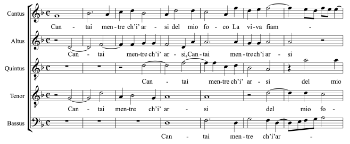
(click to enlarge and listen)
[1.3] Milsom proposes two principal reasons for flexing. One is contrapuntal necessity: Rore “did not always pre-plan his alternative interlocks, and instead superimposed statements on one another intuitively, a process that required some flexing of intervals or durations or both. For this reason, it is sometimes hard to speak of ‘the subject’ in a passage of his fuga
[1.4] Milsom’s other reason, when “flexing is not forced,” is “for the sake of variety or with expressive intent” (2016, 302). This reason seems much more persuasive to us. Irregularity seems to be a hallmark of Rore’s collection, with each voice going its own way. As if to drive this point home, in eight of the 20 madrigals, two of the voices present an interval of the first melody in contrary motion.(5) What makes these melodies seem so natural, and what prevents them from seeming arbitrary, is the rhythm of the text declamation, which is very convincing even without the artifice of melodic imitation.(6) We propose that Rore’s motivation for hiding repetition is to please an audience of initiates, most likely the singers themselves, who would notice hidden repetition and be delighted by it. Hence the word “arcane” in our title.
[1.5] In the following pages, we will demonstrate our three-phase method for finding melodic repetition. Its first step is applied to the opening of madrigal #1 “Cantai”; we then carry out an analysis of a complete madrigal (#10 “Il mal me preme”) applying all three phases; and finally, we show some examples from other madrigals that are suggestive of Rore’s compositional process. We conclude that repeating thematic melodies, which are used sparingly at the beginnings of phrases, can also be found hidden in the middles and ends of phrases, and that Rore’s melodic presentation involves a flexible interchange between what looks ancillary and what looks thematic. This interchange was adumbrated by Jessie Ann Owens (1984) forty years ago, but Rore scholarship never followed up on her observation (see paragraph [6.6] for the relevant passage).
[1.6] Our analysis of madrigal #10 takes place in three phases. We begin by examining exact(7) melodic repetitions at the beginnings of poetic verses or, when verses are obviously divided by a rest in at least one voice, hemistichs.(8) The reason that we begin by looking for exact repetition is that we can be pretty sure that it doesn’t arise by accident, or as the result of contrapuntal necessity, and also to avoid too much subjectivity (“it sounds the same to me”). This focus means that what might appear as embellished versions of a melody will be excluded from our analysis. We mark repetitions on the score by putting the repeating melodies under colored brackets, as shown in Example 2 below. We take the longest segment of exact melodic repetition as analytically more meaningful than shorter or approximate repetitions.(9)
[1.7] In the second phase, we look for exact repetition of melodic material elsewhere in the poetic verses. This is more difficult because we don’t know where in a long melody to start looking without the beginning of a text unit to use as an anchor. For this we get some help from the computer: we focus on those five-note segments that are repeated most often within the madrigal. These tend to lie not at the beginnings of verses but in the middles or at the ends. We mark where in the piece these fragments occur by putting them in colored boxes in the score, and when we examine these “strings” of intervals in context, we can see that they function as primary melodic material, often with the same rhythms and setting the same words. When we put the results of the two steps together (repeated melodies under brackets and those in boxes), we begin to get an idea of how Rore creates a long melodic line by assembling shorter bits. Such a long line can indeed be called the theme.
[1.8] In the third phase, we consider some techniques of melodic variation: inganno, altered rhythm (including dividing/merging notes), Milsom’s flexing, and melodic inversion. These can be called upon to account for many sections of a madrigal where it initially seems that there is no repeating melodic material. The very few places where none of our three analytical methods reveals anything are so rare that they, too, are meaningful (see paragraphs [3.14] and [3.15]).
[1.9] We conclude that there is a great deal of melodic repetition in Rore’s music, but that it is not where we would expect to find it. Finding these repetitions helps us to answer both how Rore might have composed these mysterious pieces and what his intention might have been. We have taken pains to put ourselves in Rore’s place, asking “if we had composed this, what would we have been thinking?” The techniques of hidden repetition, as used by Willaert (Schubert 2022) and Rore, mark the madrigal as the locus of the most sophisticated (arcane) compositional procedures of the period.
II. Exact Repetition at the Beginnings of Syntactic Poetic Units
[2.1] In traditional analysis, any melody that repeats with the same words and roughly the same rhythm is considered thematic. Because the text is so important to musical repetition, we begin by looking at how Rore handles the poem he is setting. Do verses begin with the same melodic material? Do rests occur in the middles of verses, marking caesuras? If so, what does that entail thematically? Are verses enjambed, and how does that play out musically? We follow Martha Feldman (1989) in believing that Rore’s music, like Willaert’s, privileges syntax over versification for musical structuring.(10) Indeed, we find that Rore is scrupulous about inserting rests between syntactic units and, often, not inserting rests between enjambed verses.(11) For the purposes of this study, we will follow Rore’s practice, treating melodies beginning after a rest (or immediately after a previous statement of the same text segment) as beginnings of syntactic poetic units. But we will also treat beginnings of verses enjambed with a previous verse as beginnings, even when there is no rest. This decision gives us a large number of textual occasions in which to look for musical repetition.
[2.2] We demonstrate the first step of our method by looking again at the opening of the first madrigal, “Cantai” (Example 2). Rore has divided the first verse into two sub-phrases by placing rests between “Cantai mentre ch’i arsi” (I sang while I burned) and “del mio foco / La viva fiamma” (from the lively flame of my fire) in the Altus, Quintus, Tenor and Bassus, so we treat “del mio foco” as the beginning of a text unit (the line break is shown with “/”). Another way Rore divides sub-verses is by repeating a part of a verse without a rest, as in the Altus in m. 4. This interruption is further proof that Rore considers “arsi” the end of a syntactic unit. On the other hand, since the first verse is enjambed with the second, Rore places no rests between “foco” and “La viva fiamma” in any of the five voices. Nevertheless, we will allow the latter to be treated as a beginning and we will look for a melodic idea there that might be repeated (indeed, the Cantus in mm. 5–6 is imitated by the Altus in m. 10, bracketed in green).
Example 2. #1, “Cantai mentre ch’i’arsi” mm. 1–22.
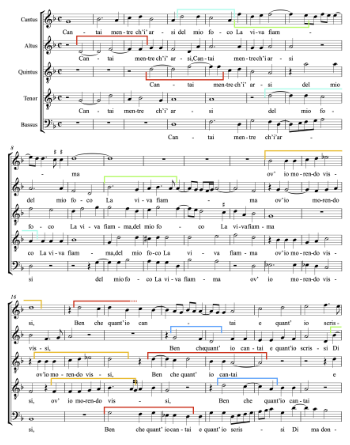
(click to enlarge and listen)
[2.3] In the first verse, four of the five voices begin with an ascending minor third. This imitation might tempt us to expect the lines to contain further similarities but only two voices share the next melodic interval (a unison in the Altus and Quintus, bracketed in red) while the others proceed with different intervals. Our threshold for meaningful repetition is two intervals, so all of the melodies bracketed in Example 1 contain at least two intervals that are shared by two or more voices. The second verse is also divided into two phrases, with rests between “fiamma” and “ov’io,” and the phrase beginning “ov’io” gets its own repeated tune (bracketed in orange).(12) This orange-bracketed melody is presented as a conventional point of imitation in three voices. The third verse, however, has two different repeated melodies associated with the first words “Ben che quant’ io cantai” (one bracketed in red, one in blue), so that the five voices do not present a unified point (the first one of these in the Cantus, in m. 17, is a partial repetition, so the bracket is left open on the right).
[2.4] Although we are rigorous about exact successions of diatonic intervals, we accept some rhythmic alterations that Rore makes in repeating his melodies. These variations include metric shifts and altered durations. In the second verse Rore lengthens “La” and shifts “viva fiamma” by a semiminim (compare Cantus mm. 5–7 and Altus mm. 10–11). In the third verse, in Bassus and Quintus, he keeps the durations for “Ben che” but shifts their metric position; however, by changing the duration of “quant’” he gets “io” of “io cantai” back on the strong part of the semibreve. These alterations mostly involve the basic values of semibreve, dotted minim, minim, and semiminim that are the rhythmic stuff of all the madrigals. When these rhythms are changed at the beginnings of verses, they are only slightly altered and retain good prosody; consequently, we do not differentiate melodic repetition altered rhythmically and focus instead on successions of intervals.
[2.5] From this investigation of the first 22 semibreves, it looks like repeated melodic material is most often sounded in only two of the five voices, and that the longest repeated melodies are two, three, four, and six intervals long. This is pretty much true throughout the madrigal: Example 3 tallies the number of intervals in repeated melodies that begin at the start of a verse or the second part of a verse, and the number of voices that repeat them. Because the bracketed melodic fragments have similar or identical rhythms and the same text syllables, we call them thematic.
Example 3. Repetition at beginnings of syntactic units in #1. The number under “int’s/voices” is the number of common intervals greater than one shared by two or more voices; the letters after the slash are the voices that share those intervals; parenthesized voices have incomplete repetitions; when there are no rests in any voice between elided verses, these are marked by an asterisk.
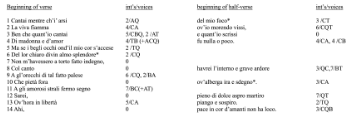
(click to enlarge)
[2.6] In madrigal #1, the average number of intervals shared by two or more voices at the beginning of a syntactic unit is only 3 (including those voices that have no intervals greater than one interval in common), and the average number of voices that share intervals is only 2.3 (including those partial repetitions in parentheses). Example 3 also shows some undivided verses (5–6–7, 9, and 11) that contain no rests, so that all 11 syllables are set in a continuous rush; in some of these (7 and 9), the voices have no shared material at all at their beginnings.
[2.7] Example 3 shows how slim the pickings are for repeated melodies in madrigal #1, and the rest of the madrigals have similar profiles. For instance, Example 4 shows the same kind of information for madrigal #10, “Il mal me preme.” Here again we find relatively little repeated melodic material at the beginning of a significant text phrase, although the averages are a little higher. The number of intervals shared is 4 and the number of voices that share intervals is 3. A striking outlier here is the first line of the final tercet, which has a melody 20 intervals long that is repeated; this will be discussed in the following section, a complete analysis of #10.
Example 4. Repetition at beginnings of syntactic units in #10. The number under “int’s/voices” is the number of common intervals greater than one shared by two or more voices; the letters after the slash are the voices that share those intervals; parenthesized voices are incomplete repetitions; when there are no rests in any voice between elided verses, these are marked by an asterisk. The same letter can appear twice when a phrase of text is repeated in the same voice.
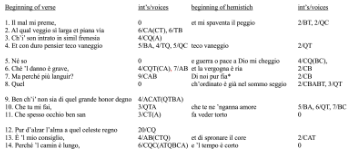
(click to enlarge)
III. Exact Repetition Anywhere in #10 “Il mal me preme”
[3.1] It was fairly easy to find the fragments bracketed in the score in Example 2 because we focused on the beginnings of syntactic units and we accepted interval successions of any length greater than one. But we were able to explain only a tiny fraction of the music in terms of thematic repetition. Might there be other exactly repeated material elsewhere? To find all the repeated melodic fragments of any length wherever they occur is a tall order. For instance, in Example 2 there are nine instances of an ascending step followed by a descending third, none at the beginning of a text phrase; can they be called thematic? How long must successions of intervals be to be meaningful? Must they be associated with text? Must they have the same rhythm?
[3.2] This is where a computer can be handy, because it can scan the melodic lines for repeating successions of intervals, which we call “strings” (for a description of the CRIM software and how we used it, see Appendix 2).(13) Many of these sequences seem so “generic” that we could never find them by just scanning the score. Our program has to be told how long a string to find, and we settled on five notes (four intervals). A shorter string would appear in greater numbers and be unmanageable. A longer string is less likely to be an accident or the result of some contrapuntal exigency or caused by some other factor, and is consequently more persuasive as to compositional intention. But a much longer string would appear so infrequently as to be more or less meaningless. We let the computer find these strings measured in diatonic interval sizes, not qualities, so that all diatonic transpositions are found (later when we see them in context we can decide whether semitone positions are meaningful or not). Strings are shown in square brackets, with ascending diatonic intervals as positive integers and descending intervals as negative integers. We then filter for the strings that occur most frequently in the madrigal. For manageability, we examine only the top five. Finally, we bring this data back into the score to see where these strings occur in context: what word(s) are they associated with? What rhythm do they have? Where are the semitones in them? Combining the thematic melodies with these strings enables us to answer broader questions: Can meaningful melodic material occur in less foregrounded places, like the middles or ends of longer melodies? Does any melodic material occur in more than one poetic verse, conferring melodic consistency to the piece as a whole?
[3.3] Our focus is musical construction, not how a listener perceives the music. To use Nattiez’s terms (1990, 135–36), we make observations on Rore’s music based on the “immanent” evidence (the score) to say something about compositional structure (the “poietic”), not to address the listener’s reception (the “esthesic”). The strings that the computer finds may be salient to some listeners and not to others; or perhaps some listeners or singers will learn to hear these melodic items once they have been pointed out. Because the strings are shown in boxes, it may look like we think they are musical items with distinct, determinate beginnings and endings. This is not the case. They are convenient amounts of music that get mixed into longer lines, like food ingredients blended into a recipe, and they may be preceded or followed organically, seeming inseparable from their context. Occasionally they are set off by rests and appear at the beginning of a syntactic unit (see paragraph [3.8]), but this is not always the case (see paragraph [4.3] for an example of a string that is seamlessly embedded into a longer line). We think it likely that singers, who are “inside” the piece, might after a few run-throughs notice and appreciate the repeating melodic material.
[3.4] Now we turn to the analysis of a complete madrigal, #10 “Il mal me preme.” (A translation of the text is given in Appendix 1.) In Example 5, the beginning of the prima parte, the five most frequently occurring five-note strings are identified to the left of the score by their diatonic intervals (e.g., 2 is an ascending second, −3 a descending third). These are boxed with numbers showing how often they occur in this madrigal (the most frequent in red, with colors cooling to blue, the fifth most frequent), and in the score these strings of notes are enclosed in correspondingly colored boxes. When we mark the occurrences of strings in the score, we see that some of the most frequent strings appear “randomly” (i.e., with very different rhythms and different words), while others have nearly identical rhythms and the same text syllables, and so deserve to be called thematic. Example 5 has also been annotated with brackets on the same principle we used in Example 2, where we looked for repeated melodic material at the beginnings of syntactic units. (The colors of the brackets are random and have no relation to the colors of the boxes, which reflect frequency of occurrence.)
Example 5. #10 “Il mal me preme,” first quatrain (mm. 1–40). Brackets have been placed over thematic material that repeats at the beginnings of syntactic units; boxes enclose melodic strings that the computer has found.
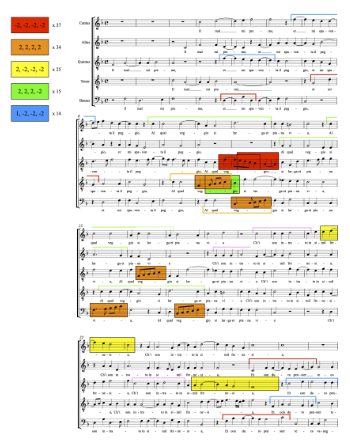
(click to enlarge, see the rest, and listen)
[3.5] The first verse contains none of the five strings that appear most often and only two thematic melodies, bracketed in red and blue, that set the second hemistich of the first verse. This might seem disappointing, but we will find some more evidence of repetition in paragraph [5.2] under “Types of Variation.” In the second verse, the computer has identified five strings in orange boxes in the lower voices in mm. 10–12 and 15–17. In these ascending scales, the rhythms are almost identical (the first note can be a fusa or a dotted semiminim and the last four are always fusae). The orange-boxed melody is a segment of a seven-note thematic string that we bracketed in orange in the Tenor and Bassus in mm. 10–12, but Rore has broken off the first two notes to repeat the five-note ascending string. (We did not bracket these fragments because the melodies setting the first two syllables, “Al qual” are not the same in mm. 15–17.) The orange- and red-boxed strings will be discussed further in section V under “Types of Variation.”
[3.6] The third verse, “Ch’i son intrato in simil frenesia,” is set with a five-note thematic segment in the Cantus and Quintus (bracketed in magenta), and a partial segment in the Altus. The Cantus and Quintus continue with a five-note string [2, −2, −2, −2] boxed in yellow; these strings have identical rhythms and set the same word, “frenesia.” The longer melody made of the magenta-bracketed tune plus the yellow-boxed tune occurs twice, and, except for a little hiccup or flexing in the middle, accounts for ten of the eleven syllables in the line. The yellow-boxed tune can be understood to be part of a longer theme because of the sameness of rhythm, because it sets the same text syllables, and because of its context (i.e., being associated twice with the magenta-bracketed theme). We believe this longer melody is “the theme.” The joint between the bracketed theme and the yellow string (the hiccup) will be explained later in section V under “Types of Variation.”
[3.7] The fourth verse, “Et con duro pensier con teco vaneggio,” gets a long treatment, with thirteen statements. The first syllables are set to three different repeating melodies, bracketed in red, blue and green in mm. 26–37. The red-bracketed theme in the Altus (m. 27) is followed by the [2, −2, −2, −2] string in a yellow box on the word “vaneggio.” The green-boxed ones in the Quintus (m. 31) and Cantus (m. 35) are also followed by the same string on “vaneggio.” Finally, the Cantus (m. 30) and Altus (m. 32) have different non-thematic tunes followed by the same string on the same word. The five occurrences of the yellow-boxed string set the same word and have almost identical rhythms (the second note is always a dotted semiminim) and are twice joined to the green-bracketed theme (with a little flexing in the middle on “teco”). So, as with the third verse, we can say that this longer melody, occurring twice, is the theme. And, since the five yellow-boxed strings in mm. 30–39 are approximate rhythmic diminutions of those in mm. 21–27, we can further say that this string unifies verses 3 and 4. The larger role played by the yellow-boxed string will be discussed in section IV.
Example 6. The second quatrain of #10 “Il mal me preme,” mm. 40–87.
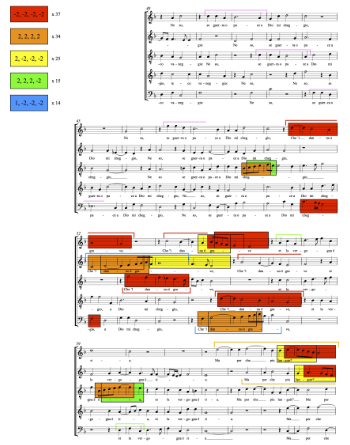
(click to enlarge, see the rest, and listen)
[3.8] The second quatrain (verses 5–8) begins with a two-note hemistich, “Ne so,” after which “se guerra o pace” is presented in conventional imitation in Cantus, Quintus and Bassus, followed by two more partial entries (see Example 6). The second verse represents a real departure from what we observed in the first quatrain: the most common five-note strings are now found at the beginnings of verses, so they coincide with our bracketed thematic melodies. Verse 6, “Ch’el danno è grave” is set to two different repeating melodies, both of which begin with the most frequently occurring strings, the ascending and descending scales. The tunes boxed in yellow in this verse (Altus and Cantus in mm. 53–55) are not related to the ones in verses 3 and 4, sharing no rhythm or words.
[3.9] The thematic statement on verse 7, “Ma perche piu languir” is sounded in three voices (Cantus, Altus, and Bassus), and contains the same yellow-boxed string that ended verses 3 and 4 of the first quatrain [2, −2, −2, −2]. This last string overlaps with the scale (boxed in red), has similar rhythms, and the same word “languir,” and may be called thematic. Two other voices (Quintus and Bassus) begin differently but also end with the same string; we might not have noticed all five of these repetitions at the ends of verses without the computer.
[3.10] The first word of the final verse (“Quel”) is enjambed with the end of the previous verse and separated from the rest of the verse by rests in two voices (Cantus and Bassus). The remainder of this verse (“ch’ordinato
[3.11] Example 7 shows the first verse of the first tercet (verses 9–11), which begins with four voices in conventional imitation (bracketed in light green in mm. 88–91) and the second verse begins almost immediately (after four and a half semibreves) in the Quintus with the same four-note theme. This is a case where the identical music sets two different text phrases (“Ben ch’i non sia” = “Che tu mi fai”).(14) The second part of the second verse “che te ’nganna amore” has three different but very similar melodies (bracketed in red, magenta and blue in mm. 100–108). The third verse of the tercet (“Che spesso
Example 7. The first tercet of #10 “Il mal me preme,” mm. 88–120.
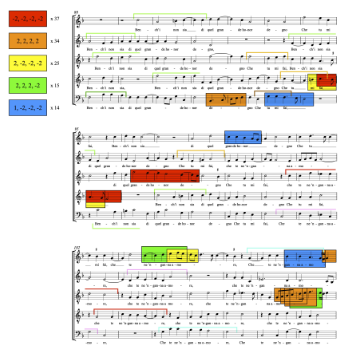
(click to enlarge, see the rest, and listen)
[3.12] The final tercet (verses 12–14) begins with a verse all of whose eleven syllables are set to the same melody twenty-one notes long in the Quintus (mm. 121–27) repeated an octave higher in the Cantus (mm. 125–31). These two long melodies contain the yellow- and red-boxed strings overlapping (on “-ste re-”), as well as the green-boxed string, and they are counterpointed with the orange- and blue-boxed strings: an assortment of all five top strings! (The green-boxed string in mm. 126–28 is not thematic, having different words and rhythm.)
[3.13] The second verse enters in the Tenor in m. 125 at the same time as the second of these long melodies. The beginning of the second verse (“E ’l mio consiglio”) is set to a five-note repeating tune (bracketed in magenta, often sounded incomplete). This is broken off from the continuation (“e dispronare il core”), which contains the yellow string in two voices (Cantus and Tenor) overlapping with a long descending scale (on “-re il co-”), similar to that in the first verse. A final occurrence of the yellow-boxed string comes on the same syllables as the previous two. These five yellow-boxed strings and seven red-boxed descending scales also seem to be thematic.
[3.14] The final verse is astounding, as the five most common strings disappear entirely between mm. 142 and 152, and a single thematic tune saturates the texture (bracketed in light blue in Example 8). This tune sets 12 of 19 statements of this text phrase (“Perche’l camin è lungo”—the other seven entries are non-thematic). The second part of the verse (“e’l tempo è corto”) is also remarkable, as the text phrase occurs 18 times set to 17 different melodies (only two contain the minimum two intervals the same, bracketed in magenta). Can this be an accident? One might think a few intervals in a row would turn up just in the course of writing counterpoint.
Example 8. The final tercet of #10 “Il mal me preme,” mm. 120–64.
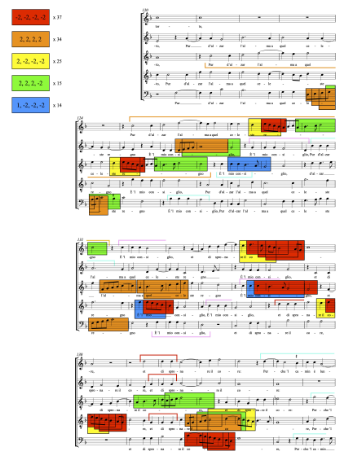
(click to enlarge, see the rest, and listen)
[3.15] Complete absence of one or more strings (like its opposite, saturation of a point by a single theme) only provides more proof that Rore is carefully managing these short fragments. Another example of meaningful absence is the omission of red-, orange-, and green-boxed strings in mm. 18–48 (see Examples 5 and 6); this is perhaps intended to set up the sudden abundance of red- and orange-boxed strings in mm. 49–73. If these strings were “just counterpoint,” we wouldn’t have such long passages of the piece with such motivic consistency. Our conclusion up to this point is that if we look at the bracketed themes and the boxed strings when they occur together, we see that Rore often combines them so that, taken together, they form a complete setting of all eleven syllables of a verse (see Example 11 below). In the following section we argue that the boxed strings can have thematic status beyond the confines of a single point.
IV. Large-Scale Motivic Consistency
[4.1] The yellow-boxed string occurs more often in “Il mal” than in any of the more obviously “thematic” tunes we bracketed. If we look at the 25 occurrences of the [2, −2, −2, −2] string as it appears throughout the madrigal, we see that sixteen times it is a part of five longer melodies. We can discard the other nine times it occurs as random elements or as the result of contrapuntal exigencies, appearing “accidentally” with different rhythms and words.(15)
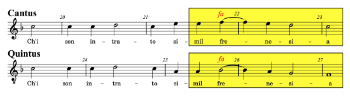
[4.2] In Examples 9a–e we have laid out the 16 occurrences of the [2, −2, −2, −2] string that appear as parts of longer melodies. Examples 9a and 9b excerpt what was discussed in paragraphs [3.5] and [3.6]. Example 9b has the most variation in the beginnings of the verses, the others are varied in minor ways. In Example 9c the beginning is rhythmically shifted so that “-che” appears variously on the strong part of the minim and the weak part. In Examples 9c, 9d, and 9e the string appears in the middle of a longer melody. In Example 9d the melodies are identical all the way through. In Example 9e the beginning is slightly varied.
Example 9. The yellow-boxed [2, −2, −2, −2] string as it occurs in five longer melodies throughout #10. a. mm. 19–27; b. mm. 27–39; c. mm. 62–72; d. mm. 121–31; e. mm. 133–39
(click to enlarge and see the rest)
[4.3] Applying the same melody to different words may mean that Rore wanted to connect “vaneggio” with “frenesia”; or, in one of the “random” occurrences of the yellow string (mm. 75–76 in Example 6), that he wanted to rhyme “vaneggio” with “-mo seggio”; or perhaps he simply wanted to give motivic consistency to these five long melodies. In 8 of the 16 occurrences, the yellow-boxed strings have fa as the syllable for the top note (shown in red in Examples 9a–e) and these are always the highest notes in the verse; seven of the others have mi as the highest note of the yellow-boxed string, but that is never the highest note in the verse. The ones with E-mi on top always continue down one more note to avoid a tritone outline, while the ones with fa on top can stop on ut or turn back. As mentioned in [3.3], we do not believe that Rore had clear limits in mind on the beginnings and ends of these strings; he could embed these smaller melodic fragments in a wide variety of ways. These solmization considerations may have some modal significance, but that is beyond the scope of the present study.
V. Types of Variation
[5.1] The two types of alteration that we accepted in the examples above do not particularly disturb our sense that music is being repeated. The first type is when only the beginning of the melody is repeated (see paragraph [2.3]), and the other type is when the rhythm is changed in some inconspicuous way (see paragraph [2.4]). But there are additional ways composers can conceal repetition. One of these is inganno, a commonplace principle of Renaissance variation.
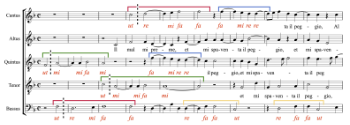
[5.2] As noted, the opening of “Il mal” seems to have no tunes that repeat; in mm. 1–9, the five voices have entirely different melodies moving by different intervals in different directions, and they contain none of the top five strings in that madrigal (see Example 10). At first glance, we might take the Bassus and Tenor entries as flexed versions of a theme that begins with a descending minor third. But if we invoke inganno, we can find longer structural repetitions. Inganno is a variation technique in which the solmization syllables of a tune are maintained but the actual notes can change because the syllables are drawn from different hexachords.(16) In this case we see that the Bassus is actually imitated by the Cantus with the syllables ut re mi fa fa (red bracket), although the ut in the Bassus comes from a different hexachord than the rest of the line (shown with a dotted line between ut and re). Likewise, we might have taken the Cantus to be a be a flexed version of the Quintus (an ascending third replaced by an ascending step), but we see that the Quintus is actually imitated by the Tenor (green bracket) with the syllables ut mi mi fa mi, the change of hexachord again shown with a dotted line. In the first four measures, only the Altus is free. The subsequent tunes bracketed in blue and yellow are imitated exactly at the octave and the unison respectively, but because they are not introduced until the texture is thicker, we barely notice their simpler presentation.(17) Thus Rore starts off with two pairs of soggetti, but their variation, along with the irregular time and pitch intervals of imitation, conceals these resemblances.
Example 10. The opening of #10 “Il mal me preme,” mm. 1–9. Switches of hexachord are indicated by dotted lines.
(click to enlarge and listen)
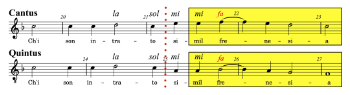
[5.3] Inganno is also responsible for the joints between the thematic tunes on “Ch’i son intrato” and the yellow-boxed continuations on “simil frenesia” in mm. 18–27 (Example 11). The red dotted line indicates the switch of hexachords. Now we can see that all 11 syllables are set to the “same” tune, which now is unquestionably thematic, setting a complete poetic verse.
Example 11. Inganno in #10 “Il mal me preme.”
(click to enlarge)
[5.4] Sometimes intervallic flexing other than inganno connects two longer thematic statements. Flexing for this purpose is found in mm. 15–17 (Example 5). If we accept one flexed interval in “si larga et piana via” (the G in the Tenor) and the repetition of the long C and A in the Cantus (indicated with dotted lines in Example 5), the scales can be understood as passos against a cantus firmus in the technique known as contrapunto fugato (Schubert 2020). Four of the five passos set the same word and have almost identical rhythms. And, accepting the red-boxed scale as a variant (the inversion) of the orange-boxed one, we have six passos against the cantus firmi in Cantus and Tenor. The verse “si larga et piana via” being set to long repeated notes is a likely instance of word painting, and, at the same time, the different methods of thematic presentation articulate the successive verses (Example 13 below summarizes presentation types with verses).
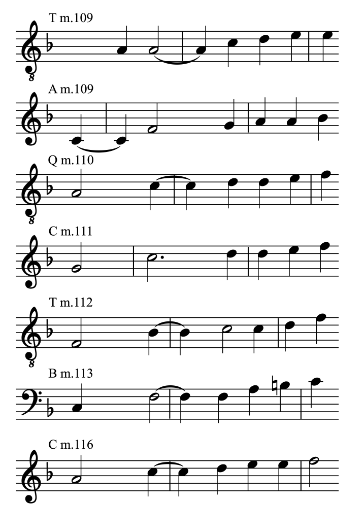
[5.5] Another means of variation involves inserting or deleting repeated notes. In mm. 114–20 (see Example 7), we found no repeating material on “che spesso occhio ben san fa veder torto” (shown in Example 12). The first part of this text phrase is repeated several times on very similar melodies that are varied by the placement of repeated notes. Some rise to the word “san” an octave, some a seventh, some a sixth. This is a rare case of deliberate flexing while the melodies would seem to sound the “same.” Perhaps these “che spesso occhio ben san” themes, all different, are a clever way of painting the text (“which oft makes a healthy eye see awry”); since each melody isn’t quite right, the theme is out of focus. (The “fa veder torto” phrases are mostly cadential.)
Example 12. Flexed versions of the “che spesso occhio ben san” theme.
(click to enlarge)
[5.6] We can now look at the whole piece to see how repeated thematic material occurs in each verse. Example 13 shows a summary of thematic presentation in “Il mal.” Several things are striking. First, out of 23 text phrases, nine of them, shown in red, are set to more than one musical theme. Second, the five times we find themes internally containing strings (“theme + string”) show the usefulness of getting the computer on board (and remember that more strings not associated with a bracketed theme and occurring at the ends of verses do not appear in Example 13). Third, most themes are repeated only twice (“x2” or “x2ea.”), although partial repetitions and boxed strings occurring at the ends of verses are not shown in Example 13. An outlier is the 14th verse, “Perché ‘l camino è lungo,” whose longest version is repeated five times, along with seven more incomplete statements.
Example 13. Summary of themes in #10 “Il mal me preme” by verse. “/” = hemistich caesura made by rest; “theme” = longest bracketed melody at beginning of syntactic unit; “x2” = number of voices that carry the longest statement of a bracketed theme, or a theme combined with a boxed string; “2 themes x2ea.” = each of the two themes occurs twice.
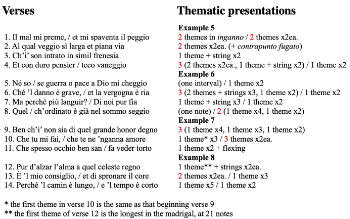
(click to enlarge)
[5.7] We conclude that Rore is consistent in his gradual release and limited distribution of repetition. Many complete 11-syllable verses are set to complete long themes—once we take into account the bracketed themes, the boxed strings, and the possibility of inganno or flexing—but they tend to appear only twice in their longest form, with fragments distributed in unpredictable ways.
VI. Singletons as Hints of What’s to Come
[6.1] We noted that some boxed strings appear “randomly” (i.e., with different words and rhythms). We conjecture that some of these might be foretastes of strings that are later used thematically, especially if they have the same rhythm. For instance, the blue-boxed string in Example 6 on “sommo seggio” at the end of the prima parte first occurred earlier with different words and slightly different rhythm in Example 5. These, we can imagine, are introduced as counterpoint to a repeated thematic melody. In madrigal #5, a green-boxed [−2, 1, −3, 2] string is sounded as one of many different counterpoints to the theme [1, 1, −2, −2, 2] that sets the first seven syllables of the verse “Che spesso nel suo volto veder parme” (bracketed in black in Example 14a). It’s as if Rore particularly liked a one-time accompanimental melody and kept it in his pocket for later.
Example 14. a) #5 “Solea,” mm. 37–43. In addition to the green-boxed string, two other counterpoints to the “Che spesso nel suo vol-” theme also reappear later in the madrigal: the red-boxed string and the yellow-boxed string (the latter comes back in its own point of imitation in mm. 118–34, not shown here). b) #5 “Solea,” mm. 45–53.
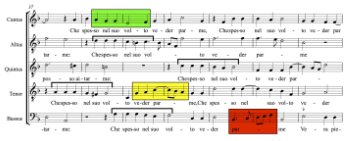
(click to enlarge, see the rest, and listen)
[6.2] A few breves later (mm. 45–53, Example 14b), a point is saturated with the same green-boxed string, used to set two segments of a verse: “Vera pieta con” and “grave dolor mista.” We would never have noticed the relationship between the first occurrence of the green-boxed melody and the later ones without the computer.
[6.3] Another example of a secondary melody becoming a principal tune much later is from #16 “Far potess’io.” Example 15a shows the first occurrence of this red-boxed string [−2, −3, 2, 2] in mm. 29–35, where it is a part of a longer theme (overlapping with two strings boxed in blue) on the words “Celando gli occhi a me si dolci et rei.”
Example 15. a) #16, “Far potess’io,” mm. 29–35. b) #16 “Far potess’io,” mm. 115–30. The large repeating block appears in a dashed box.
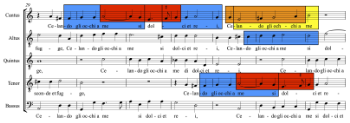
(click to enlarge, see the rest, and listen)
[6.4] Example 15b shows the final point of this madrigal (mm. 115–36), which contains a large block (mm. 115–23) that is repeated (mm. 126–34).(18) The red-boxed string from Example 15a, now mostly overlapping with an orange-boxed string, forms the theme at the beginning of the syntactic unit. The rhythmic profiles of these red-boxed strings at first may seem quite different from those in Example 15a, but even within the final point they are rhythmically varied and metrically shifted by a semiminim. So it doesn’t seem far-fetched to make this connection, especially since they occur at the beginning of a syntactic unit. This final point has a lot of irregularity because the time intervals between the entries are almost all different.(19)
[6.5] Using an earlier countermelody later as a principal theme is a technique Zarlino describes 16 years later (Schubert 2023). Rore may be riffing on what Zarlino calls “comporre di fantasia,” but instead of foregrounding the countermelody right away, as Zarlino illustrates, Rore delays its use, often for many measures, bringing it back in later points of imitation. Once again, to prevent us from immediately knowing what is going on, Rore lets us forget that countermelody. Only when we sing the piece many times might we recognize and admire the attenuated association.
[6.6] The idea that Rore might have first composed an accompanimental line and then subsequently fashioned a theme against it was suggested by Jessie Ann Owens forty years ago, when she wrote:
The revisions in this point of imitation show that in order to understand how a point was composed one must go beyond the simple distinction between motivic and non-motivic voices and consider how the parts work together to form contrapuntal events. Thus, even though the quintus contains non-motivic (“filler”) material in measures 118–121, it was composed before the two voices—cantus and tenor—that present the main motive. The revisions also show that Rore used the partbooks as he composed. He wrote the first version of the quintus into the partbook before he had composed the motive entries in the cantus and tenor. (1984, 287)
VII. Conclusion
[7.1] We are pleased to have been able to follow up on Owens’s insightful observation. While Rore’s themes are often mysterious and unpredictable, his music always sounds “right.” This “rightness” in the 1542 madrigаls comes from his impeccable prosody, conservative voice leading, and restrained use of dissonance and chromaticism.(20) The unpredictability comes from the excessive application of variety to the uniformly mundane melodic material—every melody looks like a generic cliché, so anything can be a theme! Rore conceals his art in numerous ways: by composing new melodies for each entering voice or varying them by inganno; by sounding the longest version of a theme in only two of the five voices; by setting text phrases to two or three different repeating melodies in the same point; by hiding repeated fragments seamlessly inside or at the end of longer varied melodies; by avoiding regular presentation types (modules); by repeating strings thematically that were initially accompanimental; and by transposing melodic material at intervals other than the usual fourth or fifth.(21) Rore must have had to work very hard to keep things unpredictable; the exact repetitions and convenient presentation types of Josquin and Palestrina must be much easier for a composer to work with because of the economy of exact repetition of whole contrapuntal complexes.
[7.2] Why did Rore put himself to so much trouble? Milsom, too, asks, “Why is there so much flexing? Is it a by-product of Cipriano’s compositional method, or was it his principal aim to seek variety
Peter Schubert
Schulich School of Music, McGill University
555 Sherbrooke W., Montreal H3A 1E3, Québec Canada
peter.schubert@mcgill.ca
Sylvain Margot
Fonds de recherche du Québec
500 Sherbrooke St. W. #800, Montréal H3A 0J2, Québec Canada
sylvain.margot@mail.mcgill.ca
Appendix 1: Translation of “Il mal me preme”
(Petrarch, Canzoniere 244; trans. A. S. Kline https://www.poetryintranslation.com/PITBR/Italian/PetrarchCanzoniere184-244.php#anchor_Toc11162005)
Appendix 2: Some details of computer use
[A2.1] To retrieve strings automatically, we employed CRIM Intervals,(22) a pattern-finding engine based on a Python/Pandas library, developed as part of the CRIM project (digital editions and human annotation, with links to a collection of interpretive essays, search tools, etc).(23) From a corpus of musical works encoded in musicXML, MEI, or MIDI format, CRIM Intervals yields lists detailing the precise location and characteristics of identified patterns. These lists can then be translated into a spreadsheet in Excel, or into a dataframe in Pandas,(24) or even into interactive free-standing HTML files,(25) from which it is then possible to identify items of interest and even to highlight them in score snippets.(26) Furthermore, Pandas provides many techniques for dealing with distances and encompass flexed melodies. Among many useful options, CRIM intervals can report the intervals diatonically or chromatically, retrieve durations, and even work with durational ratios. Furthermore, the strings(27) can be filtered to show only those that occur after rests/section breaks or fermatas.(28)
[A2.2] Finding strings of notes is not all that different from finding words in a corpus of text, except that strings of notes do not have natural boundaries. Rests could play such a role, but they are often too far apart to delimit units smaller than musical phrases. Such boundaries must therefore be artificially introduced in the computer via a sliding fixed-length window across the music of each voice part, so that successive string overlaps with the next one. The window closes when the number of notes remaining is lower than the fixed length. A longer repeating melody may therefore comprise two or more overlapping strings. See for instance Example 6, mm. 77–87 on the words “sommo seggio,” where a blue-boxed string overlaps with a red-boxed string. The only “natural” boundaries we respect are rests or major dividing lines (or double bars) between partes, where the computer resets.
[A2.3] We decided to study only strictly identical diatonic phrase shapes, so we ignored interval quality (major, minor, augmented, diminished—so
[A2.4] Rore restricts himself in this collection to the following twelve melodic intervals: seconds, thirds, fourths, fifths, and octaves, up or down, as well as ascending minor sixths and unisons. If we were looking for one-interval (i.e., two-note) strings, there would only be these twelve types, but they would appear everywhere. We decided to set the length of the strings to four successive melodic intervals, i.e., strings of five notes. We have chosen this length because this is a nice medium between too much information and too little.(29) A very short string appears too often—the string [−2, −2], for example, appears 202 times in #10 “Il mal mi preme.” And a string of 10 notes or more appears too rarely—the 10-note string that occurs the most, [1, 4, −2, −2, 3, 1, −4, 1, 3, 2, −8, 3, −2, 2, 2, 2, −2], appears only four times in #4 “Quand’io son tutto volto.” Given the twelve-interval world, there are 124 (20,736) possible four-interval string types, of which many would never be used, such as [−5, −5, −5, −5], five descending perfect fifths in a row. As a matter of fact, there are 2,947 different arrangements of four intervals in Rore’s twenty madrigals in the 1542 collection, roughly 15% of all possible arrangements.(30)
[A2.5] The next step was to look for frequency of occurrence and rank the types by frequency. Of the 2,947 types of string, 925 appear only once in our corpus. At the other end of the spectrum, the most commonly occurring strings, appearing in all 20 madrigals, are the five-note ascending scale [2, 2, 2, 2], which occurs 451 times, and its descending counterpart [−2, −2, −2, −2], which occurs 356 times. Taking a peek between these extremes, we find the string [1, 1, 1, 1], a single note repeated five times, occurring 26 times in thirteen madrigals, ranked 197th in the collection as a whole.(31)
Example A. Column 1: the interval content of the strings in the top five; column 2: the rank of the string when compared to other strings in the top five in any individual madrigal(s); column 3: the rank of the string in the collection as a whole.
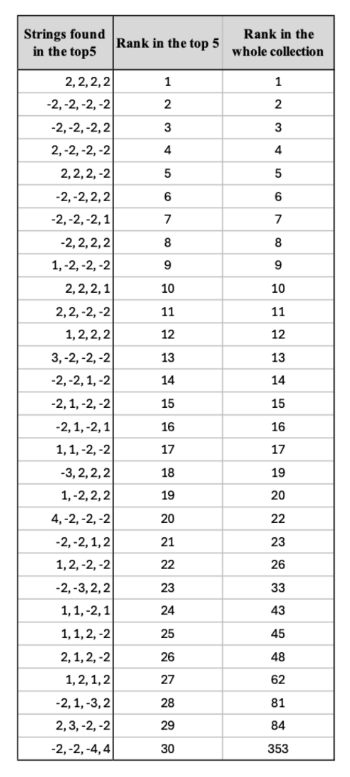
(click to enlarge)
[A2.6] We then focused on the top five melodic strings that occur most often within each madrigal. This top-five cutoff is arbitrary, chosen for workability. The top five are color-coded in the scores: the most frequently occurring one is manually boxed in the score in red, followed by orange, yellow, green, and blue. Thirty different string types occur among the top five of one or more madrigals, shown in Example A. As we might expect, only a small number of these (seven of 30) use intervals larger than a second. The predominance of ascending and descending pentachords in this list might at first seem easily disposed of, since we hardly think scales can be called motivic. But they cannot be discarded a priori, since they can hint at word painting, texture saturation, rhythmic augmentation, etc., and can even be thematic, such as mm. 10–17 of #10 (discussed in paragraph [5.4] and shown in Example 5).
[A2.7] Filtering off the top five in each madrigal reveals a discrepancy with the ranking of the strings in the collection as a whole. Those ranks are the same until the 18th-ranked string in a madrigal, which is the 19th in the collection as a whole. This discrepancy widens as we move down to strings that occur less frequently, until we get to the 30th string in the top five (in the bottom row), which is 353rd in the collection as a whole. It results from the fact that sometimes Rore uses a string a disproportionate number of times in a madrigal with respect to the collection as a whole (the “background”). We might be perplexed by this discrepancy, but there are numerous reasons for it.
[A2.8] One reason is that Rore’s madrigals often end with a substantial section that is repeated note for note and with the same text (although the very end might be slightly varied).(32) This means that whatever string is found in a repeating final section might rise in rank over other strings that only appear in a section that is not repeated. The end of #16 “Far potess’io” contains a repeated eleven-semibreve section containing many [−2, −3, 2, 2] strings (See Example 15b). Other madrigals exhibit a saturation of melodic strings at the end even when the whole final block of polyphony is not repeated.(33) In #6 “Altiero sasso” a string with striking fourth skips [−2, −2, −4, 4], the 30th in our list, is found eight times, seven of these eight occurrences are parts of the theme that sets the last verse of the poem. Some saturations of strings occur in middles of pieces, like the 28th string of our list [−2, 1, −3, 2] in #5 “Solea” (see Example 14b) or the 27th string [1, 2, 1, 2] in #19 “Hor che l’aria.”
[A2.9] The discrepancy between the ranking of occurrences in the collection as a whole and that of the individual madrigals proves that string frequency is not just a matter of Rore’s “language.” Even when he is dealing with “non-motivic” material, he chooses melodic fragments to repeat, consistent with Owens’s observation quoted in paragraph [6.6]. As we saw in a closer look at individual madrigals, even when certain melodic strings are not foregrounded, their disproportionate use gives a madrigal a unique melodic content; it defines a motivic inventory special to that piece or to a section of the piece.
Works Cited
Angleria, Camillo. 1622. Regola di contraponto. Giorgio Rolla; repr. Forni, 1983.
Bailey, Robert, ed. 1985. Richard Wagner, Prelude and Transfiguration from Tristan and Isolde. W. W. Norton.
Bernstein, Jane A., and Jessie Ann Owens. 2018. “Songs of Love and Death.” Bulletin of the American Academy of Arts and Sciences 71 (4): 25–32.
Burmeister, Joachim. 1993. Musical Poetics. Translated by Benito Rivera. Yale University Press.
Collins, Denis. 2022. “‘Some Disturbance to the Ear when the Voices Enter’: Invertible Canons at the Octave in Motets by Zarlino and Willaert.” Journal of the Alamire Foundation 14 (2): 247–82. https://doi.org/10.1484/J.JAF.5.131812.
Cumming, Julie E. 2008. “From Variety to Repetition: The Birth of Imitative Polyphony.” Yearbook of the Alamire Foundation 6: 21–44.
Feldman, Martha. 1989. “Rore's ‘selva selvaggia’: The Primo libro of 1542.” Journal of the American Musicological Society 42 (3): 547–603. https://doi.org/10.2307/831505.
Freedman, Richard, dir. 2014–24. Citations: The Renaissance Imitation Mass. CRIM. https://crimproject.org.
—————. 2020–24. CRIM Intervals Python Library. https://github.com/HCDigitalScholarship/intervals.
Gosman, Alan. 1997. “Stacked Canon and Renaissance Compositional Procedure.” Journal of Music Theory 41 (2): 289–317. https://www.jstor.org/stable/843961
Harper, John. 1978. “Frescobaldi’s Early Inganni and their Background.” Proceedings of the Royal Musical Association 105: 1–12. https://doi.org/10.1093/jrma/105.1.1.
Kerman, Joseph. 1975. “Old and New in Byrd’s Cantiones sacrae.” In Essays on Opera and English Music: In Honour of Sir Jack Westrup, ed. Frederick William Sternfeld, Nigel Fortune, and Edward Olleson, 25–43. Basil Blackwell.
Margot, Sylvain, and Peter Schubert. 2023. “With Baccusi in the Jacuzzi; or, How I Learned to Stop Worrying and Love Numbers.” CRIM Essays and Experiments, ed. Richard Freedman. Haverford College and CRIM Project. https://crimwp.richardfreedman.sites.haverford.edu/?page_id=391.
Milsom, John. 2005. “Crecquillon, Clemens, and Four-Voice Fuga.” In Beyond Contemporary Fame: Reassessing the Art of Clemens non Papa and Thomas Crecquillon, ed. Eric Jas, 293–345. Collection “Épitome musical.” Brepols.
—————. 2016. “Cipriano’s Flexed Fuga.” In Cipriano de Rore: New Perspectives on His Life and Music, ed. Jessie Ann Owens and Katelijne Schiltz, 293–329. Brepols.
Nattiez, Jean-Jacques. 1990. Music and Discourse: Toward a Semiology of Music. Translated by Caroline Abbate, 135–36. Princeton University Press.
Owens, Jessie Ann. 1984. “The Milan Partbooks: Evidence of Cipriano de Rore’s Compositional Process.” Journal of the American Musicological Society 37 (2): 270–98. https://doi.org/10.2307/831175.
—————. 1997. Composers at Work: The Craft of Musical Composition 1450–1600. Oxford University Press. https://doi.org/10.1093/oso/9780195095777.001.0001.
Pontio, Pietro. 1588. Ragionamento di musica. Erasmo Viotto. https://www.loc.gov/resource/muspre1800.101470/?sp=76&st=image&r=-0.038,0.24,0.846,0.381,0.
Ricciardi, Emiliano. 2024. “Citations: The Renaissance Imitation Mass Project (CRIM). Richard Freedman and David Fiala, Project Directors.” Journal of the American Musicological Society 77 (3): 863–875. https://doi.org/10.1525/jams.2024.77.3.863.
Schubert, Peter. 2003. “Recombinant Melody: Ten Things to Love about Willaert’s Music.” Current Musicology 75: 91–113.
—————. 2007. “Hidden Forms in Palestrina’s First Book of Four-Voice Motets.” Journal of the American Musicological Society 60 (3): 483–556. https://doi.org/10.1525/jams.2007.60.3.483.
—————. 2020. “Contrapunto Fugato: A First Step Toward Composing in the Mind.” Music Theory Spectrum 42 (2): 260–79. https://doi.org/10.1093/mts/mtaa009.
—————. 2022. “Willaert’s Elusive Counterpoint Explained.” Music Theory Online 28 (4). https://doi.org/10.30535/mto.28.4.7.
—————. 2023. “Zarlino’s Comporre di fantasia and Canon.” Music Theory Spectrum 45 (2): 309–35. https://doi.org/10.1093/mts/mtad011.
Footnotes
* The authors wish to thank Kyle Adams and the anonymous MTO reviewer for their helpful comments; also Pieter Bergé and David Burn for urging us to focus on rhythm; Ellen Bakulina; and finally Jessie Ann Owens, who spurred us to undertake this study. The scores presented here are based on digital files edited by Scott Metcalfe and Jessie Ann Owens, assisted by Holly Druckman, for the excellent recording by Blue Heron (Margot Rood, Martin Near, Owen McIntosh, Jason McStoots, Sumner Thompson, Paul Guttry; Scott Metcalfe, artistic director; from BHCD 1009: Cipriano de Rore, I madrigali a cinque voci, © 2019 Blue Heron); we thank them for their collaboration on this project. For more on the background of this recording and edition, see Bernstein and Owens (2018).
Return to text
1. Alfred Lorenz put this principle bluntly: “Form results only from repetition” (Bailey 1985, 209, italics original).
Return to text
2. An exception is the technique that Burmeister called “metalepsis,” in which some voices at their first entrance sound the second text phrase; however, these same voices often return to the first text phrase later (Burmeister 1993, 163).
Return to text
3. Labels include “stretto fuga” (Milsom 2005), “stacked canon” (Gosman 1997), various “presentation types” (Schubert 2007), “invertible canon” (Collins 2022), and “contrapunto fugato” (Schubert 2020).
Return to text
4. As Milsom acknowledges (Milsom 2016, 302), some forms of flexing resemble the commonplace Renaissance variation technique called inganno, but this very restrictive form of variation does not account for all the alterations Rore makes (see paragraphs [5.2] and [5.3] for the analytical use of inganno). Apart from work by Owens and Milsom, almost nothing has been written about Rore’s technique for combining voices; most research has focused on mode and text expression.
Return to text
5. In madrigals #4, 6, 10, 11, 14, 17, 18, and 19, the first melodic interval goes in different directions in different voices. In some of these (#s 4, 11 and 19) the melodies in contrary motion form contrapuntal combinations that repeat (modules—see Owens 1997, 251, and Schubert 2007). A close look at the beginning of one of these (#10) is found in paragraphs [3.3] and [3.4].
Return to text
6. Rore is very consistent in placing stressed syllables on metrically accented or, when the line is syncopated, agogically accented notes.
Return to text
7. By “exact” we mean interval size, not quality, and thus include diatonically transposed repetition.
Return to text
8. Hemistichs are the two parts of a verse when it is divided; they need not be the same length.
Return to text
9. The longest segment that repeats gets a closed bracket; segments that start the same but continue differently are marked with brackets open on the right-hand end.
Return to text
10. Of a Willaert example, she writes, “The rests that quietly mark each syntactic break and the gradual shifts of motivic and textural character are the music’s only prevalent means of formal definition” (1989, 557).
Return to text
11. Two verses are enjambed when the thought, phrase, or clause at the end of one verse is continued into the next verse without punctuation, the line break acting as an interruption. In Feldman’s Willaert example, none of the parts has a rest between enjambed verses.
Return to text
12. Sometimes, contrariwise, Rore inserts a rest between verses that are poetically enjambed, such as verses 3–4 and 5–6 (see Example 2).
Return to text
13. We use the term “string” to avoid the associations and implications of words like “motive” or “soggetto” or “cell” (Kerman 1975).
Return to text
14. The Bassus-Altus pair in mm. 88–89 makes a combination that is repeated a third lower by Bassus and Quintus in mm. 92–93 with different text. Modules like these are fairly rare in this madrigal.
Return to text
15. These nine are: Altus mm. 53–55, Cantus m. 55, Tenor mm. 94–95, Cantus mm. 104–5, Tenor mm. 110–11, Quintus mm. 124–25, Tenor mm. 141–42, Bassus mm. 157–58, and Quintus mm. 158–59.
Return to text
16. For more on inganno, see Harper 1978 and Schubert 2003, 91–94. Owens describes an instance of Rore’s use of inganno in a textless composition (1997, 246–47).
Return to text
17. The yellow-bracketed tune does not set the same words and is too short to have been retrieved by the computer, which was asked to find only five-note strings; of course, another pass by the computer looking for four-note strings would find it.
Return to text
18. Pontio says repetition of a complete contrapuntal combination at the end of a piece is acceptable, exceptionally, and cites Rore’s “Alla dolce ombra” (1588, 146).
Return to text
19. The time intervals are: two semiminims between Tenor and Bassus (the lengthened notes at the beginnings of these do not affect the contrapuntal combinations), three sm between Bassus and Altus, one sm between Altus and Cantus, four sm between Cantus and Bassus, and three sm between Bassus and Altus. Only the two Bassus/Altus pairs are in the same relationship and make a short module (compare mm. 116–17 and 121–22).
Return to text
20. In his later music (e.g., “Dalle belle contrade” or “Calami sonum ferentes”), Rore famously used the extreme chromaticism that may have earned him his reputation as a forerunner of the seconda prattica.
Return to text
21. Camillo Angleria, eighty years later (1622, 78), calls fugas at the seventh, sixth, and second “more modern than the others” (più nove delle altre).
Return to text
22. The CRIM Intervals Python Library has been developed by Richard Freedman, Alexander Morgan, Oleh Shostak, Edgar Leon, Freddie Gould, and Trang Dang (2020).
Return to text
23. See Freedman (2014–24) and Ricciardi (2024).
Return to text
24. https://github.com/HCDigitalScholarship/intervals/blob/main/tutorial/09_Ngrams_Heat_Maps.md.
Return to text
25. https://richardfreedman.github.io/.
Return to text
26. https://github.com/HCDigitalScholarship/intervals/blob/main/tutorial/13_Musical_Examples_Verovio.md - 5--print-with-analytic-highlights.
Return to text
27. Borrowing from the world of linguistics and text study, CRIM Intervals calls these strings “n-grams.”
Return to text
28. That is to show “entries.”
Return to text
29. In a recent study on Ippolito Baccusi’s mass based on Rore’s madrigal Quando lieto sperai, the authors showed that five-note strings play multiple roles, such as connecting several motivic fragments or serving as formal markers (Margot and Schubert 2023).
Return to text
30. The digital files we used were edited by Scott Metcalfe and Jessie Ann Owens, with the assistance of Holly Druckman, for the excellent recording by Blue Heron. We would like to thank them for their collaboration on this project. For more on the background of this recording and edition, see Bernstein and Owens 2018.
Return to text
31. CRIM Intervals offers the option to combine unisons when extracting the strings. This can sometimes reveal connections between different text settings that otherwise might be obscured.
Return to text
32. Pietro Pontio repeats Zarlino’s prohibition against repeating a contrapuntal combination, citing an exception, however, for the ends of pieces such as Rore’s “Alla dolce ombra” (1588, 146).
Return to text
33. CRIM Intervals provides great tools for data visualisation: bar charts, histograms, and even networks of associated motives within a piece or pieces sharing the same motives. See https://github.com/HCDigitalScholarship/intervals/blob/main/tutorial/18_Visualizations_Summary.md and https://richardfreedman.github.io/#a-network-of-pieces-based-on-shared-ngrams.
Return to text
Copyright Statement
Copyright © 2026 by the Society for Music Theory. All rights reserved.
[1] Copyrights for individual items published in Music Theory Online (MTO) are held by their authors. Items appearing in MTO may be saved and stored in electronic or paper form, and may be shared among individuals for purposes of scholarly research or discussion, but may not be republished in any form, electronic or print, without prior, written permission from the author(s), and advance notification of the editors of MTO.
[2] Any redistributed form of items published in MTO must include the following information in a form appropriate to the medium in which the items are to appear:
This item appeared in Music Theory Online in Volume 32, Issue 1 in March 2026. It was authored by Peter Schubert (peter.schubert@mcgill.ca) and Sylvain Margot (sylvain.margot@mail.mcgill.ca), with whose written permission it is reprinted here.
[3] Libraries may archive issues of MTO in electronic or paper form for public access so long as each issue is stored in its entirety, and no access fee is charged. Exceptions to these requirements must be approved in writing by the editors of MTO, who will act in accordance with the decisions of the Society for Music Theory.
This document and all portions thereof are protected by U.S. and international copyright laws. Material contained herein may be copied and/or distributed for research purposes only.

Prepared by Andrew Blake, Senior Editorial Assistant
Number of visits:
1851