Memory and Oblivion in the Andante of Brahms’s Second Piano Concerto
David Keep
KEYWORDS: Brahms, memory, oblivion, piano concerto, intertextuality, form, allusion, agency
ABSTRACT: The scholarly literature on Brahms has often sought to understand the composer’s music in terms of memory, often emphasizing remembrance, memorialization, and nostalgia. Musical forgetting, or oblivion, is less commonly analyzed in Brahms’s music. Memory, however, is complex and includes many contradictory functions including both remembering and forgetting, which often work simultaneously. The slow movement from Brahms’s Second Piano Concerto, op. 83, features three striking traits that can be productively interpreted in terms of memory and oblivion. First, the solo piano forgets the main theme despite repeated efforts to recall it. Second, in the vacant space left by the absent theme, the solo piano articulates intertextual allusions that reference other pieces, as if extending from the subconscious. Third, these two traits work in tandem to inflect the movement’s ternary form, which features prominent interpolations. The Andante is reconceived in the terms of Walter Benjamin’s “folded fan” ([1928] 1972), a literary metaphor for memory applied to music by John Daverio (2002), which emphasizes how interpolations express a fixation with a beloved individual. Instead of seeking to show that these musical processes reveal memories held by Brahms himself, this analysis draws on Seth Monahan’s view of agency (2013), in which the analyst ascribes meaning to musical traits. The analytical goal is to explore the wider range of cognitive function opened by the metaphor of how music may resemble the workings of the mind.
DOI: 10.30535/mto.32.2.4
Copyright © 2026 Society for Music Theory
Introduction
[0.1] The scholarly literature on Brahms has often sought to understand the composer’s music in terms of memory
[0.2] The formulations above lack one particularly significant detail: whose memories are interpreters hearing in these works? Do these “memories” belong to Brahms, the individuals from his innermost circle of friends, the analyst, the performer, or the listener? And who is forgetting? Brahms scholars have painstakingly tied close readings of musical works, particularly those framed in terms of memory, to philological evidence such as the composer’s personal correspondence
[0.3] The Andante of Brahms’s Piano Concerto in
[0.4] First, the Andante’s main theme is played at the outset by a solo cello. The piano does not repeat the theme as heard at the beginning; instead, it evolves within an overarching process of developing variation. The piano begins with an altered version of the melody progressively liquidated over the course of the movement, relegating the reprise’s recognizable entrances of the theme solely to the cello and orchestra. The similarities between the cello theme and the piano’s thematic utterances decrease and eventually vanish by the end of the movement. The piano “forgets” the melody the more it attempts to engage with it; this may resemble a quickly attained short-term memory made through a strong initial impression but quickly fading, especially if not strengthened by enough early and repeated retrievals. If the solo piano is understood to engage the theme voluntarily, it gradually fails as the movement goes on.
[0.5] Second, as the piano experiences the trajectory of forgetfulness above, it articulates a recurring figure, designated as a “memory trigger,” that launches solo entrances by unlocking allusions to other works and passages from other movements of the concerto. In the oblivion opened by the main theme’s absence, these passages act as subconscious, involuntary musical memories that surface and populate the vacant thematic space. Understood as three engagements of involuntary memories, intertextual remembrances of the slow movement from Beethoven’s “Emperor” Piano Concerto, op. 73, Brahms’s song “Todessehnen,” op. 86, no. 6, and the conclusion of the first movement of Brahms’s concerto ephemerally fill the space left open by the main theme’s absence in the piano, eventually fading away; none of these allusions return later in the movement. When the piano attempts to voluntarily access the memory of the main theme, it fails, and it instead substitutes involuntary memories of music from outside the movement’s thematic argument. The Andante interleaves the dissolution of voluntary, intentional recollections with clearer involuntary, unintentional memories. What exists in the void of musical oblivion, opened by the piano’s forgetfulness? Not silence, but subconscious, allusive memories that extend in diverse and unpredictable directions. It is striking that each of these beautiful moments occurs only once; in contrast to the trajectory of the main theme in the piano, these do not build a trajectory of overarching variation.
[0.6] Third, the piano plays a substantial role in articulating formal interpolations, characterized as a literary metaphor for memory and its personal motivations, coined by Walter Benjamin as the “folded fan.” The interaction of the two traits above, representing oblivion and memory respectively, shapes the role of interpolations. Daverio (2002) applies Benjamin’s “folded fan” to music, particularly in the contexts of works by Schumann and Brahms. While formal interpolations are not rare in such repertory, they do pose challenges for analysts. What motivates an interpolation? How do interpolations affect the formal shape of a movement? In this case, memories “fold” and “unfold” across the course of the Andante, driving the subconscious through a desire for personal intimacy. Imagining the work’s formal dimensions as “folding,” or consciously moving forward in real time, memories open at liminal seams where the piano momentarily pauses the ternary formal trajectory and redirects toward the internal space of allusive interpolations. These are the points where the fan “unfolds,” where we encounter what is beneath the memories themselves: the yearning for relational connection. This is especially true via the allusion to the poetic text’s prayer from Brahms’s setting of Schenkendorf’s “Todessehnen,” in which the speaker calls out to God amidst isolation and suffering.
[0.7] The hermeneutic sum of the analysis thus reflects on the nature of the piano’s relational connection to the solo cello and the orchestral ensemble. Resembling a dramatic persona, the piano loses memory that links it with the cello and orchestra, and therefore loses a degree of intimacy with the other personae involved
Main Features of the Op. 83 Andante
[1.1] In order to familiarize the reader with the Andante’s main features, this section summarizes the most pertinent aspects of Julian Horton’s analysis (2017), which is the most exhaustive consideration of the Andante’s formal interpretation in the analytical literature to date
- Horton views numerous aspects of the movement as hybrid in nature: its formal organization simultaneously draws on aspects of sonata and ternary patterns
,(10) tempi and stylistic traits nest an Adagio slow movement type within a larger Andante,(11) and the overall trajectory hinges on the projection of two musical topics, designated by Horton as Wiegenlied and Nocturne.(12) The crux of these hybrids is the movement’s interior Più Adagio section, which interrupts the digressive and developmental mid-movement processes as an extensive interpolation, introduces and distinguishes the new Più Adagio tempo from the a tempo Andante, and constitutes the Nocturne topic, with the piano’s florid and widely spaced arpeggiations harmonizing a long-breathed melody in the clarinets. - The resulting formal ambiguity arises because “the developmental treatment,” especially of the main theme material, “is not constrained by apparent functional boundaries.” Horton describes the entire span of the movement until m. 58 as “a case study in the problems of coordinating formal function and motivic process.” If the first portion of the movement thus is understood to “override generative functions with developmental processes,” the second portion in mm. 78–94 is heard to “assert the primacy of presentation over development” (260). Developing variation of the main theme plays a considerable role in this reading.
- The hermeneutic angle is shaped by two song allusions: the Wiegenlied main theme is interpreted as a potential allusion to Brahms’s song “Immer leiser wird mein Schlummer,” and the Più Adagio section is understood as a reference to “Todessehnen.
”(13) The first song is mapped onto the Andante slow-movement type, the second onto the Adagio. Horton reads the main theme not just as a cradle song, but also as a love song, because of its supposed “Clara” motive.(14) The developmental process collapses into “negation” at m. 55 inB♭ minor, the “expressive other of its major-mode incarnation.” This event “clears the way for the conversion of movement types (Andante becomes Adagio) and the transcendental aspiration it supports.” This application of “poetic intertextuality” is linked to the nineteenth-century trope of “negation and transfiguration,” especially since the remainder of the movement after the shift concludes in a relatively untroubled manner (313).
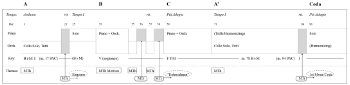
Example 1. Form Diagram: Brahms, Piano Concerto no. 2, op. 83, III. Andante
(click to enlarge)
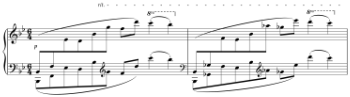
Example 2. Brahms, Piano Concerto no. 2, op. 83, III. Andante, mm. 23–24
(Clips of all Brahms op. 83 examples are from: Brahms: The Piano Concertos. Nelson Freire, piano. Leipzig Gewandhaus Orchestra. Conducted by Riccardo Chailly. Decca 1993062, 2006, compact disc.)
(click to enlarge and listen)
[1.2] My understanding of form is resonant with Horton’s insightful analysis. As shown in Example 1, I favor a ternary reading, albeit one featuring an unusual two-part digression comprising both the B and C sections. The B section conventionally digresses from the argument of A, but the C section maximizes contrast by introducing entirely new music before returning to A’. The reasoning for this interpretation has less to do with formal categorizations per se than with the relationships among the movement’s three prominent passages of allusion and the resulting interpolations that give shape to its unique trajectory. The shaded boxes (starting at mm. 23, 56, and 94, labeled as “MTr” for their function as memory triggers) show where recurring passages marked with ritardandi feature soloistic entrances in the piano, but they are strikingly athematic: ascending arpeggios embellish sustained tonic chords in the orchestra, as shown in Example 2
[1.3] These interpolations begin on the formal seams that may have featured either Eingänge or full-length cadenzas in the conventions of earlier concerti. In keeping with standard practice in most late-nineteenth-century piano concerti, the option of improvisation is not given, but the solos notated in place of an improvised cadenza add extensively to the piano’s engagement with thematic content and maximize its textural diversity. If one imagines a version of this movement without each interpolation—cutting out the piano’s opening solo, the Più Adagio, and the coda—the result is simply an orchestral ABA’ form (of course, an Andante devoid of solos, instead featuring a true “piano obbligato”). Steering the ternary form momentarily into and out of allusive interpolations, the solo piano takes on a form-defining role.
[1.4] A consequence of this distinctive formal organization is the separation between the orchestra and the piano in regard to thematic content. As Horton argues, the piano begins with thematic content tangentially derived from the cello’s memorable melody, but it immediately employs developing variation from the outset, thus rapidly transforming the theme (257). From its first solo at m. 23 until m. 56, the piano maps its liquidation of main theme material; it does not revisit the theme’s contents in the remainder of the movement.
[1.5] How typically does a piano concerto slow movement from this era deny the soloist a chance to play the main theme? Though thematic separation is not without precedent, it is most common for piano soloist and orchestra to share the main theme in a concerto slow movement from the nineteenth century, usually the first theme given in the movement
[1.6] How typically do slow movements in Brahms’s concerti employ such a scheme as the one found in the op. 83 Andante? Within Brahms’s four concerti, this movement comes closest to preventing the soloist and ensemble from sharing the main theme. Brahms often avoids thematic repetition stemming from tutti/solo alternation. In contrast to the op. 83 Andante, the slow movement from the Double Concerto, op. 102 (1887) most freely shares thematic content, both through its instrumentation (the main theme is given to the duo, and the orchestra complements and embellishes throughout) and largely unvaried double reprise. Daverio (2002, 221) observes that Brahms goes to great lengths to project a Hungarian style throughout op. 102, and especially in this movement invokes “Kuruc” fourths in the main theme. These stylistic priorities may have shaped the choice of a straightforward ternary organization and the limits on developing variation that result. The slow movements from the other two concerti rely extensively on developing variation; the soloist’s handling of thematic material is rarely repeated the same way. The Adagios of the Piano Concerto, op. 15 (1858) and Violin Concerto, op. 77 (1878) represent a middle ground between the abundant thematic sharing of soloist and ensemble found in op. 102 and the gradual separation in op. 83. Op. 15 presents a recognizable main theme that is often flexibly varied, especially when given to the solo piano. Op. 77 begins with a melody for solo oboe, and the violin prioritizes continual embellishment of the theme rather than overt repetition. Analysts have noted how soloists in both cases provide meta-commentaries on thematic discourse, essentially construed as highly sophisticated instances of developing variation
Forgetting the Main Theme
[2.1] Forgetting is a critical component within the cognitive functions of memory. The solo piano’s handling of the main theme resembles forgetfulness through its use of developing variation. The theme’s treatment as a fleeting, eventually vanishing melody parallels the failure of a memory to lodge itself in the mind long-term. Even though the piano’s voluntary efforts at recollection occur until the
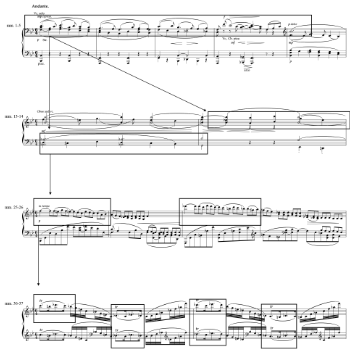
Example 3. Thematic Memory Loss in the Solo Piano of the Andante: Isolated Passages from A and B Sections
(click to enlarge and listen)
[2.2] The orchestra plays the main theme in each section of the movement: A B C A’. In contrast, the piano’s involvement with the main theme spans the A and B sections but does not continue in C, A’, or the coda. Across A and B, the piano remembers progressively less of the main theme each time it is recalled. Example 3 focuses on the main theme’s double-neighbor motive as the principally recognizable feature that remains in isolated passages of the A and B sections. The cello’s opening version of the theme occurs in mm. 1–5. The next passage shown is mm. 13–14, where the double-neighbor motive is transposed to begin on scale-degree in the violins, harmonized by a rhythmically equalized double-neighbor motive in the bass. When the piano begins its first solo in m. 25, it reharmonizes and further alters the treble version of the motive that began on F in m. 13, rather than stating the theme in its initial form heard at the outset of the movement. In m. 25, the piano combines the left-hand arpeggios from mm. 23–24 with the right hand’s triplet version of the double-neighbor motive. This kind of fluid reinterpretation continues the process of developing variation and subsequent melodic liquidation begun in the opening tutti (as observed in Horton 2017, 257, applying Schoenberg’s terminology via Frisch 1984). The opening version of the melody first heard in the cello is apparently too distant in the past for the piano to accurately remember. It instead recalls the most temporally recent version (m. 13) combined with its recent arpeggio figure. As a memory, m. 25 contains the piano’s closest attempt—a significantly varied iteration—to properly recall the theme anywhere in the movement. From this point on, the piano will only reconfigure smaller motivic segments until it abandons the theme’s likeness altogether.
[2.3] The piano’s full solo entry (mm. 25–35) treats the main theme material as a basis for improvisatory exploration, releasing its weak grip on the theme in its brief modulation to
[2.4] After the conclusion of C, the A’ section commences in m. 71. The cello and orchestra restate the anticipated main theme in its initial form, though continuing in the song interpolation’s tonic of
[2.5] On its own, the fact that Brahms positions the solo piano’s thematic involvement in such a way that corresponds with Schoenberg’s notion of “developing variation” is not particularly unusual. A characteristically fluid handling of motivic, harmonic, and rhythmic parameters is found throughout Brahms’s output (the first movement of the Cello Sonata in F major, op. 99, the slow movement of the Second Symphony, op. 73, and the song “O Tod, wie bitter bist Du?” being famous examples). Developing variation tends toward necessitating a truncated reprise in Brahms’s sonata allegro movements and slow movements; the op. 83 Andante is an example that demonstrates how this tendency helps avoid “needless repetition” (at least in the piano solo; the theme is repeated in the cello and orchestra through the end of the movement). In the reprise, the piano largely accompanies the orchestra with trills and harmonies but refrains from thematic engagement, a trait that can be found in slow-movement reprises of other piano concerti (Beethoven’s “Emperor” Concerto slow movement being one example). For all these reasons, an analyst may be justified in claiming that this movement is entirely characteristic of Brahmsian stylistic traits applied to the genre of the nineteenth-century piano concerto.
[2.6] However, in tandem with the three recurring triggers and allusions spread across the movement, this particular instance of thematic developing variation performs a special role in the Andante. Especially with its liquidation of content related to the main theme in the solo piano, the soloist’s thematic path clears space for the triggers and each allusion that follows. If large-scale liquidation did not occur, the trigger-allusion interpolations would risk becoming unnecessary, potentially falling “outside” the narrative thrust of the movement. More than extraneous asides, the three moments stimulate the piano’s growing variety of thematic material extending beyond the cello’s theme. The main theme in the piano finds its vanishing point in the Più Adagio section, and thereon surrenders the melody and its motives to the orchestra. The development and liquidation of main-theme content that occurs in the piano is associated with functions of voluntary memory, which is progressively forgetful. Thus, developing variation’s eventual liquidation is characterized here as forgetfulness. While the piano may not play the main tune, the cello and orchestra do reprise the theme in the A’ section. As this occurs, the soloist continues to participate in a limited way with the ensemble.
Triggers, Allusions, and Musical Memories
[3.1] The second feature of the solo piano in the Andante thematizes involuntary memory through the incorporation of intertextual allusions. As the piano’s voluntary, conscious efforts at remembering the main theme trail off, there is instead involuntary, subconscious memory that finds space for exploration. As Snyder (2001) divides long-term memory into explicit and implicit types, the memory triggers and subsequent allusions are potentially best described as “implicit,” which are similar to “unconscious” and involuntary memories. The memory triggers themselves may be seen as the “reminding” variety, where “an event in the environment automatically cues an associated memory of something else” (Snyder 2001, 70). The memory triggers spur subconscious, involuntary passages of allusion.
[3.2] Though it loses its grip on the main theme presented by the cello, the piano clarifies allusive memories repeatedly, although differently each time. Three times in the Andante the piano initiates with an arpeggio gesture. Each of these is answered by a separate allusion to another work or a different movement from the concerto. This wide-ranging capacity for the act of remembering in the piano contradicts its forgetfulness of the main theme. In its far-reaching intertextual connections to other pieces of music, one could characterize the Andante, at the level of Monahan’s “work-persona” (2013), as possessing functional capacities associated with long-term implicit memory. At the next highest level of the agential hierarchy, the work-persona incorporates individuated elements within itself to project a “single unbroken consciousness.
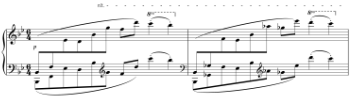
Example 4. First Memory Trigger in the Solo Piano of the Andante, mm. 23–24
(click to enlarge and listen)
[3.3] The three passages with memory triggers have five features in common, shown in Examples 4, 5, and 6. First, each of these passages occurs at a slower tempo than the overarching Andante designation for the movement. The first memory trigger, mm. 23–24, is marked with a ritardando, the second is marked with ritardando molto in mm. 57–58, and the third is marked Più Adagio in mm. 94–95. Each memory trigger thus stretches time in relation to the primary tempo, and while the first two eventually return to the original tempo, the third remains in the slower Adagio. The temporal stretch of these passages repeatedly pulls the solo piano into its own space, contrasting the psychological state one might identify as temporally represented by the orchestral ensemble and its opening Andante tempo. The piano slows as it experiences difficulty remembering the main theme, but looks to the involuntary subconscious and instead generates musical allusions in subsequent passages.
Example 5. Second Memory Trigger in the Solo Piano of the Andante, mm. 55–58
(click to enlarge and listen) | Example 6. Third Memory Trigger in the Solo Piano of the Andante, mm. 94–95
(click to enlarge and listen) |
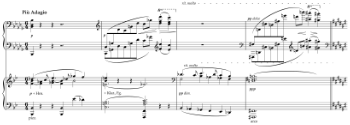
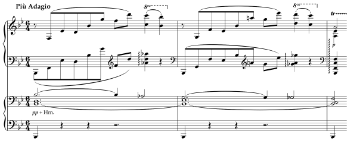
[3.5] Second, each memory trigger features modal mixture with invariant pitches that resurface in each iteration, regardless of local tonal contexts. The most significant pitch to become part of the arpeggio gestures is
[3.6] Third, each memory trigger features prominent two-note descending stepwise gestures within larger ascents (which are gesturally related to the opening arpeggios in the solo piano at the outset of the concerto’s first movement), culminating in registrally and rhythmically accented gestures at the end of each. When the main theme is initially played by the solo cello, the two-note motives are woven together to form cohesive melodic units, comprising the motivic substance for the phrase-level developing variation in the opening tutti. The metric context for the tightly knit main theme, with its hemiolic
Example 7. Beethoven, Piano Concerto no. 5, II. Adagio un poco moto: opening theme (mm. 1–4), bass reduction, first piano solo (mm. 16–24)
(Recording: Beethoven: Klavierkonzert No. 5, “Emperor.” Maurizio Pollini, piano. Berlin Philharmonic. Conducted by Claudio Abbado. Deutsche Grammophon 445 851-2, 1995, compact disc.)
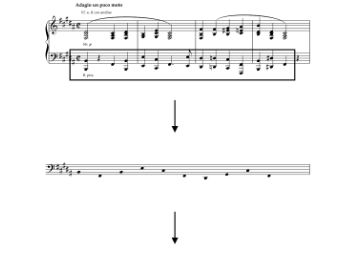
(click to enlarge, listen, and see the rest)
Example 8. Brahms, Piano Concerto no. 2, III. Andante: opening theme (mm. 1–9), bass reduction, first piano solo (mm. 23–35)
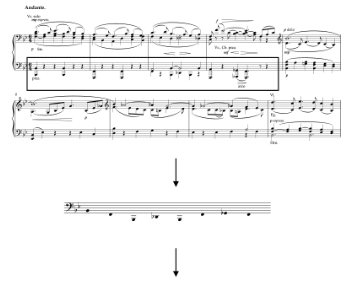
(click to enlarge, listen, and see the rest)
[3.7] Fourth, each of the memory triggers exists in between other formal sections. In contrast to unsounded notational features that articulate a boundary, such as a repeat sign, the arpeggios give voice to boundaries as sounded passages themselves. By joining music that constitutes the movement proper and that which falls on its seams, an inner subconscious space resonates in the metaphorical mind of the solo piano. The distance between this internal space and the external intertextual sources is closed in the continuing passages. The C section perhaps demonstrates this most clearly, where a psychological level is opened in the lengthy song interpolation, crossing the threshold into an altogether new space.
[3.8] Fifth, all of the memory triggers are followed by thematic material from other works or movements of the concerto, reinforcing the long-term memory function of the gestures. The first is followed by a passage that reimagines a temporally proximate variant of the main theme as the first solo from the Adagio of Beethoven’s “Emperor” Concerto (Examples 7 and 8), the second is followed immediately by the extended interpolation consisting of material from “Todessehnen” (Examples 9 and 10) and the third recollects the conclusion from the first movement (Examples 11 and 12). The variety of sources engaged via allusion is wide-ranging, and their inclusion bears upon the Andante’s own processes. In chronological order, the three allusions progress across the movement from those with historically distant sources to those that are cyclically near—reversing the main theme’s progressively fading memory in the piano. As mentioned above, interpreting the arpeggios with these features in mind, they gain prominence as sites of long-term implicit memory association
Example 9. Brahms, “Todessehnen,” op. 86, no. 6 (poetry by Schenkendorf), mm. 36–43
(click to enlarge and listen) Example 10. Brahms, Piano Concerto no. 2, op. 83, III. Andante, mm. 59–66
(click to enlarge and listen) | Example 11. Brahms, Piano Concerto no. 2, op. 83, I. Allegro non troppo, mm. 369–376
(click to enlarge and listen) Example 12. Brahms, Piano Concerto no. 2, op. 83, III. Andante, mm. 94–99
(click to enlarge and listen) |
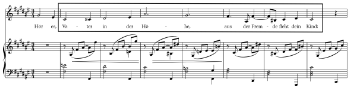
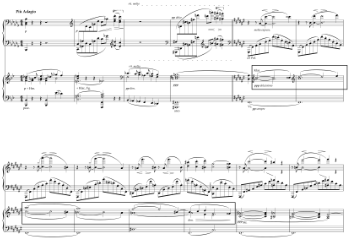
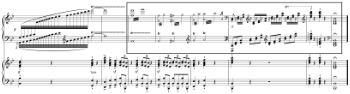
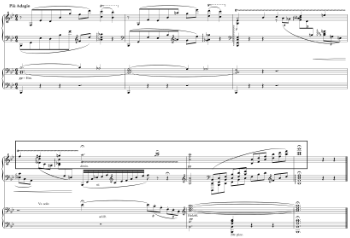
[3.9] Each of the subsequent allusions themselves imports more than thematic similarities into the Andante by drawing upon rich and detailed memory of the compositions they cite, bringing a diverse combination of musical contexts to bear upon the Andante. In the first passage of allusion, Charles Rosen (1980) has discussed in detail how Brahms invokes the slow movement of Beethoven’s “Emperor” Concerto (compare Examples 7 and 8)
[3.10] The second memory trigger invokes the most substantial involvement of external music in the form of the “Todessehnen” allusion (see Examples 9 and 10). By recalling the song’s moment of prayer, the passage turns away from past and present suffering toward the hope of future healing, suggesting desire for meaningful connection to community in place of the pain of isolation. In Schenkendorf’s poem, the “Todeslebenswind” plays a decisive role in the poem by ending the suffering experienced in life and opening the realm where “separation is unknown”; Brahms’s song setting is, unsurprisingly, very sensitive to this “life-giving wind of death,” as the song is fundamentally changed after its appearance and does not return to the opening texture of the first section of the song (
[3.11] The third memory trigger closes the movement by recalling the conclusion of the concerto’s first movement (Examples 11 and 12). As in the “Todessehnen” allusion, the slow tempo defamiliarizes the otherwise clearly recognizable musical content. Other new features include chromatic harmonization (in contrast to the orchestra’s diatonic accompaniment in the first movement excerpt), the solo cello’s final melodic descent through the dominant seventh, and the extended length of the trilled ascending scale in the piano. The focus on trills briefly recalls similar passages from Beethoven’s “Emperor” Adagio, where melodic treble trills are reharmonized in a moment of building dramatic anticipation. In contrast to the way the first memory trigger’s response paraphrases the left-hand bass of the opening theme, here the right-hand treble leads the memory of the first movement’s conclusion. If the first movement’s ending claims heroic triumph over adversity, the Andante subtly memorializes that victory and lays to rest to its own emotional burdens, which found resolution in the Più Adagio. Of the three allusions, this one’s source is the most “recent,” if the work is being heard in context of a performance of all four movements. This cyclical return has surprisingly escaped most commentaries of op. 83, as well as discussions of cyclic returns in Brahms’s instrumental works
The Motivations of Memory, Formal Design and Interpolations, and Benjamin’s “Folded Fan”
[4.1] The third aspect of the Andante to consider is the piano’s role in articulating formal interpolations, characterized in terms similar to Benjamin’s metaphor of the “folded fan.” Nineteenth-century instrumental music, especially that of the Schumann circle, is well-known for its focus on parenthetical and interpolative formal patterns. Piano concerti of the nineteenth century incorporate formal interpolations regularly as a feature of organization
[4.2] Moving up one level higher in Monahan’s agential hierarchy beyond the work-persona, the interpolative formal patterns of the Andante can be ascribed to the “fictional composer,” the “controlling, intending author of the musical text” (2013, 331). This is distinguished from the “historical composer,” the “living individual who actually brought the work into the world.” As a “Foucauldian author construct,” Monahan describes how when the fictional composer is invoked, it is merely as “an explanatory tool.” This may be an atypical view in the context of Brahms studies, as many scholars take seriously the connection to the historical Brahms and his motivations for musical expression. But of course, as Monahan put it, the “desire to align one’s fictional composer (ideologically, epistemically, psychobiographically) with the historical one should be taken as a self-imposed hermeneutic constraint and nothing more” (331). For example, Paul Berry (2014) prioritizes Brahms’s correspondence with his close musical circle as critical evidence that shapes analytical considerations. To know that Brahms aimed a particular allusion to be heard by one close friend, such as Joseph Joachim, shapes the finer aspects of allusive practice and their potential influence on musical structure. The rhetorical precision of this approach notwithstanding, such efforts are still speculative in nature; even such a painstakingly reconstructed Brahms is, for the musical interpreter, fictional
[4.3] Benjamin’s ideas figure prominently in Daverio’s book (2002), which positions Schubert, Schumann and Brahms as story-tellers. The three composers imbue ephemeral instances of Erlebnis—life experiences understood as brief, fleeting moments—with the wider wisdom of Erfahrung—the perspective shaped by the experience of living longer spans of life. Benjamin’s books for children, the photographic image, and memory are invoked to detail how these musical stories are told. Daverio observes that a recurring theme in both Schumann and Brahms is the portrayal of a loved one’s image in musical tones. For both composers, there is ample documentation of attempts to portray Clara Schumann in their compositions; Daverio cites numerous surviving letters that articulate this intention. In addition to instances of allusions to Clara’s own compositions, Daverio argues that the musical technique of interpolation is employed to “utter Clara in tones,” describing multiple types that can appear independently or interdependently—episodic, temporally disruptive, and layered (133)
Most people probably will have had the following experience: if you are in love, or even just intensely preoccupied with someone else, then you will find the other person’s portrait in nearly every book. Indeed, the beloved will appear as both protagonist and antagonist. In tales, novels and novellas you will encounter [the beloved] in ever new metamorphoses. Thus it follows from this that the faculty of imagination is the gift of making interpolations into infinitely small spaces, of conceiving every intensity as an extensiveness, thereby discovering in it a newly compressed fullness—in short, of receiving every image as if it were that of a folded fan that only in unfolding draws breath and presents, by way of its new expanse, the features of the beloved object within. (Benjamin [1928] 1972, 117
)(36)
[4.4] Daverio interprets Benjamin’s fan as “an entity caught up in a perpetual dialectic of enfoldment and unfurling, disclosure and revelation, intensification and expansion,” serving both as a metaphor for the erotic experience as well as the process of remembrance (2002, 128). Benjamin further explores the fan of memory in A Berlin Chronicle:
He who has once begun to open the fan of memory never comes to the end of its segments. No image satisfies him, for he has seen that it can be unfolded, and only in its folds does the truth reside—that image, that taste, that touch for whose sake all this has been unfurled and dissected; and now remembrance progresses from small to smallest details, from the smallest to the infinitesimal, while that which it encounters in these microcosms grows ever mightier. (Benjamin [1932] 1999, 597
)(37)
[4.5] This kind of memory is also described as “the capacity for [making] endless interpolations into what has been” through the “mysterious work of remembrance.” Thus, interpolations are the “products of the twin faculties of memory and imagination,” and disclose vivid details to the perceptive viewer, which Daverio ties to Benjamin’s ideas concerning photographic imagery (2002, 128). As the “Little History of Photography” elaborates:
It is through photography that we first discover the existence of [the] optical unconscious, just as we discover the instinctual unconscious through psychoanalysis. Details of structure, cellular tissue, [things] with which technology and medicine are normally concerned—all this is, in its origins, more native to the camera than the atmospheric landscape or the soulful portrait. Yet, at the same time, photography reveals in [these] material physiognomic aspects, image worlds, which dwell in the smallest things—meaningful yet covert enough to find a hiding place in waking dreams. (Benjamin [1932] 1999, 510
)(38)
[4.6] Daverio synthesizes Benjamin’s ideas thus: “The structural property shared by all our principal motifs—the fan, the faculty of memory, and the photographic image—is what Benjamin calls the gift or capacity of making endless interpolations, and it is this property, in turn, that enabled musical alchemists like Schumann and Brahms to transmute their lived experiences into works of art.” Furthermore, he argues that “what we hear
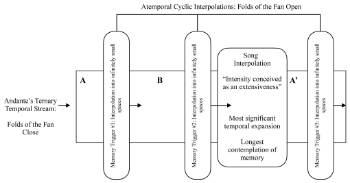
[4.7] The memory trigger interpolations of the Andante can be seen as moments where the fan unfurls before folding back again for the continuation of the movement proper
Example 13. Form Reconceived via Benjamin’s “Folded Fan” Metaphor
(click to enlarge)
[4.8] Revisiting how the Andante’s form unfolds in time, its distinctive features resonate with Benjamin’s descriptive language, as “infinitely small spaces,” “intensities” conceived as “an extensiveness,” which eventually open “a newly compressed fullness” as the fan opens and closes ([1928] 1972, 117). Applying the language of expanding and contracting to the movement’s tempo changes between Andante and Adagio is fitting. Tempo reductions defamiliarize melodies like that of “Todessehnen” and the first movement’s coda. These allusions exist quite plainly, but when heard in a slower context are defamiliarized because of the temporal stretch. This aspect potentially builds memory and forgetfulness into the listener’s own experience, integrating the observer with the processes of the work; even the astute listener familiar with Brahms’s output may miss the allusions simply because of the slower tempo. This article’s initial formulation of the movement’s design was characterized as A B C A’ coda; more generally, demonstrating a pattern of statement/digression/re-statement. The diagram in Example 13 suggests that, employing the terminology of the folded fan, the C section is absorbed within the most extensive interpolations of memory; the main stream of time in the Andante moves forward as the fan closes, while the memory triggers open the fan, bringing distant subconscious memories to the musical surface. Concentrated moments of introspection allow involuntary subconscious memory, substituting for the failure of voluntary thematic memory, to shape the formal design: the individual represented by the solo piano seeks connection with the ensemble or the solo cello via shared thematic material, and even as memory fades, the drive for personal connection continues to burn. This fuels the recollections of seemingly disparate musical allusions, opened by the piano’s release from and eventual nonparticipation with the main theme.
Conclusion
[5.1] To best approach a complex slow movement such as the op. 83 Andante, we should draw on all the understanding of memory that we can productively apply. The role of memory in a work such as this does not stop here. As a nineteenth-century concerto inflected by symphonism, the Second Concerto encapsulates conflicting trends of event-centrism and the work-concept (as understood by Goehr 1992, 113): where improvisational freedom may have previously been called for (as in the cadenza left free by Brahms in the first movement of the Violin Concerto), the fully notated score makes new demands on the memories of its performers
[5.2] Just as naturally as we remember, we forget. These aspects of cognitive function are not often expressively valued in music analysis, especially in studies that draw metaphorical relationships between music and memory. For the present essay, the metaphor of memory’s usefulness as a theoretical construct is taken seriously, which then refines an interpretation’s analytical yield. In the end, this is just one reading. Applying the complexities of remembering and forgetting to music likely can open many further avenues of interpretation that have not yet been explored. Further research may continue to adumbrate how music relies not only on memory but on the full range of cognitive function. Lest we forget: memory only takes on meaning against the backdrop of oblivion.
David Keep
Hope College
Jack H. Miller Center for Musical Arts
221 Columbia Avenue
Holland, MI 49423
keep@hope.edu
Works Cited
Agawu, Kofi. 1991. Playing with Signs. Princeton University Press. https://doi.org/10.1515/9781400861835.
Beller-McKenna, Daniel. 2016. “Vous souvenez-vous Brahms? Brahms and Memory in Françoise Sagan’s Aimez-vous Brahms
—————. 2021. “Integration and Memory: Inter-movement Thematic Recall in Beethoven and Brahms.” Nineteenth-Century Music Review 18 (2): 283–308. https://doi.org/10.1017/S1479409820000294.
Benjamin, Walter. [1928] 1972. Gesammelte Schriften, Volumes 1–4. Edited by Tilman Rexroth. Suhrkamp.
—————. [1932] 1999. Walter Benjamin: Selected Writings, Volume 2: 1927–1934. Translated by Rodney Livingstone. Edited by Michael W. Jennings, Howard Eiland, and Gary Smith. Belknap Press.
Berry, Paul. 2007. “Old Love: Johannes Brahms, Clara Schumann, and the Poetics of Musical Memory.” The Journal of Musicology 24 (1): 72–111. https://doi.org/10.1525/jm.2007.24.1.72.
—————. 2014. Brahms Among Friends: Listening, Performance, and the Rhetoric of Allusion. Oxford University Press. https://doi.org/10.1093/acprof:oso/9780199982646.001.0001.
Botstein, Leon. 2009. “Time and Memory: Concert Life, Science, and Music in Brahms’s Vienna.” In Brahms and His World, Revised Edition, ed. Walter Frisch and Kevin C. Karnes, 3–25. Princeton University Press. https://doi.org/10.1515/9781400833627.3.
Bridge, Donna J., and Ken A. Paller. 2012. “Neural Correlates of Reactivation and Retrieval-Induced Distortion.” Journal of Neuroscience 32 (35): 12144–12151. https://doi.org/10.1523/JNEUROSCI.1378-12.2012.
Burnham, Scott. 2000. “Schubert and the Sound of Memory.” The Musical Quarterly 84 (4): 655–63. https://doi.org/10.1093/mq/84.4.655.
Cone, Edward T. 1982. “Schubert’s Promissory Note: An Exercise in Musical Hermeneutics.” 19th-Century Music 5 (3): 233–41. https://doi.org/10.2307/746462.
Dahlhaus, Carl. 1988. Nineteenth-Century Music. Translated by J. Bradford Robinson. University of California Press.
Daverio, John. 2002. Crossing Paths: Schubert, Schumann, and Brahms. Oxford University Press. https://doi.org/10.1093/acprof:oso/9780195132960.001.0001.
Davis, Ronald, and Yi Zhong. 2017. “The Biology of Forgetting–A Perspective.” Neuron 95 (3): 490–503. https://doi.org/10.1016/j.neuron.2017.05.039.
Dickensheets, Janice. 2012. “The Topical Vocabulary of the Nineteenth Century.” Journal of Musicological Research 31 (2-3): 97–137. https://doi.org/10.1080/01411896.2012.682887.
Dupret, David, Joseph O’Neill, Barty Pleydell-Bouverie, and Jozsef Csicsvari. 2010. “The Reorganization and Reactivation of Hippocampal Maps Predict Spatial Memory Performance.” Nature Neuroscience 13: 995–1002. https://doi.org/10.1038/nn.2599.
Ebbinghaus, Hermann. 1885. Über das Gedächtnis. Untersuchungen zur experimentellen Psychologie. Duncker & Humblot.
Frisch, Walter. 1984. Brahms and the Principle of Developing Variation. University of California Press. https://doi.org/10.1525/9780520352322.
Goehr, Lydia. 1992. The Imaginary Museum of Musical Works: An Essay in the Philosophy of Music. Clarendon Press. https://doi.org/10.1111/j.1468-0149.1993.tb00526.x.
Goldman, Jonathan. 2014. The Musical Language of Pierre Boulez: Writings and Compositions. Cambridge University Press.
Grimes, Nicole. 2019. Brahms’s Elegies: The Poetics of Loss in Nineteenth-Century German Culture. Cambridge University Press. https://doi.org/10.1017/9781108589758.
Horne, William. 1992. “Brahms’ Heine-Lieder.” In Brahms als Liedkomponist, ed. by Peter Jost, 93–115. Franz Steiner Verlag.
Horton, Julian. 2014. “Listening to Topics in the Nineteenth Century.” In The Oxford Handbook of Musical Topics, ed. Danuta Mirka, 642–64. Oxford University Press. https://doi.org/10.1093/oxfordhb/9780199841578.013.0026.
—————. 2017. Brahms’ Piano Concerto No. 2, Op. 83: Analytical and Contextual Studies. Peeters Publishers.
Keep, David. 2023. “The Voice of Enigma: Intertextuality in ‘Im wunderschönen Monat Mai.’” Intégral: The Journal of Applied Musical Thought 36: 175–91.
Kerman, Joseph. 1999. Concerto Conversations. Harvard University Press. https://doi.org/10.4159/harvard.9780674182028.
Klein, Michael L. 2004. Intertextuality in Western Art Music. Indiana University Press. https://doi.org/10.2979/2071.0.
Kramer, Lawrence. 2009. Why Classical Music Still Matters. University of California Press.
Leistra-Jones, Karen. 2015. “Improvisational Idyll: Joachim’s ‘Presence’ and Brahms’s Violin Concerto, Op. 77.” 19th-Century Music 38 (3): 243–71. https://doi.org/10.1525/ncm.2015.38.3.243.
Loges, Natasha. 2017. Brahms and His Poets: A Handbook. Boydell Press. https://doi.org/10.1017/9781787441552.
MacDonald, Malcolm. 1999. “‘Veiled Symphonies’? The Concertos.” In The Cambridge Companion to Brahms, ed. Michael Musgrave, 156–70. Cambridge University Press. https://doi.org/10.1017/CCOL9780521481298.008.
Mahlert, Ulrich. 1994. Brahms: Klavierkonzert B-Dur op. 83. München.
Marx, Adolf Bernhard. 1837–47. Die Lehre von der musikalischen Komposition, praktisch- theoretisch. Breitkopf & Härtel.
Monahan, Seth. 2013. “Action and Agency Revisited.” Journal of Music Theory 57 (2): 321–71. https://doi.org/10.1215/00222909-2323497.
Monelle, Raymond. 2000. The Sense of Music: Semiotic Essays. Princeton University Press.
—————. 2006. The Musical Topic: Hunt, Military and Pastoral. Indiana University Press. https://doi.org/10.2979/4086.0.
Moseley, Roger. 2009. “Between Work and Play: Brahms as Performer of His Own Music.” In Brahms and His World, Revised Edition, ed. Walter Frisch and Kevin C. Karnes, 137–66. Princeton University Press. https://doi.org/10.1515/9781400833627.137.
Notley, Margaret. 2007. Lateness and Brahms: Music and Culture in the Twilight of Viennese Liberalism. Oxford University Press. https://doi.org/10.1093/acprof:oso/9780195305470.001.0001.
Oinas, Cecilia. 2023. “Sonic Bridges and Pitch-Based Bonding in Two Songs by Saariaho.” Music Theory Online 29 (3). https://doi.org/10.30535/mto.29.3.6.
Parmer, Dillon. 1995. “Brahms, Song Quotation and Secret Programs.” 19th-Century Music 19 (2): 161–90. https://doi.org/10.2307/746660.
Plantinga, Leon. 1999. Beethoven’s Concertos: History, Style, Performance. W. W. Norton.
Platt, Heather, and Peter H. Smith, eds. 2012. Expressive Intersections in Brahms: Essays in Analysis and Meaning. Indiana University Press. https://doi.org/10.2979/6077.0.
Ratner, Leonard. 1980. Classic Music: Expression, Form, and Style. Schirmer.
Rosen, Charles. 1980. “Influence: Plagiarism and Inspiration.” 19th-Century Music 4 (2): 87–100. https://doi.org/10.2307/746707.
Sagan, Françoise. 1959. Aimez-vous Brahms? René Julliard.
Sams, Eric. 2000. The Songs of Johannes Brahms. Yale University Press.
Sholes, Jacquelyn. 2018. Allusion as Narrative Premise in Brahms’s Instrumental Music. Indiana University Press. https://doi.org/10.2307/j.ctv2n7nz2.
Sisman, Elaine. 1990. “Brahms’s Slow Movements: Reinventing the ‘Closed’ Forms.” In Brahms Studies: Analytical and Historical Perspectives, ed. George S. Bozarth, 79–103. Clarendon Press.
—————. 2000. “Memory and Invention at the Threshold of Beethoven’s Late Style.” In Beethoven and His World, ed. Scott Burnham and Michael P. Steinberg, 51–87. Princeton University Press. https://doi.org/10.1515/9780691218328-004.
Snyder, Robert. 2001. Music and Memory. The MIT Press.
Stefaniak, Alexander. 2021. Becoming Clara Schumann: Performance Strategies and Aesthetics in the Culture of the Musical Canon. Indiana University Press. https://doi.org/10.2307/j.ctv21hrj1m.
Struck, Michael. 1988. “Revisionsbedürftig: Zur gedruckten Korrespondenz von Johannes Brahms und Clara Schumann: Auswirkung irrtümlicher oder lücken hafter Überlieferung auf werkgenetisches Bestimmungen (mit einem unausgewerteten Brahms-Brief zur Violinsonate op. 78).” Die Musikforschung 41 (3): 235–41. https://doi.org/10.52412/mf.1988.H3.1361.
Tarasti, Eero. 1994. A Theory of Musical Semiotics. Indiana University Press. https://doi.org/10.2979/3139.0.
Taylor, Benedict. 2011. Mendelssohn, Time and Memory: The Romantic Conception of Cyclic Form. Cambridge University Press. https://doi.org/10.1017/CBO9780511794384.
Terrigno, Loretta. 2021. “Emergent Modality: Minor-to-Major Progressions as ‘Tragic-to- Transcendant’ Narratives in Brahms’s Solo Songs.” Music Theory Online 27 (3). https://doi.org/10.30535/mto.27.3.3.
Footnotes
1. Daniel Beller-McKenna observes that “Johannes Brahms’s place in music history has often been tied to memory in one way or another,” and that the “conception of Brahms’s music as nostalgic has been, perhaps, his most uncontested legacy” (2016, 1). Gestures of historical (stylistic imitation), cultural (model composition), and personal remembrance (melodic allusion) are some of the most frequently discussed kinds of memory found in the Brahmsian scholarly literature. Paul Berry (2014) documents most extensively how Brahms’s inner circle interpreted the composer’s music and its engagement with memory via allusion. John Daverio (2002) compares how Schubert, Schumann, and Brahms evoke memory in their music. Berry (2007) retraces Clara Schumann’s musical memories that Brahms sought to stimulate via allusion, Jacquelyn Sholes (2018) explores memory in Brahms’s multi-movement instrumental works as they evoke works by composers of the past, and Beller-McKenna (2021) contrasts Beethoven’s and Brahms’s implementations of inter-movement thematic recall as reflections of contrasting conceptions of history (linear Enlightenment thought versus post-Romantic dwelling on the past).
Return to text
2. In the most general sense, this is true of much music commentary on nineteenth-century western art music, though especially focused when considered in Brahms’s output.
Return to text
3. Brahms’s response to Schubert’s influence is especially relevant here, as Schubert’s output has also received substantial attention to memory, as in Burnham 2000. Another potential influence regarding Brahms and his understanding of memory may be scientific research in German-speaking circles during the nineteenth century. As Leon Botstein has observed, Brahms enthusiastically followed scientific trends developing in his lifetime (2009, 12). Though not documented, perhaps the composer was exposed at some point to the research of German psychologist Hermann Ebbinghaus, who proposed the concept of the “forgetting curve” in the 1885 study Über das Gedächtnis (On Memory). Brahms’s friendship with the surgeon Theodor Billroth would have been another source of exposure to new trends in scientific thought.
Return to text
4. Especially with a composer as reluctant as Brahms to comment on his music, scholars have been deeply intrigued by the few lasting statements the composer allowed to surface about his works.
Return to text
5. Beller-McKenna describes an association of Brahms in a generalized “fictional” sense with memory and oblivion, recounting how the main character Paule in Aimez-vous Brahms? by Françoise Sagan “ties Brahms to memory through a negative equation.” The composer is “equated with loss: loss of memory in Paule’s forgetfulness and a loss of self (‘She would never be herself again’). On the face of it, Sagan may appear to be turning the concept of Brahms and memory on its head: Brahms as forgetfulness” (2016, 3). This is understood to be a “dimmer view of nostalgia” characteristic of modernist rather than romantic ideals.
Return to text
6. Voluntary and involuntary memories can be defined numerous ways. For the purposes of the present analysis, and in the simplest terms, “voluntary” refers to memories that are consciously driven by a will to remember, and “involuntary” refers to memories that materialize unconsciously.
Return to text
7. This understanding of the concerto genre builds on the interpretive conventions demonstrated in studies such as Kerman 1999.
Return to text
8. Nicole Grimes (2019) addresses more extensively the “aesthetics of loss” in Brahms’s choral elegies.
Return to text
9. Ulrich Mahlert (1994) also examines the concerto in detail.
Return to text
10. Elaine Sisman (1990) identifies ternary form in 23 of Brahms’s 39 instrumental slow movements. Walter Frisch (1984) notes that formal expectations for the genre are rather loose. Horton contends that the “mixture of ternary and sonata principles produces a distinctively Brahmsian design, essential to which is a tension between the functions of second-theme recapitulation and coda.” All four slow movements from Brahms’s concerti are understood by Horton to engage a ternary and sonata hybrid, in which “B projects a dual functional identity: as subordinate group, it has an expositional and recapitulatory function; however its post-cadential reprise retrospectively lends its first presentation the status of a ternary contrasting middle section” (2017, 171).
Return to text
11. Horton draws on Notley 2007 and the significance of the “cult of the Adagio” in German-speaking musical circles, which is contrasted with other slow movements types such as the Andante.
Return to text
12. Horton’s analytical approach for the concerto genre as a whole is certain not to overlook “topical discourse,” building on Ratner 1980, Agawu 1991, Monelle 2006, and Horton 2014. For nineteenth-century music and topics, see also Dickensheets 2012.
Return to text
13. This strategy, seeking extramusical substance in Brahms’s instrumental works via song allusion, applies the approach developed by Dillon Parmer (1995).
Return to text
14. Malcolm Macdonald (1999), in linking the songs and the melodic material of the Andante, identifies a “Clara” motif. Daverio (2002) critiques the interpretive viability of such musical ciphers in Brahms, particularly in approaches like that of Eric Sams (2000).
Return to text
15. In a rather distant cyclical sense, these ascending arpeggios echo the piano figuration of the beginning of the first movement, which responds to the horn’s incipit.
Return to text
16. Horton (2017) compiles an extensive corpus of “post-classical piano concerti,” consisting of works by Balakirev, Beethoven, Bennett, Brahms, Chopin, Cramer, Czerny, Dussek, Dvorak, Field, Glazunov, Grieg, Henselt, Herz, Hiller, Hummel, Kalkbrenner, Liszt, Litolff, Lyapunov, Mendelssohn, Moscheles, Pixis, Rachmaninov, Ries, Rubinstein, Saint-Saëns, Scharwenka, Schumann, Steibelt, Tchaikovsky, and Weber. Horton’s study focuses only on form in first movements of these concerti. I consulted the works from Horton’s corpus that also had interior slow movements (excluded by Horton but added to the present study are concerti composed by Clara Wieck, Emilie Mayer, and Amy Beach). In this corpus, 79 instances of thematic sharing occur in 118 slow movements. Types (listed in order of most common to least common) include 1) themes shared by soloist and orchestra in Mozartean tutti/solo alternation, often at the beginning of a slow movement (the eight concerti of Cramer exclusively demonstrate this type), 2) duet-style apotheosis of simultaneous theme sharing (Wieck, op. 7 and Grieg, op. 16) often found at a movement’s reprise, and 3) motives traded back and forth in integrated textures that break down tutti/solo divisions (Rachmaninov, op. 40). In the remaining slow movements that feature thematic separation between soloist and orchestra, types (listed in order of most common to least common) include 1) thematic priority given to the soloist alone with orchestra playing only supporting accompaniment (examples by Chopin, Kalkbrenner, Pixis, Thalberg, and Scharwenka), 2) a brief orchestral preface followed by extensive and wide-ranging piano solo that only tangentially relates to the orchestral material (Litolff, op. 22), and 3) the soloist and orchestra alternate without any shared obviously shared material (Beethoven, op. 58 and Rubinstein, op. 94).
Return to text
17. While the Andante features a characteristically Brahmsian overlap at its reprise, Dussek’s Piano Concerto no. 12, op. 70 (1810) provides a precedent that may have caught Brahms’s attention: its slow movement, also in
Return to text
18. In the op. 15 Adagio, Daverio (2002) observes that the D–G–
Return to text
19. Snyder defines long-term memory as “a very large, possibly permanent memory, whose contents are usually unconscious. Meaning and understanding are derived by processing present perception through long-term memory.
Return to text
20. Episodic memories are autobiographical, whereas general knowledge, another type of long-term memory, is not. Episodic memory records events as they happen to us. Because, however, remembering is itself an event, episodic memories are copied when they are recollected, and the copy replaces the original. This makes our episodic memories vulnerable to various kinds of transformations and distortions, especially through their interaction with our semantic memory (conceptual) categories and schemas. In a piece of music, episodic memories would be of the details of the sound of particular passages of music and their time order” (2001, 258).
Return to text
21. Snyder refers to various kinds of cues for long-term memories: “there are three types of cuing: (1) recollection, where we intentionally try to cue a memory; (2) reminding, where an event in the environment automatically cues an associated memory of something else; and (3) recognition, where an event in the environment automatically acts as its own cue. Recognition and reminding are spontaneous events that are going on constantly” (2001, 70). Snyder notes that “the real challenge of long-term memory is to retain the association between a specific cue and a specific memory over time. This usually works quite well, but the process can be derailed by irrelevant cues similar to the correct cue, which can produce various kinds of interference with recall” (70). Detailing the process, Snyder writes that “the cuing process described above is an important mechanism by which larger long-term memories are retrieved. We have seen that memories are stored in chunks, which are quite limited in size, but that an element in a chunk may act as a cue for another chunk, connecting them together in an unfolding sequence of associations. A musical example of this would be building up a memory of a piece of music phrase by phrase, with each phrase constituting a chunk. In this way, even though the size of the basic chunks of memory is limited, larger units of memory may be created by making stable connections between chunks. This process may continue on multiple levels and in multiple directions of association so that memory representations of sequences or bodies of knowledge of considerable size may be built up” (70). The “memory triggers” in the present analysis thus may be understood to act similarly to cues.
Return to text
22. The middle section’s turbulent passagework in the solo piano is similar to the analogous digression in the slow movement of Chopin’s Piano Concerto in F minor, op. 21. I thank Cecilia Oinas for this observation. Looking in more detail at Chopin’s slow movement, other similarities emerge when comparing with Brahms’s Andante, such as the tonic arpeggio gestures in the solo piano found at the beginning and end of both movements. Near the conclusion of the A’ section of Chopin’s slow movement, the piano’s main melody is heard in canon with a solo bassoon—a striking passage of thematic sharing that foils the separation of Brahms’s slow movement.
Return to text
23. Though this is a striking harmonic turn, Brahms does prepare the ear with an earlier version of the same progression at a faster tempo in mm. 42–43.
Return to text
24. Monahan notes that both individuated elements and the work-persona dwell in an intra-musical world and are “trapped” in the moment without foreknowledge. But the work-persona is “necessarily both unitary and continuous.” This “single unbroken consciousness” is “unique to a movement
Return to text
25. Monahan spells out this possibility: “Many, perhaps most, analyses that feature a central work-persona also mark off one or more individuated elements as antagonists acting in opposition to that central subjectivity” (328). This follows Tarasti 1994 and the ideas of Algirdas Greimas. Monahan observes that Cone’s famous “Promissory Note” analysis (1982) features such contradiction.
Return to text
26. The passage continues the developing variation that Horton (2017) identifies as the predominant function of mm. 1–58. Though developing variation often involves considerable destabilization of meter, this is usually achieved via metric dissonance (grouping or displacement). Rarely is it achieved via ritardandi.
Return to text
27. Viewed another way, the unusual role of these recurring interpolations may be beneficially viewed along the lines of Boulez’s concept of the “signal,” described by Goldman: “the signal, then, bursts out of the flow of musical discourse, and articulates the important formal moments of the piece” (2014, 65).
Return to text
28. Janet Schmalfeldt has observed that Brahms’s opening piano solo also bears similarity to a passage from Schumann’s Fantasy in C major, op. 17, third movement, mm. 15–23 (personal communication with the author).
Return to text
29. See Oinas 2023 for more on this topic, particularly on the expressive potential of shared unisons in performance.
Return to text
30. Max von Schenkendorf’s poem “Todessehnen” is often interpreted as an expression of pain from romantic separation (see Terrigno 2021, for example), which underscores the yearning for relational intimacy it imports into the op. 83 Andante via allusion. For more on Schenkendorf, see Loges 2017.
Return to text
31. I do not pursue the possibility of reference to “Immer leiser wird mein Schlummer” in this analysis. Horton notes the potential allusion, but hesitates to ascribe too much significance to it because of its composition well after the concerto was written. Klein (2004) advances a different view of intertextuality that does not require historical chronology, as twenty-first-century listeners have already heard many pieces in their understanding of historical repertoires “out of order,” legitimizing the consideration of this song in op. 83. But for the purposes of this analysis, I focus only on the allusions that follow directly after the memory triggers. Certainly, the reflective allusive layers of the Andante are numerous, and the references discussed here are likely just a handful within a larger web. Brahms’s “Sommerabend” and “Mondenschein,” op. 85, nos. 1 and 2, are settings of Heine poems that share similar arpeggio gestures in the piano accompaniment to the Andante’s memory triggers. Themes of sickness and healing pervade both poems. Horne (1992) relates these songs to the slow movement of Schumann’s Piano Quartet, op. 47. Notably, this movement features a beautiful melody in the strings that the piano never gets to play in its original form. The movement is in
Return to text
32. Beller-McKenna (2021) distinguishes Brahms’s end-oriented cyclic returns, in op. 5 (1853), op. 67 (1875), op. 78 (1878), op. 90 (1883), and op. 115 (1891), from those of Beethoven that spur imagination and improvisatory passagework at the beginnings of finales, as observed by Sisman (Sisman 2000). A motivating difference between views of memory between Brahms and Beethoven are given via historical contexts. In Beller-McKenna’s words: “Notably then, unlike Beethoven’s use as explained by Sisman, Brahms does not tend to bring back earlier material to openly enact the creative process; whereas for Beethoven the recalled theme is like an image that, as Sisman puts it, ‘may be a locator in memory that stimulates the composition of thematic material’, for Brahms it acts more like a reflection on what has already occurred, like a coming to terms with the past, rather than recounting it in order to imagine a way forward” (2016, 293). This is connected to the differences between Enlightenment-era thought and Brahms’s “late” position in the nineteenth century. Benedict Taylor (2011) puts forth another view on thematic recall and memory in Mendelssohn’s instrumental works, which Beller-McKenna interprets as functioning “somewhat differently” from the Beethoven and Brahms cyclic returns (286).
Return to text
33. A particularly clear interpolation is the
Return to text
34. Putting it another way, Monahan argues that “anyone who has compared two analyses of a single piece will likely have noticed that their respective composers can rarely be merged into a single hypothetical individual—let alone the historical one” (2013, 330).
Return to text
35. Clara Schumann’s Piano Concerto also prominently features a solo cello. In contrast to the op. 83 Andante, the movement is set for piano and cello alone with the orchestral ensemble tacet. The solo cello only plays in the A’ section when the piano reprises its main melody. This effusive, romantic duet foils the thematic trajectory of Brahms’s Andante. See Keep 2023 for more on Clara Schumann’s Piano Concerto.
Return to text
36. Translation by Daverio (127–28).
Return to text
37. Translation by Rodney Livingstone, in Benjamin ([1932] 1999).
Return to text
38. Translation by Rodney Livingstone, in Benjamin ([1932] 1999).
Return to text
39. See MacDonald 1999, 167. However, the illness and death in 1879 of Felix Schumann (Brahms’s godson) occurred during the composer’s work on the Second Concerto (1878–1881). This greatly affected Brahms as he composed the G major Violin Sonata, op. 78 (see Struck 1988 and Berry 2014).
Return to text
40. Another version of this temporal conception could be framed as forward-moving “narrative” time (Gang) and circular “lyrical” time (Satz), a modified version of ideas from Adolf Bernhard Marx (1837–47) articulated by Raymond Monelle (2000, 81–114).
Return to text
41. The discourse on the nineteenth-century century shift from “event” to “work” stems from Dahlhaus 1988. Roger Moseley (2009) suggests that Brahms himself was instrumental in this shift, particularly through his performances as soloist of the Second Concerto (139–46). Karen Leistra-Jones (2015) considers how the centrality of improvisation and Joachim’s presence shape an understanding of “authenticity” in the Violin Concerto.
Return to text
42. Alexander Stefaniak (2021) explores how Clara Schumann’s playing from memory made the impression of the “spirit” of the composer, i.e. Robert Schumann, inseparable with the presence of the performer herself.
Return to text
Copyright Statement
Copyright © 2026 by the Society for Music Theory. All rights reserved.
[1] Copyrights for individual items published in Music Theory Online (MTO) are held by their authors. Items appearing in MTO may be saved and stored in electronic or paper form, and may be shared among individuals for purposes of scholarly research or discussion, but may not be republished in any form, electronic or print, without prior, written permission from the author(s), and advance notification of the editors of MTO.
[2] Any redistributed form of items published in MTO must include the following information in a form appropriate to the medium in which the items are to appear:
This item appeared in Music Theory Online in Volume 32, Issue 2 in June 2026. It was authored by David Keep (keep@hope.edu), with whose written permission it is reprinted here.
[3] Libraries may archive issues of MTO in electronic or paper form for public access so long as each issue is stored in its entirety, and no access fee is charged. Exceptions to these requirements must be approved in writing by the editors of MTO, who will act in accordance with the decisions of the Society for Music Theory.
This document and all portions thereof are protected by U.S. and international copyright laws. Material contained herein may be copied and/or distributed for research purposes only.

Prepared by Amy King, Editorial Assistant
Number of visits:
2309