“I Raq and Roll”: Signs of War in Post-9/11 Country Music*
Alan Reese
KEYWORDS: Country, Rock, Toby Keith, Charlie Daniels, Clint Black, Semiotics, War on Terror
ABSTRACT: In the article, I explore how a selection of post-9/11 country songs, such as Clint Black’s “I Raq and Roll,” attempt to persuade listeners to support the War on Terror. While most scholarly attention has focused on lyrical content, commercial reception, and comparisons with other musical styles’ reactions to 9/11, I examine how certain musical elements suggestive of rock are deployed within a country context to support armed retaliation. I adopt aspects of Peircean semiotics, specifically iconic and indexical signs, to show how rock can be repurposed to signify a war that is not only just, but exhilarating.
After demonstrating my methodology, I provide detailed analyses of two country hits. In my discussion of “This Ain’t No Rag, It’s a Flag” by the Charlie Daniels Band, I apply Turino’s (1999) concept of “semantic snowballing” to navigate through a web of indexical associations formed between the song and other artists, styles, and eras. I argue that in its attempt to deploy rock as a vehicle for jingoism, “This Ain’t No Rag” neutralizes whatever remained of rock’s anti-establishment ethos, but ultimately comes across as an inauthentic, reactionary replica of Daniels’s past success. Meanwhile, Toby Keith’s “Courtesy of the Red, White, and Blue (The Angry American)” juxtaposes overt aggression with sentimentality: physical threats alternate with expressions of familial love, while the chorus’s distorted electric guitars contrast with the opening’s gentle acoustic strums. The result is a powerful conflation of the personal and the political, of intimacy and violence.
DOI: 10.30535/mto.32.2.5
Copyright © 2026 Society for Music Theory
Example 1. Clint Black, “I Raq and Roll” (2003), third verse and chorus
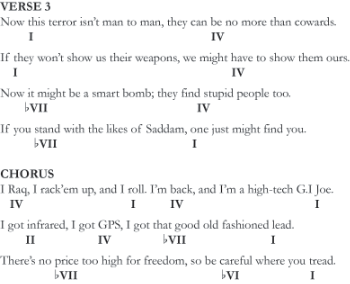
(click to enlarge and listen)
[0.1] Around the launch of the U.S. invasion of Iraq in March 2003, country star Clint Black debuted the memorably titled “I Raq and Roll.
Audio Example 1. Clint Black, “I Raq and Roll” (2003), drum fill launching the chorus
Audio Example 2. Clint Black, “I Raq and Roll” (2003), outro
[0.2] So why would Black write a Southern rock song? Besides realizing the promise of the titular pun, the rock elements, especially the instrumentation, sonically represent the raw power of the American military—in other words, Black wields rock as a weapon. This is made particularly apparent in the song’s chorus and outro. As heard in Audio Example 1, the drummer unleashes an aggressive, measure-long fill underneath the lyrics, “I Raq, I rack’em up, and I roll.” The drummer’s prominent silence on beat 3 is followed by several quick strikes on the toms and a climactic crash cymbal on the next downbeat, as if to simulate sporadic gunfire or an artillery strike. Consequently, the phrase “rock and roll” is transformed from its origins as a subversive euphemism for sex into the sounds of overwhelming military force. The outro (Audio Example 2) eliminates any remaining subtlety: repeated chants of the chorus’s opening line are accompanied not only by a thudding drumbeat, but by percussive volleys of actual gunfire.
[0.3] In what follows, I examine how a selection of post-9/11 country songs attempt to musically persuade listeners to support the War on Terror, focusing on the marked use of traditional rock elements within an otherwise country context. I begin with an overview of scholarly and journalistic work on the complex connections between country music and Bush-era conservativism, as well as rock music’s longstanding cultural association with anti-imperialist and anti-establishment politics. After discussing challenges to these narratives, I examine what distinguishes the rock and country genres, and what makes that task difficult yet analytically productive. I then present my methodology: an application of Peircean semiotics centering on iconic and indexical signs. With these tools in hand, I explore how the rock style can be repurposed to signify war—specifically a war that is not only just, but exhilarating. I then proceed to my two central analyses: “This Ain’t No Rag, It’s a Flag” (2001) by the Charlie Daniels Band and “Courtesy of the Red, White, and Blue (The Angry American)” (2002) by Toby Keith. I close with a brief look at Jason Aldean’s “Try That in a Small Town” (2023), showing how similar compositional strategies are deployed two decades later to fight the “war” at home.
1. Country, Combat, and Conservativism
[1.1] Scholarly commentary on the small but striking number of pro-war country songs from the early 2000s has largely focused on lyrical content, critical and commercial reception, and comparisons with other musical styles’ reactions to 9/11
[1.2] William Hart (2005) argues that one reason for this persistent perception is that, beginning with Nixon
Challenging the Narrative(s)
[1.3] That said, these cultural perceptions—country as conservative, rock as anti-war—haven’t gone without critique. Kenneth Bindas and Craig Houston (1989) show that rock largely ignored the Vietnam War until the public turned against it, and even then, anti-war hits were few in number, peaking in popularity in 1970–1971. According to the authors, such anti-war songs were “not a social protest rising up from the people, but a brief, commercially viable product” (20). Despite this reality, “popular imagination enthroned rock music as the leader of political antiwar opposition” (22)
[1.4] Given this context, it is less surprising that post-9/11 rock was far from unified against war. Reebee Garofalo (2007) singles out several jingoistic rock performances during the months after 9/11, noting that “in five short weeks talk of helping and healing had begun to give way to the rhetoric of revenge and retribution” (8). At the Concert for New York City in October 2001, Bon Jovi directed “Wanted: Dead or Alive” toward Osama bin Laden, while The Who performed a raucous rendition of “Won’t Get Fooled Again” in front of U.S. and U.K. flags—two countries then launching an invasion into Afghanistan. The Who’s set was particularly well received by the audience—after all, as Garofalo asks, “who better to give vent to the anger in the room than the group that practically invented the symbolic release of violent emotion?” (8). Less than a month later, Neil Young released his musical retelling of the Flight 93 hijacking, titled “Let’s Roll,” which promises retaliation in the bridge: “We gotta go in after [evil] and never be denied” (Claassen 2009, 50)
[1.5] Finally, country music’s reaction to 9/11 was hardly monolithic: Alan Jackson’s well-known “Where Were You (When the World Stopped Turning)” forgoes calls for vengeance, instead extolling the virtues of “faith, hope, and love.” In fact, many scholars emphasize a propensity for country musicians and fans to be avowedly apolitical—what Hubbs (2014) calls “a tendency not to identify with partisan politics or a political self” (138). For example, Robert W. Van Sickel (2005) finds in his corpus study of no. 1 Billboard country songs that “commercial country music does not regularly display religious, populist, patriarchal, or politically conservative views,” but rather that “the most successful songs have been explicitly apolitical, even anti-political, in their rejection and apparent unawareness of social and economic conditions outside the lives of the song characters themselves” (313)
[1.6] Intriguingly, Hubbs (2014) argues that country’s well-known penchant for celebrating soldiers emerges less from a right-wing, imperialist perspective, and more from pro-working-class values—a logical position, given the class character of America’s armed forces (141). Andrew Boulton (2008) writes that in most country music, the U.S. solider “is cast as relatively apolitical; references to the rights, wrongs, and intricacies of specific military actions are eschewed in favor of the overarching theme of the defense of broad American values” (384). Such values, and patriotism in general, are instead interpreted as politically neutral, universal truths—the “things in common” Gretchen Wilson referenced. Music critic Dorothy Horstman’s ([1975] 1996) rejection of viewing Vietnam-era country as “reactionary” is instructive: she argues that songs like Merle Haggard’s “Okie from Muskogee” are “not the product of political reaction per se, but of the defense of a treasured lifestyle perceived to be under attack” (240). Thus, the defense of traditional values (e.g., patriotism) or long-standing social structures is divorced from politics—such values and structures aren’t meant to be negotiated but preserved.
[1.7] Of course, adopting an apolitical stance is not equivalent to being apolitical, and this stance has received criticism. In his discussion of Alan Jackson’s “Where Were You,” Aaron Fox (2005) highlights the following lyrics: “I'm not a real political man, I watch CNN, but I'm not sure I can tell you the difference in Iraq and Iran.” According to Fox, Jackson’s “detach[ment] from geopolitics” is constructed, “in classic nativist terms, as a virtue” (172). Moreover, disconnecting patriotism or nationalism from political action has the effect of naturalizing these values. Take country star Travis Tritt’s claim in 2003 that “to be a good American—regardless of which side you’re on—you have to get behind President Bush” (Willman 2005, 30). The decision to support the war effort is no longer a matter of partisan politics, but one’s sacred duty as a U.S. citizen—a framing that is undoubtedly useful to both political and military leaders.
Country vs. Rock
[1.8] Before moving on to my analyses, many of which focus on rock’s apparent intrusion into a country music context, it is worth discussing the fuzzy boundaries between the two musical worlds. Despite its ubiquity, musical genre is a slippery concept. As many authors note (e.g., Holt 2007, Miller 2010, Brackett 2016), genres are dynamic categories constructed from myriad elements (musical, lyrical, social, political, etc.), and the more clearly you define the genre, the less music it seems to describe. As David Brackett (2016) puts it, this is because “generic conventions… are constantly being modified by each new text that participates in the genre,” meaning “that texts refer to a model that they are bringing into existence” (13). Notwithstanding these challenges, Brackett maintains genre’s analytical utility, especially given its role in the production of art itself: “An awareness, conscious or not, of the potentials and constraints of the genre or genres in which they have chosen to work informs the decisions of artists as they adjust their aims to the audiences they are addressing” (14). While contradictions and inconsistencies are inevitable in genre analysis, the concept remains useful.
[1.9] Although its origins are complex and subject to debate, rock and roll largely emerged from rhythm and blues music of the 1940s and 50s, along with influences from other popular styles, including boogie-woogie, gospel, and, notably, country music. Specifically, the rockabilly style of Elvis Presley and Johnny Cash is often viewed as fusion of honky-tonk and R&B, or more broadly, the musical traditions of black and white Southerners (Neal 2019, 119)
[1.10] To address this issue, Peterson (1997, 229–30) develops a historical framework he calls “the dialectic of hard core and soft shell.” In short, country producers attempt to expand the audience through crossovers (the “soft shell”), creating a short-lived fad before reverting to what’s perceived as more “authentic” country (the “hard core”), which eventually leads to another soft shell, and so on
[1.11] With that in mind: what actually makes country music sound “country”? While harmony has received some attention
[1.12] Despite elements of rock being deeply intertwined in contemporary country’s DNA, I argue that listeners can still identify these discrete elements, and depending on the context—lyrical topic, comparisons with past or present country songs, the identity or aesthetic of the performer, how the song is marketed—the rock style may emerge as marked when sounding within the country genre
2. Finding Meaning in the Mayhem
[2.1] To examine how country songs produce a pro-war message, I adopt aspects of Charles Sanders Peirce’s (1955) theory of semiotics, employing specifically Thomas Turino's application of the theory to music (1999; 2008; 2014). Two crucial components are the icon and index, each a way of describing the relationship between musical signs and their objects. I then turn my focus to connections between rock and violence, and thus the potential for stylistic elements of rock to operate as icons or indices in songs about war. I close the section with a brief demonstration of my approach: a short analysis of Luke Stricklin’s “American by God’s Amazing Grace” (2005).
Icons and Indices
[2.2] Central to semiotic analysis is the sign, which Turino (2014) defines as “something that stands for something else (the object of the sign) to a specific perceiver so as to generate an effect (interpretants of particular types) in the perceiver” (188, emphasis mine). The three core elements here—signs, objects, and interpretants—form the primary trichotomy around which the rest of Peirce’s theory unfolds
[2.3] To navigate relationships between signs and objects, Peirce developed another trichotomy: the icon, the index, and the symbol
Audio Example 3. Darryl Worley, “Have You Forgotten” (2003), bridge
[2.4] A similar example occurs in Darryl Worley’s massive hit, “Have You Forgotten?”, a song that, when played at a Pentagon-sponsored event held a week after the fall of Baghdad, “brought tears to the eyes of Secretary of Defense Donald Rumsfeld” (Toal 2004, 856)
[2.5] Besides climactic cymbal strikes, musical icons may include quotations of or allusions to other works, and they also serve a crucial function in categorizing songs with shared features into musical genres (Turino 1999, 226–27; Turino 2014, 192–93). Indices, meanwhile, generate highly personal emotional effects in the listener, in part because they can “condense great quantities and varieties of meaning—even contradictory meanings—within a single sign” (Turino 1999, 235). For example, the sampled gunfire closing “I Raq and Roll” may operate as an index for a specific war, war in general, the gun control debate, or another musical work featuring recorded gunfire (e.g., M.I.A.’s “Paper Planes,” Pink Floyd’s “The Final Cut,” or, if gunfire is expanded to include cannon volleys, Piotr Tchaikovsky’s 1812 Overture). These objects can then themselves operate indexically, taking on “new layers of meaning while potentially also carrying along former associations—a kind of semantic snowballing” (Turino 1999, 235, emphasis mine).
[2.6] As an example of semantic snowballing—a concept crucial to my analysis of “This Ain’t No Rag”—Turino (2008) cites the civil rights movement, whose members set new lyrics to preexisting religious tunes or labor songs: “What they were doing was combining the old associations of religious righteousness and progressive politics—directly felt through indexical connection—with their events and cause, thereby adding historical depth and emotional power” (9). Through this process, I argue that a sort of semiotic time travel can occur: the past not only affects how we perceive the present (e.g., through contrafacta, the civil rights movement becomes a continuation of past struggles) but the present can affect how we perceive the past (e.g., the original hymns or union songs may now be heard as stepping stones to racial justice, regardless of original intent). These colliding meanings and conflicting emotions consequently “snowball” into a “highly economical and yet unpredictable sign” (9). Part of the “unpredictability” here is due to the decidedly subjective nature of indices; as Turino (2014) writes, “Because indices are based solely on individual experience, their effects can be highly unpredictable even among different individuals within the same context—they are particularly reliant on the internal contexts of perceivers” (196). As such, to make their semantic snowballing intersubjectively convincing (in other words, reproducible), the analyst must make a case for why a connection might be made through, for example, appeals to reception history or structural similarities).
[2.7] To summarize, Peirce’s theories enable analysts to create intricate, ever-expanding networks of meanings and associations, all the while providing the necessary tools to navigate them. The two sign types most relevant to my analysis are the icon and the index: the former links sign to object through similarity, while the latter links them through co-occurrence. Following Turino (1999), I believe these and other semiotic concepts make possible a more precise exploration of difficult yet profoundly interesting topics, such as “musical affectivity, different parts of ourselves and experiences, and the special potentials of music for the construction of personal and social identities” (249).
Rock as Violence
[2.8] The connection between rock and violence has received considerable attention, and as Suzanne Cusick (2006) has detailed, rock has served as a literal weapon—during the U.S. 1989 invasion of Panama, U.S. soldiers endlessly blared hard rock to coax Manuel Noriega out of hiding. Although it appears the technique failed to work, that did not stop the military from using it during the War on Terror—most infamously as a method of torture, but also on the battlefield. According to Jonathan Pieslak (2009), two major functions of music in warfare are to “motivate troops for combat or psychologically threaten an adversary” (79). For example, during the Second Battle of Fallujah in 2004, “large speakers were bolted on Humvees’ gun turrets to play hard rock/metal music,” a tactic used so frequently soldiers nicknamed the city “LalaFallujah” (84)
[2.9] On the symbolic front, many artists have used a rock sound to signify (as Peircean icons) military or police violence, as heard in the choruses of “Have You Forgotten?” and “I Raq and Roll.” Commonly, however, rock musicians deploy these icons to protest said violence, not support or glorify it. For instance, in U2’s pacifist classic, “Sunday Bloody Sunday” (1983), Larry Mullen’s rapid-fire, irregular snare drum pattern calls to mind the sounds of indiscriminate gunfire
[2.10] Finally, besides bringing along aggressive drumming and high volumes, rock possesses a certain rebellious aesthetic—an indexical link to its countercultural past—that can be leveraged to indicate a certain social cachet, or cool
[2.11] The image of the contemporary U.S. warfighter as “cool” is closely linked to the rise of special operations forces (SOF) in military operations after World War II (e.g., the Green Berets), and especially those serving since 1980 under the Joint Special Operations Command (e.g., SEAL Team Six). As Colonel R.D. Hooker, Jr. (2023) puts it, “The iconic muddy trooper of yesteryear has been replaced by a bearded, heavily tattooed commando, wearing a baseball cap backward and festooned with exotic kit” (50). Hooker’s comments are part of his critique of the rapid growth of and increased reliance on SOF in U.S. military operations, a growth accelerated by 9/11
[2.12] With all that said, I should clarify that rock elements in a country song are not limited to mimicking gunfire or making war sound exhilarating—these meanings are contingent on the presence of pro-war lyrical content. For example, in the “bro-country” hits of the 2010s, performers and producers largely avoided fiddles and steel guitars in favor of electric guitars and hard-hitting drumming, along with rap-like vocal delivery and/or auto-tune
The shift toward the acceptance of rock has irrevocably redefined the genre’s meaning as a cultural signifier. As such, its rhythm, its timbre, and its volume cannot simply be assigned a static and unchanging meaning based on past associations. Rather, the context of its present reception and distribution determines how it is consumed, who buys it, where and how it’s listened to, and what role it plays in public social spaces. (2011, 120–21).
I add to Roessner’s argument that while the “past associations” of rock do not limit its musical meanings, the past remains as a potential index in the mind of a listener, depending on their past experiences with the rock genre
Analytical Vignette: Luke Stricklin, “American by God’s Amazing Grace”
Example 2. Luke Stricklin, “American by God’s Amazing Grace” (2005)
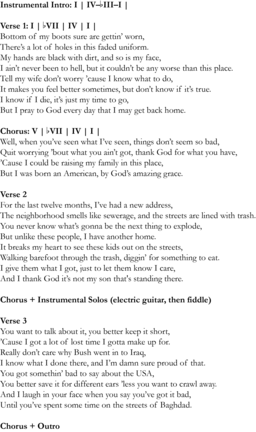
(click to enlarge and listen)
[2.13] While on active duty in Iraq, U.S. soldier-turned-singer Luke Stricklin (with co-writer J.R. Schultz) composed and recorded “American by God’s Amazing Grace,” before re-recording it in 2005 with Pacific-Time Records (Decker 2019, 106)
[2.14] While Verse 1 begins with a simple texture of acoustic guitar strums and minimal drumming, most of the song features a thick country-rock sound: electric and acoustic guitars, energetic drumming, fiddle and steel guitar fills, and the occasional organ pad. This texture is supported by bluesy riffs and chordal roots derived exclusively from the D-minor pentatonic scale, a common harmonic scheme in rock (Biamonte 2010, 104)
Example 3. Luke Stricklin, “American by God’s Amazing Grace” (2005), third verse
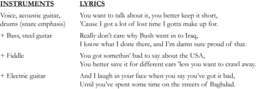
(click to enlarge and listen)
[2.15] Example 3 focuses on the climactic third verse, where Stricklin makes clear his resentment toward opponents of the war. As shown in the figure, the accompaniment drops down to Verse 1’s texture of acoustic guitar and light drumming, this time with snare rolls that, like those in “Have You Forgotten,” iconically recall a military tattoo. In other words, Stricklin’s most aggressive moment is texturally and timbrally coded as his most intimate. As a result, despite adopting (or feigning) an apolitical stance, he nevertheless places the sonic spotlight on the most explicitly political lyrics. One motivation for this choice might be to highlight a subtle change in the storytelling: while Stricklin refers to a vague “you” earlier in the song, here he explicitly references the possibility for dialogue, albeit one he hardly thinks is worth having (“You want to talk about it, you better keep it short”). With each couplet, the original instrumentation slowly returns: sustained bass and steel guitar notes in lines 3–4, more active fiddle fills in lines 5–6, and finally the electric guitar’s (somewhat muted) return in lines 7–8. The textural crescendo functions as an icon of Stricklin’s increasing rage, culminating with an explicit physical threat in lines 5–6 (“You got somethin’ bad to say about the USA, you better save it for different ears ’less you want to crawl away”). Line 7’s “And I laugh in your face” reads like an attempt to lower the temperature—while maintaining a masculine dominance—but the textural crescendo continues unabated, climaxing with the final, ecstatic chorus.
[2.16] “American by God’s Amazing Grace” contains strategies found in the two larger-scale analyses that follow. In “This Ain’t No Rag, It’s a Flag,” the Charlie Daniels Band makes use of a similar Southern rock sound—brash electric guitars, forceful drumming, bluesy riffs and chord progressions—to signal both the power of the U.S. war machine and how thrilling it is to watch it in action. In “Courtesy of the Red, White, and Blue (The Angry American),” Toby Keith, like Stricklin, juxtaposes this aggression with sentimentality: physical threats alternate with references to family, while distorted electric guitars contrast with acoustic strums. The result, especially in Keith’s hands, is a powerful conflation of the personal and the political, of intimacy and violence.
3. The Charlie Daniels Band, “This Ain’t No Rag, It’s a Flag”
[3.1] Released in October 2001, “This Ain’t No Rag, It’s a Flag” by the Charlie Daniels Band is unflinching in its call for a military response to the September 11th attacks: “We’re gonna hunt you down like a mad dog hound, make you pay for the lives you stole.” The song was largely successful both commercially and critically—Billboard called it a “well-performed rocker” that is “far more rousing than racist,” adding, “No doubt the more dovish among us will take offense, but when juxtaposed against rescue efforts that have evolved into recovery, who cares?” (Waddell 2001)
Audio Example 4. The Charlie Daniels Band, “This Ain’t No Rag, It’s a Flag” (2001), concluding recitation of the Pledge of Allegiance
[3.2] Perhaps the least subtle moment occurs in the outro (Audio Example 4), where a young girl recites the Pledge of Allegiance, suggesting that America (the girl) is both innocent and in need of protection. Meanwhile, the pledge is accompanied by incessant, celebratory chants of “U.S.A.,” all made by the adult male bandmembers. Such a juxtaposition indicates that the nation’s people (through the male-dominated military) can and will protect the young girl, and thus the country herself, from foreign threats coded as a racial Other through the opening lines’ implicit-but-unambiguous allusion to the racial slur, “r**head.
[3.3] In my analysis, however, I largely turn my attention toward the musical sounds themselves, arguing that “This Ain’t No Rag” takes musical and aesthetic elements of the rock style and repurposes them as sonic signifiers of a righteous war (righteous in both senses of the word). I then attempt to navigate through a complex web of indexical associations—Turino’s aforementioned process of “semantic snowballing” (1999, 235)—formed between “This Ain’t No Rag” and other artists, songs, styles, and eras. All told, I argue that in its attempt to deploy rock as a vehicle for jingoism, “This Ain’t No Rag” successfully neutralizes whatever anti-establishment ethos remained (or ever existed) in rock and ultimately comes across as an inauthentic replica of Daniels’s past success.
Weaponizing Rock
Example 4. The Charlie Daniels Band, “This Ain’t No Rag, It’s a Flag” (2001)
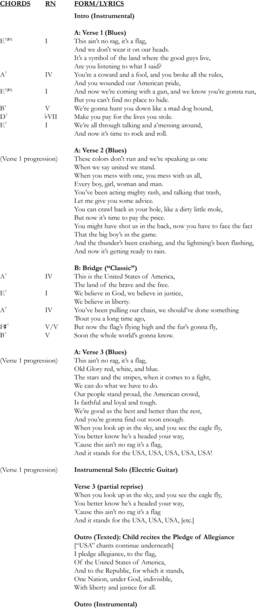
(click to enlarge and listen)
[3.4] The most obvious reference to (Southern) rock music in “This Ain’t No Rag” is the instrumentation: multiple electric guitars, distortion effects, and an aggressive 16th-note drum groove. Moreover, as shown in Example 4, both the harmonic and formal structures are stylistically iconic. After a short intro, Daniels lays out a clearcut AABA design—a form common in both early country and early roc
Audio Example 5. The Hendrix chord in Jimi Hendrix’s “Purple Haze” (1967) followed by “This Ain’t No Rag” (2001)
[3.5] A particularly subtle intertextual reference—and one directly connected to rock’s countercultural heritage—is the opening E7(
Semantic Snowballing
[3.6] Within each of these musical components, I hear Daniels employing elements of rock music—instrumental timbres, formal strategies, chord progressions, and even specific chordal voicings—to deliver a pro-war message, a message running counter to the anti-war stance popularly associated with rock, deservedly or otherwise, since the late 1960s (i.e., when Hendrix himself achieved fame). When listening to “This Ain’t No Rag,” I hear how the electrified instrumentation and rapid-fire blues riffs evoke not only the band’s vengeful rage, but also their power—each guitar strum or percussive strike feels like it takes significant force to create, and the result is an explosive barrage of sound. In this way, the instrumental timbres function as icons of gunfire and bombs—the band’s instruments have been reconfigured as weapons of war.
Example 5. Semantic snowballing in “This Ain’t No Rag”
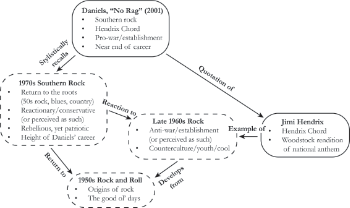
(click to enlarge)
[3.7] And yet, I cannot forget the indexical associations formed by rock in the late 1960s, such as anti-imperialism, youthful rebellion, free love, and being “cool” in the “bounded autonomy” sense of Warren and Campbell (2014)—party hard and party loud, but not in a way that jeopardizes mass appeal. Nor can I stop myself from comparing “This Ain’t No Rag” to Daniels’s earlier hits from the 1970s, an era that established Southern rock along with its complex relationship to reactionary politics (discussed below). To schematize this complex of signs and connections between them invoked within my hearing, Example 5 constructs a network, with each node containing an era or artist and each arrow linking nodes indexically. Starting at the top, “This Ain’t No Rag” points directly to 1970s Southern rock (through stylistic elements) and Jimi Hendrix (through musical quotation). Second-order connections include earlier periods in rock history, namely Hendrix’s music of the late 1960s and the early rock and roll music of the 1950s.
[3.8] The network highlights several specific relationships and allows for Turino’s process of semantic snowballing. I will begin with the Hendrix Chord’s namesake: for many rock afficionados, Hendrix’s musical persona embodies 1960s countercultural attitudes and fashion, and his 1969 performance of “The Star-Spangled Banner” at Woodstock exemplifies the anti-establishment orientation so commonly associated (accurately or otherwise) with the era. Turino (1999) highlights the use of electronic timbres and distortion—the sounds of 1960s rock—to perform what is, from a nationalist perspective, a sacred work. Through this unusual combination, Hendrix’s performance inspires a variety of reactions in listeners—is this a sign of disrespect toward the nation, a biting critique of the Vietnam War, or simply an amusing joke created by incongruity? Turino calls this process “creative indexing”—the “juxtaposition of two or more indices in novel ways that play off of the original meanings of the signs”—and he argues that with this performance, Hendrix “musically shifts the meaning of the national anthem” (242).
[3.9] Although Daniels similarly combines patriotism with rock, I find the result dramatically different: instead of rock music transforming the meanings of a patriotic sign, patriotism transforms the meanings of rock music. Because “This Ain’t No Rag” is firmly behind the nation’s political establishment, whatever remained of rock’s supposed radical politics are effectively neutered. And yet, the raw sonic power and pretensions to “coolness” and defiance remain—just as we heard in “I Raq and Roll” and “American by God’s Amazing Grace,” this war isn’t simply the right thing to do, it’s frankly badass. Rock’s rebellious attitude lingers on, but the enemy is no longer political elites advocating for war, but is instead, as Daniels’s (2003) essays make clear, a pervasive, liberal-coded “political correctness” enforced by Hollywood, the media, feminists, and the ACLU, among others (xi–xx, 15–17, 57–58, 117–118). Under the thumb of this new cultural hegemony, overt displays of patriotism, like reciting the full Pledge of Allegiance, become subversive acts. In effect, Daniels is addressing what Ted Ownby (1997) isolates as a central question for many Southern rock musicians: if Southern traditions are to be preserved and celebrated, what do you rebel against
[3.10] However, if a listener situates this song both within the contexts of both Southern Rock and Charlie Daniels’s early career, they could easily hear these musical choices undermining the song's expressive authenticity. To my ears, the rock elements of “This Ain’t No Rag” come across as overly performative—I don’t hear Daniels making jingoism sound cool as much as I hear him trying to do so. To clarify, by questioning the song’s “authenticity,” I am in no way challenging Charlie Daniels’ Southern rock bona fides; after all, as Neal (2019) rightly claims, Daniels is “one of the few musicians equally at home in rock and country” (290)
[3.11] This impression of inauthenticity is further compounded by the fact that the Southern rock genre in part emerged, according to David Gates (1994), as “a reaction to the heavily political, overbearing self-importance” of the late 1960s
[3.12] As a clarifying aside, the Southern-rock-as-conservative narrative, like the country-as-right-wing or rock-as-left-wing tropes, is an oversimplification: the Allman Brothers Band was famously integrated, and several authors note Southern rockers’ links to the counterculture, environmentalism, and support for Jimmy Carter over Gerald Ford
[3.13] To recap the semantic snowballing: “This Ain’t No Rag” weaponizes rock music, a style popularly linked to anti-war sentiment, to call for armed retaliation in Afghanistan. The stylistic elements here, particularly the instrumentation, retain their sense of power and “coolness,” but now directed in support of the political establishment. Finally, I argue that for a number of reasons—the lyrics, the Hendrix Chord quotation, the retreat to Daniels’s musical past as a nostalgic attempt to regain lost glory—the song has the potential to come across as inauthentic (strictly in Peterson’s “real, not imitative” sense of the word). These semantic crosscurrents are all present in Daniels’s closing lyrics to the first verse, “it’s time to rock and roll.” Musically speaking, the phrase indexically recalls rock’s origins in 1940s and 50s, Hendrix and 1960s counterculture, and the 1970s Southern rock sound that “This Ain’t No Rag” reproduces decades later. More importantly, just as in “I Raq and Roll,” the phrase “rock and roll” now suggests a devastating yet awe-inspiring military strike, perhaps creating the “total destruction” Daniels deemed necessary. When I hear this phrase in this context, whatever rebellious edge rock possessed seems like a distant memory.
4. Toby Keith, “Courtesy of the Red, White, and Blue (The Angry American)”
[4.1] Written in response to both 9/11 and the recent death of his veteran father, Toby Keith’s “Courtesy of the Red, White, and Blue (The Angry American)” is often held up as the jingoistic country song par excellence due to both its commercial success and multiple public controversies (Rudder 2005, 215–17). After its release on Unleashed (2002), Keith became “the most politicized figure in contemporary country” (Hubbs 2014, 144). I begin with a look at Keith’s public statements on politics and his output of patriotic songs, identifying common themes and strategies such as venerating the military and depoliticizing otherwise politically charged topics. Through this exploration, I contextualize “Courtesy’s” origins as twenty-first century martial music for soldiers and war propaganda for folks at home.
The Angry Apolitical American
[4.2] Despite his reputation, Keith’s right-wing credentials aren’t so clear-cut. While he was unequivocally behind the invasion and occupation of Afghanistan, Keith never explicitly supported the Iraq War—“All the songs I’ve had out are about the Afghanistan invasion and have nothing to do with the Iraq war”—and as a self-described “conservative Democrat,” he campaigned for both Republicans and Democrats in 2004 (Willman 2005, 63–64)
[4.3] Beyond “Courtesy,” several of Keith’s songs lionize the U.S. military, with two familiar characterizations emerging: the virtuous family man ready to sacrifice his life, and the lovable hell-raiser ready to kick some ass. The narrator of “American Soldier” (2003) belongs to the first category. While initially presenting the soldier as a typical working man providing for and protecting his family, Keith extends his paternalistic responsibilities over every civilian, as demonstrated when the solder-narrator promises us, “When liberty’s in jeopardy, I will always do what’s right; I'm out here on the front lines, so sleep in peace tonight.” On the other hand, “Call a Marine” (2013) emphasizes the eponymous marine’s ability to dish out righteous violence, either in a barfight (when “some jackoff walks up cruisin' for a bruisin'”) or in a war (when “some douchebag rises up and overthrows his government”). The U.S. soldier is simultaneously a classical hero and an action hero—an object to worship and a spectacle to consume.
[4.4] Crucially, Keith largely casts the soldier, and the U.S. war machine in general, as entirely outside of partisan politics. In interviews, he has stated that “being patriotic and supporting troops… has nothing to do with politics” (Guzmán 2007), and that “I’ve never been political. I thought it was cool to support the military” (Guarino 2024). In fact, “Courtesy” was only ever recorded as an explicit contribution to the war effort. After Keith began performing the song at USO shows in Afghanistan, General (and future National Security Advisor) James L. Jones reportedly told the singer, “You have to release it. You can serve your country in other ways besides suiting up in combat. We will go kick their butts, but we survive on morale” (Hart 2005, 166). In other words, Jones believed “Courtesy” belonged to what Christian Griffiths (2015) calls the “combat preparation genre,” which aims to “induce mental states appropriate to the conditions of battle” (230). Elsewhere, Keith claimed that “the [military] brass insisted that the folks at home hear it, too,” revealing that the Pentagon also saw in “Courtesy” propagandistic value—not only to boost troop morale but boost support for the war itself (Willman 2005, 60)
[4.5] Keith’s depoliticization of the military is representative of a broader denial of engaging in politics altogether (“I’m not a very political guy”); in fact, he has stated frankly that “politics is what’s killing America” (Guzmán 2007). The song “Drunk Americans” (2015) expresses this sentiment by appealing to what unites us (in this case, alcohol): “We ain’t left, we ain’t right… We're just all drunk Americans.” Of course, Keith does engage in politics, from opinions on public policy to formal endorsements. His songs are no different, largely (but not entirely) voicing familiar right-wing grievances: “Ain’t No Right Way” (2006) claims that schools “won’t let our children pray,” “American Ride” (2009) chides environmentalists for their climate change concerns, “Made in America” (2011) defends the Pledge of Allegiance from those who “say it isn’t cool,” and “Happy Birthday, America” (2021) laments “all the broken cities by the left’s design.” To square this contradiction, I return to the idea that in a number of country songs, certain values, many of which lean conservative, are naturalized and thus depoliticized. In Boulton’s (2008) words, “Some values are fundamental, and some actions become right without the need for elaborate reasoning [or] understanding” (384).
Personalizing the Political (and Politicizing the Personal)
Example 6. Toby Keith, “Courtesy of the Red, White, and Blue (The Angry American)” (2002), opening verses and chorus
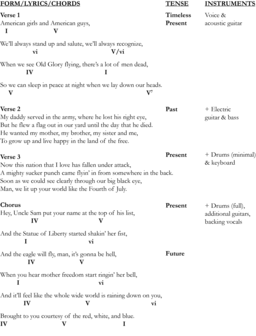
(click to enlarge and listen)
[4.6] Example 6 provides an overview of the opening verses and chorus of “Courtesy,” highlighting the changing instrumentation and lyrical tenses. The first verse describes a collective patriotic debt owed to fallen veterans, as well as an implicit assumption that whatever war cost them their lives, it was just, and it was necessary. The tense suggests what I call a “timeless present”: there have always been (and always will be) soldiers making the necessary sacrifice, rendering national pride an unquestioned value detached from history. This sense of timelessness is likewise projected by Keith’s rhythmically free, recitative-like vocal delivery, and his occasional accompanimental strums on a lone acoustic guitar create a feeling of immediacy between the singer and the listener. Adding to the verse’s sentimental character, the opening harmonic progression, a slight variation on the ground bass from Pachelbel’s Canon (in the same key, no less)
[4.7] The second verse shifts from the collective to the personal, from a timeless present to a specific past. Here, Keith reflects on the military service of his recently deceased veteran father, but the same motifs remain: a wounded soldier, grateful citizens, a flying flag. However, the more intimate subject matter is counterintuitively accompanied by the sudden addition of an electric guitar and bass. The free rhythms of the first verse are replaced by driving eighth-note strums in the guitars, shaking us out of the opening’s soothing atmosphere. This seeming contradiction between the lyrics and the music—between fond family memories and rising textural and rhythmic tension—is resolved in the third verse, where the narrative abruptly swerves to the present with implicit references to both 9/11 and the subsequent invasion. While the song begins as an ode to patriotism, both general (Verse 1’s “we”) and specific (Verse 2’s “my daddy”), it becomes a call to action akin to “This Ain’t No Rag,” and Verse 2’s thickening, electrified instrumentation foreshadows this shift. In Verse 3, the accompaniment continues to build momentum, but now with hi-hat strokes on beats 2 and 4 and a wider registral envelope in the harmony.
[4.8] Despite the shift back to the societal level, Keith’s reference to his country’s “big black eye” recalls his father “los[ing] his right eye” in the second verse. In effect, Keith is taking the qualities of his father—his protective paternalism, his honorable sacrifice, his inherent goodness—and projecting them onto his specific vision of the United States. Moreover, the U.S. military response to 9/11 is described as a patriotic celebration akin to Verse 1’s saluting of “Old Glory” or Verse 2’s “flag out in our yard”: “We lit up your world like the Fourth of July.” In sum Keith has effectively transformed the nation into an icon of his father, and a brutal bombing campaign into an icon of a fireworks display. By the time the climactic chorus arrives, having finally achieved a full-fledged rock groove in the drums (along with backing vocals and additional guitars), Keith has managed to make sympathetic listeners feel in a visceral, personal way both the tragic lows of September 11th and the euphoric highs of our violent retribution
[4.9] The move from the personal to the political, from acoustic country to electric rock, parallels a formal reinterpretation from a potential strophic design to verse-chorus form. To be clear, the strophic projection created by three successive verses is quickly challenged by Verse 2’s momentum-building change in instrumentation; nevertheless, I hear a transformation from an intimate, reflective, folk-acoustic ballad into a hard-rocking, anthemic celebration of war. Notably, Dan Blim (2017) finds a similar compositional strategy in Keith’s later song, “American Soldier,” where a move from acoustic to electric instrumentation occurs over four successive verses before the chorus finally arrives. In both songs, transformations in form and timbre parallel lyrical shifts “from familial duty to military duty,” ultimately implying that they are one and the same (483). As a result, the two songs implicitly defend military intervention not only as a nationalist obligation, but as a personal responsibility.
Video Example 1. Toby Keith, “Courtesy of the Red, White, and Blue (The Angry American)” (2002), 1:29–1:52
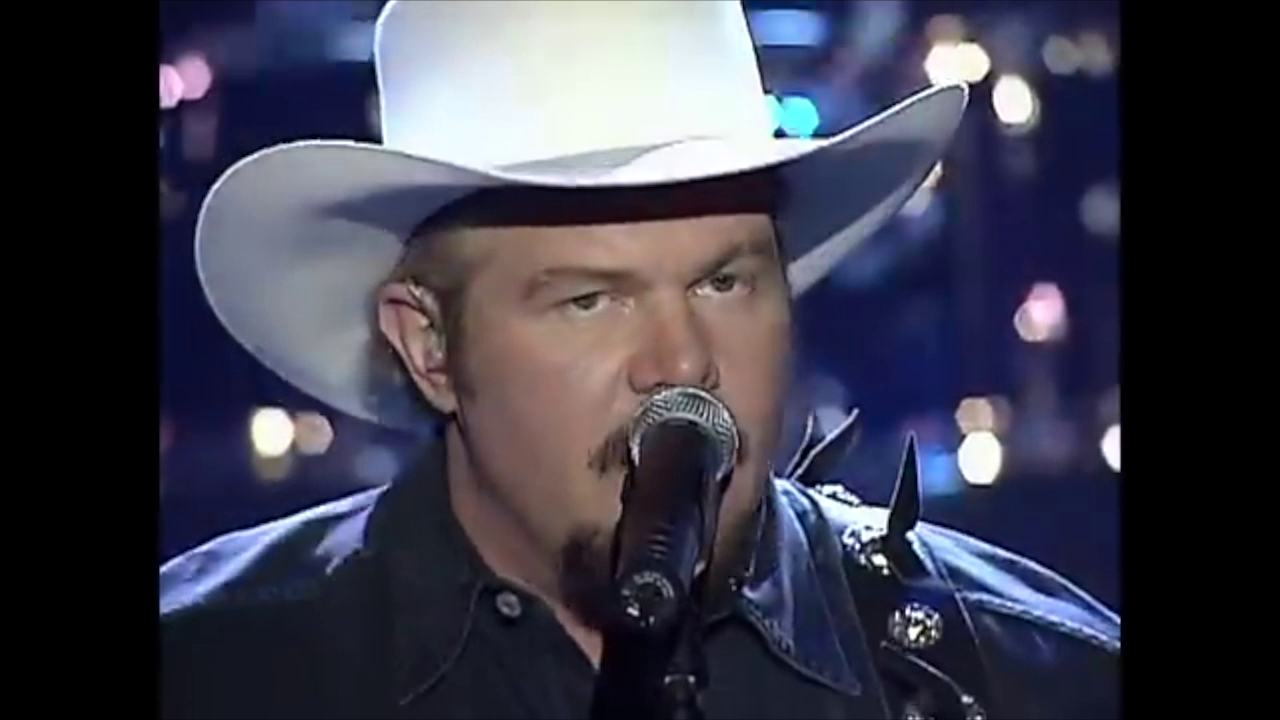
(click to watch video)
[4.10] With the arrival of the chorus, “Courtesy” finally achieves a full-fledged rock groove in the drums, along with backing vocals and additional guitars—there is little space left in the sonic landscape. While hardly new in Keith’s output, this stadium-rock sound is still a relative rarity, although very similar textures and timbres conspicuously reappear on the equally patriotic “American Made” (2011)
Example 7. Toby Keith, “Courtesy,” final verse
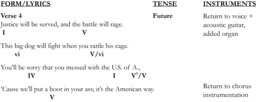
(click to enlarge and listen)
[4.11] Example 7 highlights formal, harmonic, and lyrical aspects of Verse 4. Despite the section continuing with promises of bloody reprisals in Afghanistan (“Justice will be served, and the battle will rage”), listeners are transported back to Verse 1’s intimate soundscape, with recitative-like vocals delivered above soft acoustic strums. The one instrumental change, an added organ pad, brings with it a hushed solemnity, indexically suggesting through a subtle invocation of sacred music that our crusade might just be a holy one. Time seems to stop at line 3 with the addition of a delicately arpeggiated V7/V, but this moment of vulnerability is paradoxically paired with a direct threat: “You’ll be sorry that you messed with the U.S. of A.” This tension between tenderness and violence, between the personal and political, is then dramatically released with the return of the chorus texture in the final promise, “We’ll put a boot in your ass, it’s the American way.” While this line is mostly remembered for its crassness, it is also the musical climax: the slow and steady build-up of instrumental armaments from Verse 1 to the chorus is here accomplished in one spectacular bombardment of sound. The rest of the song, an extended chorus with added chimes (“When you hear Mother Freedom start ringin’ her bell”), is simply a victory lap. Few musical moments capture the zeitgeist of post-9/11 America so well—a toxic combination of moral righteousness and apparent invincibility.
[4.12] According to Keith, when General Jones asked the country star to record “Courtesy,” Jones stated, “When you emotionally move people like this to go in and do their job, we can conquer anything” (Willman 2005, 127). With the swift return of the Taliban to power after a brutal twenty-year occupation, it’s clear “Courtesy” (or any song for that matter) wasn’t “emotionally mov[ing]” enough for the U.S. to “conquer” Afghanistan. Nevertheless, the song in and of itself is a highly effective vehicle for delivering its message. Lyrically, Keith makes clever use of iconic signs: a wounded nation becomes a wounded father, while an explosion in Kabul becomes Fourth of July fireworks. These help to not only personalize the War on Terror but make it something to celebrate. “Courtesy” also features a familiar strategy seen in my earlier analyses, namely the use of rock-oriented instruments and techniques—such as the electric guitar solo or the explosive drum hits ending Verse 4—as icons imitating the sounds of the battlefield. More importantly, these aggressive sounds are contrasted with musical indices suggestive of sincerity (the earnest singer-songwriter with an acoustic guitar), sentimentality (the Pachelbel progression), and even saintliness (the religiously coded organ and chime sounds). I argue that these contrasts are what made “Courtesy” compelling to so many listeners, especially compared to the one-note bellicosity of “I Raq and Roll” or “This Ain’t No Rag.” Akin to how he presented the soldier as both honorable and hellraising, or how he presented the War on Terror as both a patriotic duty and a thrill ride, Keith presents an America that is simultaneously emotionally vulnerable yet militarily unstoppable.
5. Postscript: The War at Home
[5.1] In the country songs analyzed above, a variety of narrative and compositional strategies are deployed to support armed retaliation after the 9/11 attacks. To examine these strategies, I made use of several semiotic tools, especially the icon and the index, as they allow for more precise language in the analysis of musical meaning. My central focus has been the marked use of rock elements—in particular timbre, but also harmony and form. Through distortion effects, heavy percussion, and sheer volume, rock-oriented instrumentation not only iconically stands in for the sounds of the battlefield but invites the listener to revel in them. In the end, rock is stripped of whatever remained of its anti-imperialist and anti-establishment credentials (if they existed at all) and is effectively repackaged and repurposed for war. New indexical associations are formed in the process. Another strategy was to counterbalance the bombast with tenderness, both lyrically and musically. This wasn’t always accomplished with subtlety—the little girl reciting the Pledge of Allegiance in “This Ain’t No Rag” is arguably more perturbing than poignant—but a tug on the heartstrings, something the country genre is well equipped to handle, is crucial in making the case for war.
[5.2] Although my focus has been on openly pro-war country songs, I should reiterate that these songs are outliers, even among those referencing the military. As Decker (2019) details in his study of “soldier songs” released between 2003–2014, most such songs avoid “explicit political positions on the progress of the ongoing wars in Iraq and Afghanistan” (99). Moreover, overt call-to-arms songs like Worley’s “Have You Forgotten” or Keith’s “Courtesy” “had little resonance after the war turned into a complicated and protracted mess” (90). Instead, war-related songs largely focused on the homelives of soldiers and loved ones
[5.3] Unsurprisingly, war-related country songs became less prevalent after the Bush years—despite continued conflicts overseas, the U.S. was no longer perceived to be “at war” in the same way
Example 8. Jason Aldean, “Try That in a Small Town” (2023)
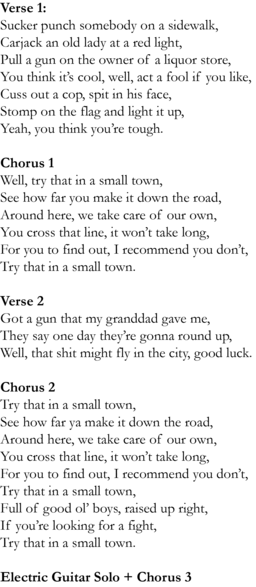
(click to enlarge and listen)
[5.4] Example 8 presents the song’s lyrics. Released only a few years after the 2020 Black Lives Matter protests, “Try That” depicts U.S. cities as sites of mayhem, conflating protest (“cuss out a cop,” “stomp on a flag”) with crime (assault, carjacking, armed robbery)
Video Example 2. Jason Aldean, “Try That in a Small Town” (2023), 0:00–2:09
(click to watch video) |
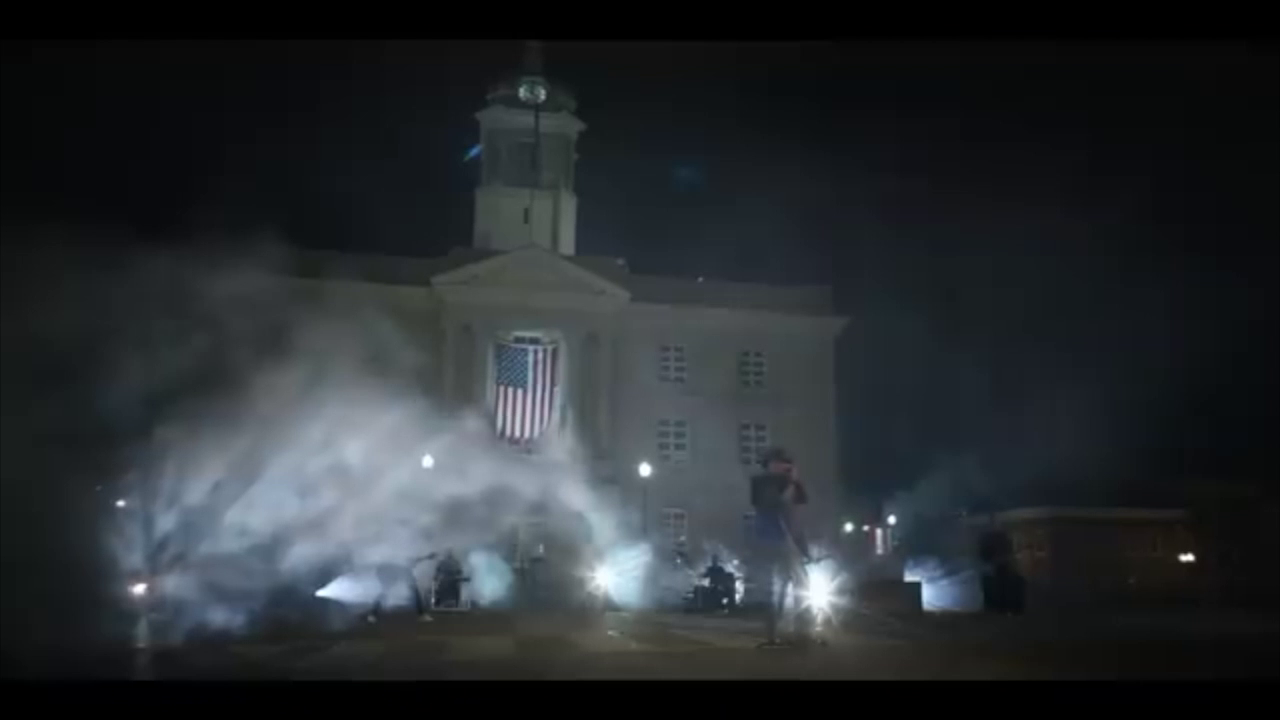
[5.5] What has received less attention is how Aldean’s song compares with its early 2000s pro-war predecessors. In the music video, U.S. cities replace the Middle Eastern warzone, with masked figures breaking store windows (Aldean 2023, 0:56), lighting Molotov cocktails (0:13), and throwing threatening objects (0:28, 0:44). With these images, I am reminded of Luke Stricklin’s description of a battle-scarred Iraq in “American by God’s Amazing Grace”: “The streets are lined with trash, you never know what’s gonna be the next thing to explode.” Moreover, the hallowed soldier and the foreign terrorist are replaced by the police officer and the American protestor, respectively. In the video, police officers, equipped with militarized riot gear, are repeatedly shown standing stoically against screaming, anarchic hordes (0:32, 0:44, 1:00). After the extended second chorus, viewers opposed to left-wing protest finally experience the intended catharsis: the cops fight back, at one point rushing protestors with weapons in hand (1:54).
[5.6] Like the post-9/11 artists discussed above, Aldean reinforces the lyrical themes through the marked use of rock-style musical elements. To be fair, given Aldean’s status as a founding father (brother?) of bro-country, such elements are unsurprising (Rosen 2013). However, as discussed above, bro-country’s thrashing electric guitars and thundering bass drums generally signify a desire familiar from classic rock to cut loose and party hard, something demonstrated in Aldean’s own “My Kinda Party” (2010) and “Take a Little Ride” (2012). Within the lyrical context of “Try That,” the rock elements are expressively transformed in ways strikingly similar to the post-9/11 songs discussed above.
[5.7] Set over an Aeolian harmonic loop (i–
Alan Reese
University of Massachusetts Amherst
300 Massachusetts Ave
Amherst, MA 01003
areese@umass.edu
Works Cited
Aldean, Jason. 2023. “Try That in a Small Town.” Directed by Shaun Silva, July 14, 2023. YouTube music video, 3:02. https://www.youtube.com/watch?v=b1_RKu-ESCY.
Aswad, Jem. 2024. “Jason Aldean Dedicates ‘Try That in a Small Town’ to Former President Trump After Assassination Attempt.” Variety, July 15. https://variety.com/2024/music/news/jason-aldean-dedicates-try-that-in-a-small-town-trump-assassination-attempt-1236072201/.
Belton, Thomas. 2011. Protecting New Jersey’s Environment: From Cancer Alley to the New Garden State. Rutgers University Press. https://doi.org/10.2307/j.ctt1bj4skc.
Biamonte, Nicole. 2010. “Triadic Modal and Pentatonic Patterns in Rock Music.” Music Theory Spectrum 32 (2): 95–110. https://doi.org/10.1525/mts.2010.32.2.95.
Billboard. 2003. “Hot Country: Singles and Tracks.” Billboard, March 29.
Bindas, Kenneth J., and Craig Houston. 1989. “‘Takin’ Care of Business’: Rock Music, Vietnam and the Protest Myth.” The Historian 52 (1): 1–23. https://doi.org/10.1111/j.1540-6563.1989.tb00771.x.
Blim, Dan. 2017. “Party Politics: Ideology and Musical Performance at Donald Trump's Inaugural Celebration.” American Music 35 (4): 478–89. https://doi.org/10.5406/americanmusic.35.4.0478.
Brackett, David. 2016. Categorizing Sound: Genre and Twentieth-Century Popular Music. University of California Press. https://doi.org/10.1525/california/9780520248717.001.0001.
Boulton, Andrew. 2008. “The Popular Geopolitical Wor(l)ds of Post-9/11 Country Music.” Popular Music & Society 31 (3): 373–87. https://doi.org/10.1080/03007760701563518.
Cancian, Mark F. 2021. U.S. Military Forces in FY 2021: The Last Year of Growth? Center for Strategic and International Studies. https://www.csis.org/analysis/us-military-forces-fy-2021-last-year-growth.
Caramanica, Jon. 2024. “Toby Keith Was More Than Mere Bluster.” The New York Times, February 6. https://www.nytimes.com/2024/02/06/arts/music/toby-keith-politics.html.
Ching, Barbara. 1993. “Acting Naturally: Cultural Distinction and Critiques of Pure Country.” Arizona Quarterly 49 (3): 107–25. https://doi.org/10.1353/arq.1993.0014.
—————. 2001. Wrong’s What I Do Best: Hard Country Music and Contemporary Culture. Oxford University Press. https://doi.org/10.1093/oso/9780195108354.001.0001.
—————. 2008. “Where Has the Free Bird Flown? Lynyrd Skynyrd and White Southern Manhood.” In White Masculinity in the Recent South, ed. Trent Williamson, 251–66. LSU Press.
Claassen, Andrew Robertson. 2009. “After the Towers Fell: Musical Responses to 9/11.” MM Thesis, University of Miami.
Cole, Matthew. 2017. “The Crimes of Seal Team 6.” The Intercept, January 10. https://theintercept.com/2017/01/10/the-crimes-of-seal-team-6/.
Covach, John, and Andrew Flory. 2022. What’s That Sound? An Introduction to Rock and Its History. 6th ed. W. W. Norton.
Cusic, Don. 2005. “Gene Autry in World War II.” In Country Music Goes to War, ed. Charles K. Wolfe and James E. Akenson, 43–57. University Press of Kentucky.
Cusick, Suzanne G. 2006. “Music as Torture/Music as Weapon.” Transcultural Music Review 10. https://www.sibetrans.com/trans/article/152/music-as-torture-music-as-weapon.
Danesi, Marcel. 1994. Cool: The Signs and Meanings of Adolescence. University of Toronto Press. https://doi.org/10.3138/9781442673472.
Daniels, Charlie. 2003. Ain’t No Rag: Freedom, Family, and the Flag. Regnery Publishing.
de Clercq, Trevor. 2012. “Sections and Successions in Successful Songs: A Prototype Approach to Form in Rock Music.” PhD diss., University of Rochester, Eastman School of Music.
—————. 2022. “A Corpus Analysis of Harmony in Country Music.” In The Oxford Handbook of Music and Corpus Studies, ed. Daniel Shanahan, Ashley Burgoyne, and Ian Quinn. Oxford University Press. https://doi.org/10.1093/oxfordhb/9780190945442.013.22.
de Clercq, Trevor, and David Temperley. 2011. “A Corpus Analysis of Rock Harmony.” Popular Music, 30 (1): 47–70. https://doi.org/10.1017/S026114301000067X.
Decker, Todd. 2019. “‘I’m an American Soldier’: Country Music’s Envoicing of Military Men and Families after 9/11.” Journal of Musicological Research 38 (1): 88–107.
DeCurtis, Anthony. 1998. Rocking My Life Away: Writing About Music and Other Matters. Duke University Press. https://doi.org/10.1215/9780822397922.
Elmore, Bartow J. 2010. “Growing Roots in Rocky Soil: An Environmental History of Southern Rock.” Southern Cultures 16 (3): 102–28. https://doi.org/10.1353/scu.0.0118.
Fink, Robert. 2010. “Prisoners of Pachelbel: An Essay in Post-Canonic Musicology.” Hamburg Jahrbuch für Musikwissenschaft 27: 89–104.
Fontenot, Kevin S. 2005. “‘Dear Ivan’: Country Music Perspectives on the Soviet Union and the Cold War.” In Country Music Goes to War, ed. Charles K. Wolfe and James E. Akenson, 143–51. University Press of Kentucky.
Fox, Aaron. 2005. “‘Alternative’ to What? O Brother, September 11, and the Politics of Country Music.” In Country Music Goes to War, ed. Charles K. Wolfe and James E. Akenson, 164–91. University Press of Kentucky.
Garofalo, Reebee. 2007. “Pop Goes to War, 2001–2004: U.S. Popular Music After 9/11.” In Music in the Post-9/11 World, ed. Jonathan Ritter and J. Martin Daughtry, 3–26. Routledge.
Gates, David. 1994. “Don’t Get Above Your Raisin’: Ricky Skaggs, Alabama, and Their Contemporaries.” In Country: The Music and the Musicians: From the Beginnings to the ‘90s, ed. Paul Kingsbury and the Country Music Foundation, 2nd ed., 360–87. Cross River Press.
Gavin, Patrick. 2009. “Toby Keith ‘Cool’ with Obama.” Politico, April 22. https://web.archive.org/web/20130514115554/http://dyn.politico.com/printstory.cfm?uuid=CD81F6BF-18FE-70B2-A835E2B5DC7E9328.
Gilbert, Calvin. 2008. “Toby Keith Registering as an Independent Voter.” CMT News, October 2. https://web.archive.org/web/20081006081745/https://www.cmt.com/news/country-music/1596198/toby-keith-registering-as-independent-voter.jhtml.
Griffiths, Christian. 2015. “The Dixie Chicks 2001–2003: The Dissonances of Gender and Genre in War Culture.” Media, War & Conflict 8 (2): 229–43. https://doi.org/10.1177/1750635215584284.
Guarino, Mark. 2024. “The Meaning of One of Toby Keith’s Biggest Hits.” BBC, February 6. https://www.bbc.com/culture/article/20240206-the-meaning-of-one-of-toby-keiths-biggest-hits.
Guzmán, Rafer. 2007. “Toby Keith, Angry American.” Newsday, January 28. https://web.archive.org/web/20070529064304/http://www.newsday.com:80/entertainment/music/ny-ettoby0128,0,6077773.story.
Hatten, Robert. 1994. Musical Meaning in Beethoven: Markedness, Correlation, and Interpretation. Indiana University Press. https://doi.org/10.2979/3489.0.
Harp, Seth. 2025. The Fort Bragg Cartel: Drug Trafficking and Murder in the Special Forces. Penguin Random House.
Hart, William. 2005. “The Country Connection: Country Music, 9/11, and the War on Terrorism.” In The Selling of 9/11: How a National Tragedy Became a Commodity, ed. Dana A. Heller, 155–73. Palgrave Macmillan. https://doi.org/10.1007/978-1-137-08003-5_7.
Hatchett, Louis, and William Kinneth McNeil. 2005. “‘There’s a Star Spangled Banner Waving Somewhere’: The Story behind Its Success.” In Country Music Goes to War, ed. Charles K. Wolfe and James E. Akenson, 33–42. University Press of Kentucky.
Hill, Trent. 1999. “A Distinctive Country Voice: The Nashville Sound and Country’s Genre Crisis in the 1950s.” Journal of Popular Music Studies 11-12 (1): 3–17. https://doi.org/10.1111/j.1533-1598.1999.tb00001.x.
Holt, Fabien. 2007. Genre in Popular Music. The University of Chicago Press. https://doi.org/10.7208/chicago/9780226350400.001.0001.
Hooker, Richard D., Jr. 2023. “America’s Special Operations Problem.” Joint Force Quarterly 108: 50–55.
Horstman, Dorothy. (1975) 1996. Sing Your Heart Out, Country Boy. 3rd ed. Country Music Foundation Press.
Hubbs, Nadine. 2014. Rednecks, Queers, and Country Music. University of California Press. https://doi.org/10.1525/california/9780520280656.001.0001.
Hudak, Joseph. 2021. “Country Music Embraced Jingoism After 9/11. It’s Finally Moving On.” Rolling Stone, September 10. https://www.rollingstone.com/music/music-country/911-country-music-songs-1221348/.
Ivey, Bill. 1994. “The Bottom Line: Business Practices That Shaped Country Music.” In Country: The Music and the Musicians: From the Beginnings to the ‘90s, ed. Paul Kingsbury and the Country Music Foundation, 2nd ed., 280–311. Cross River Press.
Jensen, Joli. 1998. The Nashville Sound: Authenticity, Commercialization, and Country Music. Country Music Foundation; Vanderbilt University Press.
Jones, David Martin, and Martin Lawrence Rowan Smith. 2021. “Blowin’ in the Wind? The Musical Response to the War on Terror.” Studies in Conflict & Terrorism 46 (12): 2454–77. https://doi.org/10.1080/1057610X.2021.1930862.
Keith, Toby. 2002. “Courtesy of the Red, White, and Blue (The Angry American).” Directed by Michael Salomon, May 31. YouTube music video, 3:19. https://www.youtube.com/watch?v=ruNrdmjcNTc.
Kelly, Martin. 2024. “American Involvement in Wars from Colonial Times to the Present.” ThoughtCo, November 4. https://www.thoughtco.com/american-involvement-wars-colonial-times-present-4059761.
Kemp, Mark. 2004. Dixie Lullaby: A Story of Music, Race, and Beginnings in a New South. Free Press.
La Chapelle, Peter. 2007. Proud to Be an Okie: Cultural Politics, Country Music, and Migration to Southern California. University of California Press. https://doi.org/10.1525/california/9780520248885.001.0001.
Leap, Braden. 2020. “A New Type of (White) Provider: Shifting Masculinities in Mainstream Country Music from the 1980s to the 2010s.” Rural Sociology 85 (1): 165–89.
Malone, Bill C., and Tracy E. W. Laird. 2018. Country Music U.S.A.: Fiftieth Anniversary Edition. University of Texas Press.
Manabe, Noriko. Forthcoming. “Intertextuality in Protest Music.” In Oxford Handbook of Protest Music, ed. Eric Drott and Noriko Manabe. Oxford University Press.
Mann, Geoff. 2008. “Why Does Country Music Sound White? Race and the Voice of Nostalgia.” Ethnic and Racial Studies 31 (1): 73–100. https://doi.org/10.1080/01419870701538893.
Martinez, Amanda Marie. 2020. “Redneck Chic: Race and the Country Music Industry in the 1970s.” Journal of Popular Music Studies 32 (2): 128–43. https://doi.org/10.1525/jpms.2020.32.2.128.
—————. 2023. “Jason Aldean's ‘Small Town’ is Part of a Long Legacy with a Very Dark Side.” NPR, July 22. https://www.npr.org/2023/07/22/1188908968/jason-aldean-small-town-vs-city.
Mercer-Taylor, Peter. 2005. “‘Stupid, Stupid Signs’: Incomprehensibility, Memory, and the Meaning (Maybe) of R.E.M.'s ‘Sidewinder Sleeps Tonite.’” The Musical Quarterly 88 (3): 456–86.
Miller, Karl Hagstrom. 2010. Segregating Sound: Inventing Folk and Pop Music in the Age of Jim Crow. Duke University Press. https://doi.org/10.2307/j.ctv125jq7b.
Neal, Jocelyn R. 2006. “Dancing Around the Subject: Race in Country Fan Culture.” The Musical Quarterly 89 (4): 555–79. https://doi.org/10.1093/musqtl/gdm008.
—————. 2019. Country Music: A Cultural and Stylistic History. 2nd ed. Oxford University Press.
—————. 2020. “‘Tennessee Whiskey’ and the Politics of Harmony.” Journal of Popular Music Studies 32 (2): 214–37. https://doi.org/10.1525/jpms.2020.32.2.214.
Nobile, Drew. 2020. Form as Harmony in Rock Music. Oxford University Press.
Olson, Emily. 2023. “How Jason Aldean’s ‘Try That in a Small Town’ Became a Political Controversy.” NPR, July 20, 2023. https://www.npr.org/2023/07/20/1188966935/jason-aldean-try-that-in-a-small-town-song-video.
Orlando, Joyce. 2024. “Jason Aldean Sits Next to Trump at RNC, Kid Rock Performs.” USA Today, July 19. https://www.usatoday.com/story/entertainment/celebrities/2024/07/19/jason-aldean-kid-rock-rnc-donald-trump/74467139007/.
Ownby, Ted. 1997. “Freedom, Manhood, and White Male Tradition in 1970s Southern Rock Music.” In Haunted Bodies: Gender and Southern Texts, ed. Anne Goodwyn Jones and Susan V. Donaldson, 369–87. University of Virginia Press.
—————. 2018. Hurtin’ Words: Debating Family Problems in the Twentieth-Century South. University of North Carolina. https://doi.org/10.5149/northcarolina/9781469647005.001.0001.
Palmer, Robert. 1994. “Get Rhythm: Elvis Presley, Johnny Cash, and the Rockabillies.” In Country: The Music and the Musicians: From the Beginnings to the ‘90s, ed. Paul Kingsbury and the Country Music Foundation, 2nd ed., 192–211. Cross River Press.
Parker, Ryan. 2017. “Punisher Logo Removed from Kentucky Cop Cars after Public Outcry.” The Hollywood Reporter, February 24. https://www.hollywoodreporter.com/tv/tv-news/punisher-logo-removed-kentucky-cop-cars-public-outcry-979612/.
Peirce, Charles Sanders. 1955. Philosophical Writings of Peirce. Edited by Justus Buchler. Dover.
Peterson, Richard A. 1997. Creating Country Music: Fabricating Authenticity. The University of Chicago Press. https://doi.org/10.7208/chicago/9780226111445.001.0001.
Pieslak, Jonathan. 2009. Sound Targets: American Soldiers and Music in the Iraq War. Indiana University Press. https://doi.org/10.2979/5770.0.
Pietroluongo, Stilvio, Minal Patel, and Wade Jessen. 2001. “Singles Minded.” Billboard, November 10.
Pountain, Dick, and David Robins. 2000. Cool Rules: Anatomy of an Attitude. Reaktion.
Rasmussen, Eric E., and Rebecca L. Densley. 2017. “Girl in a Country Song: Gender Roles and Objectification of Women in Popular Country Music across 1990 to 2014.” Sex Roles 76: 188–201. https://doi.org/10.1007/s11199-016-0670-6.
Rogers, Jimmie N., and Stephen A. Smith. 1999. ‘‘Popular Populism: Political Messages in Country Music Lyrics.’’ In Mass Politics: The Politics of Popular Culture, ed. Daniel M. Shea, 111–21. St. Martin’s Press.
Roessner Jeffrey. 2011. “That Was Now, This Is Then: Recycling Sixties Style in Post-9/11 Music.” In The Politics of Post-9/11 Music: Sound, Trauma, and the Music Industry in the Time of Terror, ed. Joseph P. Fisher and Brian Flota, 115–28. Ashgate.
Rosen, Jody. 2013. “Jody Rosen on the Rise of Bro-Country.” Vulture, August 11. https://www.vulture.com/2013/08/rise-of-bro-country-florida-georgia-line.html.
Rudder, Randy. 2005. “In Whose Name? Country Artists Speak Out on Gulf War II.” In Country Music Goes to War, ed. Charles K. Wolfe and James E. Akenson, 208–26. University Press of Kentucky.
Schmeltz, Peter J. 2007. “‘Have You Forgotten?’: Darryl Worley and the Musical Politics of Operation Iraqi Freedom.” In Music in the Post-9/11 World, ed. Jonathan Ritter and J. Martin Daughtry, 123–54. Routledge.
Stark, Phyllis. 2001. “Nashville Scene.” Billboard, December 8.
Stephenson, Ken. 2002. What to Listen for in Rock: A Stylistic Analysis. Yale University Press. https://doi.org/10.12987/yale/9780300092394.001.0001.
Temperley, David. 2011. “The Cadential IV in Rock.” Music Theory Online 17 (1). https://doi.org/10.30535/mto.17.1.8.
—————. 2018. The Musical Language of Rock. Oxford University Press. https://doi.org/10.1093/oso/9780190653774.001.0001.
Tinoco, Armando. 2023. “Jason Aldean’s Controversial ‘Try That in a Small Town’ Music Video Gets BLM Protest Clips Edited Out.” Deadline, July 26. https://deadline.com/2023/07/jason-aldean-controversial-try-that-in-a-small-town-music-video-edits-blm-protest-clips-1235448916/.
Toal, Gerard. 2004. “‘Just Out Looking for a Fight’: American Affect and the Invasion of Iraq.’ Antipode 35: 856–70.
Turino, Thomas. 1999. “Signs of Imagination, Identity, and Experience: A Peircian Semiotic Theory for Music.” Ethnomusicology 43 (2): 221–55. https://doi.org/10.2307/852734.
—————. 2008. Music as Social Life: The Politics of Participation. The University of Chicago Press.
—————. 2014. “Peircean Thought as Core Theory for a Phenomenological Ethnomusicology.” Ethnomusicology 58 (2): 185–221. https://doi.org/10.5406/ethnomusicology.58.2.0185.
Tribe, Ivan. 2005. “Purple Hearts, Heartbreak Ridge, and Korean Mud: Pain, Patriotism, and Faith in the 1950–53 ‘Police Action’.” In Country Music Goes to War, ed. Charles K. Wolfe and James E. Akenson, 126–42. University Press of Kentucky.
Van Sickel, Robert W. 2005. “A World without Citizenship: On the Absence of Politics and Ideology in Country Music Lyrics, 1960–2000.” Popular Music and Society 28 (3): 313–31.
Voice of America. 2003. “Clint Black's I Raq And Roll Makes War-Time Statement.” Voice of America, March 28. https://www.voanews.com/a/a-13-a-2003-03-28-66-clint-67303802/381140.html.
Waddell, Ray. 2001. “Charlie Daniels, ‘This Ain’t No Rag.’” Billboard, November 10.
Warren, Caleb, and Margaret C. Campbell. 2014. “What Makes Things Cool? How Autonomy Influences Perceived Coolness.” Journal of Consumer Research 41 (2): 543–63.
Wells, Paul. 1996. “The Last Rebel: Southern Rock and Nostalgic Continuities.” In Dixie Debates: Perspectives on Southern Cultures, ed. Richard H. King and Helen Taylor, 115–30. New York University Press.
Willman, Chris. 2005. Rednecks & Bluenecks: The Politics of Country Music. The New Press.
—————. 2023. “Jason Aldean Already Had the Most Contemptible Country Song of the Decade. The Video Is Worse.” Variety, July 18. https://variety.com/2023/music/opinion/jason-aldean-try-that-in-a-small-town-worst-country-song-video-column-1235673177/.
Wolfe, Charles K. 2005. “‘Bloody War’: War Songs in Early Country Music.” In Country Music Goes to War, ed. Charles K. Wolfe and James E. Akenson, 26–32. University Press of Kentucky.
Wolfe, Charles K, and James E. Akenson, eds. 2005. Country Music Goes to War. University Press of Kentucky.
Footnotes
* I wish to thank Catrina Kim, Owen Belcher, Noriko Manabe, and the editors and reviewers at MTO for their invaluable feedback on various iterations of this project.
Return to text
1. The title of “I Raq and Roll” varies in spelling across publications. For example, Willman (2005) and La Chapelle (2007) call it “Iraq and Roll” while Jones and Smith (2021) opt for “Iraq and I Roll.” I adopt “I Raq and Roll” from Garofalo (2007) and the Billboard “Hot Country Singles” chart published in March 2003; the song ultimately peaked at no. 42 (Schmeltz 2007, 152). Part of the confusion arises from the single’s limited-time, online-only release: “I Raq and Roll” can no longer be downloaded from Black’s website, and the only remaining versions online were uploaded by listeners.
Return to text
2. Similar opinions are found in Willman 2005 (115–16) and Jones and Smith 2021.
Return to text
3. Defining the Southern rock subgenre is far from simple. In addition to the musical elements discussed above, Elmore (2010) adds a “jam-band performance style” into the mix, although that doesn’t really describe “I Raq and Roll” (103). Others deemphasize musical elements in favor of highlighting geography, manhood, attitude, and whiteness. For example, Malone and Laird (2018) point to “an aggressive identification with the South, macho posturing, and good-old-boy imagery” (456), while Wells (1996) singles out Civil War imagery, traditional gender roles, and appeals to both faith and nostalgia.
Return to text
4. For detailed discussions of harmonic norms in rock, see Stephenson 2002 (100–120), Biamonte 2010, de Clercq and Temperley 2011, and Nobile 2020 (1–38). For a discussion of harmonic norms in country music (and their change over time), see Neal 2020 and de Clercq 2022.
Return to text
5. Both Garofalo (2007) and Jones and Smith (2021) provide broad overviews of post-9/11 popular music—the benefit concerts performed immediately after the attacks, country music’s perceived jingoism, and how the music industry amplified and silenced artists based on their levels of support for the War on Terror. Hart (2005) highlights direct connections between country music stars and the political actors who support them, including pundits, presidents, and Pentagon officials. Both Rudder (2005) and Willman (2005) focus on what the country stars themselves have to say about their music, with particular attention given to the 2003 Dixie Chicks controversy—from the extreme backlash to their 2003 critiques of George W. Bush to the band’s public feud with Toby Keith. Boulton (2008) is more analytical, uncovering how selected post-9/11 country songs adopt “official (i.e., Bush administration) framings of the War on Terror” (374). Finally, La Chapelle (2007) links many of these same songs to a larger tradition of “Okie populism,” a populism most famously expressed by Merle Haggard (211–22).
Return to text
6. For example, Neal (2019) writes that in the 1950s, “country music was co-opted by the social conservatism that grew out of the Cold War. By the 1960s, country music was firmly linked to a nationalist, patriotic, and conservative political agenda” (208). Similarly, Martinez (2020) observes that “though many country artists claimed to be apolitical, the industry's marketing practices had nevertheless branded the genre as a strong symbol of conservatism” (133).
Return to text
7. On the role of nostalgia in country, see Mann 2008 and Leap 2020. On gender demographics and/or masculine themes in country, see Griffiths 2015, Rasmussen and Densley 2017, and Leap 2020. Finally, on whiteness in early and/or contemporary country, see Peterson 1997, Miller 2010, Hubbs 2014, Leap 2020, and Martinez 2020.
Return to text
8. For overviews of country’s wartime role, see Wolfe and Akenson 2005, Hart 2005 (156–57), and Willman 2005 (141–51). On World War II specifically, see Wolfe 2005, Hatchett 2005, and Cusic 2005. On the Korean War and the broader Cold War, see Tribe 2005 and Fontenot 2005. On the Vietnam War, see Schmeltz 2007 (125–26) and La Chapelle 2007 (190–91); the latter focuses on Merle Haggard’s anti-protestor anthem, “Fightin’ Side of Me.” Other conflicts receiving support from country music include the Iran Hostage Crisis (the Charlie Daniels Band’s “In America”) and the Gulf War (Hank Williams Jr.’s “Don’t Give Us a Reason”) (Hart 2005, 157).
Return to text
9. Most famously, at the Grand Ole Opry in 1974, Nixon proclaimed that country “comes from the heart of America. It talks about family. It talks about religion. And as we all know, country music radiates a love of this nation, a patriotism” (Rogers and Smith 1999, 111).
Return to text
10. In fact, during the Gulf War, Bush Sr. declared October “Country Music Month,” opining that “to listen to a country and western song is to hear the story of America set to music. It is a story of patriotism and hard work, a story of faith, opportunity, and achievement. Most of all whose love of freedom is equaled only by their love of life itself” (Mann 2008, 73).
Return to text
11. Manabe (forthcoming) makes a similar point, citing “rock during the Vietnam War” as a genre that “retain[ed] a reputation as ‘political,’ even if most songs in the style are not.”
Return to text
12. Claassen (2009) offers a detailed analysis of “Let’s Roll,” arguing that despite Young’s later opposition to the War on Terror, the song advocates for a militaristic response (48–51). Jones and Smith (2021) are more circumspect, arguing that “Let’s Roll” may simply be “voicing more universal, personally redemptive, themes about the inadvisability of running away when confronted by evil, rather than a call to arms or military adventurism.”
Return to text
13. Furthermore, Jones and Smith (2021) argue that the anti-war rock songs “had little, if anything, to say of the consequences of American foreign policy for the civilian populations of Iraq or Afghanistan, or any wider implications for domestic order. The predominant concern was the waste of resources.”
Return to text
14. Notably, however, Van Sickel excludes from his corpus songs written after 2000: “I chose purposely not to examine songs from the period 2001 to the present. During those years, the political atmosphere in the country music industry, as well as within its audience, has become extremely tense and polarized. In the wake of the 2001 World Trade Center bombings, and especially since the beginning of war in Iraq, country artists and fans have taken sides in an increasingly ugly display of jingoism, intolerance, and even censorship. These events are without precedent.” (2005, 317).
Return to text
15. For an overview of rock’s musical influences and origin story, see Covach and Flory 2022 (35–111). On rockabilly’s origins, see Palmer 1994.
Return to text
16. On genre crossovers, and how they both reinforce and dissolve generic borders, see Brackett 2016 (280–323). On country rock and/or Southern rock, see Gates 1994 (370–71), Wells 1996, Ownby 1997, Kemp 2004, Elmore 2010, Malone and Laird 2018 (456–58), Ching 2008, and Neal 2019 (223–31, 282–94). On alt-country, see Fox 2005, Malone and Laird 2018 (526–44) and Neal 2019 (399–412).
Return to text
17. For example, Neal (2019) writes that 1990s New Country artists (like Toby Keith at the start of his career) added to the preceding neo-traditionalist sound an “increasing presence of distorted electric guitars playing long solos and crisper, drier, and sharper drums…, both of which betrayed the influence of stadium rock in their music” (383). Similarly, Kemp (2004) writes that “the dirty twang of southern-rock guitars has become as fundamental to country music as fiddles and pedal steel” (194).
Return to text
18. Peterson (1997) also identifies two other historical forces: the “dialectic of generations” (young innovators vs. old traditionalists) and “changing production system” (i.e., innovations in recording technology and business strategies) (230–33). Ching (2001) makes a similar point about “hard country,” a style she argues is defined relationally and not as a fixed bundle of stylistic traits: “Because of its constitutive need to oppose the soft and easy, hard country is a position rather than a well-defined entity” (16).
Return to text
19. This claim echoes Jensen’s (1998) observation about the Nashville Sound’s transformation into “authentic” country music: “Now, however, when commentators worry about today's country music scene, when the boundaries between country, folk, rock, jazz, and blues seem blurred beyond recognition, many imply that the Nashville Sound was a more authentic form of country music. The homogenization and accommodation that was criticized in the '50s, '60s, and '70s has become, in the '90s, retrospectively ‘real’” (6).
Return to text
20. Kemp (2004) cites the marketing of the Kentucky Headhunters as an example of this transformation (218–21).
Return to text
21. Peterson (1997) identifies honky-tonk’s emergence as one of several times country traditionalists bemoaned the “death of country music.” Other moments include the 1980s (country pop), the 1990s (stadium country), and even the late 1920s (!) after the commercial success of acts like Fiddlin’ John Carson began to falter (221–22).
Return to text
22. De Clercq’s (2022) corpus study of harmonic norms in country music is the most exhaustive study to date. De Clercq interprets country harmony not as “simpler” than other styles, but as a blend of common-practice classical and rock harmony, e.g., he finds an asymmetrical distribution of root motion (a classical feature), but
Return to text
23. Similarly, Hill (1999) notes that while the “Nashville Sound” era saw drastic changes in instrumentation and production aesthetic, it “remained lyrically faithful to country’s reliance on the formal characteristics of realist or naturalist narrative,” as well as retaining “honky-tonk's preoccupation with the theaters of ethical choice characteristic of nuclear-family domesticity and normal 1950s models of masculinity and femininity” (12–13).
Return to text
24. This definition certainly reflects country’s origins: as Neal (2006) notes, “there was nothing intrinsically different between the sounds of ‘white’ and ‘black’ blues or string band music in those early recordings; rather it was social convention that separated them” (564). In other words, what became “country” was a matter of production (such as the race of the performers) and consumption (such as the race of the consumer to whom the music was marketed). For a detailed history of this process of “segregating sound” in early twentieth-century Southern music, see Miller 2010.
Return to text
25. “Marked” here is in reference to markedness theory, as presented and applied to music by Hatten (1994). Markedness begins with an asymmetrical opposition: “One term is marked (with respect to some value or feature), and the opposing term (or field) is unmarked. The marked term is more narrowly defined and distributed, and, significantly, it has a correspondingly narrower realm of meaning than the unmarked term” (11).
Return to text
26. To clarify, I am not arguing that post-9/11 pro-war country is more “rock and roll” than contemporaneous country music. I am simply claiming that, given the lyrical context, rock elements (or at least, elements once primarily associated with rock) are given additional expressive weight. In Part 2, I discuss how in other lyrical contexts, like the hard-partying world of bro-country, rock elements are similarly marked but imbued with different expressive associations.
Return to text
27. This trichotomy contrasts with the semiological tradition most closely associated with Ferdinand de Saussure. Primarily concerned with linguistic signs, Saussure developed a binary conception of signs—signifier (sign) and signified (object)—without any equivalent to Peirce’s interpretant, the concept that places semiotics within phenomenology. In other words, for Peirce, signs and objects only gain meaning when a living being can interpret them. To explain this idea, Turino (1999) uses the “if a tree falls in a forest” thought experiment: while a falling tree produces waves (a potential sign of an object, sound), “the waves do not function as a sign unless there is someone there to be affected by them” (224).
Return to text
28. There are in fact several additional trichotomies in Peirce’s theories, including three types of signs (qualisigns, sinsigns, and legisigns), three types of interpretants (emotional, energetic, and sign-interpretants), three different relationships between interpretants and sign-object pairs (rhemes, dicents, and arguments), and finally three broad categories of all possible relationships between phenomena (Firstness, Secondness, and Thirdness) (1999, 224–32). While some of these concepts will come up implicitly in my analyses, I am avoiding additional vocabulary for reasons of clarity.
Return to text
29. Turino explains as follows: “It is my thesis that the power of music to create emotional responses and to realize personal and social identities is based on the fact that musical signs are typically of the direct, less-mediated [by language] type. Music involves signs of feeling and experience rather than the types of mediational signs that are about something else” (1999, 224). However, once someone describes a musical experience through language, they are using symbols. Not all scholars agree with Turino: Holt (2007) claims that “musical sound is a symbolic form of representation,” presumably because he is interpreting music as a language (5).
Return to text
30. The cymbal strike icon relates to a larger category of musical techniques Turino (1999) describes that iconically mimic non-musical actions: “Common musical devices such as a rising melodic line, accelerando, and crescendo may create tension and excitement in a listener because they sound like so many human voices we have heard rising in pitch, speed, and volume when the speaker becomes excited” (227).
Return to text
31. Schmeltz (2007) provides the most detailed examination of the song, including its genesis, its reception, and an analysis of the music and music video. Other discussions are found in Toal 2004 (856–58), Hart 2005 (166–67), Willman 2005 (123–27), Boulton 2008 (379–82), and Claassen 2009 (40–43).
Return to text
32. In the original version of the song performed in January 2003 at the Grand Ole Opry, Worley sang “And you say we shouldn’t worry ‘bout Bin Laden” at the end of the second chorus. However, once the definitive version was recorded in March, the lyrics changed to “And we vowed to get the ones behind Bin Laden,” implying that Saddam Hussein was responsible for the 9/11 attacks (Schmeltz 2007, 130). Notably, these lyrical changes followed efforts by the Bush administration to make connections between Hussein and Al Qaeda, such as during the 2003 State of the Union address (January 28) and Secretary of State Colin Powell’s infamous presentation to the U.N. (February 5). Schmeltz hypothesizes that Worley’s song may have played a small role in increasing the percentage of Americans who believed Hussein was behind 9/11 from 45% in March 2003 to 69% in August 2003 (138).
Return to text
33. “Have You Forgotten?” is not the first wartime country song to quote military music: Elton Britt’s wildly popular “There’s a Star-Spangled Banner Waving Somewhere” (1942) features a toy trumpet playing a modified rendition of “Taps” before each verse and as part of the outro. For more on the song, see Hatchett 2005.
Return to text
34. While Pieslak (2009) notes that most music used on the battlefield comes from rock, metal, or rap—primarily due to the loud volumes and/or aggressive lyrics (83)—one marine reported hearing Toby Keith’s “The Taliban Song” (2003) during an attack on an Afghan village (85–86).
Return to text
35. For a detailed analysis of the song, see Temperley 2018 (229–32).
Return to text
36. This interpretation can be found in DeCurtis 1998 (36) and Mercer-Taylor 2005 (487). Notably, “orange crush” was a nickname used by soldiers for Agent Orange, as puddles of the herbicide “reminded them of the popular orange soda sold at the base commissary” (Belton 2011, 102).
Return to text
37. As Ownby frames it: “Since the arrival of Elvis Presley, Buddy Holly, Jerry Lee Lewis, and Johnny Cash, rock ’n’ roll musicians had portrayed themselves as rule-breakers who challenged conventional sounds and frightened conventional gender relations. Those 1950s musicians and their fans had set standards for rebelliousness in their recorded music, live concerts, and lives, and they set examples of excess that future rock musicians could follow or try to surpass” (2018, 174).
Return to text
38. In one of their experiments, Warren and Campbell (2014) had participants rate the level of “coolness” for three rock bands based on answers suggesting levels of autonomy—low, bounded, and extreme. The band with a perceived bounded autonomy was the coolest (551–553). For more work theorizing what makes something cool, see Danesi 1994 and Pountain and Robins 2000.
Return to text
39. Specifically, U.S. Special Operation Forces have more than doubled in size from 29,500 personnel in 1999 to roughly 67,000 in 2021 (Cancian 2021, 103).
Return to text
40. For example, Harp (2025) examines the epidemic of drug overdoses and drug-related murders at Fort Bragg, the headquarters of the U.S. Army Special Operations Command. Cole (2017), meanwhile, exposes the criminal behavior of SEAL Team Six in Iraq and Afghanistan, and how SOF leadership either ignored it or engaged in cover-ups.
Return to text
41. The embrace of the outlaw persona is not limited to the military—consider the adoption of the “Punisher” skull emblem by police departments (Parker 2017), as well as the now-ubiquitous practice of immigration enforcement officers concealing their identities by wearing masks.
Return to text
42. My argument connects to Ownby’s (1997) observation that many Southern rockers, like the black-hat-sporting Charlie Daniels, transformed the cowboy persona from early country’s “smiling, singing” variety into a more “aggressive, violent” character (377).
Return to text
43. For more on bro-country, see Rosen 2013, Rasmussen and Densley 2017, Malone and Laird 2018 (546–48), and Neal 2019 (471–77).
Return to text
44. Brackett (2016) makes a similar argument when discussing genre formation: The “analysis of components and their relationship to categories is an example of nonlinear causality, in that one and the same cause (the use of an instrument, for example) may lead to different effects and interpretations.” As an example, Brackett cites the Fender Stratocaster’s indexical relationship to both hard country and mainstream pop, among other genres, depending on the context (327).
Return to text
45. Decker’s short but informative discussion of the song—done as part of his corpus analysis of post-9/11 “country soldier songs”—remains one of the few in the scholarly literature. Although the song charted on Billboard’s Hot Country list at no. 50, this scant attention is likely due to Stricklin’s limited commercial success, with only one album and no other charting single.
Return to text
46. As in “I Raq and Roll,” the chord-to-chord successions are more stylistically appropriate to rock than traditional country, such as the move from V to
Return to text
47. For more on Southern rock and (white) masculinity, see Ownby 1997 and Ching 2008.
Return to text
48. “This Ain’t No Rag” was also the band’s highest Billboard debut since 1980’s similarly jingoistic “In America,” a song at least partially inspired by the Iranian Hostage Crisis (Pietroluongo, Patel, and Jessen 2001).
Return to text
49. Daniels’s call for a violent response gels well with Ownby’s (1997) claims that 1) the necessity of violence is a key component of white Southern manhood, and 2) Southern rockers routinely promoted such a “willingness to fight as a central aspect of male life” (374–76).
Return to text
50. Daniels rejected accusations of racism, saying the “this ain’t no rag” line was directed not at an entire race or all “people who wear turbans,” but at the 9/11 hijackers themselves (and presumably those seen as supporters or sympathizers, such as the Taliban). Daniels added, “If you ain't done none of those things, you have nothing to be offended about… If [the terrorists] wore a cowboy hat or a fez, [the song] would have said that” (Stark 2001).
Return to text
51. In their commentary on masculinity in country music, Leap discusses in more detail how such “hegemonic masculinity” can be bolstered by racism: “White supremacy and gender inequalities have repeatedly been justified in the United States through black rapist myths that depict black men as hypersexual criminals who would pose greater threats to white women, and society more generally, if white men did not occupy positions of familial, economic, and political authority” (2020, 168). In “This Ain’t No Rag,” Muslim men replace black men as the threatening outsider, here endangering an America presented as a young, defenseless girl.
Return to text
52. While it can be linked to earlier formal practices (like rounded binary form), AABA form, a.k.a., 32-bar song form, is most associated with the Tin Pan Alley songs of the early twentieth century. AABA form remained common in popular music into the 1960s (Nobile 2020, 125).
Return to text
53. Specifically, the bridge here is a fusion of De Clercq’s first two prototypical classic bridge progressions, namely IV–I–IV–V and IV–I–V/V–V (74–77).
Return to text
54. Specifically, Ownby writes: “What traditions were worth upholding and reliving? Were they going to secede again? Fight again? Lose again? Most intriguing, how could they uphold traditions while they were at the same time, young rock musicians, rebelling against authority? If, as Daniels urged, Southern rock musicians took pride in being rebels, what was it they were rebelling against?... The tension, then, was between being a rebel against southern traditions in the late 1960s and being a Rebel as part of the tradition of white southerners” (1997, 369–370). Wells (1996) explores a similar question from a more critical angle than Ownby, directly linking the entire Southern rock movement (including, perhaps unfairly, the Allman Brothers Band) to the Lost Cause: “Southern Rock has thus taken on the mantle of resistance group, still metaphorically fighting the [Civil War] by refusing closure and signifying an enduring alternative culture, perhaps most significantly embodied in the figure of ‘the Rebel’” (118).
Return to text
55. While one of the central figures in 1970s Southern rock, Daniels started his career as a Nashville studio guitarist. As Malone and Laird (2018) put it, compared with other Southern rockers, “Daniels bore the closest relationship to country music” due in part to his trademark western swing-influenced fiddling (457). Along with Hank Williams Jr., he was one of the few Southern rockers to cross over from the country scene, as opposed to crossing over from rock (Neal 2019, 285).
Return to text
56. This definition is in obvious tension with one of Peterson’s other definitions of authenticity, namely “relic, not changed” (207). The resultant contradiction is what motivates Peterson’s dialectical history described in Part 1.
Return to text
57. I recognize that authenticity, as discussed in Part 1, is a charged topic in country music, to say the least. As Jensen (1998) puts it, sounding authentic is a “generic marker” that “offers country music an identity” (7). Later, he writes, “the authenticity of country music is part of a narrative, a myth, told by and passed on to those who care about country music—it is a way to define their music as distinctive and worthy.” (13). However, despite risking miscommunication (as well as accidentally entering the “But is this real country?” debate), I follow Peterson in recognizing the multiple useful meanings of “authenticity” and how they might reflect or revise how we hear a song. For more on authenticity in country music (beyond Peterson 1997 and Jensen 1998), see Ching 1993.
Return to text
58. There were of course other motivating forces behind the emergence of Southern rock. For example, Kemp offers an intriguing psychoanalytic narrative, viewing the subgenre as a complex reaction to the South’s racist past and the then-recent Civil Rights movement: “For white southerners like me, who began grade school in the wake of desegregation and came to embrace the rock counterculture as an alternative lifestyle, any declaration of ancestral pride carries a subtext of tremendous emotional weight. If rock & roll had initially provided refuge from the South’s legacy of violence and bigotry, the music of the southern rock family tree… offered an emotional process by which my generation could leave behind the burdens of guilt and disgrace and go home again. Step by step, the music has taken us down a path to self-awareness and forgiveness” (2004, xiv).
Return to text
59. Nobile (2020) argues that due to its fade from popularity after the 1960s, AABA form, when present in rock music written long after its heyday, can function as a musical topic invoking nostalgia for a bygone era, e.g., Billy Joel’s “It’s Still Rock and Roll to Me” (1980) or Queen’s “Crazy Little Thing Called Love” (1980) (139–141). I argue that the form, especially in combination with other “retro” musical features (like the twelve-bar blues), operates similarly in more recent country music, where verse-chorus form also reigns supreme.
Return to text
60. While Daniels 2003 remains the best source to understand the singer’s political views (at least as of the early 2000s), Kemp 2004 includes excerpts from an interview where Kemp challenges Daniels’s homophobic remarks, such as when the musician echoed Jerry Fallwell in blaming the LGBTQ+ community for 9/11 (105–7).
Return to text
61. Kemp (2004) discusses the political context of Southern rock throughout, including hippie culture (long hair, drug use), racial politics, and the genre’s role in Jimmy Carter’s 1976 presidential campaign (notably, Daniels remained a defender of Carter into at least the early 2000s). On the environmentalism of the Allman Brothers Band and Lynyrd Skynyrd, see Elmore 2010. On the rejection of traditional Southern “family values,” see Ownby 1997 and 2018.
Return to text
62. These issues are discussed thoroughly in Wells 1996, Ownby 1997, and Kemp 2004, although Ownby and Kemp are more even-handed than Wells, who states bluntly that “Southern rock cemented [itself] by remaining essentially reactionary” (125–26). Neal (2019) adds that while some Southern rock tunes clearly “professed an extreme right-wing political outlook,” 1970s Southern rock fans tended to lean further left than country fans (282–83).
Return to text
63. Specifically, Kemp writes: “By the middle of the ’70s, there was as much cognitive dissonance within southern rock and those who listened to the music as there was within southern culture at large. The mourning expressed by the Allman Brothers Band in songs like “Dreams” and “Whipping Post” had given way to righteous indignation… Whether out of ignorance, frustration, or blind willfulness, many southerners then were angry and didn’t know exactly how to express it, didn’t know how to feel about themselves or the culture at large. Responding with violence and intolerance was the only way some people knew to deal with their feelings. The songs of rock groups like the Charlie Daniels Band and Lynyrd Skynyrd reflected a growing sense of insecurity in southern culture at large; they expressed feelings of anger and resentment in the way that many southerners had long communicated such feelings—passive-aggressively” (Kemp 2004, 87).
Return to text
64. Such partisan ambiguity extended past the 2004 election. In 2008, Keith changed his registration from Democrat to Independent in 2008, a move explicitly motivated by his admiration for Sarah Palin (Gilbert 2008). But less than a year later, he expressed approval of Obama’s policy of increasing troop levels and extending the war in Afghanistan, and he later performed at Obama’s Nobel Peace Prize Concert (Gavin 2009; Caramanica 2024). Keith’s politics are also explored in Willman 2005 (58–64), Guzmán 2007, Hubbs 2014 (141–44), and Blim 2017.
Return to text
65. The Pentagon engaged in even more direct musical propaganda when they hired a relatively unknown singer, Dean Justin, to write, perform, and record “Carry the Flag,” a patriotic song expressing support for the war. It was not commercially successful (Hart 2005, 164–65).
Return to text
66. Specifically, Keith replaces iii with the harder-edged V/vi, and the final IV–V succession with a single V.
Return to text
67. Blim (2017) also describes how each verse “builds tension by melodically emphasizing the fifth scale degree” before the chorus has Keith “[jump] up to the tonic, the melodic apex” (483–84). Any sense of melodic resolution, however, is undercut by the underlying subdominant harmony. It isn’t until the end of the chorus when both melody and harmony close on the tonic.
Return to text
68. For a hard-rocking tune released before “Courtesy,” see “Gimme 8 Seconds” (2001), an aggressive Southern rock tune about bull-riding. On Unleashed, perhaps the closest stylistic companion is the aptly named romantic power ballad, “Rock You Baby” (2002).
Return to text
69. Blim (2017) argues that this deceptive cadence “emphasize[s] the pain” about to be inflicted upon our enemies (484).
Return to text
70. Examples include Tracy Lawrence’s “If I Don’t Make It Back” (2005), Carrie Underwood’s “Just a Dream” (2008), and Lee Brice’s “I Drive Your Truck” (2012).
Return to text
71. The occupations of Iraq and Afghanistan officially ended in 2011 and 2021, respectively, although hostilities resumed in Iraq in 2014 to combat the Islamic State. Other known sites of 21st-century U.S. military operations, hardly any of which triggered musical responses, include Iran, Libya, Niger, Nigeria, North Korea, Pakistan, Palestine, the Philippines, Somalia, Syria, Uganda, Ukraine, Venezuela, and Yemen (Kelly 2024).
Return to text
72. “Try That” was written by Kelley Lovelace, Neil Thrasher, Tully Kennedy, and Kurt Allison.
Return to text
73. Notably, Aldean endorsed Donald Trump in 2024, even sitting next to the president at the Republican National Convention (Aswad 2024; Orlando 2024).
Return to text
74. As was the case after 9/11, very few country songs directly staked a partisan position for or against the 2020 BLM protests. Exceptions, which only appeared well after the protests died down, include the implicit condemnations in Aaron Lewis’s “Am I the Only One” (2021) and John Rich’s “Progress” (2022).
Return to text
75. Aldean denied any political motivation, advocacy for vigilantism, or racist intent, arguing that the song “refers to the feeling of a community that I had growing up, where we took care of our neighbors, regardless of differences of background or belief” (Olson 2023). That said, after the attempted assassination of Donald Trump in Pennsylvania roughly a year after the song’s release, Aldean dedicated a performance of “Try That” to the president, stating to the crowd, “Just goes to show you there’s a lot of bullshit in the world, and that’s kind of what this song right here was about, so this one goes out to the pres” (Aswad 2024).
Return to text
Copyright Statement
Copyright © 2026 by the Society for Music Theory. All rights reserved.
[1] Copyrights for individual items published in Music Theory Online (MTO) are held by their authors. Items appearing in MTO may be saved and stored in electronic or paper form, and may be shared among individuals for purposes of scholarly research or discussion, but may not be republished in any form, electronic or print, without prior, written permission from the author(s), and advance notification of the editors of MTO.
[2] Any redistributed form of items published in MTO must include the following information in a form appropriate to the medium in which the items are to appear:
This item appeared in Music Theory Online in Volume 32, Issue 2 in May 2026. It was authored by Alan Reese (areese@umass.edu), with whose written permission it is reprinted here.
[3] Libraries may archive issues of MTO in electronic or paper form for public access so long as each issue is stored in its entirety, and no access fee is charged. Exceptions to these requirements must be approved in writing by the editors of MTO, who will act in accordance with the decisions of the Society for Music Theory.
This document and all portions thereof are protected by U.S. and international copyright laws. Material contained herein may be copied and/or distributed for research purposes only.

Prepared by Lauren Irschick, Editorial Assistant
Number of visits:
2412