Choreomusical Analogies in the Symphonic Minuet
Olga Sánchez-Kisielewska
KEYWORDS: minuet, dance, perception, embodiment, hypermeter, Haydn, Mozart
ABSTRACT: Eighteenth-century composers and their audiences knew how to dance the minuet. As Joseph Fort (2025) and others have argued, this shared, somatic knowledge informed compositional practice and historical perception of minuet music, even when not written for dancing. This article explores, through corpus analysis and close readings, common manipulations of hypermeter and phrase structure in symphonic minuets and the embodied meanings that they might have communicated to historical listeners. Certain compositional strategies—more frequent in symphonic minuets than in those written for the ballroom or the chamber—seem to imitate steps of the minuet’s choreography, evoking experiences of dancing and watching others dance. I identify three such mimetic devices, operating at different levels of hypermetrical structure. (1) Duple hypermeter is required to coordinate minuet steps with music, but numerous symphonic minuets exaggerate the alternation of weak and strong measures, as if “painting” steps with sound. (2) Minuet music tends to unfold in four-measure units, but two-measure echoes that frustrate quadruple hypermeter are common in symphonies. These phrase extensions, which I call courtesy Anhangs, provide sonic representations of bowing gestures. (3) The
DOI: 10.30535/mto.32.2.6
Copyright © 2026 Society for Music Theory
1. Introduction
[1.1] Georg Joseph Vogler noticed, in the minuet of a piano sonata, “a rhythm of five bars, within which the regular movement of the feet cannot settle into their prescribed steps” (1778–79, 380, quoted and translated in Wheelock 1992, 56). Vogler’s familiarity with the minuet’s choreography, acquired through repeated performance of the dance steps, shaped his perception of the music. Even outside the ballroom, sound has the power to activate motor imagery and evoke the physical aspect of dancing. This example of embodied music cognition may well represent a typical response from the intended listeners of the classical symphony
[T]here was considerable crossover between audiences at the public concerts in Vienna and the same people who attended the city’s public balls; as such, the minuet held an array of kinesthetic associations and expectations for these audiences. Whether engaging with the minuet as a dancer or a seated listener, these audiences did so in bodies that knew the steps and movements of the dance. (2025, 177)
This article explores how kinesthetic knowledge of the danced minuet might have informed compositional strategies and historical perception of minuet music that was not written for dancing with a focus on hypermeter and phrase structure in symphonic minuets. When hearing dance-like music in the movement of a symphony, historical listeners likely expected certain metric regularities and were attuned to phrase structures “closely allied” to the actual dance (Neumeyer 2006, [2]). My starting premise is that this nonfunctional dance music would have triggered memories in the audience, activating patterns of motor behavior and inviting listeners to remember and virtually reenact previous experiences dancing and watching others dance
[1.2] This approach is not entirely novel. Gretchen Wheelock finds deviations from “gestures and patterned steps of the dance” as a source of humor in Joseph Haydn’s symphonic minuets (1992). In a similar spirit, Jennifer Salamone examines hypermeter in “misbehaving” minuets from the String Quartets op. 76 and 77 (2017). Melanie Lowe (2007, 87) and Danuta Mirka (2009, 297) recreate hypothetical responses of listeners familiar with the danced minuet when listening to symphonies and string quartets respectively. Eric McKee has studied music-dance relations in the minuets that W. A. Mozart wrote for the ballroom (2012) and extended his findings to explain the expressive implications of the minuet as a musical topic (2014). Fort has undertaken a detailed study of the danced minuet in late eighteenth-century Vienna—including its choreography, performance practice, and unpublished musical sources. This article responds to his appeal for a “somatic enquiry” into the concert minuet (2025, 177–209) and is highly indebted to his work. By including dancing bodies in the hypothetical reconstruction of hypothetical listeners, I follow the steps of these scholars. However, my approach diverges from and expands these studies in significant respects
[1.3] Although the minuet was still danced by the end of the eighteenth century, its sociocultural associations did not derive exclusively from contemporary dance practice
Example 1. Mozart, Minuet K. 601, no. 4, mm. 1–8
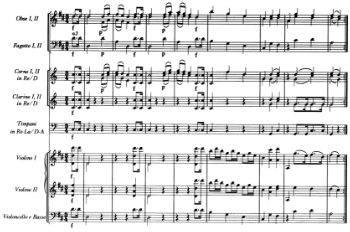
(click to enlarge and listen)
[1.4] A critical implication of the embodied meanings and modes of listening described above involves whether music facilitates the execution—real or imagined—of the basic minuet step, which requires six beats of music (i.e. two measures) and which I address in more detail in the following section. Consider for example the two minuet phrases by Mozart reproduced as Example 1 and Example 2. The openings of these minuets share multiple features: the dotted anacrusis in repeated notes, four measures of tonic harmony, and a gradual melodic ascent over scale degrees , , and . Example 1 belongs to one of the sets of danceable minuets that Mozart composed for the ballroom. Melodic parallelism creates two-measure units and basses reinforce a clear alternation between strong and weak measures. Here, each duple hypermeasure corresponds to one minuet step. For those dancing to this music, the energetic upbeats repeated every other measure would provide a convenient sonic invitation to launch every new step
Example 2. Mozart, String Quartet in D minor, K. 421, Menuetto, mm. 1–10
(click to enlarge and listen) |
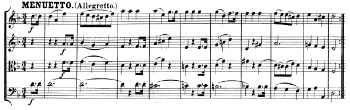
[1.5] Despite Mozart’s use of a similar motive in the minuet from the String Quartet in D minor K. 421 (Example 2), dancing to this music would present challenges. Listeners hoping to align music with minuet steps—executed or imagined—would perceive conflicting cues about the placement of hypermetrical downbeats. The first violin opens with a typical minuet rhythm, providing an invitation to open the dance
[1.6] The contrast of dance-music relations between these two minuets is hardly surprising. On the dance floor, sound and movement align. The minuets that Mozart and his contemporaries wrote for Viennese ballrooms feature regular rhythms and a clear duple hypermeter, facilitating the coordination of minuet steps with the music
[1.7] In terms of hypermeter and phrase structure, symphonic minuets occupy a space between the simplicity of the minuets written for dancing and the complex metrical strategies that Haydn and Mozart often deployed in their string quartets. As I will show, the relationship between the symphonic minuet and these two poles is not merely one of degree. Minuets written for symphonies, though less metrically intricate than those written for the chamber, display unique techniques that engage the embodied knowledge of dance in sophisticated ways. By highlighting these compositional devices, I hope to complicate the paradigm that equates the artfulness of the concert minuet with metrical disruptions and deviations from dance requirements
[1.8] To investigate these generic differences, I assembled a corpus of a symphonic minuets and another of minuets from string quartets. These samples, while inevitably biased, represent an honest effort to capture the musical style of the Viennese minuet of the late eighteenth-century. At the center of the corpus, and overrepresented by design, stand the minuets that Haydn and Mozart wrote in their symphonies (84 and 29 minuets respectively) and—for comparison—their string quartets (27 and 18). To reach beyond the idiosyncratic traits of two canonical composers and arrive at a broader understanding of the minuet in a given time and place, I included minuets in the same genres written between 1760–1800 by other composers active in the Viennese sphere. These additions rendered a total of 195 minuets from symphonies and 105 from string quartets (listed in the Appendix) by 14 composers
[1.9] The remainder of this essay is organized in three parts addressing issues of hypermeter and phrase structure at the two-, four-, and eight-measure levels respectively, followed by conclusions. Fred Lerdahl and Ray Jackendoff consider that the metrical structure of tonal music includes “regularities of two, four, and even eight measures” (1983, 99)
2. The two-measure level: right, left, right, left
Dance fact: Duple hypermeter is essential for minuet dancing.
Intuitive music fact: Symphonic minuets disrupt duple hypermeter less frequently than those in string quartets.
Counterintuitive music fact: Symphonic minuets sometimes emphasize duple hypermeter more strongly than those written for the ballroom.
Proposition: A compositional strategy typical of symphonic minuets is to not only enable but also to imitate the movements of the dance.
Example 3. Alignment of steps and beats in the minuet, according to Feldtenstein (1772)

(click to enlarge)
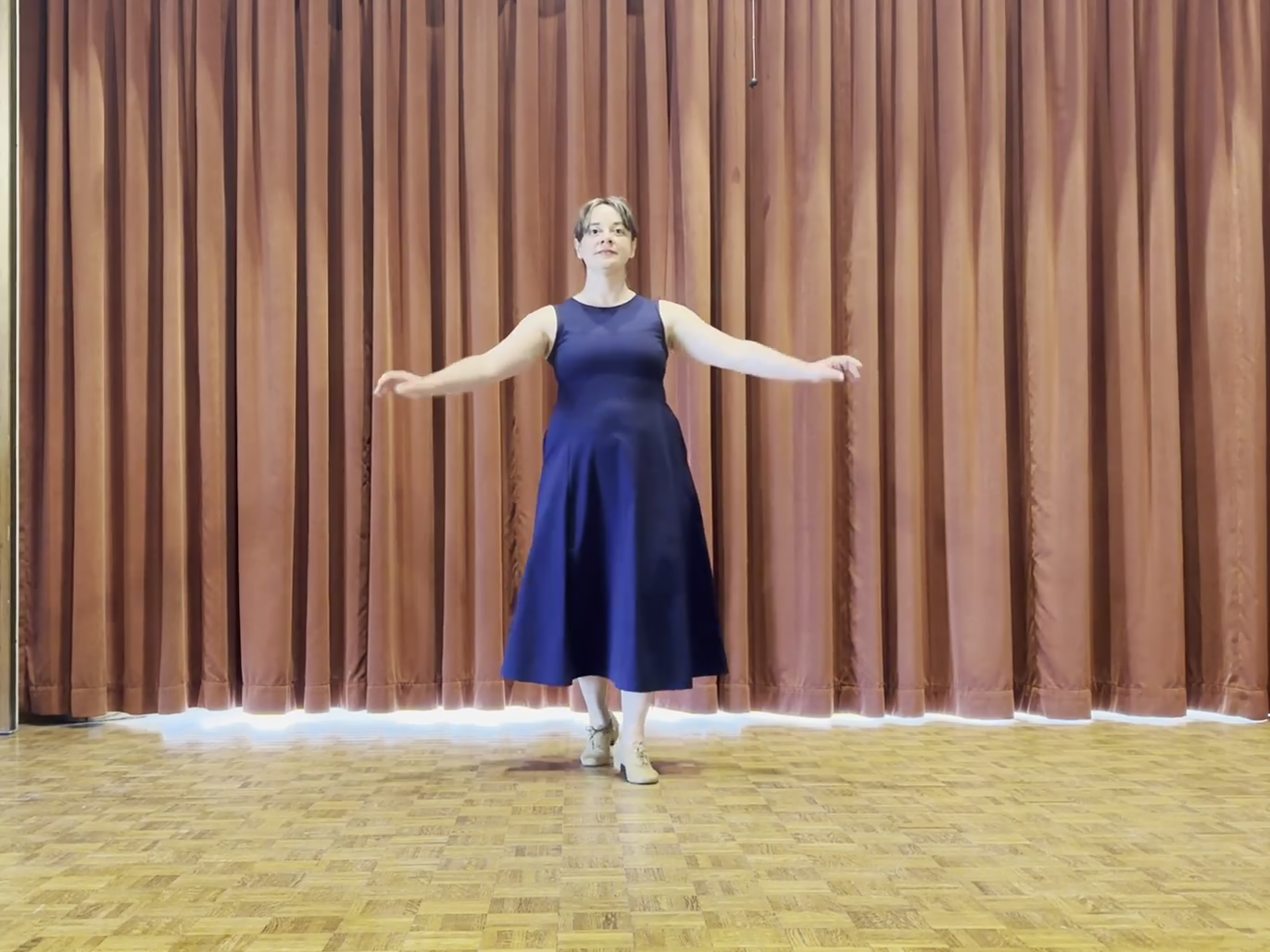
[2.1] The basic minuet step combines four changes of body weight over six beats of music. The preferred variant in the eighteenth century (Cobau 1984, 14–15) consists of two demi-coupés—steps initiated with a bend of the knees, then rising and placing one foot forward—followed by two tiny, less energetic steps that resemble walking
Video Example 1. Minuet step forwards and backwards (Dance: Sarah Edgar; Music: Haydn, Symphony no. 60 in C, Menuetto)
(click to watch video) |
[2.2] Duple hypermeter is fundamental to minuet music. Dance masters initiated their students into the minuet by teaching them to hear the alternation of strong and weak measures. For example, in one of the first lessons of his dance manual, S. J. Gardiner teaches students how to properly “beat time”:
LADY: In what manner do you teach them?
DANCE MASTER: I teach them to beat every note that is in a bar of Minuet-Time, next to every bar, and lastly to every two bars of the Music. (1786, viii)
Example 4. Musical examples from M. Malpied’s Traité sur l’Art de la Danse (1770, 100)
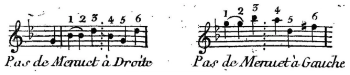
(click to enlarge)
Alexis Bacquoy-Guédon also emphasized the importance of entraining to the hypermetrical structure of the minuet, to its cadence, before learning dance steps
[2.3] Overall, minuets tend to project the two-measure hypermeter required to execute the minuet step even when they were not intended for dancing, thus enabling listeners to imagine themselves moving to the music. Fort eloquently describes how an eighteenth-century listener might have engaged in such manner with the minuet from Haydn’s Symphony no. 102 in B-flat:
The music gives such a lift to the beginning of each felt step [downbeats of bars 1, 3, 5, and 7] that, even seated, her body feels buoyed by the felt sensations of the steps. The opening phrase [bars 1–8] cements a comfortable connection between the step and the music, and her body is infused with a sense of momentum. (2025, 188)
Later, the same listener encounters a passage where Haydn disrupts the two-measure hypermeter of the minuet and “the music stutters, shattering the comfortable kinesthetic-sonic relationship” (188).
Example 5. Dittersdorf, Symphony no. 3 in G, Kr. 75, Tempo di Minuetto, mm. 1–15 (winds omitted)
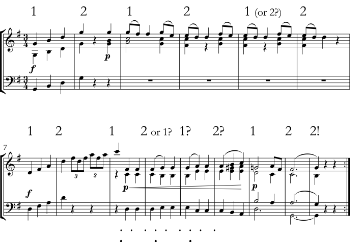
(click to enlarge and listen)
[2.4] Movements, phrases, and sections with an even number of measures are necessary although not sufficient conditions to hear minuet music in
[2.5] A listener hoping to entrain to the minuet step would have encountered a less placid experience when hearing this music. This hypothetical, historical listener could have started tapping her feet to the minuet step, encouraged by the buoyant ascent in mm. 1–2, which makes the second measure feel lighter. The anacrustic melodic gesture that follows would provide fitting musical support to the plié (bending of the knees) of the next minuet step
[2.6] An assertive repetition of the opening ascent resumes the virtual dance in m. 7, but further hypermetrical complications await. The onset of the basses and the beginning of a new idea in m. 10 contradict the expectation for a weak measure. Chord changes on second beats create harmonic syncopation and undermine the metric steadiness of mm. 10–12. Despite these instabilities, one could dance through the first section of the minuet without major difficulties, just as Andrew Imbrie’s “conservative listeners” maintain the established (hyper)meter even in the face of conflicting cues (1973, 45–66). The final challenge proves harder to overcome: the uneven phrase length created by the added m. 15 would force a misalignment between steps and music at the repeat. I read Dittersdorf’s aberrant reprise as a calculated expressive strategy that communicates the underlying tension in the scene. According to the myth, the encounter between Actaeon and Diana begins with idyllic images of nature, but it eventually triggers tragic events. The goddess punishes the hunter’s indiscretion by transforming him into a stag and slaughtering him with her hunting dogs.
Example 6. Proportion of sections with an odd number of measures in two minuet corpora
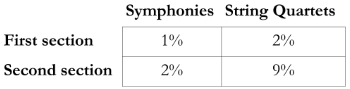
(click to enlarge)
Example 7. Mozart, Symphony in C, K. 551, Menuetto, mm. 17–28 (trumpets and timpani omitted)
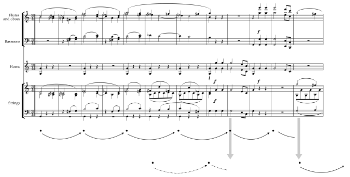
(click to enlarge and listen)
[2.7] As one might expect, the proportion of odd-numbered sections is slightly higher in string quartets than in symphonies, and more frequent in second sections, since they include unstable contrasting middles
[2.8] Obviously, an even number of measures does not equal the projection of duple hypermeter. Minuets may contain three- and five-measure units (termed by Riepel Dreyer and Fünfer), which challenge duple hypermeter but tend to combine into even-numbered phrases. Haydn used such irregular phrasing in the Symphonies nos. 3 in G
Example 8. Haydn, Symphony no. 64 in C, Menuetto, mm. 1–8 (reduction)
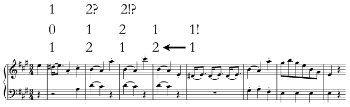
(click to enlarge and listen)
[2.9] Not even minuets that unfold in four-measure phrases guarantee the proper minuet cadence. In Haydn’s Symphony no. 64 in C, “Tempora mutantur” (times change)
Example 9. Bass-line strategies to differentiate between strong and weak measures
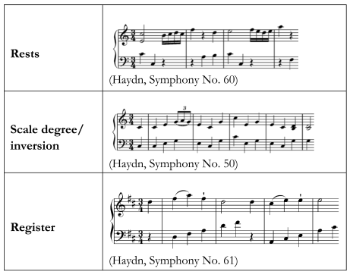
(click to enlarge)
[2.10] Unlike Example 8, symphonic minuets tend to clearly project duple hypermeter, facilitating a potential alignment with minuet steps—even though not conceived for this purpose. I will now begin to unfold a stronger version of this claim: numerous symphonic minuets do not only enable dance, imagined or real, but they encourage mimetic participation from their audiences. They invite us to dance, sometimes even more emphatically than their functional counterparts. Composers deployed a variety of strategies to facilitate the projection of two-measure hypermeter, thereby urging kinesthetic engagement with symphonic minuets. A common phrase type for symphonic minuets as well as those written for the ballroom was the sentence, since the
[2.11] One possible explanation for these differences is that creating mental associations between sound and movement requires more effort outside the dance floor. Zbikowski proposes a similar argument (regarding a bourrée by J. S. Bach), suggesting that the “dance owes its rhythmic regularity to the fact that it was not intended for dancing” but “was instead meant to evoke, through a single medium, the multimedia of music and dance” (2008, 296). McKee finds the same characteristic in the minuets from Bach’s French Suites for keyboard: “For minuet music sans dancing to be immediately recognized as minuet music, Bach and other composers needed to instill in it a well-defined perhaps even exaggerated sense of ‘minuetness’” (2012, 29). Minuets like the ones from Example 9 highlight duple hypermeter even more strongly than those composed for the ballroom. They exaggerate the alternation between hypermetrical thesis and arsis, creating a clear impression of the pas de menuet in the listener’s mind.
[2.12] By the final decades of the eighteenth century, the minuet earned a stable position within the sonata cycle, and composers might have felt somewhat freed from the need to communicate “minuetness.” Given the standard layout of instrumental works, a minuet movement would be expected; because of this expectation, unconventional minuets could still be identified as such, and deviations from the norm could be understood as expressive, surprising, or humorous. This type of play with expectations is characteristic of string quartets
3. The four-measure level: Courtesy Anhangs
Dance fact: Before the beginning of the minuet proper, dancers performed ceremonial reverences.
Intuitive music fact: Four-measure phrases are common, but exceptions abound in the concert minuet.
Counterintuitive music fact: Minuet sections with a number of measures not divisible by four occur more frequently in symphonies than in string quartets.
Proposition: In some 10- and 14-measure sections, two-measure suffixes provide a choreomusical analogy of a reverence.
[3.1] In the ballroom minuet, coordination between music and movement begins and ends at the two-measure level
[3.2] To be sure, the four-measure unit is an essential building block of eighteenth-century music, and hypermetric regularities tend to be more pronounced in dance genres (Neumeyer 2006). Especially towards the end of the century, quadruple hypermeter is so common in minuets that it is tempting to assume it by default. Although the danced minuet did not seem to require music articulated in four-measure units, compositional practice confirms them as the norm. Abundant sources (historical and current) present a rather rigid conception of phrase structure in the danced minuet. In his seventh and last rule for minuet writing, Riepel emphasized the importance of clearly differentiating the fourth measure from the fifth (1752, 2), thus encouraging apprentice composers to segment the musical surface in four-measure phrases or Vierer. Bacquoy-Guédon went as far as to deem “vicious” [vicieux] those minuets in which the number of measures of each section is not divisible by four (1785, 51). Stefan Love claims that eighteenth-century listeners expected “two- and four-measure hypermeter from the moment a minuet begins” and that “this expectation remains in the perceptual background for the entire minuet” (2015, [2.4]). McClelland (2006) and Mirka (2021) have systematically applied quadruple hypermeter in their analyses of minuets. Minuets written for the Viennese ballrooms in the late eighteenth-century frequently begin with an eight-measure section symmetrically divided in halves
Example 10. Frequency of first-section lengths in two minuet corpora
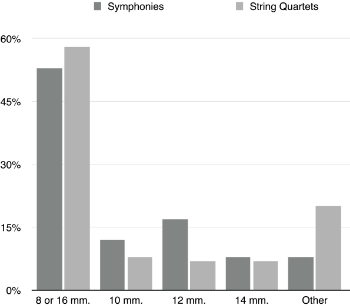
(click to enlarge)
[3.3] Outside the dance floor, composers disrupted Vierer much more frequently than in dance minuets, and more often than they deviated from Zweyer. Six-measure phrases or Sechser—which prevent establishing quadruple hypermeter without necessarily compromising the (imagined) execution of minuet steps—appear fairly often in symphonic minuets
Example 11. Mozart, Symphony in D, K. 202, Menuetto, mm. 1–14
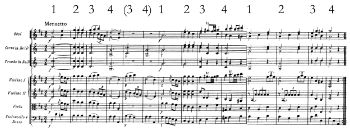
(click to enlarge and listen)
Example 12. Haydn, Symphony in D major, Hob. I: 70, Menuetto, mm. 1–10
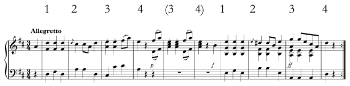
(click to enlarge and listen)
[3.4] “Vicious” minuets, in Bacquoy-Guédon’s terms, often relate back to more regular models, following processes of phrase expansion and compression described by eighteenth-century theorists and recently reformulated by William Rothstein (1989) and Danuta Mirka (2021). Sections with 10 or 14 measures can frequently be understood as 8- or 12-measure phrases internally expanded through the insertion of a two-measure unit
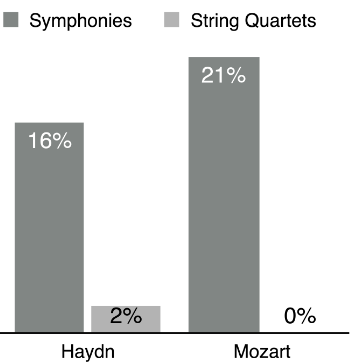
Example 13. Proportion of minuets with a two-bar extension by repetition in the first section
(click to enlarge)
[3.5] Although techniques of phrase expansion have received ample scholarly attention, little is said about the variation of these compositional strategies across genres. Rothstein 1989 and Mirka 2021 have thoroughly investigated—drawing on Kirnberger, Riepel, and Koch—how composers crafted and altered hypermeter and phrase structures. Here I deal with some considerations regarding where those alterations took place: compositional practice suggests that preferred strategies for expanding minuet phrases varied between the symphony and the string quartet. The two-measure Anhang finds itself at home in minuets, and more specifically symphonic ones
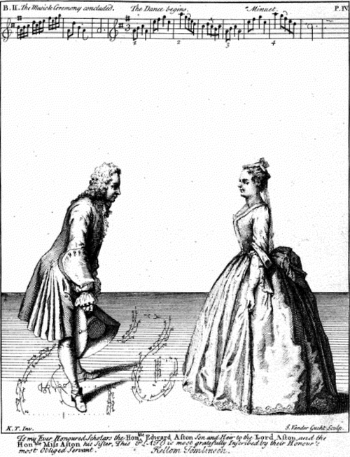
Example 14. Opening reverences illustrated in Tomlinson’s The Art of Dancing (1735, Book II, plate IV)
(click to enlarge)
[3.6] In the danced minuet, couples completed a series of ceremonial reverences before starting the actual dance. If a high-rank person was present in the room, the first bows would be dedicated to the so-called “Honors to the Presence” (Gardiner 1786). After the bows, dancers moved towards their starting positions to begin the execution of several figures (I describe these elements of the dance in the next section). Tomlinson’s The Art of Dancing (1735) choreographs the opening reverences to introductory musical material distinct from the minuet proper. Example 14 reproduces the plate corresponding to the end of “The Music or Flourish to the Ceremony” and the beginning of the dance. But the minuets learned in lessons are not the same as those danced at balls (Russell 1999, 387). Ballroom minuets lack the sort of musical introduction provided by Tomlinson. It follows that dancers would need to execute their reverences either without music or moving to the same music composed for the rest of the dance. In the latter, most likely case, the beginning of the first section would be dedicated to bowing gestures (Fort 2025, 116–19).
[3.7] Minuets such as the ones in Examples 11 and 12 provide an exceedingly fitting musical accompaniment to this element of the choreography. In Video Example 2, Sarah Edgar performs the Honors to the Presence according to a choreography by Ken Peirce to the music of the minuet from Haydn’s Symphony no. 70
Video Example 2. Honors to the Presence (Dance: Sarah Edgar; Music: Haydn, Symphony no. 70 in D, Menuetto)
(click to enlarge and listen) |
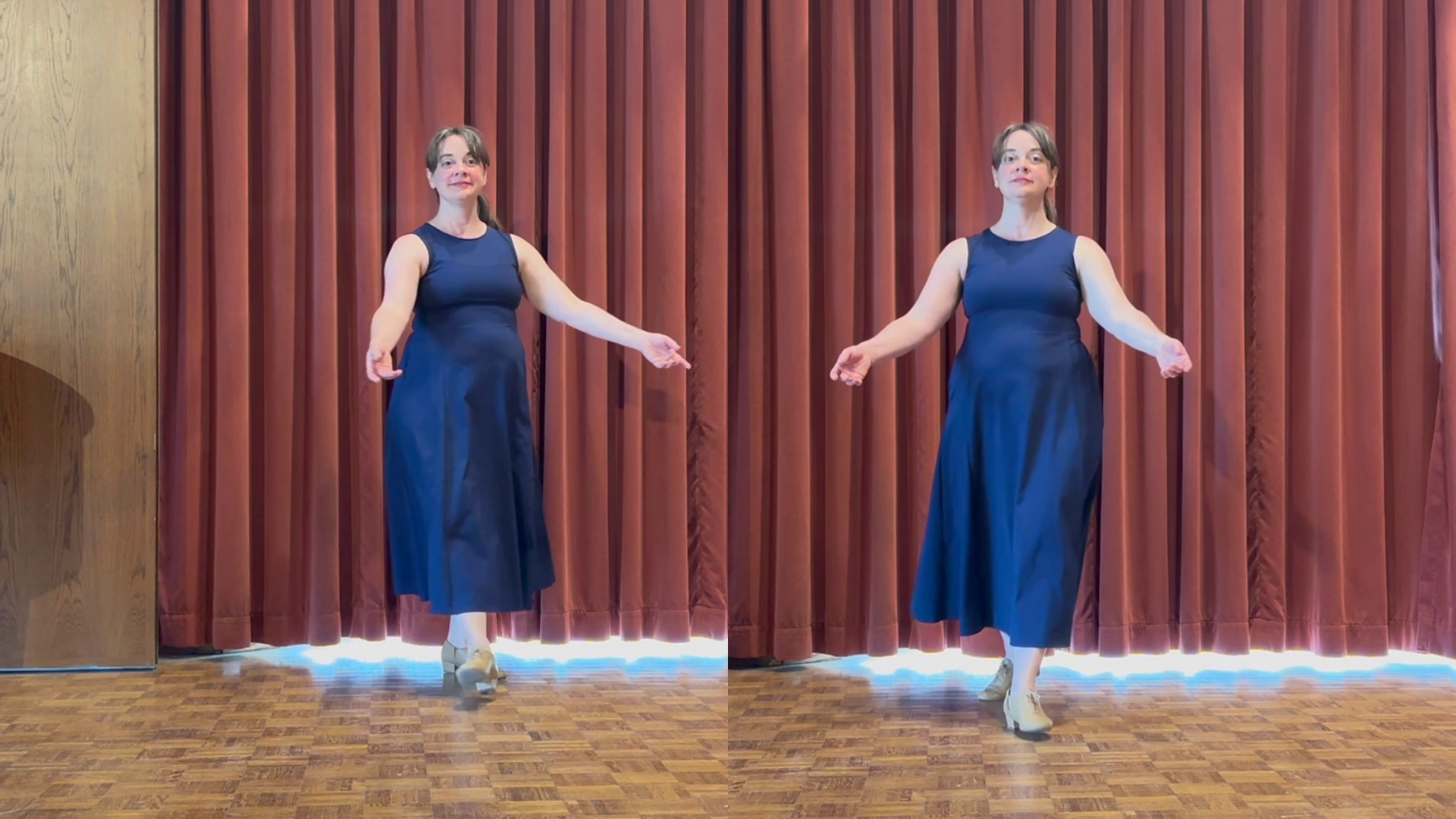
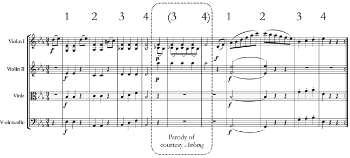
[3.8] Phrase expansion, by addition of a suffix, creates a choreomusical analogy of the bowing gestures performed at the beginning of the dance. I call the two-measure addendum of minuet phrases a courtesy Anhang, a term that honors both its embodied meaning and form-functional role. Dancers move constantly across the dance floor, but they stay in place to bow or curtsy—just as the two-measure echo does not contribute to the phrase “moving” forward. The repetition of musical material makes the incise particularly static, while restrained dynamics mirror the humble character of a reverence. An abstract device in hypermetrical theories, the two-measure expansion by repetition here acquires specific meaning in relation to the danced minuet. Courtesy Anhangs disrupt quadruple hypermeter, but for listeners acquainted with the minuet dance, such disruptions do not interfere with the performance (physical or imagined) of the dance. They facilitate dancing, imitating bodily movements with sound.
Example 15. Haydn, String Quartet in E-flat major, op. 33, no. 2, Scherzo, mm. 1–10
(click to enlarge and listen)
Example 16. Haydn, Minuet in G major, Hob. IX:8, no. 8, mm. 1–8

(click to enlarge and listen)
[3.9] This stereotyped, musical sign of decorum was apparently so familiar and predictable as to provide a source of humor. In the String Quartet op. 33, no. 2, “The Joke,” Haydn turns the polite courtesy Anhang into an irreverent gesture. Although the movement is entitled Scherzo, one can hear multiple echoes of minuet music
[3.10] Haydn’s approach to dance-music relations in Examples 12, 15, and 16 illustrates the difference between genres that I present in this study. One could choreograph the reverences shown in Video Example 2 to each of these three musical phrases and the bow would coincide every time with the two-measure repetition in mm. 5–6. In the ballroom minuet, pairing the reverence with a melodic repetition would be a suitable yet not expected coincidence. The Anhang of Example 16 blends smoothly into m. 7 and coexists with an eight-measure phrase divided in halves. In the symphonic minuet, mm. 5–6 are clearly detached from the preceding and following Vierer, and the inserted material thwarts phrase symmetry. For this suffix, Haydn changes dynamics and instrumentation, and even makes the walking bass stop. The courtesy Anhang of Example 12 thus brings attention to itself and exaggerates analogies between sound and (imagined) movement, inviting listeners to engage in mimetic participation. In the string quartet, the conventional echo provides the necessary background to showcase transgressive behavior. Music invites listeners to dance a warped minuet that lacks proper decorum.
[3.11] The expressive, embodied effects of hypermetric manipulations vary across metrical levels. Manipulating duple hypermeter gives the impression that “feet cannot settle into their prescribed steps,” as elaborated in the previous section. On the other hand, denying quadruple hypermeter with an added Zweyer perfectly accommodates opening reverences—even though this level of coordination did not seem to occur in ballroom dances. Not only can these minuet phrases be danced to: they imitate movement so overtly that one can hear bows and curtsies in the music. The courtesy Anhang is another example of how certain symphonic minuets overemphasize coordination between music and movement—movement as imagined, felt, and communicated, though not physically enacted.
4. The eight-measure level: Z-figures
Dance fact: An important component of the danced minuet, the Z-figure, required 12 bars of music.
Familiar music fact: In the late eighteenth century, danceable minuets tend to unfold in 8-bar phrases.
Counterintuitive music fact: 8-bar phrases are more common in string quartets than in symphonies.
Proposition: Twelve-bar minuet phrases, commonly found in symphonies, provide a choreomusical analogy of the Z-figure.
[4.1] Most minuets written for the Viennese ballrooms of the late eighteenth century begin with an eight-measure phrase (Fort 2025, 111)
[4.2] When writing minuets as movements within symphonies and string quartets, composers frequently deviated from this convention: only 56% of symphonies and 68% of string quartets begin their minuets with an eight-measure phrase (see Example 10). Sections consisting of eight-measure phrases are more common in minuets written for the ballroom than in concert ones—just as one would expect. What is remarkable is how the deviations of nonfunctional minuets differ across genres. Specifically, the fact that string quartets feature eight-measure phrases more frequently than symphonies is counterintuitive. The string quartet provides the quintessential arena to playfully subvert norms and frustrate the expectations of Kenner. Studies on hypermeter, such as those by Love (2015), Mirka (2021), and McClelland (2006), tend to focus on chamber minuets because they present more abundant and sophisticated manipulations than symphonic ones, making them arguably more interesting for analysts and expert listeners alike. One could thus reasonably expect to find deviations from the prototype more frequently in the string quartet than in the symphony.
[4.3] With the eight-measure reprise providing a theoretical norm and practical standard, phrases of different lengths represent deviations from convention—unusual in the ballroom but frequent in nonfunctional minuets. These concert minuets feature, in addition to standard eight-measure phrases, frequent phrase-expansion techniques resulting in reprises of 10, 12, or 14 measures (all of which are more frequent, at least slightly, in symphonies than in quartets). Among these theoretically irregular yet not uncommon phrase lengths, 10- and 14-measure reprises challenge quadruple hypermeter. As discussed in the previous section, when these phrase structures occur in the symphonic minuet, they may include the choreomusical analogy I have dubbed courtesy Anhang. The 12-measure reprise presents a special case: it potentially accommodates four-measure hypermeter while denying regularity at the eight-measure level. This structure appears over twice as frequently in the symphony (16%) than in the chamber (7%) or the ballroom
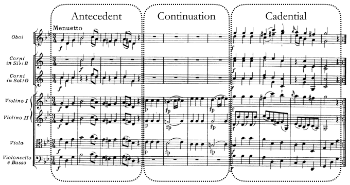
Example 17. Mozart, Symphony in G minor, K. 183, Menuetto, mm. 1–12
(click to enlarge and listen)
[4.4] The Menuetto of Mozart’s Symphony in G minor, K. 183 (Example 17) presents a paradigmatic example of the 12-measure section. Dynamics, instrumentation, and register clearly delimit the boundaries of three quadruple hypermeasures. At the end of the first Vierer, bare octaves create a half-cadence effect. Measures 5–8 display all the compositional devices that William Caplin lists as characteristic of continuation function: “(1) phrase-structural fragmentation, (2) acceleration in the rate of harmonic change, (3) increase in surface’s rhythmic activity, and (4) sequential harmonies” (1998, 40). The return of forte dynamics marks the onset of the prototypical cadential progression that unfolds in the last four measures. In Caplin’s theory of formal functions, continuation and cadential functions are typically fused in the four measures of a standard continuation. The 12-measure minuet phrase, on the other hand, presents each function separately, neatly parsed in distinct groups: four-measure antecedent, four-measure continuation, four-measure cadential.
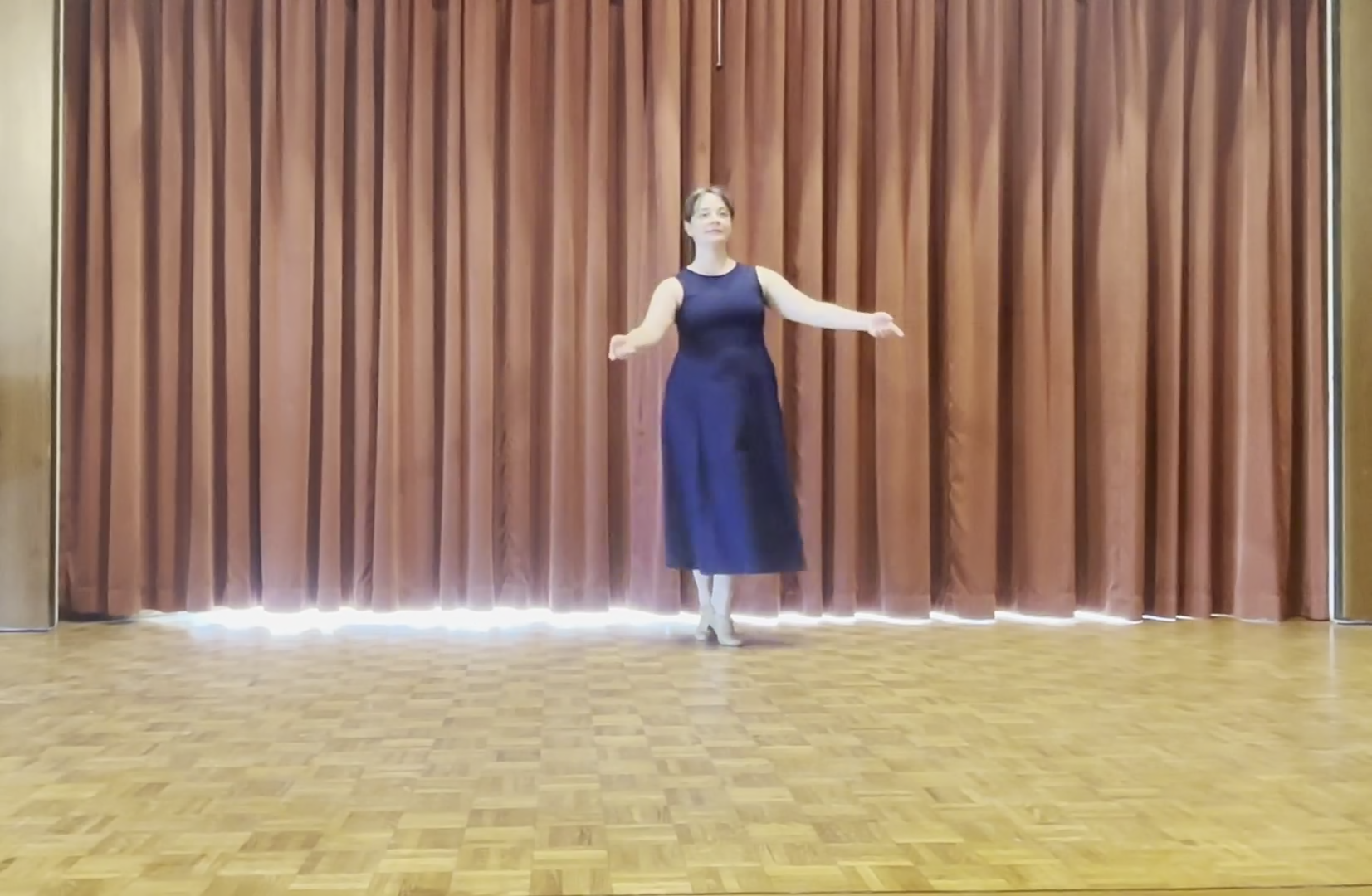
Video Example 3. Minuet steps combined into a Z-figures (Dance: Sarah Edgar; Music: Mozart, Symphony K. 183, Menuetto)
(click to watch video)
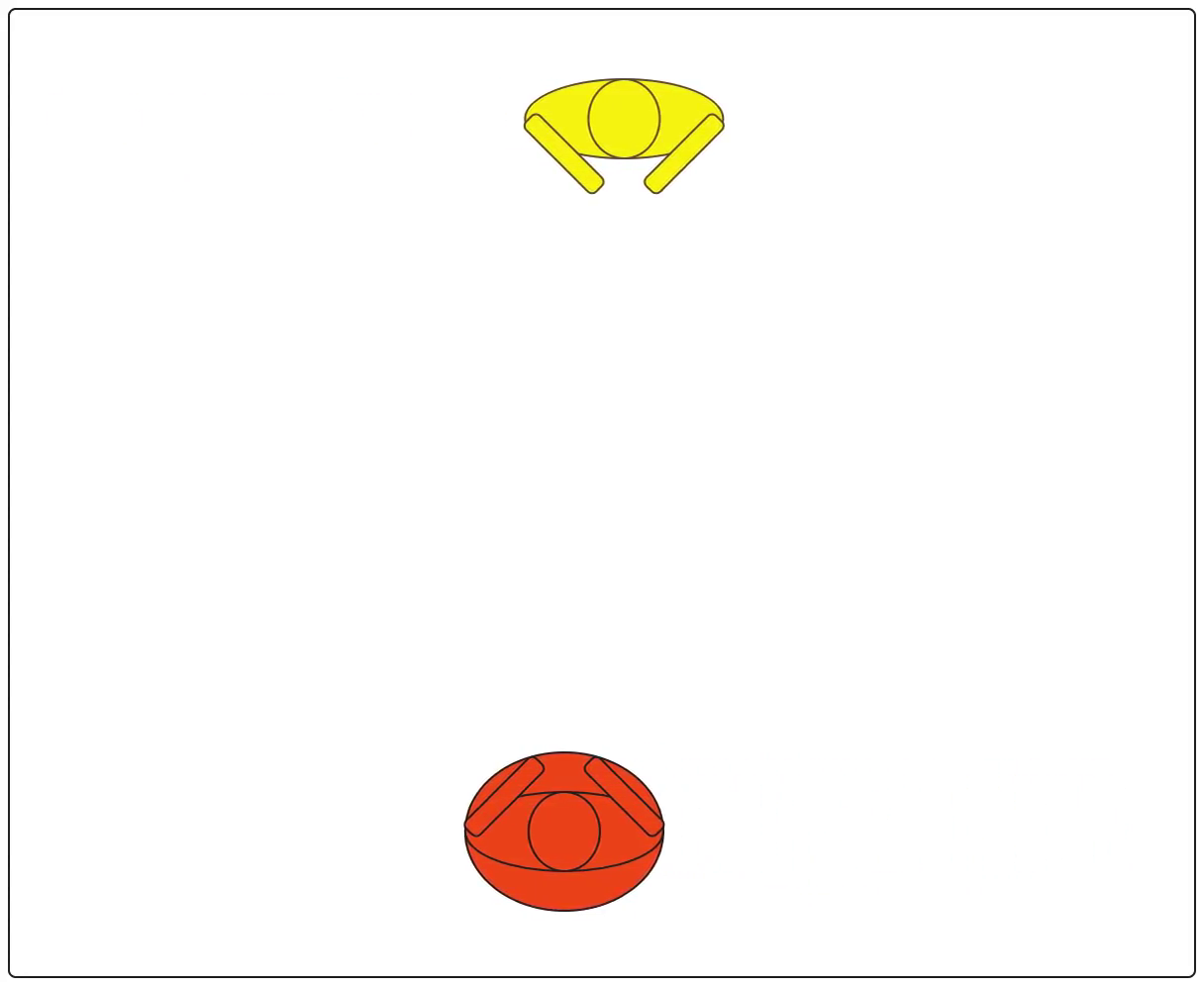
Video Example 4. Simplified execution of a Z-figures (Animation: Alison Stevens; Music: Mozart, Symphony K. 183, Menuetto)
(click to watch video)
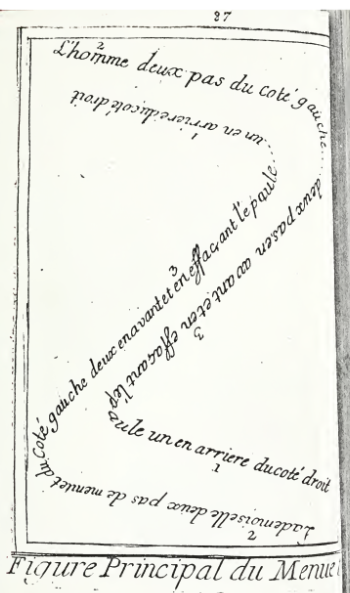
[4.5] Phrases, in minuets and elsewhere, tend to be divided in halves rather than thirds
Example 18. Three illustrations of the Z-figure in eighteenth-century dance treatises
(click to enlarge and see the rest) |
Example 19. Haydn, Symphony in A major, Hob. I:59, Menuetto, mm. 1–12 (winds omitted)
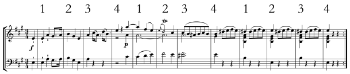
(click to enlarge and listen)
[4.6] Haydn achieves a similar effect through different means in the minuet from Symphony no. 59 in A (Example 19). In this overly articulated phrase, each four-measure unit begins with an anacrusis—a sonic analogue of the plié that launches each minuet step. The first Vierer stops at an unharmonized , potentially heard as a weakly articulated half-cadence (m. 4). The Vierer that follows arrives at a strong, tonicized half-cadence (m. 8). The third Vierer rewrites the arrival at the E major chord from a half cadence into an authentic one (m. 12). Harmonically, the difference is significant; melodically, this final Vierer does not have much to add. In the first and third four-measure groups, melodic unisons and root-position chords respectively provide a solid, static musical accompaniment to the imaginary lines travelled within the individual space of each dancer. If one paired this phrase with a Z-figure, the measures where dancers remain on their respective sides of the floor would coincide with moments where harmony barely progresses. The middle unit accompanies dancers’ crossing motion with unstable, forward-moving harmonies. Although such destabilizing devices characterize continuation function regardless of genre, the danced minuet provides a context that endows this formal function with a truly embodied meaning. In mm. 5–8 of these examples, the phrase moves away, quite literally, from its starting point. Continuation function, or the sense of “being in the middle” (Caplin 1998), is not just a matter of musical form but a physical reality. Even the contrary, stepwise motion in m. 5, closing the distance between melody and bass, seems to imitate the onset of the opposite diagonal trajectories of the dancing couple
Example 20. Dittersdorf, Symphony in D, Kr. 74, The fall of Phaeton, Tempo di Minuetto, mm. 1–12 (reduction)
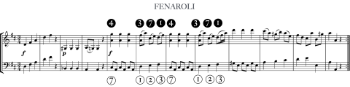
(click to enlarge and listen)
[4.7] The first minuet section from Dittersdorf’s Symphony The Fall of Phaeton (Example 20) also follows one of these tripartite structures. It shares with K. 183 the clear separation between the first and second Vierer with a rest, as well as the repeated two-measure motive at the beginning of the continuation. As in Examples 17 and 18, harmony contributes to and collaborates with hypermeter to represent the movements of the dancing couple across the floor. After dancing on their respective sides for four measures, dancers must approach one another to cross to the other side. In mm. 5–8, chords in first inversion fittingly provide a sense of instability and mobility. Furthermore, a Fenaroli schema (Gjerdingen 2007, 462), with its characteristic contrary motion and voice exchange, provides a choreomusical analogy of the dancers swapping positions on the floor during the diagonal of the Z-figure. Dittersdorf’s minuet is especially majestic and pompous, with predominantly strong dynamics and poised rhythmic behavior. The opening octaves and the insistent repeated notes ring with authoritarian scolding, and the augmented sixth, often reserved for signaling structurally important arrivals, hammers a premature half cadence. Dittersdorf exaggerates the two-measure grouping at the beginning with a registral ascent like the ones described in Example 9, followed by a drastic drop in register. Dynamics highlight the grouping of Zweyer, while the augmented sixth signals the end of a Vierer. The phrase eventually unfolds as a musical imitation of the venerable Z-figure. This is not merely music in the style of minuets; it is music that represents “minuet-ness.” The minuet, aristocratic dance par excellence presented here in its most regal fashion, stands conveniently as a symbol of high class, and by extension the realm of the gods
[4.8] As with other choreomusical analogies discussed through sections 2–4, this level of alignment between music and dance did not seem to occur in the ballroom. To elucidate possible large-scale correspondences between sound and movement, Fort aligns a choreography by Georg Link (1796) with the music of a Minuet-Trio composed of eight-measure sections (2025, 117). According to this hypothetical reconstruction, Z-figures start in the middle of sections and include the transition between Minuet and Trio—a very different and much looser level of coordination than the one I suggest for the symphonic minuets of the previous examples. Dancers allegedly ignored phrase structure, making
5. Conclusions: Rise and fall of the minuet (and the choreomusical analogies)
[5.1] I have focused on a short chapter in the history of the minuet: Vienna and its area of influence circa 1760–1800. Despite my relatively narrow focus on the minuets of given time and place, the phenomena discussed here undergo historical transformation. I have noticed changes spanning these four decades concerning phrase length and structure. Overall, the presence of choreomusical analogies seems to decline as the eighteenth century draws to a close. Haydn favored the twelve-measure first section during his tenure at Esterháza and then completely abandoned it after 1790
[5.2] The life cycle of the danced minuet underwent significant changes throughout the eighteenth-century. In its courtly origins, it was danced by one couple at a time. At this stage the minuet was an aristocratic affair. The dance was considered difficult, and the stakes were quite high: the dancing couple displayed their skill and grace in front of a scrutinizing audience. By the end of the century, with the development of public balls, multiple couples danced minuets simultaneously. Minuets opened the dance—a formality that preceded the more fashionable and arguable exciting contredanses and Deutscher. The minuet had become accessible to the middle classes, and the choreography had been simplified (Fort 2025, 70–71)
[5.3] It is also possible that the choreomusical analogies I describe evoke an archaic type minuet rather than the one practiced by the middle classes at the end of the century. For Buurman, the opening reverences represent “an overt celebration of the aristocratic status” (2021, 57) of French court balls. Feldtenstein suggests that when multiple couples danced at the same time, as occurred in public ballrooms, they should move in rows or circles to avoid collisions (1772, 80–81, quoted in Fort 2015, 27–28). If certain elements of the choreography were no longer practiced in the ballroom, their musical imitations from symphonic minuets could have only been familiar through theatrical minuets, or perhaps only accessible for listeners who had experienced the minuet at court
[5.4] During the reign of the “queen of dances” (Feldtenstein 1772, 73), choreomusical analogies such as the courtesy Anhang and the Z-figure proliferated in symphonic minuets, imitating dance steps with music. Manipulations of hypermeter and phrase structure affect virtual alignment between music and bodily movement, and these compositional strategies varied across genres. Certain hypermetric manipulations are more common in string quartets. This is not surprising, given the sophistication and complexity of the genre. What is noteworthy is that certain types of hypermetric deviations from four- and eight-measure structures happen more frequently in the symphony. To be sure, not all symphonic minuets imitate choreography. The ones that have received more analytical attention are those that challenge the conventions of the genre. Richard Cohn chooses the Menuetto of Mozart’s Symphony in G minor, K. 550 as a case study of hypermetric dissonance (1992), Wheelock finds humor in Haydn’s unruly symphonic minuets (1992), and Lowe identifies topics with low-class associations that make the aristocratic minuet “fall from grace” (2002). My analysis of a corpus of symphonic minuets reveals that expressive strategies of this kind, while remarkable, are not characteristic of the genre. Rather than frustrating expectations of meter and choreography, symphonies rely on conventional aspects of the danced minuet and derive expressive potential from these conventions.
[5.5] Danceable minuets did not require coordination between choreography and phrase structure, making analogies between movement and music neither necessary nor (perhaps) desirable. Irreverent minuets abound in string quartets and occasionally appear in symphonies, delighting listeners in subtle games of misaligning and realigning imaginary dance steps. A more typical communicative strategy for symphonic minuets is to play with the embodied knowledge of their listeners in a different, unique way. They become expressive by virtue of being overly well-behaved, imitating choreography to convey through music the embodied, multimodal experience of social dance.
[5.6] I would be remiss not to mention that I have showed these imitations of dance movements in rather scattered fashion: a minuet step here, a reverence there, a Z-figure elsewhere. No symphonic minuet presents a musical analogy of a complete minuet choreography. Such an exact mapping could be hardly achieved: the mandatory binary structure of minuet music does not align with any choreographic counterpart
Olga Sánchez-Kisielewska
University of Chicago
Department of Music
Goodspeed Hall, 101 E 59th St
Chicago, IL 60637
olgasanchez@uchicago.edu
Appendix
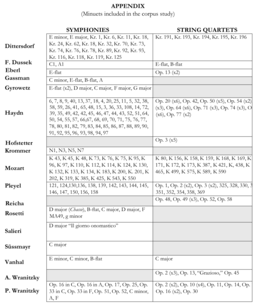
Example A below enumerates all minuets in the corpus by composer (row) and genre (column; either symphony or string quartet).
Example A. Breakdown of minuets included in the corpus
(click to enlarge) |
Works Cited
Agawu, Kofi. 2014. “Topics and Form in Mozart’s String Quintet in E Flat Major, K. 614/i.” In The Oxford Handbook of Topic Theory, ed. Danuta Mirka, 474–92. Oxford University Press. https://doi.org/10.1093/oxfordhb/9780199841578.013.0018.
Bacquoy-Guédon, Alexis. c1785. Méthode pour exercer l’oreille a la mesure, dans l’art de la danse. Valade.
Bonds, Mark Evan. 2008. “Listening to Listeners.” In Communication in Eighteenth-Century Music, ed. Danuta Mirka and Kofi Agawu, 34–52. Cambridge University Press. https://doi.org/10.1017/CBO9780511481376.003.
Buurman, Erica. 2021. The Viennese Ballroom in the Age of Beethoven. Cambridge University Press. https://doi.org/10.1017/9781108863278.
Caplin, William E. 1998. Classical Form: A Theory of Formal Functions for the Instrumental Music of Haydn, Mozart, and Beethoven. Oxford University Press. https://doi.org/10.1093/oso/9780195104806.001.0001.
Cobau, Judith. 1984. “The Preferred Pas de Menuet.” Dance Research Journal 16 (2): 13–17. https://doi.org/10.2307/1478717.
Cohn, Richard. 1992. “Metric and Hypermetric Dissonance in the Menuetto of Mozart’s Symphony in G Minor, K. 550.” Intégral: The Journal of Applied Musical Thought 6: 1–33.
Cox, Arnie. 2016. Music and Embodied Cognition: Listening, Moving, Feeling, and Thinking. Indiana University Press. https://doi.org/10.2307/j.ctt200610s.
Feldtenstein, C. J. v. 1772. Erweiterung der Kunst nach der Chorographie zu tanzen. Braunschweig.
Fort, Joseph. 2025. Haydn’s Minuets and Eighteenth-Century Dance. Cambridge University Press. https://doi.org/10.1017/9781009515603.
—————. 2015. “Incorporating Haydn’s Minuets: Towards a Somatic Theory of Music.” Ph.D. diss., Harvard University.
Gardiner, S. J. 1786. A Definition of Minuet Dancing. Rules for Behaviour in Company, &c. A Dialogue between a Lady and a Dancing Master. Edmunds.
Gjerdingen, Robert. 2007. Music in the Galant Style. Oxford University Press. https://doi.org/10.1093/oso/9780195313710.001.0001.
Hilton, Wendy. 1997. Dance and Music of Court and Theater: Selected Writings of Wendy Hilton. Pendragon Press.
IJzerman, Job. 2018. Harmony, Counterpoint, Partimento: A New Method Inspired by Old Masters. Oxford University Press.
Imbrie, Andrew. 1973. “‘Extra’ Measures and Metrical Ambiguity in Beethoven.” In Beethoven Studies, ed. Alan Tyson, 45–66. Norton.
Johnson, Mark. 1990. The Body in the Mind: The Bodily Basis of Meaning, Imagination, and Reason. University of Chicago Press. https://doi.org/10.2307/431155.
Kirnberger, Johann Philipp. 1787. “Menuet.” In Allgemeine Theorie der schönen Künste in einzeln, nach alphabetischer Ordnung der Kunstwörter auf einander folgenden Artikeln, ed. Johann Georg Sulzer, 316–317. Weidemann.
Klorman, Edward. 2016. Mozart’s Music of Friends: Social Interplay in the Chamber Works. Cambridge University Press. https://doi.org/10.1017/CBO9781316145302.
Koch, Heinrich Christoph. (1793) 1983. Introductory Essay on Composition: The Mechanical Rules of Melody, Sections 3 and 4. Trans. Nancy Kovaleff Baker. Yale University Press.
Kozak, Mariusz. 2020. Enacting Musical Time: The Bodily Experience of New Music. Oxford University Press. https://doi.org/10.1093/oso/9780190080204.001.0001.
Krebs, Harald. 1999. Fantasy Pieces: Metrical Dissonance in the Music of Robert Schumann. Oxford University Press. https://doi.org/10.1093/acprof:oso/9780195116236.001.0001.
Leman, Marc, Pieter-Jan Maes, Luc Nijs, and Edith Van Dyck. 2018. “What Is Embodied Music Cognition?” In Springer Handbook of Systematic Musicology, ed. Rolf Bader, 747–60. Springer. https://doi.org/10.1007/978-3-662-55004-5_34.
—————. 2007. Embodied Music Cognition: The Role of the Body in Musical Understanding. MIT Press.
Lerdahl, Fred and Ray Jackendoff. 1983. A Generative Theory of Tonal Music. MIT Press.
Link, Georg. 1796. Vollkommene Tanzschule aller in Kompagnien und Bällen vorkommenden Tänzen: nebst zwölf ganz neu komponirten englischen Contre-Tänzen, deren Touren und Figuren durch 17 Kupfertafeln dargestellt, und mit allen nöthigen Erklärungen zu leichtfasslichen Unterricht der Lehrer und Lehrlinge versehen sind. Jenko.
Little, Meredith Ellis, and Natalie Jenne. (1991) 2001. Dance and the Music of J.S. Bach. 2nd ed. Indiana University Press.
London, Justin. 2004. Hearing in Time: Psychological Aspects of Musical Meter. Oxford University Press.
Love, Stefan Caris. 2015. “Historical Hypermetrical Hearing: Cycles and Schemas in the String Quartet Minuet.” Music Theory Online 21 (3). https://doi.org/10.30535/mto.21.3.8.
Lowe, Melanie. 2007. Pleasure and Meaning in the Classical Symphony. Indiana University Press. https://doi.org/10.2979/1600.0.
—————. 2002. “Falling from Grace: Irony and Expressive Enrichment in Haydn’s Symphonic Minuets.” The Journal of Musicology 19 (1): 171–221. https://doi.org/10.1525/jm.2002.19.1.171.
Malpied, M. c.1770. Traite sur l’Art de la Danse. Boüin.
McClelland, Ryan. 2006. “Extended Upbeats in the Classical Minuet: Interactions with Hypermeter and Phrase Structure.” Music Theory Spectrum 28 (1): 23–56. https://doi.org/10.1525/mts.2006.28.1.23.
McKee, Eric. 2014. “Ballroom Dances of the Late Eighteenth Century.” In The Oxford Handbook of Topic Theory, ed. Danuta Mirka, 164–93. Oxford University Press. https://doi.org/10.1093/oxfordhb/9780199841578.013.007.
—————. 2012. Decorum of the Minuet, Delirium of the Waltz: A Study of Dance-Music Relations in 3/4 Time. Indiana University Press. https://doi.org/10.2307/j.ctt2005r6k.
Mirka, Danuta. 2021. Hypermetric Manipulations in Haydn and Mozart: Chamber Music for Strings, 1787–1791. Oxford University Press. https://doi.org/10.1093/oso/9780197548905.001.0001.
—————. 2012. “Absent cadences.” Eighteenth-Century Music 9 (2): 213–35. https://doi.org/10.1017/S147857061200005X.
—————. 2009. Metric Manipulations in Haydn and Mozart: Chamber Music for Strings, 1787–1791. Oxford University Press. https://doi.org/10.1093/acprof:oso/9780195384925.001.0001.
Neumeyer, David. 2006. “The Contredanse, Classical Finales, and Caplin’s Formal Functions.” Music Theory Online 12 (4). https://doi.org/10.30535/mto.12.4.1.
Riepel, Joseph. 1752. Anfangsgründe zur musicalischen Setzkunst. De Rhythmopoeia, oder von der Tactordnung. Bader.
Rothstein, William Nathan. 1989. Phrase Rhythm in Tonal Music. Schirmer.
Rousseau, Jean-Jacques. 1768. Dictionnaire de Musique. Duchesne.
Russell, Tilden A. 2006. “The Minuet According to Taubert.” Dance Research 24 (2): 138–62. https://doi.org/10.3366/dar.2007.0012.
—————. 1999. “Minuet Form and Phraseology in Recueils and Manuscript Tunebooks.” The Journal of Musicology 17 (3): 386–419. https://doi.org/10.2307/764099.
—————. 1992. “The Unconventional Dance Minuet: Choreographies of the Menuet d’Exaudet.” Acta Musicologica 64 (2): 118–38.
—————. 1983. “Minuet, Scherzando, and Scherzo: The Dance Movement in Transition, 1781–1825.” Ph.D. diss., The University of North Carolina at Chapel Hill.
Salamone, Jennifer. 2017. “Misbehaving Minuets: A Preliminary Theory of Humor and Dance Form in Haydn’s Opp. 76 and 77.” Ph.D. diss., University of Kentucky.
Sánchez-Kisielewska, Olga. 2023. “On Figaro’s Alleged Minuet and Some Challenges and Opportunities of Topic Theory.” Music Theory Spectrum 45 (1): 89–99.
Sisman, Elaine R. 2015. Haydn’s Theater Symphonies. Routledge.
—————. 1993. Mozart: The “Jupiter” Symphony. Cambridge University Press. https://doi.org/10.1017/CBO9780511613418.
Stevens, Alison. 2021. “Music in the Body: The Eighteenth-Century Contredanse and Hypermetrical Hearing.” Journal of Music Theory 65 (1): 81–106. https://doi.org/10.1215/00222909-9124738.
Temperley, David. 2008. “Hypermetrical Transitions.” Music Theory Spectrum 30 (2): 305–25. https://doi.org/10.1525/mts.2008.30.2.305.
Thomas, Günther. 1982. “Haydns Tanzmusik: Zeitgebunden oder persönlich geprägt?” Musica 36: 140–47.
Tomlinson, Kellom. 1735. The Art of Dancing Explained by Reading and Figures. London.
Vogler, Georg Joseph. 1778–79. Betrachtungen der Mannheimer Tonschule. Manheim.
Wheelock, Gretchen A. 1992. Haydn’s Ingenious Jesting with Art: Contexts of Musical Wit and Humor. New York: Schirmer.
Yeston, Maury. 1974. The Stratification of Musical Rhythm. Yale University Press.
Zbikowski, Lawrence M. 2008. “Dance Topoi, Sonic Analogues and Musical Grammar: Communicating with Music in the Eighteenth Century.” In Communication in Eighteenth-Century Music, ed. Danuta Mirka and Kofi Agawu, 283–309. Cambridge University Press.
Discography
Discography
Dittersdorf, Carl Ditters von. 1995. Sinfonias on Ovid’s Metamorphoses Nos. 1–3. Failoni Orchestra. Conducted by Hanspeter Gmür. Naxos 8.553368.
Haydn, Joseph. 2009. String Quartets op. 33. Cuarteto Casals. Harmonia Mundi HMX 2962022.23
—————. 2000. Haydn: Symphonies c. 1779–1781. The Academy of Ancient Music. Conducted by Christopher Hogwood. L’Oiseau-Lyre 466 941-2.
Mozart, Wolfgang. 2017. Mozart: Complete Dances and Marches, vol. 5. Vienna Mozart Ensemble. Conducted by Willi Boskovsky. Originally released 1965. Decca 4832024.
—————. 2006. Mozart: String Quartets, Disc 4. Hagen String Quartet. Deutsche Grammophon 00289 477 6253.
—————. 1997. Mozart: The Symphonies. The Academy of Ancient Music. Conducted by Christopher Hogwood. L’Oiseau-Lyre 452 496-2.
—————. 1990. Mozart: Symphonies Nos. 21–25. Royal Concertgebouw Orchestra. Conducted by Josef Krips. Phillips 426 973-2.
Pludermacher, George. 1996. L’Atelier des Pianistes, vol. 1: Débutant. Erato 90295348571.
Footnotes
1. All human cognition is literally embodied; the term describes an approach to psychology that emphasizes the importance of motor behavior. Embodied music cognition has been discussed at length; see for example Cox 2016, Leman 2007, Leman et al. 2018, and Kozak 2020.
Return to text
2. I use the term nonfunctional to describe music that follows the convention of dance but was not composed for dancing. Hereafter, I use nonfunctional minuet and concert minuet interchangeably, as opposed to “functional” or dance minuet, or ballroom minuet. This terminology implies neither value judgments nor opposition between the functional and the “artful” or the “dysfunctional.”
Return to text
3. The knowledge structures that I discuss here resemble Mark Johnson’s “image schemata,” the recurring patterns that emerge from physical experiences of bodies moving through space (1990). This use of the term differs from its typical use in music-theoretic discourse, popularized by Gjerdingen 2007, as cognitive patterns resulting from statistical regularities in the music. Stefan Love (2015) relies on the notion of a cognitive schema to suggest how a hypothetical eighteenth-century listener would have perceived hypermeter in minuets, but his schemata do not have an explicit embodied component.
Return to text
4. Tilden Russell’s seminal work on the minuet (1983, 1992, 1999, 2006), although less analytical in nature, remains an essential source for the study of music-dance relations. His observations and quantitative analyses on the irregular phrase structures present in danceable minuets will provide an important background to the third and fourth sections of this article.
Return to text
5. Ryan McClelland’s study on extended upbeats in the minuet focuses on chamber music, with one single example from a symphony by Haydn (2006). Stefan Love illustrates his model of historical perception of hypermeter in the minuet exclusively with string quartets (2015). Mirka’s studies of Haydn’s and Mozart’s chamber music for strings (2009, 2021) are seminal references on metrical manipulations in the classical style; these include multiple analyses of minuets. A notable exception to the analytical focus on chamber minuets is Wheelock 1992.
Return to text
6. On the importance of ballroom culture in late eighteenth-century Vienna, and the social practice of minuet dancing, see Fort 2025 and Buurman 2021. I thank Dorian Bandy for pointing me at Buurman’s work.
Return to text
7. Fort suggests that “the minuet may have retained its earlier, courtly forms in the house ball” (2015, 150), my emphasis, as opposed to the newer forms practiced in public balls.
Return to text
8. Starting with an anacrusis is common, but not required, in minuets written for the ballroom. From the twelve minuets of this set, half begin on the downbeat. As I further elaborate in subsequent sections, the movements of dancers in the public ballrooms—unlike those dancing strictly choreographed minuets for the stage—did not need to align with musical phrases (Russell 1983, 60–64). Dancers could have waited to hear a few measures of music before starting the dance (see [3.1] below).
Return to text
9. Of 108 minuets composed for the balls of the Viennese public ballrooms between 1792–99, 21% begin with a dotted anacrusis. Incipits of this corpus appear in Fort 2015, 281–300.
Return to text
10. Following the terminology introduced in Krebs 1999, 54–56.
Return to text
11. In addition to the dotted anacruses in mm. 1, 3, and 5, harmony provides other cues for this potential hypermetrical conflict or shift. Not only does the first harmonic change (a common sign for a new downbeat) occur in m. 4, but the changes in mm. 4 and 6 carry more weight than those in mm. 5 and 7. In the lament bass, chromatic tones typically occupy stronger metrical positions than diatonic ones (see IJzerman 2018, 224–26). The diatonic version of the descending tetrachord appears in the opening measures of the first movement of K. 421.
Return to text
12. This is not at all the case for earlier dance minuets. According to Russell, “the notion of linking regular periodicity to the dance minuet is fallacious and has led to manifold problems of our understanding of minuets and ultimately of Classic phrase morphology itself” (1992, 118).
Return to text
13. The distinction between Kenner and Liebhaber, connoisseur and amateur listeners, was common in German music criticism. See, for example, Bonds 2008.
Return to text
14. Wheelock claims that danced minuets “provide a measure of the functional against which to judge the ‘dysfunctional’ deviations that distinguish the artful minuet from its danced counterpart” (1992, 57). For a critique of this position, see Fort 2025, 195–96.
Return to text
15. Dittersdorf, Pleyel, Anton and Paul Wranitzky, Eberl, Reicha, Krommer, Süssmayr, Gyrowetz, Gassman, Rosetti, and Hoffstetter. The corpus is limited to works that were available on IMSLP and the University of Chicago Library in 2018.
Return to text
16. Cognitive thresholds for entrainment challenge the possibility of eight-measure hypermeter in minuets. With a reasonable minuet tempo of 112 bpm, eight measures of music take more than 12 seconds, falling outside the upper limit of 5–6 seconds for meter perception (London 2004, 27). Thus, technically, section 2 deals mostly with hypermeter, section 3 with both hypermeter and phrase structure, and section 4 with phrase structure rather than hypermeter.
Return to text
17. The empirical component draws on a rather brute measure-counting process, which provides evidence for claims about typicality that I incorporate into more nuanced analyses. As William Rothstein put it, “a phrase cannot be defined by some a priori measure count. Yet counting measures is not completely irrelevant, either” (1989, 7).
Return to text
18. Dance treatises refer to this variant, which enjoyed increasing favor over the eighteenth century, as pas de menuet en fleuret, New Minuet Step, French Minuet Step, and Court Step (Cobau 1984, 14).
Return to text
19. The example is adapted from Fort 2025, 73. Fort provides a comprehensive description of the step as described in four German treatises of the late eighteenth century (72–78).
Return to text
20. I asked the dancer, Sarah Edgar, to start dancing at the repeat of the first section, aligning her first step with the beginning of the musical phrase. This type of tight coordination was not expected in the ballroom, where dancers might have started dancing at a different point. For a summary of coordination (and lack thereof) between music and movement in the minuet, see McKee 2012, 16–23.
Return to text
21. Bacquoy-Guédon asks the reader to consult J. J. Rousseau’s Dictionnaire de Musique regarding cadence. The term is defined there as the “conformance of the steps of the dancer to the meter indicated by the music.” The next entry indicates that music is bien cadencée when it “makes possible to feel the movement” (Rousseau 1768, 68).
Return to text
22. As a counterexample, Riepel shows a minuet by a fictional student where the second section lasts for 13 measures. It should be noted that the requirement for an even number of measures does not take the repetition into account.
Return to text
23. Obviously, an even number of measures is not sufficient to convey duple hypermeter. I address below how measures pair to create duple hypermeasures.
Return to text
24. The only other exception found in the first section from the corpus of symphonic minuets occurs in Pleyel’s Symphony no. 146.
Return to text
25. Each movement includes a quotation from Ovid. For the minuet, the words Ecce nepos Cadmi [Look, the grandson of Cadmus] point at the passage where Actaeon is walking in the grove, right before the encounter with the goddess.
Return to text
26. Pickups are the most common beginning for danceable minuets in late-eighteenth-century Vienna: 75% of minuets written for the balls organized by the Gesellschaft Bildender Künstler begin with a pickup (Sánchez-Kisielewska 2023, 7, after Fort 2015).
Return to text
27. Echoes are common in minuet music (and I turn to them in the next section), but this echo repeats three times a weak measure instead of the standard repetition of a strong-weak pair.
Return to text
28. Dittersdorf stands out for his penchant for odd-numbered sections: four of his 22 symphonies included in the corpus have an odd number of measures in the second section.
Return to text
29. McKee argues that Mozart’s danceable minuets typically present loud and majestic music for the minuet proper and a softer style for the trios, characterized by “rhythmic ease” and “murmuring accompaniments” (2012, 62–63). Elaine Sisman observes that the beginning of the minuet of K. 551 “appears to deliberately contravene the various kinds of pas de minuet” (1993, 64).
Return to text
30. According to Riepel, the main building blocks of the minuet should be two and four-measure units but the inclusion of units with an odd number of measures is acceptable under certain conditions. His requirement to group irregular units to achieve regularity at a larger level does not rely on repeat signs.
Return to text
31. The nickname of the symphony is attributed to Haydn, who wrote “Tempura mutantur etc.” on the orchestral parts, referring to the Latin proverb Tempura mutantur, nos et mutamur in illis (The times change, and we change with them).
Return to text
32. An analysis in terms of quadruple hypermeter is also possible, but not relevant for this section. Parallelism contributes to create two quadruple hypermeasures, which would retrospectively make m. 1 what McClelland calls a “gestural, but no hypermetric extended upbeat” (2006, 25).
Return to text
33. For example, eight of the twelve “Wiener Hofball” minuets Hob. IX:11 by Haydn begin with the repetition, literal or varied, of a two-measure unit. The symphonic minuets that Haydn composed during the 1770s replicate the proportion: two thirds follow a sentential structure. Mozart did not share this predisposition. On the importance of the sentence in minuet music, see McKee 2012, 200–201.
Return to text
34. Mirka has discussed instances of counter-generic behavior in Mozart’s late chamber music. She finds that the beginning of the minuet from the String Quintet in C, K. 515 “was designed by Mozart to mislead the listener into believing that she is hearing the beginning of a slow movement” (2009, 64), or that the first measures from the minuet of the String Quintet in E-flat major, K. 614 “fake” the rhythm of a march. In both openings, surface features do not contribute to establish a clear triple meter—let alone two-measure hypermeter—and texture, articulation, and dynamics contribute to the ambiguous character of the first minuet phrase.
Return to text
35. Notable exceptions in symphonic minuets by Haydn are discussed in Wheelock 1992 (55–89) and Lowe 2002. Unlike Wheelock and Lowe, my interest here is on the typical rather than the exceptional.
Return to text
36. This is the position taken by McKee (2012), following Little and Jenne ([1991] 2001) and others, but there is no complete agreement on the issue. Minuets for the stage were choreographed in detail and pursue exact coordination between music and movement, but this did not seem to be the case for minuets performed in public ballrooms. For more on the relation between choreography and music see McKee 2012, 47–48, and (with an emphasis on the Viennese public ballrooms of the late eighteenth century) Fort 2015, 136–46.
Return to text
37. For Russell, “the notion of linking regular periodicity to the danced minuet is fallacious” (1992, 118).
Return to text
38. From the 170 minuets written for the Gesellschaft bildender Künstler, all but four begin with an eight-measure reprise (Fort 2015, 119). In the 36 minuets Mozart wrote for the Viennese ballrooms (K. 568, 585, 599, 601, and 604) all the first sections have 8 measures of music (10 of them are structured as
Return to text
39. 22% of all the symphonic minuets from the corpus contain a Sechser in the first section, while less than 3% include Dreier or Fünfer (in other words, 6-measure units tend to be organized as 2+4 or 4+2). From the 10- and 14-measure sections, over 70% include a Sechser.
Return to text
40. The 12-measure reprise does not necessarily compromise quadruple hypermeter and will be discussed in the next section.
Return to text
41. Obviously, phrases whose length is a multiple of four measures do not necessarily exhibit four-measure hypermeter. I take this number only as a first indicator of potential hypermetrical conflict. Mirka’s study of hypermetric irregularities includes multiple examples from minuets (2021, especially chapters 5, 6, and 8).
Return to text
42. For additional details on Sechser as the result of phrase expansion in eighteenth-century theory and practice, see Mirka 2021, 92–93, 108–9, and 198–213.
Return to text
43. As Koch puts it, “such a four-measure phrase, which has been extended to six measures by the repetition of two, is always considered a four-measure unit with respect to the rhythmic relation of phrases” ([1793] 1983, 43).
Return to text
44. It is noteworthy that when Koch discusses “the extension of a basic phrase through the repetition of two measures which form an incise,” he provides only melodies in
Return to text
45. Mozart’s quartets K. 172 and K. 387 include related phrase extensions, although without the literal repetition of the Anhangs I discuss here. Haydn and Mozart because they started their symphonic minuets with a 10 or 14-measure reprise more frequently than the other composers included in the corpus.
Return to text
46. I learned these bows in a minuet workshop led by Peirce and organized by Joseph Fort during the Annual Meeting of the Mozart Society of America (Tufts University, 2015). Edgar performs both parts, the lady’s on the left and the gentleman’s on the right. There was no consistent approach to the choreography of the reverences, and the number of steps before and after the bows varied. In a more complex version of the “Honors to the Presence,” Georg Link divides it in several components (bows, steps, and pauses), alternating four and two measures of music (1796, quoted in Fort 2025, 116–19).
Return to text
47. Movements labelled Scherzo were not included in the corpus of this study.
Return to text
48. Since the Symphony no. 70 premiered in 1779 and the String Quartets op. 33 were published in 1781, Haydn might have had the former in mind when writing the latter. The minuets Hob. IX: 8 were published as piano reduction by Artaria in 1785.
Return to text
49. I thank Yoel Greenberg for bringing this example to my attention.
Return to text
50. According to Fort’s study of 319 minuets and trios composed in Vienna for the charity balls of the Gesellschaft bildender Künstler (1792–1804), almost 90% “consist exclusively of eight-measure sections.” All but one begin with an eight-measure phrase for the A section (2025, 113).
Return to text
51. Günther Thomas separates composers in two categories: those who “more or less often” deviated from the eight-measure norm in their dance music—Holzbauer, Haydn, Ordonez, Phillip von Dittersdorf, Mozart, Eybler, and Molitor—and those who systematically followed the rule—Kozeluch, Teyber, Eberl, Süssmayr, Beethoven, and Lipavsky (1982, 146).
Return to text
52. The difference between 12-measure sections in Example 10 is statistically significant (p < 0.05), suggesting that the discrepancy reflects actual differences between genres beyond the chosen samples. Differences between other phrase lengths did not reach statistical significance. My corpus analysis includes only symphonies and string quartets. For ballroom minuets, I take Fort 2015 as a reference. Although his study does not specifically address 12-measure sections, he observes that in the 30% of minuets that contain some sections longer than eight measures, the majority of these sections consist of sixteen-measure B sections (118).
Return to text
53. Lerdahl and Jackendoff’s grouping preference rule GPR 5 (Symmetry), reflects the preference: “Prefer grouping analyses that most closely approach the ideal subdivision of groups into two parts of equal length” (1983, 49).
Return to text
54. As with the basic minuet step, there is no conclusive evidence of how minuets were danced in the ballrooms of late eighteenth-century Vienna. Other sources offer more flexibility regarding the number of steps involved in the Z. For example, Pierre Rameau lists a variation with three steps forward instead of two, for a total of 14 measures of music (1997, 299).
Return to text
55. The animation is meant to emphasize the ternary geometry of the figure. In practice, changes of direction were curved rather than angular. The diagonal took a winding shape, and dancers moved forward rather than to the right, but I chose to represent it with a sideway motion to emphasize eye contact and the direction of the head.
Return to text
56. I thank Cora Palfy for this metaphor.
Return to text
57. The excerpt from the Metamorphoses quoted in this movement reads “Paenituit jurasse patrem” (his father regrated his oath). Dittersdorf’s pioneering programmatic symphonies follow the Greek myths only loosely: much music does not correspond to any element of the text. Yet I argue one can find such a correspondence in this minuet. Helios laments granting his son the favor of riding the Sun chariot, framing the problem with a juxtaposition: “Your fate is mortal: it is not mortal what you ask. Unknowingly you aspire to more than the gods can share.” The distinction between Olympians and mortals, and the risks of their transgression, is a recurring theme in Greek mythology. The passage centers the concept of immortality and the powers and privileges exclusive of the gods. In the context of eighteenth-century culture, the separation between mortals and gods can be allegorically translated into class distinction: the low-born should not aspire nor ask for the privileges of nobility.
Return to text
58. From the symphonies composed between 1761 and 1784, 23% minuets begin with a 12-measure section. Between 1761 and 1774, the 12-measure section slightly surpassed the eight-measure section in Haydn’s symphonic minuets.
Return to text
59. From the symphonies composed in Salzburg in the 1770s, K. 124 begins with a 10-measure section, K. 133, 134, 183, and 201 with 12 measures, and K. 132, 200, and 202 with 14. From the late symphonies, composed in Vienna in 1788, the minuets of K. 543 and 551 begin with a 16-measure section.
Return to text
60. The Menuetto of K. 551 might have not even registered as a true minuet in the first place. The theme is a 16-measure sentence with a four-measure basic idea: although sentences appear in countless minuets, danceable and otherwise, ballroom minuets feature only 2-measure basic ideas, corresponding to one minuet step. Similarly, the minuets of Haydn’s Symphonies 95 and 98 lack the walking basses that characterized earlier minuets and feature slow harmonic rhythm, with 2 or 4 measures without harmonic change. For a study on Haydn’s experimentation with topics in minuet movements see Lowe 2002. The movements written towards the end of the century, may still be understood as members of the minuet category, but they are often quite atypical minuets. On the role of atypical category members in music perception and historical listening, see Sánchez-Kisielewska 2023.
Return to text
61. Fort argues against the previous assumption that only the nobility danced the minuet (see Lowe 2007, 80–97).
Return to text
62. Lowe has described two contrasting historical hearings of a symphonic minuet by Haydn along similar lines (2007, 80–92).
Return to text
63. A complete minuet dance would require more than 100 mm. of music (Little and Jenne [1991] 2001, 65). It was likely that the performance of a figure would, for example, start in the minuet and continue into the trio (2025, 117–18).
Return to text
Copyright Statement
Copyright © 2026 by the Society for Music Theory. All rights reserved.
[1] Copyrights for individual items published in Music Theory Online (MTO) are held by their authors. Items appearing in MTO may be saved and stored in electronic or paper form, and may be shared among individuals for purposes of scholarly research or discussion, but may not be republished in any form, electronic or print, without prior, written permission from the author(s), and advance notification of the editors of MTO.
[2] Any redistributed form of items published in MTO must include the following information in a form appropriate to the medium in which the items are to appear:
This item appeared in Music Theory Online in Volume 32, Issue 2 in June 2026. It was authored by Olga Sánchez-Kisielewska (olgasanchez@uchicago.edu), with whose written permission it is reprinted here.
[3] Libraries may archive issues of MTO in electronic or paper form for public access so long as each issue is stored in its entirety, and no access fee is charged. Exceptions to these requirements must be approved in writing by the editors of MTO, who will act in accordance with the decisions of the Society for Music Theory.
This document and all portions thereof are protected by U.S. and international copyright laws. Material contained herein may be copied and/or distributed for research purposes only.

Prepared by Leah Amarosa, Editorial Assistant
Number of visits:
2075