Woody Guthrie's “Hard-Driving, Truth-Telling” Hypermeter and Phrase Rhythm*
Ryan H. Jones
KEYWORDS: Woody Guthrie, folk, hypermeter, phrase rhythm, schema, persona, authenticity
ABSTRACT: Fellow folk singer Pete Seeger writes that Woody Guthrie “held out long notes in unexpected places,” so that “no two verses sounded alike” (Seeger 1958, 4). In this article, I develop two premises related to Guthrie’s irregular, inconsistent hypermeter and phrase rhythm. First, I argue that Guthrie’s phrase rhythm is schematic. A small number of phrase-rhythmic patterns recur within and between songs, and hypermeter and phrase structure combine in predictable ways. I introduce three phrase rhythm schemas that pair phrase-structural considerations (the durations of melodic motion and melodic rest) with consistent hypermetrical frameworks. With this vocabulary in hand, I turn to the second premise, namely, that Guthrie’s hypermetrical and phrase-rhythmic inconsistency is meaningful, contributing to his persona and perceived authenticity. In four analytical case studies, I interpret Guthrie’s hypermeter in terms of various aspects of his persona: individualism, roughness, mutable selfhood, and storytelling. Relationality is a central issue for these interpretations. I argue that features of Guthrie’s persona were crafted with audiences in mind, and his music’s perceived authenticity emerges from the intersection of music and audience. This means that the discussion of phrase rhythm can shed light on various sorts of relationships—between different performances, performers, and audiences.
DOI: 10.30535/mto.32.3.0
Copyright © 2026 Society for Music Theory
Introduction
Well, I’m a folksinger, and if I want to clear my throat, I play a few chords and do it, and if I want to think of the words for the next stanza, I play some more chords while I am thinking about it, and if I want to leave town, I get up and leave town.
—Woody Guthrie(1)
[0.1] Woody Guthrie spoke these words after a frustrating dance rehearsal. He was enlisted to accompany dancer Sophie Maslow’s choreography, but, in the words of his daughter Nora Guthrie, “Woody could/would not play the song the same way as he recorded it. Nor could he even play it through the same way twice” (2006). As she tells it, her father’s unpredictable timing wreaked havoc for the dancers. In their efforts to follow him, they found themselves falling over and colliding with one another.
[0.2] His unwillingness—or inability—to perform with consistent timing may have created logistical issues for the dancers he accompanied, but it also comprises a central aspect of his style. Fellow folk singer Pete Seeger writes of Guthrie’s irregularity in his performance: “Woody, like all American ballad singers, held out long notes in unexpected places, although his guitar strumming maintained an even tempo. Thus no two verses sounded alike. Extra beats were often added to measures” (Seeger 1958, 4). While Guthrie’s music occasionally involves mid-phrase expansions, such unexpected or inconsistent long notes typically occur in the space between phrases. In this way, Guthrie participates in a long tradition of playing folk tunes “crooked” (Rockwell 2011)—there is non-isochrony at some pulse level, and this non-isochrony may be inconsistently performed. In Guthrie’s music, this non-isochrony typically occurs at a pulse level that is usefully described as hypermetrical.(2)
[0.3] This article has two goals. The first is to develop a vocabulary designed for discussing Guthrie’s hypermetrically crooked music. In doing so, I aim to address the lack of close investigation of (hyper)metrical irregularity in Guthrie’s music. The vocabulary I present can synthesize phrase-structural and hypermetrical considerations in order to analyze a great deal of popular and vernacular music, though it is especially helpful for music like Guthrie’s that is both irregular and inconsistent. Drawing on the work of John Paul Ito (2013), I advance three ideas: (1) hypermeter offers orientation; (2) hypermeter organizes units that can be called heard measures; and (3) hypermeter, considered in the context of phrase rhythm, is schematic. In Section 2, I work from these foundations to interrogate Guthrie’s temporal inconsistency in the space between phrases. I consider the length of a given hypermeasure in comparison to its expected length, and I observe whether a given melodic cadence is hypermetrically accented. In Section 3, I introduce three phrase rhythm schemas that pair phrase-structural considerations (the durations of melodic motion and melodic rest) with consistent hypermetrical frameworks.
[0.4] After outlining a method and vocabulary for discussing hypermeter in Guthrie’s music, I turn to the second goal: interpreting Guthrie’s approach to hypermeter in a series of analytical case studies. Making reference to four of his most well-known recordings, I consider how his hypermetrical and phrase-rhythmic inconsistency contributes to his persona and perceived authenticity. In this hermeneutic endeavor, I align with recent music scholarship that frames (hyper)metrical flexibility as self-expression (Murphy 2022, 2023), focusing on the particular issues of individualism, roughness, mutable selfhood, and storytelling. Relationality is a central issue for these interpretations: I argue that features of Guthrie’s persona were crafted with audiences in mind, and his music’s perceived authenticity emerges from the intersection of music and audience. This means that the discussion of phrase-rhythmic structure can help us understand the relationships between performer and audience, across different audiences, between various performances, and between multiple performers. These relationships are all considered in the analytical case studies.
[0.5] In this second goal, I also aim to redress a gap in Woody Guthrie scholarship, namely, that lyrics and historical context tend to be privileged over the sound and structure of his music.(3) Mark Allan Jackson asks, “Do his lyrics lose all power when they are found on the page instead of coming directly out of the singer’s mouth?” (2007, 8). I argue that Guthrie’s lyrics do lose a great deal of meaning when extracted from his musical performance.(4) The musical dimension helps build his lyric-singing persona, and it authenticates him to various audiences.
[0.6] Before discussing hypermeter, I briefly address two considerations: I situate Guthrie’s recordings in the context of his biography, and I consider the issue of authorship in “his” music.
1. Notes on Recordings and Authorship
[1.1] Nearly all recordings of Guthrie were completed in the years 1940–45. This limited, idiosyncratic corpus is not unified by purpose, nor is it necessarily representative of other periods of his life.(5) In this article, I focus on the four most well-known collections. Two recording collections represent documentation by folklorists: the Library of Congress Recordings (hereafter LOC) produced by Alan Lomax in 1940 and The Asch Recordings (AR) produced by Moses Asch in 1944–45. Dust Bowl Ballads (DBB) is a commercial album that was marketed to the public, recorded in 1940; Columbia River Collection (CRC) is a set of songs written in 1941, meant to comprise a soundtrack for a government-produced propaganda film. Throughout this study I use these parenthetical abbreviations to specify which recording I analyze because Guthrie recorded some songs more than once. In recent decades, a small number of additional recordings have been made available to the public.(6) One should also note the dearth of radio and live recordings, given the centrality of these performance situations to Guthrie’s career.
[1.2] The early 1940s, when these recordings were made, comprised a transitional period for Guthrie. I contend that the hypermeter of his performances becomes meaningful in new ways when this context is kept in focus. Guthrie moved from California to New York in 1940, and the change of environment transformed his relationship with his audience.(7) In California, his Okie/hobo persona helped him fit in with his working-class listeners; in New York, he became an object of fascination for urban leftists and folklorists (Reuss 1970, 278). In New York, he also became a fixture in the burgeoning folk revival scene—he mentored and collaborated with musicians like Pete Seeger and joined the Almanac Singers. His politics shifted on the east coast as well. He was a fellow traveler of the Communist Party (though, famously, never a member), he took stances on war involvement (shifting from isolationism to interventionism), and he became a staunch advocate for labor organizing. These political shifts (and general broadening in the scope of subject-matter) were represented in his songs, often expressed by changes in lyrics. In the analytical case studies, I draw meaning from the hypermeter of Guthrie’s performances, considering this alongside his relationships with his audiences and fellow musicians, as well as his changing politics.
[1.3] Throughout, I use the phrases “Guthrie’s music” and “Guthrie’s recordings” to refer to his contribution to recorded materials, but not necessarily authorship. As with many early and mid-twentieth-century folk singers, the question of authorship with respect to Guthrie’s recordings is a fraught one. Most of Guthrie’s best-known songs set original lyrics to borrowed melodies.(8) Typically, these borrowed melodies had a well-known prior recording (often by the Carter Family), as well as a prior history in a folk tradition or liturgical setting.(9) Additionally, many of Guthrie’s songs use stock patterns or schemes, as discussed by Nicholas Stoia (2013, 2021, 2026). As Stoia writes, such patterns can meaningfully determine a song’s melody, harmony, rhythm, and lyrical content. These considerations can challenge conventional notions of authorship, and they can blur the boundaries between different songs. But they also offer opportunities for exploring Guthrie’s relationship to broader folk music practices, as well as to particular performances and recordings, which I will do throughout this study.
2. Hypermeter: Heard Measures and Orientation
Example 1. “The Sinking of the Reuben James” (AR), verse 1 and chorus 1[
(click to enlarge and listen)
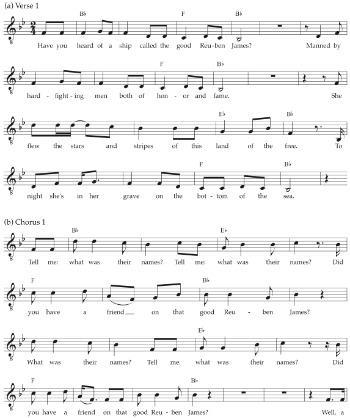
[2.1] “The Sinking of the Reuben James” (AR) exemplifies many of the phrase-structural and hypermetrical challenges posed by Guthrie’s music. The first verse and chorus of “Reuben James” are transcribed in Example 1. While the
[2.2] The inconsistent phrase structure of “Reuben James” is reflected in the dynamic hypermetrical attending it demands. In this song, as in most of Guthrie’s music, the initial downbeats of phrases (excluding anacruses) are hypermetrical beginnings, which means that the phrase-structural irregularity involves hypermetrical manipulations.(10) Phrase lengths and hypermeasures grow and shrink over the course of the song. At issue is orientation—the sense that a given moment is a hypermetrical beginning, middle, or end. A given postcadential measure could be a hypermetrical ending (if the next phrase begins in the following measure), or a listener may need to wait another measure or two for the hypermeasure to conclude. Additionally, although cadences arrive right on time, inconsistency manifests saliently with respect to their hypermetrical status. The relevant question is: Does a given cadence conclude a hypermeasure or initiate a new hypermeasure? Put differently, is a given cadence hypermetrically weak or strong? More generally, we can ask: What sorts of phrase-structural and hypermetrical patterns occur within and between Guthrie’s songs, orienting our experience? There is no single phrase length that governs “Reuben James”; rather, it demonstrates multiple patterns that recur throughout Guthrie’s output. These patterns enable us to develop expectations of what will happen, and they allow us to organize the downbeats we have already heard into hypermetrical frameworks. In this section, I adapt John Paul Ito’s (2013) schema-based work on metrical orientation, which offers a vocabulary to contend with these questions. First, it is worth outlining what factors lead me to consider a particular unit of time to be a “measure.”
Heard Measures
[2.3] In his work on hypermeter, Ito attends to a single salient pulse layer, and I do the same here. Ito (2013, 60) calls these pulses heard downbeats, which mark the boundaries of heard measures. This is a departure from much (hyper)metrical analysis that takes either the tactus or the notated measure as its foundation. In fact, heard measures may interact with the tactus in a number of ways. Ito (2013, 61) writes that heard measures typically contain between one and four tactus pulses, but it is possible for them to contain six or more.(11)
[2.4] I propose that for Guthrie’s music, heard measures correspond with what Stefan Caris Love (2016) calls the hypermetrical floor: the “uppermost level of the metrical hierarchy which is persistently regular” (147).(12) This pulse layer might be grouped inconsistently, but the layer itself remains constant. When Guthrie adds time to clear his throat or think of the next words (as he describes in this article’s epigraph), it is typically in units of this pulse layer. Love’s goals are different from mine, as he aims to reconstruct eighteenth-century chamber music practices; due to this differing context, two caveats must be applied when considering Guthrie’s music. First, Guthrie’s hypermetrical floors are not always persistently regular, though in most songs they are. Irregularities at this level appear most commonly in his talking blues songs, as well as songs that thematize mid-phrase expansions.(13) Second, a small number of Guthrie’s recordings do not strongly project a pulse layer above the tactus. Such recordings do not readily lend themselves to hypermetrical analysis.(14)
[2.5] The concept of heard measures fills in gaps left by prior hypermetrical analyses of American folk, folk revival, and early country music. Much work that addresses this repertoire (Neal 2000, 2002; Stoia 2013, 2021; Murphy 2025) focuses on a single pulse layer—the downbeats of notated measures—but the rationale for barline placement in transcriptions is left underdefined. In their work on early country music, Jocelyn Neal (2000, 138n5) and Nicholas Stoia (2013, 200), determine downbeats by assuming the prototypicality of four-measure phrases and hypermeasures. Heard measures, considered in tandem with the hypermetrical floor, introduce a bottom-up complement to Neal’s and Stoia’s work. This is useful for music like Guthrie’s in which four-measure phrases are not necessarily normative. In all of this article’s transcriptions, barlines separate heard measures. For consistency, duple meter (including what might be conceptualized as quadruple meter) is realized as
[2.6] In contrast to the approach advanced here, Nancy Murphy’s (2022, 2023) work on folk revival music considers “any level above the tactus” (2022, 21n35) to be hypermetrical. Treating (hyper)meter as “a symmetrical hierarchy of metrical accent” offers multileveled richness but loses the ability to clearly express orientation (Ito 2013, 57). Murphy analyzes music in which meter itself recedes and re-emerges. In such music, it is analytically rewarding to attend to multiple (hyper)metrical layers. However, for Guthrie’s music, in which meter is typically regular and clearly asserted, discussion of hypermetrical orientation is facilitated by attending primarily to heard downbeats.
Metrical Orientation
[2.7] Following Ito, hypermeter is the “metrical organization of heard downbeats,” untethering hypermeter from notation (2013, 63). The organization of these downbeats offers orientation because each hypermeasure has a sense of beginning, middle, and ending. To model this sense of orientation, Ito (2013, 49) notates hyperbeats as fractions, making each hyperbeat’s position within a larger unit explicit.(15) For instance, “2/4” indicates the second hyperbeat of a four-bar hypermeasure. In this article, all denominators are 2, 3, 4, or x.(16) The integers model concrete expectations for the length of a hypermeasure. By proposing “x” as a possible denominator, I extend Ito’s theory to include fuzzy or flexible expectations for hypermeter duration. Such hypermeasures are most often two or three measures long.
Example 2. “Reuben James” (AR), chorus 1, phrases 3 and 4: three hypermetrical interpretations
(click to enlarge and listen)
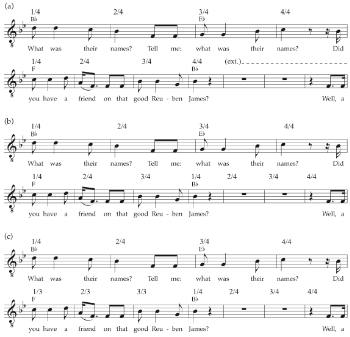
[2.8] Adapting Ito’s notation, Example 2 offers three hypermetrical interpretations of the final two phrases of Example 1(b). In Example 2(a), the final phrase is treated as an extended four-measure phrase, so that the fourth hyperbeat is extended while the melodic motion is arrested. At the final cadence of Example 2(b), the expected fourth hyperbeat is omitted, with this cadence instead initiating a new four-bar hypermeasure. If the hypermeasure had not been interrupted, measure 4/4 would coincide with the cadence (as it does in phrase 2 of Example 1[b]). Example 2(c) is similar to Example 2(b), but no hypermetrical manipulation occurs. Rather, a complete three-bar hypermeasure ends before the cadence, followed by the beginning of a new hypermeasure. This means that this phrase’s third hyperbeat is weak in Example 2(c), while it carries a hypermetrical accent in Example 2(b). The nature of the final cadence is at stake: Is it a prolonged hypermetrical ending, an interrupting hypermetrical beginning, or a beginning that comes right on time? Guthrie’s self-expressive, individualistic persona is audible in passages like these—prospectively, a field of hypermetrical manipulations await actualization, and retrospectively, ambiguity often remains between plausible interpretations.
[2.9] When deciding between these interpretations (or explaining one’s own interpretation), there are bottom-up and top-down considerations. Lerdahl and Jackendoff’s (1983) metrical preference rules (MPRs) “work ‘bottom-up’ and cue single events as strong” (Mirka 2021, 281).(17) Most relevant to Example 2 is MPR 5, the preference for metrical strength at the beginning of relatively long events (Lerdahl and Jackendoff 1983, 84). Examples 2(b) and 2(c) accord with MPR 5: the final cadence, which introduces a long melodic note and an extended new harmony, initiates a hypermeasure.
[2.10] Top-down considerations, on the other hand, are schematic. They rely on familiar patterns, rather than moment-to-moment cues of (hyper)metrical strength.(18) In this article, I focus on schemas that wed phrase-structural patterns to hypermetrical structures (three schemas are discussed in the next section). Example 2(a) models a hearing in which a sticky four-measure schema persists through the extended melodic cadence. This four-measure schema is contextually established by the first three phrases of the chorus. Similarly, in Example 2(b), the four-measure schema is in effect until it is interrupted by the cadence. Example 2(c) differs from the other interpretations in that it introduces a new schema in the final phrase. In this new schema, a phrase contains two hypermeasures: a three-bar hypermeasure leading to a (post)cadential hypermeasure.
[2.11] There are multiple sources for tension and conflict among these considerations. Conflict can occur between different schemas that can plausibly be applied to the same passage, as can be found between the interpretations in Example 2. Examples 2(a) and 2(b) continue to apply the schema that has been established throughout the chorus; Example 2(c) applies a new schema to the final phrase, so that no extension or interruption is required. Conflict can also exist between schemas and bottom-up considerations. Example 2(a) privileges the four-measure phrase prototype, and this consideration overrides the cadence’s MPR 5 cues. Example 2(b) favors the same prototype, but this model is interrupted rather than sustained in response to the cadence’s hypermetrical cues. Additionally, schemas can exist in tension with the inertia of sustained hypermetrical patterns. Example 2(c), for instance, breaks the chorus’s hypermetrical regularity, introducing a new schema.
[2.12] Although bottom-up cues and schematic considerations may conflict, in this article, I maintain that hypermetrical interpretations must correspond with strong hypermetrical cues. This leads me to disqualify interpretations such as Example 2(a). While the phrase structure may be adequately explained as a four-measure phrase with a postcadential extension, the cadence is hypermetrically accented, meaning that it is not a weak 4/4 hyperbeat. This is not to discount the possibility for multiple interpretations in certain cases—Examples 2(b) and 2(c) are cases in point. But in this article, “hypermeter” relates to hypermeter-as-experienced; hypermeter is not subsumed by phrase structure.(19)
[2.13] Two questions are relevant throughout: First, is a given hypermeasure the expected length, abbreviated, or extended? Second, is a given moment a hypermetrical beginning, middle, or end? The second question is especially significant with respect to cadences.
3. Phrase Rhythm Schemas
[3.1] To address these considerations—a hypermeasure’s actual duration versus expectation and a melodic cadence’s hypermetrical strength—I turn to phrase rhythm. Following William Rothstein (1989, 11–13), I employ the term “phrase rhythm” to synthesize concerns related to hypermeter and phrase structure. Here, I introduce three phrase rhythm schemas, which are abstract representations of phrase structure that carry hypermetrical implications. Each schema’s label entails two factors for a given phrase, following Ken Stephenson (2002): the durations of melodic motion and melodic rest. After introducing the three schemas, I address their relationship to formal function.
[3.2] The schemas I introduce share conceptual grounding with the “schemes” that Stoia (2013, 2021) proposes for related repertoire. Both abstractly represent common musical structures while considering cognitive modeling. However, there are three key differences between my schemas and Stoia’s schemes. First, Stoia’s schemes involve melody, harmony, rhythm, and lyrics, while my schemas solely address phrase rhythm. Second, Stoia’s schemes represent complete sections, while my schemas involve phrase-level patterns. In this way, schemes and phrase rhythm schemas can complement one another. Third, Stoia’s schemes almost exclusively assume a four-measure phrase prototype, while not all of my schemas do. In my discussion of the 3+x schema below, I explain why I do not uniformly assume a four-measure background for all of Guthrie’s phrases.
[3.3] Phrase rhythm schemas are potential conceptual background structures for a given musical phrase, representing patterns that Guthrie’s music commonly expresses. But the schemas need not be literally realized to affect the listening experience. They can be prospectively applied, generating a phrase-rhythmic expectation that may or may not be realized. They may also be applied retrospectively, as they comprise a repertoire of templates that can be applied following music that proceeds unexpectedly. The music may vary a particular schema while still invoking it, so that the music is understood as a deviation from this pattern. And the music may exist in the gray area between two schemas, so that the tension between them is itself meaningful.
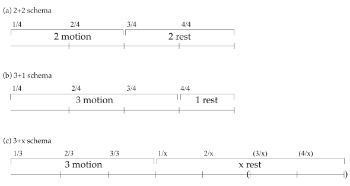
[3.4] In my presentation of these schemas, I do not seek to universalize. Listeners come to Guthrie’s music with varying amounts of familiarity with his music, the mid-century folk style more generally, and other styles of music; further, there are many ways to engage with his music, even when a degree of expertise is shared.(20) Rather, I simply observe that certain phrase-structural patterns—which can be abstractly represented as schemas—appear frequently in Guthrie’s music, and that they carry relatively consistent hypermetrical implications. Even when Guthrie’s music presents unclear hypermetrical situations, one or more of these patterns can be usefully put in dialogue with the music to understand it. For clarity of presentation, in this section, I present unambiguous instances of each schema, saving cases that are ambiguous or invite divergent interpretations for the case studies. Example 3 abstractly represents the phase structure and hypermeter of the three phrase rhythm schemas that will be introduced.
Example 3. Abstract representation of the three phrase rhythm schemas
(click to enlarge) |
The 2+2 Schema
Example 4. “Blowin’ Down This Road (I Ain’t Going to Be Treated This Way)” (DBB), verse 1, phrases 1 and 2: 2+2 schema
(click to enlarge and listen)
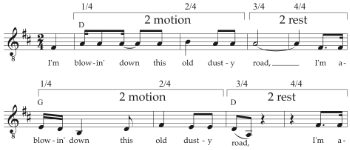
[3.5] The first two phrases of “Blowin’ Down This Road (I Ain’t Going to Be Treated This Way)” (DBB), shown in Example 4, each feature the 2+2 schema. In this schema, two measures of melodic motion are followed by two measures of melodic rest.(21) (In all discussion of these schemas, “measures” refers to heard measures.) Example 4 includes annotations to show the relevant spans. Melodic motion refers to the “period of rhythmic activity . . . from the beginning of a phrase to the attack time of its last (metrically accented) note” (Stephenson 2002, 2). In “Blowin’ Down This Road,” as in many songs, some degree of normalization is required. The period of melodic motion excludes the anacruses at the beginning of each phrase, so that it measures the span between two downbeats. Some songs require other sorts of adjustments, such the omission of post-downbeat phrase-endings and the normalization of anticipatory syncopations (Temperley 2018, 73). Melodic rest “lasts from the attack time of the last note of one phrase to the beginning of the next phrase” (Stephenson 2002, 2). This includes a held melodic note and rest; the precise point at which the voice cuts off is not relevant to this measurement. In this article, the schema labels correspond to phrase structure not hypermeter (although they carry consistent hypermetrical implications); the plus sign is placed between the durations of melodic motion and rest.
[3.6] The 2+2 schema is consistently aligned with a four-bar hypermeasure, indicated by the fractions in Example 4. Both the phrase beginning and melodic cadence fall on positions of hypermetrical strength. The role of each hyperbeat can be schematized as initiation–continuation–conclusion–end-of-conclusion.(22)
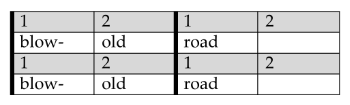
Example 5. “Blowin’ Down This Road (I Ain’t Going to Be Treated This Way)” (DBB), phrase rhythm of verse 1, phrases 1 and 2
(click to enlarge and listen)
[3.7] Example 5 adapts notation from Murphy 2020, showing only syllables that fall on hyperbeats to more efficiently display phrase structure and facilitate comparison. My use of this notation departs from Murphy’s, in that the numbers above each row of syllables correspond to the periods of melodic motion and rest, rather than hypermeter. Instead, I represent hypermeter by placing thick black lines before strong hyperbeats. For the purposes of this notation, “strong hyperbeats” are (1) those that initiate hypermeasures and (2) the third hyperbeats of four-bar hypermeasures.
The 3+1 Schema
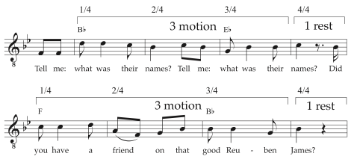
Example 6. “Reuben James” (AR), chorus 1, phrases 1 and 2: 3+1 schema
(click to enlarge and listen)
[3.8] The chorus of “Reuben James,” discussed in the previous section, begins with the 3+1 schema—three measures of melodic motion, followed by one measure of melodic rest.(23) In Example 6, the first two phrases of the chorus are annotated, showing the hypermeter and the periods of melodic motion and rest. Like the 2+2 schema, this four-measure schema consistently unfolds in phase with a four-bar hypermeasure. However, unlike the 2+2 schema, its melodic cadences fall on a position of hypermetrical weakness. (In this article, all four-bar hypermeasures alternate strong and weak beats; the 3+1 label corresponds only to phrase structure.) The roles of the four hyperbeats can be schematized as initiation–continuation–continuation–conclusion.
The 3+x Schema
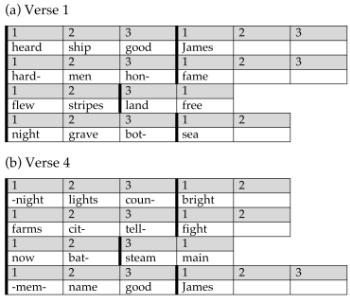
[3.9] The third and final phrase rhythm schema I introduce is the 3+x schema.(24) This schema features (1) a three-measure period of melodic motion, (2) a hypermetrically accented cadence, and (3) a period of melodic rest “x” of at least two measures. This third criterion ensures that the phrase’s second hypermeasure contains at least a strong–weak alternation of hyperbeats, and it distinguishes this schema’s phrase structure from that of the 3+1 schema. The verses of “Reuben James” primarily use this schema; Example 7 shows the first, second, and fourth phrases of verse 1. Each phrase’s first hypermeasure aligns with the three-measure period of melodic motion. For each phrase, the cadence initiates a new hypermeasure, given that the relatively long melodic note and new chords cue hypermetrical strength (MPR 5).(25) The flexible duration of each phrase’s second hypermeasure is indicated by the denominator “x,” corresponding with the inconsistent periods of melodic rest: 3, 3, and 2. Such inconsistency can occur between proximate phrases, as in Example 7, or it can occur between parallel phrases in different formal sections. The latter sort of inconsistency can be seen in Example 8, which models the phrase structure of verses 1 and 4. Between these verses, the two- and three-measure periods of melodic rest exchange places. In much of his output, as in “Reuben James,” Guthrie treats phrases with 3+2 and 3+3 (and occasionally 3+4) phrase structures as interchangeable, both between phrases and sections. This interchangeability in practice is the motivation for grouping these phrase rhythms within a single schema. In some cases, particular realizations of “x” emerge as normative. In the case studies below, I use the labels 3+2 and 3+3 when this occurs. I still consider these to be versions of the broader 3+x schema, rather than independent schemas.
Example 7. “Reuben James” (AR), verse 1, phrases 1, 2, and 4: 3+x schema
(click to enlarge and listen) | Example 8. “Reuben James” (AR), phrase rhythm of verses 1 and 4
(click to enlarge and listen) |
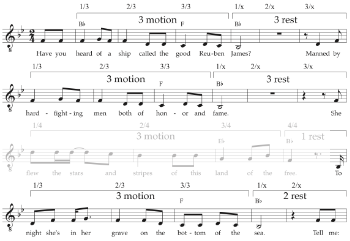
[3.10] It bears emphasizing that this schema requires a hypermetrically accented cadence. It is possible for phrases to have 3+2, 3+3, and 3+4 phrase structures but hypermetrically weak cadences—such phrases do not belong to this schema.(26) This means that the phrase structure alone cannot determine membership for the 3+x schema (as it can more reliably for the 2+2 and 3+1 schemas). Rather, membership depends in part on the hypermeter, which is driven by certain musical features, most often harmony, as in Example 7.
[3.11] I resist asserting that four-measure phrases are globally normative in Guthrie’s music because of this particular schema. Although Guthrie’s 3+x phrases can be reduced to a four-measure model by eliminating the requisite number of postcadential measures, it is not always useful to do so, especially when hypermeter is at stake. When considering phrase structure alone, one can plausibly interpret the 3+x schema as the 3+1 schema with a postcadential extension. However, such a claim either retreats from making a hypermetrical interpretation or unconvincingly implies that the fourth measure of the 3+x schema is hypermetrically weak. Because this article’s aims involve hypermeter, and because 3+x phrases with accented cadences are well-represented in Guthrie’s music, I untether the 3+x schema from the four-measure phrase prototype.
Schemas and Formal Function
[3.12] Most of Guthrie’s recorded songs exemplify one of two formal types: strophic (with or without a refrain) and, less commonly, verse-chorus. Here, I consider how Guthrie’s manipulation of hypermeter and phrase structure cues formal function.(27) Of course, numerous elements collaborate to provide formal orientation, but hypermeter and phrase structure are an important part of the broader picture. Here, I focus on three processes that are common in Guthrie’s music: (1) hypermetrically strong cadences that conclude sections, (2) 3+1 schemas in penultimate phrases of sections, and (3) phrase-rhythmic contrasts between verses and choruses.
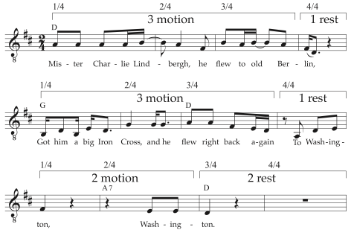
[3.13] Many authors have argued that end-accented phrases express closing function across many genres.(28) The same is true for Guthrie’s music—hypermetrically accented melodic cadences often provide conclusive punctuation to sections that are dominated by hypermetrically weak cadences. In some cases, a hypermetrical manipulation places a section’s final cadence on a hyperdownbeat. This is the case in the chorus of “Reuben James,” in which three 3+1 phrases are followed by a fourth phrase with a hypermetrically accented cadence (see Examples 2[b] and 2[c]). In other cases, Guthrie adjusts the phrase rhythm but not the hypermeter, so that the melodic cadence aligns differently with the unchanged hypermeter. In “Lindbergh” (AR), shown in Example 9, a 2+2 refrain follows the verse’s two 3+1 phrases. The four-measure hypermeter stays constant, but the final phrase is contracted, cadencing on the strong third hyperbeat instead of the weak fourth.(29)
Example 9. “Lindbergh” (AR), verse 1: two 3+1 phrases followed by an end-accented 2+2 refrain
(click to enlarge and listen) |
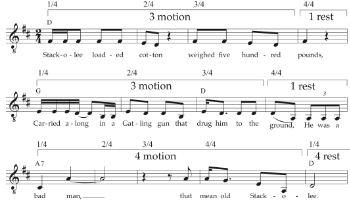
Example 10. “Stackolee” (AR), verse 2: two 3+1 phrases followed by an end-accented expanded phrase
(click to enlarge and listen)
[3.14] “Stackolee” (AR), shown in Example 10, is structured similarly. As in “Lindbergh,” the verses of “Stackolee” comprise two 3+1 phrases followed by an end-accented refrain.(30) In “Stackolee,” however, the refrain phrase is expanded, so that the melodic cadence falls on the downbeat of the following hypermeasure. Stephenson (2002, 9) calls this phrase rhythm the “extension-overlap” because the expanded melodic phrase overlaps with the next hypermeasure.(31) As in Example 9, the hypermeter is unchanged.
[3.15] The second process involves the use of 3+1 phrase rhythm for a given section’s second-to-last phrase. For brevity, I refer to this process as the penultimate 3+1. This can be observed in the verses of “Reuben James” (see Examples 1[a] and 8). The 3+1 phrases offer continuity, in that each hyperbeat receives a syllable, the cadences are hypermetrically weak, and the 3+1 phrases are shorter than the surrounding phrases. In these ways, they build toward the section’s concluding cadence.(32) The 3+x phrases punctuate each verse with longer periods of melodic rest and hypermetrically strong cadences.
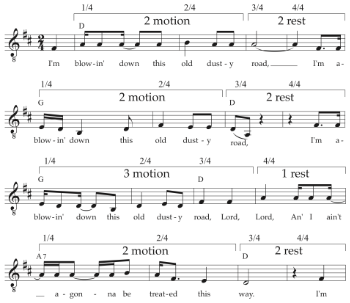
Example 11. “Blowin’ Down This Road (I Ain’t Going to Be Treated This Way)” (DBB), verse 1: 2+2 phrases with a penultimate 3+1
(click to enlarge and listen)
[3.16] As with the previous process, the penultimate 3+1 does not always involve a hypermetrical adjustment. “Blowin’ Down This Road (I Ain’t Going to Be Treated This Way)” (DBB) places a penultimate 3+1 in verses that are dominated by the 2+2 schema, shown in Example 11. Throughout, the hypermeter is static: the verse is entirely built from four-bar hypermeasures that alternate strong and weak measures. However, the penultimate phrase is more saturated by melodic motion, given that the filler words “Lord, Lord” push the melodic cadence to the fourth downbeat. Like in in “Reuben James,” this penultimate 3+1 phrase establishes melodic continuity, building momentum toward the phrase that concludes the verse.(33)
[3.17] Third, many of Guthrie’s verse-chorus songs involve phrase-rhythmic contrasts between sections. Again, this is the case in “Reuben James.” Its verses are largely built from the 3+x schema (with a penultimate 3+1), while its choruses are largely built from the 3+1 schema (with a hypermetrically strong final cadence). This phrase-rhythmic structure evokes David Temperley’s (2007) “loose verse/tight chorus” (LVTC) model, applied to the domains of rhythm and meter by Nicole Biamonte (2014).(34) In the LVTC model, choruses are more unified and stable than verses. In the verses of “Reuben James,” the 3+x phrases involve irregular, inconsistent periods of melodic rest; this tension resolves in the chorus, which features consistent 3+1 phrases and four-bar hypermeasures. The between-verse phrase-rhythmic inconsistency serves to intensify the looseness of the verses.(35)
4. Analytical Case Studies
[4.1] In the case studies that follow, I attend to phrase structure and hypermeter, putting these musical parameters in dialogue with issues of broader context: the history of the tunes and the context of the lyrics. Musical considerations contribute to Guthrie’s persona-construction, they inflect the meaning of his words, and they authenticate him to his audiences.
[4.2] In my analysis of “I Ain’t Got No Home,” I interpret Guthrie’s phrase-rhythmic inconsistency (relative to the song’s precedents) to reflect individualism, just as his transformed lyrics serve as an intervention in his community. Returning to “Reuben James,” I observe that the phrase rhythm of his AR recording is unusually irregular, compared with the song’s precedents and subsequent recordings. In this phrase-rhythmic irregularity and inconsistency, I identify an aesthetic of roughness, which involves value ascribed to imperfection. In “Pastures of Plenty,” phrase structure and hypermeter are inconsistent between verses. Finding that the structures of multiple (previous) verses infuse the hearing of any single verse, I associate this multiplicity and transformation with Guthrie’s multifaceted, developing values and personae. Finally, I consider the storytelling role of hypermetrical (in)stability in “1913 Massacre.” In this song, ambiguity foreshadows the tragedy, while hypermetrical dissonance and contracted phrase structures depict the event.
[4.3] To discuss authenticity, I use Allan Moore’s (2002, 2012) tripartite typology of authenticity: (1) first person authenticity is the sense that Guthrie’s music aligns with his personal values, (2) second person authenticity is the sense that Guthrie represents the listener’s community, and (3) third person authenticity is the sense that Guthrie faithfully draws on another group’s musical practice. Authenticity and its relation to phrase rhythm are discussed more generally following the case studies, but a few points are worth drawing out here. Each type of authenticity suggests a sort of persona: individualist, community member, and cultural other, respectively. Additionally, authenticity is relational, as it emerges from his music meeting audiences. This meaning is not purely generated by the reactions of audiences, but also from Guthrie’s strategic performance decisions with audiences in mind. Finally, the audience in question matters. While Guthrie could frame himself as a peer to his rural California audience, he was marked as other by urban New Yorkers. In these case studies, such considerations—what sort of persona is being built and for whom—imbue the discussion of phrase-rhythmic structure with meaning.
“I Ain’t Got No Home”: New Words, New Phrase Rhythm
I made up new words to old tunes and sung them everywhere I’d go. (W. Guthrie 1943, 231)
[4.4] In 1938, Guthrie wrote the lyrics to “I Ain’t Got No Home,” which would become one of his most well-known songs. He set new lyrics to the tune of “Can’t Feel at Home in this World Anymore,” a gospel song made popular by the Carter Family’s recording. When visiting camps of Dust Bowl migrants in California, Guthrie was dismayed by the popularity of the hymn—the hymn’s lyrics advocate for dealing with hardship by looking beyond this world, rather than seeking change (Cray 2004, 123): “This world is not my home, I’m just a passing through / My treasures are laid up somewhere beyond the blue.”(36)
[4.5] Guthrie’s rewrite addresses the literal homelessness faced by many agricultural workers at the time, pointing a finger at structural sources of economic inequality. His vivid articulation of earthly hardship and class division is especially clear in verse 2 of the DBB recording:
My brothers and my sisters are stranded on this road,
A hot and dusty road that a million feet have trod;
Rich man took my home and drove me from my door And I ain't got no home in this world anymore.
[4.6] In what follows, I consider the subtle hypermetrical and phrase-structural differences between the notated hymn, the Carter Family recording, and Guthrie’s two recordings. It is apt to put the Carter Family’s recording in dialogue with Guthrie’s not only because of the former’s general popularity, but also in light of Guthrie’s deep familiarity with the Carter Family’s recordings (Guthrie learned guitar by playing along with Carter Family records [Kaufman 2019, 116]). I then relate Guthrie’s phrase-rhythmic irregularities to the perceived individualistic alignment between his values and music.
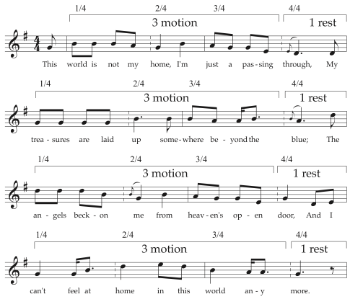
Example 12. “This World is Not My Home,” arr. Albert E. Brumley (adapted from Winsett 1947)
(click to enlarge)
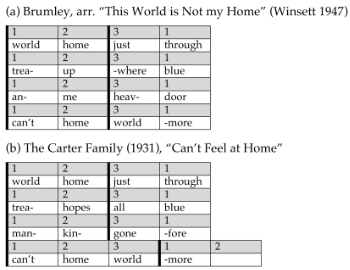
[4.7] Albert E. Brumley’s arrangement of the gospel tune is featured in many hymnals; the melody of this arrangement is reproduced in Example 12. The dashed barlines in Example 12 facilitate comparison with the Carter Family’s and Guthrie’s recordings, given that a two-quarter-note duration serves as the hypermetrical floor of these recordings. Put more simply, these dashed barlines show heard measures across all versions of the song discussed here. The verse of Brumley’s arrangement is exclusively made up of 3+1 phrases (counting heard measures), and it is followed by a chorus (not shown) with the same consistent phrase rhythm. The Carter Family’s 1931 recording is different in two ways: it is strophic, as the chorus is omitted, and an extra heard measure of melodic rest is added after each verse. Thus, the fourth phrase of each verse invokes a new, consistent phrase rhythm—the 3+2—unambiguously lending hypermetrical strength to the melodic cadence, supported by the V–I harmonic motion. The phrase structure of each version of “Can’t Feel at Home” is represented in Example 13.(37)
Example 13. Phrase rhythm of Brumley, arr. “This World is Not my Home” (Winsett 1947) and The Carter Family (1931), “Can’t Feel at Home” [AB: Missing Audio 13a?]
(click to enlarge and listen) |
Example 14. “I Ain’t Got No Home” (LOC), phrase rhythm of verse 1
(click to enlarge and listen)
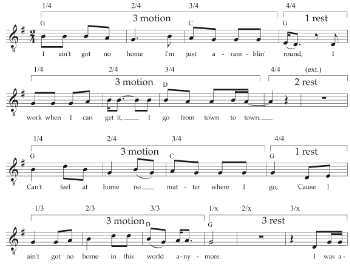
[4.8] Guthrie’s two recordings (LOC and DBB, recorded in 1940 and 1944, respectively) are also strophic, and the phrase-rhythmic changes from the Carter Family version are subtle. Verse 1 of his LOC recording is transcribed in Example 14. Odd-numbered phrases retain their 3+1 structure, but even-numbered phrases are performed less consistently between verses. The final phrase of each verse retains the Carter Family’s hypermetrically strong cadence. However, in Guthrie’s recordings, the period of melodic rest is inconsistent, with two to four measures of melodic rest leading into the following verse or an instrumental interlude. The second phrase, however, does not clearly invoke any single phrase rhythm schema. In the six verses of the LOC recording, its periods of melodic rest are 2, 2, 2, 3, 3, 2; on DBB, the periods of melodic rest are 1, 2, 3, 3. In my analysis, I place this phrase in dialogue with the 3+1 schema, rather than the 3+x. Although its inconsistent length of melodic rest may seem to suggest the 3+x schema, the harmonic change in the phrase’s third measure renders the melodic cadence hypermetrically weak. For this reason, it is better described as a 3+1 phrase with a postcadential extension. It proceeds just as a prototypical 3+1 phrase does, with strong–weak–strong–weak hypermeter and a cadence on the fourth measure, with the simple addition of a one- or two-measure extension.
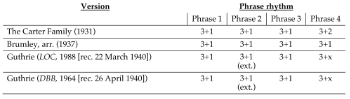
[4.9] Example 15 compiles the phrase rhythm schemas associated with each version. Within each verse, it can be seen that Guthrie’s phrase rhythm is more varied than the other recordings. More strikingly, Guthrie’s use of phrase extensions and the 3+x schema invites a greater degree of inconsistency between verses. For Brumley’s and the Carter Family’s arrangements, any one verse can serve as a model to accurately predict the phrase structure of any other verse. However, even listeners familiar with Guthrie’s recordings may struggle to predict the durations of melodic rest for phrases 2 and 4.
Example 15. Phrase rhythm of “I Ain’t Got No Home” and its precedents
(click to enlarge) |
[4.10] I argue that it is a mistake to simply attribute this sort of transformation to the folk tradition within which Guthrie was embedded (though this stylistic context matters a great deal). We can also understand it as an expression of Guthrie’s individualism—this performed individualism binds together the lyrical and phrase-rhythmic changes. The “this-world” complacency of the Carter Family rendition left Guthrie with “grating, pulsing anger” (Klein 1980, 117). Guthrie not only represented or portrayed the migrant community, but he took it upon himself to intervene in this community’s politics. Through lyrical changes that were often minimal, he inverted the message of the song. The Carter Family’s song of passive acceptance was transformed to become “an attack on inaction” (Klein 1980, 118). He would perform his lyrically altered version(s) on his radio show, “Woody and Lefty Lou,” to an audience largely made up of migrant and working-class listeners (Cray 2004, 123; Reuss 1970, 277). While phrase-rhythmic freedom is less politically incisive than a change in lyrics, Guthrie attributes his own temporal freedom to the same sort of willful individualism, expressed clearly in this article’s epigraph. The ethos of first person authenticity (Moore 2002)—the sense that his musical actions accord with his personal values—permeates his lyrics and his approach to musical time, as well as his comments on both. In his adjustments, he contradicted the political commitments shared by much of the community he represented, and he broke from the model established by the Carter Family’s landmark recording.
“Reuben James”: Guthrie's Bent-Up Flower
I’m glad to hear you say Mr. Einstein that my light ray does come back, a little bit bent up maybe, but better bent than to just not have no light ray at all. (W. Guthrie 1965, 193)
[4.11] In this case study, I return to “Reuben James.” I introduce two more of Guthrie’s recordings of the song, and I excavate the tune’s pre-Guthrie history. Situating Guthrie’s AR recording in a dense network of other versions of the song—both recordings and notated sheet music—I find that this particular recording is distinctive in its phrase-rhythmic inconsistency and hypermetrical instability. I close by connecting this “bent-up” recording to Guthrie’s personal aesthetic of roughness.
Example 16. The Carter Family (1929), “Wildwood Flower,” phrase rhythm of verse 1
(click to enlarge and listen)
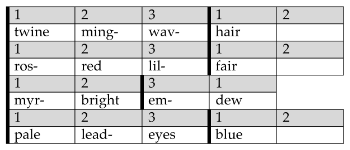
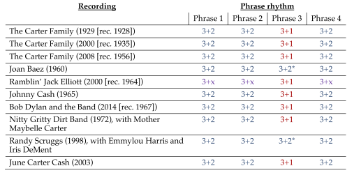
[4.12] For the verse of “Reuben James,” Guthrie borrowed the tune of “Wildwood Flower,” a love song commonly attributed to Joseph Philbrick Webster (alternately titled “I’ll Twine ‘Mid the Ringlets”). The Carter Family recorded “Wildwood Flower” in 1928; they employed 3+2 phrase rhythm with a penultimate 3+1, modeled in Example 16.(38) Two points are worth emphasizing here. First, except for the third phrase of each verse, melodic cadences receive hypermetrical accents. Second, the phrase-rhythmic pattern is consistent throughout the recording. Example 17 compiles a small corpus of subsequent recordings of “Wildwood Flower.”(39) For all but one recording in Example 17, 3+2 phrase rhythm dominates, and the penultimate 3+1 is present in all in some form. Two of these recordings (Baez 1960; Scruggs 1998) use the penultimate 3+1 only in instrumental interludes, while the sung verses are exclusively 3+2. Ramblin’ Jack Elliott’s recording is the lone exception in this corpus; his periods of melodic rest are inconsistent. This is meaningful, in that Elliott has been called “Guthrie’s most faithful disciple” (Kaufman 2011, xxii).
Example 17. Phrase rhythm of various recordings of “Wildwood Flower” (asterisks indicate phrases that are performed as 3+1 in instrumental interludes)
(click to enlarge) |
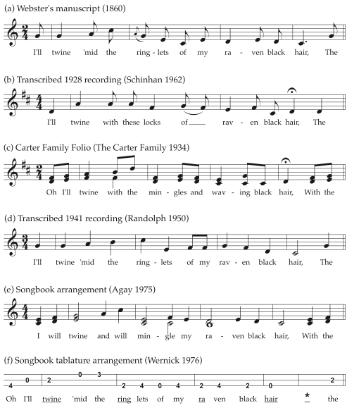
Example 18. Various notated renderings of “Wildwood Flower,” phrase 1
(click to enlarge)
[4.13] Example 18 summarizes the first phrase of various notated renderings of “Wildwood Flower.” The 3+1 schema is used throughout Webster’s manuscript (Example 18[a]), a transcription of an Ozark folk-song recording (Example 18[d]), and a 1975 arrangement by Denes Agay (Example 18[e]). Two versions (Examples 18[b] and 18[c]) place fermatas over certain melodic cadences.(40) Example 18(f) references the Carter Family in the surrounding prose. This transcription follows the Carter Family’s phrase structure, notating each second measure of melodic rest with an underlined asterisk. Any attempt to construct a linear narrative through these recordings and notated materials would oversimplify a situation that was complicated by various factors. The Carter Family often gained new repertoire by collecting sheet music (Rockwell 2011, 69). Additionally, notated music often responded to a specific recording, whether collected or commercial (McCulloh 1967, 235). Further, sheet music for public consumption was not meant to be descriptive—four-measure phrases were typically notated, and performers would render the tune crooked in stylistically appropriate ways (Rockwell 2011, 69). Even if this network of scores and recordings is tangled, the Carter Family recording clearly serves as a central node in this network. It the first commercial recording of the song, and the persistence of 3+2 phrase rhythm in subsequent recordings further suggests its status as an important touchstone.
[Example 18 approximately here][4.14] After the USS Reuben James was torpedoed by a German submarine in 1941, Guthrie and the Almanac Singers decided to write a song in commemoration. This reflected his recent ideological shift from isolationism toward nationalist support of war participation.(41) Guthrie wrote verses to the tune of “Wildwood Flower,” while fellow Almanac Singers Pete Seeger and Millard Lampell composed an original chorus (Guthrie is typically credited for writing the entire song; Klein 1980, 209–10). As previously discussed, the verses of Guthrie’s AR recording feature the 3+x schema with a penultimate 3+1. This retains the Carter Family’s hypermetrically strong cadences while introducing inconsistent periods of melodic rest. The choruses are more predictable, dominated by the 3+1 schema.
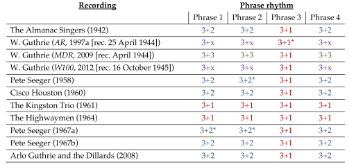
Example 19. Phrase rhythm of various recordings of “Reuben James” (asterisks indicate that one verse differs from the noted phrase rhythm)
(click to enlarge)
[4.15] It turns out that the inconsistency of Guthrie’s verses on AR is distinctive, set against three bodies of media: (1) the largely 3+2 recordings of “Wildwood Flower,” (2) the primarily 3+1 notated versions of the same song, and (3) subsequent recordings of “Reuben James.” Example 19 compiles the phrase rhythms of many recordings of “Reuben James” (the chorus is not included because all follow the model of AR). The only other recording that employs an inconsistent 3+x schema is from a 1945 radio show, recently released on Woody at 100 (W100). All others maintain consistency between verses. For some recordings, this consistency involves exclusive use of the 3+1 schema, aligning with the notated sheet music discussed in Example 18. For others, consistency is established by following the Carter Family’s model (3+2 phrase rhythm with a penultimate 3+1)—it is worth remarking that these include one recording involving Guthrie (the Almanac Singers) and multiple recordings by performers closely associated with Guthrie (Seeger, Houston, and Arlo Guthrie). One other recording should be singled out: a recently discovered second solo recording, released on My Dusty Road (MDR). In this recording, the 3+x schema is consistently realized as 3+3. With the Almanac Singers and on MDR, even Guthrie himself employed between-phrase and between-verse consistency.
[Example 19 approximately here][4.16] Guthrie’s AR and W100 recordings are anomalies in this network, even when considering other recordings of “Reuben James.” In AR and W100, he not only performs the tune crooked, but inconsistently so. This sort of crookedness is one plausible approach to realizing the fermatas in Example 18(c), though it is significant that the other performances discussed enact a consistent crookedness. Guthrie’s between-phrase freedom can be interpreted as offering first person authenticity (as in the previous analysis) and, relatedly, indexing self-expression (Murphy 2023, 14). But this inconsistent crookedness also corresponds with Guthrie’s personal aesthetic of roughness, given his stated preference for “songs that ain’t sung too good” (W. Guthrie 1967, 19) and self-identification as “Th’ Dustiest of th’ Dust Bowlers.” Will Kaufman writes that Guthrie’s quote about Einstein and light rays is “a good analogy for Guthrie on his own wanderings” (2019, 3). We can say the analogy works just as well with respect to Guthrie’s borrowed tunes—they come back, just a little bit bent up.
“Pastures of Plenty”: Rambling and Becoming
Sometimes I was lucky and found me a good job. I sung on the radio waves in Los Angeles, and I got a job from Uncle Samuel to come to the valley of the Columbia River and I made up and recorded twenty-six songs about the Grand Coulee Dam. (W. Guthrie 1943, 340–41)
[4.17] In 1941, Guthrie was commissioned by the Bonneville Power Administration—a federal agency—to produce a soundtrack for a film. This film would advocate for the prospect of generating public power from the Columbia River, a project that promised to create working-class jobs and lower electricity costs (Kaufman 2019, 60). “Pastures of Plenty” is one of the twenty-six songs that Guthrie composed for this film, depicting the American West as a place of hope for agricultural workers displaced by the Dust Bowl.(42) This song incorporates many of Guthrie’s familiar personae and values: his participation in propaganda is inseparable from the socialist sensibilities he solidified while living in New York; he sings from the perspective of a Dust Bowl refugee; and he embodies a depoliticized naïveté associated with urban imaginaries of the working class.
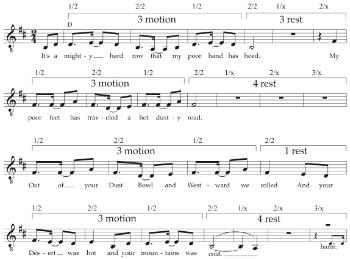
Example 20. “Pastures of Plenty” (CRC), verse 1
(click to enlarge and listen)
[4.18] In “Pastures of Plenty” (CRC), the phrase-rhythmic situation is as tangled up as the facets of selfhood he presents. Example 20 shows verse 1, which largely features three-measure periods of melodic motion followed by long melodic rest; the exception is a penultimate 3+1. Phrases 1, 2, and 4 are hypermetrically ambiguous: they can be plausibly interpreted either as beginning with strong–weak–strong–weak hypermeter, or as featuring hypermetrically accented cadences. However, there is greater musical support for the former interpretation, which is the one shown in Example 20. This reading accords with the motivic parallelism (between mm. 1–2 and mm. 3–4 of each phrase) and the relatively unstressed cadences in Guthrie’s singing. I call these phrases 3+1–3+x hybrids. Such phrases begin with the strong–weak–strong–weak hypermeter characteristic of the 3+1 schema, followed by a final hypermeasure (in this case the third hypermeasure) of inconsistent length, like in the 3+x schema. The 3+1–3+x hybrid is abstractly modeled in Example 21.(43) While I argue that this interpretation is preferable, ambiguity is built into the performance of this verse. Lines 1, 2, and 4 can be interpreted in dialogue with multiple schemas, and the unchanging D major guitar chord does not tip the scale.(44)
Example 21. Abstract representation of the 3+1–3+x hybrid
(click to enlarge) |

Example 22. “Pastures of Plenty” (CRC), phrase rhythm of verses 1, 3, and 4
(click to enlarge and listen)
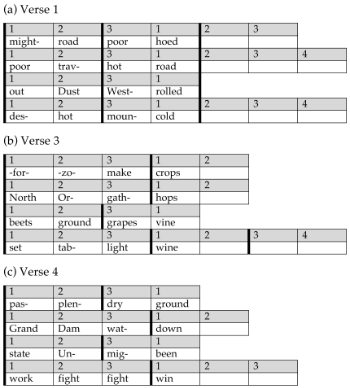
[4.19] Verse 3, modeled in Example 22(b), offers a greater degree of clarity. The first two phrases each feature two measures of melodic rest, shorter than the corresponding phrases of verse 1. Like in verse 1, these phrases are ambiguous, but two factors point toward the 3+x schema: (1) Guthrie sings each melodic cadence with a pronounced phenomenal accent, and (2) it is unlikely to hear two consecutive phrases ending with a single-hyperbeat unit.(45) Retrospective reinterpretation can occur in two phases: first, when the melodic cadence receives a phenomenal accent, and second, when the melodic rest is known to be shorter than previous verses. In the particular sense discussed by Janet Schmalfeldt (2011), the 3+1–3+x hybrid schema becomes the 3+x. Although the latter hypermetrical interpretation is the final one, it does not replace the prospective interpretation. Rather, the play between interpretations comprises an important part of the listening experience. In Schmalfeldt’s words, “The original perception still exists; . . . it has been overturned but at the same time preserved” (2011, 19).
[4.20] Verse 4, modeled in Example 22(c), features further shortened phrases. Both odd-numbered phrases feature the 3+1 schema, and the cadences of even-numbered phrases fall on positions of clear hypermetrical strength. Additionally, new V–I motion lends further hypermetrical weight to the final cadence. Here, the five-measure first phrase of verse 3 becomes one measure shorter in verse 4. In the first phrase of verse 4, then, the third hyperbeat is strong (not the fourth hyperbeat), resulting in a hypermetrically weak cadence. Each couplet concludes with a clear point of articulation—a strong melodic cadence—preceded by continuous motion building toward this point. Verse 5, the final verse, is identical to verse 4 in its periods of melodic motion and rest; it also concludes with a V–I motion.
Example 23. Phrase-rhythmic becoming in “Pastures of Plenty” (CRC)
(click to enlarge)
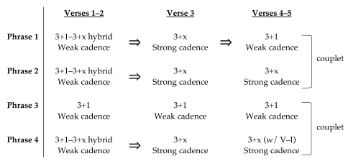
[4.21] Shown in Example 23, the recording undergoes a twofold becoming: from the 3+1–3+x hybrid to 3+x, and then to 3+1/3+x couplets. In Example 23, “becomes” is represented by a double-lined arrow (⇒), following Schmalfeldt (2011). Two processes unfold in lockstep: first, acceleration, with gradually shortened melodic rest; and second, increasing hypermetrical clarity, with harmony and phrase-length regularity presenting stronger hypermetrical cues. But this increased clarity does not constitute a replacement of what came before—this is reinterpretation with a sticky precedent. Hypermetrical becoming, understood in Schmalfeldt’s sense, resonates with Guthrie’s shifting but not discrete musical personae of hobo, Okie, and socialist activist (Reuss 1970). Certainly, his experience around displaced Dust Bowl refugees (if not as one of them) inflected his composition of “Pastures of Plenty,” as well as its reception to this day. But despite his stories of hitching around Washington to compose this album, he was in reality chauffeured around in a sleek modern car (Kaufman 2019, 58). His newfound privilege in New York established real-life distance from the working-class persona that he continued to present in his music. In one sense, his hitchhiking fantasy was a bald-faced lie; in another sense, it carries forward the echoes of a strain of past experience, partially imagined, but with lasting relevance.
“Take a trip with me in 1913”
I never did make up many songs about the cow trails or the moon skipping through the sky, but at first it was funny songs of what all’s wrong, and how it turned out good or bad. Then I got a little braver and made up songs telling what I thought was wrong and how to make it right, songs that said what everybody in that country was thinking. And this has held me ever since. (W. Guthrie 1943, 232)
[4.22] In “1913 Massacre” (AR), Guthrie tells an embellished version of a true story, the Italian Hall Disaster that took place in Calumet, Michigan.(46) In Guthrie’s rendering of this event, a Christmas party attended by striking copper miners and their families is tragically interrupted. From outside, an associate of the copper boss untruthfully yells, “There’s a fire,” and dozens of children are trampled in the commotion that ensues. Although the accuracy of Guthrie’s account can be (and has been) questioned, this song is a prime example of his ballad storytelling. Here, I explore how this storytelling is supported by phrase-structural and hypermetrical manipulations. Of the ten verses, no two have the same phrase-structural framework. In this analysis, I consider verses 1, 2, 5, 7, and 8. Ambiguous hypermeter foreshadows the tragedy; beginning in verse 5, terror is musically enacted by shortened periods of melodic rest and conflict between clear hypermetrical frameworks.
[4.23] Example 24 shows the melody and guitar bass-string downbeats of verse 1, and the phrase structure of this verse is modeled in Example 25(a). In each phrase, four syllables fall on hyperbeats. For the first three phrases, these syllables fall on consecutive hyperbeats, followed by extended melodic rest; the final phrase features an expansion after “miners,” so that the final cadence falls on a hyperdownbeat.(47) This shape—three phrases with extended melodic rest followed by an expanded, end-accented fourth phrase—persists for the remaining nine verses.
Example 24. “1913 Massacre” (AR), verse 1: melody and guitar bass-string downbeats
(click to enlarge and listen) | Example 25. “1913 Massacre” (AR), phrase rhythm of verses 1, 2, 5, 7, and 8 (yellow indicates the guitar’s hypermetrical cues)
(click to enlarge and listen) |
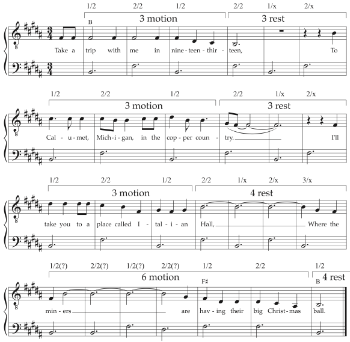
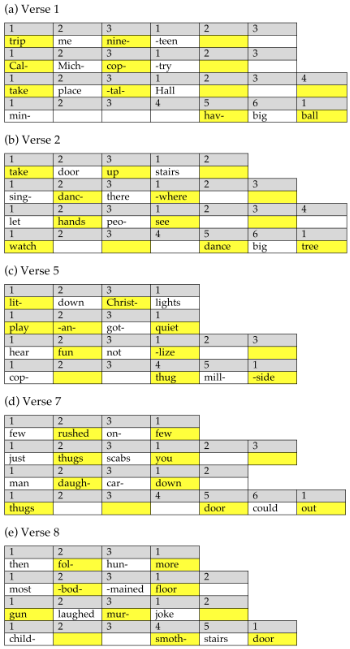
[4.24] The guitar strongly asserts duple hypermeter. In Example 25, yellow represents the guitar’s hypermetrical cues. These are (1) low notes in the bass-string low–high alternations and (2) onsets of harmonies that last for more than one measure.(48) This invokes the 3+1–3+x hybrid schema and its corresponding duple-hypermeter-then-wait mode of attending. In Example 24, the question marks reflect the guitar’s unclear hypermetrical cues during phrase 4. A listener might continue to project duple hypermeter in the absence of clear cues, or a listener might enter a “hypermetrical tunnel” (Ito 2013, 63), losing hypermetrical orientation altogether. In either case, hypermetrical clarity returns with the resumed melodic motion and chord change.
[4.25] Verse 2, however, undermines this schematic and hypermetrical clarity. Modeled in Example 25(b), this verse’s phrase structure is nearly identical to that of the first, with one important difference: the first period of melodic rest is one measure shorter. However, the guitar continues to project two-measure hypermetrical units, not realigning with the sung melody. The melody alone does not project a clear hypermeter, in light of two factors. First, considering the melody itself, the 3+x and the 3+1–3+x hybrid schemas are both possible, and these schemas carry contrasting hypermetrical implications. Second, the inconsistent periods of rest do not permit listeners to develop clear predictions regarding the timespan between phrases. As a result, the guitar takes the lead in determining the hypermeter, so that the first phrase is odd-measure strong, while the next two phrases are even-measure strong. This means that the guitar carries the listener away from the familiar territory of the phrase rhythm schemas discussed so far.
[4.26] Verses 5–8 depart from the prior verses in two meaningful, related ways. This can be observed with reference to Examples 25(c), 25(d), and 25(e). First, periods of melodic rest are generally shortened, creating a sense of acceleration that reflects the urgency in the lyrics. Second, the 3+1 schema is introduced. Unlike phrases with extended melodic rest, phrases with a 3+1 structure carry clear hypermetrical implications—here, the melody is able to contend with, rather than merely be contextualized by, the hypermetrical cues of the guitar.
[4.27] In verse 5 (Example 25[c]), the first two phrases present a 3+1 schema. In the first phrase, the guitar supports the typical strong–weak–strong–weak hypermeter of this schema. In the second measure of phrase 2, the guitar’s chord change causes the hypermetrical cues to fall out of phase. The guitar shifts so that it accents the even-numbered measures, while the 3+1 melody continues to accent odd-numbered measures. This hypermetrical displacement dissonance (Krebs 1999) also occurs in the first phrase of verses 7 and 8, shown in Examples 25(d) and 25(e). In these passages, hypermetrical tension is inherent. Conflicting cues offer multiple modes of engagement between hearings, and they compete for primacy within a single hearing.
Example 26. “1913 Massacre” (AR): textual narrative and hypermetrical/phrase-rhythmic trajectory
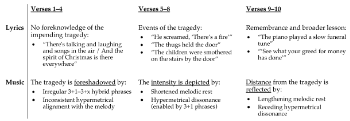
(click to enlarge)
[4.28] Example 26 tracks the narrative of the lyrics, associating this narrative with the recording’s hypermetrical and phrase-rhythmic trajectories. The first four verses describe only a joyful Christmas party, making no mention of the impending tragedy. However, the music foreshadows the events to come, as the phrases align with the hypermeter inconsistently. While the phrase structure is roughly predictable, it is not tethered to its usual hypermetrical implications—phrase-rhythmic schematic knowledge is consistently overridden by the guitar’s insistent hypermetrical cues. In verse 5, the “copper boss’s thug men” are introduced, and the events leading up to the deaths are told through verse 8. The shortened periods of melodic rest depict the panic, and (in the case of the 3+1 schema) they enable hypermetrical dissonance. In verses 9 and 10, the phrases lengthen, and attention turns to the aftermath of the tragedy.
[4.29] Guthrie believed “it was more artful and effective to show than tell,” deriding the sort of songwriting that might be called “agitprop exhortation” (Klein 1980, 208). He would much rather dramatize corporate greed than explicitly ask listeners to unionize. As Daniel Wolff writes, the song’s last line “could be Guthrie stepping out of history to explain the story he’s just told, to draw a conclusion. . . . ‘See what your greed for money has done.’ And, he implies, is still doing” (2017, 228). But to tell this story—to make his lesson land—Guthrie resorts to musical means that were, for him, unconventional. As he sells his version of this contested story, his usually reliable phrase rhythm schemas are fractured, with phrase structures divorced from their typical hypermetrical implications. He does more than tell, but he also does more than show. His performance invites a particular mode of participation in the unfolding drama, namely, disorienting hypermetrical attending.
5. Authenticity: Meaning for Whom?
You can’t fake it, and if you try to fake it, you don’t fool anybody except yourself.
(W. Guthrie 1967, 15)
[5.1] Throughout these analytical vignettes, I have considered various ways that Guthrie’s hypermeter and phrase rhythm is meaningful—in terms of individualism, roughness, mutability, and storytelling—in ways that contribute to his musical persona. Here, I briefly consider in more detail how these meanings are shaded differently with respect to different sorts of audiences. The question of “for whom” is relevant to Guthrie because he calibrated his musical performance (selection of repertoire and version of lyrics) and general self-presentation to particular situations and audiences (Reuss 1970, 292). Discourse surrounding the topic of authenticity offers a way into this consideration. If authenticity is “ascribed not inscribed” (Moore 2012, 210), how did Guthrie perform hypermeter so that his audience would ascribe authenticity? Or, how did his standard approach to hypermeter authenticate him to his various audiences?
[5.2] Most of Guthrie’s recordings were made in the early 1940s, which comprised a transitional period in his life. He moved from California to New York in 1940, and his audience shifted from Dust Bowl refugees to urban leftists (Reuss 1970, 278). Before his move, for the working-class and migrant listeners of “Woody and Lefty Lou” in the 1930s, crookedness meant he was “one of us.” It was not only Guthrie himself who was authenticated by his audience, but his audience’s experience was also authenticated by his performance. This second person authenticity—the sense that his music “articulate[d] on their behalf ‘this is what it is like to be you’” (Moore 2012, 269)—offered belonging and familiarity for a geographically displaced audience. Although a “minority” of radio listeners “would see through Guthrie’s quickly developing ‘Okie’ persona” (Kaufman 2011, 6), an impressive amount of positive fan mail affirmed that he was “part of the family” (Wolff 2017, 75).
[5.3] Wolff notes that such authenticity came from the intentional construction of his persona, one that involves a particular approach to timing (whether spoken or sung):
Guthrie hadn’t come west that way, but he was singing for an audience that had. He didn’t consider himself an Okie—his father’s former wealth made him “a little bit different”—but he sounded like one. And if he drew out the accent and lengthened the pauses, he became the ultimate Okie, larger than life. (Wolff 2017, 77–78)
Guthrie’s authentication of himself and his radio audiences, then, was grounded in a persona-construction that involved successfully absorbing (and possibly exaggerating) a musical style, crookedness and all. Further, it was a persona that Guthrie deployed strategically and selectively. Sometimes, he referred to Okie struggles as “ours,” but at other moments presented himself as an observer.(49)
[5.4] In New York, he became “one of them” to leftists and enthusiastic folklorists. In the words of John Steinbeck, author of The Grapes of Wrath, “He sings the songs of a people and I suspect that he is, in a way, that people” (1967, 9). Richard Reuss writes that leftists “were so imbued with the spirit of proletarian romanticism that a natural tendency developed to drape Woody in the venerable garb of the Noble Savage stereotype” (1970, 278–80). He seemed to be the sort of resistant everyman worker they had only read about in books—that they hoped actually existed. Folklorist Alan Lomax, who facilitated Guthrie’s LOC recordings, was similarly taken. Kaufman writes, “In his caricature of the Okie rube, Guthrie seems to be deliberately playing upon Lomax’s adulation for his most stunning discovery” (2011, 39–40).(50) Guthrie was more than happy to play into this ascribed third person authenticity, “the impression of accurately representing the ideas of another, embedded within a tradition of performance” (Moore 2002, 218). He would renounce authorship of his songs so that they could more fully represent “the people,” and he would downplay his intelligence and sophistication (Cray 2004, 170).(51) Further, as he got settled in New York and was increasingly involved in leftist politics, he became distanced from his Okie persona. The invocation of this persona served primarily to authenticate an absent (partially imagined) other, rather than himself.
[5.5] Returning to the dance rehearsal story from this article’s opening, we can find Guthrie performing third person authenticity in his approach to phrase rhythm. When he says, “Well, I’m a folksinger,” this is no small detail. Prior to 1940, Guthrie self-identified as a hillbilly singer. “Folk” was an etic term, made available for his self-conception through his relationship with Lomax (Reuss 1970, 289–90). His resistance to conform to the needs of the dancers was tied up with his performance of otherness, adopting the language used by ethnographic scholars when they gazed upon “traditional” musicians. It is notable, though, that with the help of dancer Marjorie Mazia (his future wife), he was able to straighten out his rhythm (Kaufman 2011, 89)—another example of Guthrie calibrating his performance to his situation.
[5.6] Guthrie’s hypermetrical irregularity, then, communicates many things to different people, all associated with authenticity: he does what he wants (first person), his life is like the listener’s (second person), and he represents (imagined) cultural others (third person). Even as his hypermetrical performance practice likely stayed consistent, new meanings emerged from his interactions with new people. Additionally, as his self-conception and broader politics transformed, his crooked performance gained new meaning—meaning he could strategically leverage. The many meanings associated with his hypermetrical performance, then, offer a way into understanding the constructedness of his persona(e). This, in turn, helps to trace the many tangles associated with his life, as a figure who routinely contradicted himself; as the writer of a “hard-driving, truth-telling autobiography” (according to the subtitle) that is partially fictionalized; and as a writer of songs described as “long on truth and short on fact” (Greenway 1966, 28).
6. Conclusion
[6.1] In this article, I have outlined an approach for analyzing Woody Guthrie’s signature variety of crookedness—irregular, inconsistent periods of melodic rest. Drawing on Ito (2013) and Stephenson (2002), I considered hypermeter and phrase structure in tandem, proposing a series of phrase rhythm schemas that relate these two parameters. These schemas offer a vocabulary for discussing metrical orientation, and they serve as models that can be recognized, expected, manipulated, subverted, and combined.
[6.2] Using this vocabulary, I also considered Guthrie’s crookedness as embedded in a broader context. It is an aspect of his persona-formation, his self-authentication, and his storytelling. Guthrie’s performance of phrase rhythm is intimately tied to the circumstances that formed him, his own self-making, and the expectations of his audiences. In this way, phrase rhythm schemas not only accommodate musical analysis as such, but also the exploration of relationships—between text and music; between multiple performances; between multiple performers; between the actual music and a given listener’s schematic representations; between performer and audience; and between different audiences. Though not explored here, phrase rhythm schemas also offer a foundation to study the relationship between Guthrie and those he influenced because his followers also tend to perform with irregular and inconsistent hypermeter. Robert Zimmerman, still developing his nascent Bob Dylan persona, sought to emulate Guthrie’s style early in his career. In his copy of a Guthrie songbook, he highlighted Pete Seeger’s words: “Woody, like all American ballad singers, held out long notes in unexpected places. . . . Thus no two verses sounded alike. Extra beats were often added to measures” (Heylin 2011, 82).(52)
[6.3] Such schematic understanding can also help us to imagine Guthrie’s performances that can never be heard. His recorded corpus is small, and most of his songs were recorded only once or twice. Even still, knowledge of Guthrie’s flexible, schematic approach to phrase rhythm allows us to speculate beyond the few recordings that exist. It turns out that imagining unheard performances is one way that Nora Guthrie remembers her father: “The cast of Folksay [the dance production] is now holding rehearsals in heaven. And Woody is still singing the same song—differently” (2006).
Ryan H. Jones
Eastman School of Music
Department of Music Theory
26 Gibbs St
Rochester, NY 14604
rjones71@u.rochester.edu
Works Cited
Agay, Denes. 1975. Best Loved Songs of the American People. Doubleday.
BaileyShea, Matt. 2021. Lines and Lyrics: An Introduction to Poetry and Song. Yale University Press. https://doi.org/10.12987/9780300262735.
Biamonte, Nicole. 2014. “Formal Functions of Metric Dissonance in Rock Music.” Music Theory Online 20 (2). https://doi.org/10.30535/mto.20.2.1.
Brower, Candace. 1993. “Memory and the Perception of Rhythm.” Music Theory Spectrum 15 (1): 19–35. https://doi.org/10.2307/745907.
Caplin, William E. 1998. Classical Form: A Theory of Formal Functions for the Instrumental Music of Haydn, Mozart, and Beethoven. Oxford University Press. https://doi.org/10.1093/oso/9780195104806.001.0001.
The Carter Family. 1934. Album of Smokey Mountain Ballads. Southern Music Publishing.
Cray, Ed. 2004. Ramblin’ Man: The Life and Times of Woody Guthrie. W. W. Norton.
Frith, Simon. 1996. Performing Rites: Evaluating Popular Music. Oxford University Press. https://doi.org/10.1093/oso/9780198163329.001.0001.
Greenway, John. 1966. “Woody Guthrie: The Man, the Land, the Understanding.” The American West 3 (4): 24–30.
Guthrie, Nora. 2006. “Sophie Maslow and Woody Guthrie.” MR Online, June 11. https://mronline.org/2006/07/11/sophie-maslow-and-woody-guthrie/.
Guthrie, Woody. 1943. Bound for Glory. E. P. Dutton
—————. 1965. Born to Win. Edited by Robert Norton. Collier Books.
—————. 1967. Introduction to Hard Hitting Songs for Hard-Hit People, edited by Alan Lomax, Woody Guthrie, and Pete Seeger, 15–20. Oak Publications.
Heylin, Clinton. 2011. Behind the Shades: The 20th Anniversary Edition. Faber and Faber.
Ito, John Paul. 2013. “Hypermetrical Schemas, Metrical Orientation, and Cognitive-Linguistic Paradigms.” Journal of Music Theory 57 (1): 47–85. https://doi.org/10.1215/00222909-2017106.
Jackson, Mark Allan. 2007. Prophet Singer: The Voice and Vision of Woody Guthrie. University Press of Mississippi.
Kaufman, Will. 2011. Woody Guthrie, American Radical. University of Illinois Press.
—————. 2019. Mapping Woody Guthrie. University of Oklahoma Press.
Klein, Joe. 1980. Woody Guthrie: A Life. Alfred A. Knopf.
Krebs, Harald. 1999. Fantasy Pieces: Metrical Dissonance in the Music of Robert Schumann. Oxford University Press. https://doi.org/10.1093/acprof:oso/9780195116236.001.0001.
Lerdahl, Fred, and Ray Jackendoff. 1983. A Generative Theory of Tonal Music. The MIT Press.
Leventhal, Harold, and Marjorie Guthrie, eds. 1976. The Woody Guthrie Songbook. Grosset and Dunlap.
Logsdon, Guy. 1999. “Biblio/Discography.” In Hard Travelin’: The Life and Legacy of Woody Guthrie, ed. Robert Santelli and Emily Davidson, 181–243. Wesleyan University Press.
London, Justin. 2004. Hearing in Time: Psychological Aspects of Musical Meter. Oxford University Press.
Love, Stefan Caris. 2016. “Historical Hypermetrical Hearing: Uncertainty, Floors and Trapdoors.” Music Analysis 35 (2): 142–70. https://doi.org/10.1111/musa.12058.
McCulloh, Judith. 1967. “Hillbilly Records and Tune Transcriptions.” Western Folklore 26 (4): 225–44. https://doi.org/10.2307/1499326.
Mirka, Danuta. 2021. Hypermetric Manipulations in Haydn and Mozart: Chamber Music for Strings, 1787–1791. Oxford University Press. https://doi.org/10.1093/oso/9780197548905.001.0001.
Moore, Allan. 2002. “Authenticity as Authentication.” Popular Music 21 (2): 209–23. https://doi.org/10.1017/S0261143002002131.
—————. 2012. Song Means: Analyzing and Interpreting Recorded and Popular Song. Ashgate.
Murphy, Nancy. 2020. “Expressive Timing in Bob Dylan’s ‘With God on Our Side.” Music Analysis 39 (3): 387–413. https://doi.org/10.1111/musa.12151.
—————. 2022. “The Times are A-Changin’: Metric Flexibility and Text Expression in 1960s and 1970s Singer-Songwriter Music.” Music Theory Spectrum 44 (1): 17–40. https://doi.org/10.1093/mts/mtab017.
—————. 2023. Times A-Changin’: Flexible Meter as Self-Expression in Singer-Songwriter Music. Oxford University Press. https://doi.org/10.1093/oso/9780197635216.001.0001.
—————. 2025. “The Performed-Out Fermata from the 1920s to Bob Dylan.” Theory and Practice 49-50. https://tnp.mtsnys.org/vol49-50/murphy.
Neal, Jocelyn. 2000. “Songwriter’s Signature, Artist’s Imprint: The Metric Structure of a Country Song.” In Country Music Annual 2000, ed. Charles K. Wolfe and James E. Akenson, 112–40. University Press of Kentucky.
—————. 2002. “Song Structure Determinants: Poetic Narrative, Phrase Structure, and Hypermeter in the Music of Jimmie Rodgers.” PhD diss., University of Rochester.
Ng, Samuel. 2012. “Phrase Rhythm as Form in Classical Instrumental Music.” Music Theory Spectrum 34 (1): 51–77. https://doi.org/10.1525/mts.2012.34.1.51.
—————. 2021. “End-Accented Sentences: Towards a Theory of Phrase-Rhythmic Progression.” Music Theory Spectrum 43 (1): 43–73. https://doi.org/10.1093/mts/mtaa018.
—————. 2022. “Musical Eschatology in Contemporary Christian Worship Songs.” Music Theory Online 28 (4). https://doi.org/10.30535/mto.28.4.5.
Randolph, Vance, ed. 1950. Ozark Folksongs. Vol. 4, Religious Songs and Other Items. State Historical Society of Missouri.
Reuss, Richard A. 1970. “Woody Guthrie and His Folk Tradition.” The Journal of American Folklore 83 (329): 273–303. https://doi.org/10.2307/538806.
Rings, Steven. 2013. “A Foreign Sound to Your Ear: Bob Dylan Performs ‘It’s Alright, Ma (I’m Only Bleeding),’ 1964–2009.” Music Theory Online 19 (4). https://doi.org/10.30535/mto.19.4.3.
Rockwell, Joti. 2011. “Time on the Crooked Road: Isochrony, Meter, and Disruption in Old-Time Country and Bluegrass Music.” Ethnomusicology 55 (1): 55–76. https://doi.org/10.5406/ethnomusicology.55.1.0055.
Rosenblatt, Elizabeth L. 2019. “Copyright’s One-Way Racial Appropriation Ratchet.” UC Davis Law Review 53 (2): 591–662.
Rothstein, William. 1989. Phrase Rhythm in Tonal Music. Schirmer Books.
—————. 1995. “Beethoven with and without Kunstgepräng: Metrical Ambiguity Reconsidered.” In Beethoven Forum IV, ed. Christopher Reynolds, Lewis Lockwood, and James Webster, 165–93. University of Nebraska Press.
Schachter, Carl. 1980. “Rhythm and Linear Analysis: Durational Reduction.” In The Music Forum, Vol. 5, edited by Felix Salzer, 197–232. Columbia University Press.
—————. 1987. “Rhythm and Linear Analysis: Aspects of Meter.” In The Music Forum, Vol. 6, Part 1, edited by Felix Salzer, 1–59. Columbia University Press.
Schinhan, Jan Philip, ed. 1962. The Frank C. Brown Collection of North Carolina Folklore. Vol. 5, The Music of the Folksongs. Duke University Press.
Schmalfeldt, Janet. 2011. In the Process of Becoming: Analytic and Philosophical Perspectives on Form in Early Nineteenth-Century Music. Oxford University Press.
Seeger, Pete. 1958. Introduction to California to the New York Island: Being a Pocketfull of Brags, Blues, Bad Men Ballads, Love Songs, Okie Laments, and Children’s Catcalls, by Woody Guthrie, 3–4. Guthrie Children’s Trust Fund.
Steinbeck, John. 1967. Foreword to Hard Hitting Songs for Hard-Hit People, edited by Alan Lomax, Woody Guthrie, and Pete Seeger, 8–9. Oak Publications.
Stephenson, Ken. 2002. What to Listen for in Rock. Yale University Press. https://doi.org/10.12987/yale/9780300092394.001.0001.
Stoia, Nicholas. 2013. “The Common Stock of Schemes in Early Blues and Country Music.” Music Theory Spectrum 35 (2): 194–234. https://doi.org/10.1525/mts.2013.35.2.194.
—————. 2021. Sweet Thing: The History and Musical Structure of a Shared American Vernacular Form. Oxford University Press. https://doi.org/10.1093/oso/9780190881979.001.0001.
—————. 2026. “‘Stackolee’: A Floating Ballad Text.” Theory and Practice 51. https://tnp.mtsnys.org/vol51/stoia.
Stone, Alison. 2016. The Value of Popular Music: An Approach from Post-Kantian Aesthetics. Palgrave Macmillan.
Sullivan, James. 2023. “Extending the Parallel Multiple-Analysis Processor: Perceived Meter in Post-Tonal Music.” Music Theory Online 29 (1). https://doi.org/10.30535/mto.29.1.4.
Temperley, David. 2003. “End-Accented Phrases: An Analytical Exploration.” Journal of Music Theory 47 (1): 125–54. https://doi.org/10.1215/00222909-47-1-125.
—————. 2007. “The Melodic-Harmonic ‘Divorce’ in Rock.” Popular Music 26 (2): 323–42. https://doi.org/10.1017/S0261143007001249.
—————. 2018. The Musical Language of Rock. Oxford University Press. https://doi.org/10.1093/oso/9780190653774.001.0001.
Wernick, Peter. 1976. Bluegrass Songbook. Oak Publications.
Winsett, R. E., ed. 1947. Abiding Faith. R. E. Winsett.
Wolff, Daniel. 2017. Grown-Up Anger: The Connected Mysteries of Bob Dylan, Woody Guthrie, and the Calumet Massacre of 1913. HarperCollins.
Discography
Discography
The Almanac Singers. 1942. Dear Mr. President. Keynote 111.
Baez, Joan. 1960. Joan Baez. Vanguard VSD 2077.
The Carter Family. 1929. “Wildwood Flower” / “Forsaken Love.” Victor V-40000.
—————. 1931. “Can’t Feel at Home” / “When I’m Gone.” Victor 23569.
—————. 2000. Can the Circle Be Unbroken: Country Music’s First Family. Columbia/Legacy CK 65707.
—————. 2008. The Acme Sessions 1952/56. JSP Records JSP 4201.
Cash, Johnny. 1965. Johnny Cash Sings the Ballads of the True West. Columbia C2L 38.
Cash, June Carter. 2003. Wildwood Flower. Dualtone 80302-01142-2.
Dylan, Bob, and the Band. The Bootleg Series, Vol. 11: The Basement Tapes Complete. Columbia/Legacy 88875016122.
Elliott, Ramblin’ Jack. 2000. Best of the Vanguard Years. Vanguard VCD 79573.
Guthrie, Arlo, and the Dillards. 2008. Thirty-Two Cents: Postage Due. Rising Son Records RSR 1127.
Guthrie, Woody. 1964. Dust Bowl Ballads. RCA Victor LPV 502.
—————. 1987. Columbia River Collection. Rounder Records 1036.
—————. (1988). Library of Congress Recordings. Rounder Records 1041/2/3.
—————. 1997a. This Land is Your Land: The Asch Recordings, Vol. 1. Smithsonian Folkways SF 40100.
—————. 1997b. Muleskinner Blues: The Asch Recordings, Vol. 2. Smithsonian Folkways SF 40101.
—————. 1998. Hard Travelin’: The Asch Recordings, Vol. 3. Smithsonian Folkways SF 40102.
—————. 1999. Buffalo Skinners: The Asch Recordings, Vol. 4. Smithsonian Folkways SF 40103.
—————. 2009. My Dusty Road. Rounder Records 11661-1162-2.
—————. 2011. The Live Wire: Woody Guthrie in Concert 1949. Rounder Records 11661-1167-2.
—————. 2012. Woody at 100: The Woody Guthrie Centennial Collection. Smithsonian Folkways SF 40200.
The Highwaymen. 1964. Homecoming. United Artists Records UAL 6348.
Houston, Cisco. 1960. Cisco Houston Sings the Songs of Woody Guthrie. Vanguard VRS-9089.
The Kingston Trio. 1961. Close-Up. Capitol Records T 1642.
Nitty Gritty Dirt Band. 1972. Will the Circle Be Unbroken. United Artists Records UAS 9801.
Paley, Tom. 1953. Folk Songs from the South Appalachian Mountains. Elektra EKL-12.
Scruggs, Randy. 1998. Crown of Jewels. Reprise Records 9 46930-2.
Seeger, Pete. 1958. Gazette, Vol. 1. Folkways Records FN 2501.
—————. 1967a. Pete Seeger Sings Woody Guthrie. Folkways Records FTS 31002.
—————. 1967b. Waist Deep in the Big Muddy and Other Love Songs. Columbia 9505.
Footnotes
* I would like to thank James Sullivan, David Temperley, and Maeve Gillen for offering feedback at various stages in this article’s development, as well as the reviewers for their helpful suggestions during the submission process.
Return to text
1. Quoted in N. Guthrie (2006).
Return to text
2. Dancing logistics and Seeger’s “extra beats” may seem to correspond to meter rather than hypermeter. However, the conception of hypermeter that I introduce in Section 2 places Guthrie’s irregularities in the domain of hypermeter; my placement of barlines is roughly consistent with that of other Guthrie analysts (Murphy 2025; Stoia 2013, 2021). Because the downbeat-to-downbeat pulse layer is often quick enough to facilitate entrainment, hypermetrical manipulations can interfere with dancing, and hyperbeats are likely to be colloquially referred to as “beats.”
Return to text
3. The few contributions to the music-analytical discourse on Guthrie’s music are Stoia 2013, 2021, which situate Guthrie’s songs in networks of schemas, and Murphy 2025, which addresses Guthrie’s lengthened phrases. This article serves as a complement to Murphy 2025. While Murphy focuses on anacrustic and mid-phrase expansions, I focus on between-phrase irregularity.
Return to text
4. Richard Reuss (1970, 289) argues along the same lines that I do here, finding that Guthrie’s music “suffers” when lyrics are considered alone, given that the words were written to be sung. In popular and folk contexts more generally, the case against divorcing lyrics from music has been taken up by various scholars, including Simon Frith (1996, 176–82), Allan Moore (2012, 109, 113), Alison Stone (2016, chapter 6), and Matt BaileyShea (2021, 6).
Return to text
5. For a comprehensive account of Guthrie’s recordings that were released in the twentieth century, see Logsdon 1999.
Return to text
6. These include My Dusty Road (2009), a collection of previously unreleased recordings from Guthrie’s 1944 sessions with Asch; The Live Wire (2011), a 1949 live performance; and Woody at 100 (2012), which includes recordings dating back to 1937 or 1939, as well as recordings of radio shows.
Return to text
7. Woody Guthrie (1912–67) moved from Texas to California in the 1930s in search of work, along with numerous others whose livelihood was threatened by the Dust Bowl. In the late 1930s, Guthrie achieved regional fame, performing music on the radio station KFVD. The network he built at KFVD helped to launch his career in New York. Around 1950, Guthrie’s ability to perform became limited by Huntington’s disease and a gasoline accident. For Guthrie’s biography, see Klein 1980 and Cray 2004.
Return to text
8. Will Kaufman writes, “Precious few songs in his entire output contain an original tune composed by him. The vast majority of Guthrie’s songs are original lyrics put to borrowed musical settings—not only folk songs and other tunes in the public domain, but also published, copyrighted songs by identifiable composers” (2019, 37).
Return to text
9. It is worth noting that Guthrie’s estate owns the copyright to most of the songs he recorded, despite their collective creation. For the particular issue of Guthrie’s copyright ownership of adaptations of Carter Family music that, in turn, appropriates African-American music, see Rosenblatt 2019, 621–22.
Return to text
10. There is a degree of subjectivity involved in granting such normativity to beginning-accented interpretations. Although this framework aligns with most current discourse, it is not universally held. For a useful review of this debate and a case for the centrality of end-accented interpretation, see Ng 2021.
Return to text
11. Ito (2013, 61–62) notes that the Viennese waltz (when felt in one) is a genre in which the tactus articulates heard (and notated) downbeats. This corresponds with Guthrie’s tendency to perform in a fast triple meter—in this music, a listener may identify the tactus with heard downbeats, as well.
Return to text
12. While unexplored in this article, it is worth noting that orienting hypermeter around the hypermetrical floor offers a variety of relationships with cognitive processing. Candace Brower (1993) and Danuta Mirka (2021) posit a fundamental distinction based on the roughly two-second limit of echoic (sensory) memory. At intervals less than two seconds, entrainment can occur; at longer intervals, entrained pulses are more flexibly grouped. This distinction is typically aligned with the meter/hypermeter distinction. However, Guthrie’s heard downbeats are often separated by less than two seconds. These recordings invite entrainment strategies to hypermetrical attending.
Return to text
13. “Talkin’ Dust Bowl Blues” (DBB) and “Talking Fishing Blues” (AR) are examples of the talking blues. Murphy (2025) calls certain mid-phrase expansions “performed-out fermatas.” “Pretty Boy Floyd” (LOC) and “Muleskinner Blues” (AR) are examples of songs in which performed-out fermatas create irregularities at lower metrical levels.
Return to text
14. “End of the Line” (AR) is one such song with irregularities that inhibit the emergence of hypermeter. Murphy’s (2022, 2023) conception of “flexible meter” would be a fruitful analytical lens for this song.
Return to text
15. In this work, Ito shares concerns and methodological details with Schachter 1980, 1987 and Rothstein 1989. One of Ito’s contributions is the denominator in hypermetrical annotations. He notes the ambiguity with regard to “whether the sequence ‘1 2 3 1’ [annotated with no denominator] describes an incomplete four-bar hypermeasure or a complete three-bar hypermeasure” (Ito 2013, 49).
Return to text
16. I cap the denominator at 4 primarily for clarity—the placement of secondary stress in hypermeasures of five or more hyperbeats is ambiguous. (Ito [2013, 69n29] proposes the adaptation of mixed meter notation, e.g., m/[2+2+2]. I do not use this notation, but it may be fruitful for future work.) If there are readers who are drawn to attend to deeper levels of hypermeter or longer hypermeasures, it is straightforward to follow along with this article’s annotated examples while attending in such ways.
Return to text
17. Mirka notes that Lerdahl and Jackendoff’s rule of parallelism (MPR 1) is an exception. Unlike other, predominantly bottom-up MPRs, it “works ‘top-down’ . . . relying on episodic memory, which contains our recollections of specific events” (Mirka 2021, 281n25).
Return to text
18. Justin London (2004, 50–51) refers to bottom-up and top-down considerations as “period extraction” and “template matching,” respectively. Template matching allows listeners to introduce irregularity into “a real-time process that [otherwise] seeks moment-to-moment regularity” (Sullivan 2023, [2.13]). London notes the role of stylistic familiarity in template matching. Without appropriate templates, one must induce meter from the musical surface.
Return to text
19. See Mirka 2021, 54–55 for a critique of interpretations like Example 2(a) that rigidly tether hypermeter to phrase structure. Mirka convincingly argues that Rothstein’s (1995) “rule of congruence” between hypermeter and phrase structure should be treated as one preference factor among many.
Return to text
20. One source of varied engagement involves embodiment. Joti Rockwell (2011, 61) speculates that listeners who conduct would find certain (hyper)metrical irregularities to be more disruptive than those who tap their feet to the tactus.
Return to text
21. Neal (2000, 125–27) discusses this schema in country music as the “prototypical strong-bar cadence pattern”; Stephenson (2002, 7–9) discusses this model in rock music.
Return to text
22. These are the terms that Ito (2013, 51) assigns to hyperbeats when considered in tandem with grouping units.
Return to text
23. The 3+1 schema is normative in common-practice music. It is often referred to as the “1–2–3–4” schema in related literature (Ito 2013; Ng 2021). The numbers indicate hypermeasures that are in phase with the phrase structure. I use the motion+rest notation to highlight the position of melodic cadences, given that Guthrie’s periods of melodic rest often exceed one measure.
Return to text
24. While the 3+1 and 2+2 schemas are introduced by Stephenson (2002), the 3+x schema and the denominator “x” are my own contributions.
Return to text
25. This is not to deny the presence of conflicting hypermetrical cues. The motivic parallelism (MPR 1) between mm. 1–2 and mm. 3–4 of the first two phrases of Example 7 point toward duple hypermeter. (The Woody Guthrie Songbook transcription of “Reuben James” favors [hyper]metrical division according to parallelism—what I notate as two measures of
Return to text
26. In this article, I interpret such phrases as either extended 3+1 phrases or hybrids between the 3+1 and 3+x schemas. I introduce these models in the analyses of “I Ain’t Got No Home” and “Pastures of Plenty.”
Return to text
27. By “formal function,” I refer to William Caplin’s definition: “the more definite role that the [passage] plays in the formal organization of the work” (1998, 9). Here, this corresponds to particular phrases in sections—most often penultimate and concluding phrases—and section types (i.e., verse and chorus).
Return to text
28. This includes country music (Neal 2000, 125), Contemporary Christian Worship Music (Ng 2022), and common-practice instrumental music (Temperley 2003; Ng 2012).
Return to text
29. “Lindbergh,” like many twelve-bar ballads discussed by Stoia (2013, 2026), features two rhymed 3+1 phrases followed by a 2+2 refrain. Stoia diagrams this phrase rhythm as 7,7,5, identifying the position of each phrase’s cadence (half-measure positions are numbered 1–8).
Return to text
30. Stoia (2026) discusses many renditions of “Stackolee,” including Guthrie’s. For Stoia, the final phrase of Guthrie’s version is a rhythmically augmented 2+2. In this interpretation, it develops the 3+1, 3+1, 2+2 phrase rhythm pattern exemplified by “Lindbergh.” It is worth acknowledging that the opening four measures may instead be heard as a pair of 1+1 phrases, given the repose in m. 2. Although this reading is possible, the rhymed syllables in m. 4 and m. 8 point toward hearing continuity through the opening four measures.
Return to text
31. Ito (2013, 71) calls this the “hybrid schema” because it is both beginning-accented like his 1–2–3–4 schema and end-accented like his 2–3–4–1 schema. Ng (2021, 41) calls this an example of “mixed rhythm,” again, given that it is both beginning- and end-accented.
Return to text
32. These penultimate 3+1 phrases are in dialogue with Caplin’s fragmentation function, in which shortening units impart “mobility” and “momentum” (1998, 41). In “Reuben James,” the 3+1 phrase is a fragment of the prior 3+x phrases, pressing forward toward the verse’s final phrase. Thanks to Nancy Murphy for suggesting this connection.
Return to text
33. This song is in dialogue with the “Sweet Thing” scheme, given book-length treatment by Stoia (2021). One common phrase-rhythmic shape of this scheme involves the schematic pattern 2+2, 2+2, 3+1, 2+2.
Return to text
34. Temperley (2007, 337–38) considers the Beatles’ “A Hard Day’s Night” to be an early instance of the LVTC model. “Reuben James” was recorded by Guthrie two decades earlier, suggesting that the LVTC model may have precedents that predate the rock genre’s emergence. Another instance of the LVTC model in Guthrie’s catalogue is “Do-Re-Mi” (LOC). As in “Reuben James,” the verses of “Do-Re-Mi” (LOC) have inconsistent periods of melodic rest.
Return to text
35. Phrase-rhythm contrasts between verses need not involve the LVTC model or hypermetrical manipulations. “Do-Re-Mi” (DBB), for instance, has 3+1 verses and 2+2 choruses. Phrase-rhythmic contrasts can also distinguish sections other than verses and choruses. “Poor Boy” (AR) and “Danville Road” (AR) are strophic songs with verses that consist of two modules. The first module of each is 3+1, and the second module of each is 2+2.
Return to text
36. These lyrics and Example 12 are reproduced from the Abiding Faith hymnal (Winsett 1947). The copyright date of the arrangement is 1937, six years after the Carter Family’s recording of the song. There is a good chance that there was crisscrossing influence between Carter Family recordings, hymnal printings, and strands of oral tradition—Brumley’s notated arrangement should not be assumed to be primary.
Return to text
37. The audio corresponds only to Example 13(b). For Brumley’s arrangement (Example 13[a]), no single or authoritative recording exists.
Return to text
38. Murphy (2025) analyzes the Carter Family’s recording of “Engine 143,” which freely switches between 3+2 and 3+1 phrases. Murphy argues that the 3+2 phrases create “elongated harmonic zones” in this particular song, given that they extend a prototype that actually occurs in the same recording. The same cannot be said for the Carter Family’s recording of “Wildwood Flower,” in which 3+2 phrase rhythm is normative.
Return to text
39. The corpora of recorded and notated music in this section were not created systematically; any broader conclusions drawn from them are provisional. Media were included according to two criteria: (1) connections to the Carter Family or Guthrie and (2) general popularity. If these corpora do not definitively point toward broader patterns, they allow one to study the musical relationships between artists who share a network.
Return to text
40. These fermatas do not necessarily indicate the same thing. Example 18(c) is prescriptive, adapted from a folio that may have been sold at Carter Family performances. Here, fermatas direct performers to add cadential extension in performance (Rockwell 2011, 70). Example 18(b), on the other hand, is meant to describe a particular recorded performance of the song that predates the Carter Family’s recording. Referencing the recording confirms that the fermatas of Example 18(b) indicate only subtle extensions (certainly not an entire measure). The transcribed recording is found in the Frank Clyde Brown Recordings, housed within the Duke University Digital Collections.
Return to text
41. For more on Guthrie’s (and the Almanac Singers’) ideological turn toward interventionism, see Kaufman 2011, 55–81.
Return to text
42. As with previously discussed songs, the word “composed” needs qualification. Guthrie set newly written words to the tune of the murder ballad, “Pretty Polly”; he changed the mode from minor to major as well.
Return to text
43. The 3+1–3+x hybrid overlaps conceptually with the extended 3+1 that is discussed in the first case study. Both take the 3+1 schema and add an inconsistent number of extra measures. However, each concept is most useful in a different situation. The extended 3+1 best describes five- to six-measure phrases surrounded by normative 3+1 phrases. The 3+1–3+x hybrid is best used for six- to seven-measure phrases, so that a complete hypermeasure can occur after the cadence.
Return to text
44. In Example 20, the 3+1 phrase is annotated with two duple hypermetrical units, rather than the more typical four-measure span. Both two- and four-measure units are relevant to this phrase’s hypermetrical experience. Developing Ito’s work, Samuel Ng writes, “In cases where I believe that two [metrical] windows are operative concurrently, I admit that usually one of them is much stronger than the other. In the case of a 1–2 schema embedded within a 1–2–3–4, for instance, my sense is that usually one of the two windows takes the primary position, while the other is ‘lurking’” (Ng 2021, 45). Here, I place two-measure units in the primary position for two reasons: (1) inertia, following two-measure-oriented 3+1–3+x hybrid and (2) the constant motivic parallelism between pairs of two-measure spans.
Return to text
45. Single-hyperbeat hypermeasures would violate Lerdahl and Jackendoff’s third Metrical Well-Formedness Rule: “At each metrical level, strong beats are spaced either two or three beats apart” (1983, 69). While hypermetrical manipulations can cause successive hyperdownbeats, the emerging pattern in “Pastures of Plenty” makes such an interpretation unlikely.
Return to text
46. Guthrie’s primary source for this event was Ella May “Mother” Bloor’s autobiography We Are Many. For more on the veracity of the story told in this song, see Jackson 2007, 113–16 and Wolff 2017.
Return to text
47. These phrase expansions are examples of what Murphy (2025) calls mid-phrase “performed-out fermatas.” If not for these expansions, the fourth phrase of each verse would match the three-measure periods of melodic motion of the previous phrases.
Return to text
48. There are consecutive yellow boxes in Example 25, as well as stretches without a yellow box. It is important to note that yellow indicates hypermetrical cues, not hypermeter (and is therefore not beholden to Lerdahl and Jackendoff’s [1983] Metrical Well-Formedness Rules). Low bass notes are sometimes immediately followed by a change in harmony; there are also repeated low bass notes.
Return to text
49. Guthrie was the son of a middle-class landowner. He was not wealthy for much of his life, but he did not live the typical life of a Dust Bowler either. Rather than freight-hopping out West, he mainly walked and hitchhiked, supporting himself by sign-painting (Kaufman 2019, 31–32).
Return to text
50. Lomax’s infatuation was so overblown that Guthrie felt compelled to uncharacteristically poke holes in his own Okie persona during the LOC recording sessions: “I wasn’t in the class that John Steinbeck called ‘the Okies’ because my dad to start with was worth about thirty-five or forty thousand dollars, and he had everything hunky-dory. Then he started having a little bad luck” (W. Guthrie 1988).
Return to text
51. In the introduction to Hard Hitting Songs for Hard-Hit People, Guthrie writes, “It’s a song book that come from the lungs of the workin’ folks” (1967, 16). Fellow musician Sarah Ogan Gunning quoted Guthrie as saying, “Well, they think we're goddamned fools. Let’s be sure not to disappoint ‘em” (Reuss 1970, 295).
Return to text
52. Steven Rings (2013, [24]) also notes that Dylan highlighted this passage.
Return to text
Copyright Statement
Copyright © 2026 by the Society for Music Theory. All rights reserved.
[1] Copyrights for individual items published in Music Theory Online (MTO) are held by their authors. Items appearing in MTO may be saved and stored in electronic or paper form, and may be shared among individuals for purposes of scholarly research or discussion, but may not be republished in any form, electronic or print, without prior, written permission from the author(s), and advance notification of the editors of MTO.
[2] Any redistributed form of items published in MTO must include the following information in a form appropriate to the medium in which the items are to appear:
This item appeared in Music Theory Online in Volume 32, Issue 3 in September 2026. It was authored by Ryan H. Jones (rjones71@u.rochester.edu), with whose written permission it is reprinted here.
[3] Libraries may archive issues of MTO in electronic or paper form for public access so long as each issue is stored in its entirety, and no access fee is charged. Exceptions to these requirements must be approved in writing by the editors of MTO, who will act in accordance with the decisions of the Society for Music Theory.
This document and all portions thereof are protected by U.S. and international copyright laws. Material contained herein may be copied and/or distributed for research purposes only.

Prepared by Ryan Galik, Editorial Assistant