Unison Opening as Schema in Post-1945 Compositions*
Noah Kahrs
KEYWORDS: psychoacoustics, timbre, post-1945, schema, function, James Tenney, Julius Eastman, Toshio Hosokawa, Per Nørgård, György Ligeti, Pamela Z, Ambrose Akinmusire, Eric Wubbels
ABSTRACT: Sustained unisons on single pitches constitute a schema in post-1945 compositions—they recur across hundreds of pieces, establishing an initiating function in the absence of common-practice tonal function. Such unison openings thematize on the psychoacoustic cues by which we identify the presence of multiple notes. Standardized departures from unisons—particularly wedges away and addition of notes—invoke how auditory roughness/smoothness and (in)harmonicity cue a frequency to be heard either as part of a compound timbre or as a separate pitch in a consonant or dissonant pitch collection. While some compositions directly reference these acoustical foundations, unison openings persist more broadly, showing how psychoacoustic foundations underpin a wide range of repertoire.
DOI: 10.30535/mto.32.3.0
Copyright © 2026 Society for Music Theory
Notes from A.B.: I sometimes see frequencies expressed without space between the number and "Hz", i.e. [1.9], and others with space as in [2.13]. Are all spaces or lack thereof the way you intend it to be?
For quarter-tone accidentals as in [3.9], do you want me to try to insert the 3/4 sharp as an inline graphic?
Fors Example 50 & 52, are the imagemap clicks as you want them, or do you need any of the map rectangles shifted in any way? For the other imagemaps I did what I could to re-center the coordinates onto the boxes.
Organizer Guy: Okay, now look. This is how the piece is going to start. It’s gonna begin
. . . with just one. . . tone. . .
Critical Guy: Oh, that’s original.
– Mark Applebaum, in Pre-Composition (2002), 1:35–1:50
[0.1] Many post-1945 compositions begin with a lengthy unison passage exclusively focusing on a single pitch.(1) I claim that such single-pitch unisons are common enough to function as a musical schema, with an initiating function that relies on their perceptual clarity and on the psychoacoustics by which listeners perceive sounds as having pitch. Such unisons are usually departed via just three exit strategies—wedges, addition of notes, and glissandi—which dramatize how the unison’s one pitch leads to several distinct pitches. Through these exit strategies, unison openings direct listeners towards the boundaries of what we can hear as “one pitch.”
[0.2] In Part 1 of the article, I introduce the unison opening schema and its foundations in psychoacoustic smoothness/roughness and harmonicity/inharmonicity through James Tenney’s chamber piece Critical Band (1988), an extreme example in which the schema and the standardized departures from it span the entire piece, putting the unison opening schema under the microscope. I dwell on Critical Band to contemplate how the piece invokes roughness and harmonicity as tied into both consonance/dissonance and auditory fusion. In Part 2 of the article, I build on this analysis to theorize what it means for such unisons to constitute a recognizable schema and instantiate an opening function across a wide range of post-1945 compositional styles.
[0.3] Following this investigation of Critical Band, I demonstrate the schema’s broad relevance through a series of short analyses that show the schema’s psychoacoustic bases, explanatory power, and wider generalizability. In Part 3, I consider pieces that open on unisons but may not reference psychoacoustics on the surface, showing how my reading of Critical Band can inform interpretations of dissimilar works. Through three longer vignettes in Part 4, I show how the schema’s norms remain helpful for pieces whose “unisons” or “openings” are less clear-cut. Across the article, psychoacoustic principles provide a unifying thread shaping both compositional structures and potential listening experiences, demonstrating a shared musical vocabulary circulating among many composers from the last eight decades.
1. Roughness and Harmonicity in James Tenney’s Critical Band
Example 1. My annotations for the three exit strategies
(click to enlarge)
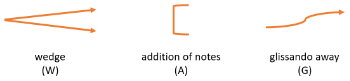
[1.1] Before proceeding with the investigation of Critical Band, some terminology should be clarified. By definition, a unison opening should be both a unison (it should begin with two or more instruments or voices articulating the same note) and an opening (it should move on to other, non-unison, material). This means that a unison opening is departed by moving from one sound to many, calling our attention as listeners to the psychoacoustics of pitch—that is, the aspects of a sound by which we identify the presence of one or multiple pitches. I find that unison openings often highlight two such cues in particular, as I define below: roughness/smoothness and (in)harmonicity. Most often, composers showcase these cues via standardized exit strategies from the initial unison. Example 1 introduces my shorthand notation: the wedge highlights roughness/smoothness and addition of notes highlights [in]harmonicity (the slow glissando away continues a wedge, but will not be discussed until Section 2).
[1.2] In this first section, I introduce these exit strategies and their ramifications via James Tenney’s Critical Band. Through a combination of close musical analysis and an introduction to select psychoacoustic principles, I make the following points that I rely on in the rest of this article:
- Frequencies, pitches, and notes are distinct: frequencies exist in a physical sound wave, a listener identifies pitch(es) from these frequencies, and a note is a conceptual understanding of a pitch or an instruction to make a sound.
- A sound is most often perceived as “one pitch” if it has a smooth amplitude envelope (smoothness rather than roughness) and its frequency spectrum resembles a harmonic series (harmonicity rather than inharmonicity). These foundations are also essential to consonance/dissonance perception: the more closely a collection of frequencies resembles the spectrum of “one pitch,” the more it is conventionally consonant.
- A collection of frequencies affords either synthetic hearings, in which a listener interprets frequencies as contributing to the timbre of one fundamental, or analytic hearings, in which those frequencies are heard as distinct pitches.
- A composition can direct listeners’ attention to these psychoacoustic phenomena and invite different modes of hearing.
Example 2. James Tenney, Critical Band, full score. Click on green boxes for audio examples.
(click to enlarge, listen, and see the rest)
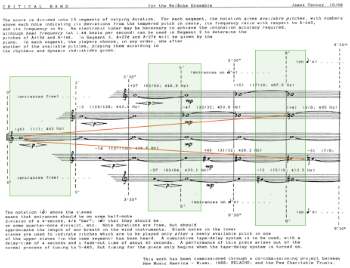
[1.3] Example 2 provides the full score for Critical Band, with my light annotations. Critical Band is an open-score piece with flexible instrumentation: within each section, Tenney indicates possible notes a performer might choose from, to be sustained for approximately “the length of one breath.” Each note in the score consists of a note name, a deviation in cents from 12-tone equal temperament, and a frequency. Following Parncutt (2024, 79) and Parkhurst and Hammel (2018, 9–15), I term such markings on scores notes. The instruments produce sounds with frequencies, generally following harmonic spectra of those shown in the score. Frequency is a property of physical sound waves, interpreted as pitch only upon being perceived by a listener.(2) The construction of Critical Band discourages listeners from hearing all of the score’s notes and resulting frequencies as distinct pitches.
[1.4] Critical Band lasts 17 minutes: in the first 10, the ensemble slowly wedges outward from an A4 tuning note to an [01234] cluster around it; in the remaining 7 minutes, the ensemble moves further afield to complete a harmonic series on A2, of which A4 is eventually revealed to be its overtone.(3) The composition relies entirely on two of the exit strategies shown in Example 1, with the original A4 remaining audible for the full duration. While unusual even for other pieces starting on unisons, many of Critical Band’s features are characteristic for such repertoire. In particular, note Critical Band’s use of exit strategies: the initial wedge away (shown with expanding orange arrows) destabilizes the opening pitch by creating rhythmic pulses such as beating and roughness, which we might hear either as thickening the note or as adding dissonance to it; the final addition of notes (shown with orange brackets) restabilizes A4 as a harmonic partial of an A2 fundamental, which we might hear as a single note with a rich timbre or as a harmonic-series pitch collection. I will discuss these terms in turn.
[1.5] Critical Band is titled after the psychoacoustic phenomenon known as the critical band, the range around a given frequency within which other frequencies are indistinguishable in a listener’s physiological inner ear.(4) To that end, the first few minutes present and then destabilize a single pitch, within one critical band. As notated in the score, Critical Band begins with a perfectly smooth A4 at 440Hz, after which notes move 3.4Hz outwards both up and down. Here, listeners will likely perceive a pitch around A440, beating at a pulse of 3.4Hz or 6.8Hz—such differences are not only within A440’s critical band, but well within our range of rhythmic perception.(5) The only other pitches that might emerge would not be in the immediate vicinity of A440, but rather at least an octave higher in an instrument’s frequency spectrum.
[1.6] Once frequencies within a critical band beat too rapidly to be heard as rhythmic, they create auditory roughness. This sensation has traditionally been interpreted as contributing to dissonance, following Helmholtz ([1885] 1954).(6) Around the 4-minute mark of Critical Band, the beats get too fast to hear metrically: 433.1Hz beats against 446.9Hz at 13.8Hz, yielding a 72ms inter-onset-interval marginally shorter than the usual 100ms lower limit (London 2012, 35–37). The move to roughness is confirmed around the five-minute mark, where 453.8Hz enters and beats against 433.1Hz at 20.7Hz, solidly within the “fast amplitude fluctuation (c.20–30Hz)” of Harrison and Pearce’s definition (2020, 218). I find that the beats are too fast to be heard as within a single pitch, yet the frequencies are too close to be heard as two distinct pitches.
Example 3. Theoretical values for roughness and harmonicity over the course of Critical Band

(click to enlarge)
[1.7]
[1.8] I suggest that over Critical Band’s ambiguous first few minutes, we can perceive either a “synthetic” or an “analytic” hearing (McAdams 1982, 280; see also Hasegawa 2019, 529–31):(8) In a synthetic hearing, we seek to interpret all auditory cues as part of a single pitch percept. Critical Band opens with a sustained A4: the beating in its amplitude envelope and the shifts in upper partials as instruments enter and exit are perceived not as changes in pitch, but rather as changes in composite timbre.(9) No other pitches emerge until after six minutes in, when the span of frequencies is simply too wide for the categories by which we understand pitch (Parncutt and Hair 2018, 490–91). By contrast, in an analytic hearing, A4 is unstable immediately: the introduction of 3.4Hz beating around A4 at the 2-minute mark might already suggest we hear harmonic overtones A5 or E6 emerge as pitch percepts due to their faster beating. Nearing the 5-minute mark we might choose between many possible fundamentals even within the critical bandwidth. Critical Band affords both hearings because there are so few other auditory cues—in the absence of clear attacks or any pitches ending, the listener is given space to alternate between possible analytic and synthetic hearings.
[1.9] The second half of the piece continues expanding outwards in register, but the new notes are too far away to create beating—instead of a wedge, we now have addition of notes, highlighting how harmonicity (notes’ proximity to those of a harmonic series) contributes to pitch perception. In Critical Band, all notes added from the eighth minute onward (when the ratio indications have a denominator of 8) contribute to a harmonic series over A1 (55Hz), whose common tones prepare the concluding sonority, a full harmonic series (up to the eighth partial) over A2 (110Hz).(10) Example 3 shows that roughness is low throughout the passage, resulting mainly from a few high partials. Meanwhile, harmonicity in this passage is substantially higher than in the first half of the piece, reaching a full value of 1.0 at the concluding complete harmonic series.(11) Critical Band, then, dramatizes a shift from smoothness (or non-roughness) to harmonicity as primary psychoacoustic cues by which we recognize sounds as fusing together.
[1.10] The end of Critical Band is ambiguous, offering both a synthetic hearing as a [AB: hyphenate?] timbrally rich A2 and an analytic hearing as a consonant pitch collection. Like smoothness, harmonicity constitutes both a psychoacoustic cue for recognizing “one pitch”—sounds resembling the harmonic series fuse into one percept across cultures (McPherson et al. 2020)—and a foundation for conventional judgments of consonance among pitch collections, following Stumpf’s [1890] 1965 explanation of consonance as “tonal fusion.”(12) The end of Critical Band, with performers given notes fitting one A2 harmonic series, entails a collection of frequencies that might all fuse into one pitch at A2 or, with performers rearticulating their notes, might encourage us to perceive pitches as partials 1 through 8.
Hearing Pitch(es) in Critical Band
[AB: Paragraph numbers 1.11—1.14 missing, renumbering the 1.15 I was given as 1.11, and so forth.]
[1.11] I believe that Tenney designed Critical Band to focus listeners’ attention on smoothness, harmonicity, and their potential interpretations as either fusion or consonance. The first clue is, of course, the title, which refers to a range of frequencies that fuse together in the inner ear. But much of the score, paratext aside, still points towards auditory fusion. As discussed above, the note collections lead from smoothness through roughness to harmonicity over the course of the piece. The open-score long tones remove most cues by which we might hear instruments as distinct sources. Such a dramatization fits with Tenney’s musical backgrounds and larger projects. His early training in computer music involved studies of psychoacoustics, which in turn shaped his compositional theories, including a treatise on consonance and dissonance. In Critical Band, Tenney encourages us to hear a constant fluctuation between analytic and synthetic hearings, or between hearing consonant/dissonant collections or thick timbres.
[1.12] In Auditory Scene Analysis, Albert Bregman suggests that “the perception of dissonance can be suppressed when the tones that form the dissonance are perceived as belonging to different auditory streams” (1994, 508). That is, roughness and inharmonicity are more likely to be perceived as dissonance if they come from one apparent source, rather than being two pitches from separate lines. Bregman suggests that common-practice counterpoint rules are designed to minimize perceived dissonance—pitch combinations that might be dissonant are instead perceived as separate streams (503). Critical Band does the opposite: the performers play long tones that minimize such separations. As a result, Tenney pushes us to hear psychoacoustic phenomena that tonal norms obscure.
[1.13] Tenney distinguished between roughness and inharmonicity not just in Critical Band but also in his treatise of the same year, A History of “Consonance” and “Dissonance.” He presents five different historical concepts of consonance/dissonance; in his second concept, a dyad’s consonance is defined as how much it fuses into a tone via harmonicity (resemblance to the harmonic series); in his fifth, the same dyad’s consonance is defined as its smoothness (Tenney 1988, 28–31, 87–90; Wannamaker 2021a, 147–51; 2022).(13) In distinguishing these concepts, Tenney inserted himself into a longstanding debate on the origins of consonance, originating from a nineteenth-century dispute between Carl Stumpf and Hermann von Helmholtz (Steege 2012, 216), and continuing into modern-day psychoacoustic research.(14) I find that Critical Band constitutes a musical illustration of the same distinction. By presenting roughness and harmonicity in separate portions of the same piece and associating them with the exit strategies described above that help highlight them, Critical Band makes audible the enduring distinction between roughness and inharmonicity as theories of dissonance.
[1.14] By encouraging us to pivot between synthetic and analytic hearings, Critical Band strains the borders between timbre and pitch. To hear timbres aligns with Tenney’s background in psychoacoustic research for Bell Labs: while developing early computer music software, he studied harmonic spectra as part of scientific research into timbre perception (Tenney; Wannamaker 2021a, 62–63).(15) But to hear pitches aligns with his return, after leaving Bell Labs and computer music, to writing fully notated compositions for instruments (Wannamaker 2021a, 111). That we might hear both reflects the legacy of Tenney’s computer music training in his instrumental works—in the latter, he anchored his harmonic language in the harmonic series because of its potential for fusion; he described it as “a structure that our auditory systems have built into them: the capacity to reduce to a unity” (Dennehy 2008, 87; see also Wannamaker 2021a, 169–72; 2022). By encouraging his listeners to pivot between analytic and synthetic hearings of Critical Band, Tenney was encouraging attention to the psychoacoustics essential to pitch identification, showcasing the very compositional affordances—of unisons, wedges, and addition of notes—that I draw across many examples in the remainder of this article.
2. Theorizing the Unison Opening
The Unison Opening as a Schema with Initiating Function
[2.1] Among pieces I have encountered so far, Critical Band is unique in its combination of formal simplicity, didactic presentation of material, and direct (indeed, titular) reference to psychoacoustic cues for fusion or consonance. These features make it an ideal example through which to demonstrate how a composition can thematize harmonicity/inharmonicity of a frequency collection, smoothness/roughness of beating, and ways we can hear such features as potentially contributing to consonance/dissonance. However, its central features are common to many other works from a range of post-1945 musical styles. The pathways by which Tenney departs his unison—wedging away from the opening note and then adding notes to complete a chord—appear in numerous other pieces. Correspondingly, it remains useful to focus on how roughness and inharmonicity contribute to perceiving multiple notes or a dissonant sonority. Because these aspects are common within post-1945 classical music, I believe Critical Band’s unison opening is a model example of a schema with an initiating function. Let’s unpack these terms in turn.
[2.2] As above, I define a unison as the same note being sounded simultaneously by at least two distinct sources and heard as the same pitch. Most often, these sources are different instruments or voices; in some cases, they might be multiple parts of the same instrument, include electronics, or so forth. I consider such unisons to be openings when they are the first sound of a piece (including as the sustaining component of a single percussive impulse), but not the entire piece.
[2.3] The unison opening is a schema because it is 1) a stock phrase (Gjerdingen 2007, 6); 2) bordering on a cliché (Byros 2012, 112, 117; Sutcliffe 2009, 468); 3) defined by a constellation of distinct features that often move together (Gjerdingen 1984, 44, 125; 1988, 64; Gjerdingen 2015, [3]); and 4) practiced in a historically specific compositional style suggesting certain strategies for listening (Byros 2009, 287–89; Sherrill 2011, 230–32). We know it is a stock phrase because it is used so widely, as shown by the examples cataloged below. Its distinct features include it being a unison at the start of a piece, three common exit strategies, acoustic references, and open-string pitches. Unison openings are associated with particular compositional styles from the last few decades, and they suggest listening strategies with attention to psychoacoustics. While the term “schema” is often associated with outer-voice scale-degrees in Galant music (Temperley 2006, 278; Rabinovitch 2019; Sherrill 2011, 228–30), the unison opening’s ubiquity makes it a schema even without tonal grounding.
[2.4] The unison opening schema has an initiating function because it is a “standardized way” a passage can be “characterized as a beginning” (Caplin 2009, 54). As Anabel Maler observes, while form-function theory derives from an 18th-century tonal context, its definitions can be generalized as formal function did not end with tonality (2022, 47–48). I argue for the unison opening as being one way to establish formal functions later in the 20th and 21st centuries. While formal analysis of post-tonal music often relies on Schoenbergian notions of motive (Boss 2014, 71–73; Burstein and Straus 2024, 438–40; Heneghan 2006, 241–54; Hier 2023, n8–9), my analysis establishes temporality even in music whose continuous surface allows few cues for segmentation. Much as amplitude envelopes can establish the beginning, middle, or end of an individual sound (Smalley 1997, 112; Blackburn, 6–7), the unison opening can articulate a sense of beginning within a larger unit subject to the generic context of the late 20th and early 21st centuries.
[2.5] The unison opening’s initiating function is strengthened by its schematic nature and the destabilizing of the opening note. Certain schemata take on conventionalized temporal positions (Rabinovitch 2022, 370–72)—in associating a recognizable constellation of features with a specific temporal position, the unison opening follows these precedents. And, in the absence of conventionalized tonal syntax, the appeal to basic psychoacoustics matches more general norms of how to initiate a piece. In Matthew Arndt’s terms, the clarity of a single pitch, a “[part] that include[s] a sense of beginning,” constitutes the piece’s establishment, while the exit strategies, destabilizing the pitch percept, suggest a confrontation with contrasting material (2018, 212–13) to push the piece forward.
Unison Openings and Harmonic-Series Endings
[2.6] For the unison opening to be a schema or have a specific formal function, it must be normative within a genre’s conventions, an assertation supportable only by a variety of examples. While my examples span a range of post-1945 compositional styles from composers with scant biographical ties, I find that the ubiquitous presence of unison openings among what has been considered “new music” demonstrates a shared compositional vocabulary that circulates as widely as any from earlier in music history.(16) To that end, the remainder of this article considers an assortment of pieces that begin on unisons, grouped around central features that may help point us to smoothness/roughness and (in)harmonicity.
Example 4. List of pieces beginning on a unison and ending on a harmonic series
(click to enlarge)
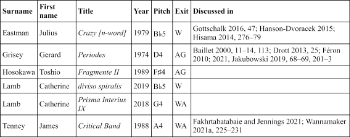
[2.7] I will begin with pieces that share Critical Band’s pathway from a unison opening to a harmonic-series ending, which suggests listening for psychoacoustic cues throughout. Example 4 (duplicated in Appendix 1) lists all such pieces I have identified that use this framework. I will proceed from the most like Tenney’s to the least, to show how my analysis of Critical Band generalizes.
Example 5. Julius Eastman, Crazy [n-word], opening (click on green boxes for audio examples)
(click to enlarge and listen)
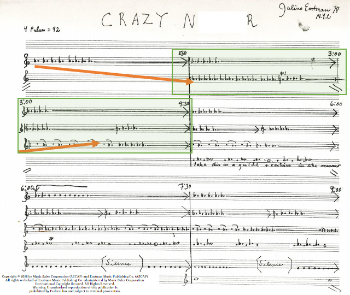
[2.8] Julius Eastman’s Crazy [n-word] (1979) uses an open-score format to slowly wedge outward before filling out a harmonic series.(17) Example 5 shows the opening of Crazy [n-word]: over 12 minutes, the piece expands outward in both directions from the opening
Example 6. Julius Eastman, Crazy [n-word], reduction and analysis of opening
(click to enlarge) |
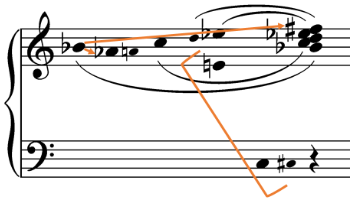
[2.9] I should concede some caveats: Eastman’s notational flexibility means that this opening is probably not, strictly speaking, a unison. The performance notes in the published score indicate that “absolute pitch values are not indicated” and that “any passage may be realized in any register.” Accordingly, in recordings, the opening
Example 7. Julius Eastman, Crazy [n-word], conclusion
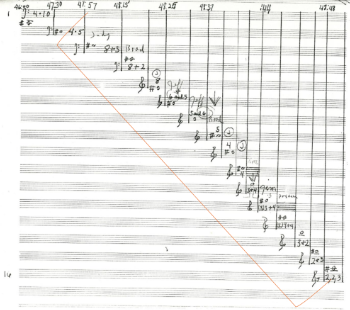
(click to enlarge and listen)
[2.10] Like Critical Band, Crazy [n-word] moves from roughness to harmonicity. After the opening passage, much of the piece relies on similar registral expansions, with transposed equivalents returning notated at A5, B4 again, and B5, and then sections starting on F and A, notated only as pitch-class names without staff notation. But the piece concludes, as shown in Example 7, with a statement of the harmonic series no less didactic than Tenney’s. The fundamental is stated for a full minute and a half as a single note, and harmonic partials are added on top of it, notated (and most often performed) at pitch.(18)
[2.11] Gérard Grisey’s Périodes (1974) concludes with one of the most discussed passages in late twentieth-century music, the orchestration of a trombone’s acoustic spectrum.(19) This sound famously affords both timbre and pitch hearings—it is modeled on the sound of a single trombone sound with an E2 fundamental frequency, but harmonic partials emerge moments later as clear pitches, orchestrated separately.(20) Much as with the harmonic series at the end of Critical Band, we as listeners have a sound that we can hear either way—Grisey describes it as “without being a timbre
Example 8. Gérard Grisey, Périodes, opening
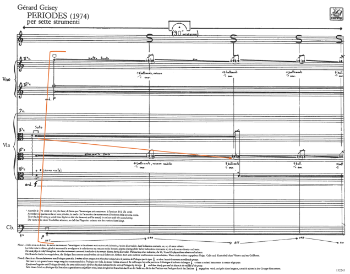
(click to enlarge and listen)
[2.12] Less discussed than this harmonic-series ending is Périodes’s unison opening and wedge.(21) Example 8 shows the opening: the unison consists of D4 on 3 strings of the same viola; a slow glissando downward on the G string begins a wedge and introduces beating, which accelerates into roughness. Added notes confront us with conflicting harmonic contexts for that D4: the open-string tuning is a fundamental over which the violin’s A5 is a third partial added, but the G-string’s flat D4 is a 7th partial for the double bass’s E1. The slight difference in intonation, made audible by beating, keeps the two possibilities separate. Although the harmonic-series ending eventually confirms D to be an overtone of low E, the beating is crucial to initiating the conflict.
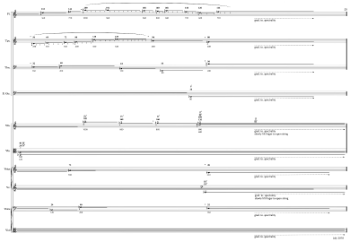
[2.13] Catherine Lamb’s Prisma Interius IX (2018) adapts Tenney’s just-intonation techniques into a more through-composed format that still showcases beating (Lamb 2017).(22) The piece exclusively contains overtones of a 5 Hz fundamental, so that all note combinations will beat at that frequency or some multiple thereof. Example 9 shows the opening—above each note in the score, Lamb provides what partial it is of 5Hz (
Example 9. Catherine Lamb, Prisma Interius IX, opening
(click to enlarge and listen) |
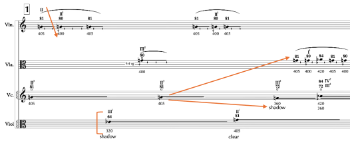
Example 10. Catherine Lamb, Prisma Interius IX, conclusion
(click to enlarge and listen)
[2.14] When describing the Prisma Interius series, Lamb asks, “how is one tone a pivot between activating a total harmonic space as well as expanding a contour in time?” (liner notes to Lamb 2019, 16). The opening G4 provides an answer to the question while raising another: its two possible interpretations leave open whether the harmonic space relies on Pythagorean or just-intonation ratios. As Lamb’s pitches expands outward, this ambiguity sets up such a contrast. The end of the piece, shown in Example 10, illustrates that “harmonic space:” all partial numbers on the last page are multiples of 8, so that the whole ending passage composes out a harmonic series over a 40Hz
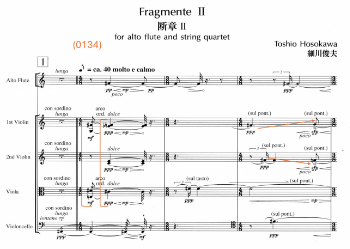
Example 11. Toshio Hosokawa, Fragmente II, opening
(click to enlarge and listen)
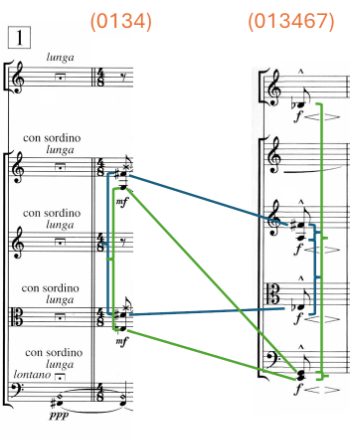
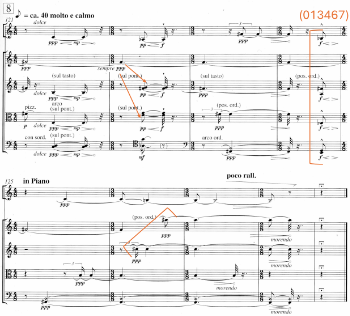
[2.15] Toshio Hosokawa’s Fragmente II (1989) sits at the margins of this formal archetype: instead of a unison, it starts with a single note that other instruments later join, and instead of a harmonic series, it ends with a widely spaced major triad. Example 11 shows the opening and exit strategies: although the
Example 12. Comparison of sonorities at start and end of Fragmente II, showing subset relationships
(click to enlarge and listen) | Example 13. Toshio Hosokawa, Fragmente II, conclusion
(click to enlarge and listen) |
3. Additional Continuations of Unison Openings
[3.1] Most single-pitch unison openings do not invoke both smoothness/roughness and (in)harmonicity quite so directly. Yet, unison openings persist in a broad range of music from the last few decades, and as they share the same schematic norms, similar analytical strategies remain useful. This section demonstrates how these principles of unison openings generalize as we move beyond the previous examples’ defining characteristics. None of the pieces here end on a harmonic series or other such symbols, but the same (psycho)acoustic foundations remain essential as the pieces depart their unisons.
[3.2] I begin with compositions whose materials explicitly reference beating, roughness, or inharmonicity as they depart their unison openings, suggesting that their listeners consider how sounds split apart. The remaining compositions in this section do not mention such phenomena explicitly on the score, but still share many surface features. I next discuss compositions whose unison openings begin on open strings or natural harmonics on bowed string instruments—the acoustic purity of the open string is common in pieces that do reference acoustics, and provides a purer tone against which to hear beating. Finally, I examine pieces that begin with a unison but have no open strings or references to (psycho)acoustics, showing the schema’s broader ubiquity.
Other Explicit Acoustic References
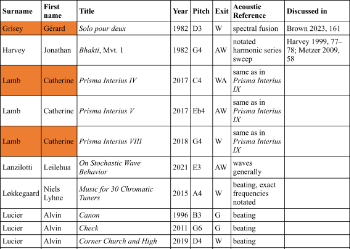
Example 14. List of compositions explicitly referencing acoustic phenomena without ending in a full harmonic series (orange indicates composers previously mentioned)
(click to enlarge)
[3.3] Example 14 (duplicated in Appendix 2) lists compositions that directly invoke acoustic phenomena. By and large, the layout of the table is the same as that of Example 4, with an added column documenting just what the acoustic reference is. In most cases, the acoustic phenomenon is familiar from previous analyses, being either beating/roughness or (in)harmonicity. The reference to acoustics is most often an explicit mention or notation—whether in the score, performance notes, or program notes—of beating or harmonic-series intervals.
[3.4] Some composers’ techniques are familiar from analyses above—Lamb and Tenney continue to notate frequencies and/or ratios as in Prisma Interius IX and Critical Band, as do Niels Lyhne Løkkegaard, Alvin Lucier, and Sam Pluta. Not all notational invocations of beating, however, are quite so precise: Giacinto Scelsi and Per Nørgård indicate beating speeds less precisely, showing how microtonal frequencies can create beating in a more intuitive fashion.
[3.5] Scelsi’s music might be taken as a logical extreme of unison openings: he wrote a set of pieces titled Quattro pezzi su una nota sola (Four Pieces on a Single Note) (1959), all of which begin with a lengthy unison or octave passage.(25) Many of his later pieces proceed in similar ways—beginning on a unison and often juxtaposing it against adjacent notes. However, beating emerged incidentally in these early works, and although Scelsi probably was aware of the phenomenon, the scores do not document beating explicitly. As Thomas DeLio (2017) suggests, Scelsi’s music reached more precise technical sophistication a few decades later, such as in his 1973 pair of solo violin works L’âme ailée and L’âme ouverte.
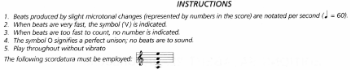
Example 15. Performance instructions for Scelsi, L’âme ouverte, indicating notation of beating speeds
(click to enlarge)
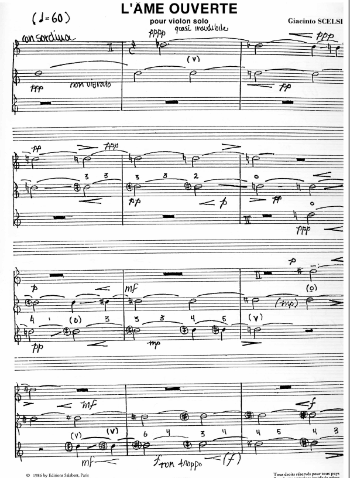
[3.6] In L’âme ouverte, Scelsi creates beating by slowly destabilizing an opening pitch until it drifts away by a semitone. As shown in Example 15, Scelsi provides exact notation for how fast near-unison dyads should beat: instead of precise intonation, he notates the desired psychoacoustic results. Example 16 presents how this technique appears at the opening. While Scelsi starts with one D5, he soon thickens it with a
Example 16. Scelsi, L’âme ouverte, opening with specific beating speeds indicated
(click to enlarge and listen) |
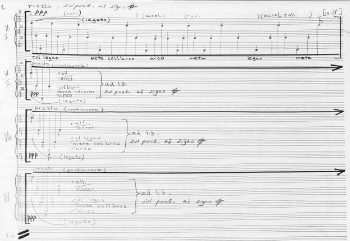
[3.7] Per Nørgård’s String Quartet No. 5, “Inscape” (1988), notates beating both graphically and verbally in score and sketches. The first two movements reside entirely within a B3–D4 minor third, seeking a path downwards from an opening unison on D4. Moving primarily by microtones, the first two movements are even more severe than Critical Band in their dramatic thematization of beating. Nørgård termed beating “interference,” a term I use interchangeably with beating below, and considered it a central technique in works of this period (Jensen 1986, 118–21; Nørgård 1969). He had likewise used the harmonic series a year earlier in Voyage into the Golden Screen (Jakubowski 2019, 186–90), further illustrating his interest in acoustics. The unison opening and its exit strategies, then, provide a compositional tool by which Nørgård could achieve his desired acoustical results.
Example 17. Per Nørgård, String Quartet No. 5 (“Inscape”), opening unison (manuscript from Nørgårds arkiv III, 01 mu 7909.1512)
(click to enlarge and listen)
[3.8] In the first movement, beating from a unison D4 expands to fill out a semitone. The gesture fuses characteristics of the wedge and the glissando—like in a wedge, D4 continues sounding throughout, but like in a glissando, the expansion is only in one direction (downward). Example 17 shows the opening: all four instruments play D4 in unison across strings tuned in a scordatura, shown in Example 18, in which D4 is simultaneously an open string, natural harmonics, and stopped note.(27)
Example 18. Scordatura for Per Nørgård, “Inscape” (Nørgårds arkiv III, 01 mu 7909.1512)
(click to enlarge) |
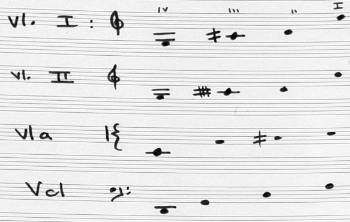
Example 19. Notated “interference” at the end of the first phrase of “Inscape,” a minute and a half in (Nørgårds arkiv III, 01 mu 7909.1512)
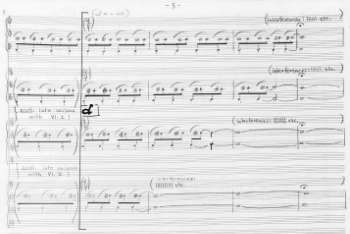
(click to enlarge and listen)
[3.9] Example 19 shows the end of this process—at the first pause in the piece, all instruments sustain a quarter-tone dyad between
Example 20. Performance instructions for Per Norgard’s “Inscape,” showing notation for beating (Nørgårds arkiv III, 01 mu 7909.1512)
(click to enlarge) |

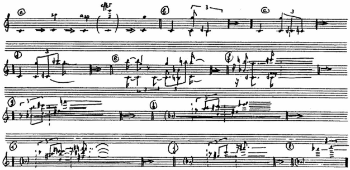
Example 21. Murail’s Figure 9 (1980) 2005, showing his summary of the opening in his own Mémoire/Erosion
(click to enlarge and listen)
[3.10] Just as Scelsi and Nørgård use wedges to achieve roughness and beating, later French spectral composers add notes to emphasize (in)harmonicity.(28) Tristan Murail’s work provides a didactic case study. Example 21 reproduces his summary of Mémoire/Erosion (1976), showing how he “organiz[es] pitches by successive generators” (Murail [1980] 2005, 128). That is, each note generates overtones that slip out of tune and create new tones through ring modulation, slowly accumulating into one of his favored “complex sounds.” Murail writes that “the spectrum is increasingly distorted” and suggests this example “might provide an entry into the domain of inharmonic spectra” (129)—we can thus listen to this passage in terms of its deviation from harmonicity.
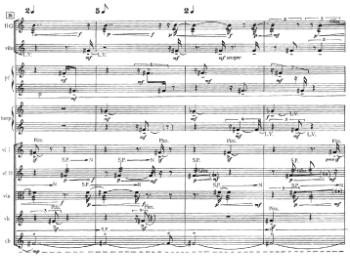
Example 22. Saariaho, Lichtbogen, mm. 25–28
(click to enlarge and listen)
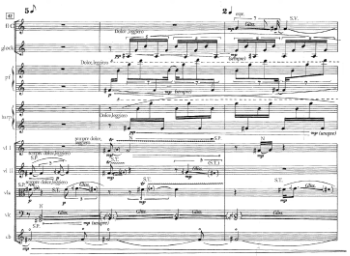
[3.11] Kaija Saariaho’s Lichtbogen (1986) also uses a unison opening to introduce a sound’s deviations from harmonicity. The piece’s pitch content is built on computer-aided spectral analysis of both “pure” and “very noisy” cello sounds (Saariaho 1987, 129–30; see also Kankaanpää 2011, 166–72; Cobb 2024, 248–53). Accordingly, the opening moves away from its “basic chord” (Cobb 2024, 263), a sul tasto unison on
Example 23. Saariaho, Lichtbogen, mm. 42–44
(click to enlarge and listen) |
Open-String Unison Openings
[3.12] Many of the examples discussed so far began with unisons on open strings or their natural harmonics. As shown in Example 4, Tenney’s Critical Band began on the quintessential tuning note A4, Grisey’s Périodes on open-string D4, and Lamb’s Prisma Interius IX on a G4 open in the piece’s unique scordatura. In these examples, open-string tuning aids performers in achieving a precise frequency with few overtones; for Tenney and Grisey, these features help beating become audible as performers slowly drift away to another string. Open strings also begin many of the acoustics-focused compositions listed in Example 14 and Appendix 2.(29) In all of these cases, the open string or natural harmonic makes the deviation from that opening note, and the (psycho)acoustic phenomena that result, that much more audible.
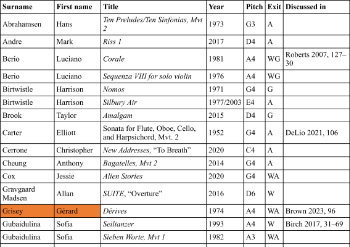
Example 24. Compositions starting on a unison playable as an open string or natural harmonic (orange indicates composers previously mentioned)
(click to enlarge)
[3.13] Following this trend, Example 24 (duplicated in Appendix 3) lists compositions with string instruments that begin on open strings or natural harmonics, without explicitly referencing acoustics. Note that Grisey, Saariaho, Scelsi, Soper, and Tenney recur here after appearances in previous tables. I find it likely that in these cases, rather than overtly highlighting acoustics, the schema instead is simply part of a vocabulary each composer deploys across their compositions. For instance, Example 25 presents the opening of Scelsi’s 1965 Xnoybis, for solo violin. Although the
Example 25. Scelsi, Xnoybis, opening
(click to enlarge and listen) |
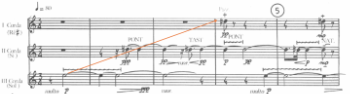
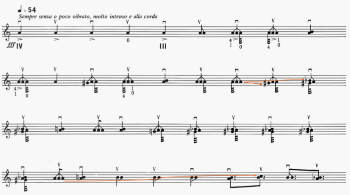
Example 26. Berio, Sequenza VIII for violin solo, opening
(click to enlarge and listen)
[3.14] Luciano Berio’s 1976 Sequenza VIII for solo violin likewise combines open and stopped notes to produce beating and roughness, while not naming them in the score. Example 26 shows that first six notes ask for the same pitch, A4, to be played on the G, A, and D strings (in that order), setting up subsequent triple-stops and a wedge away. Within those triple stops, beating becomes audible—perhaps not composed in, but as an unavoidable practicality of performance. Beating transitions to and from roughness as the triple-stops move between A4 unisons and a semitone wedge around them. As in Scelsi’s L’Aime Ouverte, the beating and wedge help the passage slowly push upward, in this case by a whole-step to B4, where the same processes can resume and push further.
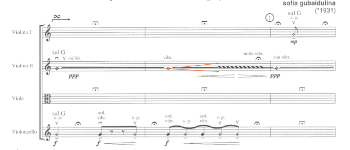
Example 27. Gubaidulina, String Quartet No. 2, opening
(click to enlarge and listen)
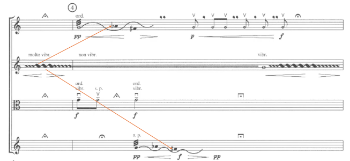
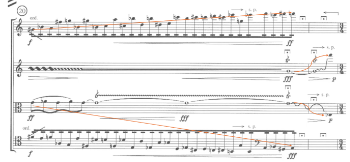
[3.15] Sofia Gubaidulina’s Second String Quartet (1987) deploys similar techniques to depart a natural harmonic rather than an open string. Example 27 presents the opening of the piece. The instruments sit on G4, with some sul pont highlighting overtones as in Saariaho’s Lichtbogen. The octave harmonic, much like an open string, guarantees pure intonation, but when the note is stopped and played with vibrato, the intonations clash and we hear beating, making the vibrato as the beginning of a wedge. In Example 28, vibrato develops into separate notes, moving outward further. Example 29 shows the end of the piece’s unison passage: the wedge gets larger, but the unison remains underneath; the wedge fails at achieving an exit. Instead of leaving by wedge or addition of notes, the wedge develops into a glissando much like in Scelsi’s and Berio’s works.
Example 28. Gubaidulina, String Quartet No. 2, around m. 4, showing how vibrato wedges further to chromaticism
(click to enlarge and listen) | Example 29. Gubaidulina, String Quartet No. 2, end of unison passage at m. 20, failed wedge leading to glissandi
(click to enlarge) |
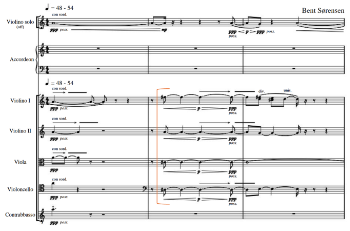
Example 30. Sørensen, It is pain flowing down slowly on a white wall, opening
(click to enlarge and listen)
[3.16] So far, these examples have departed open strings (or natural harmonics) by sliding away and creating a wedge that emphasizes beating. But an addition of notes can also lead away from open strings. Example 30 shows the opening of Bent Sørensen’s It is pain flowing down slowly on a white wall: the A4 unison is shared by all string instruments at first, including a double bass natural harmonic, and is sustained by the offstage solo violinist as the rest of the strings recontextualize it within a series of chords.
Remaining Unambiguous Acoustic Unison Openings
[3.17] Not all unison openings reference acoustics or open-string pitches. Example 31 (duplicated in Appendix 4) lists all remaining examples of unison openings that are both unambiguously unisons and entirely acoustic.(30) Virtually all of these examples demonstrate the same three exit strategies, suggesting a broader applicability for both the schema and my suggested attention to roughness/smoothness, (in)harmonicity, and (psycho)acoustics.
Example 31. List of other compositions starting on an acoustic unison, none of which contain open strings or acoustic references (orange indicates composers previously mentioned)
(click to enlarge) |
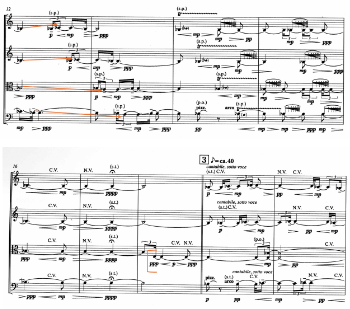
Example 32. Hosokawa, Blossoming, mm. 12–20, showing exit strategies
(click to enlarge and listen)
[3.18] Many composers use unison openings both in pieces with acoustic and/or open-string references and in those without, as shown by the orange highlighting in Example 31. For example, consider Toshio Hosokawa’s Blossoming (2008) for string quartet. Much like Fragmente II, discussed above, the piece begins by lingering on a unison, here
[3.19] Among composers who have not yet been mentioned, György Ligeti has a crucial position—not only does his name appear seven times in Example 31, he is the most previously analyzed composer discussed in this article. Several of his unison openings have been analyzed by Benjamin Levy as being “chromatic wedges,” one of Ligeti’s preferred “contrapuntal structures” in his 1960s works (2017, 213–18). I would add that Ligeti is not unique in this regard, and that his use of unison openings follows generic norms of his time. While Ligeti’s unison openings seldom reference acoustics or open strings like the examples above, he shares the standardized exit strategies of the wedge and addition of notes. Because of this common vocabulary, I suggest that the same attention to (psycho)acoustics remains a useful analytical strategy, particularly given Ligeti’s own studies in auditory fusion as applied to electronic sound synthesis.
[3.20] Of all the unison-opening pieces I am aware of, Ligeti’s Lontano (1967) has by far the most extant analyses. The unison opening itself has been described as a “stable tonal area” (Morgan 1977, 49) or as a “focal point of clarity” (Bauer 2004, 125). Most often, analyses begin with describing the compositional process—the work contains several canons in Ligeti’s characteristic micropolyphony—and consider how such canons shape the resulting textures. (31) In addition to these findings, I note that the unison opening provides another connection between composition and perception: the canon’s dux is constructed so that the unison opening schema and a wedge departure emerge as the audible outcome.
[3.21] In stronger terms, the subject of Ligeti’s canon is designed to result in a unison opening and wedge departure, situating his micropolyphonic techniques within broader stylistic trends. Furthermore, Ligeti’s studies in electronic music at the West German Radio meant he was familiar with the psychoacoustic principles underlying auditory fusion, linking his use of the schema to the perceptual concerns discussed above. Indeed, his sound mass music (of which Lontano is often considered an example) was an acoustic adaptation of additive synthesis, which relies on psychoacoustic research just as much as music by Tenney or Grisey.(32) Even though Ligeti provides no surface references to (psycho)acoustics, his compositional methods still reflect the influence of such studies on his broader musical environment.
Example 33. Levy’s Example 5.18a (2017, 201), showing first canonic theme in Ligeti, Lontano, with my analytical overlay

(click to enlarge)
[3.22] Lontano’s dux first repeats a note, creating a unison when realized as a canon at the unison, and then moves away from it by step, causing a wedge. Example 33 reproduces the dux, in turn borrowed from Lux Aeterna, as identified by Levy (2017, 200–202). Example 34 reproduces Amy Bauer’s range graph of the opening, showing that this dux results in a wedge.(33) Note the arrows I have overlaid on these examples, which show that as the subject expands in register, the resulting canon saturates an increasingly wide pitch range. The canon’s initial motion by tone and semitone will create auditory roughness once realized for multiple instruments. The canon is, by Ligeti’s own design, inaudible and rather intended to create a larger-scale effect (Bauer 2004, 121–22; Bernard 1987, 209; Reiprich 1978), or, as in Ligeti’s words, “polyphony is written, but harmony is heard” (Iverson 2009a, 167).
Example 34. Example 34: Bauer’s (2004, 128) range graph for the opening of Lontano, with my annotations showing exit strategies
(click to enlarge and listen) |
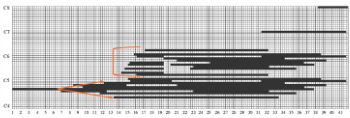
[3.23] At measure 14, pitches arrive in a new register. They do not result from the initial canon and its wedge; rather, they constitute a further exit by addition of notes. As Jonathan Bernard notes, the passage doubles the in-progress canon at the octave (1987, 228), which Amy Bauer considers a “second canonic unit” (2004, 125). But from the perspective of the unison opening schema, what matters is that this doubling establishes a new register perceived as separate. As the canon is inaudible, I hear the passage as adding notes beyond those of the wedge. The dux and canon create the wedge; Ligeti’s further doublings create addition of notes.
Example 35. Terrazas’s “Tótem II (Miro hacia el cielo),” from The Torres Cycle, opening
(click to enlarge and listen)
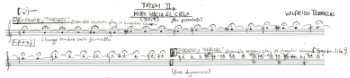
[3.24] Wilfrido Terrazas’s “Tótem II (Miro hacia el cielo),” from The Torres Cycle (2019), also uses a canon to instantiate a unison opening and its exits. Instead of fully composing out a realization, “Tótem II” presents the canonic subject as a score for performance, shown in Example 35, along with instructions. Composed for any number of piccolos, “Tótem II” presents an “irregular canon” in which the first note, B6, is repeated four times to establish a unison much like in Lontano. The canon first implies a wedge with beating and roughness: the motion down a quarter tone is answered up a whole tone. But when the subject jumps to E, the move is too large to be heard as a continuation of the same line. Instead, the E is a new added note, also departed by small intervals to maximize beating and roughness. As in Lontano, the canonic subject and its treatment generate the eventual shape of the unison opening and departure therefrom.
4. Beyond Unisons and Openings
[4.1] So far, every example has been both a unison and an opening, without problematizing those definitions. Each example has been a unison because one pitch emerges from two distinct sources. Each example has been an opening to a piece that begins with the single pitch but then deploys an exit strategy to move on to contrasting material. But many compositions employ the same acoustic references and exit strategies even when the opening is not quite a unison or not quite an opening.
Example 36. La Barbara, Voice Piece, 0:00–0:50
(click to enlarge)
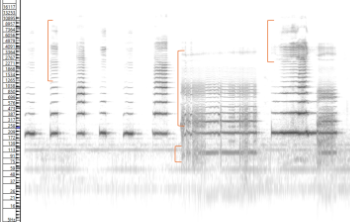
[4.2] Consider, for example, Joan La Barbara’s Voice Piece: One-Note Internal Resonance Investigation (1974). By the definitions set out above, this piece is neither a unison nor an opening—it is only one pitch from one performer, and the single pitch lasts the piece’s full 15 minutes. Yet, Voice Piece shares many of the schema’s defining characteristics. While the piece maintains one source throughout, it develops the initial pitch by changes in timbre that can be heard as adding new pitches. Example 36 shows the first 50 seconds from the 15-minute track: La Barbara only sometimes sings with overtones above 1000 Hz (approximately
[4.3] Despite her calling the piece “one note,” I find some additional pitches to be potentially audible—in the sixth articulation of her A3, at 0:20, the high harmonics are so much richer that I find
[4.4] In the remainder of this article, I present three analytical vignettes that push at the definitional limits of my proposed schema and exit strategies. My first example, Pamela Z’s Quatre Couches (2015), shows how electronic compositions blur the boundaries between unisons and single notes. The second example, Ambrose Akinmusire’s “Americana / the garden waits for you to match her wilderness” from Origami Harvest (2018), demonstrates how unison passages can point to one another in shifting contexts over the course of a piece. My final example, Eric Wubbels’s the children of fire come looking for fire (2012), returns to (psycho)acoustics, showing how varied use of unison passages can intertwine acoustic references with one another across a larger form.
Pamela Z’s Quatre Couches and other Electronic Unisons
[4.5] Many electronic compositions imply that multiple sources are present. Such pieces might combine electronic and acoustic sources, so that sounds come from two distinct places. They might also invoke an element of live performance where one can visually associate sources with performers. In the absence of such cues, layered and overlapping amplitude envelopes might help listeners hear the sounds as being multiple. Even when one sample is looped, so that notes share both fundamental and overtone pitches, “different parts of the spectrum [might] change in the same way at the same time” (Bregman 1994, 249), suggesting underlying grouping. If an electronic passage contains only one plausible pitch percept, such questions take on increased importance.
Example 37. Z, “Quatre Couches / Flare Stains” from A Secret Code, 0:00–0:30
(click to enlarge and listen)
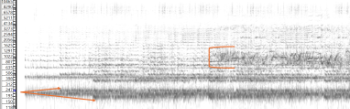
[4.6] The opening of Pamela Z’s Quatre Couches is recognizable as a unison on account of its mix of live and electronic sounds, the alignment of the performer’s actions to sounds’ onsets, and audible sonic overlap between grains of the same pitch. Some specifics of the piece vary between Z’s performances; I analyze her studio recording (combined with Flare Stains) on her album A Secret Code. Example 37 provides an annotated spectrogram of the opening. In such a fixed format, all the sounds come from the same set of speakers. Listening to it, the first note, in all its repetitions, is recognizable entirely as Z’s voice. Despite this, I still hear it as a unison. And, as my annotations show, this unison’s subsequent behavior confirms its place in the schema: the first few seconds wedge away from the first note by step in either direction, and then another sonic texture is added atop the resultant cluster.
[4.7] The opening note is recognizable as a unison, rather than just a single note, because it is audibly looped and thus distinct from the sound of an unprocessed voice. Z writes in the album’s accompanying liner notes:
Quatre Couches is a sonic trifle, tiramisu, or mille-feuille―juxtaposing four contrasting vocal layers and toying them―mixing them and moving them around on the plate until they all melt away. The first (numeric) layer originated when I was counting during a concert soundcheck and, pleased with the resulting looped sound, decided to incorporate it into a new piece I was experimenting with. When I perform this piece live I manipulate that layer, along with three others, using a gesture-controlled MIDI instrument. (liner notes to Z 2020, 5)
The looping of her voice, then, establishes a contrast between her voice as actually sounding (likely amplified through the same speakers as the processed electronics) and the numerous instances of it when played back from the electronics, creating unisons both between her live voice and between the many recurrences of it that emerge from her software.
Video Example 38. 1:35–1:47 of Z’s performance of Quatre Couches for Gray Sound Series
(click to enlarge)
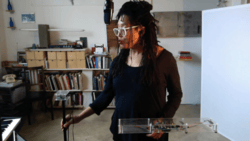
[4.8] In performance, Z’s physical gestures might help distinguish the different layers. To that end, Example 38 presents a short excerpt from her June 24, 2020 streamed performance for the University of Chicago’s Gray Sound Sessions.(34) This video begins with her initial pitch, counted in English: note that she looks to the right, with her hands away from the front MIDI controller, as the loop continues to echo. Five seconds into the clip, Z prepares to reenter a step up, counting in French. As she inhales, not quite yet making the sounds a pitch above, the loop at the original pitch continues, firmly detaching the audio from her visual presence. Her hand, being positioned closer to the MIDI controller, helps cue that second layer.
[4.9] Although live performance helps to highlight the contrast between live and processed sound, I still hear the opening as a unison even when the piece is just an audio recording. In both situations, listeners can hear the sounds as overlapped because words’ initial articulations arrive as other words are sustaining. This multiplicity makes such overlaps unison dyads rather than solo monads. But even amid a plethora of sonic events, her voice’s overtones remain fused—unlike the many articulations of the first pitches, those high frequencies do start and stop together with their fundamentals.
Example 39. List of unisons involving electronics (orange indicates composers previously mentioned)
(click to enlarge)
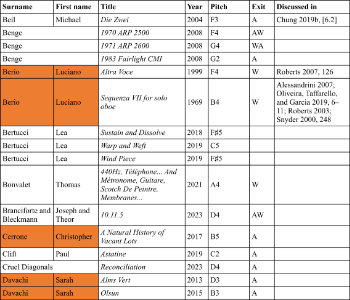
[4.10] Z’s opening gambit is not uncommon within electronic music: Example 39 (duplicated in Appendix 5) lists compositions that start on electronic unisons. This is not surprising: we saw above that the unison opening relies on psychoacoustics of pitch and timbre, which were studied through listener responses to electronically synthesized sounds. Likewise, we saw that composers, including Tenney, Grisey, Saariaho, and Ligeti approach their acoustic unison openings with the help of their studies in electronic music. As timbre recognition is so intertwined with source recognition, unisons can be quite difficult to follow in electronic music—and while many compositions in Example 39 rely on distinct acoustics and electronic sources, many contain their unisons within a single prerecorded track.
[4.11] Electronic musicians, then, manipulate psychoacoustic cues not just for how many pitches one hears, but for how many sources that pitch might come from. A brief comparison is instructive—relative to Z’s Quatre Couches, Phil Niblock and Joseph Kamaru trace a path towards an uncanny valley between unison and one-note, in which a sound has the characteristics both of one instrument and of many. Example 40 shows how Phill Niblock’s fixed-media piece Harm progresses from suggesting one cello note to many notes. The piece consists entirely of prerecorded cello samples, often pitch-shifted but without additional sound synthesis (Demers 2010, 96). Despite being presented only as a fixed-media recording, I hear the piece as reflecting the many samples it is made from: during the opening unison, onset transients (marked with in blue arrows) rearticulate the pitch even as its partials sustain, creating the impression of multiple sources. As high frequencies accumulate, the piece suggests hearing the one fundamental pitch as emerging from many cellos.
Example 40. Niblock, Harm, 0:00–0:56
(click to enlarge and listen) |
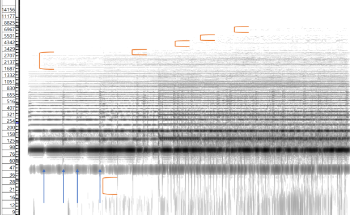
Example 41. KMRU, Imperceptible Perceptible, 0:00–0:35
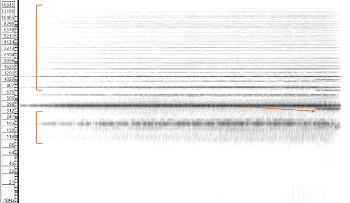
(click to enlarge and listen)
[4.12] Finally, Example 41 shows how sound artist KMRU (Joseph Kamaru)’s Imperceptible Perceptible sits on the edge between unison and one-note. While the spectrogram shows a clear single pitch at
Ambrose Akinmusire’s “Americana:” Opening Single Notes and Non-Opening Unisons
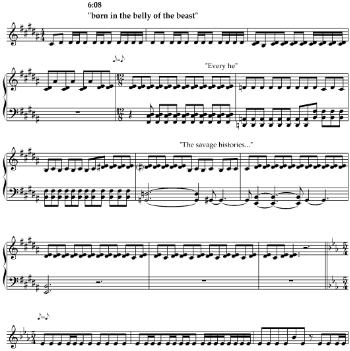
Example 42. Transcription of Akinmusire, “Americana,” 6:04–6:54
(click to enlarge and listen)
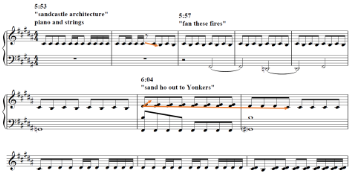
[4.13] Ambrose Akinmusire’s “Americana / the garden waits for you to match her wilderness” (henceforth “Americana”), from his 2018 album Origami Harvest, demonstrates how unisons can take on different roles throughout the same piece. Over the course of “Americana,” unisons (and one-note passages that are immediately repeated as unisons, not unlike in Z’s Quatre Couches) begin the piece, return to opening material, and introduce contrasting material—even when not at the opening of the piece, they initiate formal regions. To demonstrate how unisons on the same pitch can invoke different material, Example 42 provides fifty seconds from the middle of the track, from 6:04 to 6:54. 6:04 and at 6:40 both introduce unisons on
[4.14] Example 43 provides an outline of “Americana,” showing which instruments and voices make sound over the course of the track, and where a few particularly pivotal pitches—unisons on
Example 43. Orchestration chart for Akinmusire, “Americana,” with schematic analytical overlay. Dark blue indicates
(click to enlarge) |
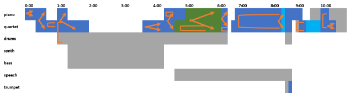
Example 44. Transcription of Akinmusire, “Americana,” 5:53–6:14
(click to enlarge and listen)
[4.15] Within this instrumental context, Example 44 presents my transcription of 5:53 to 6:14, where the unison on
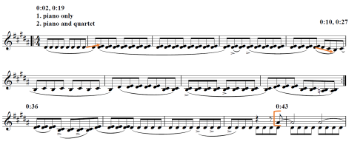
Example 45. Transcription of Akinmusire, “Americana,” 0:02–0:46
(click to enlarge and listen) |
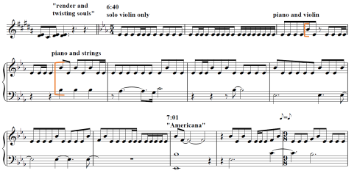
Example 46. Transcription of Akinmusire, “Americana,” 6:36–7:09
(click to enlarge and listen)
[4.16] After the 3-second pause at 6:37,
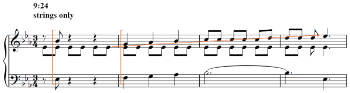
Example 47. Transcription of Akinmusire, “Americana,” 9:24–9:29
(click to enlarge and listen) |
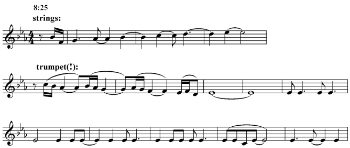
Example 48. Partial transcription of Akinmusire, “Americana,” 8:25–8:50
(click to enlarge and listen)
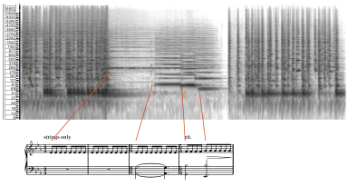
[4.17] Before the 6:37–40 pause, exit strategies are evaded, achieving genuine exists only afterwards. As shown in my exit-strategy annotations in Example 43, passages such as the actual opening (Example 45) get stuck on their unisons. In “Americana,” the conventional wedge thus becomes part of a continuous musical fabric, transcending its generic role in the schema to recur across the piece. Addition of notes is part of a larger breakthrough after the pause at 6:40, confirmed by theoctave-5 register (Example 47) and the singular appearance of the composer on his usual instrument of trumpet, shown in Example 48.
Example 49. Spectrogram and partial transcription of Akinmusire, “the lingering velocity of the dead’s ambitions,” 8:50–9:20
(click to enlarge and listen)
[4.18] Unison passages and their departures in “Americana” transcend their opening function for long-range connections across the piece. The piece does begin with a unison (a single note on piano, immediately repeated as a unison with strings)—but as it goes on, the same material takes on further layers. At 6:04, the return to
Conclusion: Eric Wubbels’s the children of fire come looking for fire
[4.19] Eric Wubbels’s the children of fire come looking for fire provides an ideal concluding analysis as it brings together every aspect of unisons that I have discussed so far. A momentary unison at the opening echoes more and more as the piece goes on, culminating in a large backwards wedge whose eventual unison initiates a brief coda. As the piece goes on, its unisons and their exits gradually point towards acoustics, with notated beating speeds, multiple open strings, and at times attempting to sound fragments of a harmonic series. In the children of fire come looking for fire, then, the unison’s acoustical, schematic, and formal aspects all depend on one another.
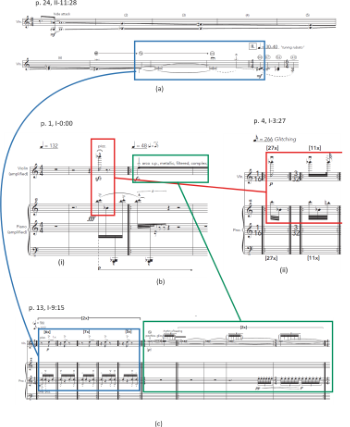
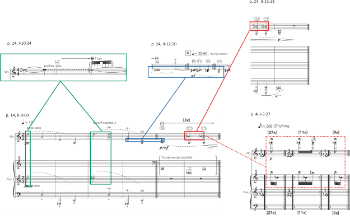
Example 50. Prominent unisons in Wubbels, the children of fire come looking for fire, with boxes showing links between them and colors highlighting shared pitches or pitch-classes. Click directly on a passage to play corresponding audio.
(click to enlarge and listen)
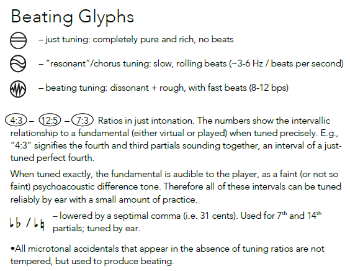
[4.20] The leadup to the piece’s coda, illustrated in Example 50a, demonstrates how these elements can all emerge together.(36) In a grand rhetorical gesture, the violin wedges by glissando a bit over an octave inward to a beatless unison. In the first system, the violin’s pitches are notated; in the second, only beating speeds are notated, in Wubbels’ own idiosyncratic notation (resembling those of Scelsi and Nørgård) as shown in Example 51. This is an inwards wedge that brings the piece to its apparent ending; as opposite of the outward-opening wedge normative in our schema, it fits a concluding role. Nonetheless, beating, the wedge, and concluding function are all linked here, with help from the D being an open string. The unison at the end of the wedge does not, however, completely end the piece. Instead, it segues into a short “after-the-end” coda that adapts a passage by Brahms into just intonation, fitting it into the harmonic series. The coda uses the unison, then, to lead from a smooth lack of beats to near-fusion, echoing the acoustic possibilities discussed above.
Example 51. Wubbels’ instructions on production of beating
(click to enlarge) |
[4.21] The unisons throughout the children of fire take on distinct relations to function, acoustics, and open strings over the course of the piece. These unisons, by resemblance to each other, set up a network of interrelated features much like those I have shown in the schema more broadly. The piece, over two large sections, slowly builds up a network of associations between unisons; the ending establishes the final connections as traced by the boxes and arrows in Example 50.
[4.22] While clear pitch is fragmentary at the opening of the children of fire, a lengthy unison (3 minutes later) suggests that we retrospectively hear the opening as a unison proper. Example 50b shows that the unambiguous unison of the
[4.23] The same combination of events—a pause and then a unison—initiates the first half’s coda. On page 13, shown in Example 50c, E5 in the violin enters, doubled between the open E string and a stopped A string; the stopped note slowly drifts flat.(37) This dyad introduces beating whose frequency is precisely notated in the score, with exact rhythmic indications, taking the earlier notations by Nørgård and Scelsi to their logical extreme. This introduction of beating constitutes a wedge, joined later by addition of notes in the piano. This extended passage on E has a few distinct formal and schematic roles. Temporally, it initiates a large section in the middle of the whole piece, which concludes the first half of the piece. But as a recognizable open string invoking beating so directly, it also connects the passage, and by extension the earlier
Example 52. Associations connecting Wubbels p. 14 (opening of second part) to other moments in the piece, with colors as in Example 50. Click directly on a passage to play corresponding audio.
(click to enlarge and listen)
[4.24] The opening of the children of fire’s second half helps to bring these unisons together. A rare passage (along with the coda) not to feature rapid-fire attacks, the system at the bottom of page 14 provides the context necessary to integrate the E5, D5, and
[4.25] By way of conclusion, this final example has brought together much of what the unison opening schema offers. A momentary unison at the beginning of the piece, too brief to notice at first, is vastly expanded when it initiates a new section later. Across the piece, unisons begin sections, highlight the psychoacoustics of beating, roughness, and harmonicity, and bring the piece to its close. Eric Wubbels’s own program notes note that the wedge, a conventionalized exit strategy, is crucial to the piece (he writes that the wedge is “converted to a neume that functions on every structural level”). While the wedge becomes clearest at the end, unisons allude to it throughout. As my analysis shows, the piece’s unisons become increasingly inseparable from their exit strategies: they gradually lead into wedges with notated beating and addition of notes within notated harmonic series. Likewise, the unisons become bound up with one another, referencing each other’s pitches, pitch-classes, and motivic material at moments bookending and within the piece.
[4.26] Of course, the children of fire is not the most representative example—for one, it does not exactly begin on a sustained unison. But it still demonstrates how many of the schema’s usual features can operate in conjunction with one another, bringing together many of the unison opening’s typical behaviors. Like the many pieces that do place unisons at their start, the children of fire repurposes beating and harmonicity as new aesthetic ends. While they can be interpreted as contributing to traditional common-practice consonance, as Wubbels showcases in the Brahms quotation, their interpretations at the borders of pitch and timbre provide new contexts.
[4.27] Wubbels’s composition could not have relied on unisons so extensively if they were not such a recognizable schematic trope in his musical surroundings. Like in Tenney’s Critical Band, a unison from an open string generates beating at a notated tempo, within a piece that concludes by referencing the harmonic series and its consonance-fusion borders. Unisons recur on two different open-string pitches and a natural harmonic, echoing their common association with sonic purity, and yet the piece begins with a stopped note, showing the unisons’ potential independence from such constraints. Unisons here transcend their opening role—the initial pitch at the opening spirals outward, showcasing the vast potentials of smoothness, roughness, inharmonicity, and harmonicity as they emerge from a single pitch. Wubbels’s composition traces much of this article’s course: while unisons are an effective way to highlight the psychoacoustics of pitch, they take on conventionalized structural roles within post-1945 compositional styles. The connections I have drawn demonstrate how unison passages, particularly at openings, place the psychoacoustic foundations of pitch perception within a shared musical vocabulary in decades of recent compositions.
Appendix
Appendix 1 (duplicating Example 4): list of pieces beginning on a unison and ending on a harmonic series
| Surname | First name | Title | Year | Pitch | Exit | Discussed in |
| Eastman | Julius | Crazy [n-word] | 1979 | W | Gottschakk 2016, 47; Hanson-Dvoracek 2015; Hisama 2014, 276–79 | |
| Grisey | Gerard | Periodes | 1974 | D4 | AG | Baillet 2000, 11–14, 113; Drott 2013, 25; Féron 2010; Féron 2021, Jakubowski 2019, 68–69, 201–3 |
| Hosokawa | Toshio | Fragmente II | 1989 | AG | ||
| Lamb | Catherine | diviso spiralis | 2019 | W | ||
| Lamb | Catherine | Prisma Interius IX | 2018 | G4 | WA | |
| Tenney | James | Critical Band | 1988 | A4 | WA | Fakhrtabatabaie and Jennings 2021; Wannamaker 2021a, 225–231 |
Appendix 2 (duplicating Example 14): list of compositions explicitly referencing acoustic phenomena without ending in a full harmonic series (orange indicates composers previously mentioned)
| Surname | First name | Title | Year | Pitch | Exit | Acoustic Reference | Discussed in |
| Grisey | Gérard | Solo pour deux | 1982 | D3 | W | spectral fusion | Brown 2023, 161 |
| Harvey | Jonathan | Bhakti, Mvt. 1 | 1982 | G4 | AW | notated harmonic series sweep | Harvey 1999, 77–78; Metzer 2009, 58 |
| Lamb | Catherine | Prisma Interius IV | 2017 | C4 | WA | same as in Prisma Interius IX | |
| Lamb | Catherine | Prisma Interius V | 2017 | Eb4 | AW | same as in Prisma Interius IX | |
| Lamb | Catherine | Prisma Interius VIII | 2018 | G4 | W | same as in Prisma Interius IX | |
| Lanzilotti | Leilehua | On Stochastic Wave Behavior | 2021 | E3 | AW | waves generally | |
| Løkkegaard | Niels Lyhne | Music for 30 Chromatic Tuners | 2015 | A4 | W | beating, exact frequencies notated | |
| Lucier | Alvin | Canon | 1996 | B3 | G | beating | |
| Lucier | Alvin | Check | 2011 | G6 | G | beating | |
| Lucier | Alvin | Corner Church and High | 2019 | D4 | W | beating | |
| Lucier | Alvin | Fan | 2003 | D4 | G | beating, exact ratios notated | |
| Lucier | Alvin | Fideliotrio | 1987 | A3 | W | beating | Lucier and Tenney 1988, 12; Lucier 1998, 8 |
| Lucier | Alvin | Indian Summer | 1993 | C (any) | W | beating | |
| Lucier | Alvin | Intervals | 1983 | A3 | WG | beating | Lucier 1995, 290 |
| Lucier | Alvin | Step Slide and Sustain | 2014 | D4 | WG | beating, exact frequencies notated | |
| Murail | Tristan |
Mémoire/ Erosion |
1976 | C4 | A | ring modulation spectra | Murail [1980] 2005, 125–33 |
| Murail | Tristan | Treize Coleurs du Soleil Couchant | 1978 | E6 | A | ring modulation spectra | |
| Nørgård | Per | String Quartet No. 5 “Inscape” | 1988 | D4 | WG | beating and interference notated in score | |
| Pluta | Sam | Broken Symmetries | 2012 | D4 | WA | beating, exact frequency ratios notated | |
| Saariaho | Kaija | Lichtbogen | 1986 | WA | spectral analysis of a sound | Cobb 2024, 248–53; Drott 2017, 271–80; Kankaanpää 2011, 166–72; Saariaho 1987, 129–31 | |
| Scelsi | Giacinto | L'âme ouverte and L'âme ailée | 1973 | D5 | W | beating and interference notated in score | DeLio 2017 |
| Schafer | R. Murray | String Quartet No. 3, Mvt. 1 | 1981 | A3 | W | Elliott 1997, 145–47 | |
| Soper | Kate | “Across the Turbid Waves/In a Silent Valley” from Here be Sirens Suite |
2013 | C5 | W | singing and hitting into resonant piano, tuning fork often included in staging. More speculatively, perhaps the “waves” and “sirens” of the title. | |
| Tan | Anthony | OntheSensationsofTone_II | 2016 | D4 | A | Title invokes Helmholtz | |
| Tenney | James | Diapason | 1996 | Bb6 | AW | whole piece is harmonic series collection | Wannamaker 2021b, 333–37 |
| Tenney | James | Saxony | 1978 | Eb2 | A | whole piece is harmonic series collection | Wannamaker 2021b, 169–72 |
| Tenney | James | Septet | 1981 | A2 | A | whole piece is harmonic series collection | Wannamaker 2021b, 193–99 |
| Tenney | James | “Trias Harmonica” from Glissade | 1982 | D3 | W | whole piece is harmonic series collection | Wannamaker 2021b, 207–12 |
Appendix 3 (duplicating Example 24): compositions starting on a unison playable as an open string or natural harmonic (orange indicates composers previously mentioned)
| Surname | First name | Title | Year | Pitch | Exit | Discussed in |
| Abrahamsen | Hans | Ten Preludes/Ten Sinfonias, Mvt 2 | 1973 | G3 | A | |
| Andre | Mark | Riss 1 | 2017 | D4 | A | |
| Berio | Luciano | Corale | 1981 | A4 | WG | Roberts 2007, 127–30 |
| Berio | Luciano | Sequenza VIII for solo violin | 1976 | A4 | WG | |
| Birtwistle | Harrison | Nomos | 1971 | G4 | G | |
| Birtwistle | Harrison | Silbury Air | 1977/2003 | E4 | A | |
| Brook | Taylor | Amalgam | 2015 | D4 | G | |
| Carter | Elliott | Sonata for Flute, Oboe, Cello, and Harpsichord, Mvt. 2 | 1952 | G4 | A | DeLio [2007] 2021, 106 |
| Cerrone | Christopher | New Addresses, “To Breath” | 2020 | C4 | A | |
| Cheung | Anthony | Bagatelles, Mvt 2 | 2014 | G4 | A | |
| Cox | Jessie | Alien Stories | 2020 | G4 | WA | |
| Gravgaard Madsen | Allan | SUITE, “Overture” | 2016 | D6 | W | |
| Grisey | Gérard | Dérives | 1974 | A4 | WA | Brown 2023, 96 |
| Gubaidulina | Sofia | Seiltanzer | 1993 | A4 | W | Birch 2017, 31–69 |
| Gubaidulina | Sofia | Sieben Worte, Mvt 1 | 1982 | A3 | WA | |
| Gubaidulina | Sofia | String Quartet No 2 | 1987 | G4 | WG | Lochhead 2016, 123–46 |
| Haas | Georg Friedrich | in nomine | 1999 | D4 | A | |
| Horst | Marta | The Universe Remembers Gravitational Waves | 2021 | G4 | W | |
| Ludwig | David | Pale Blue Dot | 2014 | A5 | W | |
| Kurtág | György | Kafka-Fragmente, Part 1, No 16 “No Going Back” | 1992 | D4 | AG | |
| Kyriakides | Yannis | Paramyth | 2010 | D4 | G | |
| Montgomery | Jessie | Break Away, Mvt. 4 “Quick Pass” | 2013 | D4 | G | |
| Montgomery | Jessie | Source Code | 2013 | A4 | G | |
| Nemtsov | Sarah | SKOTOM | 2019 | A4 | G | |
| Neuwirth | Olga | In the realms of the unreal | 2009 | A4 | G | |
| Saariaho | Kaija | Nymphea Reflection, Mvt 1 | 2015 | A4 | G | |
| Satoh | Somei | Kyokoku | 1991 | F♯4 | W | |
| Saunders | Rebecca | To and Fro | 2013 | D4 | W | |
| Saunders | Rebecca | Vermillion | 2003 | A3 | WG | |
| Scelsi | Giacinto | Voyages, Mvt 2 | 1985 | D4 | A | |
| Scelsi | Giacinto | Xnoybis | 1965 | E5 | WG | Dickson 2012, 223–26 |
| Schafer | R. Murray | String Quartet. No. 2 “Waves” | 1976 | D4 | WA | |
| Soper | Kate | Cipher | 2012 | D5 | A | |
| Soper | Kate | The Ultimate Poem is Abstract | 2016 | D4 | W | |
| Sørensen | Bent | It Is Pain Flowing Down Slowly on a White Wall | 2010 | A4 | A | |
| Sørensen | Bent | Sirenengesang | 1994 | D4 | W | |
| Sørensen | Bent | String Quartet 1 No. “Alman”, Mvts 1 and 2 | 1986 | D4 | WA | |
| Sorey | Tyshawn | Sentimental Shards | 2014 | F♯6 | A | |
| Spahlinger | Mathias | Gegen unendlich, Mvt 1 | 1997 | D5 | AG | Menke 2001 |
| Szmytka | Jagoda | f* for music | 2012 | A5 | G | |
| Tenney | James | Harmonium 5 | 1978 | E5 | A | |
| Tenney | James | Seeds, Mvts 1 and 2 | 1956 | E5 | A | Wannamaker 2021a, 25–30 |
| Tenney | James | Song 'n' Dance for Harry Partch, Mvt. 2 | 1999 | G5 | A | Wannamaker 2021b, 346–49 |
| Tulve | Helena | L'ombre derrière toi | 2011 | D4 | AG | Bauer 2021 |
| Wijeratne | Dinuk | Tabla Concerto, Mvt. 1 | 2011 | D4 | WA | |
| Wooley | Nate | Experiment Three Modney Roberts Take Two | 2023 | D4 | AW | |
| Zimmermann | Bernd Alois | Stille und Umkehr | 1970 | D4 | A | Decroupet 2022, 184 |
Appendix 4 (duplicating Example 31): list of other compositions starting on an acoustic unison, none of which contain open strings or acoustic references (orange indicates composers previously mentioned)
| Surname | First name | Title | Year | Pitch | Exit | Discussed in |
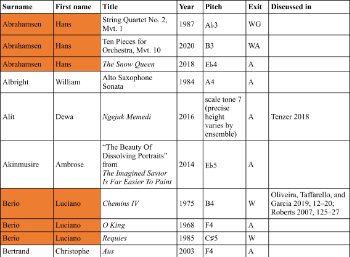
| Abrahamsen | Hans | String Quartet No. 2, Mvt. 1 | 1987 |
|
WG | |
| Abrahamsen | Hans | Ten Pieces for Orchestra, Mvt. 10 | 2020 | B3 | WA | |
| Abrahamsen | Hans | The Snow Queen | 2018 | E♭4 | A | |
| Albright | William | Alto Saxophone Sonata | 1984 | A4 | A | |
| Alit | Dewa | Ngejuk Memedi | 2016 |
scale tone 7 (precise height varies by ensemble) |
A | Tenzer 2018 |
| Akinmusire | Ambrose |
“The Beauty Of Dissolving Portraits” from The Imagined Savior Is Far Easier To Paint |
2014 |
|
A | |
| Berio | Luciano | Chemins IV | 1975 | B4 | W | Oliveira, Taffarello, and Garcia 2019, 12–20; Roberts 2007, 125–27 |
| Berio | Luciano | O King | 1968 | F4 | A | |
| Berio | Luciano | Requies | 1985 |
|
W | |
| Bertrand | Christophe | Aus | 2003 | F4 | A | |
| Birkenkotter | Jorg | In Nomine | 1999 | D4 | A | |
| Birtwistle | Harrison | Duets for Storab: VI. Crunluath | 1983 | D4 | A | |
| Birtwistle | Harrison | Hoquetus Petrus | 1995 | E5 | A | |
| Birtwistle | Harrison | Meridian | 1971 | E4 | A | |
| Birtwistle | Harrison | String quartet: The Tree of Strings | 2008 | E5 | WA | |
| Causton | Richard | Phoenix | 2006 | C5 | WA | |
| Chacon | Raven | Old Song | 2022 | C5 | W | Yazzie and Chacon 2022 |
| Cheah | Victoria | Walk for a shell | 2023 | A4 | WG | |
| Cheung | Anthony | A line can go anywhere, Mvt. 1 | 2019 | E♭4 | A | |
| Cheung | Anthony | Double Allegories | 2019 |
|
W | |
| Cheung | Pius | Unsynced | 2020 | B3 | WA | |
| Chin | Unsuk | Cello Concerto | 2013 |
|
WG | Lee 2020 |
| Chin | Unsuk | Graffiti, Mvt. 1 “Palimpsest” | 2013 | F♯5 | G | |
| Cline | Nicholas | I HAD A WHITE ROOM | 2018 | A3 | G | |
| Davachi | Sarah | Long Gradus, Part III | 2021 | G4, F4, or F3 | A | |
| Dean | Brett | And once I played Ophelia | 2013/ 2018 | A4 | WG | |
| Dean | Brett | Eclipse, Mvt. 1 | 2003 | A3 | A | |
| Eastman | Julius | Gay Guerrilla | 1979 | A5 notated | A | |
| English | Lawrence | A Binding | 2021 |
|
A | |
| Ferneyhough | Brian | Mnemosyne | 1986 | C4 | G | |
| Gravgaard Madsen | Allan | SUITE, “Gigue” | 2016 | D6 | WA | |
| Green | Brittany | Maps | 2017 | C4 | A | |
| Gubaidulina | Sofia | Garden of Joys and Sorrows | 1980 | A4 | W | |
| Gubaidulina | Sofia | Sieben Worte, Mvt. 5 | 1982 | F2 | WG | |
| Haddad | Saad | String Quartet No. 2 | 2021 | G6 | W | |
| Hennies | Sarah | Clock Dies | 2021 | C5 | AW | |
| Herndon | Julie | I Can Take | 2018 | C4 | W | |
| Holliger | Heinz | Ma'mounia | 2002 | A3 | G | |
| Honstein | Robert | Endless Landscape, Mvt. 3 “Darkly hypnotic, insistent” | 2022 | C5 | AW | |
| Hosokawa | Toshio | A Song from far away: in nomine | 1999 | D4 | A | |
| Hosokawa | Toshio | Arc Song | 2012 |
|
G | |
| Hosokawa | Toshio | Blossoming (String Quartet) | 2008 |
|
W | |
| Hosokawa | Toshio | Threnody | 2012 | G3 | G | |
| Kidambi and Liberatore | Amirtha and Matteo | "Bells" from Neutral Love | 2020 | D3 | WA | |
| Kurtág | György | Kafka-Fragmente, Part 1, No 4 “Restless” | 1992 | G5 | W | |
| Kurtág | György | Kafka-Fragmente, Part 3, No. 12 “Scene on a Tram” | 1992 | E4 | A | |
| Kurtág | György | Kafka-Fragmente, Part 4, No 1 “Too late” | 1992 |
|
W | |
| Kyriakides | Yannis | the arrest | 2010 | E4 | W | |
| Lancaster | Yaz | intangible landscapes | 2020 | C4 | A | |
| Lang | Klaus | parthenon | 2018 | C5 | W | |
| Laurello | Michael | Churches Made Out of Shipwrecks | 2018 | C4 | A | |
| Ligeti | György | Cello Concerto | 1966 | E4 | W | DeLio 2017; Levy 2017, 205–9; 2022, 145–46 |
| Ligeti | György | Chamber Concerto, Mvt. 3 | 1974 | E4 | G | |
| Ligeti | György | Lontano | 1967 | A♭4 | W | Bauer 2004, 121–30; Bernard 1987, 228–33; Levy 2017, 200–5; Morgan 1977, 49–50, Reiprich 1978 |
| Ligeti | György | Lux Aeterna | 1968 | F4 | A | Levy 2017, 192–200 |
| Ligeti | György | String Quartet 2, Mvt. 2 | 1968 | G♯4 | WA | |
| Ligeti | György | Ten Pieces for Wind Quintet, Mvt. 5 | 1969 | D4 | W | |
| Ligeti | György | Ten Pieces for Wind Quintet, Mvt. 9 | 1969 | E♭6 | W | Clendinning and Marvin 2021, 867; Levy 2017, 213–15 |
| Lockwood | Annea | Bayou-Borne | 2016 | B3 | GA | |
| Løkkegaard | Niels Lyhne | Music for 19 Clarinets | 2016 | A5 | WG | |
| Løkkegaard | Niels Lyhne | Towards a major third | 2016 | A5 | W | |
| Maysaud | Nebal | Decolonized Arabesques, Mvt. 2 | 2018 | D4 | W | |
| Morris | Robert | Landscape Greeting | 2020 | B♭4 | A | |
| Morris | Robert | Multiplicities and then some | 2019 | E3 | A | |
| Netzer | Osnat | They bury their dead with great ululations | 2018 | B4 | WG | |
| Neuwirth | Olga | In Nacht und Eis | 2007 |
|
WA | |
| Oliveros | Pauline | Horse Sings from Cloud | 1975 | any | A | |
| Poppe | Enno | Stoff | 2015 |
|
A | |
| Rands | Bernard | Canti dell’Eclisse | 1992 |
|
AW | |
| Rosing-Schow | Niels | FlashNight | 2016 | E4 | W | |
| Rowden and Birdsey | Zach and Henry | From the Crypt, Side B | 2024 |
|
A | |
| Saariaho | Kaija | Leino Songs, Mvt. 2 “Sydan” | 2007 | E5 | A | |
| Saariaho | Kaija | Neiges | 1998 |
|
A | |
| Saariaho | Kaija | Nymphea Reflection, Mvt. 6 | 2015 | D3 | G | |
| Saunders | Rebecca | A Visible Trace | 2006 | B3 | AG | |
| Scelsi | Giacinto | Elegia per Ty, Mvt. 1 | 1988 |
|
G | |
| Scelsi | Giacinto | Elegia per Ty, Mvt. 2 | 1988 |
|
G | |
| Scelsi | Giacinto | Quattro pezzi su una nota sola, Mvt. 3 | 1959 |
|
WGA | Elezovic, 57–66; Reish 2006, 185; DeLio [2007] 2021, 105–43 |
| Scelsi | Giacinto | Quattro pezzi su una nota sola, Mvt. 4 | 1959 | A3 | AW | Elezovic, 66–84; Reish 2006, 186–87 |
| Scelsi | Giacinto | Sauh IV | 1973 | A4 | W | |
| Scelsi | Giacinto | Voyages, Mvt. 1 | 1985 | B♭3 | WG | |
| Schafer | R. Murray | Gamelan | 1980 | C4 | W | |
| Schafer | R. Murray | Requiems for the Party Girl | 1966 | C4 | WA | |
| Schafer | R. Murray | Scorpius | 1990 | C4 | W | |
| Schafer | R. Murray | String Quartet No. 3, Mvt. 3 | 1981 | C4 | G | |
| Sharpe | Christopher | Joy Cometh in the Morning | 2018 |
|
A | |
| Singleton | Alvin | Be Natural | 1974 | B3 | A | |
| Smooke | Vid | All are Welcome Here | 2017 | C5 | A | |
| Soper | Kate | Here be Sirens, "Prologue" | 2013 | E4 | W | |
| Strand | Ryan Townsend | PAX - NOX | 2017 | F3 | A | |
| Stockhausen | Karlheinz | Inori | 1973 | G4 | A | Harvey 1999, 81–82 |
| Stockhausen | Karlheinz | Stimmung | 1968 |
|
A | |
| Tanaka | Gen | Sobering | 2018 | F4 | A | |
| Tenney | James | Three New Seeds, Mvt. 7 | 1992 | F4 | W | Wannamaker 2021b, 288 |
| Terrazas | Wilfrido | The Torres Cycle, “Tótem II, Miro hacia el cielo” | 2019 | B5 | WA | |
| Thomas | Augusta Read | Dance Mobile | 2022 | E4 | A | |
| Thomas | Augusta Read | Of Being is a Bird | 2015 | G4 | W | |
| Travers | Aaron | The Nameless Path | 2022 |
|
WA | |
| Tsao | Ming | (Un)cover | 2010 | D4 | G | |
| Tulve | Helena | Öö (Night) | 1997 | C4 | AW | |
| Webber | Anna | Swell | 2023 | C4 | A | |
| Woods | Ayanna | Shift | 2020 | G3 | A | |
| Xenakis | Iannis | Waarg | 1988 | E4 | AW | |
| Xenakis | Iannis | Pléïades, “Metaux” | 1978 | perc. | W | [AB: Citation needed?] de Ceuster 2021 |
| Xu | Shuya | In nomine | 1999 | D4 | WA |
Appendix 5 (duplicating Example 39): list of unisons involving electronics (orange indicates composers previously mentioned)
| Surname | First name | Title | Year | Pitch | Exit | Discussed in |
| Beil | Michael | Die Zwei | 2004 | F3 | A | [AB: Provided table refers to Chung 2019b, please confirm or provide reference]Chung 2019, [6.2] |
| Benge | 1970 ARP 2500 | 2008 | F4 | AW | ||
| Benge | 1971 ARP 2600 | 2008 | G4 | WA | ||
| Benge | 1983 Fairlight CMI | 2008 | G2 | A | ||
| Berio | Luciano | Altra Voce | 1999 | F4 | W | Roberts 2007, 126 |
| Berio | Luciano | Sequenza VII for solo oboe | 1969 | B4 | W | Alessandrini 2007; Oliveira, Taffarello, and Garcia 2019, 6–11; Roberts 2003; Snyder 2000, 248 |
| Bertucci | Lea | Sustain and Dissolve | 2018 |
|
||
| Bertucci | Lea | Warp and Weft | 2019 | C5 | ||
| Bertucci | Lea | Wind Piece | 2019 |
|
||
| Bonvalet | Thomas | 440Hz, Téléphone... And Métronome, Guitare, Scotch De Peintre, Membranes... | 2021 | A4 | W | |
| Branciforte and Bleckmann | Joseph and Theor | 10.11.5 | 2023 | D4 | AW | |
| Cerrone | Christopher | A Natural History of Vacant Lots | 2017 | B5 | A | |
| Clift | Paul | Astatine | 2019 | C2 | A | |
| Cruel Diagonals | Reconciliation | 2023 | D4 | A | ||
| Davachi | Sarah | Alms Vert | 2013 | D3 | A | |
| Davachi | Sarah | Olsun | 2015 | B3 | A | |
| Davidovsky | Mario | Synchronisms No. 6 | 1970 | G5 | A | |
| de Asis | Clara | Repetition of the Same Dream | 2020 | A5 | A | |
| Diels | Natacha | automatic writing mumbles of the late hour | 2020 | E6 | A | |
| Ellis | JJJJJerome | The Clearing, “Punch Line” | 2021 | B3 | WA | Ellis 2020 |
| Ergün | Cenk | Inseln | 2021 |
A½ |
W | |
| Geaney | Susan | Tape Melt | 2022 |
|
AG | |
| Haddad | Saad | A Hummingbird Told Me | 2019 | C6 | WA | |
| Johns | Sullivan | Pitched Variations | 2025 | D4 | AW | |
| Kamaru | Joseph | Along A Wall | 2023 |
|
A | |
| Kamaru | Joseph | Argon | 2021 | C4 | A | Chattopadhyay 2022 |
| Kamaru | Joseph | falling dreams | 2021 |
|
A | |
| Kamaru | Joseph | Imperceptible Perceptible | 2022 |
|
W | |
| Kirkegaard | Jacob | 0102 Köln | 2002 | B4 | A | |
| Kirkegaard | Jacob | 0602 Köln | 2002 |
|
A | |
| Lee | Charmaine | Market Slip | 2021 |
|
W | |
| Lisel | Polyphony for Voices | 2023 |
|
W | ||
| Lowe | Robert Aiki Aubrey | Structural Swell | 2018 |
|
fade | |
| Lowe | Robert Aiki Aubrey | Wit's end | 2007 | G4 | WA | |
| Lucier | Alvin | Charles Curtis | 2002 | C4 | W | Saunders and Lucier 2009, 305–6; Rietbrock 2022, 194–95 |
| Lucier | Alvin | Ever Present | 2002 | C4 | W | |
| Lucier | Alvin | Fruits and Vegetables, “Granny Smith Apple” and “Two Lemons” | 2000 | E3 and F3 | W | Lucier 2002, 261 |
| Lucier | Alvin | Kettles | 1987 | A2 | W | Lucier and Tenney 1988, 11 |
| Lucier | Alvin | Music for Piano with Slow Sweep, Pure Wave Oscillators | 1992 | E4 | W | Lucier 2002, 254–55 |
| Lucier | Alvin | On the carpet of leaves illuminated by the moon | 2000 |
|
G | |
| Lucier | Alvin |
Six Geometries, Mvts. 1. “Small Fish Logo”, 3 “Right Angle,” 4 “Triangle,” and 6 “Plums.” |
1992 |
G4, C4, G4, |
W, AW, WA, WA | Lucier 1995, 286; Lucier 2002, 255 |
| Lucier | Alvin | Still Lives, Mvts. 1 “Sunlight Diamond”, 2 “Hammock”, 4 “Lamp Shade”, 5 “Three Floor Tiles” | 1996 |
|
WA, G, WA, WA | Rietbrock 2022, 193 |
| Lucier | Alvin | Two Circles | 2012 | E4 | W | Rietbrock 2022, 202 |
| Magnetic Coroner | Cloned Ghost 1 | 2023 | E5 | WA | ||
| Mincek | Alex | Glossolalia, “Thread 2” | 2019 | C4 | A | |
| Mitterer | Wolfgang | Little Smile | 2011 | F4 | fade | |
| Mounir | Nancy | Ana Bas Saktalak (with Fatma Serry) | 2022 | C2 | A | |
| Niblock | Phill | A Cage of Stars | 2013 | G4 | A | |
| Niblock | Phill | Feed Corn Ear | 2012 | G3 | A | |
| Niblock | Phill | Harm | 2003 | G2 | AW | Demers 2010, 95–96 |
| Niblock | Phill | P K | 1990? |
|
WA | |
| Niblock | Phill | S L S | 1990? | F4 | WA | |
| Niblock | Phill | Stosspeng | 2007 | F2 | A | |
| Noit | Hatis | Aura | 2019 |
|
W | |
| Noit | Hatis | Aura | 2022 |
|
W | |
| Oliveira | João Pedro | Beyond | 2006 | A5 | G | |
| Poppe | Enno | Rundfunk, Mvt. 1 | 2018 |
C4 notated, |
AG | |
| Radigue | Éliane | Adnos 3 | 1980 | D2 | A | |
| Radigue | Éliane | Kyema | 1994 | A3 | A | |
| Rangaswamy | Varun | REINHERITANCE, “wing joint alapana” | 2023 | D3 | W | Carnatic alapana genre discussed in Viswanathan 1977, 56 |
| Reider | C. | sever the invisible hand, “false divine” | 2022 |
|
A | |
| Rothwell | Carmen Q. | Blissful Ignore | 2021 |
|
A | |
| rousay | claire | Sigh In My Ear | 2023 | D | A | |
| rousay | claire | Your First Armadillo | 2023 |
|
A | |
| Saariaho | Kaija | Frises, Mvts. 1 and 3 | 2011 | D4 | G | |
| Smylex Attack | Aether / Flux | 2021 | A4 | A | ||
| Tipp | Devon Osamu | Good Morning if it is Good Morning | 2021 | G4 | WA | |
| Wincek | Thomas | The desert of the real itself, SIDE A | 2020 |
|
A | |
| Young | Nina | Kolokol | 2010 | A6 | A | |
| Z | Pamela | Occupy, “Site Four” | 2017 |
|
A | |
| Z | Pamela | Quatre Couches | 2015 |
|
WA | Lansang 2019, 145–55 |
| Z | Pamela | Timepiece Triptych, “Declaratives in the First Person” | 2005 | E3 | G | |
Noah Kahrs
200 S Eagleson Ave
Bloomington, IN
nkahrs@iu.edu
Works Cited
Adams, George William. 2019. “Listening to Conceptual Music: Technology, Culture, Analysis.” PhD diss., University of Chicago. https://doi.org/10.6082/uchicago.2006.
Alessandrini, Patricia. 2007. “A Dress or a Straightjacket? Facing the Problems of Structure and Periodicity Posed by the Notation of Berio’s Sequenza VII for Oboe.” In Berio’s Sequenzas: Essays on Performance, Composition and Analysis, ed. Janet K. Halfyard, 67–82. Ashgate. https://doi.org/10.4324/9781315096476-5.
Anderson, Julian. 2000. “A Provisional History of Spectral Music.” Contemporary Music Review 19 (2): 7–22. https://doi.org/10.1080/07494460000640231.
Arndt, Matthew. 2018. “Form—Function—Content.” Music Theory Spectrum 40 (2): 208–26. https://doi.org/10.1093/mts/mty024.
Baillet, Jérôme. 2000. Gérard Grisey: Fondements d’une Écriture. L’Harmattan.
Bauer, Amy. 2001. “‘Composing the Sound Itself’: Secondary Parameters and Structure in the Music of Ligeti.” Indiana Theory Review 22 (1): 37–64. https://www.jstor.org/stable/24054247.
—————. 2004. “‘Tone-Color, Movement, Changing Harmonic Planes’: Cognition, Constraints and Conceptual Blends in Modernist Music.” In The Pleasure of Modernist Music: Listening, Meaning, Intention, Ideology, ed. Arved Mark Ashby, 121–52. University of Rochester Press. https://doi.org/10.1515/9781580466233-007.
—————. 2021. “Spectral Aesthetics and Ecological Listening in the Music of Helena Tulve.” In The Oxford Handbook of Spectral Music, ed. Amy Bauer, Liam Cagney, and William Mason, 383–89. Oxford University Press. https://doi.org/10.1093/oxfordhb/9780190633547.013.34.
Beal, Amy C. 2006. New Music, New Allies: American Experimental Music in West Germany from the Zero Hour to Reunification. University of California Press. https://doi.org/10.1525/9780520932814.
Bell, Gelsey. 2016. “Extended Vocal Technique and Joan La Barbara: The Relational Ethics of Voice on the Edge of Intelligibility.” Journal of Interdisciplinary Voice Studies 1 (2): 143–60. https://doi.org/10.1386/jivs.1.2.143_1.
Bernard, Jonathan. 1987. “Inaudible Structures, Audible Music: Ligeti’s Problem, and His Solution.” Music Analysis 6 (3): 207–36. https://doi.org/10.2307/854203.
Birch, Alexandra. 2017. “Balancing Mathematics and Virtuosity: A Performer’s Guide to Sofia Gubaidulina’s Dancer on a Tightrope.” DMA diss., Arizona State University. http://hdl.handle.net/2286/R.I.45955.
Blackburn, Manuella. 2011. “The Visual Sound-Shapes of Spectromorphology: An Illustrative Guide to Composition.” Organized Sound 16 (1): 5–13. https://doi.org/10.1017/S1355771810000385.
Boss, Jack. 2014. Schoenberg’s Twelve-Tone Music: Symmetry and the Musical Idea. Cambridge University Press. https://doi.org/10.1017/CBO9781107110786.
Bowling, Daniel L., Dale Purves, and Kamraan Z. Gill. 2018. “Vocal Similarity Predicts the Relative Attraction of Musical Chords.” Proceedings of the National Academy of Sciences 115 (1): 216–21. https://doi.org/10.1073/pnas.1713206115.
Bregman, Albert S. 1994. Auditory Scene Analysis: The Perceptual Organization of Sound. MIT Press. https://doi.org/10.1121/1.408434.
Brodsky, Seth. 2017. From 1989, or European Music and the Modernist Unconscious. University of California Press. https://doi.org/10.1525/california/9780520279360.001.0001.
Brown, Jeffrey Arlo. 2023. The Life and Music of Gérard Grisey: Delirium and Form. University of Rochester Press. https://doi.org/10.1515/9781805430728.
Burstein, L. Poundie, and Joseph N. Straus. 2024. Concise Introduction to Tonal Harmony. 3rd ed. W. W. Norton.
Byros, Vasili. 2009. “Towards an ‘Archaeology’ of Hearing: Schemata and Eighteenth-Century Consciousness.” Musica Humana 1 (2): 235–306.
—————. 2012. “Unearthing the Past: Theory and Archaeology in Robert Gjerdingen’s Music in the Galant Style.” Music Analysis 31 (1): 112–24. https://www.jstor.org/stable/23322094.
Cagney, Liam. 2023. Gérard Grisey and Spectral Music: Composition in the Information Age. Cambridge University Press. https://doi.org/10.1017/9781009399494.
—————. 2025. “Tristan Murail’s Musical Poetics.” In The Oxford Handbook of Spectral Music, ed. Amy Bauer, Liam Cagney, and William Mason. Oxford University Press. https://doi.org/10.1093/oxfordhb/9780190633547.013.20.
Caplin, William. 2009. “Response to the Comments.” In Musical Form, Forms & Formenlehre: Three Methodological Reflections, by William E. Caplin, James A. Hepokoski, and James Webster, ed. Pieter Bergé, 51–61. Leuven University Press. https://doi.org/10.2307/j.ctt9qf01v.8.
Ceuster, Diederik Mark de. 2021. “‘Use 19 Metal Pieces of Approximately the Same Timbre’: An Analysis of Twelve Recorded Performances of Xenakis’s Métaux (Pléïades).” Zeitschrift Der Gesellschaft Für Musiktheorie 18 (1): 71–100. https://doi.org/10.31751/1106.
Chattopadhyay, Budhaditya. 2022. Sound Practices in the Global South: Co-Listening to Resounding Plurilogues. Palgrave Macmillan. https://doi.org/10.1007/978-3-030-99732-8.
Chung, Andrew J. 2019. “What Is Musical Meaning? Theorizing Music as Performative Utterance.” Music Theory Online 25 (1). https://doi.org/10.30535/mto.25.1.2.
Clendinning, Jane Piper, and Elizabeth West Marvin. 2021. The Musician’s Guide to Theory and Analysis. W. W. Norton.
Cobb, Nathan Alexander. 2024. “Synthesis at the Frontiers: Kaija Saariaho and the Formation of a Practice.” PhD diss., University of California, Santa Barbara. https://www.proquest.com/docview/3123648754.
Colombat, Henri. 2020. “Amazing Moments in Timbre #11: the children of fire come looking for fire – Eric Wubbels.” Timbre and Orchestration Resource, May 1. https://doi.org/10.5281/zenodo.7922718.
Cowell, Henry. (1930) 1996. New Musical Resources. Edited by David Nicholls. Cambridge University Press. https://doi.org/10.1017/CBO9780511597329.
Cross, Jonathan. 2018. “Musical Spectra, l’espace Sensible and Contemporary Opera.” Twentieth-Century Music 15 (1): 103–24. https://doi.org/10.1017/S1478572218000087.
Decroupet, Pascal. 2022. “Making Audible the Mysteries of Sound: An Alternative Historiography for the Musical Avant-Garde from Varèse to Grisey.” In Revisiting the Historiography of Postwar Avant-Garde Music, ed. Anne-Sylvie Barthel-Calvet and Christopher Brent Murray, 173–91. Routledge. https://doi.org/10.4324/9781315108162-9.
DeLio, Thomas. 2017. “Composing a Sound: Giacinto Scelsi’s L’âme Ailée / L’âme Ouverte for Violin Solo.” College Music Symposium 57. https://symposium.music.org/index.php/57/item/11365-composing-a-sound-giacinto-scelsi-s-l-ame-ailee-l-ame-ouverte-for-violin-solo.
—————. [2007] 2021. “Su Una Nota Sola: Giacinto Scelsi’s ’Quattro Pezzi, No. 3.” In Analytical Studies about Music by Thomas Delio: Beethoven, Carter, Chopin, Delio, Feldman, Haydn, Mahler, Reynolds, Satie, Scelsi, Webern, Wolpe, and Xenakis, ed. Thomas Licata, 105–44. The Edwin Mellen Press.
Demers, Joanna. 2010. Listening through the Noise: The Aesthetics of Experimental Electronic Music. Oxford University Press.
Dennehy, Donnacha. 2008. “Interview with James Tenney.” Contemporary Music Review 27 (1): 79–89. https://doi.org/10.1080/07494460701671541.
Dewitt, Lucinda A., and Robert G. Crowder. 1987. “Tonal Fusion of Consonant Musical Intervals: The Oomph in Stumpf.” Perception & Psychophysics 41 (1): 73–84. https://doi.org/10.3758/BF03208216.
Dickson, Ian. 2012. “Towards a Grammatical Analysis of Scelsi’s Late Music: Towards a Grammatical Analysis of Scelsi’s Late Music.” Music Analysis 31 (2): 216–41. https://doi.org/10.1111/j.1468-2249.2012.00336.x.
Dohoney, Ryan. 2015. “A Flexible Musical Identity: Julius Eastman in New York City, 1976–90.” In Gay Guerrilla: Julius Eastman and His Music, ed. Renee Levine-Packer and Mary Jane Leach, 116–30. University of Rochester Press. https://doi.org/10.1017/9781782046868.009.
Drott, Eric. 2013. “The End(s) of Genre.” Journal of Music Theory 57 (1): 1–45. https://doi.org/10.1215/00222909-2017097.
—————. 2017. “Saariaho, Timbre, and Tonality.” In Tonality Since 1950, ed. Felix Wörner, Ullrich Scheideler, and Philip Ernst Rupprecht, 259–81. Franz Steiner Verlag.
Eastman, Julius. [1980] 2023. “Julius Eastman Introduces His Concert at Northwestern University.” In On Minimalism: Documenting a Musical Movement, ed. Kerry O’Brien and William Robin, 278–79. University of California Press.
Elezovic, Ivan. 2007. “Scelsi’s Approach to the Third Dimension in ‘Quattro Pezzi (Su Una Nota Sola).’” DMA diss., University of Illinois at Urbana-Champaign. https://www.proquest.com/docview/304854080.
Elliott, Robin. 1997. “The Spirit of Compromise in the Canadian String Quartet.” In Music in Canada: A Collection of Essays, ed. Guido Bimberg, 137–50. Universitätsverlag Dr. N. Brockmeyer.
Ellis, JJJJJerome. 2020. “The Clearing: Music, Dysfluency, Blackness and Time.” Journal of Interdisciplinary Voice Studies 5 (2): 215–33. https://doi.org/10.1386/jivs_00026_1.
Fakhrtabatabaie, Ashkan, and Skyler G. Jennings. 2021. “Evaluating Tenney’s Critical Band Using a Computational Model of the Human Cochlea.” In Proceedings of the Future Directions of Music Cognition International Conference, 6–7 March 2021, 241–45. The Ohio State University Libraries. https://doi.org/10.18061/FDMC.2021.0048.
Fales, Cornelia. 2002. “The Paradox of Timbre.” Ethnomusicology 46 (1): 56–95. https://doi.org/10.2307/852808.
Féron, François-Xavier. 2010. “Sur Les Traces de La Musique Spectrale: Analyse génétique des modèles compositionnels dans Périodes (1974) de Gérard Grisey.” Revue de Musicologie 96 (2): 411–43. https://www.jstor.org/stable/41637956.
—————. 2021. “Spectra as Theoretical and Practical Models in Gérard Grisey’s Creative Process.” In The Oxford Handbook of Spectral Music, ed. Amy Bauer, Liam Cagney, and William Mason, 227–51. Oxford University Press. https://doi.org/10.1093/oxfordhb/9780190633547.013.19.
Fineberg, Joshua. 2000. “Musical Examples.” Contemporary Music Review 19 (2): 115–34. https://doi.org/10.1080/07494460000640281.
Fisette, Denis. [2009] 2019. “Carl Stumpf.” In The Stanford Encyclopedia of Philosophy, Spring 2019 Edition, ed. Edward N. Zalta. Metaphysics Research Lab, Stanford University. https://plato.stanford.edu/archives/spr2019/entries/stumpf/.
Friedman, Ronald S., Douglas A. Kowalewski, Dominique T. Vuvan, and W. Trammell Neill. 2021. “Consonance Preferences Within an Unconventional Tuning System.” Music Perception 38 (3): 313–30. https://doi.org/10.1525/mp.2021.38.3.313.
Gjerdingen, Robert O. 1984. “A Musical Schema: Structure and Style Change, 1720–1900.” PhD diss., University of Pennsylvania. https://www.proquest.com/docview/303304609.
—————. (1988). A Classic Turn of Phrase: Music and the Psychology of Convention. University of Pennsylvania Press.
—————. 2007. Music in the Galant Style. Oxford University Press. https://doi.org/10.1093/oso/9780195313710.001.0001.
—————. 2015. “Schema Theory as a Construction Grammar.” Music Theory Online 21 (2). https://doi.org/10.30535/mto.21.2.3.
Gottschalk, Jennie. 2016. Experimental Music since 1970. Bloomsbury. https://doi.org/10.5040/9781501396328.
Grisey, Gérard. [1982] 2008. “La musique: le devenir des sons.” In Écrits, Éd. augmentée, edited by Guy Lelong and Anne-Marie Réby. Répercussions. Éd. augmentée. MF.
Gutkin, David. 2022. “Eight Listening Sketches and an Interview with Joan La Barbara.” Tempo 76 (301): 19–37. https://doi.org/10.1017/S0040298222000031.
Hanson-Dvoracek, Andrew. 2015. “A Postminimalist Analysis of Julius Eastman’s Crazy N*****.” In Gay Guerrilla: Julius Eastman and His Music, ed. Renée Levine Packer and Mary Jane Leach, 140–50. University of Rochester Press. https://doi.org/10.1017/9781782046868.011.
Harrison, Peter M. C., and Marcus T. Pearce. 2020. “Simultaneous Consonance in Music Perception and Composition.” Psychological Review 127 (2): 216–44. https://doi.org/10.1037/rev0000169.
Hartmann, William M. 2005. Signals, Sound, and Sensation. Springer.
Harvey, Jonathan. 1999. In Quest of Spirit: Thoughts on Music. University of California Press.
Hasegawa, Robert. 2009. “Gérard Grisey and The ‘Nature’ of Harmony.” Music Analysis 28 (2–3): 349–71. https://doi.org/10.1111/j.1468-2249.2011.00294.x.
Hasegawa, Robert. 2019. “Timbre as Harmony—Harmony as Timbre.” In The Oxford Handbook of Timbre, ed. Emily I. Dolan and Alexander Rehding, 525–51. Oxford University Press. https://doi.org/10.1093/oxfordhb/9780190637224.013.11.
Helmholtz, Hermann L. F. (1885) 1954. On the Sensations of Tone as a Physiological Basis for the Theory of Music. Translated by Alexander J Ellis. Dover.
Heneghan, Áine. 2006. “Tradition as Muse: Schoenberg’s Musical Morphology and Nascent Dodecaphony.” PhD diss., Trinity College Dublin. https://www.tara.tcd.ie/items/7787f7cd-b604-4390-a9c2-aa76c157fc10.
Hier, David. 2023. “Chromatic Function in Schoenberg’s Little Piano Piece, Op. 19, No. 1.” Music Theory Online 29 (3). https://doi.org/10.30535/mto.29.3.3.
Hisama, Ellie M. 2014. “‘Diving into the Earth’: The Musical Worlds of Julius Eastman.” In Rethinking Difference in Music Scholarship, ed. Olivia Bloechl, Melanie Lowe, and Jeffrey Kallberg, 261–86. Cambridge University Press. https://doi.org/10.1017/CBO9781139208451.009.
Hui, Alexandra. 2012. The Psychophysical Ear: Musical Experiments, Experimental Sounds, 1840–1910. The MIT Press. https://doi.org/10.7551/mitpress/9460.001.0001.
Huron, David. 2016. Voice Leading: The Science behind a Musical Art. The MIT Press. https://doi.org/10.7551/mitpress/9780262034852.001.0001.
Hutchinson, William, and Leon Knopoff. 1978. “The Acoustic Component of Western Consonance.” Interface 7 (1): 1–29. https://doi.org/10.1080/09298217808570246.
Iverson, Jennifer. 2009a. “Historical Memory and György Ligeti’s Sound-Mass Music 1958-1968.” PhD diss., University of Texas at Austin. https://www.proquest.com/docview/305005528.
Iverson, Jennifer. 2009b. “Shared Compositional Techniques between György Ligeti’s Pièce Électronique No. 3 and Atmosphères.’” Mitteilungen Der Paul Sacher Stiftung 22: 29–33.
Iverson, Jennifer. 2010. “The Emergence of Timbre: Ligeti’s Synthesis of Electronic and Acoustic Music in Atmosphères.” Twentieth-Century Music 7 (1): 61–89. https://doi.org/10.1017/S1478572211000053.
Iverson, Jennifer. 2019. Electronic Inspirations: Technologies of the Cold War Musical Avant-Garde. Oxford University Press. https://doi.org/10.1093/oso/9780190868192.001.0001.
Jakubowski, Joseph R. 2019. “Between Concept and Perception: Cognition, Experience, and Form in Spectral Music.” PhD diss., Washington University in Saint Louis. https://doi.org/10.7936/hnjp-r164.
Jean-Francois, Isaac. 2020. “Julius Eastman: The Sonority of Blackness Otherwise.” Current Musicology 106. https://doi.org/10.52214/cm.v106i.6772.
Jensen, Jørgen I. 1986. Per Nørgårds Musik: Et Verdensbillede i Forandring. Amadeus.
Kankaanpää, Vesa. 2011. “Dichotomies, Relationships: Timbre and Harmony in Revolution.” In Kaija Saariaho: Visions, Narratives, Dialogues. Routledge.
La Barbara, Joan. 2002. “Voice Is the Original Instrument.” Contemporary Music Review 21 (1): 35–48. https://doi.org/10.1080/07494460216648.
Lahdelma, Imre, Tuomas Eerola, and James Armitage. 2022. “Is Harmonicity a Misnomer for Cultural Familiarity in Consonance Preferences?” Frontiers in Psychology 13. https://doi.org/10.3389/fpsyg.2022.802385.
Lamb, Catherine. 2017. “Tenney’s Aggregates.” https://www.sacredrealism.org/artists/catherine-lamb/text/Lamb_Tenney_Aggregates.pdf.
—————. 2019. Atmospheres Transparent/Opaque. New World Records.
Lansang, Rachael Leigh. 2019. “Songs for Contemporary Voices: Perspectives and Strategies of Women Making Music in the Twenty-First Century.” PhD diss., Rutgers University. https://rucore.libraries.rutgers.edu/rutgers-lib/60817/.
Lee, Jung-Min. 2020. “The Story of Unsuk Chin’s Cello Concerto.” Global Musical Modernisms (blog), January 16. https://globalmusicalmodernisms.hcommons.org/2020/01/16/the-story-of-unsuk-chins-cello-concerto/.
Lenchitz, Jordan. 2021. “Partial-Oriented Listening and the Timbre-Pitch Perceptual Continuum.” In Proceedings of the Future Directions of Music Cognition International Conference, 6–7 March 2021, 268. The Ohio State University Libraries. https://doi.org/10.17605/OSF.IO/KAVJY.
Leroux, Philippe. 2004. “Intégrer La Surprise: Les Processus Dans Partiels de Gérard Grisey.” In Le Temps de l’écoute. Gérard Grisey Ou La Beauté Des Ombres Sonores, ed. Danielle Cohen-Lévinas, 37–50. Editions L’Harmattan.
Levy, Benjamin R. 2009. “Shades of the Studio: Electronic Influences on Ligeti’s ‘Apparitions.’” Perspectives of New Music 47 (2): 59–87. https://doi.org/10.1353/pnm.2009.0010.
—————. 2017. Metamorphosis in Music: The Compositions of György Ligeti in the 1950s and 1960s. Oxford University Press.
—————. 2022. “Ligeti’s Distant Resonances with Spectralism.” In The Oxford Handbook of Spectral Music, ed. Amy Bauer, Liam Cagney, and William Mason, 136–58. Oxford University Press. https://doi.org/10.1093/oxfordhb/9780190633547.013.17.
Lewis, George E. 2015. “Foreword.” In Gay Guerrilla: Julius Eastman and His Music, ed. Renee Levine-Packer, and Mary Jane Leach. University of Rochester Press. https://doi.org/10.1515/9781782046868-001.
Lochhead, Judy. 2016. Reconceiving Structure in Contemporary Music: New Tools in Music Theory and Analysis. Routledge. https://doi.org/10.4324/9781315740744.
London, Justin. 2012. Hearing in Time: Psychological Aspects of Musical Meter. 2nd ed. Oxford University Press. https://doi.org/10.1093/acprof:oso/9780199744374.001.0001.
Lucier, Alvin. 1995. Reflections: Interviews, Scores, Writings. Edited by Gisela Gronemeyer and Reinhard Oehlschlägel. MusikTexte.
—————. 1998. “Origins of a Form: Acoustical Exploration, Science and Incessancy.” Leonardo Music Journal 8 (1): 5–11. https://doi.org/10.2307/1513391.
—————. 2002. “Fruits and Vegetables.” Current Musicology 67-68: 253–68.
Lucier, Alvin, and James Tenney. 1988. “Crossings.” MusicWorks 41: 6–13.
Maler, Anabel. 2022. “Listening to Phrase Structure and Formal Function in Post-Tonal Music.” Intégral 35: 45–68. https://www.esm.rochester.edu/integral/35-2022/maler/.
Marvin, Elizabeth West. 1987. “Tonpsychologie and Musikpsychologie: Historical Perspectives on the Study of Music Perception.” Theoria 2: 59–84. https://digital.library.unt.edu/ark:/67531/metadc287880/m1/67/.
McAdams, Stephen. 1982. “Spectral Fusion and the Creation of Auditory Images.” In Music, Mind, and Brain: The Neuropsychology of Music, ed. Manfred Clynes, 279–98. Springer. https://doi.org/10.1007/978-1-4684-8917-0_15.
McDermott, Josh H., Andriana J. Lehr, and Andrew J. Oxenham. 2010. “Individual Differences Reveal the Basis of Consonance.” Current Biology 20 (11): 1035–41. https://doi.org/10.1016/j.cub.2010.04.019.
McPherson, Malinda J., Sophia E. Dolan, Alex Durango, Tomas Ossandon, Joaquín Valdés, Eduardo A. Undurraga, Nori Jacoby, Ricardo A. Godoy, and Josh H. McDermott. 2020. “Perceptual Fusion of Musical Notes by Native Amazonians Suggests Universal Representations of Musical Intervals.” Nature Communications 11 (1): 2786. https://doi.org/10.1038/s41467-020-16448-6.
Mendez, Matthew. 2024. “History beyond Recovery: Julius Eastman and the Challenge of the Heterological.” Journal of the American Musicological Society 77 (1): 163–222. https://doi.org/10.1525/jams.2024.77.1.163.
Menke, Johannes. 2001. “Mathias Spahlingers gegen unendlich.” Musik & Ästhetik 5 (20): 15–26. https://www.musikundaesthetik.de/article/99.120205/mu-5-4-15.
Metzer, David Joel. 2009. Musical Modernism at the Turn of the Twenty-First Century. Cambridge University Press.
Milne, Andrew J., Eline A. Smit, Hannah S. Sarvasy, and Roger T. Dean. 2023. “Evidence for a Universal Association of Auditory Roughness with Musical Stability.” PLoS ONE 18 (9): e0291642. https://doi.org/10.1371/journal.pone.0291642.
Molchanov, Andrey Sergeyevich. 2016. “Fenomen odnozvukovykh kompozitsiy v muzyke XX veka” (The Phenomenon of One-Tone Compositions in the XXth Century Music).” In Yuzhno-rossiyskiy muzykalnyy almanakh (South-Russian Musical Anthology) 4 (25): 35–40. https://musalm.ru/assets/almanac/2016-4/1-6.pdf.
Morgan, Robert P. 1977. “On the Analysis of Recent Music.” Critical Inquiry 4 (1): 33–53. https://doi.org/10.1086/447923.
Morrison, Landon. 2019. “Sounds, Signals, Signs: Transductive Currents in Post-Spectral Music at IRCAM.” PhD diss., McGill University. https://escholarship.mcgill.ca/concern/theses/sq87bz707.
Murail, Tristan. [1980] 2005. “The Revolution of Complex Sounds.” Translated by Joshua Cody. Contemporary Music Review 24 (2-3): 121–35. https://doi.org/10.1080/07494460500154780.
—————. (1999) 2005. “Scelsi, de-Composer.” Translated by Robert Hasegawa. Contemporary Music Review 24 (2-3): 173–80. https://doi.org/10.1080/07494460500154822.
Noble, Jason, and Stephen McAdams. 2020. “Sound Mass, Auditory Perception, and ‘Post-Tone’ Music.” Journal of New Music Research 49 (3): 231–51. https://doi.org/10.1080/09298215.2020.1749673.
Nørgård, Per. 1969. “‘Sway’ - Dehumaniseret Musik.” Selvsyn 10 (1): 42–45. https://img.kb.dk/export/sites/kb_dk/da/nb/dcm/udgivelser/norgard/artikler/Sway.1969.pdf.
Nørgård, Per. Arkiv. Det Kgl. Bibliotek.
O’Callaghan, Casey. 2007. Sounds: A Philosophical Theory. Oxford University Press.
Oliveira, Vinícius Cesar de, Tadeu Moraes Taffarello, and Denise Hortência Lopes Garcia. 2019. “Berio via Pousseur e Costère: Uma proposta de análise de Sequenza VII e Chemins IV.” Revista Vórtex 7 (3): 1–29. https://doi.org/10.33871/23179937.2019.7.3.3198.
Oxenham, Andrew J. 2018. “How We Hear: The Perception and Neural Coding of Sound.” Annual Review of Psychology 69 (1): 27–50. https://doi.org/10.1146/annurev-psych-122216-011635.
Parkhurst, Bryan, and Stephan Hammel. 2018. “Pitch, Tone, and Note.” In The Oxford Handbook of Critical Concepts in Music Theory, ed. Alexander Rehding and Steven Rings, 3–39. Oxford University Press. https://doi.org/10.1093/oxfordhb/9780190454746.013.25.
Parncutt, Richard. 2024. Psychoacoustic Foundations of Major-Minor Tonality. The MIT Press. https://doi.org/10.7551/mitpress/15050.001.0001.
Parncutt, Richard, and Graham Hair. 2018. “A Psychocultural Theory of Musical Interval: Bye Bye Pythagoras.” Music Perception 35 (4): 475–501. https://doi.org/10.1525/mp.2018.35.4.475.
Piekut, Benjamin. 2011. Experimentalism Otherwise: The New York Avant-Garde and Its Limits. University of California Press. https://doi.org/10.1525/9780520424654.
—————. 2014. “Actor-Networks in Music History: Clarifications and Critiques.” Twentieth-Century Music 11 (2): 191–215. https://doi.org/10.1017/S147857221400005X.
Rabinovitch, Gilad. 2019. “Implicit Counterpoint in Gjerdingen’s Schemata.” Music Theory and Analysis 6 (1): 1–50. https://doi.org/10.11116/MTA.6.1.1.
—————. 2022. “In Search of Carl Czerny’s Schemata: Listening to Early Nineteenth-Century Improvisation.” Music Theory Spectrum 44 (2): 370–97. https://doi.org/10.1093/mts/mtac008.
Rasch, Rudolph. 2002. “Tuning and Temperament.” In The Cambridge History of Western Music Theory, ed. Thomas Christensen, 193–222. Cambridge University Press. https://doi.org/10.1017/CHOL9780521623711.009.
Reiprich, Bruce. 1978. “Transformation of Coloration and Density in György Ligeti’s Lontano.” Perspectives of New Music 16 (2): 167–80. https://doi.org/10.2307/832681.
Reish, Gregory N. 2006. “Una Nota Sola: Giacinto Scelsi and the Genesis of Music on a Single Note.” Journal of Musicological Research 25 (2): 149–89. https://doi.org/10.1080/01411890600613827.
Rietbrock, Bernhard. 2022. Alvin Lucier’s Reflexive Experimental Aesthetics. Wolke.
Ripley, Samara. 2016. “Joan La Barbara’s Early Explorations of the Voice.” MA thesis, University of British Columbia. https://doi.org/10.14288/1.0314171.
Roberts, Paul. 2003. “On Luciano Berio’s Sequenza VII for Oboe.” Mitteilungen Der Paul Sacher Stifting 16: 36–41.
Roberts, Paul. 2007. “The Chemins Series.” In Berio’s Sequenzas: Essays on Performance, Composition and Analysis, ed. Janet K. Halfyard, 117–36. Ashgate. https://doi.org/10.4324/9781315096476-8.
Rüdiger, Wolfgang. 2001. “Improvisationen Mit Einem Ton.” Musik Und Bildung 33 (4): 56–58.
Saariaho, Kaija. 1987. “Timbre and Harmony: Interpolations of Timbral Structures.” Contemporary Music Review 2 (1): 93–133. https://doi.org/10.1080/07494468708567055.
Saunders, James, and Alvin Lucier. 2009. “Alvin Lucier.” In The Ashgate Research Companion to Experimental Music, ed. James Saunders, 305–12. Ashgate.
Schäfer, Armin, and Julia Kursell. 2016. “Microsound and Macrocosm: Gérard Grisey’s Explorations of Musical Sound and Space.” In The Oxford Handbook of Sound and Image in Western Art, ed. Yael Kaduri, 192–213. Oxford University Press. https://doi.org/10.1093/oxfordhb/9780199841547.013.18.
Sethares, William A. 2005. Tuning, Timbre, Spectrum, Scale. Springer-Verlag.
Sherrill, Paul Moravitz. 2011. Review of Music in the Galant Style, by Robert O. Gjerdingen. Theory and Practice 36: 225–35. https://www.jstor.org/stable/41784513.
Smalley, Denis. 1997. “Spectromorphology: Explaining Sound-Shapes.” Organized Sound 2 (2): 107–26. https://doi.org/10.1017/S1355771897009059.
Snyder, Bob. 2000. Music and Memory: An Introduction. The MIT Press.
Steege, Benjamin. 2012. Helmholtz and the Modern Listener. Cambridge University Press. https://doi.org/10.1017/CBO9781139057745.
Sterne, Jonathan. 2012. MP3: The Meaning of a Format. Duke University Press. https://doi.org/10.1215/9780822395522.
Stumpf, Carl. [1890] 1965. Tonpsychologie. Vol. 2. Frits A. M. Knuf.
Sutcliffe, W. Dean. 2009. Review of Music in the Galant Style, by Robert O. Gjerdingen. Music & Letters 90 (3): 468–73. https://doi.org/10.1093/ml/gcn127.
Temperley, David. 2006. Review of Music in the Galant Style, by Robert Gjerdingen. Journal of Music Theory 50 (2): 277–90. https://doi.org/10.1215/00222909-2008-018.
Tenney, James. 1988. A History of Consonance and Dissonance. Excelsior.
Tenzer, Michael. 2018. “Chasing the Phantom: Features of a Supracultural New Music.” Music Theory Online 24 (1). https://doi.org/10.30535/mto.24.1.7.
Venturino, Stephanie. 2022. “Dualist Approaches to Resonance in French Music and Music Theory.” PhD diss., Eastman School of Music. http://hdl.handle.net/1802/36992.
Viswanathan, T. 1977. “The Analysis of Rāga Ālāpana in South Indian Music.” Asian Music 9 (1): 13–71. https://doi.org/10.2307/833817.
Walden, Daniel K. S. 2019. “Pitch vs. Timbre.” In The Oxford Handbook of Timbre, ed. Emily I. Dolan and Alexander Rehding, 641–75. Oxford University Press. https://doi.org/10.1093/oxfordhb/9780190637224.013.33.
Wannamaker, Robert. 2008. “The Spectral Music of James Tenney.” Contemporary Music Review 27 (1): 91–130. https://doi.org/10.1080/07494460701671558.
—————. 2021a. The Music of James Tenney: Volume 1: Contexts and Paradigms. University of Illinois Press.
—————. 2021b. The Music of James Tenney: Volume 2: A Handbook to the Pieces. University of Illinois Press.
—————. 2022. “James Tenney and the Theory of Harmony.” In The Oxford Handbook of Spectral Music, ed. Amy Bauer, Liam Cagney, and William Mason, 179–202. Oxford University Press. https://doi.org/10.1093/oxfordhb/9780190633547.013.23.
Williams, James Gordon. 2021. Crossing Bar Lines: The Politics and Practices of Black Musical Space. University Press of Mississippi. https://doi.org/10.2307/j.ctv1j55gvn.
Willis, Laurence. 2025. “A Concrete Naming Convention for Small Intervals.” Gamut: Online Journal of the Music Theory Society of the Mid-Atlantic 12 (1). https://doi.org/10.7290/gamut2ccl.
Yazzie, Renata, host, and Raven Chacon. 2022. “Episode 2—Raven Chacon.” American Classical Voices (podcast). https://exchange.prx.org/pieces/454559-episode-2-raven-chacon.
Z, Pamela. 2020. A Secret Code. CD. Neuma Records.
Footnotes
* Previous versions of this paper were presented at the annual meetings of the Society for Music Theory, Music Theory Society for New York State, and South Central Society for Music Theory in 2022, and select excerpts were presented at the Theorizing African-American Music Preconference and the SMT Post-1945 Music Analysis Interest Group Meeting in 2023. I would like to thank one anonymous reviewer and Landon Morrison for helpful comments on the submitted draft of this article, with particular thanks to Landon Morrison for his open collaboration in the peer-review process. I would also like to thank Zachary Bernstein, David Temperley, and Robert Hasegawa for reading complete drafts of this article; Eron, David Falterman, Rob Hamilton, Matt Curlee, Ben Baker, and James Donaldson for helpful discussions on specific theoretical and analytical points; and Reilly Spitzfaden, Patrick Dugan, Reiny Rolock, Miles Friday, Logan Barrett, Jaz Thomasian, and Varun Rangaswamy for directing me to unisons as they encountered them.
Return to text
1. In addition to Applebaum, Wolfgang Rüdiger (2001) and Andrey Molchanov (Molchanov 2016) have made similar observations about the prevalence of one-note passages, albeit not necessarily unisons or openings.
Return to text
2. This pair of definitions is standard in psychoacoustics (Hartmann 2005, 282–84; Oxenham 2018, 31; Parncutt 2024, 78) and philosophical discussions thereof (O’Callaghan 2007, 76–80). However, my terminology inevitably differs from others’. Parkhurst and Hammel (Parkhurst and Hammel 2018) use “pitch” for what I call “frequency” and “tone” for what I call “pitch.” Tenney himself, predating some modern psychoacoustics, uses “pitch” rather unclearly to mean what I call either “note” or “frequency” within the score of Critical Band.
Return to text
3. Critical Band is in just intonation, with frequencies and their ratios relative to A440 notated directly on the score. My calling it an [01234] cluster requires some rounding into a 12-equal division of the octave.
Return to text
4. For discussion of the role of critical bands in Critical Band specifically, see Fakhrtabatabaie and Jennings (2021) and Wannamaker (2021a, 227). For discussion of critical bandwidths in auditory perception more generally, see Hartmann (2005, 242–54), Huron (2016, 41–47), and Sterne (2012, 99–101).
Return to text
5. More precisely, all notes in the piece are partials of an inaudible 3.4375Hz conceptual fundamental—all beating in the piece is at this frequency or multiples of thereof. Because Tenney has constructed the piece around this fundamental, all beating will be clear and rhythmically perceptible, rather than creating a chorusing effect, as long as the musicians perform the indicated frequencies. (Tenney suggests using electronic tuners when performing.)
Return to text
6. More specifically, Helmholtz suggested that dissonance in larger dyads or chords results from beating among their upper partials (Helmholtz [1885] 1954, 179–97; Hui 2012, 95–96; Steege 2012, 13). The C4–
Return to text
7. This figure relies on Hutchinson and Knopoff’s 1978 formula. I chose this formula because among roughness models, it was the best predictor of listener rankings of consonance in Harrison and Pearce’s 2020 review. Accordingly, I computed roughness using Harrison and Pearce’s dycon package, available at https://github.com/pmcharrison/dycon/; note that this presumes a harmonic spectrum for all tones (as is almost certain in performance).
Return to text
8. One might also discuss “fundamental-oriented” vs “partial-oriented” listening strategies (Lenchitz 2011).
Return to text
9. FWhile definitions of timbre remain contested and beyond this article’s scope, it suffices to define it here as the difference between two sounds perceived to have the same pitch. While this is approximately the “negative
Return to text
10. Note that the fifth and seventh staves, in the last few time brackets, are silent—that is, G4 and B4, partials 7 and 9 of the A1 harmonic series, exit to prepare the end of the piece.
Return to text
11. I calculated harmonicity according to Bowling’s algorithm (Bowling, Purves and Gill 2018) as documented in Friedman et al. (2021, 330). Informally speaking, this algorithm computes harmonicity as the fraction of relevant harmonics present over a passage’s implied fundamental. Computational implementation of the algorithm was my own. Note that decreases in harmonicity at 13 and 15 minutes in reflect odd-numbered high partials of A1 (not A2) that fill out the composition’s ascending soprano line.
Return to text
12. The concept of tonal fusion originated with Stumpf’s Tone Psychology ([1890] 1965; see also Marvin 1987, 65; Fisette 2019) and was taken up as a predictor of consonance by modern-day music-psychological research following DeWitt and Crowder (1987; see also Bregman 1994, 507). More recent advocates for the importance of contribution of harmonicity (rather than roughness) to consonance include Bowling, Purves, and Gill (2018) and McDermott, Lehr, and Oxenham (2010). The former article argues that consonance relies on acoustic similarity to speech sounds, which are ecologically important to the human auditory system.
Return to text
13. Tenney’s third and fourth concepts are applicable only to specific contexts in Western music (counterpoint and chord-root analysis), and he does not use them extensively in his own music. His first concept refers to consonance between melodically related notes, and although it is crucial to some of his other pieces, it is harder to apply to pieces like Critical Band that are so static (Wannamaker 2021a, 136–47).
Return to text
14. See footnotes 6 and and 12 above for the current relevance of smoothness and harmonicity in particular. Their relative contributions remain debated—because most instruments and voices have harmonic spectra, intervals with high harmonicity usually have smooth spectra when performed, and vice versa. Many current researchers prefer a hybrid approach in which smoothness and harmonicity together form consonance; see for example Harrison and Pearce (2020), Friedman et al. (2021), and Parncutt (2024, 229–32).
Return to text
15. Tenney may also have learned about critical bandwidths at Bell Labs—although his own research was timbre-focused and reliant on digital technology, critical bandwidths had been extensively studied at Bell Labs using analog technology decades prior (Sterne 2012, 97–98).
Return to text
16. One could find any number of definitions for a style or genre that would encompass many, if not nearly all, of the composers discussed herein. One could enumerate features of their music and work—such as those of Seth Brodsky’s seven-circle Venn diagram beginning with the premise that such composers “call themselves composers” (2017, 108–9). One might also follow actor-network lines, tracing the communities created by and around certain people and institutions—few if any composers discussed in this paper are more than a few steps from the overlapping circles of John Cage (Piekut 2011, 6–19, 2014, 207), IRCAM (Cagney 2025, 278–90; Morrison 2019, 11–23), and Darmstadt (Beal 2006, 91–113). However, the influence of schematic vocabulary tends wider than a strict institutional focus would allow, and I provide no explicit geographical-institutional bounds on the examples I discuss.
Return to text
17. While I acknowledge that Eastman’s use of this slur is important to the composition and its poetics, I nonetheless avoid stating it in this article, being one of “many [who] do not wish to utter or circulate the titles of these works” (Hisama 2014, 273). As Matthew Mendez notes, such censorship helps to minimize the harm caused by use of such words even now (2024, 228). I do admit, however, that much as my analysis’ exclusive focus on pitch collections strips away part of the work’s essence, so does my censorship of the title. Indeed, Eastman’s titles are famous specifically for their controversial use of slurs. In his spoken introduction to the 1980 concert at Northwestern University at which this piece was premiered, he contextualizes his use of the n-word (against protests from Black students at the same university) by redefining it as “that which is fundamental,” which he takes as essential to his musical aesthetic (Eastman [1980] 2023, 279). Within his broad social context, some interpret him as “seizing” (Jean-Francois 2020, 18) or “repurposing” (Dohoney 2015, 124) the slur for his own purposes, in dialogue with contemporaneous Black literature (Lewis 2015, xii–xiii). Within the narrower context of his musical world, the terms calls attention to his subject position as a music maker, in opposition to a certain detached quasi-objectivity of his (White) minimalist colleagues (Adams 2019, 216; see also Mendez 2024, 165).
Return to text
18. In all three available recordings of the piece, the harmonic series is performed at pitch despite the initial instructions in the score—most likely, the recognizability of a harmonic series overrides the rest of the piece’s practice. Further highlighting the acoustic reference, the harmonic series is performed in matching rhythmic proportions, in the style of Henry Cowell ([1930] 1996, 46–66)—that is, the 2nd partial is played twice as often as the fundamental, the 3rd partial thrice as often, etc. This rhythm is notated in the score through the numbers underneath the notes, which suggest how many metric units a performer should count before rearticulating their note. For example, the fundamental is played every 4×10, or 40, units, whereas the third partial is played every 8+5, or 13, units, and 13 approximates 40/3. (Eastman’s notation is not entirely consistent: later on the page, “+” should be interpreted as alternating between durations. For example, G5 approximates the 11th partial, and 40/11 is between 3 and 4, so “3+4” means it should be played every 3 or 4 units.)
Return to text
19. This moment is better known as the opening to Partiels (see for instance Cross 2018, 108; Drott 2013, 19; Fineberg 2000; Hasegawa 2009; Leroux 2004; Schäfer and Kursell 2016), which Grisey composed a year later while expanding Périodes into the Les espaces acoustiques cycle (Féron 2021, 172, 191–96).
Return to text
20. Indeed, Périodes is Grisey’s first work to use actual spectra as determined by spectral analysis, rather than an idealized harmonic series (Baillet 2000; Féron 2010; 2021; Cagney 2023, 172).
Return to text
21. Cagney (2023, 141) briefly examines this unison as a borrowing of technique from Scelsi, but does not connect it to the piece’s underlying harmonic series.
Return to text
22. Example 4 also includes Lamb’s divisio spiralis, which uses similar techniques. I focus here on Prisma Interius X on account of its greater conceptual clarity.
Return to text
23. This corresponds to an
Return to text
24. Their ratio, 81:80, is the syntonic comma, or the difference between a Pythagorean and just-intonation major third (Rasch 2002, 196–98; Willis 2025, 7–8).
Return to text
25. For more on Scelsi’s four pieces, see DeLio ([2007] 2021), Elezovic (Elezovic), [AB: Which Murail?] Murail (2005), and Reish (2006). While many take Scelsi as a precursor to some composers I discuss here—particularly French spectralists (Murail [1999] 2005; Cagney 2023, 136–41), I find that such trends persist beyond any one lineage.
Return to text
26. The connection to wedges is strengthened through comparison to L’âme ailée, which moves instead by wedge but lacks precise notation of beat frequencies; see DeLio (2017) for a more thorough comparison.
Return to text
27. Nørgård re-notated the piece in standard tuning in 1988, and the later version is more common in libraries. My examples focus on the original version because the beating is more often notated explicitly, even when the sonority in the revised version is the same. Interested readers can find passages corresponding to my examples on pages 1, 3, 9, 11, and 13 of the published 1988 score.
Return to text
28. Scelsi is often taken as a precursor to spectral music; see for instance (Drott 2013, 17–18; Murail [1999] 2005). To my knowledge, relatively few such claims are made about Nørgård (with some notable exceptions including Anderson 2000, 14; Jakubowski 2019, 186–90).
Return to text
29. Nørgård’s Inscape began with unison open-string and stopped-note D4s, as well as with natural harmonics on the same note. Among compositions listed in Example 14 (Appendix 2) but not otherwise discussed in this article, open strings also begin Pluta’s Broken Symmetries (2012) and Lucier’s Corner Church and High (2019), paralleled by natural harmonics in Lucier’s Step Slide and Sustain (2014) and Harvey’s Bhakti (1982).
Return to text
30. A few examples excluded on account of temporal scope are Frédéric Chopin’s Waltz Op. 18 and Mazurka Op. 30 No. 3, as well as the second of André Jolivet’s Cinc Incantations (Venturino 2022, 264).
Return to text
31. See Bauer (2004, 121–30), Bernard (1987, 228–33), Levy (2017, 200–205), Iverson (2009a, 157–73), Morgan (, 49–50), and Reiprich (1978).
Return to text
32. While such influence is clearest with earlier works—Apparitions and Atmosphères famously repurpose Ligeti’s electronic-studio techniques and sketches for acoustic ensembles (Levy 2009; 2017, 85–127; Iverson 2009b; 2010; 2019, 97–103)—Lontano was written less than a decade later and is considered to share sound-mass techniques (Bauer 2001, 37–38, 45; Iverson 2009a, 2; Levy 2017, 210; Noble and McAdams 2020).
Return to text
33. Figures nearly identical to Levy’s and Bauer’s can be found in Jonathan Bernard’s analysis of the same piece (1987, 228–31).
Return to text
34. See https://youtu.be/m-UtOmbstlg. Fittingly, Quatre Couches opens the set here.
Return to text
35. Both transcriptions are my own. I do not claim that my choices of time signature are in any way final—in transcribing, I have not chosen a meter that necessarily represents my own first hearing of the piece, but rather one that minimizes meter changes and that I can hear consistently should I choose to do so.
Return to text
36. In this and the next figure, timestamps refer to the two tracks of the piece available at https://ericwubbels.bandcamp.com/album/duos-with-piano.
Return to text
37. This entrance is prepared by a shorter unison before it, on D5. It is also worth noting that E5 was the pitch at the start of the piece just after the brief
Return to text
Copyright Statement
Copyright © 2026 by the Society for Music Theory. All rights reserved.
[1] Copyrights for individual items published in Music Theory Online (MTO) are held by their authors. Items appearing in MTO may be saved and stored in electronic or paper form, and may be shared among individuals for purposes of scholarly research or discussion, but may not be republished in any form, electronic or print, without prior, written permission from the author(s), and advance notification of the editors of MTO.
[2] Any redistributed form of items published in MTO must include the following information in a form appropriate to the medium in which the items are to appear:
This item appeared in Music Theory Online in Volume 32, Issue 3 in September 2026. It was authored by Noah Kahrs (nkahrs@iu.edu), with whose written permission it is reprinted here.
[3] Libraries may archive issues of MTO in electronic or paper form for public access so long as each issue is stored in its entirety, and no access fee is charged. Exceptions to these requirements must be approved in writing by the editors of MTO, who will act in accordance with the decisions of the Society for Music Theory.
This document and all portions thereof are protected by U.S. and international copyright laws. Material contained herein may be copied and/or distributed for research purposes only.

Prepared by NAME, TITLE