Examining Minor-Mode Scale Practice
Jenine L. Brown and Yeonju Lindsey Lee
KEYWORDS: Charles-Louis Hanon, harmonic minor, minor mode, scale pedagogy, Yale-Classical Archives Corpus
ABSTRACT: Every day, music students practice their major and minor scales. The benefits of playing scales include warming up the fingers, improving technique, and aiding in sight reading. This article does not question the act of practicing scales itself. Instead, it probes scale pedagogy by investigating which minor scale versions were taught during the eighteenth and nineteenth centuries within theory treatises and keyboard manuals, and explores how these traditions still impact today’s practice sessions. We first demonstrate that the primary minor scale practiced at the start of the nineteenth century was melodic minor. We then describe the emergence of harmonic minor, illustrating practical keyboard manuals from the late nineteenth century, such as Charles-Louis Hanon’s The Virtuoso Pianist (1878), that were the first to elevate practicing harmonic minor over melodic. Despite the fact that the harmonic minor collection is generally thought of as a theoretical manifestation of the notes comprising the most commonly used harmonies in the minor mode, and that theorists routinely treat the melodic augmented second between and as a part-writing error, playing harmonic minor in scale practice continues through today, likely due to the long-standing popularity of Hanon’s manual. Following this historical overview, the article examines the fourteen thousand compositions in the Yale-Classical Archives Corpus to illustrate a first empirical attempt to quantify the frequency of various minor-mode scale patterns in the common-practice period, and explores whether minor-scale use differs across musical periods or composers. Based upon these findings, recommendations for minor-scale pedagogy are provided.
DOI: 10.30535/mto.32.2.1
Copyright © 2026 Society for Music Theory
1. Introduction
[1.1] Pianists throughout the last two centuries have noted the essential value of practicing scales. Indeed, the foreword to Alfred’s well-known scale text (Palmer, Manus, and Lethco 1994, 2) lists quotes from luminaries such as Van Cliburn, Carl Czerny, Jan Paderewski, Sergei Rachmaninov, Arthur Rubinstein, and Robert Schumann, each reiterating the importance of daily scale practice. This article focuses upon the pedagogy of minor-mode scales, investigating which minor scales were emphasized in practice from the eighteenth and nineteenth centuries through today
[1.2] The three minor scale forms (natural minor, harmonic minor, and melodic minor) are mainstays in theory and piano texts today, and students are often called upon to spell and perform these scales. The emphasis of harmonic minor in daily practice sessions is curious, given that the scale contains an augmented second, an interval that music theorists teach as undesirable in voice-leading exercises (e.g., Clendinning and Marvin 2021, 563). Practicing harmonic minor melodically is also at odds with the music-theoretical conception that while this collection comprises commonly used minor-mode harmonies (e.g., Piston 1959, 11), such as the minor iv chord (with
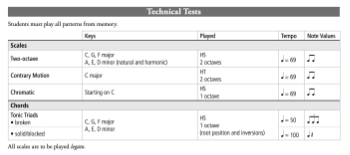
Example 1. Scales required for the Level 1 Examination by The Royal Conservatory (2022, 19)
(click to enlarge)
[1.3] And yet, popular exam programs such as Canada’s Royal Conservatory of Music require playing only natural and harmonic minor scales for their Level 1 examination, and not melodic minor, as shown in Example 1. Similarly, the examinations by the American Piano Guild ask students to construct harmonic minor scales in their Level 5, whereas melodic minor is not required until the very final level of achievement (Level 10, American Guild of Music n.d.). Between the Royal Conservatory of Music, The American Piano Guild, and the Associated Board of Royal Schools of Music, over one million exams in over 93 countries are administered to students per year (Royal Consevatory n.d.; Yamaha Music School 2019). Thus, a critical exploration of why and how we teach various minor scale forms is necessary.
[1.4] This article begins by illustrating the ways that minor scales were described in practical keyboard manuals of the eighteenth and nineteenth centuries. That is, prominent practical keyboard treatises (e.g., Bach, C.P.E. 1753/1762; Clementi 1802; Czerny 1839) typically depict just one version of the minor scale: melodic. We share evidence of how scales were taught in nineteenth-century conservatories, which also largely centered on melodic minor as the scale to practice. We then probe the first appearance of harmonic minor, identifying key treatises and piano methods that elevate the concept, and ultimately argue that it was texts in the nineteenth century written by Ferdinand Beyer (1850) and Charles-Louis Hanon (1878) that led to the rise of harmonic minor in daily practice. We subsequently trace Beyer's and Hanon’s influence, which continues even in present day, sharing examples of well-known piano pedagogy scale books today that prefer harmonic minor over melodic minor (Schaum 1946; Royal Consevatory 2002).
[1.5] The second part of this article investigates whether this preference of practicing harmonic minor over melodic is substantiated in the repertoire. Using the Yale-Classical Archives Corpus (White and Quinn 2016), a large dataset comprising of 13,769 MIDI files by 571 composers, we employ data-science methods to quantify the frequency of minor-scale excerpts in the literature and determine whether this distribution differs across musical eras and composers. We find that while harmonic minor (as a melody) occasionally occurs in the repertoire, it is far less frequent than melodic minor. We conclude by providing recommendations for scale practice in light of these findings.
2. Minor-Scale Pedagogy in the Common-Practice Period
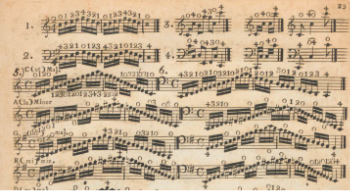
[2.1] Scales were recommended for regular practice by Tomás de Sancta María as early as 1565 (Soderlund 2019, 11). Jan Ladislav Dussek (1760–1812) was one of the first to advocate for the regular practice of scales and arpeggios (Soderlund 2019, 161; see also Dussek 1796, 31), and Friedrich Wilhelm Marpurg’s (1765) treatise is one of the earliest to provide modern scale fingerings for all 24 keys. Practicing scales in all keys gained a stronghold on keyboard pedagogy by the nineteenth century (Soderlund 2019). Lia Laor (2016a) describes the nineteenth-century emphasis on drill-based pedagogy, and scales are oft-used musical source material for these exercises.
Example 2. Clementi’s practice regimen for the major and minor scales (with fingerings where 4 is the pinky and 0 is the thumb), within his op. 42 (1802, 23). Note that the minor scale is melodic minor.
(click to enlarge)
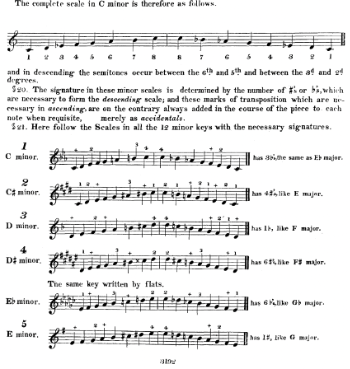
[2.2] Early approaches to scale pedagogy do not present the harmonic minor scale as one to be practiced. A review of the most influential eighteenth- and nineteenth-century keyboard treatises reveals that, instead, each describes practicing major and melodic minor scales, and none other, as can be seen in C. P. E. Bach (1753/1762), Marpurg (1765), Türk ([1789] 1982), Milchmeyer (1797), Clementi (1802), Hummel (1827), Czerny (1839), Fétis and Moscheles (1840), Kalkbrenner (1841; 1849), and Lebert and Stark (1883)
Example 3. Czerny’s introduction to the minor scales in his op. 500 (1839, 194)
(click to enlarge) |
Example 4. Türk’s illustration of the minor scale forms ([1789] 1982, 66)

(click to enlarge)
[2.3] While melodic minor is the minor form described as the one to practice, harmonic minor is sometimes included in a brief introduction to the major and minor keys at the start of these practical method books, where it is listed as something that exists but is not as common as melodic minor. This passage is often found within a very brief introduction to general music notation concepts, such as what the staff and clefs look like, possible rhythms, and key signatures. Türk ([1789] 1982) illustrates one such introduction, presenting these three minor scale forms shown in Example 4. When discussing these scale forms, he writes:
The diatonic scale is used in two forms, namely hard (major) and soft (minor). In the preceding two paragraphs I have said what is necessary about major scales, for which the C major scale is the pattern. The soft principal or basic (primitive) scale is that of A minor. It is distinctly different from the major scale by its minor third; it will be seen, therefore, that the first semitone does not fall on the fourth degree but between the second and third. With regard to the position of the second semitone in ascending, several opinions prevail among music teachers, for some want to have a minor sixth and seventh, as in example a, others want a minor sixth and a major seventh, as in example b, and yet others wish to have a major sixth and a major seventh as in example c. Consequently, in example a, the second semitone would fall between the fifth and sixth step, and in example c, between the seventh and eighth step; in example b, however, two more such intervals would result, other than the first semitone, namely between the fifth and sixth and between the seven and eighth steps. There would then occur in this scale a progression of an augmented second from f to g
♯ which would probably not be present in a diatonic scale. Which of these considerations prevails is not for me to decide. The most customary progression is that in example c, by way of the major sixth and major seventh. (Türk [1789] 1982, 65–66, bold emphasis added)
Thus, while Türk acknowledges the existence of all three minor scale forms (harmonic, natural, melodic), he writes that melodic is most customary, and later in his treatise he provides fingerings for all major but only melodic minor scales ([1789] 1982, 146–152). This approach continues in most subsequent piano method books, where harmonic minor is introduced in some way in a brief discussion of mode at the start of the text (like that in Example 4), but fingerings are only provided for the melodic minor scales throughout the text. Friedrich Wilhelm Kalkbrenner’s text is another example of this, sharing illustrations of both C melodic and C harmonic minor at the beginning (1841, 13–14), writing that the harmonic version is another way to perform the scale but calls the scale “irregular,” citing the augmented second as one reason. Later, the scale-practice regimen only consists of major scales and their parallel melodic minor (46–51). It is important to emphasize that in all of the texts described thus far, the actual terms “melodic” and “harmonic” are not yet used; we trace the appearance of these terms that emerge the late nineteenth century within Section 3, below.
[2.4] Rule-of-the-octave treatises are another source for learning which scale forms were practiced by common-practice musicians. Joel Lester (2002, 756) writes that Thomas Campion (1567–1620) “canonized a normative harmonization of both ascending and descending major and (melodic) minor scales.” Similarly, Ewald Demeyere (n.d.a) illustrates numerous minor-mode examples by Fedele Fenaroli (1730–1818), always using melodic minor (Fenaroli 1813/1814, 53)
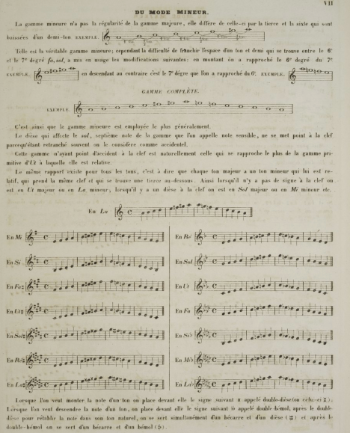
Example 5. An excerpt from the violin treatise by de Bériot (1858), the primary violin professor at the Royal Conservatoire of Brussels, which introduces the minor mode by saying that while there is the true minor of harmonic, the scale used more generally is melodic minor
(click to enlarge)
[2.5] Scholars such as Laor (2016b) and Joshua Navon (2020) have described the rise of conservatory education and its role in developing piano pedagogy during the nineteenth century, especially as the piano became more popular in its standard form, noting its obsession with asking students to practice for hours solely on technique. Thus, materials penned by conservatory piano professors are another source for studying the scales taught and learned by musicians. According to Navon (2020, 78–79), students were expected to practice for four to five hours a day on technique (rather than composition/theorizing, p. 69). Navon focuses his exploration on pedagogues such as Louis Plaidy, who was hired by Felix Mendelssohn to teach at the Leipzig Conservatory. Plaidy's piano method book was used at the Leipzig and Munich conservatories and presents a scale regimen consisting of major and melodic minor (1853, Chapter 5, Section 5). Similarly, the text from the first and longstanding violin professor at the Leipzig Conservatory presents major and their relative melodic minor scales (David 1863). Professors at other conservatories likewise emphasized melodic minor in scale practice. For example, Charles de Bériot studied at the Paris Conservatoire and then became the primary violin professor at the Royal Conservatoire of Brussels in 1843. Shown in Example 5, his practical method for violin players introduces the minor mode by first illustrating the “true” minor as harmonic, but then presenting all melodic minor scales, stating that this is because they are used more frequently (de Bériot 1858, VII). And while not a piano manual, William Crotch’s theory text (1812) used by the Royal Academy of Music in the early nineteenth century describes the melodic minor scale as the “usual manner” of ascending and descending the minor scale (1812, see Crotch’s Example 15), reflecting both a recommendation and illustration of how the minor scale was most frequently practiced. Note that once again these authors do not use the terms “melodic” and “harmonic” minor in their writings, as they have not yet emerged as standardized terms.
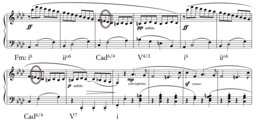
Example 6. The descending harmonic minor scale in F minor over a V harmony in Beethoven’s Piano Sonata op. 2, no. 1 (1795), first movement, recapitulation, with the augmented second circled in mm. 133 and 137
(click to enlarge)
[2.6] Despite the prominence of melodic minor in these texts and pedagogies, harmonic minor occasionally occurs in the repertoire, of course, often in descending form and over a dominant-functioning chord; Section 5 of this article explores its frequency of occurrence in the common practice, but some examples from the literature may be meaningful to our reader now. Example 6 illustrates an excerpt by Beethoven from his op. 2, no. 1 (1795), in the first movement’s recapitulation, with a descending F harmonic minor scale over a cadential
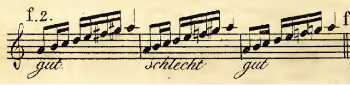
Example 7. Vogler’s illustration of acceptable ascending minor scales (1778, Tab. IV, f. 2)
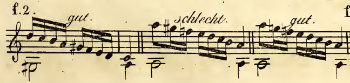
(click to enlarge) | Example 8. Vogler’s illustration of acceptable descending minor scales (1778, Tab. V, f. 2)
(click to enlarge) |
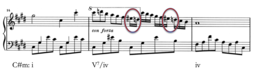
Example 9. The descending
(click to enlarge) |
3. Emergence of the Harmonic Minor Scale
[3.1] There is overwhelming evidence that melodic minor was what musicians practiced throughout the eighteenth and nineteenth centuries. When, then, did harmonic minor become commonplace in daily scale practice? As described above, while most practical piano method books illustrate melodic minor as the scale to practice, a handful of texts also include harmonic minor, particularly those authored by Bernard Viguerie (1761–1819), Louis Adam (1758–1848), Ferdinand Beyer (1803–1863), and Charles-Louis Hanon (1819–1900). This section illustrates that harmonic minor emerged in theoretical and practical discourse and became standard by the end of the nineteenth century.
[3.2] The two earliest texts to include harmonic minor as a scale to practice were written by professors at the Paris Conservatoire: Viguerie (1796) and Adam (1804). In Viguerie (1796), part I of the manual solely illustrates an A melodic minor scale and its fingering (34), and part II lists each major scale followed by its parallel minor scale written in two ways: melodic then harmonic (the scale terms of “melodic” and “harmonic” themselves are not given, but instead the scale known as melodic is titled “1ère manière” and harmonic as “2e manière” (72–73). A similar presentation of scales can be found in Adam (1804, 9–17): in article 4 of the manual, melodic minor is exclusively presented when describing fingering for all major scales and their respective parallel minor. Inexplicably, when recapping scales on pp. 25–27, Adam now presents all minor scales in the harmonic minor form without any explanation for this substitution. Notably, in both of these manuals, harmonic is secondary to melodic, and no rationale is provided for why there are two forms of minor scales. This lack of explanation may be in part due to the feeling by pedagogues of the time that technical textbooks were supplementary to oral instruction (Navon 2020, 79), and that it was not generally acceptable for students to ask why something is the case (85).
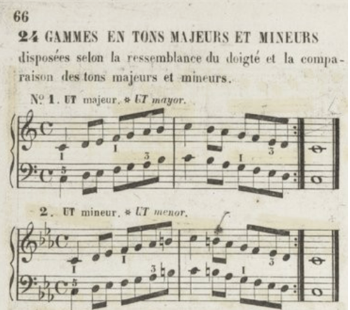
Example 10. The beginning of the scale regimen for practice in Beyer (1850, 66–67), which include each major scale and its parallel harmonic minor
(click to enlarge and see the rest)
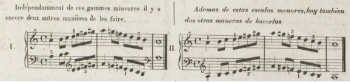
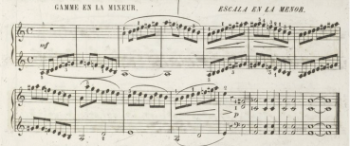
[3.3] Two texts of the later nineteenth century appear to be the first to elevate harmonic minor over melodic as the scale to practice: one written by Beyer (1850), a piano teacher and composer of light music such as “piano arrangements of popular orchestra works” (Nagao 2001), and one by Hanon (1878), who was largely an unknown musician during his time. Shown in Example 10, Beyer (1850, 66–67) lists all major and parallel harmonic minor scales for all keys. After this presentation, Beyer writes, “regardless of these minor scales, there are still two other ways to do them” (1850, 67, translated by JB) and Example 11 shows his illustration of those two ways: Beyer writes an A melodic minor followed by an A minor scale that ascends with a raised and and descends with a raised and a lowered . But while Beyer’s scale regimen consists of harmonic minor, when presenting a short piece of music in A minor he precedes it with a warmup in using primarily A melodic minor (with other measures such as m. 11 also being that of harmonic minor), shown in Example 12 (1850, 49)
Example 11. Following the scales in Example 10, Beyer (1850, 67) illustrates two additional ways to play the minor scale.
(click to enlarge) | Example 12. Earlier in the manual, Beyer presents a warmup that consists mostly of melodic minor (1850, 49).
(click to enlarge) |
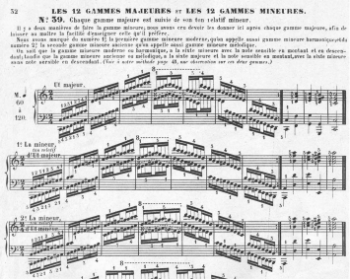
Example 13. The beginning of Exercise 39 in Hanon (1878, 32), illustrating the presentation of C major and its relative harmonic and melodic minor scales
(click to enlarge)
[3.4] This article asserts that Charles-Louis Hanon (1819–1900), French composer, organist, third-order Franciscan, and publisher, was the first to prefer harmonic minor as the scale to practice and also include the minor scale-form terms (i.e., melodic and harmonic) with written rationale for why to practice one over the other. Example 13 illustrates Hanon’s famous exercise 39 from his self-published piano exercise manual titled Le Pianiste Virtuose (The Virtuoso Pianist). This exercise introduces all major scales, where each major scale is followed by its relative harmonic and then relative melodic scale. This figure is taken from a facsimile of Hanon’s second edition of the manual, published in 1878; the first edition, which was published earlier in 1873–4 (Adams and Martin 2009 refer to 1874 as the year of publication, while Rougier 2001 states that it was written in 1873), has been lost. Hanon introduces the scales in the following way:
Each major scale is followed by its relative minor. There are two ways to do the minor scale; we thought it necessary to give them here after each major scale, in order to allow the master the ease of teaching the one he prefers. We marked with number 1, the first modern minor scale, which is also called the harmonic minor scale; and number 2, the second former minor scale which is also called melodic minor scale. We know that the modern minor or harmonic scale has the minor sixth with the leading tone going up and down; while the former or melodic minor scale has the major sixth and the leading tone going up, with the minor sixth [and the lowered
] going down.(5) (Hanon 1878, 32)
Hanon’s writing and exercises suggest an overall preference for the harmonic minor scale. First, the harmonic minor scale is given before the melodic minor scale, and later in the manual when scales in broken octaves are presented in the 24 keys (Hanon’s exercise 56, p. 60), the C-major broken-octave scale is followed by A harmonic minor in broken octaves, not melodic minor. Second, Hanon characterizes the harmonic minor scale as “moderne” as opposed to the “ancienne” melodic minor. Third, the preference for harmonic is supported by the fact that the chordal progression following each scale (in minor) comprises notes of harmonic minor: i, iiø
[3.5] Hanon wrote two additional practical manuals earlier in his career. The first, Système nouveau pratique et populaire pour apprendre à accompagner tout plain-chant à première vue en 6 leçons (1867), contains neither major/minor scales nor suggestions for how they should be practiced; this would lie outside of the purpose of the text, which was to provide strategies for accompanying plainchant on the organ. Hanon also wrote a more elementary manual for pianists around 1873 (Méthode Élémentaire de Piano: Introduction au Pianiste Virtuose) that was intended to precede The Virtuoso Pianist
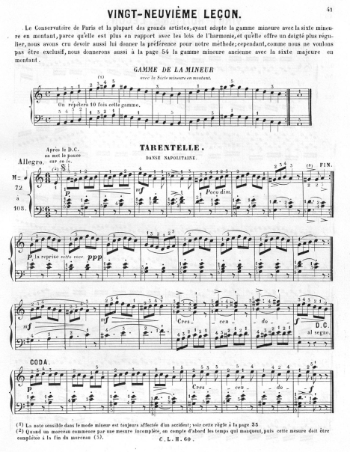
Example 14. Hanon’s introduction to the minor scale in Méthode Élémentaire (ca. 1873, 41)
(click to enlarge)
[3.6] Like Hanon (1878), Hanon’s Méthode Élémentaire (ca. 1873) also introduces some rationale for why he prefers the harmonic minor scale. Hanon describes the minor scale for the first time in lesson 29 (of 36). This lesson is shown in Example 14, which begins with a description of the minor scale and then presents the A harmonic minor scale along with a short piece of music composed in A minor. While measures 1–8 draw upon the collection of harmonic minor, mm. 21–23 in the right hand suggest other minor forms (where a Monte sequence tonicizes III, then IV, then V). Nevertheless, Hanon introduces the minor scale in the following way:
The Paris Conservatory and most of the great artists, having adopted the minor scale with the minor sixth going up, because it is more in line with the laws of harmony, and because it offers a more regular fingering, we thought we should also give it preference for our method; however, as we do not want to be exclusive, we will also give on page 54 the former [melodic] minor scale with the major sixth going up
.(7) (Hanon ca. 1873, 41, bold emphasis added)
Similar to that observed in Example 13, Hanon again refers to the melodic minor scale as “ancienne.” It is also evident that he is conflating the concepts of harmony and melody when preferring harmonic minor over melodic minor in scale practice. Hanon may have known that his preference for harmonic minor needed justification, because he makes the claim that “the Paris Conservatory and most of the great artists” use harmonic minor, not melodic, as a way to defend his preference for harmonic in his Méthode Élémentaire. In fact, both of Hanon’s piano texts (ca. 1873; 1878) are unique because they provide rationale in prose for preferring one scale over another; something that is noticeably lacking in other similar documents of the time. One additional point to consider from the quote above is Hanon’s reference to fingering. In it, he suggests that harmonic minor offers “a more regular fingering,” over melodic minor, but Hanon’s own fingering is identical for melodic and harmonic minor in Example 13
[3.7] It is crucial to note that Hanon made these claims despite not having any formal training nor any real connection to pedagogues at the Paris Conservatoire. Few details about Hanon's musical training have survived. Rougier argues that he “took little part in local musical life” (2001) in Boulogne and beyond, and is unlikely that he would have known the pedagogy taking place within the famed conservatory. Adams and Martin (2009) state that Hanon studied with a local organist in Boulogne and did not have any conservatory training. Further, in Soderlund’s (2019) authoritative text on influential keyboard technique and pedagogy spanning the last four centuries, Hanon’s name is noticeably absent. This all suggests that Hanon would not have insider knowledge of scale practice in these conservatories, despite his statement (ca. 1873, 41) that harmonic minor has been adopted by the “great artists” over melodic minor. In fact, there is conflicting evidence: paragraph [2.5] describes numerous texts by conservatory professors that exclusively teach melodic minor, although paragraph [3.2] acknowledges some evidence of harmonic minor being included in scale pedagogy as well in the early nineteenth century.
[3.8] It is unclear where Hanon got the idea to elevate the harmonic minor scale over melodic as something that one should practice. It could simply be that the idea made sense to him or was reflective of what he knew of music pedagogy of the time, as limited as that may have been. But it could also be due to two other hypotheses. First, he might have gotten the sense that harmonic minor was superior to melodic from his (mis)interpretation of writings by theorists who were known to most musicians of the time: Jean-Philippe Rameau, Gottfried Weber, and François-Joseph Fétis. That is, harmonic minor likely emerged first as a theoretical concept and then made its way into keyboard manuals for scale practice, and paragraphs [3.9]–[3.12] explore possible influences of these theorists’ writings on Hanon in turn.
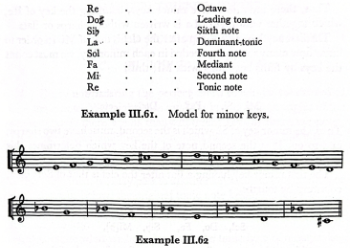
Example 15. Rameau’s introduction to the minor mode ([1722] 1971, 265)
(click to enlarge)
[3.9] Hanon was also a publisher, which may have facilitated easier access to well-known musical treatises. For example, when Rameau discusses the minor mode in Book II of his well-known Treatise on Harmony, he writes: “As for the minor mode, it differs from the major only in that the third and sixth should be minor, although there are various problems with regard to the sixth, which we shall explain in the following book” (Rameau [1722] 1971, 158)
Example 16. Rameau’s octave harmonization exercises illustrating only melodic minor ([1722] 1971, 499)
(click to enlarge) |
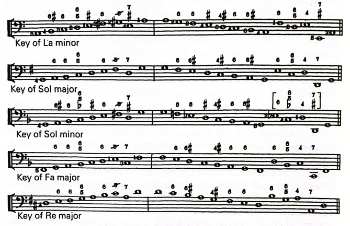
Example 17. The diatonic harmonies in the minor mode according to Weber (1830–32, section 149)

(click to enlarge)
[3.10] Numerous scholars such as Janna Saslaw (2003, 148) and Daniel Harrison (1994, 24n7) argue that Gottfried Weber is the first to recognize harmonic minor as the principal minor form. Weber, a student of Georg Joseph Vogler (the first to use Roman numerals for analysis), was known for refining Vogler’s method of associating scale degrees with Roman numerals; Weber also expanded Vogler’s method by using upper/lowercase Roman numerals to indicate chord quality. When doing so, Weber necessarily invoked the harmonic minor scale as the basis for his Roman numerals in the minor mode, in order to have a major dominant harmony (as does Brossard in 1705, described in note 9 above). Suzannah Clark (2015, paragraph 11) writes, “At the beginning of the nineteenth century, theorists began to argue that this dominant major harmony was so prevalent in minor-mode music that it needed to be shown to be diatonic, rather than borrowed from elsewhere. They therefore turned to the harmonic minor as their new foundational scale.” Critically, however, it does not appear from Weber’s treatise that this scale was meant for practice as a melody. For example, Hyer (2002, 735) illustrates how Weber’s treatise (1817–1821) derives major chords from the major scale and minor chords from the harmonic minor scale (Example 17); taken together, all notes in this example make up the harmonic minor scale (note also Weber’s omission of the mediant chord).
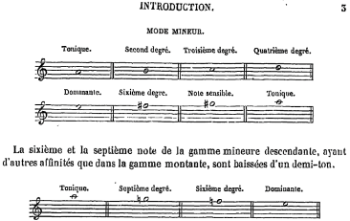
Example 18. Introduction to the minor mode by Fétis (1844, 3)
(click to enlarge)
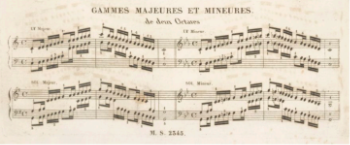
Example 19. An excerpt from the presentation of scales for practice in the piano treatise co-authored by Fétis and Moscheles, where only the major and melodic minor scales are included (1840, 33)
(click to enlarge)
[3.11] Hanon may also have derived some of his ideas from Fétis, who scholars have described as “possibly the most influential music theorist of the first half of the nineteenth century” (Simms 1975, 112). Like Rameau, Fétis conceived of scales as abstractions (Arlin 1994, xxiv), something Hanon may not have understood. According to Mary Arlin, “Fétis believed that the primary factor in the determination of tonality is the scale: the order of the succession of tones in major and minor, the distances that separate the tones, and the resultant melodic and harmonic affinities” (Arlin 1994, xxiii; see also Fétis 1844, 2). Hanon may have interpreted discussions of these melodic and harmonic affinities by applying them to scale practice in a way that Fétis never intended. Fétis writes, “it is evident that there remains no other principle for the construction of the scale and tonality than the metaphysical principle” (Fétis 1844, 251, translation by Arlin 1994, xxiv)
[3.12] Recall also that Hanon characterizes the harmonic minor scale as modern as opposed to the “former” melodic minor scale (“ancienne” in Hanon 1878, 32). It is possible that Hanon took these terms from Fétis (1844), given that Christensen (2019, xi) argues that Fétis was well known and considered the preeminent music scholar in the nineteenth century. And yet, Hanon does not use the terms in the same way, as Fétis applies the term “ancienne” to the prima prattica, and modern tonalities to Monteverdi and beyond; Hanon instead applies the terms to the melodic and harmonic minor scales. Page 55 of Fétis (1844) might have provided Hanon with some rationale. Of course, Fétis’s conception of modern tonality is rooted in the dominant seventh chord and its substitutions, to include V7
[3.13] The second possible hypothesis is that Beyer and Hanon got the idea to elevate harmonic minor into one’s practice regimen from another practical piano manual (or from corresponding with those who have studied in conservatories), although we cannot directly point to such a source. After all, Adams and Martin have suggested that Hanon derived many of his exercises from earlier manuals, writing:
Hanon’s work contains nothing that is in any way new or innovative. The method is, in fact, remarkably similar to a number of French and German piano methods of the period that display an identical progression from simple exercises to a variety of basic technical elements. Notable among these, Aloys Schmitt’s Études pour le piano, published in the decade before Hanon’s birth, contains five-finger exercises that clearly influenced Hanon. For example, Schmitt’s exercise 170, the first exercise in his collection, is identical to Hanon’s own first exercise published approximately 60 years later. (Adams and Martin 2009, 20)
But Schmitt (1820) is decidedly not the source of Hanon’s scale pedagogy, as scales were not included in the former’s set of etudes. We cannot be certain which texts or pedagogy he consulted when forming his ideas on harmonic minor. However, there is no question that Hanon’s text was part of an emerging trend, even a catalyst, for including harmonic minor (and preferring it over melodic minor) in scale-practice regimens.
[3.14] And yet, with the exception of Beyer (1850), other contemporaneous sources only illustrate melodic minor as the scale to practice. For example, Josef Pischna’s minor-mode exercises (1887) are exclusively melodic minor (exercises 33, 34, and 40) and harmonic minor is not found. Liszt also used major and minor scales for various technical purposes (Soderlund 2019, 302), and emphasized melodic minor in his Technische Studien, S. 146 (1887). According to Neil Goodchild,
Liszt does not include harmonic minor octave scales in exercises nos. 39, 40 or 41. A possible explanation for this is that this variety of scale, with the augmented second between the sixth and seventh degrees of the scale occurs less in actual music than do melodic minor lines, whether this is in finger articulated octave or bravura octave passages. The technical detail of other techniques in harmonic minor scales is also omitted from other exercises, such as nos. 31 and 32. (Goodchild 2007, 137)
Still, harmonic minor can be found within the 450 pages of Liszt’s text (although this article maintains that Hanon, not Liszt, was the likeliest source for harmonic minor’s proliferation into today’s scale pedagogy.
4. Scale Pedagogy After Beyer and Hanon
[4.1] What is evident is that the publications by Hanon (1878) and Beyer (1850) became extremely popular, and continue to have a significant effect on piano pedagogy. This has undoubtedly added to the prominence of harmonic minor in scale practice. These two texts are unique because they were written by musicians who did not have strong ties to conservatories during their careers; Hanon especially was not involved in local musical circles. Yet, these texts continue to have an immense influence. In fact, these texts may have been popular because they were well suited for beginners (Chung 1992, 3). For example, the title page of the English translation of Beyer (1864) states that it is “designed for the exclusive use of young students and dedicated to mothers of families.” While we do not know much about the influence of Beyer’s (1850) text in mid-nineteenth century Germany, where it originated, it remains today the predominant piano text in Japan and Korea. The source of this is due to American music pedagogue Luther Whiting Mason, who was hired by the Japanese government in the 1880s to disseminate Western music in Japanese music education. Mason spent 1880–1882 in Tokyo (Howe 1997), where he used Beyer’s text to teach piano students (Nagao 2001), and Beyer’s method “is still widely used in Japan with beginning students” (Ogawa 1991, 121). An examination of a mid-twentieth century Japanese translation of Beyer (Beyer n.d.) reveals no differences from Beyer’s 1850 version and thus Japanese students were learning a scale regimen consisting of major scales and their parallel harmonic minor. The text was then disseminated in Korea, where according to Chung (1992, 3), Beyer’s method was utilized there through the 1970s “to the exclusion of all other methods.” The modern Korean translation of Beyer (1975) is similar to the Japanese version in that there are no differences in the exercises and scales from Beyer 1850.
[4.2] Like Beyer (1850), Hanon (1878) remains an often-used text by pianists today. Hanon was self-published and knew how to promote his mostly didactic works, and his efforts to distribute his works resulted in an enormous influence on piano pedagogy. According to Fitch (n.d.), this business acumen took him far. Although Rougier (2001) describes the harmonizations within Hanon 1867 as rudimentary, Hanon submitted his organ method Système nouveau to the 1867 Paris Exposition world fair and won an honorable mention (Adams and Martin 2009, 19). Hanon subsequently submitted The Virtuoso Pianist along with other works to the next Parisian world fair in 1878, where his complete works were awarded a silver medal (Adams and Martin 2009, 21). This accolade was then proudly included on the cover page of later editions of The Virtuoso Pianist (see Hanon 1923).
[4.3] Historical evidence suggests that the influence of Hanon’s The Virtuoso Pianist was almost immediate, solidifying harmonic minor’s place within daily scale practice. Its second edition (1878) was printed along with praises by three well-known and long-standing members of the faculty at the Paris Conservatoire: Félix Le Couppey, Antoine Marmontel, and Georges Mathias (the last being a student of Chopin). Hanon’s text was adopted at the Paris Conservatoire and the Royal Conservatoire of Brussels during his lifetime (Adams and Martin 2009), an impressive feat given that it seems that Hanon had no formal conservatory training himself. His 1878 second edition also quickly disseminated to Russia. Graduating from the Moscow Conservatory in 1892, Rachmaninov recounts that Hanon’s text was the predominant text used by Russian conservatory pianists:
During the first five years the student gets most of his technical instruction from a book of studies by Hanon, which is used very extensively in the conservatories. In fact, this is practically the only book of strictly technical studies employed. All of the studies are in the key of ‘C.’ They include scales, arpeggios, and other forms of exercises in special technical designs. At the end of the fifth year an examination takes place. The examination is twofold. The pupil is examined first for proficiency in technic, and later for proficiency in artistic playing—pieces, studies, etc. However, if the pupil fails to pass the technical examination he is not permitted to go ahead. He knows the exercises in the book of studies by Hanon so well that he knows each study by number, and the examiner may ask him, for instance, to play study 17, or 28, or 32, etc. The student at once sits at the keyboard and plays. (Rachmaninov as quoted in Cooke 1917, 210–11, bold emphasis added)
Hanon 1878 has undergone hundreds of translations and editions, including an English edition in 1894, as well as a Russian edition (Hanon 1909) and an Italian edition (1927). Even now, Alfred Music publishing calls it “the most widely used piano technique book ever written” (Hanon 1992, back cover)
[4.4] While Hanon’s exercises within his text were not particularly novel in comparison to other contemporaneous manuals, Hanon’s preference for harmonic minor as the scale to practice was unique for the time. Whereas countless texts prior to Hanon’s The Virtuoso Pianist focused only on major and melodic minor scales, a review of similar texts published after its publication now included the harmonic minor scale. For example, the piano method published by Émile Decombes, one of Chopin’s last students and a professor at the Paris Conservatoire, replaces melodic altogether with harmonic when presenting fingerings for all 12 major keys and their relative harmonic minor scales (1888, 33–35), and same for the method book by Alberto Jonás (1922, Book II, 9–14). Following the list of major and harmonic scales in each key, Jonás defends the elevation of harmonic minor by writing the following:
Only the “minor harmonic” is employed in the minor scales and also in the exercises in minor mode given in this work. There are ample reasons for discarding the “melodic minor” scale as an antiquated, illogical, and underserving musical feature. A “scale,” that is to say, a diatonic succession of tones, deserves the name only if these tones are the same in a descending as well as in an ascending direction. The “melodic minor” is really made up of two scales, the ascending scale being the old Greek “Doric” scale, with major instead of minor seventh; and the descending scale being the “Aeolian.” (1922, 15, English text by Jonás)
[4.5] Subsequent scale manuals published after Hanon were also likely influenced by his incorporation of harmonic minor, including those by Louis Köhler (1894, book 2, 62–63; and 1908), Pischna and Wolff (1908), and F. A. Schulz (1896/1939/1967), who all present both relative melodic and harmonic scales after the major scales. These texts are still in print today. And Liszt’s famed American student William Mason advocated practicing ascending melodic followed by descending harmonic when describing scales in his own manual’s Volume II, and states this technique “has many advocates among prominent pianists, Alexander Dreyschock and Hans von Bülow” (Mason 1889, 8); notably, he also uses the terms harmonic and melodic
[4.6] Published by Schirmer in 1900, the English translation of Hanon (1878) facilitated its dissemination in the United States. Given Hanon’s influence described thus far, it is likely that American piano pedagogues knew of and considered Hanon’s book when writing their own methods. Well-known American piano pedagogues taught the harmonic minor scale alongside melodic. For example, Mathilde Bilbro’s (1919, 5) progressive studies first present major (which she calls “pure (or normal)”) and then the corresponding relative melodic and harmonic scales. John Schaum’s method is still used by beginners today; in his book of scales (1946), he introduces each of the 12 major scales along with a short piece, and then presents the 12 minor scales. When doing so, he writes “minor scales are related to major scales. The minor scale is built on the sixth tone of the relative major scale. The key signature of a minor key is the same as its relative major key. There are three kinds of minor scales: Harmonic, Melodic, and Natural. The Harmonic Minor is the most important” (1946, 18, bold emphasis added); this quote also solidifies that the terms melodic and harmonic minor are well established by this point. The A harmonic minor scale is then presented along with a corresponding composition (1946, 19). Other English-language scale manuals also include harmonic minor, often found prior to the presentation of melodic minor. The book of scales published by Alfred (Palmer, Manus, and Lethco 1994) presents all of the major scales first, and then all of the minor scales beginning on p. 48 with natural, harmonic minor, harmonic minor in contrasting motion, and melodic minor. The Royal Conservatory’s Brown Scale Book (Royal Consevatory 2002) is organized in a similar fashion, presenting all the major scales followed by a section devoted to all the minor scales (each starting with harmonic, harmonic in contrasting motion, and then melodic).
[4.7] Similar to what Rachmaninov reported as taking place in fin-de-siècle Russian conservatories, scales were also a pillar of piano pedagogy in the United States, and crucially, that harmonic minor was a mainstay. For example, in the Ward-Belmont school (which eventually became Belmont University in 1953), the 1919–1920 catalog listed the technical and artistic requirements for diplomas and certificates in each performance emphasis. In order to obtain either a certificate or diploma, students had to meet rigorous technical and performance demands, including playing harmonic and melodic minor scales (Rumbley 2014, 235). Similarly, Howard Hanson also recommended that along with the major scale, harmonic and melodic minor should be required at the secondary level to prepare for collegiate music study, a statement made while serving as Director of the Eastman School of Music (Hanson and Swarthout 1950).
[4.8] Since these advances in elevating harmonic minor in scale practice at the end of the nineteenth century, the state of scale pedagogy over the last century has largely remained static. Today, the most frequently required scales in piano accreditation programs are major, melodic, and harmonic. For example, at the most advanced levels (Levels 9 and 10), the Royal Conservatory of Music (RCM) examinations require four-octave melodic and harmonic minor scales—requiring students to learn to play a melodic augmented second between and that the composers of the common practice routinely tried to avoid melodically
[4.9] To summarize: in most post-Hanon piano pedagogy texts and examination programs, there seems to be a preference for practicing harmonic minor over melodic minor, speaking to the extraordinary influence of Hanon’s 1878 manual. This is in direct contrast with most of the earlier nineteenth-century texts described above, which primarily teach melodic minor. In these pre-Hanon texts, minor scales are also presented with no explanation of which scale occurs more frequently in the literature, and why the scales are thus named; that is, the harmonic scale generates the most commonly used collection of T-PD-D chords, whereas the melodic scale is generally used for melodic passages. Indeed, Hanon’s introduction to the scales in Example 13 utilizes the terms “harmonique” and “mélodique,” and to our knowledge, seems to be the first use of these terms as applied to scale practice
5. Frequency of Scales in the Repertoire
Aims and Method
[5.1] To date, no empirical project has investigated the prevalence of minor scales in the common-practice period, despite general claims surrounding their frequency by influential music theory texts (e.g., Clendinning and Marvin 2021, 98), and thus a systematic study of minor scale frequency in the literature is underexplored. In response, we sought to quantify the frequency of various minor-scale excerpts in the literature and determine whether this distribution differs across musical eras and/or composers. This exploration may help understand the rise of harmonic minor in scale practice in the mid-nineteenth century observed in Hanon, for example.
[5.2] Leveraging the Yale-Classical Archives Corpus (hereafter “YCAC,” White and Quinn 2016), which consists of 13,769 MIDI files by 571 composers (and 14+ million harmonic slices), we used Python to identify the following scale-degree patterns occurring contiguously in the highest voice within minor-mode excerpts:
Findings
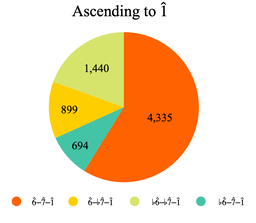
Example 20. Frequency of minor-mode fragments counted in the Yale-Classical Archives Corpus within stepwise passages when ascending to
(click to enlarge)
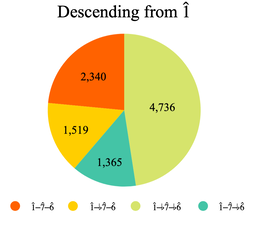
Example 21. Frequency of minor-mode fragments counted in the Yale-Classical Archives Corpus within stepwise passages when descending from
(click to enlarge)
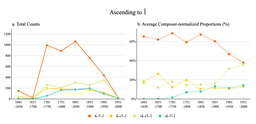
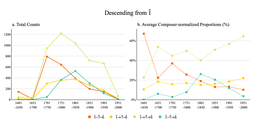
[5.3] We first analyzed the total counts of stepwise motion to/from found in the dataset. When an excerpt is in the minor mode and approaching stepwise from below (i.e., to to ), composers in the corpus use ascending melodic minor most often (Example 20), followed by natural, dorian, then harmonic. For excerpts that descended stepwise down from tonic (i.e. to to ), the lowered sixth and seventh scale degrees were most utilized (Example 21): of course, both descending melodic and natural minor scales share this fragment. These data also illustrate the finding that
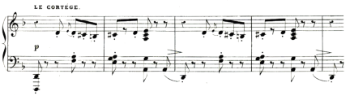
Example 22. Charles Gounod’s Funeral March of a Marionette, mm. 23–26
(click to enlarge) |
Example 23. The left panel (“a”) shows the total raw counts of stepwise fragments ascending to in all minor-mode passages by the 166 composers from the Yale-Classical Archives Corpus, organized by composer’s year of death. The right panel (“b”) shows the average percentage with which each composer employed the ascending minor-mode scale forms.
(click to enlarge)
Example 24. Same as in Example 23, but now showing scale fragments that are descending from in minor-mode passages
(click to enlarge)
[5.4] We then sought to learn whether the use of minor scale fragments changes over time, depending on when the composer was living. Example 23 (left panel) illustrates how many stepwise minor-mode scale segments ascending from up to were found in each half century, with the x axis reflecting the composer’s year of death. Once again, it is apparent that ascending melodic minor is far more common than other minor scale forms overall, with peak use occurring in the early nineteenth century. Ascending natural minor is also more common than dorian and harmonic minor. The left panel of Example 24 again illustrates that the descending scale form with
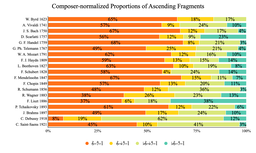
Example 25. Proportion used for each of the minor-mode ascending scale fragments containing variants of -- by the 19 most represented composers in the corpus, presented chronologically by the composer’s year of death
(click to enlarge) |
[5.5] The right panels of Examples 23 and 24 expand this exploration for all 166 composers in the dataset, where each composer now contributes equally to the average for each scale fragment, regardless of how many of their works are contained in the corpus. This avoids bias from highly represented/well-known composers. The right panel of Example 23 provides a visual illustration that when in the minor mode and no matter the time period, composers use the scale fragment
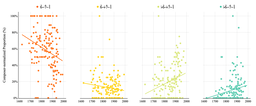
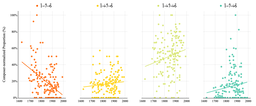
Example 26. Average proportional use of all ascending minor-mode fragments by all 166 composers in the corpus, organized by composer’s year of death with trend lines for each scale type
(click to enlarge)
[5.6] Given that Example 23 visually indicates that ascending melodic minor seems to diminish in use over time in comparison to the other minor scale forms, we then sought to test the significance of these trends. Example 26 tests this directly and confirms that ascending melodic minor decreases significantly in proportional use by composers over time
Example 27. Same as Example 26, but for descending minor-mode fragments
(click to enlarge)
[5.7] In Example 27, we examined trends in use of descending minor-mode scale fragments
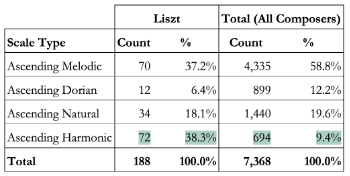
[5.8] We have observed a slight increase in the use of harmonic minor over time in the repertoire. This may be due to the rise of practicing harmonic minor illustrated earlier in this article, but it could also be for other reasons. That is, it is important to consider that the two composers from Example 25 using harmonic minor proportionally more often in their oeuvre were Dominico Scarlatti, who spent much of his life working in royal courts in Portugal and Spain, and Franz Liszt, who was Hungarian, and that these regions may utilize the harmonic minor scale fragment more than others. Musicians have made note of Scarlatti’s use of the augmented second, possibly due to Moorish influence (e.g., Bogner 2015, 9)
Example 28. A comparison of Liszt’s scale use versus other composers in the Yale-Classical Archives Corpus
(click to enlarge)
[5.9] Alternatively, it may be that Liszt’s preference for harmonic minor is a statistical outlier. To explore this, we conducted a binomial test (i.e., examining whether Liszt uses this scale fragment at a significantly higher rate compared to all other composers). Example 28 shows the distribution for each scale type, with the frequency of each scale type extracted from Liszt in the middle column and all 166 corpus composers in the right-most column. Based on a one-sided binomial test, the observed values for Liszt (N = 188, K = 72, proportion = 38.3%) give significant support to the assumption that Liszt’s use proportion of the ascending harmonic scale is significantly higher than the percentage with which other composers use that harmonic scale fragment (9.4%, p < .001). Next, we investigated whether the distribution of Liszt’s scale use proportion differs from the distribution of other composers’ use proportion; a chi-square goodness-of-fit test was used to assess this question
[5.10] Broadly, these empirical findings support the assertion made in music theory pedagogy that melodic minor is the most frequent scale form used by composers (e.g., Kostka and Payne 2009; Clendinning and Marvin 2021). To contextualize these overall findings, we want to emphasize that while this section contains a study of how composers used various minor-mode scale forms, focusing on those included in the YCAC, much labor of music pedagogy was done by women and/or lesser-known figures who may not be included in the dataset; Hanon was certainly one of these. That said, one of the benefits of the YCAC is that it is one of the biggest datasets of music from the Western classical era, allowing researchers to study a large amount of music, including that of many lesser-known composers. Caution should also be given due to the corpus’s wide span of music that ranges from early Baroque through the mid-twentieth century
6. Recommendations
[6.1] Taking together these musicological and empirical findings, this article offers six recommendations for scale pedagogy moving forward: 1) Following the way that the minor scales are described in widely used theory texts (Kostka and Payne 2009, 60 and 63; Clendinning and Marvin 2021, 98–99), piano pedagogy texts might also include a brief explanation for why the melodic and harmonic scales are thus named, and to remind students that notes of the harmonic collection generate the most commonly used T-PD-D harmonies in the minor mode, whereas melodic minor is more common as melodies. This kind of rationale is largely missing from piano technique texts (e.g., see the discussion of the minor scales in Palmer, Manus, and Lethco 1994, 12).
[6.2] 2) Melodic minor could be emphasized more in scale practice due to its prevalence in common-practice repertoire; conversely, harmonic minor could be de-emphasized. Further, examination programs such as the Associated Board of Royal Schools of Music, the Royal Conservatory of Music, and the American College of Musicians Piano Guild might also require melodic minor more than other scales. Given that these programs proctor approximately one million exams in total per year, this would have a marked effect on students’ daily practice habits around the world. This recommendation to practice the harmonic minor scale less often follows sentiments offered by Gerald Eskelin (1999) and others.
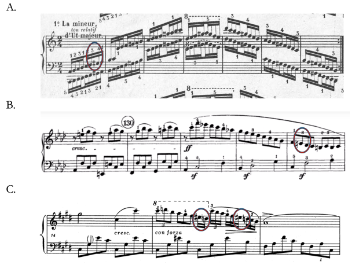
Example 29. Fingerings of the augmented second in various passages, with the augmented second circled in each excerpt. (A) The augmented second performed with right-hand fingers 3 and 4 in an A harmonic minor scale in Hanon (1878, 32). (B) The augmented second performed with right-hand fingers 3 then 2 as part of an F minor harmonic minor scale excerpt within Beethoven’s op. 2, no. 1, m. 133. (C). The augmented second performed by right-hand fingers 2 then 1 as part of a
(click to enlarge)
[6.3] 3) Taking the modern piano’s ergonomics into account further undercuts the utility of harmonic minor scale practice. The modern piano’s size has generally been stable for the past 130 years, with an octave typically spanning 188 millimeters; thus, small-handed pianists, particularly children, are at a disadvantage (Yoshimura and Chesky 2019, 3). The piano, after all, is different from some other instruments like those in the string family that utilize several instrument sizes for smaller, often younger, students. Eri Yoshimura and Kris Chesky (2019) found that performance pain on a slightly smaller keyboard (octave spanning 174mm.) was significantly less for participants with smaller hand sizes; they also note that this more ergonomic piano size is not commonplace, reporting that Yamaha stopped making pianos of this size in 2003 due to lack of demand. The augmented second within the harmonic minor scale is particularly problematic because it is practiced with consecutive fingers, as shown in the fingered passages in Example 29. Research by Richard Parncutt et al. (1997, 346) found that best fingering practices for spans of three semitones (like the augmented second) should not be used with fingers 3 and 4, such as that in Example 29A, and suggests that these two fingers only comfortably perform a span of a semitone, even with adult male hands. Meanwhile, most scale texts teach that the right hand uses fingers 3 and 4 for the augmented second in the following harmonic minor scales: c, d, e, g, and a, which also happen to correspond with the keys typically taught to beginning pianists (e.g., Example 1). Taken together, this research on health in the performing arts provides additional support for the argument that harmonic minor might be practiced less often in comparison to other minor forms. Drill-based pedagogy in the nineteenth century even acknowledged and accepted pain while practicing (Laor 2016a, 14), and we should be actively trying to avoid this possible outcome when practicing scales today.
[6.4] 4) Piano pedagogy should follow the trend in music theory to emphasize the parallel relationship when teaching scales (Telesco 2001), rather than relative relationships. Theory texts largely have taken this pedagogical stance (Hamm and Hughes 2023, Example 4), and yet piano scale texts in popular method books (e.g., Bastien 1988, Royal Consevatory 2002) and skills programs (e.g., ABRSM and RCM, see Example 1) strongly favor practicing minor scales from the relative major, a practice that stems at least back to Clementi (1802) and Czerny (1839).
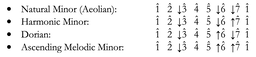
Example 30. All possible versions of and with minor-mode tonics (-↓-)
(click to enlarge)
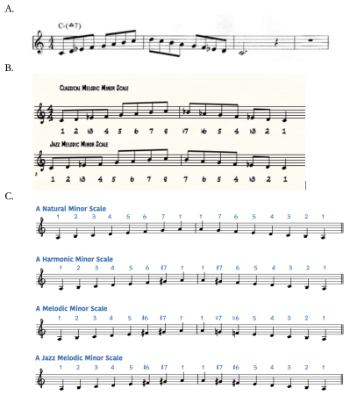
[6.5] 5) Scale pedagogy could better explore the variations available to scale degrees and . That is, if harmonic minor has entered scale pedagogy despite it being the least common minor-mode variant, then other patterns might be studied as well. Example 30 illustrates all possible variations of and in a minor mode, which consists of natural minor (aeolian), harmonic, melodic, and dorian
Example 31. The jazz melodic minor scale as found in jazz theory, where the melodic minor scale is played both ascending and descending with ↑ and ↑: (A) Reeves (1989, 191), (B) Hughes (2015), (C) LaDisa (n.d.)
(click to enlarge)
[6.6] 6) Finally, melodic minor could also be practiced with
Example 32. A recommended daily scale-practice regimen, where represents one shared tonic in each scale. As a student progresses from one scale to the next, only a single scale degree is changed per scale (in red).
(click to enlarge) |

7. Conclusion
[7.1] Overall, this article provides the first large-scale, systematic study of minor-mode scales in Western classical repertoire, and combines data-driven and musicological approaches to understanding minor-mode scale practice across centuries and how it has impacted today’s scale-practice regimens. We found that composers use melodic minor most often in common-practice literature, adding much-needed empirical evidence to the many texts throughout centuries that make similar arguments without frequency data. We also find that harmonic minor (specifically the scale-excerpt
Declaration of conflicting interests
The authors declare no potential conflicts of interest with respect to the research, authorship, and/or publication of this article.
Funding
JB received a grant from the Johns Hopkins University to pay for the statistical contributions from YLL.
Author Contributions
JB conceived of the topic and argument. She also conducted the musicological research. She designed the corpus search algorithm and corresponded with YLL on developing hypotheses and data analysis. YLL provided data visualizations. JB drafted the manuscript and YLL provided edits.
Acknowledgements
JB would like to express thanks to various scholars who have corresponded on previous versions of this research, providing advice and resources (alphabetically): Drs. Ric Ashley, Miles Brown, Kris Chesky, Remi Chiu, Mike DeKovich, Ken Johansen, Matt Kiple, Paula Maust, Thomas Posen, and Daphne Tan. We are also extremely grateful to MTO’s wonderful editorial staff and the reviewers of this article, including Paula Telesco, for their helpful feedback and suggestions for improvement. Finally, JB would like to thank her two children, whose small hands and daily piano practice inspired this entire line of inquiry (to Isla and Lawson: it has been the joy of my life to teach you).
Appendix
Appendix Sheets [XLSX]:
- Sheet 1: Raw data of count frequencies of the eight scale excerpts for each of the 166 composers.
- Sheet 2: All instances found of ascending harmonic minor (
↓ -↑ -) found in the dataset, organized by composer, piece/movement, and location (called “offset” in the YCAC dataset; see White and Quinn 2016). - Sheet 3: Same as Sheet 2, but for descending harmonic
(-↑ -↓).
Jenine L. Brown
The Peabody Conservatory of the Johns Hopkins University
1 East Mount Vernon Place
Baltimore, MD 21202
Jenine@jhu.edu
Yeonju Lindsey Lee
The Peabody Conservatory of the Johns Hopkins University
1 East Mount Vernon Place
Baltimore, MD 21202
ylee237@alumni.jh.edu
Works Cited
Adam, Louis. 1804. Méthode de piano du Conservatoire. Marchand.
Adams, Andrew, and Bradley Martin. 2009. “The Man Behind the Virtuoso Pianist: Charles-Louis Hanon’s Life and Works.” American Music Teacher 58 (6): 18–21. http://www.jstor.org/stable/43544822.
American Guild of Music. n.d. “Theory Test Guidelines.” Accessed June 17, 2026. https://www.americanguild.org/programs/theory-test-guidelines.
Arlin, Mary. 1994. Equisse de l’histoire del’harmonie: An English-language translation of the François-Joseph Fétis History of Harmony. Pendragon Press.
Associated Board of the Royal Schools of Music. 2023. “Practical Musical Grades: Piano Syllabus.” https://www.abrsm.org/sites/default/files/2023-10/Piano%202023%20%26%202024%20Prac%20syllabus%2020230807.pdf.
Bach, Carl Philipp Emanuel. 1753/1762. Versuch über die wahre Art das Clavier zu spielen. Part one: C. Ph. E. Bach. Printed by Christian Friedrich Henning; Part two: C. Ph. E. Bach. Printed by George Ludewig Winter.
—————. [1753/1762] 1949. Essay on the True Art of Playing Keyboard Instruments. Translated by W. J. Mitchell. London.
Bastien, James. 1988. Scales, Chords & Arpeggios. Kjos Music Company.
Beyer, Ferdinand. n.d. Beyer Piano Teaching Book. Japanese edition. Zen-on Music Company.
—————. 1850. École Préliminaire de Piano, Op. 101. E. Heu. https://gallica.bnf.fr/ark:/12148/bpt6k312805r/f7.item.
—————. 1864. Ferd. Beyer’s School for the Piano-Forte. A. C. Peters & Brothers. https://archive.org/details/vorschuleimklavi0000alfr/page/n5/mode/2up.
—————. 1895. Vorschule im Klavierspiel, Op. 101. Edited by Adolf Ruthardt. Edition Peters.
—————. 1975. Beyer Piano Textbook, with Commentary. Se-Kwang Publishing House.
Bilbro, Mathilde. 1919. Progressive Early Grade Studies for the Advancing Young Student. The Willis Music Company.
Bogner, Johannes M. 2015. “Domenico Scarlatti Sonatas.” Liner notes. Translated by Roderick Shaw. FRA Bernardo, CD.
Brossard, Sébastien de. 1705. “MODO.” In Dictionnaire de Musique, contenant une Explication des Termes Grecs, Latins, Italiens & François les plus usitez dans la Musique. 2nd ed. Ballard. Facsimile: F. Knuf, 1965.
Burrowes, John F. 1823. The Pianoforte Primer. London: the author; Chappell & Co.; and Clementi & Co.
Christensen, Thomas. 2019. Stories of Tonality in the Age of François-Joseph Fétis. University of Chicago Press. https://doi.org/10.7208/chicago/9780226627083.001.0001.
Chung, Wan Kyu. 1992. An Analysis and Evaluation of Beginning Piano Methods Used in Korea. PhD diss., Texas Tech University.
Clark, Suzannah. 2015. “Music Theory’s Monstrous Chord: How a Lone Theorist’s Pursuit of Symmetry Shaped Music History.” Institute for Advanced Study at Princeton: The Institute Letter. https://www.ias.edu/ideas/2015/clark-music.
Clementi, Muzio. 1802. Introduction to the Art of Playing on the Pianoforte, Op. 42. Hoffmeister & Kühnel.
Clendinning, Jane Piper, and Elizabeth West Marvin. 2021. The Musician’s Guide to Theory and Analysis. 4th ed. W. W. Norton.
Cooke, James Francis. 1917. Great Pianists on Piano Playing: Study Talks with Foremost Virtuosos. Theodore Presser.
Crotch, William. 1812. Elements of Musical Composition. Longman, Hurst, Reese, Orme, & Brown. https://imslp.org/wiki/Elements_of_Musical_Composition_(Crotch%2C_William)
Czerny, Carl. 1839. Complete Theoretical and Practical Piano Forte School, Op. 500. Translated by J. A. Hamilton. R. Cocks & Co.
David, Ferdinand. 1863. Violinschule. Breitkopf & Härtel.
de Bériot, Charles. 1858. Méthode de Violon, Op. 102. 1st ed. Paris & Mainz.
De Smet, Luc, Helena Ghyselen, and Roeland Lysens. 1998. “Incidence of Overuse Syndromes of the Upper Limb in Young Pianists and its Correlation with Hand Size, Hypermobility and Playing Habits.” Annales de Chirugie de la Main 17 (4): 309–13. https://doi.org/10.1016/S0753-9053(98)80030-6.
Decombes, Émile. 1888. Petite méthode élémentaire de piano composée pour les petites mains. Heugel.
Demeyere, Ewald. n.d.a. “The Rule of the Octave in Minor According to Fenaroli.” Accessed December 12, 2023. https://essaysonmusic.com/the-rule-of-the-octave-in-minor-according-to-fenaroli.
—————. n.d.b. “The Rule of the Octave: Alternative Settings.” Accessed December 12, 2023. https://essaysonmusic.com/the-rule-of-the-octave-alternative-settings.
Derry, Sîan R. 2012. Beethoven’s Experimental Figurations and Exercises for Piano. PhD diss., University of Manchester.
Dussek, Jan Ladislav. 1796. Dussek’s Instructions on the Art of Playing the Piano Forte or Harpsichord. Corri, Dussek & Co.
Eskelin, Gerald. 1999. Lies My Music Teacher Taught Me. 4th ed. Stage 3 Publishing.
Fenaroli, Fedele. 1813/1814. Partimenti Ossia Basso Numerato, Opera Completa Di Fedele Fenaroli. Per uso Degli alunni del Regal Conservatorio di Napoli. Imbimbo & Carli.
Fétis, François-Joseph. 1844. Traité complet de la théorie et de la pratique de l’harmonie. Maurice Schlesinger. https://babel.hathitrust.org/cgi/pt?id=nyp.33433082267414&seq=269.
Fétis, François-Joseph, and Ignaz Moscheles. 1840. Méthode des Méthodes, Op. 98. Maurice Schlesinger.
Fitch, Graham. n.d. “Jailbreaking Hanon.” Practicing the Piano. Accessed January 7, 2024. https://practisingthepiano.com/jailbreaking-hanon-piano-exercises.
Fitton, Sarah Mary. 1855. Conversations on Harmony. Longman, Brown, Green, & Longmans.
Foucault, Michel. 1977. Discipline and Punish: The Birth of the Prison. Vintage/Random House.
Gjerdingen, Robert. 2020. “Video 7.2—The Rule of the Octave.” In Child Composers in the Old Conservatories: How Orphans Became Elite Musicians. Oxford University Press. https://www.youtube.com/watch?v=NvTh11Pc2YQ&list=PL-PYUAknRtUF4ce0hv6iGUvdo7ShbvqPf&index=3.
Goodchild, Neil John. 2007. Liszt’s Technical Studies: A Methodology for the Attainment of Pianistic Virtuosity. MM document, University of South Wales.
Hamm, Chelsey, and Bryn Hughes. 2023. “Minor Scales, Scale Degrees, and Key Signatures.” In Open Music Theory, Version 2, ed. Erin K. Maher. https://viva.pressbooks.pub/openmusictheory/chapter/minor-scales.
Hanon, Charles-Louis. 1867. Système nouveau pratique et populaire pour apprendre à accompagner tout plain-chant à première vue en 6 leçons. C. L. Hanon. http://bdh.bne.es/bnesearch/detalle/bdh0000292124.
—————. ca. 1873. Méthode Élémentaire de Piano: Au Pianiste Virtuose. C. L. Hanon. Méthode Élémentaire de Piano: Au Pianiste Virtuose. http://bnedigital.bne.es/bd/es/card?id=8183b079-62e2-4623-a1aa-15efaf5389d0.
—————. 1878. Le Pianiste Virtuose, 2nd ed. C. L. Hanon. http://bdh.bne.es/bnesearch/detalle/bdh0000067483.
—————. 1900. The Virtuoso Pianist. Translated by Theodore Baker. G Schirmer.
—————. 1909. 32 упражнения для фортепиано Ш. Ганона. Edited by Aleksandr Goldenweiser. P. Jurgenson.
—————. 1923. Le Pianiste Virtuose. Schotte.
—————.1927. Il Pianista Virtuoso. Edited by Ettore Pozzoli. Ricordi.
—————. 1992. The Virtuoso Pianist in 60 Exercises. Edited by Allan Small. Alfred Publishing. https://www.alfred.com/hanon-the-virtuoso-pianist-in-60-exercises-complete/p/00-616C.
Hanson, Howard, and Donald M. Swarthout. 1950. “Specimen Examinations for Applied Music at Secondary School Level.” Bulletin of the Music Teachers National Association 15 (1): 27–49. http://www.jstor.org/stable/43528435.
Harrison, Daniel. 1994. Harmonic Function in Chromatic Music. University of Chicago Press.
Howe, Sondra W. 1997. Luther Whiting Mason: International Music Educator. Detroit Monographs in Musicology Studies in Music 21. Harmonie Park Press.
Hughes, Camden. 2015. “4 Important Applications of the Melodic Minor Scale.” Learn Jazz Standard (website). https://www.learnjazzstandards.com/blog/4-application-ons-of-the-melodic-minor-scale.
Hummel, Johann Nepomuk. 1827. Anweisung zum Piano-Forte-Spiel. 1st ed. Tobias Haslinger.
Hyer, Brian. 2002. “Tonality.” In The Cambridge History of Western Music Theory, ed. Thomas Christensen, 726–52. Cambridge University Press. https://doi.org/10.1017/CHOL9780521623711.025.
Jonás, Alberto. 1922. Master School of Modern Piano Playing and Virtuosity. Carl Fischer.
Kalkbrenner, Friedrich Wilhelm. 1841. Pianoforte-Schule, Op. 108. Fr. Kistner.
—————. 1849. Traité d’harmonie du pianist, Op. 185. Self published, Paris.
Köhler, Louis. 1894. Practical Method for the Pianoforte, Op. 249. Edited by Hans Semper. B. F. Wood Music Co.
Köhler, Louis. ca. 1908. Scales and Chords. Century Music Publishing Co.
Kostka, Stefan M., and Dorothy Payne. 2009. Tonal Harmony, with an Introduction to Twentieth-Century Music. 6th ed. McGraw Hill.
LaDisa, Michael. n.d. “Jazz Piano Improv with the Melodic Minor Scale.” Piano with Johnny (website). https://pianowithjonny.com/piano-lessons/jazz-piano-improv-with-the-melodic-minor-scale.
Laor, Lia. 2016a. “‘In Music Nothing is Worse Than Playing Wrong Notes’: Nineteenth-Century Mechanistic Paradigm of Piano Pedagogy.” Journal of Historical Research in Music Education 38 (1): 5–24. https://doi.org/10.1177/1536600616662540.
—————. 2016b. Paradigm War: Lessons Learned from 19th Century Piano Pedagogy. Cambridge Scholars Publishing.
Lebert, Sigismund, and Ludwig Stark. 1883. Grosse Klavierschule. 12th ed. Cotta’sche Buchhandlung Nachfolger. https://s9.imslp.org/files/imglnks/usimg/5/56/IMSLP300022-PMLP485809-Lebert-Stark,_Klavierschule,_Teil_2.pdf.
Lester, Joel. 2002. “Rameau and Eighteenth-Century Harmonic Theory.” In The Cambridge History of Western Music Theory, ed. Thomas Christensen, 753–77. Cambridge University Press. https://doi.org/10.1017/CHOL9780521623711.026.
Liszt, Franz. 1887. Technische Studien, S. 146, Books I and II. Edited by Alexander Winterberger. J. Schuberth & Co. https://vmirror.imslp.org/files/imglnks/usimg/0/06/IMSLP518119-PMLP15817-SIBLEY1802.15727.7399-39087009941412vol._1_(etc).pdf.
Marpurg, Friedrich Wilhelm. 1765. Anleitung zum Clavierspielen. Berlin.
Mason, Lowell. 1839. Manual of the Boston Academy of Music, for Instruction in the Elements of Vocal Music, on the System of Pestalozzi. 5th ed. J. H. Wilkins & R. B. Carter.
Mason, Luther Whiting. 1891. The Independent National Music Reader: Supplementary to the Intermediate Music Reader of the ‘National’ Music Course. Ginn & Company.
Mason, William. 1889. Touch and Technic, Op. 44. Vol. II. Theodore Presser.
Milchmeyer, Johann Peter. 1797. Die wahre Art das Pianoforte zu spielen. Carl Christian Meinhold. https://imslp.org/wiki/Die_wahre_Art_das_Pianoforte_zu_spielen_(Milchmeyer%2C_Johann_Peter)
Nagao, Isaac. 2001. “Beyer, Ferdinand.” Grove Music Online. Accessed May 22, 2025. https://doi.org/10.1093/gmo/9781561592630.article.51838.
Navon, Joshua. 2020. “Pedagogies of Performance: The Leipzig Conservatory and the Production of Werktreue.” The Journal of Musicology 37 (1): 63–93. https://doi.org/10.1525/jm.2020.37.1.63.
Nichols, Robert Shelton. 1971. François-Joseph Fétis and the Theory of Tonalite. PhD diss., University of Michigan.
Ogawa, Masafumi. 1991. “Contributions to the Beginning of Public Music Education in Japan.” The Bulletin of Historical Research in Music Education 12 (2): 113–28. https://doi.org/10.1177/153660069101200203.
Palmer, Willard A., Morton Manus, and Amanda Vick Lethco. 1994. The Complete Book of Scales, Chords, Arpeggios & Cadences. Alfred Publishing.
Parncutt, Richard, John A. Sloboda, Eric F. Clarke, Matti Raekallio, and Peter Desain. 1997. “An Ergonomic Model of Keyboard Fingering for Melodic Fragments.” Music Perception 14 (4): 341–82. https://doi.org/10.2307/40285730.
Pedneault-Deslauriers, Julie. 2017. “The French Path: Early Major-Minor Theory from Jean Rousseau to Saint-Lambert.” Music Theory Online 23 (1). https://doi.org/10.30535/mto.23.1.5.
Pischna, Josef. 1887. Technical Studies. Edited by Bernhard Wolff. Eulenburg.
Pischna, Josef, and Bernhard Wolff. ca. 1908. The Little Pischna: 48 Practice Pieces for the Piano. Schirmer.
Piston, Walter. 1959. Harmony. 3rd ed. Victor Gollancz Ltd.
Plaidy, Louis. 1853. Technische Studien für das Pianofortespiel: Eingeführt in den Conservatorien der Musik zu Leipzig und München. Breitkopf und Härtel.
Rameau, Jean-Philippe. [1722] 1971. Treatise on Harmony. Translated by Philip Gossett. Dover Publications.
Reeves, Scott D. 1989. Creative Jazz Improvisation. Prentice Hall.
Rizzo, Rhonda. 2019. “This is Why Hanon Exercises are a Waste of Time (and Possibly Dangerous).” Pianist Magazine, June 27. https://www.pianistmagazine.com/blogs/this-is-why-hanon-exercises-are-a-waste-of-time-and-possibly-dangerous.
Rougier, Philippe. 2001. “Charles-Louis Hanon.” Grove Music Online. https://www.oxfordmusiconline.com/grovemusic/display/10.1093/gmo/9781561592630.001.0001/omo-9781561592630-e-0000041669.
Royal Conservatory. n.d. “About Us.” The Royal Conservatory (website). Accessed December 15, 2023. https://www.rcmusic.com/about-us.
—————. 2002. Scales, Chords and Arpeggios for Piano: The Brown Scale Book. The Frederick Harris Music Co.
—————. 2022. Piano 2022 Edition Syllabus. The Royal Conservatory.
Rumbley, Erica J. 2014. From Piano Girl to Professional: The Changing Form of Music Instruction at the Nashville Female Academy, Ward’s Seminary for Young Ladies, and the Ward-Belmont School, 1816–1920. PhD diss., University of Kentucky.
Sakai, Naotaka. 1992. “Hand Pain Related to Keyboard Techniques in Pianists.” Medical Problems of Performing Artists 7: 63–65.
Sanguinetti, Giorgio. 2012. The Art of Partimento: History, Theory, and Practice. Oxford University Press.
Saslaw, Janna. 2003. “The Concept of Ausweichung in Music Theory, ca. 1770–1832.” Current Musicology 75: 145–63.
Schaum, John W. 1946. Scales and Pieces in All Keys for Piano. Belwin Mills Publishing Corp.
Schenker, Heinrich. 1954. Harmony. Translated by Elisabeth Mann Borgese. University of Chicago Press.
Schmitt, Aloys. 1820. Etudes, Op. 16. N. Simrock.
Schulz, F. A. 1896/1939/1967. Scales and Chords in All the Major and Minor Keys: For the Piano. G. Schirmer.
Searle, Humphrey. [1954] 2013. The Music of Liszt. Dover Publications.
Simms, Bryan. 1975. “Choron, Fétis, and the Theory of Tonality.” Journal of Music Theory 19 (1): 112–38. https://www.jstor.org/stable/843752.
Soderlund, Sandra. 2019. How Did They Play? How Did They Teach? 2nd ed. Hinshaw Music.
Sutcliffe, W. Dean. 2023. Review of Sonate per Clavicembalo, volumes 9 and 10 by Domenico Scarlatti, ed. Emilia Fadini and Marco Moiraghi (Ricordi, 2016 and 2021). Eighteenth Century Music 20 (2): 199–205. https://doi.org/10.1017/S1478570623000180.
Telesco, Paula. 2001. “Rethinking the Teaching of Minor Scales and Keys.” Journal of Music Theory Pedagogy 15: 69–90. https://doi.org/10.71156/2994-7073.1119.
Türk, Daniel. [1789] 1982. Klavier-Schule [School of Clavier Playing]. Translated by Raymond H. Haggh. University of Nebraska Press.
Viguerie, Bernard. 1796. L’art de touche le piano-forte. Viguerie (Part I); and V. Dufaut et Dubois (Part II).
Vogler, Georg Joseph. 1778. Gründe der kuhrpfälzischen Tonschule in Beyspielen als Vorbereitung zur Mannheimer Monatschrift, und zu den Herausgaben des öffentlichen Tonlehrers. 2nd ed.
Weber, Gottfried. 1817–1821. Versuch einer geordneten Theorie der Tonsetzkunst. 3rd ed. 4 vols. Mainz, B. Schott, 1830–32. Translated by J. Warner as The Theory of Musical Composition, R. Cocks, 1851.
White, Christopher William, and Ian Quinn. 2016. “The Yale-Classical Archives Corpus.” Empirical Musicology Review 11 (1): 50–58. https://doi.org/10.18061/emr.v11i1.4958.
Yamaha Music School. 2019. “The ABRSM Exams – Why You Should Take Them?” Yamaha Music School (website). Accessed March 19, 2024. https://www.cerritosyamahamusicschool.com/single-post/2019/04/24/the-abrsm-exams-why-you-should-take-them.
Yoshimura, Eri, and Kris Chesky. 2009. “The Application of an Ergonomically Modified Keyboard to Reduce Piano-Related Pain.” MTNA E-Journal: 2–13.
Footnotes
1. This article primarily limits itself to the study of scale pedagogy at the keyboard; similar explorations could be made for other instruments.
Return to text
2. The preference of melodic minor is not exclusive to piano scale pedagogy. Described later, violin methods such as that penned by de Bériot (1858) also ask students to perform melodic minor, not harmonic. Melodic minor is also taught in vocal pedagogy; Lowell Mason, who is known for establishing public music education in the United States, presents melodic minor as the scales to sing (1839, Chapter XXXV). Further, while the texts listed in [2.2] are largely for advanced students, a review of early nineteenth century texts designated for private instruction of beginners also exclusively contains melodic minor as the scale to practice; see Burrowes (1823, 45–47 and 68–70) for such an example.
Return to text
3. In another discussion of alternative settings of the rule of the octave, Demeyere (n.d.b) illustrates one example of a bass line in G harmonic minor (G-A-
Return to text
4. This particular excerpt is one of the few passages from Beyer’s manual that varies in later editions. For example, in the 1895 printing of Beyer, edited by Adolf Ruthardt, measure 11 now contains an
Return to text
5. “Chaque gamme majeure est suivie de son ton relatif mineur. Il y a deux manières de faire la gamme mineure; nous avons cru devoir les donner ici après chaque gamme majeure, afin de laisser au maître la facilité d'enseigner celle qu'il préfère. Nous avons marqué du numéro 1, la première gamme mineure moderne, qu'on appelle aussi gamme mineure harmonique; et du numéro 2, la seconde gamme mineure ancienne qu'on appelle aussi gamme mineure mélodique. On sait que la gamme mineure moderne ou harmonique, à la sixte mineure avec la note sensible en montant et en descendant; tandis que la gamme mineure ancienne ou mélodique, à la sixte majeure et la note sensible en montant, avec la sixte mineure sans note sensible en descendant.” Translated by JB.
Return to text
6. The publication year of this text is unknown. A description by the Biblioteca Nacional de España lists the year as “1873?”: http://bdh.bne.es/bnesearch/detalle/bdh0000094249.
Return to text
7. “Le Conservatoire de Paris et la plupart des grands artistes, ayant adopte la gamme mineure avec la sixte mineure en montant, parce qu’elle est plus en rapport avec les lois de l’harmonie, et qu’elle offre un doigté plus régulier, nous avons cru devoir aussi lui donner la préférence pour notre méthode; cependant, comme nous ne voulons pas être exclusive, nous donnerons aussi à la page 54 la gamme mineure ancienne avec la sixte majeure en montant.” Translated by JB.
Return to text
8. Hanon’s right-hand fingerings in his scale regimen (1878, 32) are identical between melodic and harmonic minor for all keys with the exception of
Return to text
9. Pedneault-Deslauriers (2017, n37) writes that the first French description of harmonic minor comes from just a few years before Rameau’s Traité, found within a dictionary entry on mode by Sébastian de Brossard (1705, 50). Brossard describes the importance of the major dominant harmony when invoking the concept of what we think of as harmonic minor today. We note, however, that the terms melodic and harmonic minor are absent in this 1705 publication.
Return to text
10. Fétis (1844, 251) writes, “il est évident qu’il ne reste plus d’autre principe pour la construction de la gamme et de la tonalité que le principe métaphysique.”
Return to text
11. The first scales within Liszt’s Technische Studien include mostly melodic minor (, Book II, p. 4), but four scales (
Return to text
12. And yet, there has been much dialogue as to the benefits and critiques centered on the exercises in Hanon’s method. These pros and cons of Hanon’s The Virtuoso Pianist lie outside of the scope of this article. Those interested in such a dialogue might consider Rizzo (2019), who argues that while practicing Hanon’s exercises focus students’ attention upon finger strength and independence, wrist and forearm strength, and endurance, Hanon’s exercises might also be harmful if applied incorrectly, leading to possible injury.
Return to text
13. William Mason was the son of Lowell Mason, who is commonly regarded as a pioneer of American public music education, and is the brother of Henry Mason, co-founder of Mason and Hamlin pianos. Luther Whiting Mason, who is also mentioned in this article for bringing Western music pedagogy to Japan during the Meiji Period, is unrelated by family to the other Masons mentioned here, but was a student of Lowell Mason in Boston and a music educator himself. Luther Whiting Mason taught piano to Japanese students using Ferdinand Beyer’s method book, which teaches major and its parallel harmonic minor (although does not use the term harmonic); see [4.1].
Return to text
14. While the harmonic scale is required in practice, pedagogical books containing solos for beginners do not typically contain repertoire that uses the melodic augmented second that is part of harmonic minor. For example, an augmented melodic second only occurs three times in all of Books 1–4 of the Suzuki Violin Method.
Return to text
15. These terms are again used by American general music educator Luther Whiting Mason in his 1891 supplement to his singing method for music programs in the public schools when illustrating minor scale forms (1891, 22). Both Luther Whiting Mason and Hanon were both present at the World Fair in 1878, and we can only speculate that the two met and exchanged ideas.
Return to text
16. We wish to thank Paula Telesco for suggesting this example.
Return to text
17. To determine whether this finding is statistically significant for the 166 composers in the dataset, a paired-sample statistical test was conducted. For each composer, the total number of descending and ascending scale instances was calculated, and these values were treated as matched pairs. Before conducting the test, the normality of the difference scores was assessed using the Shapiro–Wilk test, so that we may learn how to best calculate the statistical difference between two populations. Each difference score was obtained by subtracting the number of ascending instances from the corresponding number of descending instances. The result indicated a significant deviation from normality (W = 0.441, p < 0.001, N = 166), suggesting that the assumption of normality was not satisfied. Consequently, a non-parametric alternative, the Wilcoxon signed-rank test, was applied. The test revealed a statistically significant result, indicating that descending scale fragments in the minor mode were used more frequently than ascending scale fragments across the set of composers (W = 3731.5, p < 0.001, N = 166). This finding provides strong evidence that descending scale forms were more prevalent in the repertoire under study.
Return to text
18. For this test, the Shapiro–Wilk test indicated a significant deviation from normality (W = 0.396, p < 0.001, N = 166), so the Wilcoxon signed-rank test was applied for the purposes of analysis. The test revealed a statistically significant result, indicating that descending harmonic minor scales were used more frequently than their ascending counterparts (W = 2132, p < 0.001, N = 166). This result reinforces the overall pattern that descending scale forms were more prevalent in the repertoire.
Return to text
19. The bell-shaped curves from the left panels of Examples 23 and 24 also illustrate that the YCAC overrepresents music from composers active between 1700 and 1900.
Return to text
20. The YCAC dataset distinguishes between what the source data designates as “major” (well-known) and “minor” (lesser-known) composers; this example shares findings for the 19 composers designated as “major” in the database. A discussion of the scale use by these particular composers continues in paragraph [5.8].
Return to text
21. Significance of trend lines shown in Example 26 are as follows:
Ascending Melodic: y = 2.184 − 0.0009 x, R2 = 0.066, F(1, 164) = 11.68, p < 0.001.
Ascending Dorian: y = 0.587 − 0.0002 x, R2 = 0.012, F(1, 164) = 3.08, p = 0.08 (not significant).
Ascending Natural: y = −1.086 − 0.0007 x, R2 = 0.072, F(1, 164) = 12.63, p < 0.001.
Ascending Harmonic: y = −0.703 + 0.0004 x, R2 = 0.048, F(1, 164) = 8.2, p < 0.001.
Return to text
22. While the residuals for these two fragments violated the assumption of normality, the regression lines can still be interpreted descriptively, and both scales exhibit clear upward trends across the corpus, with the natural minor increasing at a somewhat higher rate.
Return to text
23. Significance of trend lines shown in Example 27 are as follows:
Descending Melodic: y = 2.191 – 0.0011 x, R2 = 0.201, F(1, 164) = 41.36, p < 0.001.
Descending Dorian: y = –0.15 + 0.0002 x, R2 = 0.01, F(1, 164) = 1.66, p = 0.19 (not significant).
Descending Natural: y = –0.532 + 0.0006 x, R2 = 0.035, F(1, 164) = 5.91, p < 0.05.
Descending Harmonic: y = –0.51 + 0.0004 x, R2 = 0.023, F(1, 164) = 3.89, p = 0.05.
Return to text
24. That said, an analysis of this descending melodic minor fragment trend line’s residuals reveals violations of both normality (meaning that the residuals are not distributed in a bell-shaped curve) and homoscedasticity (meaning that the residuals do not maintain equal variance across fitted values). Since these are assumptions required for linear regression, we report the observed trend but caution against overinterpreting this result as statistically robust or predictive.
Return to text
25. That said, Sutcliffe (2023, 203) describes that sources disagree about “cases where an augmented second exists between the sixth and seventh degrees of the scale played adjacently (the harmonic-minor scale)” within Scarlatti’s keyboard sonatas, suggesting that these instances may be open to debate and may have been introduced by various editors and not by the composer himself.
Return to text
26. Interested readers may wish to explore this hypothesis further by accessing the list of all instances of harmonic minor found in the dataset included in the Appendix. Sheets 2 and 3 of this document provide the composer, piece/movement, and location (called “offset” in the YCAC dataset; see White and Quinn 2016) in which the ↓-↑- or -↑-↓ excerpt was found.
Return to text
27. Assumptions for this test were met. Interested readers may reference background information about this statistical test here: https://www.jmp.com/en/statistics-knowledge-portal/chi-square-test/chi-square-goodness-of-fit-test.
Return to text
28. The structures of power in music education have contributed both to the creation of the YCAC and findings of minor-mode scale frequencies by composers within the dataset. A consideration of Foucault’s (1977) work, for example, can remind us of this influence.
Return to text
29. This figure echoes the four versions of scales with a lowered third scale degree found in Schenker’s harmony text (1954, 87), where he illustrates the different scales with all combinations of raised and lowered versions of , , and . However, it is unclear whether he meant these to be practiced.
Return to text
30. One might even imagine starting with C mixolydian (--↑---↑-↓-) prior to C major in the proposed scale-practice plan shown in Example 32.
Return to text
Ascending Melodic: y = 2.184 − 0.0009 x, R2 = 0.066, F(1, 164) = 11.68, p < 0.001.
Ascending Dorian: y = 0.587 − 0.0002 x, R2 = 0.012, F(1, 164) = 3.08, p = 0.08 (not significant).
Ascending Natural: y = −1.086 − 0.0007 x, R2 = 0.072, F(1, 164) = 12.63, p < 0.001.
Ascending Harmonic: y = −0.703 + 0.0004 x, R2 = 0.048, F(1, 164) = 8.2, p < 0.001.
Descending Melodic: y = 2.191 – 0.0011 x, R2 = 0.201, F(1, 164) = 41.36, p < 0.001.
Descending Dorian: y = –0.15 + 0.0002 x, R2 = 0.01, F(1, 164) = 1.66, p = 0.19 (not significant).
Descending Natural: y = –0.532 + 0.0006 x, R2 = 0.035, F(1, 164) = 5.91, p < 0.05.
Descending Harmonic: y = –0.51 + 0.0004 x, R2 = 0.023, F(1, 164) = 3.89, p = 0.05.
Copyright Statement
Copyright © 2026 by the Society for Music Theory. All rights reserved.
[1] Copyrights for individual items published in Music Theory Online (MTO) are held by their authors. Items appearing in MTO may be saved and stored in electronic or paper form, and may be shared among individuals for purposes of scholarly research or discussion, but may not be republished in any form, electronic or print, without prior, written permission from the author(s), and advance notification of the editors of MTO.
[2] Any redistributed form of items published in MTO must include the following information in a form appropriate to the medium in which the items are to appear:
This item appeared in Music Theory Online in Volume 32, Issue 2 in June 2026. It was authored by Jenine L. Brown (Jenine@jhu.edu) and Yeonju Lindsey Lee (ylee237@alumni.jh.edu), with whose written permission it is reprinted here.
[3] Libraries may archive issues of MTO in electronic or paper form for public access so long as each issue is stored in its entirety, and no access fee is charged. Exceptions to these requirements must be approved in writing by the editors of MTO, who will act in accordance with the decisions of the Society for Music Theory.
This document and all portions thereof are protected by U.S. and international copyright laws. Material contained herein may be copied and/or distributed for research purposes only.

Prepared by Ryan Galik, Editorial Assistant
Number of visits:
4009