A Comparison of the Accuracy of Two Models for Predicting the Behavior of “Soul Dominants” in the McGill Billboard Corpus
Stanley Ralph Fink
KEYWORDS: soul dominant, eleventh chord, harmony, tonality, beat class, corpus studies, popular music
ABSTRACT: The “soul dominant”—Mark Spicer’s (2017) term for the dominant eleventh—poses challenges to harmonic theories of popular music, as evidenced by the diverse array of labels and functional categories applied to the chord. I created a dataset (n = 2033) of chords of the “soul dominant” quality across 153 songs in the McGill Billboard corpus (Burgoyne 2011), classifying them by their bass scale degree within the tonal context given by the transcription. For each chord, I recorded the root and bass of the previous and following chords, as well as the beat class (Cohn 1992) of the chord’s onset and offset within four-measure units of quadruple meter. This article tests and compares some models designed to reflect theorists’ intuitions regarding whether a “soul dominant” will resolve to “tonic” (if only locally), empirically demonstrating some shortcomings in conventional wisdom. The article finds that soul dominants are more likely to resolve conventionally when preceded by bass motion of a perfect fourth or perfect fifth, or when the chord transition happens on a relatively strong beat. In their relative simplicity, the models hold potential for capturing the experience of a stylistically educated listener; excerpts from the corpus furnish explanatory cases that demonstrate the models’ true and false predictions. Findings are duplicated with a second, smaller corpus, showing consistency in soul-dominant harmonic practice. The article also reveals major-minor seventh chords to be less predictable in their behavior than eleventh chords, furthering recent theoretical revisions to the concept of “dominant function.”
DOI: 10.30535/mto.32.2.2
Copyright © 2026 Society for Music Theory
1. Introduction
[1.1] Mark Spicer’s 2017 article “Fragile, Emergent, and Absent Tonics in Pop and Rock Songs” begins with a thought-provoking analysis of the harmony in Daryl Hall and John Oates’s 1973 song “She’s Gone.” In the song’s verse, Spicer identifies “close position A major and B major triads alternating over a B pedal” ([2]). Spicer terms the A-major triad over a B bass a “‘soul dominant’—best thought of . . . as a close position IV chord over in the bass, conflating subdominant and dominant functions” ([3])
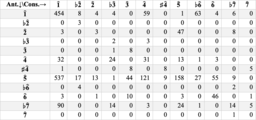
Example 1. Bass-note transitions in the McGill Billboard corpus from an eleventh chord (the antecedent, “Ant.”) to the ensuing chord (the consequent, “Cons.”)
(click to enlarge)
[1.2] In Spicer’s hearing, the soul dominant in “She’s Gone” provokes an expectation of tonic—a summoned by the bass voice’s . Spicer is not alone in reacting to the sonority in this way. David Temperley, for instance, offers the following assessment: “V11 nearly always moves to I” (2018, 62). Nevertheless, corpus data—shown in Example 1—reveal some surprising statistics. The corpus (whose construction I explain below) includes not only instances of V11 in the Ionian mode (in other words, chords like the soul dominant in “She’s Gone”), but also equivalent sonorities built on any scale degree. These equivalent sonorities arise in local tonicizations as well as in the context of other modes, such as the Mixolydian mode. To be sure, V11 moving to I is a frequent occurrence, although only a slight majority (53.8%) of V11 chords in the corpus do so. In Example 1, that particular resolution is located at the intersection of an antecedent bass note of and a consequent bass note of , of which there are 537 such transitions. In this article, I show dependency between the bass voice’s approach to what I agnostically call “an eleventh chord” and that eleventh chord’s “resolution.” By eleventh chord, I mean a four- or five-note chord featuring a bass note, an optional perfect fifth above the bass, and a minor seventh, a major ninth, and a perfect eleventh above the bass; the upper voices may occur in any registral ordering. For example, an eleventh chord built above the bass note G would necessarily include the notes F, A, and C (and optionally include the note D) in the upper voices. Furthermore, I also show dependency between an eleventh chord’s offset beat (i.e., the moment in which the chord ceases to be in effect), the global scale degree of its bass voice, and its resolution. In practical terms, attention to one or two features concerning a given eleventh chord can improve the accuracy of an engaged listener’s prediction regarding the chord’s resolution.
[1.3] In section 2 of this article, I describe the dataset that I use in my research; I also elaborate on existing theoretical explanations of the soul dominant. I compare and contrast the efficiency of two models designed to reflect aspects of theorists’ intuitions about the soul dominant in section 3; in section 4, I examine their application to specific songs from the corpus. In light of the observed dependency between various factors concerning eleventh chords and their musical contexts, I surmise that a stylistically educated listener might reasonably expect a particular resolution of these chords. In section 5, I test the validity of my findings by applying the two models to a second, smaller corpus; I also consider the models’ application to another sonority to which music theorists often attribute dominant function: the dominant seventh chord. I conclude with some suggestions for further research in section 6.
2. Methods and Materials
[2.1] Given the high degree of subjectivity inherent in analyzing recorded popular music, I decided to use archival data from the McGill Billboard corpus (“MBC”). This publicly available dataset includes harmonic transcriptions for 1,084 randomly selected songs that charted between 1958 and 1991, transcribed by over a dozen jazz musicians (Burgoyne 2011, xvii–xviii, 130–31, 135). John Ashley Burgoyne, the corpus’s creator, has stated that a goal of the corpus was “to represent an experience whereby a particular person in the United States listened to a particular song at a particular time in a particular week” (2011, 128)
[2.2] I am committed to modeling a specific listener experience via models that take one or two distinctive features of eleventh chords’ behavior overall and form a cognitive category around those specific behaviors. This follows the theories of Spicer and Temperley, who—each in their own way—understand the “soul dominant” as exhibiting very specific behaviors: when an eleventh chord behaves along these lines, it is a soul dominant; when it does not, we may question the application of that categorical label
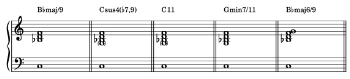
Example 2. Five chord symbols in the MBC transcriptions (Burgoyne 2011)
(click to enlarge)
[2.3] The variety of labels applied to eleventh chords in the MBC transcriptions reflects some of the challenges the chord poses to harmonic analysis, as well as disagreement between theoretical explanations of how the chord arises. The chord is mentioned in some of the corpus’s documentation, specifically in directions that Jonathan Wild used to coach the corpus’s transcribers. Wild groups the four labels C11,
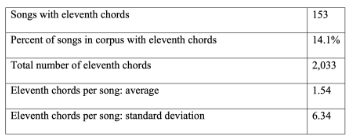
Example 3. Statistics concerning eleventh chords in the MBC
(click to enlarge)
[2.4] Regardless of this labeling difference, my corpus analysis treats the five labels shown in Example 2 as a single chord class—a generic “eleventh chord.” The chord class can be transposed to each of the twelve relative pitch classes available in a key (Snyder 1990, 125). In other words, a key consists of twelve scale-degree classes, the seven diatonic scale degrees plus the five chromatic degrees with enharmonic equivalence (,
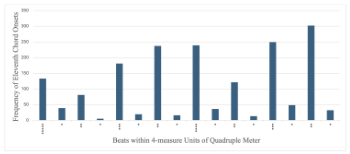
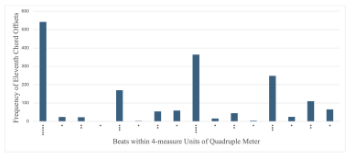
Example 4. Onsets of eleventh chords organized by beats within four-measure units of quadruple meter
(click to enlarge)
Example 5. Offsets of eleventh chords organized by beats within four-measure units of quadruple meter
(click to enlarge)
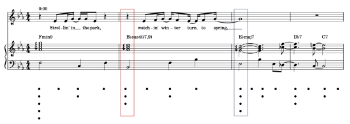
[2.5] Spicer (2017, [27]) and Temperley (2018, 62) both assert that soul dominants are common at the ends of formal sections such as verses and bridges. To test this, I also recorded the beat class of the onset (moment of initiation) and offset (moment of termination) of eleventh chords in the MBC within normative four-measure units of quadruple meter when possible. Also, when possible, I divided sections into multiple four-measure units (e.g., I divided eight-measure sections into two four-measure units)
Example 6. The first four measures of Roberta Flack’s “Feel Like Makin’ Love” (1974). All chord symbols are taken from the MBC transcription. The red box highlights the eleventh chord’s onset; the blue box highlights its offset.
(click to enlarge and listen) |
3. Results
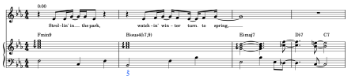
Example 7. The first four measures of Roberta Flack’s “Feel Like Makin’ Love” (1974). The eleventh chord in m. 2 is built on .
(click to enlarge)
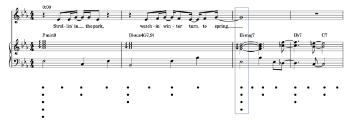
[3.1] I use the data I collected to test a few suppositions about the soul dominant: Temperley’s claim that V11 usually resolves to I, Spicer’s claim about the soul dominant’s dominant function (a function associated with particular chord-to-chord successions, as I outline below), and—extrapolating from observations of both Spicer and Temperley—the idea that eleventh chords tend to resolve on strong beats. Consider first a simple model designed to test Temperley’s claim that V11 usually moves to I. We can test this theory with a simple binary classifier that implements the following rule: if an eleventh chord has in the bass, then it is predicted to resolve by descending perfect fifth in the bass; if an eleventh chord does not have in the bass, then it is not predicted to resolve by descending perfect fifth. (Here, I’ll use “descending perfect fifth” on account of the interval’s historical legacy; in practice, the bass motion may also be realized as an ascending perfect fourth. For my purposes, the direction in pitch space is not important.) In the MBC, 537 V11 chords do indeed behave like “soul dominants,” resolving to some chord with in the bass. Example 7 illustrates one such instance. By adding to those 537 V11 chords the 904 eleventh chords built on any of the eleven other scale degrees that do not resolve down by fifth, and dividing this sum by 2,033—the total number of eleventh chords in the MBC—the rule appears approximately 71% accurate
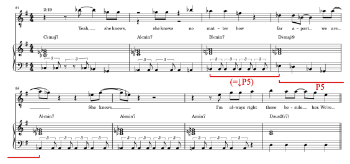
Example 8. The last eight measures of the bridge of Phil Collins’s “Two Hearts” (1988). In mm. 93–94, the ascending P4 in the bass is equivalent to a descending P5; in m. 94,
(click to enlarge and listen)
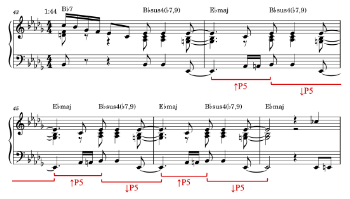
Example 9. Measures 43–47 of Brother Jack McDuff’s “Theme from Electric Surfboard” (1969). In mm. 44–46, the
(click to enlarge and listen)
[3.2] Given Spicer’s claim about the soul dominant’s dominant function, one question that arises concerns the role that chord-to-chord succession may play in this dominant function. To allow for the possibility of secondary soul dominants (e.g., V11/IV resolving to IV, of which there are 59 instances in Example 1), I explore models that base their predictions on the interval with which the bass voice approaches the eleventh chord. If the soul dominant has dominant function, it is fair to wonder how often it is preceded by a pre-dominant—a harmony “whose primary purpose is to lead to the dominant” (Caplin 1998, 23). A rule that predicts an eleventh chord to be followed by bass motion of a descending perfect fifth if and only if it is itself preceded by descending-perfect-fifth bass motion (e.g., ii–V11–I in the global key or any local key) is 69% accurate
[3.3] To test Spicer and Temperley’s assertion that soul dominants commonly occur at the ends of formal sections—and thus the end of phrases and end of measures—I queried how many eleventh chords terminate on downbeats or hyperdownbeats
Example 10. The first four measures of Roberta Flack’s “Feel Like Makin’ Love” (1974). The eleventh chords in m. 2—
(click to enlarge) |
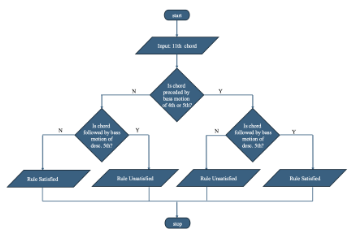
Example 11. Flow-chart illustrating the input and output of Model A.
(click to enlarge)
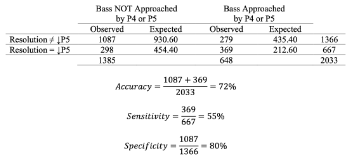
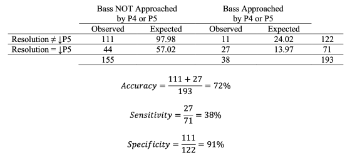
Example 12. Error matrix for a model (Model A) that predicts resolution by descending perfect 5th if and only if an eleventh chord is approached by perfect 4th or perfect 5th.
(click to enlarge)
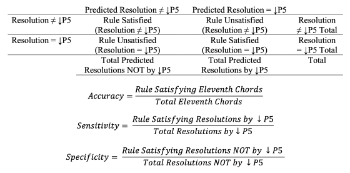
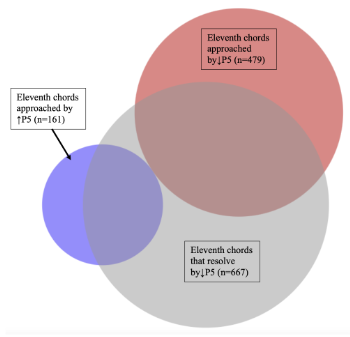
[3.4] For the remainder of the article, I focus on two rule-based models that demonstrate aspects of eleventh-chord harmonic practice when applied to specific chords from the dataset, allowing us to further test Spicer and Temperley’s theoretical intuitions. Example 11 shows a flow-chart illustrating a binary classifier that I term Model A. Model A formalizes some of the above observations surrounding these chords’ bass-motion behaviors, namely the tendency for soul dominants to be preceded by either a pre-dominant or by tonic. It predicts resolution by descending perfect fifth if and only if the bass voice of an eleventh chord is approached by perfect fourth or perfect fifth. That is: the model’s rule is “satisfied” if an observed eleventh chord resolves down by fifth if it is preceded by bass motion of fourth or fifth; but, it is also satisfied if the chord does not resolve down by fifth if it is not preceded by a fourth or fifth. Example 12 shows an “error matrix”—a useful table for scrutinizing the performance of a model. Eleventh chords approached by a perfect fourth or fifth in the bass are more than twice as likely as eleventh chords approached any other way to be followed by bass motion of a descending perfect fifth. Example 13 provides a key for deciphering the statistics presented in the error matrix. Accuracy denotes the percent correctly classified overall; sensitivity denotes the percent of soul dominants correctly classified; specificity denotes the percent of non-soul dominants correctly classified
Example 13. Explanation of how to interpret the statistics presented in the error matrix.
(click to enlarge) | Example 14. Area-proportional Venn diagram for Model A. The gray circle represents eleventh chords followed by bass motion of a descending P5. The red circle represents eleventh chords approached by a descending P5 in the bass voice. The blue circle represents eleventh chords approached by an ascending P5 in the bass voice.
(click to enlarge) |
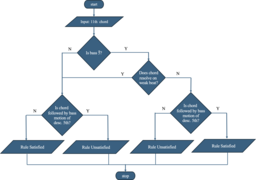
Example 15. Flow-chart illustrating the input and output of Model B.
(click to enlarge)
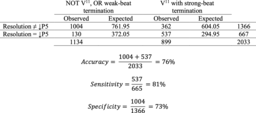
Example 16. Error matrix for a model (Model B) that predicts resolution by descending perfect 5th if an only if an eleventh chord has in the bass and terminates on a strong beat.
(click to enlarge)
[3.5] The eleventh chord in the Roberta Flack excerpt shown in Example 7 adheres to Model A—its rules are satisfied—and also to what I term Model B. Example 15 shows a flow-chart for Model B, a combination of the remaining two factors. Model B predicts resolution by descending perfect fifth if and only if an eleventh chord has in the bass and terminates on a strong beat
Example 17. Area-proportional Venn diagram for Model B. The yellow circle represents eleventh chords followed by bass motion of a descending P5. The red circle represents eleventh chords built on . The blue circle represents eleventh chords that do not resolve on a weak beat.
(click to enlarge) |
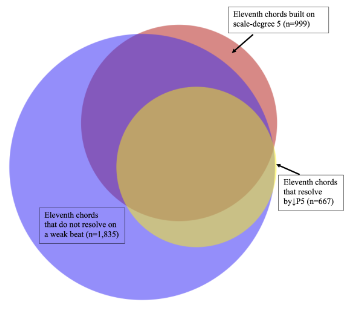
[3.6] Example 12 reveals a lack of independence between the bass’s approach to and departure from an eleventh chord; Example 16 reveals a lack of independence between an eleventh chord’s resolution, its bass scale degree, and its offset beat. For the engaged listener following along with the harmony in real time, the lack of independence between these factors may give rise to the appearance of cause and effect relationships
4. Comparative Case Studies for Models A and B
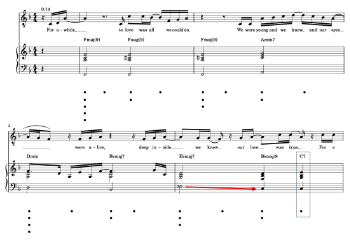
Example 18. The first four measures of the first verse of Earth, Wind & Fire’s “After the Love Has Gone” (1979). Both models decline to predict bass resolution by descending perfect 5th (bass of “
(click to enlarge and listen)
[4.1] Example 18 shows the musical factors that impact the outcomes of Models A and B applied to an eleventh chord found within the first four measures of the first verse of Earth, Wind & Fire’s “After the Love Has Gone.” With regards to the excerpt’s penultimate chord, “
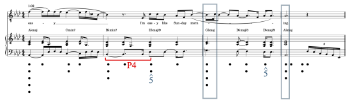
[4.2] Example 19 highlights the pertinent musical details of the last four measures of the first chorus of the Commodores’ “Easy.” This excerpt features two eleventh chords, both labeled “
Example 19. The last four measures of the first chorus of the Commodores’ “Easy” (1977). Both models incorrectly predict a leap of a descending perfect 5th in the bass across the excerpt’s second and third measures. Model B correctly predicts the resolution of the second “
(click to enlarge and listen) |
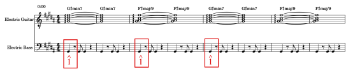
Example 20. The first eight measures of Tina Turner’s “What’s Love Got to Do with It” (1984). Both models decline to predict bass resolution by descending perfect 5th (bass of “
(click to enlarge and listen)
[4.3] Both models are equipped to handle tonic pedal points in modal contexts effectively. Example 20 shows a tonic pedal point in the Aeolian mode in the introduction to Tina Turner’s “What’s Love Got to Do with It,” an instance of what de Clercq refers to as “hierarchy divorce” between the bass and upper voices (2019, 271). Megan Lavengood (2020, [0.1]) identifies the bass guitar and electric guitar in this song as the “functional bass layer” and “harmonic filler layer,” respectively. Above a stationary
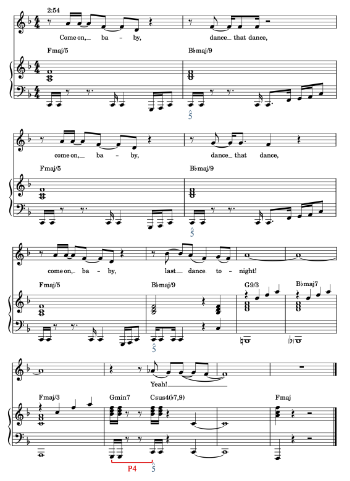
Example 21. The final twelve measures of Donna Summer’s “Last Dance” (1978) generate several incorrect predictions of resolution by descending 5th from Model B and one correct prediction of resolution by descending 5th (final three measures) from Model A.
(click to enlarge and listen)
[4.4] On the other hand, Model B often makes inaccurate predictions when pedal points occur on the dominant scale degree
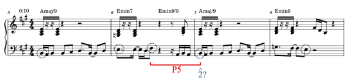
Example 22. Measures 5–8 of “Dial My Heart” (1988) by the Boys. Dashed circles highlight the bass notes included in the MBC transcription. Model A correctly predicts that a chord with E in the bass will succeed the “Amaj/9” chord in m. 7; Model B declines such a prediction because the transcription does not recognize the bass note of “Amaj/9” as .
(click to enlarge and listen)
[4.5] The predictions of each of the models also illustrate interesting and conflicting facets of complex musical situations such as tonal ambiguity or harmonic-bass divorce (de Clercq 2019). Example 22 shows an excerpt from the introduction to “Dial My Heart” by the Boys that elicits contrasting classifications from the two models considered in this article. The MBC transcription lists the song’s tonic as A, even though the bass notes of Example 22’s excerpt—B, E, and
5. Further Explanation of Models A and B, and a Test
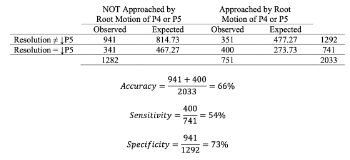
Example 23. Error matrix for a model that predicts resolution by descending perfect 5th if and only if an eleventh chord is approached by root motion of a perfect 4th or perfect 5th.
(click to enlarge)
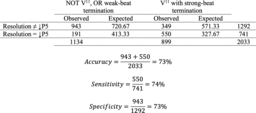
[5.1] Thus far, this article has focused on bass notes rather than chord roots. This is for two main reasons. First, there is clearly some debate between theorists—as well as the MBC’s transcribers—over which note is the true root of chords within popular-music repertoires. A chord’s bass note, however, is quite clear. Additionally, bass notes had greater predictive power than did chord roots in this corpus. Model A describes the behavior of 72% of my corpus when using bass motion, while the same model using root motion describes only 66%. (See Example 23.) Similarly, while Model B describes 76% of the corpus using bass notes, it falls to 73% when using chord roots (see Example 24). In both cases, predictions concerning the ensuing bass note were more accurate than predictions concerning the ensuing root.
Example 24. Error matrix for a model that predicts as chord root to ensue if and only if an eleventh chord has in the bass and terminates on a strong beat.
(click to enlarge) |
Example 25. The first verse of Billy Joel’s “Just the Way You Are” (1977) concludes with an Asus4(
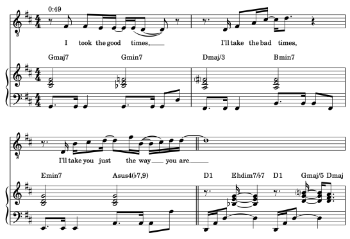
(click to enlarge and listen)
[5.2] These discrepancies in accuracy owe to two factors. For one, 5.9% of the pre- and post-eleventh chords in this study are in inversion
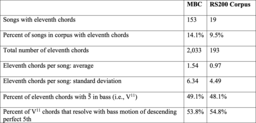
Example 26. Comparison of eleventh chords in the MBC and in Temperley’s RS200 transcriptions.
(click to enlarge)
[5.3] To test these models’ generalizability, I test Models A and B on a separate corpus: Temperley and de Clercq’s “Rolling Stone 200 Corpus” (2013, 187–88). Temperley and de Clercq’s dataset includes two sets of harmonic analyses of two hundred songs from Rolling Stone magazine’s 2004 article “The 500 Greatest Songs of All Time.” Both authors independently analyzed each piece within this corpus, and I will focus specifically on Temperley’s analyses, as they include more eleventh chords than de Clercq’s. The Rolling Stone 200 (“RS200”) corpus has fewer total songs and fewer total eleventh chords than the MBC—see Example 26 for a comparison. As with the MBC, only a plurality of eleventh chords in the RS200 have in the bass voice. Despite Temperley’s pronouncement that “V11 nearly always moves to I,” according to his transcriptions such a move happens only 54.8% of the time. Example 27 reveals that Model A is slightly less accurate when applied to the RS200 corpus transcription data; Example 28 shows Model B to be slightly more accurate. Eleventh chords approached by a perfect fourth or perfect fifth in the bass are more than twice as likely as eleventh chords approached any other way to be followed by bass motion of a descending perfect fifth (χ2(1, N = 193) = 23.89, p < .001). Eleventh chords with in the bass and a chord offset not on a weak beat are more than three times as likely to be followed by bass motion of a descending perfect fifth than eleventh chords that do not meet both of those criteria (χ2(1, N = 193) = 49.55, p < .001).
Example 27. Error matrix for Model A applied to Temperley’s transcriptions from the RS200 corpus.
(click to enlarge) | Example 28. Error matrix for Model B applied to Temperley’s transcriptions from the RS200 corpus.
(click to enlarge) |
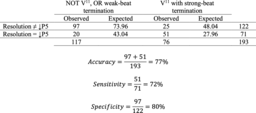
[5.4] This alternate dataset also illustrates the potential problem of overfitting, or constructing a model whose complexities are specific to a single corpus but do not accurately describe events outside that specific dataset. We could, for instance, combine the three factors used across Models A and B—the bass scale degree, the interval with which the bass voice approaches the chord, and the metric offset—into a single model. Such a model would link together all the features useful within the MBC, but suffers when applied to the RS200. In this case, combining all three factors into one model mildly improves predictive accuracy when applied to the MBC-derived data to 78%, but such a model underperforms the simpler Model B when applied to the RS200 corpus (only 73%, compared to Model B’s 77% accuracy)
[5.5] Overall, this suggests that the dominant function of an eleventh chord—the category of the soul dominant—seems to arise from a combination of overlapping but not necessarily co-occurring factors. Often, an eleventh chord preceded by a particular bass interval (such as a fourth or fifth) will proceed, in characteristic fashion, one position counterclockwise around the circle of fifths to the ensuing chord. Additionally, soul dominants tend to be chords with in the bass that resolve to I on strong beats. Furthermore, my modeling shows that the “soul dominant” concept ought to include not only V11 chords, but also tonicizing dominants (as well as small-scale modulations subsumed into a song’s tonal hierarchy).
Example 29. Error matrix for Model A applied to major-minor seventh chords in the MBC.
(click to enlarge)
Example 30. Error matrix for Model B applied to major-minor seventh chords in the MBC.
(click to enlarge)
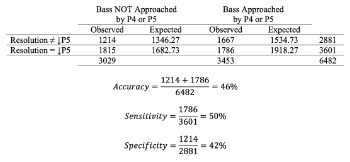
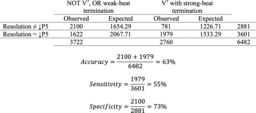
[5.6] Remarkably, my models also show that V11 chords seem to behave in more predictable ways than the common-practice form of the dominant—the major-minor seventh chord, or “dominant seventh.” Following the same procedure as before, I gathered data from the MBC transcriptions on major-minor seventh chords. Example 29 shows an error matrix for Model A as applied to the 6,482 major-minor seventh chords in the corpus. As can be seen from the table, Model A is less accurate when applied to major-minor seventh chords than it is when applied to eleventh chords—in fact, major-minor seventh chords approached by a perfect fourth or perfect fifth in the bass voice are actually less likely to be followed by bass motion of a descending perfect fifth than major-minor seventh chords approached by any other interval
6. Conclusion
[6.1] This article compared and tested the accuracy of two models’ predictions regarding harmonic transitions from eleventh chords. Eleventh chords approached by a perfect fourth or perfect fifth in the bass voice are more than twice as likely than eleventh chords approached by any other interval (including a perfect unison) to be followed by bass motion of a descending perfect fifth—in other words, to behave as soul dominants. Eleventh chords with in the bass that terminate on a strong beat are more than five times as likely to behave similarly. This behavior derives from the entire MBC, including songs from the soul music era, songs that pre-date the era, and songs from subsequent eras that were influenced by soul music.
Example 31. The first eight measures of D’Angelo’s “Another Life” (2014). The transcription and chord labels are those of the author.
(click to enlarge and listen)
Example 32. Shares of bass departure intervals from eleventh chords in the MBC. Boldface indicates the intervals used in the excerpt found in Example 31.

(click to enlarge)
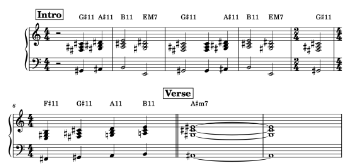
[6.2] Spicer 2017 also discusses another facet of dominant chord usage in popular music that does not seem to be captured in the MBC’s random sample of songs. He writes: “By the late 1970s [the soul dominant] sometimes operated as a coloristic sonority for its own sake, irrespective of its dominant function (not unlike, for example, the way in which Debussy often composed passages that utilized harmonic planing of non-functional dominant-seventh chords)” [27]. Example 31 shows an excerpt from neo-soul musician D’Angelo’s “Another Life” (2014) that illustrates this harmonic practice. The song’s introduction features eleventh chords built on five different pitch classes. As Example 32’s inferential statistics suggest, bass departures of an ascending perfect fourth from an eleventh chord (e.g., B11 to EM7) are relatively common, though the “Another Life” introduction also features some rare bass departures (e.g., B11 to
[6.3] This article has used empirical testing to test conventional wisdom about eleventh chords and the “soul dominant.” By operationalizing systems of rules and categorical expectations, these systems model musical expectations, especially one where a certain outcome is expected a majority of the time. Re-examining the behavior of the eleventh chords in this corpus also shows how harmonic function in popular music might be better understood through a lens of greater emphasis on chord context, rather than chord content. Finally, simple models may not only be used to test theoretical intuitions, but also as new listening strategies to tease out the surprising and satisfying moments in music.
Stanley Ralph Fink
The University of Alabama
Moody Music Building
810 2nd Ave
Room 151
Tuscaloosa, AL 35487
srfink1@ua.edu
Works Cited
Brown, Jenine. 2020. “The Perception of Frozen Intervals in Anton Webern’s Concerto for Nine Instruments, Op. 24, Third Movement.” Music Theory Spectrum 42 (1): 38–53.
Burgoyne, John Ashley. 2011. “Stochastic Processes & Database-Driven Musicology.” PhD diss., McGill University.
Caplin, William. 1998. Classical Form: A Theory of Formal Functions for the Instrumental Music of Haydn, Mozart, and Beethoven. Oxford University Press.
Cohn, Richard. 1992. “Transpositional Combination of Beat-Class Sets in Steve Reich’s Phase-Shifting Music.” Perspectives of New Music 30 (2): 146–77.
de Clercq, Trevor. 2019. “The Harmonic-Bass Divorce in Rock.” Music Theory Spectrum 41 (2): 271–84.
de Clercq, Trevor, and David Temperley. 2011. “A Corpus Analysis of Rock Harmony.” Popular Music 30 (1): 47–70.
Doll, Christopher. 2017. Hearing Harmony: Toward a Tonal Theory for the Rock Era. University of Michigan Press.
Haralambos, Michael. 1975. Right On: From Blues to Soul in Black America. Drake Publishers, Inc.
Huron, David. 2006. Sweet Anticipation: Music and the Psychology of Expectation. MIT Press.
Larson, Steve. 2002. “Musical Forces, Melodic Expectation, and Jazz Melody.” Music Perception 19 (3): 351–85.
Lavengood, Megan L. 2020. “The Cultural Significance of Timbre Analysis: A Case Study in 1980s Pop Music, Texture, and Narrative.” Music Theory Online 26 (3).
Lerdahl, Fred, and Ray Jackendoff. 1983. A Generative Theory of Tonal Music. MIT Press.
Lewin, David. 1986. “Music Theory, Phenomenology, and Modes of Perception.” Music Perception 3 (4): 327–92.
London, Justin. 2004. Hearing in Time: Psychological Aspects of Music Meter. Oxford University Press.
Loui, Psyche. 2012. “Statistical Learning—What Can Music Tell Us?” In Statistical Learning and Language Acquisition, ed. Patrick Rebuschat and John Williams, 433–62. De Gruyter Mouton.
Maultsby, Portia K. 1983. “Soul Music: Its Sociological and Political Significance in American Popular Culture.” Journal of Popular Culture 17 (2): 51–60.
Middleton, Richard. 1990. Studying Popular Music. Open University Press.
Nobile, Drew. 2016. “Harmonic Function in Rock Music: A Syntactical Approach.” Journal of Music Theory 60 (2): 149–80.
—————. 2020. Form as Harmony in Rock Music. Oxford University Press.
Piston, Walter. 1962. Harmony. 3rd ed. W. W. Norton & Company, Inc.
Prince, Jon B., and Mark A. Schmuckler. 2014. “The Tonal-Metric Hierarchy: A Corpus Analysis.” Music Perception 31 (3): 254–70.
Saffran, Jenny R., Elizabeth K. Johnson, Richard N. Aslin, and Elissa L. Newport. 1999. “Statistical Learning of Tone Sequences by Human Infants and Adults.” Cognition 70: 27–52.
Shea, Nicholas, Christopher Wm. White, Bryn Hughes, and Dominique T. Vuvan. 2023. “Metric Accent Affects Perception of Key Center in Pop-Music Chord Loops.” PsyArXiv. doi:10.31234/osf.io/spj6h.
Snyder, John L. 1990. “Entropy as a Measure of Musical Style: The Influence of a Priori Assumptions.” Music Theory Spectrum 12 (1): 121–60.
Spicer, Mark. 2004. “(Ac)cumulative Form in Pop-Rock Music.” Twentieth-Century Music 1 (1): 29–64.
—————. 2017. “Fragile, Emergent, and Absent Tonics in Pop and Rock Songs.” Music Theory Online 23 (2).
Stephens, Robert W. 1984. “Soul: A Historical Reconstruction of Continuity and Change in Black Popular Music.” The Black Perspective in Music 12 (1): 21–43.
Tagg, Philip. 2014. Everyday Tonality II: Towards a Tonal Theory of What Most People Hear. The Mass Media Music Scholars’ Press.
Temperley, David. 1999. “Syncopation in Rock: A Perceptual Perspective.” Popular Music 18 (1): 19–40.
—————. 2001. The Cognition of Basic Musical Structures. MIT Press.
—————. 2018. The Musical Language of Rock. Oxford University Press.
Temperley, David, and Trevor de Clercq. 2013. “Statistical Analysis of Harmony and Melody in Rock Music.” Journal of New Music Research 42 (3): 187–204.
Tufte, Edward. 1997. Visual Explanations: Images and Quantities, Evidence and Narrative. Graphics Press.
White, Christopher Wm., and Ian Quinn. 2018. “Chord Context and Harmonic Function in Tonal Music.” Music Theory Spectrum 40 (2): 314–37.
Footnotes
1. See also Spicer 2004, 38. Piston (1962, 262) refers to such a sonority as the “dominant eleventh.”
Return to text
2. Haralambos (1975, 154) locates the beginning of soul music as a style between 1960 and 1964 and observes that it became the foremost style of Black popular music by the middle of the 1960s (101). By the end of the 1970s, the term “soul” had undergone further development. Stephens (1984, 37) notes its blanket application to all Black popular music by that point, and Maultsby (1983, 58) finds that it also applied to any white performer who drew musical influence from blues and/or gospel music.
Return to text
3. As a measure of a song’s popularity, chart position and duration has been criticized, given that record labels sometimes paid radio stations to play songs they wanted to market (Burgoyne 2011, 129; Middleton 1990, 5–6).
Return to text
4. Thus, not all eleventh chords are soul dominants. I would explain the difference like this: if the bass note of an eleventh chord may be reasonably predicted to resolve by descending perfect fifth (and this criteria may be satisfied in more than one way), it is a soul dominant, regardless of how it actually resolves.
Return to text
5. Huron 2006 offers various “heuristics” that perform better than chance as explanation for listeners’ expectations.
Return to text
6. Tagg mentions Gm7 over C as another possible label.
Return to text
7. A future study might address how to control for the repetition of harmonic progressions in this dataset; such an undertaking is beyond the scope of this project.
Return to text
8. As the transcription for Milli Vanilli’s “Baby Don’t Forget My Number” did not match the song’s audio, I excluded its data from my study. The corpus also includes a handful of mislabeled eleventh chords in the following songs: Bing Crosby’s “White Christmas,” Color Me Badd’s “I Adore Mi Amor,” Milli Vanilli’s “Girl You Know It’s True,” and Bob Seger’s “Like a Rock.” After aurally verifying the errors, I excluded those eleventh chords from my study.
Return to text
9. Thirteen of the corpus’s eleventh chords were not followed by any chord or bass note, either because they were the last chord of the song, or they were followed by a passage that lacked harmony and/or a bassline (e.g., a drum solo).
Return to text
10. Example 1 therefore departs from aspects of the data collection approach used by Trevor de Clercq and David Temperley in their investigation on chord transitions in a one-hundred-song subset of Rolling Stone magazine’s “500 Greatest Songs of All Time” list—the “RS 5 x 20 corpus.” In that study, the authors counted changes of chord root, but not chord quality, in song transcriptions; consequently, they did not collect data on changes of quality with a constant root (2011, 61). Burgoyne’s Table 4.10 and Table 4.11 (2011, 176, 178) take a similar approach to that of de Clercq and Temperley.
Return to text
11. In rock music, Temperley notes the “strong norm of duple (two-measure and four-measure) hypermeter” (2018, 143). Out of the 2,033 chords in this study’s dataset, 1,752 (86.2%) were found in contexts with clear quadruple meter and hypermeter. This figure includes some compound meters (e.g., eight bars of
Return to text
12. In Example 6, the onset of the eleventh chord (“
Return to text
13. Shea, White, Hughes, and Vuvan (2023, 21) similarly demonstrates how a tonal scenario involving several possible outcomes may be collapsed into a binary choice when investigating a first-level default.
Return to text
14. Successful predictions made by such a model exhibit Steve Larson’s notion of “inertia”: the bass voice approaches the soul dominant via a descending perfect fifth and continues, in pattern fashion, via another descending perfect fifth to the ensuing chord. On inertia, see Larson 2002 (352).
Return to text
15. Adding the possibility of the bass voice approaching the eleventh chord by ascending major second to the possibility of an approach by descending perfect fifth (e.g., approached from or ) actually lowers the model’s accuracy to 66%.
Return to text
16. The higher onset rate in the last measure of the hypermeasure—as well as the higher offset rate on the hypermetric downbeat—could be connected to Temperley’s observation that V11 chords are common at cadences (2018, 62). Furthermore, Example 1, above, shows that a majority of eleventh chords (1,120/2,033, 55.1%) are followed by in the bass voice. Together, Examples 1 and 5 lend support to Prince and Schmuckler’s observations about the correlation between tonal and metric stability (2014, 261).
Return to text
17. Technically, the model filters out from its predicted resolutions any eleventh chord with a chord offset on a weak beat (i.e., all second and fourth beats in a passage of quadruple hypermeter). Eleventh chords in non-normative metric and hypermetric contexts are not filtered out, and are therefore predicted to resolve conventionally.
Return to text
18. Measures 3–4 of Example 10 provide a glimpse of how the MBC transcribers handled syncopation. The transcribers reduced-out syncopation, recording instead the “deep structure” (Temperley 1999, 26) of the songs’ harmonic rhythm. Thus, the transcription records “
Return to text
19. The binary data in the “Resolution ≠ ↓P5” row in Example 12 represent a compound event, encompassing the eleven other bass departure intervals (P1, ↓m2, etc.), as well as eleventh chords not followed by bass notes (e.g., as a song’s final chord).
Return to text
20. Of the 648 eleventh chords with bass notes approached by perfect fourth or perfect fifth, 369 (56.9%) were followed by bass motion of a descending perfect fifth; of the 1,385 eleventh chords with bass notes not approached by perfect fourth or perfect fifth, 298 (21.5%) were followed by bass motion of a descending perfect fifth. The chi-square (χ2) value, then, exceeded the tabled critical value on account of the differences between the observed and expected cell frequencies. In the error matrix for Model A (Example 12), the observed counts of successfully-predicted resolutions exceed the expected successfully-predicted resolutions, the observed unsuccessfully-predicted resolutions lag behind the expected unsuccessfully-predicted resolutions, and so on. Because the tabled critical value of χ2 = 3.84 was exceeded by the derived value of χ2 = 251.35, I reject the null hypothesis that the bass’s departure from an eleventh chord is independent of its approach. It is important to clarify that there is no “ground truth” label of confirmed “soul dominants” used to assess the accuracy of the model’s performance—accuracy hinges solely on the bass motion found after the eleventh chord.
Return to text
21. This model suggests that eleventh chords’ resolution (as theorized by Temperley) more often than not occurs during moments where a listener’s “attentional peak” is likely to be higher than a minimum threshold. On attentional peaks, see London 2004 (158).
Return to text
22. Of the 899 eleventh chords with in the bass and a chord offset not on a weak beat, 537 (59.7%) were followed by bass motion of a descending perfect fifth; of the 1,134 eleventh chords that did not meet both of those criteria, 130 (11.5%) were followed by bass motion of a descending perfect fifth.
Return to text
23. Model B would explain why Spicer felt the introduction and verses of “She’s Gone” produce “constant tension.” Because those sections lack tonic chords entirely, the model’s predictions about the resolution of the many V11 chords all prove false.
Return to text
24. Edward Tufte offers that “the reason we seek causal explanations is in order to intervene, to govern the cause so as to govern the effect” (1997, 28). I hesitate, however, to speculate on what the models compared herein say about how songwriters deploy eleventh chords in the act of songwriting. It is possible that a songwriter might structure the harmony of a song hierarchically—or work backwards from a terminal tonic chord in writing a chord progression. Model B reveals that global scale degree and meter are also important factors. Since tonic chords are common—both generally and on odd-numbered downbeats—it is also possible that the characteristics that Spicer and others have attributed to “soul dominants” owe to the chords’ tendency to be deployed in the interstices (from both a metric standpoint as well as a pitch and pitch-class standpoint) between tonic chords.
Return to text
25. Theories of statistical musical learning suggest that listeners should be able to learn the musical norms illuminated in this article. On the conjectural connection between corpus studies and statistical musical learning, see White and Quinn 2018 (317).
Return to text
26. On this expansive view of musical context, see Lewin 1986 (335).
Return to text
27. This chord illustrates Trevor de Clercq’s notion of syntax divorce, a type of harmonic-bass divorce: “the harmonic layer and the bass share a structural or cadential goal [here, tonic] but approach that goal via different pathways” (2019, 271–72).
Return to text
28. This generalization assumes a regular harmonic rhythm of chords changing on the first and third beat of each measure—or slower.
Return to text
29. For eleventh chords built on , such a bass departure happens less than 1% of the time (9/999).
Return to text
30. Curiously, “Amaj/9–Emin7” in Example 22 is an exact transposition of mm. 94–95 from Example 8 (“
Return to text
31. Conversely, 94.1% of the pre- and post-eleventh chords are in root position. Compare these findings to those of de Clercq and Temperley, who observe that 94.1% of all chords in the RS 5 x 20 corpus are in root position (2011, 66).
Return to text
32. Such a model would predict conventional resolution of any II11 (i.e., V11/V) or V11 chord approached by perfect fourth or fifth in the bass voice that terminates on a strong beat. As David Huron points out, there is a linear relationship between information content and reaction time (2006, 63). Increasing the complexity of a model may reduce the likelihood that the model reflects how listeners arrive at predictions in real time.
Return to text
33. The 153-song MBC subset includes one cover of a song in the 19-song RS200 subset (Jeff Beck’s cover of The Impressions’ “People Get Ready”), but the two recordings have non-trivial differences in their harmonic progressions.
Return to text
34. Of the 3,453 major-minor seventh chords with bass notes approached by perfect fourth or perfect fifth, 1,786 (51.7%) were followed by bass motion of a descending perfect fifth; of the 3,029 major-minor seventh chords with bass notes not approached by perfect fourth or perfect fifth, 1,815 (59.9%) were followed by bass motion of a descending perfect fifth.
Return to text
35. Of the 2,760 major-minor seventh chords with in the bass and a chord offset not on a weak beat, 1,979 (71.7%) were followed by bass motion of a descending perfect fifth; of the 3,722 major-minor seventh chords that did not meet both of those criteria, 1,622 (43.5%) were followed by bass motion of a descending perfect fifth.
Return to text
36. The status of the first “B11 to EM7” progression as a key-defining progression may only be recognized after the fact. Upon hearing the first B11 chord, the listener has no way of predicting how—or when—it might “resolve.”
Return to text
37. One possible direction would be to explore the effect of harmony in passages like Example 31 on the tonal pitch-class “center-of-gravity” (Temperley 2001, 125).
Return to text
Copyright Statement
Copyright © 2026 by the Society for Music Theory. All rights reserved.
[1] Copyrights for individual items published in Music Theory Online (MTO) are held by their authors. Items appearing in MTO may be saved and stored in electronic or paper form, and may be shared among individuals for purposes of scholarly research or discussion, but may not be republished in any form, electronic or print, without prior, written permission from the author(s), and advance notification of the editors of MTO.
[2] Any redistributed form of items published in MTO must include the following information in a form appropriate to the medium in which the items are to appear:
This item appeared in Music Theory Online in Volume 32, Issue 2 in June 2026. It was authored by Stanley Ralph Fink (srfink1@ua.edu), with whose written permission it is reprinted here.
[3] Libraries may archive issues of MTO in electronic or paper form for public access so long as each issue is stored in its entirety, and no access fee is charged. Exceptions to these requirements must be approved in writing by the editors of MTO, who will act in accordance with the decisions of the Society for Music Theory.
This document and all portions thereof are protected by U.S. and international copyright laws. Material contained herein may be copied and/or distributed for research purposes only.

Prepared by Ryan Galik, Editorial Assistant
Number of visits:
2194