Changed for Good: Pathways of Motivic and Tonal Development in Wicked
Kyle Hutchinson
KEYWORDS: Wicked, Analysis, “For Good”, Musical Theater, Music Theory, Schwartz, Broadway
ABSTRACT: This article proposes three analytic pathways through Wicked. As Schwartz describes, Wicked’s primary motif derives from the song “Somewhere Over the Rainbow,” which I divide into two parts: “Unlimited,” which uses a major-mode ---, and the continuation which includes and as subordinate motivic pitches. But intertextual aspects of “Unlimited” are only one dimension of the musical fabric: the motif also undergoes transformation across the show in a manner reminiscent of Schoenberg’s theory of developing variation. During “Defying Gravity,” the verse rearranges these scale degrees; in Act II, the Wizard corrupts the motif through inversion in “Wonderful.” Elphaba then adapts the original motif into a minor-mode context as she spirals into despair in “No Good Deed,” while the motif returns to its original form in “For Good.”
Similarly, the show’s large-scale tonal design (following Motazedian 2023 and Gilliam 1991) develops three tonal pathways that Elphaba traverses: C major reflecting her initial goals, and later the semitonally juxtaposed keys of B (the Wizard) and D-flat (defying the Wizard). In Act II, as Elphaba accepts the moniker of “wicked,” she descends into the Wizard’s associated tonality (B minor), before being redeemed by Glinda, who brings Elphaba back to D-flat major before her disappearance. A final pathway suggests that there are other relationships of note in Wicked: like “Unlimited,” namely other melodies from the show also originate in The Wizard of Oz. These analyses suggest a deeper-level musical unity and development that repudiates common criticisms of megamusicals, and, I argue, provide a compelling path for larger-scale musical analysis of Broadway shows.
DOI: 10.30535/mto.32.2.3
Copyright © 2026 Society for Music Theory
[0.1] Stephen Schwartz’s Broadway musical Wicked (2003)—an adaptation of Gregory Maguire’s 1995 novel of the same name—tells the story of Elphaba, the Wicked Witch of the West from L. Frank Baum’s The Wonderful Wizard of Oz (1900), who is perhaps most recognizable as the green-skinned antagonist in the 1939 film adaptation of Baum’s novel
[0.2] “Schwartz’s eclectic pop-tinged score,” as Paul R. Laird writes, “has played a major role in the show’s popularity” (2011, 89). And while the same could be said for almost any megamusical—Jesus Christ Superstar, Les Misérables, The Phantom of the Opera, Aida, and so on—it is notable that unlike many of its megamusical brethren, Wicked’s score has received some level of scholarly analytic attention
[0.3] Megamusicals, as Sternfeld describes them, are “large in several respects” including their plot, staging, and marketing (2006, 2–4). Likewise, their scores are also grandiose: “typically sung throughout” (2), and “featur[ing] ballads, tinged with pop, country, blues, or cabaret influences; they also offer hard-driving up-tempo numbers, songs in early rock ‘n’ roll style, and love duets that could work just as well in the movies or on television as they do onstage. All these appear alongside quasi-operatic ensembles and purely theatrical styles” (94)
Mozart can prepare a climactic finale for twenty minutes, Wagner for an entire act, but a theater song must make its point and quit within a very few minutes. Only by constructing musical relationships across the entire drama could Broadway composers create similar effects, and that level of composition was beyond all but a handful of the best musical plays of the tradition. (2002, 10
)(6)
[0.4] While Laird’s critical commentary on the score suggests that issues of development and unity are overcome, at least to some extent, in Wicked through the repetition of short musical motifs, these observations only begin to scratch the surface of Wicked’s musical construction. Indeed, unlike Andrew Lloyd Webber—who Sternfeld (2006, 89) describes as being somewhat tight-lipped about his compositional process—Schwartz has often spoken openly about aspects of his compositional approach to Wicked’s score beyond observations of Leitmotivic recurrence. In particular, Schwartz (2024) has described how the show’s primary motif, “Unlimited” (Example 2a, discussed below), is a rhythmic variation of the first seven notes of the song “Somewhere Over the Rainbow” (Example 2b, below), concluding on an eighth pitch that is not in the original melody () prior to a repetition of the motif up a major third. Given that “Somewhere Over the Rainbow” is arguably the most recognizable musical association with the world of Oz—owing to its use in the 1939 movie where it is sung by Judy Garland’s character, Dorothy—“Unlimited” acquires a marked semiotic importance from its intertextual derivation. Indeed, musicological research has focused on this motif, and its recurrence in an almost Leitmotivic fashion throughout the show; Laird, for instance, notes that the “Unlimited” theme occurs “early in the show and then [becomes] ‘I’m limited’ towards the end” (2017, 12).
[0.5] But the intertextual and Leitmotivic aspects of “Unlimited” are only one dimension of the musical fabric. In this article, I demonstrate the pathways—or yellow-brick roads, if one prefers—of motivic and tonal development in Wicked that refute many of the aforementioned criticisms of megamusicals, while also providing a deeper analytic engagement with Wicked’s musical structure. Ultimately, “Unlimited” is more than simply a recurring Leitmotif to be used as an aural calling card: what I will demonstrate through analysis of the songs most integral to Elphaba’s dramatic progression across the show (“The Wizard and I,” “Defying Gravity,” “Wonderful,” “No Good Deed,” and “For Good”) is that transformations of the “Unlimited” theme permeate the show. These transformations occur at structurally important dramatic moments, and in ways that musically reinforce the associated plot development, while simultaneously developing the motif in a manner reminiscent of the Schoenbergian concept of developing variation (Schoenberg 1975; see also Frisch 1984)
[0.6] Thus, I suggest that Schwartz’s score for Wicked is not only developed intentionally through integration with the plot, but also undertakes motivic and tonal development that more closely links it with nineteenth-century operatic and instrumental antecedents. In situating my conclusion in questions of perception, I contend that Wicked is not alone in its association with its operatic and symphonic antecedents: recent analytic work by both Nicole Biamonte and myself, as well as comments from musical theater composers themselves (see, e.g., Lloyd Webber and Rice 1978, Schwartz 2010a and 2010b, or comments by Sondheim in Horowitz 2010) suggest that, pace Swain’s claim to the contrary, developmental processes and structures in musical theater are part-and-parcel of the musical construction, albeit often embedded in ways that are not immediately aurally apparent to the listener. I thus contend that the analytic approaches I apply to Wicked in this article are more broadly applicable and form a compelling case for continued analytic and theoretic engagement with musical theater.
1. The “Unlimited” Motif and its Transformations
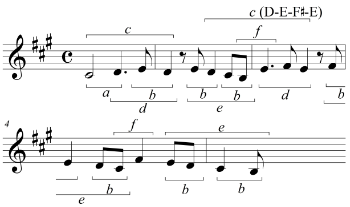
Example 1. Brahms, String Quartet Op. 51, no. 2, II, mm. 1–5, Violin Part (Schoenberg’s Analysis)
(click to enlarge)
[1.1] Much of the thematic content of Wicked that concerns Elphaba can be interpreted through a modified process of developing variation. Schoenberg describes the concept of developing variation as involving “variation of the features of a basic unit [that] produces all the thematic formulations which provide for fluency, contrasts, variety, logic and unity on the one hand, and character, mood, expression, and every needed differentiation, on the other hand—thus elaborating the idea of the piece” (1975, 397). Walter Frisch notes that “Schoenberg stresses that this is primarily a thematic or melodic procedure” (1984, 2) and describes how Schoenberg undertakes this type of analysis locally by dissecting the theme of Brahms’ String Quartet op. 51 no. 2 (Example 1). In cordoning off several short three- or four-note units, “Schoenberg explains that b is the inversion upward of a, c is a+b, d is a part of c, e is b+b, [and] f is the interval of a fourth, abstracted from e, in inversion” (4). In other words, each of the thematic utterances are derived via some transformation of a, often combined in various ways. Other types of developmental procedures Schoenberg identifies include the addition of ancillary notes, reduction, omission or condensation, and additions of upbeats or repetitions (10). Frisch concludes that “by developing variation, Schoenberg means the construction of a theme by the continuous modification of the intervallic and/or rhythmic components of an initial idea” (9)
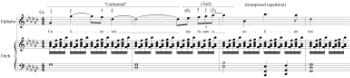
Example 2. The “Unlimited” Motif
(click to enlarge and see the rest)
[1.2] The first step in adapting this analytic process to Wicked is to define the basic unit: the “Unlimited” motif (Example 2a), which serves as a central nexus owing to its consistent dramatic and intertextual role within the show. Owing to the salience of the “Unlimited” portion of the motif, I will for the purposes of this analysis refer to the first four pitches—an octave leap on , followed by a stepwise descent to and a skip down to , all in the major mode—as the primary scale-degree content
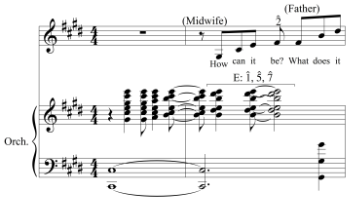
Example 3. Schwartz, Wicked, “No One Mourns the Wicked” mm. 120–21 (“Wicked” motif in the orchestra)
(click to enlarge)
[1.3] Outside of the Overture, the first appearance of the “Unlimited” motif is concealed in the harmonic material heard during Elphaba’s birth during the opening “No One Mourns the Wicked” sequence. This motif, which Schwartz describes as Elphaba’s “Wicked” motif, begins with a
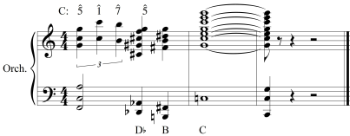
Example 4. Schwartz, Wicked, “The Wizard and I,” mm. 154–56
(click to enlarge)
[1.4] In its most recognizable melodic form, “Unlimited” first appears in “The Wizard and I,” a song in an expansive AABA(C)A form that occurs early in Act I of the show. “The Wizard and I” is Elphaba’s “I Want” song, detailing her desire to excel at her study of sorcery in order to work altruistically with the Wizard of Oz, a desire that fuels much of Elphaba’s dramatic arc in Act I of the show. As the third refrain approaches its cadence, the music suddenly and dramatically shifts from C major to G-flat major
Example 5. Schwartz, Wicked, “Defying Gravity,” mm. 38–41: rearrangement of “Unlimited”
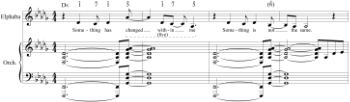
(click to enlarge)
[1.5] “Unlimited” then recurs sporadically in unaltered form throughout Act I, most prominently during the Ozdust Ballroom dance scene as Elphaba and Glinda take their first steps toward friendship. The motif’s first major transformation, however, comes in the climactic finale to Act I, “Defying Gravity.” Having realized that the Wizard is both a fraud and an aspiring dictator, Elphaba begins “Defying Gravity” with a slow rendition of the verse, stating: “Something has changed within me, something is not the same.” As shown in Example 5, the verse’s melody is set using the scale-degree content of “Unlimited,” but reorganized from its original iteration. In this case, the melody still begins on , but instead of an octave leap, the melody progresses –––, while the next four pitches outline –––. Here, the octave ambitus from the original motif is still present, but occurs with , rather than , at its highest and lowest points, and is filled in by ancillary repetitions of and . This reorganization of the scale-degree content of “Unlimited” continues: “I’m through with playing by the rules of someone else’s game” is likewise built of , , and in a different ordering, with neighboring at the conclusion. In this case, as Elphaba’s words speak of a realignment of her goals and motivations, the musical material that underscored her initial vision undergoes a similar musical transformation.
Example 6. Schwartz, Wicked, “Defying Gravity,” mm. 55–58: development of “Unlimited”
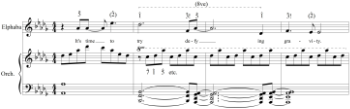
(click to enlarge)
[1.6] This transformation then continues into the chorus of the song that includes the “defying gravity” hook, shown in Example 6. First, the accompaniment ostinato in the high strings and woodwinds is built from a repeating ––– pattern, another rearrangement of the scale-degree content of “Unlimited.” The melody in the chorus similarly emphasizes and (and to a lesser extent ), but stabilizes the motif by trading for , albeit in an embellishing rather than structural role. The result of this trade is a more traditionally tertian melodic outline of the tonic triad: ––, rather than the dissonant –– of “Unlimited,” as though Elphaba’s realization about the Wizard’s treachery has brought a musical clarity to the non-tertian content of the original motif.
Example 7. Schwartz, Wicked, “Wonderful,” mm. 27–33
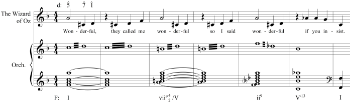
(click to enlarge)
[1.7] The next transformation of the motif comes in the Wizard’s song “Wonderful,” about halfway through Act II. At this juncture, the Wizard is making a second attempt to convert Elphaba to his side, promising her that with his help she can change the popular narrative from her being “wicked” to her being “wonderful.” The way that the Wizard tempts Elphaba here is musically insidious. Shown in Example 7, the primary motif of the song, to which the word “wonderful” is sung, consists of a descending minor sixth from A to
[1.8] The Wizard’s multitude of masks are thus on full display as he attempts to entice Elphaba by singing a version of her own motif to her. The insidiousness of the minor-mode allusions and the retrograded and inverted scale-degree progression, however, are masked by the harmonic content over which this motif occurs, which is unambiguously F major. This type of melodic-harmonic divorce suggests an intentional deployment of the major mode in the harmonic layer as a mask for the Wizard’s underhandedness in the melodic domain. Smoke and mirrors, deceit, and fraudulence are all well-established elements of the Wizard’s personality, not only in Wicked, but in the source material and 1939 movie adaptation as well; it stands to reason that the Wizard would not be above using musical deception as well
[1.9] Elphaba almost falls for the Wizard’s ploy: she is willing to join him, on the condition that he set free the winged monkeys that he uses as servants and spies. It is only upon the discovery of Dr. Dillamond—a Goat and Elphaba’s former teacher—caged and voiceless, that the Wizard’s illusion is shattered, prompting Elphaba to once again denounce him. At this moment, the music transitions into a forte outburst of the “Wicked” motif first heard during “No One Mourns the Wicked.” The juxtaposition of the aspirational major-mode “Unlimited” motif in the upper voices against its tonic’s relative minor in the harmonic layer (as discussed previously with respect to Example 3) further characterizes Elphaba and the Wizard as musical inversions of each other: the Wizard masks the minor-mode qualities of his melodic line with a major-mode harmonic underpinning in “Wonderful,” whereas Elphaba’s “Wicked” motif sees the major-mode connotations of “Unlimited” in the upper voices masked by the overwhelming minor-mode implications of the bass layer.
Example 8. Schwartz, Wicked, “No Good Deed,” mm. 71–73: developed minor-mode version of “Unlimited”
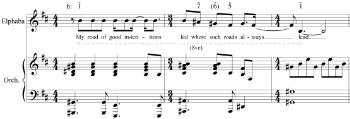
(click to enlarge)
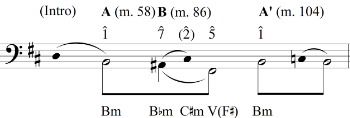
[1.10] Eventually, Elphaba spirals into despair after a flying house crushes her sister and the Wizard’s guards capture and kill her lover, Fiyero. During “No Good Deed”—perhaps the most dramatically important moment of her narrative arc—she laments that all her attempts to do good have hurt the people she loves and earned her hatred and scorn, leading her to embrace the moniker of The Wicked Witch of the West. Indeed, her renunciation of doing good is at odds with her previous motivations, and as such it makes sense that the thematic material in this song, with its emphasis on and , is not derived from “Unlimited”—save in one conspicuous place. The refrain of “No Good Deed,” which is cast in a periodic structure and uses the gamut of pitches in the B-minor scale, contains a parenthetical insertion (see Rothstein 1989, 87) in which Elphaba intones that her “road of good intentions led where such roads always lead” (Example 8)
Example 9. Key Structure Analysis of “No Good Deed”
(click to enlarge)
[1.11] In addition to this thematic use of “Unlimited” in “No Good Deed,” a particularly daring analysis of this song might also suggest that a variant of “Unlimited” is embedded in the deeper-level key structure of this song’s frequent and ambitious modulations. Following the introductory material, the song proper begins in B minor with the “no good deed” refrain. The B section then modulates to B-flat minor (enharmonically A-sharp minor), then C-sharp minor, and finally stands on a dominant
[1.12] The final variants of “Unlimited” occur in the song “For Good,” the emotional climax of the show. During this scene, Elphaba—having assumed the moniker of The Wicked Witch of the West—is making good on her promise to be wicked by threatening to harm Dorothy, whom she has imprisoned in order to retrieve her sister’s magical slippers
Example 10. Schwartz, Wicked, “For Good,” m. 25
(click to enlarge)
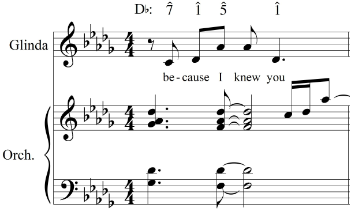
[1.13] The chorus of the song is sung three times: once by Glinda, once by Elphaba, and finally together. Each iteration of the chorus concludes with the line “because I knew you, I have been changed for good.” As shown in Example 10, this acknowledgment of their importance to each other, specifically the “because I knew you” line, uses a compressed version of the scale-degree content of “Unlimited.” The importance of this particular segment of the melody is reinforced in the final verse, where the words “because I knew you” are repeated three times. As shown in Example 11, this short melodic motif transforms from the compressed ––– version, through a version with the octave leap on
Example 11. Schwartz, Wicked, “For Good,” mm. 70–78
(click to enlarge) |
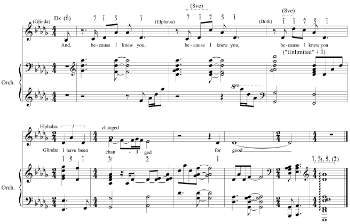
[1.14] The song then concludes by subtly revisiting the transformation of the motif that occurred in “Defying Gravity.” The final moments of the song use the pitches of “Unlimited,” but again rescind —which had long served as a dissonant tone between and —and replace it with the same that brought the “defying gravity” hook triadic stability. Not inconspicuously, this (F) is sung by Glinda, whose tonal center in songs such as “What is This Feeling” and “Popular” is also F, and first enters the vocal part on the word “changed,” suggesting it is Glinda’s influence in Elphaba’s life that was ultimately the most stabilizing and meaningful. This erasure of remains in effect through to the final chord of the song, a I(add9) which contains , , , and (): “Unlimited,” but with in place of
Example 12. Summary of Motivic Transformations of “Unlimited”
(click to enlarge)
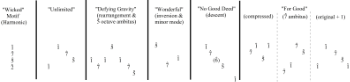
[1.15] While many of Schoenberg’s analyses of developing variations are restricted to local events, employing the concept on a larger scale—across Wicked’s score—generates important analytic observations, which are summarized in Example 12
2. On Key Relationships and Tonal Trajectory
[2.1] In a recent study on film music, Táhirih Motazedian has proposed to differentiate between tonal structure, which is concerned with “the hierarchical relationship of pitches within a single key (in a Schenkerian sense),” and tonal design, which “refers to a development of keys not necessarily governed by a global tonic and possibly influenced by extramusical factors” (2023, 3). Motazedian further distinguishes between structure as prescriptive, and design as descriptive: “the versatility of this approach makes tonal design a better tool for analyzing expansive, multifarious works like opera and film,
[2.2] Building on Motazedian’s conception of tonal design, as well as the associative and network-style analyses of both myself (2025a) and Biamonte (2023), this sort of tonal trajectory, untethered to traditional tonal-structural relationships, is an effective tool for describing Elphaba’s musical-dramatic journey in Wicked
Example 13. Tonal Trajectory of Elphaba’s Journey in Wicked
(click to enlarge) |
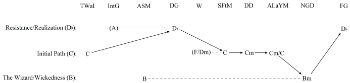
[2.3] The first path, which I have labeled “Initial Path,” constitutes a tonality centered on C and represents Elphaba’s initial altruistic path toward working with the Wizard. As noted earlier, “The Wizard and I,” Elphaba’s “I Want” song, is in the key of C major, thus serving as both her initial key as well as the key that is emblematic of her goals: it is optimistic and “pure” reflecting her genuine desire to use her magic powers help people and do good. In her second major song in Act I, “I’m Not that Girl,” Elphaba laments that her burgeoning attraction to Fiyero could not possibly be requited. Because the song is in the key of A major, I have placed it outside of the “initial” C-major path: the chromatically disjunct relationship of A major to Elphaba’s initial C major—a chromatic submediant, specifically one that distorts the tonic pitc
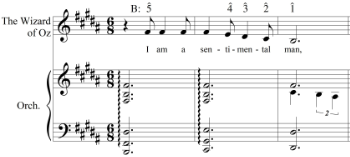
Example 14. Schwartz, Wicked, “A Sentimental Man,” mm. 1–2
(click to enlarge)
[2.4] When Elphaba first meets the Wizard, their musical incompatibility is on display even before she realizes his authoritarian ambitions. His song “A Sentimental Man” (Example 14), which he sings upon meeting Elphaba for the first time in an attempt to appear sympathetic, is in the key of B major which, like A major, is chromatically removed from Elphaba’s C major
[2.5] Rather than undergoing a musical transfiguration that would transform her C major into something more closely aligned with the Wizard’s tonal track—a change that would place her in a tonal position antithetic to her initial goals—Elphaba rejects him. As she vows to oppose the Wizard, her tonal grounding changes: the “Monkey Reveal” scene shifts from C major-minor, through several brief intermediary keys, to the D-flat major of her Act I finale, “Defying Gravity” (Examples 5 and 6). D-flat major thus constitutes a third tonal path and can be thought of as Elphaba’s “Resistance” or “Realization” key. The fact that it stands a semitone higher than her initial C major is intriguing: rather than pulling her key a semitone down to the Wizard’s B major, she shifts it a semitone up, reflecting a musically analogous movement away from his key of B major.
[2.6] Act I thus sets up three semitonally related tonal pathways for Elphaba: C, B, and
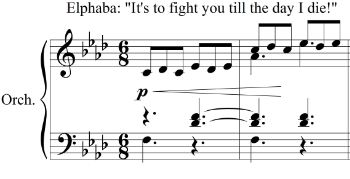
Example 15. Schwartz, Wicked, “Dillamond Discovered,” mm. 24–25
(click to enlarge)
[2.7] The next time Elphaba meets the Wizard, during the “Wonderful” sequence, he nearly convinces her to join him by shifting his key to the dual D-minor/F-major complex discussed earlier (see Example 7), which is diatonic to Elphaba’s original C-major trajectory, but a tritone away from the Wizard’s initial B major. After “Wonderful,” the music shifts back to C major, returning to the centric pitch of the “Initial” path as Elphaba agrees to join him on the condition that he free the winged monkeys. This return to C major reflects what appears to be a realization of Elphaba’s initial goals: working with the Wizard to help the people of Oz. Upon the discovery of Dr. Dillamond, however, Elphaba rejects the Wizard once more and vows to keep fighting him as the music reverts to the D-flat major of the upper “Resistance” path (Example 15).
[2.8] After her brief C-minor tryst with Fiyero in “As Long as You’re Mine” and subsequent despair at Fiyero’s murder by order of the Wizard (in G-sharp minor, B’s relative minor), Elphaba adopts the “Wicked Witch of the West” moniker in the key of B minor during the “No Good Deed” scene (see Examples 8 and 9 above). As the parallel minor of the Wizard’s initial B major, B minor falls within the “Wizard and Wickedness” trajectory. In the musical’s plot, this is Elphaba’s lowest point, both dramatically and musically. She has fallen, in some sense, to the level of the Wizard and, in abandoning her goals to do good, fallen victim to the gravity of his B-oriented key-path
[2.9] As seen earlier in my analysis of “For Good”, Elphaba is only pulled out of her despair—and the associated B-minor key—when Glinda reminds Elphaba of the importance of their friendship and promises to take up her cause against the Wizard, returning the music to D-flat major. After “For Good,” the key shifts briefly to B minor in the lead-up to Elphaba’s demise at the hands of Dorothy and a pail of water, before returning to D-flat major when Glinda learns of Elphaba’s death and undertakes her subsequent confrontation of the Wizard
[2.10] In my analysis of the tonal trajectory of Wicked, I have focused on Elphaba’s story, and therefore the songs prominently featuring that character. Other numbers (such as “Dear Old Shiz,” “What is this Feeling,” or “Popular”) have been excluded. This is not to say that these keys do not fit into the trajectory: Glinda’s associated key of F major (in both “What is this Feeling” and “Popular”), for instance, could be seen as contributing to Elphaba’s initial C-major path as its subdominant, and also reflects Glinda’s stabilizing role as the mediant in Elphaba’s subsequent D-flat-major trajectory. Conversely, Glinda’s E-flat major of “I Couldn’t Be Happier” reflects her decision to side with the Wizard after the events of Act I (
3. Thematic Derivation and Worldbuilding in Wicked and The Wizard of Oz
[3.1] While emphasizing motivic transformation or tonal design are more traditional approaches to musical structure, the idea of intertextual derivation is, perhaps, a strategy more unique to Wicked than to other megamusicals given its connection to the well-known movie The Wizard of Oz
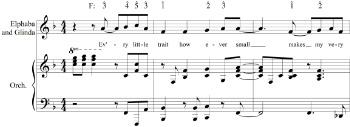
Example 16. Schwartz, Wicked, “What is This Feeling?,” mm. 40–41
(click to enlarge)
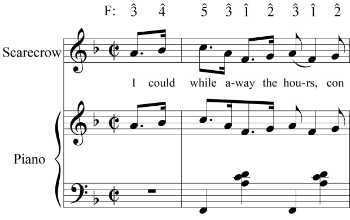
[3.2] For instance, the melodic line in the passage from “What is this Feeling” shown in Example 16 is identical to the opening melody of “If I Only Had a Brain” (Example 17) sung by the Scarecrow in The Wizard of Oz, with the same music used by the Tin Woodsman in “If I Only Had a Heart” and by the Cowardly Lion in “If I Only Had the Nerve.” In narrative terms, each of these three characters crosses paths with Elphaba at Shiz University (where “What is this Feeling” takes place): Elphaba rescues the Lion, her classmate Boq is transformed into the Tin Woodsman in Act II, and another classmate, Fiyero, is likewise transformed into the Scarecrow. One might thus see the characters’ use of this melody in The Wizard of Oz as arising out of their shared familiarity with it during their youth
Example 17. H. Arlen, The Wizard of Oz, “If I Only Had a Brain,” m. 1
(click to enlarge) |
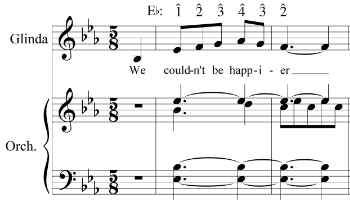
Example 18. Schwartz, Wicked, “I Couldn’t Be Happier,” mm. 1–2
(click to enlarge)
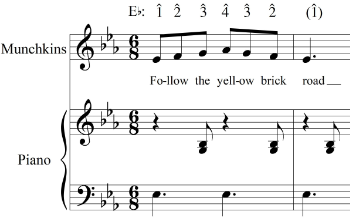
[3.3] Another overt example can be found in Glinda’s song “I Couldn’t Be Happier,” part of the “Thank Goodness” sequence that begins Act II. The song’s primary theme, shown in Example 18, is unabashedly derived from “Follow the Yellow Brick Road” (Example 19) in The Wizard of Oz, save that the former ends on , while the latter ends on . Indeed, in The Wizard of Oz it is Glinda who first tells Dorothy to “follow the yellow brick road”; it is thus easy enough to imagine “Thank Goodness,” with its slightly truncated melody, exists (in the imaginary musical world of Oz) as a sort of early or incomplete version of “Follow the Yellow Brick Road.” While Schwartz has not commented directly on this connection, he has noted that in constructing this song his aim was to “conceive a song for folk and village people” (Laird 2017, 14). While not expressing a distinct correlation with the Munchkins who take up Glinda’s suggestion and sing “Follow the Yellow Brick Road” in The Wizard of Oz, Schwartz’s statement certainly alludes to the folksy and village setting of the Munchkins.
Example 19. H. Arlen, The Wizard of Oz, “Follow the Yellow Brick Road,” mm. 1–2
(click to enlarge) |
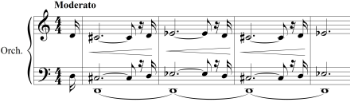
Example 20. Schwartz, Wicked, “The Cyclone,” mm. 6–9
(click to enlarge)
[3.4] There are also melodic allusions to The Wizard of Oz that occur only in the orchestra. During “The Cyclone” (which depicts Dorothy’s house falling on Elphaba’s sister, The Wicked Witch of the East), a winding three-note chromatic motif (Example 20) appears to be a rhythmic variation of Miss Gulch’s theme in The Wizard of Oz (Example 21). This theme is first heard in the film when Miss Gulch is riding her bicycle in Kansas, but also when she appears within the cyclone and transforms (in Dorothy’s fever dream) into the Wicked Witch of the West. This case appears to simply exist as an allusion to the well-known and sinister tune from the tornado scene in the movie, but reinforces the notion that much of this music has a connection to Arlen’s score for The Wizard of Oz.
Example 21. H. Arlen, The Wizard of Oz, “Miss Gulch,” mm. 1–2
(click to enlarge) |
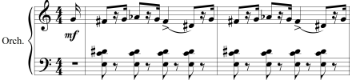
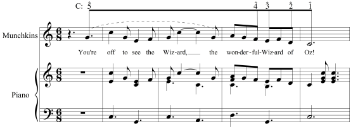
Example 22. H. Arlen, The Wizard of Oz, “You’re Off to See the Wizard,” mm. 1–3
(click to enlarge)
[3.5] In addition to these very direct melodic correlations there are also relationships that exist at a more structural level, concealed by melodic development or embellishment on the musical surface. For instance, the Wizard’s song “A Sentimental Man”—essentially a self-serving ode to himself—in Wicked has as its main theme a melodic line that descends directly and succinctly from to (see Example 14). The chorus of Arlen’s “You’re Off to See the Wizard” (Example 22) from The Wizard of Oz is likewise an ode to the Wizard and also features a structural descent from down to ; this descent, however, is embellished by other tones compared the more straightforward descent in “A Sentimental Man.” Since both songs exalt the Wizard—one in private, one in public—the embellishment of the line in “You’re Off to See the Wizard” might be read as a type of propagandization of the Wizard: the music of “You’re Off to See the Wizard” takes the humbler descending-fifth progression of “A Sentimental Man” and elaborates it, deifying the Wizard even further among the citizens of Oz.
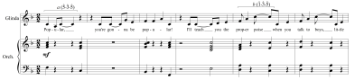
Example 23. Schwartz, Wicked, “Popular,” mm. 18–23
(click to enlarge)
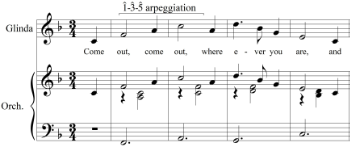
[3.6] The songs “Popular” (Wicked) and “Come Out, Come Out” (The Wizard of Oz), both sung by Glinda, share a similar hidden motivic connection. The basic idea of “Popular,” shown in Example 23, is constructed of an oscillation between and in F major, while the fragmentation in the theme’s continuation section is constructed of an arpeggiated F-major triad. As shown in Examples 24 and 25, both of these motifs are also present in “Come Out, Come Out.” The triadic arpeggiation from “Popular” forms the basic idea of “Come Out, Come Out” but is further developed into a full melody, while an embellished version of the oscillation between and forms the basic idea of the contrasting B section. Here, too, these motivic links suggest an element of musical world building: when she sings “Popular,” many years before Dorothy arrives in Oz, Glinda is a somewhat vapid university student, barely able to form coherent musical phrases. Comparatively, Glinda in The Wizard of Oz has grown and become a well-respected Good Witch; she still builds her musical material out of the same motivic building blocks, but these motifs are more developed and structured, creating an entirely different musical portraiture of Glinda that obscures the musical connection between the two songs
Example 24. H. Arlen, The Wizard of Oz, “Come Out, Come Out,” mm. 1–4
(click to enlarge) | Example 25. H. Arlen, The Wizard of Oz, “Come Out, Come Out,” mm. 12–15
(click to enlarge) |
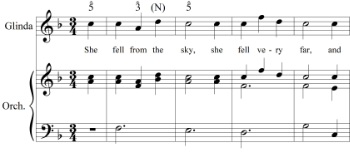
[3.7] A complete catalogue of references to The Wizard of Oz that occur in Wicked is, of course, beyond the scope of this paper; instead, these examples show that Wicked musically references The Wizard of Oz in such a consistent way as to build a rich, coherent, and intertextual musical world that includes both the musical and the earlier movie. As de Giere writes, “There are numerous other winks, nods and self-references that weave themselves in and under the score. Part of the fun is finding them and appreciating just how much thought and talent went into their deliberate use” (2007).
4. Conclusion
[4.1] One question that often underscores transformational and large-scale key analysis is whether these relationships are audible. Without the benefit of a close study of the score, can one, and especially one without absolute pitch, hear the scale-degree transformations of the “Unlimited” motif, or the tonal trajectory of Elphaba’s journey? Indeed, Schwartz himself ponders these types of questions, as Laird (2017) summarizes:
‘Does the audience hear this stuff at all? Maybe some do, but it’s a fun way to
write. . . It’s all the stuff I learned as a music student.’ Concerning the entire process of writing a musical, but especially repeating themes in appropriate places, Schwartz notes: ‘That is part of the fun. It is so satisfying to take this great, big amorphous blob and watch it slowly come to clarity and focus, the fat get trimmed away, and [find] the things that really work about it structurally and the repetitions.’ (12)
Contending with similar issues, Motazedian deploys Carolyn Abbate’s (2004) terms “gnostic and drastic forms of perception”: “On the drastic
[4.2] In this sense, the three pathways through Wicked that I have discussed—motivic transformation, tonal design, and intertextual derivation—all exist along a spectrum of drastic-gnostic perception. I suspect that previous Leitmotivic analyses by Laird, as well as many of the motivic derivations discussed in this article, may align more closely to the drastic side of perception and thus be more readily audible to listeners. Conversely, the long-range tonal trajectories I’ve outlined may be less perceptually salient and therefore align more closely to the gnostic side of perception. The motivic transformations of “Unlimited” discussed in Section 1 likely lie somewhere in the middle.
[4.3] We can only speculate whether these issues affect critical assessments of this musical specifically and musical theater as a whole, though Brantley’s condemnation of Wicked’s score as “pop-eretta” devoid of “any glimmer of originality” (2003) certainly seems diluted against the musical relationships I have explored over the course of this article
[4.4] And these relationships and developmental processes exist whether they are audible or not—whether they fall on the drastic or gnostic pole of musical experience. And the fact that they do exist substantiates Buchler and Decker’s entreaty for more analytic and theoretic engagement with musical theater repertoire (2023). If one subscribes to the notion that analytic approaches to this music can adopt a level of flexibility that reflects the cosmopolitanism of style and compositional diversity of theater composers, then this in turn suggests that the path forward is not a homogenous one. One analytic approach to musical theater, in other words, is insufficient, and analytic methodologies must be suitably flexible to adapt to the dramatic ideas of a given show. What works for analyzing musical relationships in Jesus Christ Superstar (conflicts between plagal and authentic constructs that permeate the surface-level musical construction of songs, but also a deeper-level tonal design) might not—or might need to be adapted—for something like The Phantom of the Opera, where conflict between the subtonic as IV/IV and
Kyle Hutchinson
Colgate University
khutchinson1@colgate.edu
Works Cited
Abbate, Carolyn. 2004. “Music—Drastic or Gnostic?” Critical Inquiry 30 (3): 505–36. https://doi.org/10.1086/421160.
Alegant, Brian, and Donald McLean. 2001. “On the Nature of Enlargement.” Journal of Music Theory 45 (1): 31–71. https://doi.org/10.2307/3090648.
Biamonte, Nicole. 2023. “Style, Tonality, and Sexuality in The Rocky Horror Picture Show.” In Here for the Hearing: Analyzing the Music in Musical Theater, ed. Michael Buchler and Gregory John Decker, 169–89. University of Michigan Press.
Blustein, Nathan Beary. 2023. “Was it Ever Real?: Tonic Return via Stepwise Modulation in Broadway Songs.” In Here for the Hearing: Analyzing the Music in Musical Theater, ed. Michael Buchler and Gregory John Decker, 9–34. University of Michigan Press.
Brantley, Ben. 2000. “Destiny and Duty, Nile Style.” The New York Times, March 24. https://www.nytimes.com/2000/03/24/movies/theater-review-destiny-and-duty-nile-style.html.
—————. 2003. “Theater Review; There’s Trouble In Emerald City.” The New York Times, October 31.
Brown, Matthew, Douglas Dempster, and David Headlam. 1997. “The
Buchler, Michael. 2008. “Modulation as a Dramatic Agent in Frank Loesser’s Broadway Songs.” Music Theory Spectrum 30 (1): 35–60. https://doi.org/10.1525/mts.2008.30.1.35.
Buchler, Michael, and Gregory John Decker. 2023. “Introduction.” In Here for the Hearing: Analyzing the Music in Musical Theater, ed. Michael Buchler and Gregory John Decker, 1–8. University of Michigan Press. https://doi.org/10.3998/mpub.11969716.
Cohn, Richard. 2012. Audacious Euphony: Chromaticism and the Triad’s Second Nature. Oxford University Press. https://doi.org/10.1093/acprof:oso/9780199772698.001.0001.
Cook, Nicholas. 1987. “The Perception of Large-Scale Tonal Closure.” Music Perception 5 (2): 197–205. https://doi.org/10.2307/40285392.
de Clercq, Trevor. 2021. “The Logic of Six-Based Minor for Harmonic Analyses of Pop Music.” Music Theory Online 27 (4). https://doi.org/10.30535/mto.27.4.4.
de Giere, Carol. 2007. “Wicked’s Web of Musical Themes.” MusicalSchwartz.com. Accessed February 17, 2025. https://www.musicalschwartz.com/wicked-musical-themes.htm.
Del Mar, Norman. 1962–1972. Richard Strauss: A Critical Commentary on his Life and Works. Barrie and Rockliff.
Doll, Christopher. 2017. Hearing Harmony: Towards a Tonal Theory for the Rock Era. University of Michigan Press. https://doi.org/10.3998/mpub.3079295.
Frisch, Walter. 1984. Brahms and the Principle of Developing Variation. University of California Press. https://doi.org/10.1525/9780520352322.
Gilliam, Bryan. 1991. Richard Strauss’ Elektra. Oxford University Press.
—————. 2014. Rounding Wagner’s Mountain: Richard Strauss and Modern German Opera. Cambridge University Press. https://doi.org/10.1017/CBO9780511979699.
Harrison, Daniel. 1994. Harmonic Function in Chromatic Music: A New Dualist Theory and an Account of its Precedents. The University of Chicago Press.
Horowitz, Mark Eden. 2010. Sondheim on Music: Minor Details and Major Decisions. 2nd ed. Scarecrow. https://doi.org/10.5771/9780810874374.
Hutchinson, Kyle. 2022. “Chromatically Altered Diminished-Seventh Chords: Reframing Function through Dissonance Resolution in Late Nineteenth-Century Tonality.” Music Analysis 41 (1): 94–144. https://doi.org/10.1111/musa.12185.
—————. 2025a. “Andrew Lloyd Webber and Tonal Structure in Musical Theater: Plagal and Authentic Conflict in Jesus Christ Superstar.” Journal of Music Theory 69 (2): 285–315. https://doi.org/10.1215/00222909-11931875.
—————. 2025b. Processual Tonality and the Psychoacoustics of Chromaticism. Oxford University Press. https://doi.org/10.1093/9780197800300.001.0001.
Jarvis, Brian, and John Peterson. 2020. “Detour or Bridge?” SMT-V 6 (2). https://doi.org/10.30535/smtv.6.2.
Krebs, Harald. 1996. “Some Early Examples of Tonal Pairing: Schubert’s ‘Meeres Stille’ and ‘Der Wanderer.’” In The Second Practice of Nineteenth-Century Tonality. Edited by William Kinderman and Harald Krebs. University of Nebraska Press.
Laird, Paul R. 2011. Wicked: A Musical Biography. Scarecrow Press.
—————. 2014. The Musical Theater of Stephen Schwartz: from Godspell to Wicked and Beyond. Rowman and Littlefield. https://doi.org/10.5040/9798881823573.
—————. 2017. “How to Create a Musical: The Case of Wicked.” In The Cambridge Companion to the Musical, ed. William A. Everett and Paul R. Laird, xv–xvi. Cambridge University Press. https://doi.org/10.1017/9781316335468.002.
Lewis, Christopher. 1984. Tonal Coherence in Mahler’s Ninth Symphony. UMI Research Press.
Lloyd Webber, Andrew, and Tim Rice. 1978. Evita: The Legend of Eva Perón. Drama Book Specialists.
Maguire, Gregory. (2024) 1995. Wicked: The Life and Times of the Wicked Witch of the West (Film tie-in edition). William Morrow.
McCreless, Patrick. 1983. “Ernst Kurth and the Analysis of the Chromatic Music of the Late Nineteenth Century.” Music Theory Spectrum 5 (1): 56–75. https://doi.org/10.2307/746095.
—————. 1990. “Motive and Magic: A Referential Dyad in Parsifal.” Music Analysis 9 (3): 227–65. https://doi.org/10.2307/853979.
Motazedian, Táhirih. 2023. Key Constellations: Interpreting Tonality in Film. University of California Press. https://doi.org/10.1525/9780520382183.
Nobile, Drew. 2015. “Counterpoint in Rock Music: Unpacking the ‘Melodic-Harmonic Divorce.” Music Theory Spectrum 37 (2): 189–203. https://doi.org/10.1093/mts/mtv019.
Parker, Roger. 1989. “Motives and Recurring Themes in Aïda.” In Analyzing Opera: Verdi and Wagner, ed. Carolyn Abbate and Roger Parker, 222–38. University of California Press. https://doi.org/10.1525/9780520310810-011.
Rothstein, William. 1989. Phrase Rhythm in Tonal Music. Schirmer.
—————. 2023. The Musical Language of Italian Opera: 1813–1859. Oxford University Press. https://doi.org/10.1093/oso/9780197609682.001.0001.
Schoenberg, Arnold. 1975. Style and Idea: Selected Writings of Arnold Schoenberg. Edited by Leonard Stein. St. Martin’s Press.
Schwartz, Stephen. 2010a. “Stephen Schwartz Answers Questions About Wicked’s Score.” StephenSchwartz.com. https://stephenschwartz.com/wp-content/uploads/2017/04/WickedSongs.pdf.
—————. 2010b. “Wicked – Stephen Schwartz Answers Miscellaneous Questions About the Show.” StephenSchwartz.com. https://stephenschwartz.com/wp-content/uploads/2017/04/Wicked.pdf.
—————. 2024. “Wicked Composer Stephen Schwartz Breaks down ‘Defying Gravity.’” Classic FM, November 22. YouTube video, 8:59. Accessed November 28, 2024. https://www.youtube.com/watch?v=zhND6ZDi5HI.
Secrest, Meryle. 1998. Stephen Sondheim: A Life. Knopf.
Snelson, John. 2004. Andrew Lloyd Webber. Yale University Press.
Stein, Deborah. 1983. Hugo Wolf’s Lieder and Extensions of Tonality. UMI Research Press.
Sternfeld, Jessica. 2006. The Megamusical. Indiana University Press.
Swain, Joseph P. 2002. The Broadway Musical: A Critical and Musical Survey. Scarecrow Press. https://doi.org/10.5040/9798881836740.
Swayne, Steve. 2005. How Sondheim Found His Sound. University of Michigan Press.
Temperley, David. 2007. “The Melodic-Harmonic Divorce in Rock.” Popular Music 26 (2): 323–42. https://doi.org/10.1017/S0261143007001249.
von Bülow, Hans, and Richard Strauss. 1955. “Correspondence.” Edited by Willi Schuh and Franz Trenner. Boosey and Hawkes.
Wolf, Stacy. 2011. Changed for Good: A Feminist History of the Broadway Musical. Oxford University Press.
Youmans, Charles. 1998. “The Private Intellectual Context of Richard Strauss’s Also sprach Zarathustra.” Nineteenth-Century Music 22 (2): 101–26. https://doi.org/10.2307/746853.
Footnotes
1. The Wicked Witch of the West in Baum’s novel is not described as having green skin.
Return to text
2. Stacy Wolf describes Wicked as espousing elements of both traditional “Golden Age” musicals and the more contemporary megamusical: “First, it epitomizes the twenty-first-century megamusical in its production values, which are spectacular, and in its marketing strategy, which is global capitalism. It can be replicated with unprecedented meticulousness across a greater number of international venues. For audiences familiar with Phantom or Les Miz, these aspects of Wicked seem familiar. Second, it is structured by the conventions of the traditional, classic, ‘golden age’ musical theater and so calls up ideas and feelings about musical theater thoroughly embedded in the U.S. cultural imagery” (2011, 217). To Wolf’s contentions, we might add that Wicked espouses a stylistic eclecticism that was less typical in earlier musicals but highly typical of the megamusical (see Snelson 2004, Sternfeld 2006).
Return to text
3. Intriguingly, apart from citations of stylistic eclecticism and grandiosity, there is very little scholarship regarding what musical processes, if any, set the megamusical apart from non-mega musicals. Indeed, despite surface-level differences in musical style I am not certain that the processes of musical development differ significantly from one subgenre to the other: Gypsy (1959), for instance, undertakes a process of melodic development similar to what I will describe in Wicked (Hutchinson 2025a); similarly, Oklahoma! (1943), like Wicked, has a dramatically driven tonal structure (descending fifths toward the final tonic, emblematic of Curly and Laurey’s progression toward admitting their love for each other) that makes compelling use of associative keys. The question of what differentiates “musical theater” from “megamusicals”—again, if anything—from musico-structural perspectives, is thus an intriguing one, but alas one that lies beyond the scope of this article.
Return to text
4. Snelson is writing particularly of Andrew Lloyd Webber, who is arguably the originator—or at the very least the most successful composer of—the megamusical (Sternfeld 2006, 2–4), though this description aptly applies to other composers, including Boublil and Schonberg (Les Miserables, Miss Saigon), Stephen Schwartz (Wicked, Godspell), Frank Wildhorn (Dracula, Jekyll & Hyde), and Lin-Manuel Miranda (Hamilton).
Return to text
5. Brantley makes a related claim in his review of Wicked, noting that “whenever Ms. Chenoweth leaves the stage, “Wicked” loses its wit, while its swirling pop-eretta score sheds any glimmer of originality” (2003).
Return to text
6. Sternfeld also suggests that the disdain for megamusicals results from a confluence of factors, including “loyalty to the Golden Era, or to Sondheim. . . or resistance to anything so popular that it feels unscholarly to discuss it” (2006, 6).
Return to text
7. I have likewise (2025a) suggested that Jules Styne’s Gypsy (1959) develops Rose’s “I have a dream” motif by subjecting it to various transformations throughout the show, an intriguing parallelism when considered alongside Schwartz’s statement “I always knew that ‘Unlimited’ was going to be our ‘I ha[ve] a dream.’ And what I wanted to do was have her say, at the very beginning, ‘Unlimited. My future is Unlimited.’ And at the end of the show say, ‘I’m limited’. . . It was always going to be in ‘Defying Gravity’ as well” (de Giere 2007).
Return to text
8. By analytic cosmopolitanism, I simply mean that musical theater responds well to a variety of analytic methodologies (e.g. tonal structure, tonal design, motivic development, intertextual analysis, topic theory, etc.) and that one should adopt or adapt any methodological approach that produces analytically fruitful observations.
Return to text
9. Roger Parker describes a similar process in Verdi’s Aïda, in which the themes for Aïda and the Priests are “contrasting in register, rhythm, and degree of chromaticism. . . [but] are also complementary, and derive from one another” (Parker 1989, 223). Intriguingly, Sondheim acknowledges a similar process in his approach to melodic composition, though typically at the level of the song or the scene, rather than across the entire show: Sondheim “praised Jerome Kern’s ability to develop a single motif through tiny variations into a long and never boring line, and his maximum development of the minimum of material” (Secrest 1998, 87). This concept of motivic development through small variations—which sounds identical to Schoenberg’s concept of the developing variation—was “one of the most valuable lessons [Sondheim] learned from [Milton] Babbitt[:] how to structure a piece of music so that it will make a coherent whole, whether it goes on for three minutes or forty, what he called ‘long-line’ compositions” (Secrest 1998, 86).
Return to text
10. Laird contends that the “Unlimited” motif only occurs in the major mode once in the show (2017, 14; de Giere 2007 makes a similar claim). This is a perplexing statement since the scale-degree content of the motif uses the major-mode and (the motif does not include , though the repetition of the motif occurs a major third higher, also suggesting major-mode connotation). Thus, while the motif might occur in surrounding minor-mode contexts, the motif itself seems to be unequivocally in the major mode; this makes sense, given its derivation from the major-mode theme of “Somewhere Over the Rainbow.” Conversely, the unaltered theme’s only minor-mode occurrence in the show is its distorted reprise during the scene where Dorothy melts Elphaba with water. As such, I treat the theme as a major-mode theme beginning on , rather than a minor-mode theme beginning on .
Return to text
11. “The theme’s identification with Elphaba becomes obvious during her birth” (Laird 2014, 232).
Return to text
12. Theories of melodic transformation naturally err more typically toward strings of ordered pitch classes (e.g. Alegant and McLean 2001), though unordered pitch motifs have also been the subject of discussion (see McCreless 1990).
Return to text
13. My analyses and transcriptions are derived from the touring version of the show’s orchestral score, which reduces the orchestra from twenty-three musicians to eighteen. As Michael Buchler describes, using full scores or piano-vocal scores are generally more accurate, as “sheet music versions are often abridged and/or simplified, regularly removing modulations and extra verses, while imposing recomposed introductions and endings” (2008, 36). As Laird notes, Schwartz worked with two orchestrators on the Broadway score—Stephen Oremus and Alex Lacamoire—but “Schwartz approved every note in the score” (2014, 233). It is also worth noting that my analysis herein is of the stage version of the show, rather than the recent film adaptations (2024 and 2025) which include subtle changes to the score as adapted for the film medium.
Return to text
14. Brian Jarvis and John Peterson refer to this section as a “detour,” or “diversion” in which “an event causes the music to temporarily veer from the piece’s expected trajectory on to an unexpected alternative path, before eventually returning to the original path” (2020, [02:12]).
Return to text
15. The preceding C7 does, of course, set the listener up to hear A as of F, though the subsequent accented
Return to text
16. “And a wonderful road of yellow brick” in mm. 56–57 likewise contains an allusion to the “Unlimited” motif: the pitches C–C–D–F retain the intervallic structure of the motif in inversion (P8–m2–m3), but not the scale degree content.
Return to text
17. I interpret this as a periodic structure: BI+CI (HC) // BI + (parenthetical insertion) + CI (IAC). Jarvis and Peterson (2020) might likewise refer to this contrasting material as a “detour” elicited by Elphaba’s brief reflection into the past here.
Return to text
18. There is also a brief foray into C minor in this final iteration of the refrain (which then returns to B): the music recaptures the same half cadence from the first iteration, which is followed by a direct modulation into C minor. This modulation appears to be more akin to what Buchler describes as a dramatic, rather than structural, modulation: “the ascending half-step modulation. . . does nothing to challenge our sense of tonal unity. The [two] tonics play the same role: neither is hierarchically central, and neither anticipates or is anticipated by the other. When we abruptly move to [C minor], it simply substitutes for [B minor]. . . Again, this does not behave like a large-scale auxiliary cadence both because the modulation. . . fulfills no implicit tonal goal and, more broadly, because coloristic/utilitarian modulations carry no tonal force” (2008, 39).
Return to text
19. Alegant and McLean describe enlargement as a process whereby “a surface (or near-surface) object [can be] subsequently ‘enlarged,’ or re-presented in temporally expanded form” (2001, 31).
Return to text
20. For those familiar primarily with the 1939 movie version these are the ruby slippers, but in Baum’s original novel, as well as Maguire’s Wicked and the Broadway show, they are silver.
Return to text
21. Intriguingly, the emphasized here is C, Elphaba’s initial key, and, as I will discuss in the next section, the primary tonal track of Elphaba’s initial ambitions to do good.
Return to text
22. This harmony resembles the ‘Wicked’ motif as well, but with in place of and without in the bass.
Return to text
23. If one wanted to draw out this analysis even further, it is notable that both of Glinda’s solo numbers, “Popular,” and “I Couldn’t be Happier,” use melodies that outline stable tonic triads, and place a significant emphasis on .
Return to text
24. I have arranged the scale degrees in Example 12 so that the highest scale degree is always the visually highest in the chart.
Return to text
25. I say this not to diminish or repudiate earlier work on this show that focuses on Leitmotivic aspects of the score, but rather to encourage analysts working in developing theoretic approaches to musical theater that excavating below the musical surface does indeed yield important, interesting, and useful analytic results. As Michael Buchler and Gregory J. Decker have succinctly described, “Musicologists and theater historians have much to tell us about the genre’s history and social contexts, and their critical readings of musicals form an important body of scholarship,” but analytic and theoretic approaches can “enrich critical and historical research foci with deep musical engagement” (2023, 1).
Return to text
26. William Rothstein suggests that in Verdi’s Macbeth—which of course also contains witches [!]—“the motion from C minor to D-flat major is a recurring theme in the opera, as is the goal-status of D-flat more generally. It is as though the motive C–
Return to text
27. Elsewhere, I have noted that “Musical theater, unlike opera, traditionally transposes songs to meet the vocal needs of the performers,” but “mitigates this issue in part by treating the vocal score as a sort of standardized musical text” (2025a). More tellingly, when asked “if the [published] sheet music [for Wicked] will be written in the original Broadway key?” Schwartz responds that “in all cases except one, the piano vocal selections are in the show keys” (Schwartz 2010a, 27), which indicates that the songs in the show indeed have a set, or at least ideal, key. Schwartz has also described how he has “basic vocal ranges (soprano, tenor, etc.) in mind when [he] writes,” but that he allows for the transposition of songs if necessary for individual actors (2010b, 12–13), but cautions that transposing can be complicated because of the relationships between keys (13), which suggests that there is some intent behind his original key choices.
Return to text
28. McCreless provides a more detailed study of the concept of associative tonality, noting in particular that it refers to “tonal structure arising not from the established tonal and harmonic constraints of the classical system. . . but from the deliberate choice that particular keys, whatever their traditional relationships, may represent vital symbols of the drama” (1983, 90).
Return to text
29. Naturally my analysis of Elphaba’s tonal trajectory does not encapsulate every key of every song present in the show. As Motazedian describes in her work on tonal design in film music, “Judicious selectivity and assessment are inherent features of this kind of work—as they are with analysis in general. We cannot weight every component equally but must be critical in deciding where to place emphasis in order to produce a compelling interpretation. It’s important to resist the urge to include every musical element or concoct convoluted rationales for components that defy characterization. Not every key will be significant. . . and a successful analysis need not strive for complete tonal accountability” (2023, 18).
Return to text
30. For more on chromatic mediants and their functional incompatibility with a tonic, see Stein 1983, Cohn 2012, and Hutchinson 2022 and 2025b.
Return to text
31. See Harrison 1994 and Hutchinson 2022, for further discussion on the functional importance of these scale degrees, and McCreless 1983 on the functional interchangeability of parallel major and minor modes.
Return to text
32. The relationship of B and C recalls Richard Strauss’ tone poem Also Sprach Zarathustra (1896), whose “famous polytonal ending” (Youmans 1998) in which “the conflict between Man and Nature [is] basically unresolved and as irreconcilable as the two nearest, yet harmonically so distant keys of B and C” (Del Mar 1962–1972, 145) even positions B major and C major as tonally irreconcilable keys.
Return to text
33. The preceding song, “One Short Day,” which is sung by the citizens of the Emerald City, with Elphaba and Glinda joining in partway through the song, is in F-sharp major; this too could be integrated into the tonal trajectory as an anticipation of the Wizard’s B-major tonality in the form of B’s dominant.
Return to text
34. See footnote 26 above for a similar tonal trajectory in Verdi’s Macbeth.
Return to text
35. See Brown, Dempster, and Headlam 1997 for further discussion of the disjunct nature of
Return to text
36. Both IV and V are typical “pretonics” in popular music; Christopher Doll (2017) uses the term “pretonic” to describe chords—including both dominant and subdominant—that anticipate, or precede, the tonic in popular music.
Return to text
37. In Maguire’s novel, Elphaba explicitly justifies her (attempted) murder of the Wizard’s minister of propaganda, Madame Morrible, as “I have fought fire with fire. . . and I ought to have done it sooner!” ([2024] 1995, 422), confirming that she realizes that she has indeed fallen to their level.
Return to text
38. The musical version of Wicked slightly alters the ending of both The Wizard of Oz and Maguire’s novel, suggesting that the “melting” was a ruse concocted by Elphaba and a (somehow alive) Fiyero (now a scarecrow). I have personally never enjoyed this aspect of the plot, as I feel it undermines much of Elphaba’s development and character arc throughout the show (though Elphaba and Fiyero do leave Oz, with no one knowing that they are alive; so with respect to the larger plot of the show they are thus no longer catalysts driving the dramatic or musical action and are effectively considered dead by the rest of the characters).
Return to text
39. One other situation where this type of approach might yield intriguing results that comes immediately to mind is Lloyd Webber’s Love Never Dies (2010), which is a direct sequel to The Phantom of the Opera (1986), though Lloyd Webber is the composer for both. There exists, for instance, a countermelody sung by the Phantom (“obey your heart and sing for me”) in the song “Devil Take the Hindmost (Quartet)” that is derived from the melody of the song “The Phantom of the Opera,” from the earlier show, but in a different rhythmic profile.
Return to text
40. This approach does not assign a priori normative status to the music in The Wizard of Oz despite being composed more than half a century before Wicked in real-world time, but rather considers when the music is first heard temporally in the timeline of the world of Oz. Thus, while Arlen certainly wrote “If I Only Had a Brain” before Schwartz wrote “What is this Feeling?,” the latter takes place before the former in the Oz timeline, and thus “comes first” in that sense.
Return to text
41. Both songs also feature prominent octave leaps, though on different scale degrees. That both songs are in the key of F major is also intriguing, though I do not want to put undue weight on that observation having consulted only the sheet music published by MGM, rather than any sort of original score for The Wizard of Oz.
Return to text
42. Sternfeld litigates this point to some extent, noting that “There has always been debate over the qualifications of critics,” who, she laments, “know theater but not music” (2006, 74).
Return to text
43. Strauss elucidates that this is the “basic principle of Liszt’s symphonic works in which the poetic idea was really the formative element” requiring the music to “develop logically from within” (von Bülow and Strauss 1955, 139). Strauss further notes that: “If you want to create a work of art that is unified in its mood and consistent in its structure. . . [then] this is only possible through the inspiration by a poetical idea, whether or not it be introduced as a programme. I consider it a legitimate artistic method to create a correspondingly new form for every new subject” (von Bülow and Strauss 1955, 82–83).
Return to text
Copyright Statement
Copyright © 2026 by the Society for Music Theory. All rights reserved.
[1] Copyrights for individual items published in Music Theory Online (MTO) are held by their authors. Items appearing in MTO may be saved and stored in electronic or paper form, and may be shared among individuals for purposes of scholarly research or discussion, but may not be republished in any form, electronic or print, without prior, written permission from the author(s), and advance notification of the editors of MTO.
[2] Any redistributed form of items published in MTO must include the following information in a form appropriate to the medium in which the items are to appear:
This item appeared in Music Theory Online in Volume 32, Issue 2 in May 2026. It was authored by Kyle Hutchinson (khutchinson1@colgate.edu), with whose written permission it is reprinted here.
[3] Libraries may archive issues of MTO in electronic or paper form for public access so long as each issue is stored in its entirety, and no access fee is charged. Exceptions to these requirements must be approved in writing by the editors of MTO, who will act in accordance with the decisions of the Society for Music Theory.
This document and all portions thereof are protected by U.S. and international copyright laws. Material contained herein may be copied and/or distributed for research purposes only.

Prepared by Lauren Irschick, Editorial Assistant
Number of visits:
3561