Revisiting Polymeter: “Veneno Rítmico” and Colombian Currulao*
Lina S. Tabak
KEYWORDS: Meter, rhythm, polymeter, projection, Colombia, currulao, Grupo Naidy, Rio Mira
ABSTRACT: Several musicians and scholars have observed that the Afro-Colombian genre currulao frequently uses a highly syncopated rhythmic pattern, which, when presented in isolation, may cause some listeners to entrain to a stylistically unconventional meter. By contrast, expert musicians tend to entrain to the conventional meter with ease, despite there being no onsets which align with its beats. For listeners who possess some familiarity with the genre’s conventions—though not to the extent of performing musicians—the pattern, often referred to as the “rhythmic venom” (veneno rítmico) of the genre, may induce rapid switching between conventional and unconventional metric interpretations. The potential rapid switching implies that this pattern is a multi-stable stimulus, despite its onsets aligning with beats of only one of the two interpretations.
In this article, I expand upon James Sullivan’s claim (2023) that humans can rapidly switch between metric interpretations, contending that this phenomenon is closely related to Ève Poudrier’s concept of a “balanced polymeter” (2008). Further, I argue that such rapid switching is, functionally, equivalent to polymetric perception. I then offer a theoretical extension to Sullivan’s application of the parallel multiple-analysis processor (Jackendoff 1991, Mirka 2009), and to the theory of metrical projection as a whole (Hasty 1997), arguing that beats of potential meters need not align with onsets in the musical surface. Implicit meters—exclusively in the minds of enculturated listeners and not implied by onsets—can exist in a polymetric tension with sounding pulse streams in the music.
DOI: 10.30535/mto.32.2.7
Copyright © 2026 Society for Music Theory
Introduction
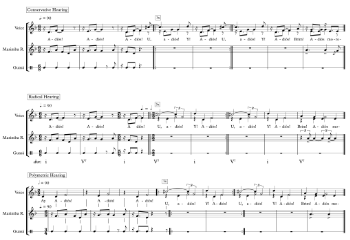
Example 1. Conservative, Radical, and Polymetric Interpretations of “Adiós Morena,” Rio Mira, Marimba del Pacífico (2017), 3:19–3:36 (simplified texture)
(click to enlarge and listen)
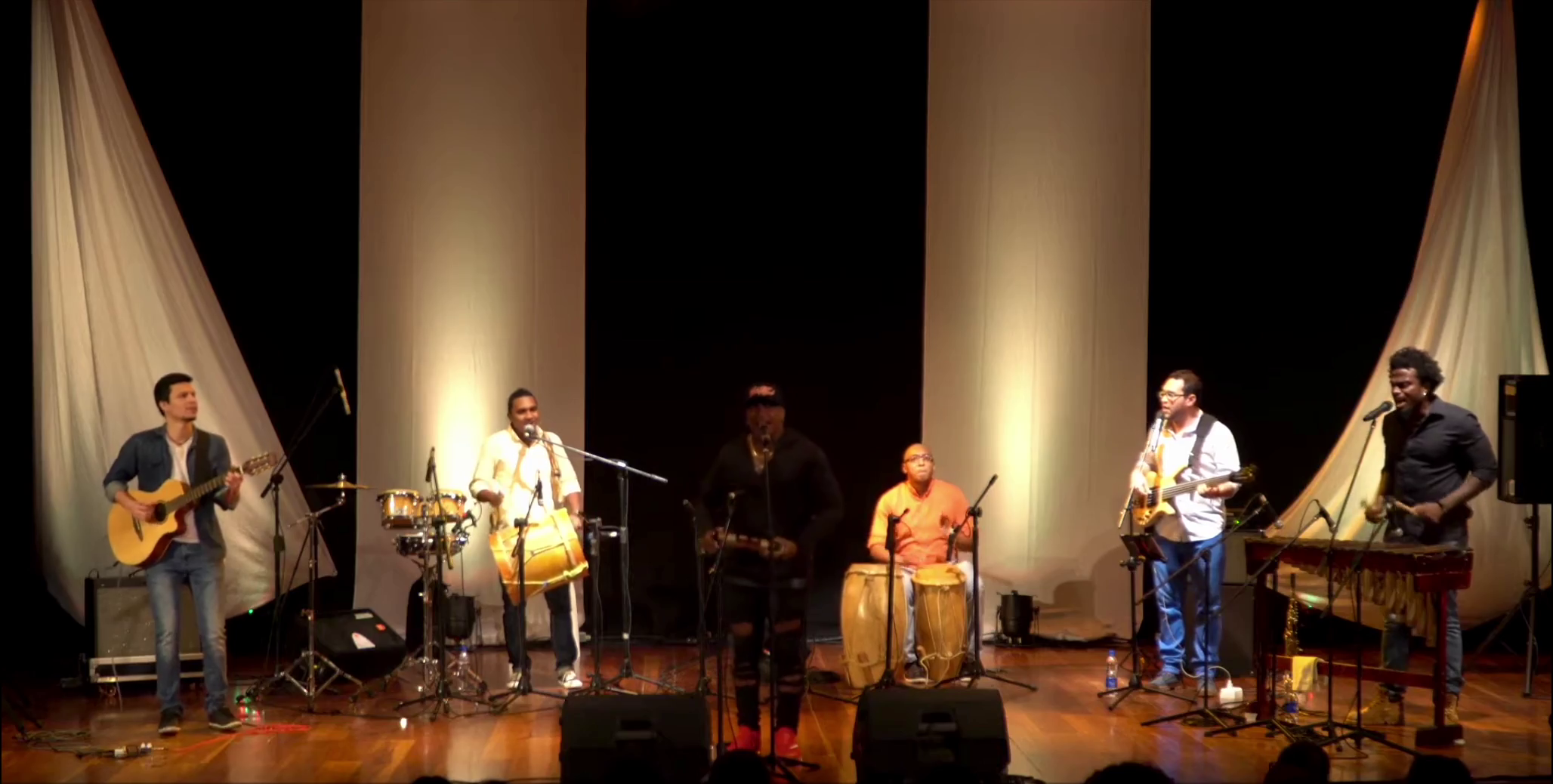
[0.1] The audio of Example 1 features a transition to a contrasting section in “Adiós Morena” from Rio Mira’s Marimba del Pacífico (2017). This song is a modern example of an Afro-Colombian folk genre called currulao. In this contrasting section, all percussion instruments in the ensemble drop out, leaving the vocalists to continue their repeated patterns alone. Although the vocalists had been singing similar patterns before the percussionists stopped playing, in this thinner setting a listener’s metric feeling might change drastically, though seamlessly
[0.2] On the one hand, in a more conservative hearing—in which a listener maintains entrainment to a meter for as long as possible through significant surface-level contradictions (shown in the top system of Example 1)—there are no onsets on any downbeats for nine measures (thirteen seconds)
[0.3] There are few topics in meter analysis, particularly when concerned with African and Afro-diasporic repertoires, as contentious as that of polymeter—the presence or perception of two or more meters simultaneously. The heated debate has implicated factors as wide-ranging as human cognitive limits (London 2012), racial essentialism (Agawu 2003), and of course, musical structure (Poudrier 2008). The debate over the existence of polymeter may in part be due to the varied ways in which scholars have defined it
[0.4] While I cannot hope to do justice to all these strands of thought here, currulao serves as an interesting case study for the study of polymeter, as it allows for a dialogue between several viewpoints on the subject. While currulao frequently uses contrasting and non-nesting pulse streams and may be considered structurally polymetric, there is one conventional meter (
[0.5] In this article I suggest that listeners (and specifically for currulao, non-expert listeners) may very rapidly shift between two or more metric interpretations of the same music, and I take this phenomenon to be as close as one can get to “polymetric perception.” This view is influenced by James Sullivan’s claim (2023, [6.1–6.6]) that rapid fluctuations between metric interpretations arise from a parallel multiple-analysis processor (Jackendoff 1991)—a concept which will be more fully explained in Section 2. Like Sullivan, I use Danuta Mirka’s “dynamic model for meter” (2009), itself partially an adaption of Christopher Hasty’s theory of projection (1997), to suggest that different pulse-streams on the musical surface may allow for a rapid switching back and forth between multistable metric interpretations.
[0.6] My main theoretical argument concerns the role of onsets in projecting one or multiple meters. The theoretical bases of projection (as described by Hasty) and of the parallel multiple-analysis processor (explained by Jackendoff, Mirka, and Sullivan) depend primarily on onsets to establish the beginnings of metric projections. Onsets function in this way in the radical hearing of Example 1, in which listeners match perceived downbeats to vocal onsets. However, for listeners intimately familiar with currulao—who have formed mental metric templates for its rhythmic patterns—the parallel multiple-analysis processor matches the vocal pattern to a metric template (London 2012, 69). When hearing Example 1, these enculturated listeners would know to infer a downbeat not coinciding with the vocal patterns’ onsets, but in the empty space slightly before the onsets instead. Therefore, I ultimately argue that projection’s dependence on onsets-as-beginning is insufficient as a model for meter finding (and, in Example 1’s case, for keeping it going). Here, musical expertise outweighs any requirements for onsets to establish and align with the beats
[0.7] In addition to the two listening types mentioned above (roughly aligning with the conservative and radical listeners of Example 1)
[0.8] Overall, the contributions of the article are twofold. First, it introduces currulao to an audience of American music theorists, where existing scholarship on the genre has come from ethnomusicologists and Colombian musicologists. Second, it begins a dialogue between several strands of research on meter: the analysis of polymetric structures by Poudrier; some cognitive aspects of metric perception by Jackendoff, Mirka, and Sullivan; and theoretical perspectives on African and Afro-Diasporic rhythmic practices by Agawu, Alejandro Martínez Carvajal, and others. Overall, this article provides further evidence for how stylistic expertise can affect metric perception—I find that emphasizing such top-down cognition is vital when studying meter, and that it is generally underdiscussed. By positioning currulao as a case study, this article not only expands the repertoires studied in music theory, but also offers a synthesis and expansion of these various branches of meter scholarship.
[0.9] This article is organized into three sections. The first is an introduction to currulao, and will discuss context, instrumentation, form, and the common, highly syncopated rhythmic pattern known in some circles as dosillo or veneno rítmico (“rhythmic venom”), including how some currulao musicians describe this rhythm as implying a non-conventional meter. The second section is methodological, discussing theories of polymetric structure and perception, and bringing them into dialogue with scholars who study metric perception and the parallel multiple-analysis processor. At the end of this section, I argue that despite general agreement by scholars of polymeter and theorists who use projection as a methodology, onsets are insufficient as the basis for metric perception when listeners or musicians have practiced and internalized another meter, whose beats do not align with onsets. The final, third section is analytical, discussing three currulao
1. Currulao
Introduction to Currulao
[1.1] Currulao is perhaps the most distinctive genre from the southern Pacific region of Colombia (departments of Valle del Cauca, Cauca, and Nariño) and from the northwest of Ecuador (the province of Esmeraldas). According to Alejandro Martínez Carvajal (2005, 58), the term currulao has three implications: it is not only a groove, but it is also a dance and a social event.
[1.2] To Juan Sebastián Ochoa, Leonor Convers, and Oscar Hernández, the secular social event in which currulao traditionally occurred was a “party in every sense of the word” (una fiesta en todo el sentido de la palabra), with music-making, dancing, and drinking sometimes lasting seven days and nights, following a religious musical celebration called an arrullo (Ochoa 2014/i, 56). While these long, rural parties were the most common setting for currulao performances several decades ago, the settings in which the currulao genre is performed—and the meaning the genre holds for Pacific-Colombian society—have changed significantly through its history, as is detailed in Michael Birenbaum Quintero’s “historical ethnography,” Rites, Rights and Rhythms: A Genealogy of Musical Meaning in Colombia’s Black Pacific (2018). Nowadays, currulao gets the most national and global attention during the Festival Petronio Álvarez, an annual festival that has taken place in the city of Cali, Colombia each August since 1997, that celebrates Afro-Diasporic cultural traditions from the country’s Pacific Region.
[1.3] Musically, currulao is a polyphonic and polyrhythmic genre with clear African influences. Although it is not traditionally notated, it is conventionally perceived in a compound duple meter, and thus scholars tend to transcribe it in
Instruments
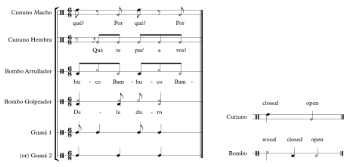
Example 2. Polyrhythmic matrix and legend of currulao’s unpitched percussion (adapted from Ochoa et al. 2014/i, 92; audio provided by Andy Miller)
(click to enlarge and listen)
[1.4] Currulao is characterized by vocalists, several unpitched percussion instruments, and—most essentially—by a marimba called a marimba de chonta. The vocalists generally include one usually male soloist called a glosador (who simultaneously plays one of the percussion instruments) and a chorus of women called cantaoras. The unpitched instruments often include two cununos, two larger bombos, and a type of rain-stick called a guasá, which is played by the cantaoras. The simplest basic patterns played by the unpitched percussionists are heard and transcribed in Example 2, with some onomatopoetic devices commonly used to teach them
[1.5] The primary melodic and harmonic instrument in currulao is the marimba de chonta, so called because its bars are made of chonta palm; its resonators are built from a bamboo called guadua. This instrument is traditionally diatonic, although chromatic marimbas de chonta have recently increased in popularity
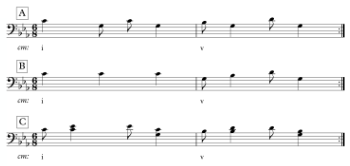
Example 3. Three Currulao Bordónes in C minor for marimba de chonta (audio provided by Andy Miller)
(click to enlarge and listen)
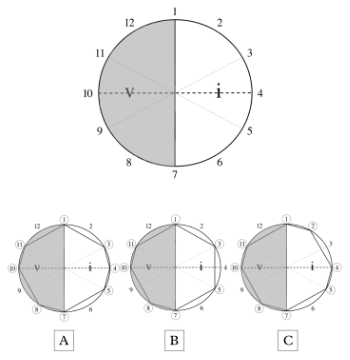
[1.6] The marimba de chonta can be played by two performers. One (optional) performer stands on the left side of the marimba de chonta and plays a two-measure long, low-register ostinato called a bordón, which alternates between tonic and dominant harmonies each measure, such as those transcribed in staff and cyclic notation in Example 3 and Example 4 respectively
Example 4. Cyclic representation of Currulao, and of Bordónes A, B, and C
(click to enlarge and listen) |
Form
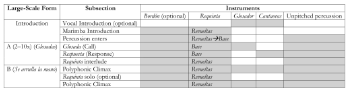
Example 5. Currulao Form Chart
(click to enlarge)
[1.7] Currulao structure tends to have three parts, shown in the form chart of Example 5
[1.8] What I call the A section begins when the vocalists enter. This section features call-and-response phrases between the glosador and the cantaoras. The calls are referred to as glosadas, although if they are non-lexical, they may also be called chureos (Martínez Carvajal 2005, 184). The response is typically the end-accented hook, landing on a sustained dyad ( and over a tonic triad). Following one call-response pair, the requintero will have a short interlude with improvisatory lines (revueltas). This three-part A section (call, response, marimba interlude) repeats at least two times before moving onto the B section.
[1.9] The B section is the climactic and polyphonic final section, nicknamed when “the hand warms up” (se calienta la mano, or se arrulla la mano) (Martínez Carvajal 2005, 185). In it, the tempo gradually increases, the percussionists play with increased density and in a more improvisatory manner, the cantaoras begin repeating the hook continuously (causing the phrase rhythm to speed up), while the glosador improvises over the thicker texture (usually in a higher vocal register than in the previous section). Since the 1990s, it has been common for the B section to contain a requinta improvisation within it, used to lengthen the song (Ochoa 2014/i, 95).
Veneno Rítmico
Example 6. An example of the Dosillo rhythm (audio provided by Andy Miller)

(click to enlarge and listen)
[1.10] Example 6 shows one rhythmic pattern that requinta players both frequently improvise around and often use as a base. Regarding this rhythmic pattern and its variations, Ochoa, Convers, and Hernández write:
On some occasions the master Gualajo and his brother Gerano perform this figure on the marimba continuously, establishing a rhythmic ostinato of great performative complexity. When presented in this continuous manner, it produces a sensation of juxtaposition of a binary beat subdivision, slightly displaced from the downbeat. For this reason, many musicians tend to call this schema dosillo [duple]: a rhythmic figure that marks a binary subdivision within a compound context
.(16) (Ochoa 2014/i, 93)
[1.11] As Ochoa et al. imply, it is not only scholars and musical outsiders who find dosillo to be a complex rhythmic pattern. In a pedagogical video on the genre, Hugo Candelario—perhaps the most celebrated marimba de chonta player alive—colorfully describes it as the “rhythmic venom of this genre” (el veneno rítmico de este estilo) (2021, 37:54). The “venom” Candelario and other musicians speak of is a description given to dosillo’s omnipresence and its ability to confuse listeners who, when listening to a dosillo-heavy passage, may alternate between perceiving a compound duple meter (
[1.12] Danuta Mirka’s theory of “finding meter” (2009) is useful for understanding why dosillo can dramatically suggest a different meter from currulao’s conventional
Example 7. Dosillo creating projections displaced from
(click to enlarge and listen) |
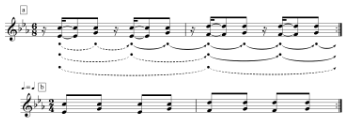
[1.13] While such an analysis explains some aspects of dosillo’s effects, such as Sarmiento’s inability to easily entrain to
[1.14] The two experiences—feeling the “venomous” simple duple or the conventional
Currulao as Polymetric
[1.15] Before delving into a methodology for the polymetric analysis of currulao, I would like to address how currulao makes for an interesting, and perhaps unique case study for polymeter. As mentioned previously, polymetric interpretations of African and Afro-Diasporic repertoires have often been outright rejected in recent years. For instance, in perhaps the most extensive critique of African polymeter, “Polymeter, Additive Rhythm, and Other Enduring Myths,” Kofi Agawu argues that insiders do not verbally recognize polymeter; that dancers’ choreographies do not suggest polymeter, but rather, one meter with polyrhythmic interest; and that phenomenal accents common in African music should not be confused for metrical accents (Agawu 2003, 84).
[1.16] Yet, within the wider conversations regarding polymeter in African and Afro-Diasporic music, currulao finds itself in an unusual position. First, as we have seen above, some currulao insiders (including some musically renowned ones) do verbally recognize the multiple meters to which listeners might entrain when dosillo is emphasized. Second, while choreographies suggest a monometric interpretation of
[1.17] While describing the affinities between currulao and West African genres, Alejandro Martínez Carvajal writes that “although the polyrhythmic performances can sound like a complex metric structure to the Western ear, African musicians conceive them in a very different way. Each of the diverse rhythmic lines is based on metric units of equal length” (Martínez Carvajal 2005, 30)
[1.18] Overall, I find that polymetric analyses should clarify what the conventionally appropriate meter is (should there be one) and might additionally study why listeners may perceive one or several alternative meters. In the following methodological section, I propose three ways to connect musical expertise to theories of polymeter: I flesh out some differences between naïve listeners who depend on “bottom-up” metric signals and expert listeners who primarily use “top-down” schemas to develop a metric understanding; argue that onsets need not align with beats for the expert listeners; and argue that rapid switching between multistable metric interpretations is—whether all these interpretations’ beats align with onsets or not—functionally, polymeter.
2. Theoretical Background
Polymetric Structure
[2.1] This section first summarizes and synthesizes some scholarship on polymetric structure and perception. This research—especially Ève Poudrier’s concept of balanced polymeters—resonates with research on multi-stable stimuli, as well as with Mirka’s and Sullivan’s studies on rapid switching between metric interpretations. After showing how Poudrier’s work relates to multi-stability and to the “parallel multiple-analysis processor” and suggesting that rapid switching is equivalent to polymetric perception, I argue that all these theories’ dependence on onsets-as-beginning leads scholars to underestimate the effects that prior familiarity can have on metric perception
[2.2] Ève Poudrier defines polymetric structure as “contrasting rhythmic strands that are built on competing pulse streams or non-isochronous beat structures and give rise to non-synchronous metrical projections” (Poudrier 2008, v). She takes the concept of “competing pulse streams” from John Roeder, who describes them as musical passages in which two or more parts individually articulate (semi-) regular timespans that do not align with or nest within one another (Roeder 1994, 233–34). Poudrier classifies polymetric structures into three idealized categories: integrated polymeter, “in which competing pulse streams are assimilated by a single metrical projection”; polarized polymeter, in which “one of the pulse streams is dominant and the other provides cross-accentuation”; and balanced polymeter, “in which two or more concurrent pulse streams achieve metrical significance” (2008, 105)
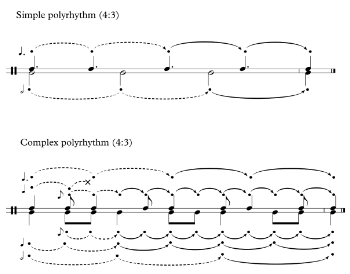
Example 8. Simple and complex 4:3 polyrhythms engender non-synchronous metric projections
(click to enlarge)
[2.3] In a later article, Ève Poudrier and Bruno Repp (2013) differentiate between structural polymeters made up of “simple polyrhythms” and those made up of “complex polyrhythms.” Simple polyrhythms are built from streams of isochronous but contrasting durations, as found in the top staff of Example 8 (a 4:3 polyrhythm). On the other hand, complex polyrhythms feature non-isochronous durations: the bottom staff of Example 8 shows a complex 4:3 polyrhythm. If beginnings of longer durations (quarter notes) are taken to represent beat placements, there are four dotted-quarter-note beats on the top line of the staff and three half-note beats on the bottom one. Thus, although the complex 4:3 polyrhythm is more rhythmically dense than the simple one, and therefore creates a more robust projective metric hierarchy, both polyrhythms in Example 8 create polymetric structures arising from dotted-quarter-note against half-note projections
Polymetric Perception and Multi-Stability
[2.4] Summarizing several empirical studies, Justin London suggests that even when listening to structurally polymetric music, it is not possible to entrain to two independent metric structures simultaneously. Instead, he argues that a listener will either perceive a composite pattern arising from the multiple pulse streams (somewhat like Poudrier’s integrated polyrhythm) or entrain to one of the meters and hear the other stream as “noise” against it (as in her polarized polymeter) (London 2012, 66). For example, a simple 4:3 polyrhythm (Example 8a) might be perceived as a single composite pattern, in
[2.5] Poudrier and Repp’s empirical study on polymetric perception—to them meaning “the simultaneous perception and tracking of two independent [non-nesting] beats” (Poudrier and Repp 2013 , 371)—seemingly confirms London’s claim about polymeter’s (conscious) perceptual nonexistence. Their results suggest that although highly trained musicians seem to be able to track independent beats in simple, in-phase polyrhythms, this ability can be attributed to the tracking of a familiar composite pattern. In complex polyrhythms, the ability to track independent beats was imprecise and could be attributed to guessing. This study leaves the possibility of entrainment to multiple meters independently and simultaneously inconclusive, leaning toward unlikely
[2.6] Many scholars have grappled with a phenomenon related to polymetric perception for which there is a general scholarly consensus: listeners can rapidly switch between contrasting interpretations of the same stimulus, and often do so subconsciously. While enculturated listeners of African and Afro-Diasporic music may indeed always move and entrain to the same beats, as James Burns (2010) writes, many of these repertoires have also been noted to be metrically malleable, and thus as possibly felt in different meters by the same listener (without stylistic expertise) at slightly different times. For instance, regarding Afro-Cuban clave music, David Peñalosa calls dotted-quarter-note beats the “primary beat cycle,” and quarter-note beats the “secondary beat cycle.” He argues that the “structure of clave music is such that primary and secondary elements can flip in one’s mind” (emphasis mine) and that “it is not uncommon for students to become confused by mistaking a secondary element for a primary one” (Peñalosa 2009, 37).
[2.7] The metric multidimensionality expressed by Peñalosa and others (see, for instance, Locke 2009, and, in a very different repertoire, Temperley 2008) seems to result from the musical surface being “multi-stable.” Multi-stability is not exclusive to the metrical, or even musical, realms: some well-known visual examples of this phenomenon include the duck-rabbit, the Necker cube, or Rubin’s vase. Regarding the perception of such structures, Ludwig Wittgenstein writes that the duck-rabbit “can be seen as a rabbit’s head or as a duck’s,” but not as both at the same time (Wittgenstein 1953, 194, emphasis mine)
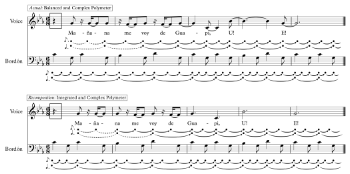
Example 9. Original and recomposed melodic line featuring dosillo in “Adiós Guapi,” Grupo Naidy (2002), 0:31–0:40
(click to enlarge and listen)
[2.8] Returning to currulao briefly, Example 9 shows two glosadas (calls), superimposed onto a bordón ostinato. The one on top uses the familiar dosillo rhythmic pattern, as heard in “Adiós Guapi” by Grupo Naidy. As is shown, this dosillo rhythm establishes projections of dotted eighths and dotted quarters, while the bordón establishes eighth note and dotted quarter note projections. The dotted quarter projections in the two parts, however, are displaced from one another by an eighth note. Therefore, since there are no nesting projections between these two rhythmic patterns, these are likely understood as forming a balanced polymeter, or, if it is aurally clear to the listener which is dominant, then at least as polarized. Meanwhile, if the melodic line of “Adiós Guapi” began one eighth note later, as suggested in the recomposition of the bottom system, then its dotted quarter note projections would align with those in the bordón. As such, is it probable that the ensemble as a whole would be perceived as using a 2-against-3 polyrhythm, nested within the shared dotted quarter note projection, thus forming a (much less disorienting) integrated polymeter
The Parallel Multiple-Analysis Processor and Onsets
[2.9] So far, I have linked balanced polymeters to multi-stability and, by extension, to the possibility for listeners to rapidly switch between different metric interpretations of a single musical surface. But, while it is well established that listeners can rapidly switch interpretations, it is less clear how the mind processes such stimuli to allow for this rapid switching. Ray Jackendoff (1991) suggests three possible perceptual mechanisms (a listener’s “unconscious musical parsers”
[2.10] Jackendoff concludes that both serial models pose problems for the understanding of meter as it unfolds in time, and thus suggests that a parallel multiple-analysis processor is more apt
[2.11] Several scholars praise the parallel multiple-analysis processor because, in addition to being able to describe prospective or anticipatory hearing (also accounted for by London’s entrainment model and most other models of meter), it can account for retrospective hearing and reinterpretation. Echoing Jackendoff (1987), Mirka (2009) argues that a surprising musical event—surprising because it does not fit into the entrained meter—can engender “retrospective reanalysis” in which the selection function “falls back on” another potential metric structure that the surprising event does fit. The ability to “fall back on” another meter implies that an alternate analysis was already available
[2.12] Jackendoff’s parallel multiple-analysis processor has significant implications for discussions of polymeter. The most obvious of these is that the selection function may raise different structures to consciousness in different listeners, depending on their metric preferences, prior experiences, or other factors
[2.13] How does the parallel multiple-analysis processor decide which meters are well-formed, and thus decide which to subconsciously generate as potential options for entrainment? Sullivan argues that the primary basis for the parallel multiple-analysis processor is projection. And, as he and others point out, the projective model is primarily based on onsets
Once confirmed, projections are maintained as long as there are attacks to sustain them. A confirmed projection can withstand some absent attacks but does not persist indefinitely without them. If the musical surface does consistently suppress such attacks, then the corresponding projection will vanish. This hypothesis explains our ability to sense a rest as metrically strong, while also observing that persistent rests of this kind undermine an established meter. (Sullivan 2023, [3.7])
[2.14] Returning to currulao, while projection’s reliance on onsets explains a non-expert listener’s interpretation of the meter, it does not account for the hearing of experts who “unconsciously” hear
[2.15] This highlights a vital tension in meter studies—that between stimulus-driven, bottom-up metric perception, and top-down, prior familiarity. Bottom-up theories of meter still dominate in music-theoretical literature. For example, in Lerdahl and Jackendoff’s model (1983), the imagined listener picks out signals from the musical surface: event onsets (MPR3), contextually long notes (MPR5a), suspensions (MPR8), and the like. These signals are constantly interpreted by the listener, who subconsciously molds their perception of meter based on the presence, absence, and relative strength of these signals. Similarly, projection is introduced by Hasty (1997) as a bottom-up model: upon hearing a mensurally determinate duration between two onsets, listeners project forward in time, expecting a third onset to occur about the same duration after the second onset.
[2.16] Increasingly, however, scholars are acknowledging that meter is largely a top-down, rather than bottom-up, phenomenon. Writing more generally about musical schemas, Mariusz Kozak writes that “[h]abits are gestures that maintain structural similarities between new situations and actions that are familiar to us from experience” (Kozak 2021, 222). This recalls London’s (2012, 69) and Mirka’s (2021, 51) writings regarding “template matching.” To them, “template matching” occurs when a listener has heard a melody, style, or schema several times in the same metric interpretation, such that even when clarifying metric signals are no longer heard, this listener will still maintain their metric interpretation as if a clarification were present.
[2.17] Thus, expert musicians who have heard dosillo accompanied by clarifying percussion and dancers enough times are able to impose the
[2.18] For the parallel multiple-analysis processor, this implies that onsets need not establish both meters in a polymetric structure. Instead, a polymetric tension can exist between bottom-up metric signals and top-down, schematic knowledge. In other words, the toggling between metric interpretations can occur even if only one of those interpretations is implied by onsets. This seems to have been Sarmiento’s experience: active selection of
[2.19] Thus, although it currently seems that simultaneous and conscious metric entrainment to two or more meters is beyond human cognitive capabilities, rapidly changing sensations of meter can occur and may be attributed to the parallel multiple-analysis processor. I argue that this, for all intents and purposes, is a type of polymetric perception. There are four conditions that allow for such rapidly changing sensations. In the cases where polymetric structure is created by audible pulse streams,
- There must be at least two competing (non-nesting) pulse streams with confirmed projections, if taken individually.
- The 2+ pulse streams must be strongly differentiated timbrally, registrally, or otherwise to encourage their perception as separate streams in a balanced polymeter.
- The 2+ pulse streams must not share the same beat-level. The fewer metric levels and onsets shared by the pulse streams, the more likely they are to be perceived as separate streams rather than as a composite rhythm. (Therefore, although listeners can rapidly switch entrainment between meters in an integrated polyrhythm, such as
and , which share a metric level slower than the beat, the simultaneous use of these meters can easily cause perception of the slower, common, metric level as the beat or, alternatively, of a single, composite rhythm created by the sum of onsets in the two streams.)
Yet, although polymeter is most often based on projections supported by onsets in the music, there are instances in which onsets do not mark beats in one or more participating meters:
- Should there not be competing pulse-streams established by onsets, in order to create polymeter, there must be at least one projected meter established by an audible pulse stream and another, implicit meter that is plausibly perceived by musicians who base their entrainment on familiar schemas.
[2.20] While the first three conditions are discussed by Poudrier (2008), the inclusion of the fourth condition is a new contribution to the study of polymeter. Implicit meters—which exist exclusively in the minds of enculturated listeners and whose beats do not align with sounding pulse-streams—are capable of existing in a polymetric tension with sounding pulse-streams in the music. Indeed, much of the fun for practiced listeners may be maintaining entrainment to the implicit meter in the face of the contrasting pulse streams in the musical surface, which push and pull against it.
3. Analytical Case Studies: How Polymeter can Manifest
[3.1] The three following examples, “Adiós Guapi,” “Adiós Morena,” and “Mirando,” use dosillo in different ways, such that the effects for less familiar listeners may contrast. I begin by discussing “Adiós Guapi,” by Grupo Naidy, in which two pulse streams are implied by onsets simultaneously, and thus rapid switching—induced only by onsets—can occur. In the case of “Adiós Morena,” composed by Esteban Copete and performed by two of his ensembles separately (Rio Mira, and Esteban Copete y su Kinteto Pacífico), the vocal use of dosillo is likely to trigger a one-time change in metric interpretation, such as that discussed by Mirka and Jackendoff. Consistent toggling between implied meters is one of several options for metric interpretation here, but only for highly conservative listeners, or for listeners vaguely aware of the convention of
“Adiós Guapi”
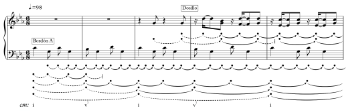
Example 10. Marimba introduction of “Adiós Guapi,” Grupo Naidy (2002), 0:00–0:07
(click to enlarge and listen)
[3.2] Example 10 shows the opening to “Adiós Guapi” by Grupo Naidy. The bordón player begins with “Bordón A” in C minor
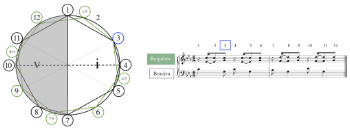
Example 11. Cyclic notation of dosillo (green) superimposed onto Bordón A (black), coinciding on the third eighth note (blue) (audio provided by Andy Miller and author)
(click to enlarge and listen)
[3.3] In “Adiós Guapi,” the non-nesting pulse streams in the introduction contrast significantly. In addition to being out of phase and registrally differentiated, the complex polyrhythm in mm. 4–5 of “Adiós Guapi”—a result of the interaction between Bordón A and dosillo—contains only one simultaneous onset between the two parts. (Example 10’s bordón does not feature isochronous durations, so when it forms a polyrhythm with the dosillo, it is a complex rather than a simple one.) Example 11 represents this complex polyrhythm in both cyclic and staff notation, with the simultaneous onset highlighted in blue. As an out-of-phase polyrhythm, this polyrhythm leans towards being balanced (Poudrier 2008, 107). Additionally, the coincidence point between the two streams—which is in a metrically weak position and not at the beginning of the polyrhythm—helps to audibly differentiate the pulse streams. Both pulse streams achieve potential metrical significance by being audibly differentiated, and thus this appears to be an example of a balanced polymeter
[3.4] In “Adios Guapi,” different listeners may have different metric interpretations, depending on a myriad of elements such as their metric preferences and prior experiences. I will address three possible metric interpretations below: one radical, one conservative, and one common for highly practiced and expert currulao musicians.
[3.5] In a radical hearing of this song, the parallel multiple-analysis processor has subconsciously provided options for understanding the bordón in the first two measures, based on its onsets (
[3.6] A more conservative listener, meanwhile, may have a clearer sense of meter during the requinta’s entrance, as they will tend to maintain entrainment to the continuing bordón’s projections: the bordón’s unchanging nature is something to keep attending to, allowing the listener to effectively ignore the requinta and hear its music as noise against the bordón. For this conservative listener, the polyrhythm may be perceived as a polarized polymeter, as they may keep attending to the meter that was established first. By nature, conservative listeners tend to avoid switching (both avoiding one flip and several rapid switches), for as long as they can avoid it.
[3.7] Finally, some listeners may maintain entrainment to the bordón’s
[3.8] There may be some other, more subtle differences in hearings between the conservative and expert listeners. For instance, since the expert is likely to use template matching when listening to currulao, they may assume
“Adiós Morena”
[3.9] My first example in this article was “Adiós Morena.” As we have discussed, in most currulaos, the opening tends to have the thinnest texture in the song, and thus is the most common place in which metric confusion may occur for non-expert listeners. Once the unpitched percussion instruments enter after an introduction, they traditionally do not stop playing until the end (see Example 5). Although requinteros may use dosillo in improvisatory middle sections between vocal phrases, and vocalists’ phrases often feature dosillo’s rhythm
Example 12. Form of “Adiós Morena,” Rio Mira, Marimba del Pacífico (2017), with unusual Section C
(click to enlarge and listen) |
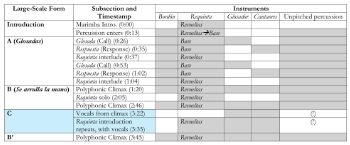
[3.10] In Example 1, I transcribed this unusual section in three ways: as a conservative listener may perceive it, as a radical listener might, and in a polymetric transcription. While polymeter is itself a contentious subject, perhaps the most heated debates about it involve polymetric transcriptions such as that one, in which a barline’s meaning—as an instructive suggestion of where metric strength should be perceived—is distorted, in that different parts of a clearly coordinated ensemble texture seemingly do not share the same metric structure. As Kofi Agawu suggests, polymeter in this sense “indexes coexistence, not (necessarily) cooperation” (Agawu 2003, 79)
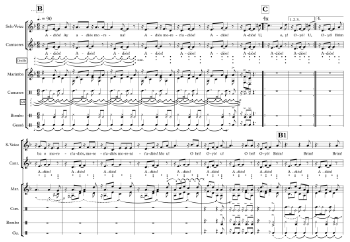
Example 13. Pulse streams in Section C of “Adiós Morena,” Rio Mira, Marimba del Pacífico (2017), 3:19–3:50
(click to enlarge and listen)
[3.11] Perhaps a less contestable, and a more detailed, transcription of Section C is found in Example 13. The transcription and analysis of Example 13 respectively show that, while you should try to perceive
[3.12] As is most striking, before the repeat sign that signals the beginning of Section C, the requinta and unpitched percussionists play three notes continuing the dotted-eighth-note pulse stream. This sounds like a cadential figure as the requinta arpeggiates down a tonic triad (the same three notes complete the song about a minute later). Instead of ending there, however, the vocalists continue their dosillo pattern and carry its pulses through to the next section. The lack of unpitched percussion during the following section is striking, and, for non-expert listeners, all pulses that aligned with the transcribed meter seem to evaporate after the three accented notes immediately prior to Section C. Following this, there are thirteen seconds in which no onsets align with downbeats—to say it is a challenge for non-experts to maintain entrainment to the established
[3.13] I find that many non-expert listeners experience a completely seamless transition from
[3.14] If the reader perceives the shift in “Adiós Morena” to be less shocking than the requinta entrance in “Adiós Guapi”—which features the same metric transition—this seems to suggest that they agree with the concept of a parallel multiple-analysis processor. Attending to the requinta in “Adiós Guapi’s” opening creates a sense of Jackendoff’s and Mirka’s “metric bewilderment,” since the projections were not previously there. On the other hand, changing attention to the dosillo in “Adiós Morena’s” Section C means falling back on projections that were already present, postulated by the parallel multiple-analysis processor.
[3.15] The radical hearing involving a seamless metric shift, and a more conservative hearing maintaining
[3.16] Despite the potential both for a radical hearing and for a listener with some knowledge of the genre to toggle between hearings, Copete enters on marimba on a conventional downbeat (without trouble, eight measures after the percussionists drop out), playing the same metrically interesting revueltas he had played alone during the song’s introduction. In videos of him performing the track, such as Video Example 1, sometimes he and the ensemble members continue tapping their feet or moving their heads to the transcribed beats, but sometimes they do not, and they still enter with equal precision. They have internalized the meter, and may have been able to entrain to
Video Example 1. Fragment of YouTube video of “Adiós Morena,” from “Esteban Copete Y su Kinteto Pacífico - Adios Morena (Live),” 2017
(click to watch video) |
“Mirando”
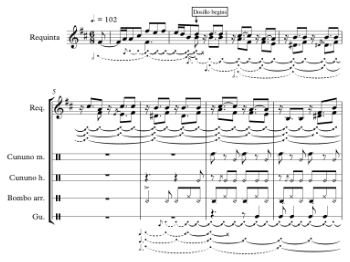
Example 14. Onsets do not align with
(click to enlarge and listen)
[3.17] Example 14 shows a short transcription of the final example in this article, “Mirando” by Grupo Naidy, from their album Vive Tus Raices (2011). This song begins with a prolonged requinta introduction performed by Antonio “Gualajo” Torres. Gualajo continuously plays variations on dosillo, unaccompanied from mm. 2–6, and past the unpitched percussionists’ entrance in m. 6. Gualajo’s continuous use of dosillo establishes projections of a dotted-eighth note into a simple duple meter. From a perspective in which onsets establish the beginnings of projections, the conventional
[3.18] As such, a listener who is not intimately familiar with currulao will likely entrain to the simple duple meter implied by the dosillo’s onsets. Much like for “Adiós Guapi,” this listener might experience “bewilderment” in m. 6—although the opposite bewilderment than that experienced in “Adiós Guapi,” in which the bordón establishes
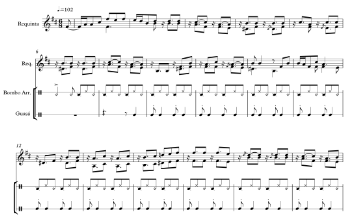
Example 15. Introduction to “Mirando,” Grupo Naidy, Vive Tus Raices (2011), 0:09–0:33 (simplified transcription)
(click to enlarge and listen)
[3.19] Starting at m. 7, “Mirando” is another example of an onset-established balanced polymeter, now between the requinta and the unpitched percussion, rather than between the requinta and bordón. As can be heard and seen in Example 15, the balanced polymeter continues through the introduction. (In fact, the balanced polymeter continues throughout most of the track, but is most audible only when the voices are not singing.) I invite the reader to listen and see if they experience this introduction as a multi-stable stimulus, and whether they can experience a toggling between the two meters
[3.20] As I have been emphasizing, this potential experience is quite different to that of the performers, and of currulao musicians in general: in this recording it is Irlando “Maky” López, Grupo Naidy’s leader and lead bombo player (to whom I spoke about dosillo) who enters in m. 6, on the transcribed downbeat. It is he who told me that entering in such a way was “unconscious” for him, although he also acknowledged the difficulty that musicians with less expertise have in similar situations. The tension between expert currulao musicians and casual participants was clear in August 2023, at the Festival Petronio Álvarez, in which one particular “traditional modality” performance began in a parallel manner to “Mirando,” with unaccompanied requinta playing dosillo. A person in the audience clapped along; most other audience members within range looked at him like his clapping was absurd. But, of course, he was simply clapping along with the implied beats of
Conclusion
[4.1] The central aims of this paper were twofold. The first aim was to introduce readers to the rich genre of currulao. The second aim was to explore some implications for models of polymeter—and for models of meter more broadly—to account for a range of possible experiences when listening to dosillo, a common “venomous rhythm” used in currulao’s vocal and marimba lines. One of my suggestions regarding meter is that toggling between meters is a possible experience when presented with a “balanced polymeter” or a “multistable stimulus.” The more significant argument is that a stimulus could be made multistable even when its sounding notes seem to imply only one metric interpretation: if some listeners have created mental templates or schemata that impose the stimulus onto a syncopated metrical understanding, then dynamic toggling may occur between a bottom-up meter, implied by onsets, and a top-down meter, implied by schematic familiarity. Thus, polymeter—here taken to be synonymous with rapid switching between metric possibilities—can exist even when the musical structure does not seem to suggest it.
[4.2] Although the motivating repertoire for this article was currulao, it seems that the same theoretical ideas may translate to a far wider range of repertoires. Indeed, it is often the case that listeners in the audience and musicians performing the music have entirely contrasting interpretations of the music. Regarding this phenomenon in the Western classical (notated) tradition, Jackendoff writes that “[w]hat the listener hears, of course, is the sequence of pitches with durations; that is, the notated key signature, time signature, bar lines, and beams play no role in the musical surface” (Jackendoff 1991, 202). Throughout a performance, although the musicians may think their perception is being communicated to the audience, many listeners will only hear projections and metric signals that do not align with the notated meter, and thus may not be able to entrain to the meter that the performers have practiced hearing.
[4.3] This seems to be a particularly common occurrence in performances of certain post-tonal repertoires
Lina S. Tabak
Indiana University
Jacobs School of Music
1201 E. Third Street
Bloomington, IN 47405
lstabak@iu.edu
Works Cited
Agawu, Kofi. 2003. Representing African Music: Postcolonial Notes, Queries, Positions. Routledge.
—————. 2023. On African Music: Techniques, Influences, Scholarship. Oxford University Press. https://doi.org/10.1093/oso/9780197664063.001.0001
Anku, Willie. 2000. “Circles and Time: A Theory of Structural Organization of Rhythm in African Music.” Music Theory Online 6 (1). https://doi.org/10.30535/mto.6.1.2.
Arom, Simha. 1991. African Polyphony and Polyrhythm: Musical Structure and Methodology. Cambridge University Press. https://doi.org/10.1017/CBO9780511518317.
Birenbaum Quintero, Michael. 2018. Rites, Rights, and Rhythms: A Genealogy of Musical Meaning in Colombia’s Black Pacific. Oxford University Press. https://doi.org/10.1093/oso/9780199913923.001.0001.
Burns, James. 2010. “Rhythmic Archetypes in Instrumental Music from Africa and the Diaspora.” Music Theory Online 16 (4). https://doi.org/10.30535/mto.16.4.1.
Candelario, Hugo. 2021. “Conferencia: Matrices rítmicas en las músicas del Pacífico Colombiano con Hugo Candelario.” Ministerio de Cultura, Facebook Live. https://www.facebook.com/MinisterioCultura/videos/377305267514695/.
Carter, David S. 2025. “Building Bridges: Rebuilds in Popular Song, 1959–2024.” Intégral 38: 25–60.
Dubiel, Joseph, Marion A. Guck, and Bryan Parkhurst. 2017. “Hearing as Hearing-As.” Music Theory and Analysis 4 (2): 229–32. https://doi.org/10.11116/MTA.4.2.3.
Guevara Calderón, Antonio, and Camilo Godoy Acosta. 2015. “El Currulao: Una Propuesta de Exploración, Interpretación y Creación, a través de la batería y la guitarra eléctrica.” Thesis, Universidad el Bosque.
Hannan, Calder. 2026. “I Don’t Hear It That Way: Temporal Parallax, Metal, and Music Theory’s ‘Listener.’” Music Theory Spectrum 48 (1): 54–77. https://doi.org/10.1093/mts/mtaf015
Hasty, Christopher. 1997. Meter as Rhythm. Oxford University Press.
Henrich, Joseph, Steven J. Heine, and Ara Norenzayan. 2010. “The Weirdest People in the World?” Behavioral and Brain Sciences 33: 61–135. https://doi.org/10.1017/S0140525X0999152X.
Hernández Salgar, Óscar. 2010. “De currulaos modernos y ollas podridas.” In Músicas y practicas sonoras en el Pacífico afrocolombiano, ed. Juan Sebastián Ochoa Escobar, Carolina Santamaría Delgado, and Manuel Sevilla Peñuela, 237–86. Editorial Pontificia Universidad Javeriana.
Imbrie, Andrew. 1973. “‘Extra’ Measures and Metrical Ambiguity in Beethoven.” In Beethoven Studies, ed. Alan Tyson, 45–66. W. W. Norton.
Jackendoff, Ray. 1987. Consciousness and the Computational Mind. The MIT Press.
—————. 1991. “Musical Parsing and Musical Affect.” Music Perception 9 (2): 199–229. https://doi.org/10.2307/40285529.
—————. 1992. Languages of the Mind: Essays on Mental Representation. The MIT Press. https://doi.org/10.7551/mitpress/4129.001.0001.
Jacoby, Nori, Elizabeth H. Margulis, Martin Clayton, Eric Hannon, Henkjan Honing, John Iverson, Tobian R. Klein, Samuel A. Mehr, Lara Pearson, Isabella Peretz, Marc Perlman, Rainer Polak, Andrea Ravignani, Patrick E. Savage, Gavin Steingo, Catherine J. Stevens, Laurel Trainor, Sandra Trehub, Michael Veal, and Melanie Wald-Fuhrmann. 2020. “Cross-Cultural Work in Music Cognition: Challenges, Insights, and Recommendations.” Music Perception 37 (3): 185–95. https://doi.org/10.1525/MP.2020.37.3.185.
Jones, Arthur Morris. 1959. Studies in African Music: Volumes I–II. Oxford University Press.
Kozak, Mariusz. 2021. “Feeling Meter: Kinesthetic Knowledge and the Case of Recent Progressive Metal.” Journal of Music Theory 65 (2): 185–237. https://doi.org/10.1215/00222909-9143190.
Krebs, Harald. 1999. Fantasy Pieces: Metrical Dissonance in the Music of Robert Schumann. Oxford University Press. https://doi.org/10.1093/acprof:oso/9780195116236.001.0001.
Lerdahl, Fred, and Ray Jackendoff. 1983. A Generative Theory of Tonal Music. The MIT Press.
Lester, Joel. 1986. “Notated and Heard Meter.” Perspectives of New Music 24 (2): 116–28. https://doi.org/10.2307/833216.
List, George. 1974. “The Reliability of Transcription.” Ethnomusicology 18 (3): 353–77. https://doi.org/10.2307/850519.
Locke, David. 2009. “Simultaneous Multidimensionality in African Music: Musical Cubism.” African Music 8 (3): 8–37. https://doi.org/10.21504/amj.v8i3.1826.
—————. 2011. “The Metric Matrix: Simultaneous Multidimensionality in African Music.” Analytical Approaches to World Music Journal 1 (1): 48–72. https://iftawm.org/journal/oldsite/articles/2011a/Locke_AAWM_Vol_1_1.pdf.
London, Justin. 2006. “Metric Fake Outs.” Excel spreadsheet. Justin London (webpage). https://www.carleton.edu/people/jlondon/downloads-and-media/.
—————. 2012. Hearing in Time: Psychological Aspects of Musical Meter. 2nd ed. Oxford University Press. https://doi.org/10.1093/acprof:oso/9780199744374.001.0001.
Londoño, Luis Javier. 2006. “Contexto, análisis rítmico y adaptación a la batería de los ritmos de currulao, juga y bunde.” Undergraduate Thesis, Pontificia Universidad Javeriana.
Marandola, Fabrice. 1997. “Review of African Rhythm: A Northern Ewe Perspective by K. Agawu.” Revue de Musicologie 83: 137–39. https://doi.org/10.2307/947035.
Marian-Bălașa, Marin. 2005. “Who Actually Needs Transcription? Notes on the Modern Rise of a Method and the Postmodern Fall of an Ideology.” The World of Music 47 (2): 5–29.
Martínez Carvajal, Alejandro. 2005. “Currulao: aspectos generales, patrones de ejecución y análisis musical.“ Undergraduate Thesis, Universidad del Valle.
Merriam, Alan P. 1959. “African Music.” In Continuity and Change in African Cultures, ed. William Bascom and Melville J. Herskovits, 49–86. The University of Chicago Press.
Miñana Blasco, Carlos. 2010. “Afinación de las marimbas en la Costa Pacífica colombiana: ¿un ejemplo de la memoria interválica africana en Colombia?” In Músicas y practicas sonoras en el Pacífico afrocolombiano, ed. Juan Sebastián Ochoa Escobar, Carolina Santamaría Delgado, and Manuel Sevilla Peñuela, 287–346. Editorial Pontificia Universidad Javeriana.
Mirka, Danuta. 2009. Metric Manipulations in Haydn and Mozart: Chamber Music for Strings, 1787–1791. Oxford University Press. https://doi.org/10.1093/acprof:oso/9780195384925.001.0001.
—————. 2021. Hypermetric Manipulations in Haydn and Mozart: Chamber Music for Strings, 1787–1791. Oxford University Press. https://doi.org/10.1093/oso/9780197548905.001.0001.
Myler, Derek. 2023. “Temporal Experience and the Music of Charles Ives.” PhD diss., University of Rochester, Eastman School of Music.
Nzewi, Meki. 1997. African Music: Theoretical Content and Creative Continuum: The Culture-Exponent’s Definitions. Institut für Didaktik populärer Musik.
Ochoa, Juan Sebastián, Leonor Convers, and Óscar Hernández. 2014. Arrullos y Currulaos: Material para abordar el estudio de la música tradicional del Pacifico sur colombiano. Tomos I–II. Editorial Pontificia Universidad Javeriana.
Otero Estrada, Laura. 2009. “Proceso de Composición de Arreglos Vocales (Con o sin acompañamiento instrumental) en Repertorio de Música Tradicional y/o Popular Colombiana.” Master’s Thesis, Pontificia Universidad Javeriana.
Peñalosa, David. 2009. The Clave Matrix: Afro-Cuban Rhythm: Its Principles and Origins. Bembe Books.
Poudrier, Ève. 2008. “Toward a General Theory of Polymeter: Polymetric Potential and Realization in Elliott Carter’s Solo and Chamber Instrumental Works after 1980.” PhD diss., CUNY Graduate Center.
Poudrier, Ève, and Bruno H. Repp. 2013. “Can Musicians Track Two Different Beats Simultaneously?” Music Perception 30 (4): 369–90. https://doi.org/10.1525/mp.2013.30.4.369.
Roeder, John. 1994. “Interacting Pulse Streams in Schoenberg's Atonal Polyphony.” Music Theory Spectrum 16 (2): 231–49. https://doi.org/10.2307/746035.
Sabogal Palomino, Adrián. 2010. “Una aproximación urbana a la Música de Marimba.” Master’s Thesis, Pontificia Universidad Javeriana.
Stover, Chris. 2022. “Can We Learn to Hear Multi-metrically?” Engaging Students: Essays in Music Pedagogy 8. https://doi.org/10.18061/es.v8i0.7737.
—————. 2023. “Participatory Identity, ‘Anexactitude’, and Music Analysis: Lessons from African Philosophy.” Paper presented at the Annual AAWM Conference, Virtual.
Sullivan, James. 2023. “Extending the Parallel Multiple-Analysis Processor: Perceived Meter in Post-Tonal Music.” Music Theory Online 29 (1). https://doi.org/10.30535/mto.29.1.4.
—————. 2024. “Performing Meter: Toward a Motive-Oriented Performance Practice for Post-Tonal Music.” Music Theory Online 30 (4). https://doi.org/10.30535/mto.30.4.3.
Tabak, Lina S. 2020. “Pulse Dissonance in Colombian Currulao.” Paper presented at the Annual SMT Conference, Virtual.
—————. 2022. “Short Notes on Strong Beats: Case Studies in African and Afro-Diasporic Meter.” Musica Theorica 7 (1): 45–67. https://doi.org/10.52930/mt.v7i1.213.
Temperley, David. 2000. “Meter and Grouping in African Music: A View from Music Theory.” Ethnomusicology 44 (1): 65–96. https://doi.org/10.2307/852655.
—————. 2001. The Cognition of Basic Musical Structures. The MIT Press.
—————. 2008. “Hypermetrical Transitions.” Music Theory Spectrum 30 (2): 305–25. https://doi.org/10.1525/mts.2008.30.2.305.
—————. 2009. “Review of Metric Manipulations in Haydn and Mozart: Chamber Music for Strings, 1787–1791 by Danuta Mirka.” Journal of Music Theory 53 (2): 305–28. http://doi.org/10.1215/00222909-2010-005.
Toussaint, Godfried. 2013. The Geometry of Musical Rhythm: What Makes a Good Rhythm Good? CRC Press.
Vuust, Peter, Andreas Roepstorff, Mikkel Wallentin, Kim B. Mouridsen, and Leif Østergaard. 2006. “It Don’t Mean a Thing…: Keeping the Rhythm during Polyrhythmic Tension Activates Language Areas (BA47).” NeuroImage 31 (2): 832–41. https://doi.org/10.1016/j.neuroimage.2005.12.037.
Winkler, Peter. 1997. “Writing Ghost Notes: The Poetics and Politics of Transcription.” In Keeping Score: Music, Disciplinarity, Culture, ed. David Schwartz and Annahid Kassabian, 169–203. University of Virginia Press.
Wittgenstein, Ludwig. 1953 [1998]. Philosophical Investigations. P. M. S. Hacker and Joachim Schulte.
Zapata Olivella, Delia. 1967. “An Introduction to the Folk Dances of Colombia.” Ethnomusicology 11 (1): 91–96. https://doi.org/10.2307/850500.
Footnotes
* I would like to thank the many mentors, colleagues, and friends who have been thinking through these issues with me for several years, and the reviewers for their thoughtful comments on this work. Thank you also to Andy Miller for recording audio files for this article, and to Irlando “Maky” López, Samir Aldana, Jayer Torres, and Esteban Copete for their generosity and for sharing some of their thoughts on currulao with me.
Return to text
1. Perceiving a change is dependent on hearing the shaker’s—guasá’s—quarter note right before the syllable “A” of “Adiós” as a downbeat.
Return to text
2. The terms “radical” listener and “conservative” listener were coined by Andrew Imbrie (1973) to describe listening habits or strategies for hypermeter in the music of Beethoven. He writes that conservative listeners tend to maintain entrainment to a meter for as long as possible through significant surface-level contradictions, while radical listeners are more easily and rapidly swayed by the musical surface.
Return to text
3. Some radical listeners might feel that the repeating chorus’s long note on “A-diós” is metrically stronger than the long notes of the lead vocalist, therefore shifting the chorus’s long notes onto downbeats. While this hearing is understandable, it cuts against the harmonic changes between A7 and Dm.
Return to text
4. The variations in ideas about polymeter also relate to how scholars define meter itself. If meter is merely reflective of a score or musical structure, then of course polymeter may exist. If, rather, it is based on whether a performer can play two contrasting strands simultaneously, then, also, of course polymeter can exist. If meter is based on attention and neuronal synchronization, however, then the possibility for polymeter’s existence is less clear.
Return to text
5. Justin London (2012) explains that a passage is “metrically malleable,” or metrically neutral, when it may be plausibly perceived in several metric interpretations.
Return to text
6. In a sense, my argument about the role of onsets is similar to Lerdahl and Jackendoff’s idea that onsets aligning with (strong) beats is merely a preference rule (MPR3), rather than the primary requirement for metric perception (1983, 76). In practice, however, to Lerdahl and Jackendoff this preference rule is very strong, since no other preference rule (save “Binary Regularity,” MPR10) can occur without a concurrent onset. As such, the only exception to onsets aligning with metrically strong positions in their theory is when MPR3 cannot be fully satisfied under one metric interpretation, in that any one metric interpretation allows some, but not all, rests to be metrically weak (Lerdahl and Jackendoff 1983, 76–77).
Return to text
7. In Section 3 of this article I address differences between a conservative listener and an enculturated one, with reference to several examples. In summary, in Example 1 the conservative listener happens to align with a stylistically competent one merely because the conventional meter was established first in the music. Yet, even if the conventional meter had not been established first by onsets, a stylistically competent listener would still provide that meter through template matching (London 2012, 69).
Return to text
8. Currulao’s dance is an example of a zapateo genre, meaning that footsteps are audible. The dance is partnered between a man and a woman, in which the man does increasingly complex steps to impress the woman, who plays “hard to get.” For more information about Colombian folk dances in general, see Zapata Olivella 1967.
Return to text
9. Alternative onomatopoetic devices are transcribed by Ochoa et al. (2014/ii, 55).
Return to text
10. More complex patterns performed and improvised around by the basic currulao instrumentalists are transcribed in various theses: Guevara Calderón and Godoy Acosta 2015, Londoño 2006, Otero Estrada 2009, Sabogal Palomino 2010, and Martínez Carvajal 2005. In addition to these, one method book has been written for aspiring currulao performers (Ochoa 2014); this provides several transcriptions and additional schemas for the primary currulao instruments.
Return to text
11. The increasing numbers of chromatic marimbas de chonta featured in the Festival Petronio Álvarez seems to have angered some followers of currulao, who commented on the festival’s social media announcements of the 2023 participating ensembles that they should only allow traditional instruments in the traditional genres competition.
Return to text
12. The uses and limitations of Western transcription have been discussed widely (and sometimes heatedly) in ethnomusicological, theoretical, and popular music literature (List 1974, Winkler 1997, Marian-Bălaşa 2005, Agawu 2023). Although the transcriptions in this article are not meant to replace the sounds of the music, nor the contexts in which they are typically performed, they do clarify elements and subtleties of the musical sound in a language that likely audiences—Anglo-American music theorists and Colombian musicologists—are generally able to comprehend.
Return to text
13. The cyclic notation roughly takes after Toussaint (2013), London (2012), and Peñalosa (2009). Each number on the clockface represents an eighth note in the 12-cycle; moving clockwise represents moving forward in time. I borrow from David Peñalosa in highlighting both primary and secondary beat cycles in this example (dotted quarter notes of
Return to text
14. Juan Sebastian Ochoa et al. (2014) transcribe several schemas which serve as a base. All the patterns omit onsets on downbeats; they usually orient themselves toward the second half of the measure, with longer note values falling on the second dotted-quarter-note beat. The omission of the strongest beat and articulation on the second, weaker beat of the measure is similar to 2-3 clave son (Stover 2023).
Return to text
15. Others parse the formal structure of currulao slightly differently from myself. For example, Martínez Carvajal considers it to be a four-part form, in which the marimba solo is its own formal section (Martínez Carvajal 2005, 183–186).
Return to text
16. “En algunas ocasiones el maestro Gualajo y su hermano Gerano interpretan esta figura en la marimba de forma continua, estableciendo un ostinato rítmico de una gran complejidad interpretativa. Al presentarse de manera continua, produce la sensación de una yuxtaposición de subdivisión binaria del pulso, ligeramente desplazada del primer tiempo. Por esta razón, muchos músicos suelen llamar “dosillo” a este patrón: una figura rítmica que marca una subdivisión binaria dentro de un contexto de subdivisión ternaria.”
Return to text
17. I do not know whether Candelario was the first to use the phrase “rhythmic venom” to refer to dosillo, but it seems that among some circles of currulao musicians, this rhythm has become commonly referred to not only as dosillo, but as dosillo venenoso (“venomous duple”). That said, one of celebrated marimba player’s Antonio “Gualajo” Torres’s sons, Jayer Torres, has never heard the term, and thinks that even the term “dosillo” is not used by the more traditional currulao musicians, but rather is only used by musicians such as Hugo Candelario, who are coming from a more urban background (Torres, in-person communication with author, December 21, 2024).
Return to text
18. “Si no hay percussion tranquilamente se puede sentir a dos.”
Return to text
19. “Porque este man empezaba a tocar y uy no! a mí me tocaba cerrar los ojos, cerrar los ojos, concentrarme, a todos, a todos.”
Return to text
20. “Aunque las interpretaciones polirrítmicas pueden sonar para el oído occidental como una estructura compleja bajo un molde métrico, los músicos africanos las conciben de un modo muy diferente. Cada una de las diversas líneas rítmicas consta de unidades métricas de igual longitud.”
Return to text
21. Martínez Carvajal’s idea about enculturated and unenculturated listening strategies has strong resonances with Justin London’s ideas about period extraction and template matching (2012, 68–69), the latter of which will be summarized in Section 2.
Return to text
22. Although the focus of his article is on bottom-up approaches to metric perception, based on projection, Sullivan (2023) does list several caveats for why a listener may entrain to a meter before the “necessary” number of onsets. Many of these caveats are related to pre-existing mental categories and top-down approaches to metric entrainment ([4.9]). For instance, he writes that stock patterns “can facilitate meter in a similar way as melodic parallelism” ([4.8]), though—unlike Lerdahl and Jackendoff’s MPR 1—schemas are frequently intra-opus rather than inter-opus. Similarly, he writes that in repeated listenings, “a listener might consciously or subconsciously impose [a] meter onto the passage” before the projections are confirmed ([4.9]). The use of schemas, therefore, allow for metric imposition, rather than metric deciphering, “overriding” bottom-up information presented on the musical surface.
Return to text
23. In her discussion of polymetric types, Poudrier presents musical structure and perception as more tightly intertwined than most other meter scholars. For instance, pushing back against Justin London’s ideas about metric entrainment, she writes that “it is obvious that meter must be situated in the music (as a hybrid product of a score and its performance) as well as in the mind” (Poudrier 2008, 31), and thus not exclusively in the mind. As may be apparent by my argument about the role of onsets in metric perception, I do not agree that musical structure necessarily has such a close relationship with metric perception.
Return to text
24. Although Poudrier and Repp write that both simple and complex polyrhythms may give rise to polymetric interpretations, they suggest that “simple polyrhythms are rarely so perceived because simple pulse trains are generally insufficient to give rise to independent metric hierarchies” (Poudrier and Repp 2013, 370). Thus, the more robust projective hierarchies created by complex polyrhythms are more likely to give rise to polymetric interpretations.
Return to text
25. Chris Stover emphasizes a suggestion by Poudrier and Repp themselves, namely, that the inconclusive nature of their results may have been largely due to their experiment participants being “all musicians trained in the Western ‘classical’ tradition” (Stover 2022, 3) and not experts of any African or Afro-Diasporic musical traditions (Poudrier and Repp 2013, 379). On the one hand, Stover is right to highlight that empirical studies’ disproportionate inclusion of Western, university-affiliated participants biases their results and that all participants of Poudrier and Repp’s study matched this category (see Jacoby et al. 2020 and Heinrich et al. 2010 for more thorough discussion of such disproportions). On the other hand, it is not so clear to me that this assumption of difference is warranted: James Burns’s experience with Southern Ewe repertoires leads him to state that “having attended so many African music events over the years, I find it difficult to believe that everyone is not moving to the same beats” (Burns 2010, [16]). Similarly, Meki Nzewi writes of Igbo music that “[i]f we miss the fundamental principle of pulse in the deep structural layering of African ensemble music, we drift into the mirage of polymetric speculations” (Nzewi 1997, 42). If anything—in currulao as least—it is the less-experienced listeners, rather than the more-experienced ones, who upon hearing dosillo will be confused about what the (single) conventional meter is.
Return to text
26. A trio of articles by Joseph Dubiel, Marion A. Guck, and Bryan Parkhurst focus on exploring Wittgenstein’s concept of “seeing as,” translating it to the musical experiences of “hearing as” (Dubiel, Guck, and Parkhurst 2017).
Return to text
27. The opening polychord of Stravinsky’s “Augurs of Spring” is an example of a slightly different musical polystructure, whose
Return to text
28. This study by Vuust et al. (2006) specifically argues that polymetric scenarios are also examples of bistable states, “in which the determination of foreground-background relationship is ambiguous” (Vuust et al. 2006, 832). Results of their study suggest that when tapping along with a polyrhythmic song, the part of the brain which deals with bistable stimuli (Broadmann area 40) is indeed activated.
Return to text
29. Rhythmic patterns like those found in the recomposition are pervasive in other traditional African and Afro-diasporic repertoires and have been noted in scholarship. Willie Anku (2000) refers to such 3:2 polyrhythms as a “cross-set,” James Burns (2010) titles it “Medium Interweave” or “Rhythmic Archetype 2,” while David Locke (2011) calls it an “eight-feel” in ternary quadruple time. It is the added displacement relative to the recomposition which makes dosillo more complex, and more likely perceived as a balanced polymeter.
Return to text
30. The term “parser” became “processor” by the 1992 version of Jackendoff’s work. The latter is more commonly used in music cognition.
Return to text
31. Jackendoff’s focus on music perception as it unfolds in time is a move away from final-state analysis, as represented by his and Fred Lerdahl’s work, A Generative Theory of Tonal Music (1983).
Return to text
32. Some authors do not dismiss both serial models. For instance, while Jackendoff rejects the serial single choice model because it assumes substantial backtracking, David Temperley argues that “it is possible, for example, that the system is backtracking, but is just doing it so quickly and effortlessly that we do not notice” (Temperley 2001, 209). In this article, however, I adopt the parallel multiple-analysis processor.
Return to text
33. Although he does not discuss it explicitly, David Temperley (2008) seems to rely on a parallel multiple-analysis processor to discuss hypermeter in music (primarily) of the Western common practice, arguing that perception of metric strength is not determined from a single point in time. Instead, he suggests that at a particular measure (m), a listener will have a certain understanding of its metric strength. As more measures are heard, however, listeners may alter their perception of the measure that has passed. He writes that, therefore, “each measure in the piece is experienced from the vantage points of all subsequent measures. [
Return to text
34. Calder Hannan (2026) coins the term “temporal parallax” to refer to the varying meters that different listeners may feel.
Return to text
35. Danuta Mirka writes that the parallel multiple-analysis processor, without the requirement for onsets, would need to “elaborate an extremely high number of analyses including quite improbable ones; for instance thoroughly syncopated analyses of a given passage. Note that [Lerdahl and Jackendoff’s Metrical Well-Formedness Rule 1
Return to text
36. In 12-tone equal temperament where A=440, the tonic in “Adiós Guapi” lies somewhere between B and C. For this reason, Martínez Carvajal’s transcription of “Adiós Guapi” is in B minor rather than C minor (Martínez Carvajal 2005, 185).
Return to text
37. One could argue that the bordón establishes
Return to text
38. The requinta’s entrance feels anticipatory to the beats of
Return to text
39. In Tabak 2020, I argue that in this excerpt the structural grouping dissonance is not felt as such, because the sixteenth notes are at such a rapid tempo that they cannot be tracked as a pulse layer that can be grouped. Rather, I coin the term “pulse dissonance” and argue that there are two simultaneous fast layers—an eighth note and a dotted-eighth note pulse layer.
Return to text
40. In their reasons for being likely perceived as balanced, Examples 10 and 11 are quite similar to Example 9, which is from the same track. Yet, the bordón is slightly different in the opening than in the glosada shown in Example 9. In the opening, there are less simultaneous onsets between bordón and dosillo than in Example 9, so the strands are further differentiated from this perspective.
Return to text
41. For an additional example of vocal parts in dosillo rhythm, listen to “Quítate de mi Escalera” by Grupo Socavón de Timbiquí.
Return to text
42. Section C in “Adiós Morena” is much like a formal blend found in popular music that David S. Carter terms a “breakdown and rebuild” section (Carter 2025). These sections involve an abrupt reduction in texture in which music found in a previous section is recycled. Despite the borrowing of prior formal material, the abrupt reduction in texture and position about three quarters of the way through the song give it a bridge-like quality.
Return to text
43. The most infamous polymetric transcriptions are by Arthur Morris Jones (1959), hailed by Fabrice Marandola as the “apostle of African polymeter” (1997, 139). Many scholars have critiqued the barring of Jones’s transcriptions, attributing his out-of-phase barlines to a misunderstanding of phenomenal accents (Arom 1991), a confusion between grouping and meter (Temperley 2000), a conservative notion of how much syncopation is possible (Burns 2010), and an often-incorrect association of note length with strong metric position (Tabak 2022).
Return to text
44. I have notated the dosillo rhythm slightly differently from the previous examples for ease of legibility with the vocal part. The reader should understand that the rhythm is identical to all other instances of dosillo, with streams of a dotted eighth note, displaced by a sixteenth note from the downbeats.
Return to text
45. For readers having a difficult time entraining to
Return to text
46. In August 2023, I attended a gig at La Topa Tolondra, a renowned salsa bar in Cali, during the week of the Petronio Álvarez festival. Esteban Copete and another ensemble of his, Kinteto Pacífico, performed “Adiós Morena.” Nobody danced during the marimba introduction; they just enjoyed watching Copete play his opening revueltas. As soon as the unpitched percussion entered with their “beat drop,” everybody began dancing comfortably. (Most people stepped bipedally to
Return to text
47. While I lack formal evidence for this, this is my general sense based on discussions with students and colleagues, who, although prompted to feel
Return to text
48. In “Mirando,” it is also possible that a listener will hear the dosillo as essentially in
Return to text
49. I observed this in person, during one of the traditional ensemble competition blocks in the 2023 Festival Petronio Álvarez. Unfortunately, I do not recall the name of the ensemble or the requintero that was playing at the time.
Return to text
50. James Sullivan’s article on “Performing Meter” discusses many post-tonal examples in which notated and perceived meter are at odds with one another (Sullivan 2024). He argues that, in such cases, the performers should even encourage hearing the “wrong,” non-notated meter by emphasizing motivic parallelisms that may misalign with notated meter.
Return to text
Copyright Statement
Copyright © 2026 by the Society for Music Theory. All rights reserved.
[1] Copyrights for individual items published in Music Theory Online (MTO) are held by their authors. Items appearing in MTO may be saved and stored in electronic or paper form, and may be shared among individuals for purposes of scholarly research or discussion, but may not be republished in any form, electronic or print, without prior, written permission from the author(s), and advance notification of the editors of MTO.
[2] Any redistributed form of items published in MTO must include the following information in a form appropriate to the medium in which the items are to appear:
This item appeared in Music Theory Online in Volume 32, Issue 2 in June 2026. It was authored by Lina S. Tabak (lstabak@iu.edu), with whose written permission it is reprinted here.
[3] Libraries may archive issues of MTO in electronic or paper form for public access so long as each issue is stored in its entirety, and no access fee is charged. Exceptions to these requirements must be approved in writing by the editors of MTO, who will act in accordance with the decisions of the Society for Music Theory.
This document and all portions thereof are protected by U.S. and international copyright laws. Material contained herein may be copied and/or distributed for research purposes only.

Prepared by Andrew Blake, Managing Editor
Number of visits:
2292