Reading Singing in Gerbert de Montreuil’s Roman de la Violette*
Matthew P. Thomson
KEYWORDS: Music and literature, Trouvère song, Power of song, Hermeneutics of form, Formal analysis, Gerbert de Montreuil, Gace Brulé
ABSTRACT: This article connects musical form with one of the cultural meanings most consistently associated with song, its ability to change emotions and behavior. While medieval clerical writers from Augustine onwards praised vocal music’s power, they also worried about the unpredictable mechanisms by which such consequences were produced. Similar concerns occupied the early-thirteenth-century narrative literary texts that began to place pre-existing trouvère songs into the mouths of their characters; unlike the temporal bubble of a free-standing song, these diegetic musical performances now had (often troubling) narrative consequences. In episodes from Gerbert de Montreuil’s literary narrative Le Roman de la Violette (c. 1227–31), I argue that these overlapping concerns come vibrantly to life when a song’s musical form produces narrative effects quite different from those intended by the characters who sing them. This active role for a specifically musical element of song fulfills the prologue’s boast that Violette’s worth is based on its ability to be “both sung and read.” Such a hermeneutics of musical form in Violette has three important consequences. First, it expands existing scholarship on song in medieval literature, which has previously focused on the impact of a song’s genre, provenance, intertextual connections, and melodic style. Second, it advances a growing scholarly understanding of trouvère formal practice as offering nuanced hermeneutic affordances to its audiences. Third, it suggests the fruitfulness of readings, in both medieval and transhistorical contexts, that bring music-analytical understandings of song to bear on cultural narratives about its volatile vocal power.
DOI: 10.30535/mto.32.2.8
Copyright © 2026 Society for Music Theory
[0.1] The prologue of Gerbert de Montreuil’s Roman de la Violette, a literary narrative written around 1227–31, forges a close link between reading and singing:
This story which I want to recite and tell to you, is beautiful and noble, because it can be both sung and read. And the songs fit so well with the spoken narrative, I take the listeners as witnesses that I am telling the truth. (Violette, ll.36–41
)(1)
The largely pre-existing songs sung by Violette’s characters, the text insists, make a distinct impact on those who hear the story read aloud
[0.2] My analysis proposes that Violette would have afforded its audiences opportunities to link some of these melodies’ musical forms with cultural meanings commonly attributed to music in both medieval and transhistorical contexts. From St Augustine’s Confessions to nineteenth-century opera, writers both praise and critique music’s powerful but unpredictable ability to change peoples’ emotions and behavior
[0.3] In many cases, scholarship has approached cultural narratives about song’s volatile powers by analyzing the force exerted by its non-semantic vocality, focusing on elements of musical practice that Abbate (2004) terms “drastic” rather than “gnostic
[0.4] Across all manuscripts of Violette, characters break into song around 40 times
[0.5] After setting out the background both to medieval worries about the behavioral consequences of song and to thirteenth-century understandings of song form, I analyze each of these songs in turn, demonstrating that their formal properties allow them to play an active role in producing consequences that their singers neither expect nor desire. I explore how each song plays with what modern scholarship understands to be the formal expectations of thirteenth-century musicians, including those of melodic repetition, tonal focus, and integration between musical and poetic structures. Importantly, by tracing the behaviors of scribes who copied these songs into chansonniers, I also show more directly that their melodies caused thirteenth-century musicians to think twice about how they should be parsed.
1. The Emotional and Behavioral Consequences of Song
[1.1] Many thirteenth-century clerical thinkers drew on a long-established tradition of thought, stretching back to Plato and Aristotle, which held that music could induce people to mimic its emotional state and thereby change their behavior in unpredictable ways (Schoen-Nazzaro 1978). Thirteenth-century accounts of such powers, which were heavily influenced by Book 10 of St Augustine’s Confessions (c. 397–427) and Boethius’ De institutione musicae (early sixth century), occurred in two types of text
[1.2] Within clerical discourses, song’s power is held to be morally ambivalent. If carefully managed, it can induce positive emotional and behavioral change, but authors consistently warn that the consequences of song might be more difficult to predict than expected. In some cases, these writings focus on the experience of the listener. In a passage that influenced many thirteenth-century texts, Augustine stresses the care that must be taken when hearing liturgical singing. Listeners must avoid getting carried away by the beauty of sound, instead maintaining their focus on the sacred text being sung; only then will “the delight experienced by the ears
[1.3] Other texts are more focused on the role of the performer. Boethius’s De institutione musicae, which was a standard text in thirteenth-century clerical educations (Leach 2009, 23–24), tells of Pythagoras instructing a performer to change from one type of song, which has incited a young man to lust and violence, to a different kind of song, which restores him to reason (Boethius 1989, 5–6). Here, Pythagoras is not himself a performing musician, but functions as what Boethius calls a musicus (Boethius 1989, 50–51): because Pythagoras understands music rationally (for example by knowing the mathematical ratios that form the acoustical basis of musical intervals), he is able not only to reliably affect the behavior of others, but also to make sure that he maintains control over his own conduct. Through the music theory of the Middle Ages, the category of musicus and its accompanying responsibilities of retaining a rational understanding of music came to include performers (Reimer 1978; Leach 2007, 43–51). Although such music-theoretical texts would likely have been inaccessible for Gerbert’s audience, numerous lay-oriented thirteenth-century texts also stressed the dangers of performers being unable to determine the effects of their music. The thirteenth-century treatises on the vices and virtues found in the Mireour du monde, designed for the use of preachers and confessors, speak of musical entertainers who are so careless about the topics they discuss that the devil can play them as if they were a “pipe (chalemel)” (Chavannes 1845, 75). In Jacques de Vitry’s Sermones vulgares, furthermore, he compares women who sing at public dances known as caroles with a trap used for catching quails. Once their senses have been dulled by song, he says, each of these women becomes like a caught bird who is placed in a field so that they keep singing and thereby unknowingly attract other women to the moral trap of these dances, which were infamous within clerical writings for their supposed extra-marital sexual activities (Jacques de Vitry 1890, 114). In all these texts, performers have a special responsibility to stay rational so that they can determine the effects of their song, for example by keeping a careful watch on its textual content. If they do not stay alert, these texts warn, their songs could easily have unexpected consequences.
[1.4] The focus of clerical discourse on the effects of song links it with the treatment of similar concerns in song-rich vernacular narrative literature. Such texts often critique the courtly lyricism embodied by the trouvère and troubadour song they use by examining its likely consequences, as stressed by scholars including Emmanuèle Baumgartner (1981), Sylvia Huot (1987, Ch. 4), Marc-René Jung (1980), and Sarah Kay (1990, Ch. 5). The desire in troubadour and trouvère songs largely depends on a static monologic temporality, in which the male speaker expresses his love for a woman and his hatred of jealous meddlers, none of whom can speak back. When these songs are used in narrative literature, however, this temporality is broken apart: the male singer can no longer control the reactions either of women or of jealous men to his songs and the desire expressed therein. These texts, by exploring the consequences of sung courtly lyricism, often critique it either as an unproductive and sterile approach to eroticism that gets nobody anywhere (Baumgartner 1981; Huot 1987, Ch. 4) or as a pretty but obfuscatory way of covering up the more effective but cruder motivations of sex and money that sit behind it (Kay 1990, 194–97).
Form in Thirteenth-Century Song
[1.5] The argument that the musical structures of Violette’s songs are linked with such clerical and vernacular worries about song requires a nuanced picture of medieval conceptions of form, a perspective that has often proved difficult to access. The few contemporary theoretical discussions of poetic and musical form, including Dante’s comments in De vulgari eloquentia (c. 1304–6; Tavoni 2022), Johannes de Grocheio’s Ars musice (c. 1270s; Johannes de Grocheio 2011, 12), and the Occitan treatise Doctrina de compondre dictats (possibly c. 1286–91), offer little elucidation of performers’ practical knowledge of the trouvère repertory
2. The Consequences of Reckless Performance: Quant bone dame
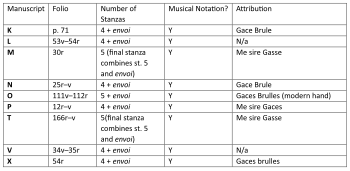
Example 1. Gace Brulé, Quant bone dame as found in trouvère chansonniers
(click to enlarge)
[2.1] Violette’s story begins at the court of a king of France named Louis, widely recognized as the fictional counterpart of Louis VIII (r. 1223–26) (Gerbert de Montreuil 1928, lv–lvi; Doyle 2004)
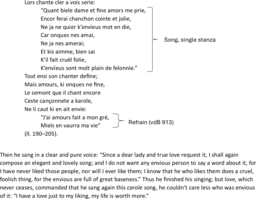
Example 2. Text and translation of Violette, ll. 190–205
(click to enlarge)
[2.2] Gerart’s musical performance in this scene is not limited to the first stanza of Quant bone dame. As marked in Example 2, he also sings a short two-line burst of song known as a refrain: this is not a refrain in the modern sense of a repeating section of song, but rather in the medieval sense of a short and catchy combination of text and music
[2.3] However, Gerart is not in the monologic temporal stasis of a standalone song. His attempt to use his song to dismiss the envious, therefore, is not automatically guaranteed to succeed, as his narrative surrounding means that he cannot determine the reactions of others. Indeed, the behavioral consequences of his song are much less desirable than those which he intended. Instead of getting rid of the envious, he creates them:
Quant li chevaliers ot canté
Et li baron l’ont escouté,
Tels i ot ki en ont envie
De son solas et de sa vie;
Et pour chou que il se deduit,
En avoit a la court plus d’uit,
Cui il anoie tant et grieve,
K’a poi ke li cuers ne lor crieve;
Mais sour tous poise Lisïart,
Qui molt fu fel et de mal art.
(ll. 239–48)When the knight had sung and the barons had heard him, there were some who were envious of his joy and his life. There were more than eight at the court who were so angry and grieved at his delight that their hearts could not but break. But especially Lisiart, who was cruel and an expert in trickery, outweighed them all.
[2.4] Both in choosing a song that focused so much on the envious and in being careless of the consequences (“he couldn’t care less who was envious of it”), Gerart seems to have directly summoned the envious into being
[2.5] Gerart’s disastrous singing does not only exemplify what happens when the lyric stasis of trouvère song is introduced into literary narrative; it also recalls thirteenth-century clerical warnings about the difficulty of determining the emotional and behavioral consequences of song. Like the performers discussed in the Mireour du monde and in Jacques de Vitry’s sermons, Gerart’s carelessness about his song’s contents and effects meant that it could not achieve his intended consequences and instead led directly to an unexpected negative outcome. The musical form of Quant bone dame, I argue, made it a particularly appropriate choice for this narrative situation: Gace’s melody seems as if it will fall into normative formal patterns, but then frustrates those expectations. Quant bone dame therefore viscerally enacts clerical warnings about the effects of song: as it demonstrates, even seemingly conventional songs can go off in unexpected directions if they are not closely watched. Crucially, some of the song’s moments of formal rupture occur at important moments during the discussion of the envious in the text of Gace’s song, providing a direct link for audiences between the form of Quant bone dame and the problems it causes for Gerart.
[2.6] For many clerical thinkers, especially those influenced by Boethius, singers could only reliably ensure the effects of their song if they could also exercise a rational understanding of music’s construction. As demonstrated below, Quant bone dame’s form not only makes the song difficult to understand within modern scholarly conceptions of trouvère form, but also caused some of the scribes who copied it into thirteenth-century manuscripts to think twice about how it should be parsed.
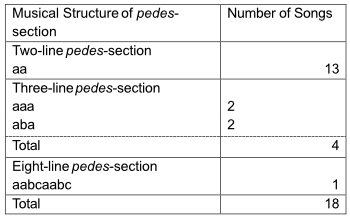
[2.7] The form of Quant bone dame plays with the norms of the most common musico-textual pattern for trouvère song, known as pedes-cum-cauda form. Archetypally, pedes-cum-cauda melodies begin with an opening section comprising four lines of poetry, with the melodies of lines 1–2 being reused for lines 3–4. This pedes-section is then followed by a cauda of an unfixed number of poetic lines; taking these parts together, the form is often schematized as ababx. In the general trouvère repertoire, variants on this structure are not uncommon. The pedes-section, for example, may have only two poetic lines, all using the same melodic material. More unusually, a pedes-section may have three poetic lines, all of which often use the same melody
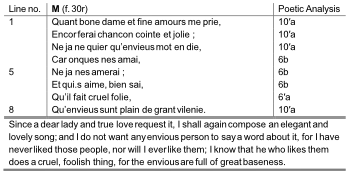
Example 3. Text and translation of Gace Brulé, Quant bone dame, stanza 1
(click to enlarge)
[2.8] Although Quant bone dame’s form is anomalous within its immediate contexts, it has clear structuring principles in both text and music. Most of its stanzas follow the poetic pattern outlined in Example 3, which contains the first stanza of the song as found in manuscript M
Example 4. Trouvère songs that begin with three “a”-rhymed lines and whose extant music uses a pedes-cum-cauda form
(click to enlarge) |
[2.9] Quant bone dame has a three-line pedes section, observable as much from its text as its melody. It is marked by the textual turning point that occurs in each of Quant bone dame’s stanzas at the beginning of line 4 (although only the first stanza is in Violette). As in all the stanzas, the first word of line 4 in Stanza 1 is a conjunction: ‘car’ (because). In each stanza, therefore, the opening of line 4 marks the beginning of a new clause. Furthermore, as is conventional, the closing envoi of the song is only a partial stanza; the portion it omits consists of the first three lines of the stanza, demonstrating its status as a structural unit.
Example 5. The melodies for Gace Brulé, Quant bone dame provided in manuscripts MKO
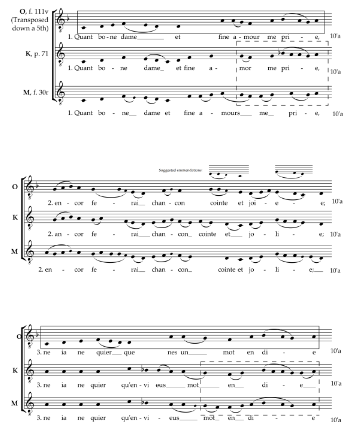
(click to enlarge and see the rest)
[2.10] The melodic patterns of this opening unit of Quant bone dame, however, are unusual for three-line pedes sections. These idiosyncrasies are expressed differently across the nine manuscripts of trouvère song in which Quant bone dame’s melody is notated. Manuscript V transmits a different melody from that found in all other sources of Quant bone dame. As discussed above, this is normal for this source and I therefore set aside V’s melody, which provides significantly different challenges, in order to deal with the other eight manuscripts, which all transmit versions of broadly the same melody. The musical variants in those manuscripts split them into three groups: MT, KLNPX, and O
[2.11] In O, the melodic structure of the three-line pedes section is very clear: the first and third lines use the same melody, producing an aba pattern. In other manuscripts, this pattern is traceable although less clear: the ends of lines 1 and 3 are the same, as highlighted by the dashed box. The melodic opening of lines 1–3 in KM seem at first to suggest an abc pattern. However, the opening of line 3, whose long series of repeated pitches is unusual in the context of the rest of the melody, may have been caused by a problem with manuscript transmission
[2.12] This is not to say that audiences would be surprised if a Gace Brulé song used in Violette began with an aba pattern. The overwhelming majority (93.5%) of Gace’s melodies, those with an ababx pedes-section, also begin in this way; crucially, though, these melodies then go on to complete the pattern in line 4. I contest, therefore, that most thirteenth-century listeners would have heard the first three lines of Quant bone dame less as a self-contained three-line pedes-section and more as the first three lines of a normative abab four-line pedes-section. Consequently, they would have expected line 4 to complete the pattern by repeating, or at least recalling, the melody of line 2. This expectation would have been reinforced by the tonal behavior of the pedes-section. The first three lines of Quant bone dame clearly outline a and D as tonal poles, marking them through turns and other cadential gestures and ending each poetic line on them
Example 6. The tonal structure of line-ending pitches in the pedes-sections of melodies associated with Gace Brulé
(click to enlarge) |
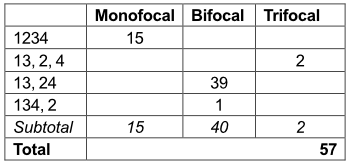
[2.13] Bifocal pedes-sections are by far the most common; among these, all but one adopt a normal “13, 24” pattern. In all of these 39 cases, the line-ending pitch shared by lines 2 and 4 is what Mason (2019, 60–61) calls the “primary” or home pitch of the pedes-section. The first three lines of Quant bone dame, therefore, sound like the beginning of a four-line abab pedes-section not only in their motivic repetition, but also in their tonal unfolding. Example 6 suggests that, after hearing lines 1 and 3 end on the same pitch and line 2 close with a different pitch, there are three possible scenarios that listeners might expect. Of the 42 songs that start with this tonal unfolding, the most likely option by far is represented by the 39 songs in which line 4 closes with the same pitch as line 2 (13, 24; 92.9%). The other two options, either a bifocal pedes-section in which line 4 ended with the same pitches as lines 1 and 3 (134, 2; 1/42; 2.38%) or a trifocal pedes-section which closed with a different pitch from the other three lines (13, 2, 4; 2/42; 4.76%), would be decidedly less common.
[2.14] The first three lines of Quant bone dame therefore create an expectation that line 4 will recall the music of line 2 and end on the pedes-section’s primary pitch of D. This expectation is raised only to be frustrated, however, as line 4 is clearly marked as the beginning of the cauda: it is immediately obvious that this line is not a repeat of previously heard music, while the opening G–d leap, found in all sources, entails an expansion of ambitus which seems to be characteristic of caudae in general (Mason 2019, 55–60). This audible moment of transition to the cauda had huge hermeneutic potential for many trouvères, as Jennifer Saltzstein (2023, 92–98) has noted in her study of the so-called “nature opening.” In Quant bone dame, unlike in the more normative songs studied by Mason and Saltzstein, this moment seemingly arrives too quickly, before the expected four-line pedes-section has been completed. Importantly, this frustration of expectation occurs just after line 3, in which the singer has introduced and supposedly dismissed the “envious.” As soon as these hated figures have been mentioned, the song seems prematurely to push Gerart onwards to further invectives, which occupy the entire cauda of the song. As established above, it is this obsessive focus on the envious that seems to call them into being, arousing the jealousy of Lisiart and his fellow courtiers. The form of Quant bone dame, therefore, vividly enacts the role of Gerart’s singing in his own downfall.
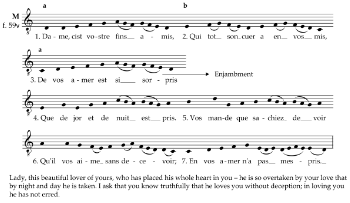
Example 7. Thibaut de Champagne, Dame, cist vostre fins amis, stanza 1
(click to enlarge)
[2.15] The formal understanding of Quant bone dame proposed here is supported by the only other three-line pedes known to me that uses an aba pattern: Thibaut de Champagne’s Dame cist vostre fins amis (RS 1516). Like Quant bone dame, Thibaut’s song seems to play with audience expectations that a three-line aba pedes-section will be completed by a fourth line that melodically repeats line 2. As seen in Example 7, Dame cist vostre fins amis frustrates this expectation in the same way: line 4 clearly begins the cauda with a similar upwards expansion in ambitus. In stanza 1, this hurried movement into the cauda joins with a textual enjambment to dramatically embody the disturbed state of the singing persona, who complains in ll. 3–4 that he is “overtaken” [sorpris] by his lady’s love by both night and day
[2.16] In Quant bone dame, the cauda has its own complex patterns of musical reuse, which differ across the eight manuscripts that contain this melody. As the motivic repetitions of caudae are usually less systematic, more piecemeal, and more varied across manuscripts than those in pedes-sections, it is harder to base an analytical understanding of this part of the song on the likely expectations of listeners. Instead, I adopt another approach, using the different versions of the cauda copied by music scribes as evidence for medieval understandings of this music. In doing so, I build on recent scholarship (Bleisch 2022; Leach 2019, 35) that sees scribes’ actions as taking place in the interface between the structures of any given song and their own knowledge of the norms of the repertoire. This is not to say that the caudae presented for Quant bone dame in its medieval manuscripts testify to an unusual level of variance for trouvère song; rather, in studying the melodic patterns of repetition that result from this variance, it is possible in particular cases to trace scribes’ attempts to understand how this song was put together. In each of these cases, “scribes” acts as a convenient shorthand for the musicians involved in the complex processes of written and oral transmission behind each manuscript version of the song
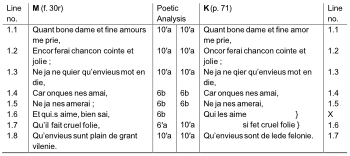
Example 8. Stanza 1 of Gace Brulé, Quant bone dame in manuscripts MK
(click to enlarge)
[2.17] The clearest example of these processes in the cauda of Quant bone dame concerns lines 6 and 7. As previously noted, line 7 is an anomalous moment in the poetic structure of the song: it combines the rhyme sound used in lines 1–3 and 8 (designated as a in Example 3 and Example 8) with the line length (6 syllables) usually associated with the b rhyme. This disjunction seems to have caused some scribes to wonder whether there had been an error and attempt to restore regularity through a thorough reimagining of the structure of the cauda. In stanza 1, K and its related manuscripts LNPX omit some of lines 6 and 7 and run them together to make a single poetic line. This produces a more consistent overall poetic structure, as annotated on the right-hand side of Example 8. This version of the poetic pattern avoids the mismatch between syllable count and rhyme previously present in line 7: lines that use the a rhyme sound always have 10′ syllables, while lines with the b rhyme consistently have 6 syllables. It seems clear that this was a scribal attempt at post-facto rationalization, as it only appears in stanza 1; in all other stanzas except the envoi, KLNPX all follow the normative pattern found on the left side of Example 8. Indeed, the anomalous place of lines 6–7 within the song’s poetic structure is suggested by the comparatively high level of variance between the syllable counts presented for them by different manuscripts. With very few exceptions, all manuscripts present line 6 with six syllables from stanza 2 onwards
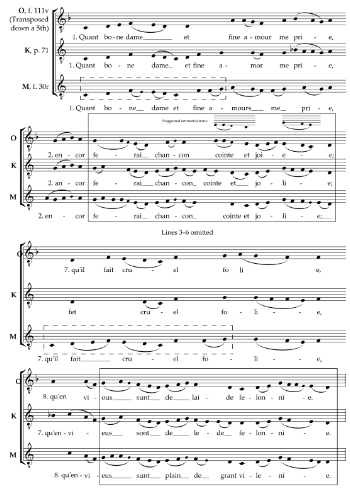
Example 9. The first two poetic lines and last two poetic lines of Quant bone dame in manuscripts OKM
(click to enlarge)
[2.18] For some scribes, therefore, there seems to have been a mismatch between the cauda of Quant bone dame and their expectations about the poetic regularity of trouvère song, to the extent that they provided a more regular solution. A similar amplification of regular patterns can be observed in different manuscripts’ treatment of the melodic repetition between the pedes section and cauda, although here it is less clear that the differences were intentional. As indicated by a solid box in Example 9, which shows the first two and last two lines of the stanza, the melody of the last line largely repeats line 2 in all three manuscript groups, once the posited corrections in manuscript O’s line 2 are taken into account
[2.19] When thinking about the meanings that might have been afforded to Violette’s audiences by the form of Quant bone dame, it seems prudent to treat the two primary sections of the song separately. In the pedes-section, audience expectations of repetitive structures can be quite clearly outlined, given the statistical survey of Gace’s songs carried out above. Despite the arguments above about possible issues of transmission in K, it is difficult to be certain whether the audiences of Violette, or even Gace himself, would have known a version of the melody that looked like that of O, with a more exact repetition between lines 1 and 3, or that of KM, with a fuzzier match. In either of these cases, however, once line 3 had recalled line 1, audiences would likely have expected line 4 similarly to recall the material found in line 2, completing an abab pedes-section. After mentioning the “envious” in line 3, however, Gace’s song fails to fulfil this expectation and instead rushes straight onto the ranting of the cauda. For audiences of Violette, this effect would have been intensified by the fact that the narrative preserves only the first stanza of the song
[2.20] When turning to the cauda of Quant bone dame, it is important to recall that in much thirteenth-century clerical discourse, the ideal strategy for remaining in control of the effects of one’s song was to employ a rational understanding of it, in the tradition of a Boethian musicus (see [1.3]). In Jacques de Vitry’s sermon discussed above, for example, the female performer whose song calls all her fellow dancers into the moral trap of the carole does so only because, like a blinded bird in a snare, her rational perception of the world around her has been dulled or confused. This throws a new light not only on the pedes-section of Quant bone dame, whose form is difficult to understand within the norms of Gace’s songs, but also on its cauda, which seems to have prompted some medieval scribes to think twice about its construction. Although categories of audience expectation carry much less weight in the cauda, the scribes and other kinds of musicians involved in the production of the version of lines 6 and 7 found in KLNPX clearly felt the need to produce a more poetically consistent version of the cauda in stanza 1, even if this post-facto rationalization was not applied to any of the other stanzas. If scribes found it anomalous enough to require a solution, it is perhaps unsurprising that Gerart was unable to direct the effects of Quant bone dame; a rational understanding of this song’s construction, as required by Boethian strategies, would require much closer attention than that which could be exercised by Violette’s careless protagonist.
3. The Downfall of a Careful Performer: Amors mi fait renvoisier et chanter
[3.1] If the narrative results of Quant bone dame’s formal play demonstrate the dangers of insufficient care over song and its consequences, the narrative’s subsequent episode goes even further. Here, Euriaut’s predicament suggests that the effects of song can be difficult to determine even for those who adopt the Boethian tactic of taking a careful and rational approach to music. When Lisiart journeys to Euriaut’s home to try and win his bet by persuading her to have sex with him, he finds her more steadfast than he imagined. His opening salvo is a speech full of the commonplaces of trouvère love songs (ll. 387–92), but this proves totally ineffective. Euriaut firmly rejects him, assuring him that she is only doing so politely because of her own courtliness (ll. 402–4). Lisiart refuses to be persuaded, mendaciously insisting on the durability of his passion, so Euriaut resorts to song:
Et s’or avés entendement,
Oïr porrés apertement
Comment je vous escondirai
En un vier que je vous dirai
C’aparmain porrés escouter
(ll. 436–40)And if you have understanding, you will be able to hear openly how I will turn you down, in a verse that I will sing to you, which you will be able to hear right away.
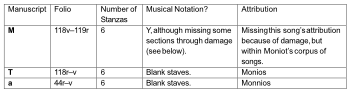
Example 10. Moniot d’Arras, Amours mi fait renvoisier et chanter as found in trouvère chansonniers
(click to enlarge)
[3.2] Euriaut then sings the first stanza of Amours mi fait renvoisier et chanter, found as a six-stanza song in chansonniers MTa, where it is attributed to Moniot d’Arras, as shown in Example 10. In Moniot’s version of the song, found on the left side of Example 11, the refrain that returns at the end of each stanza places the female first-person speaker in the conventional role of the malmariée, or ill-wed wife: a young married woman, who is deeply dissatisfied with her husband, has taken a lover in recompense and refuses to give him up despite her husband’s (often domestically violent) protestations (Johnson 2007; Ruisard 2021, Ch. 2; Pesce 2022)
Example 11. The text and translation of the first stanza of Moniot d’Arras, Amors mi fait renvoisier et chanter compared with the version found in Violette
(click to enlarge) |
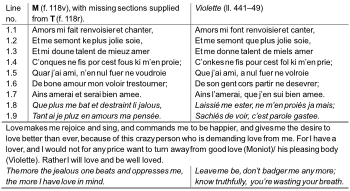
[3.3] At first, Euriaut seems completely capable of determining the effects of her song. Her singing succeeds where her speech had failed, persuading Lisiart that he will never convince Euriaut to give in to him voluntarily. The eventual consequences, however, are not those which Euriaut intended. Immediately after her song, the narrator notes, Lisiart begins to think about how he might deceive Euriaut (ll. 450–452) and thereby win his bet. His conundrum is solved when Euriaut’s bitter servant, Gondrée, offers to show Lisiart where he can spy on Euriaut in her bath, revealing the mark on her breast in the shape of a violet. Lisiart returns to court and uses his knowledge of Euriaut’s body to pretend that he has won his bet, prompting Gerart to disown Euriaut and abandon her in a forest.
[3.4] Scholars have recognized this scene as central to the relationship between song and Violette’s narrative. Mireille Demaules (2003, 135–37) argues that it represents one of the many passages in which Violette demonstrates its suspicion of the efficacy of courtly discourse: both Lisiart’s pretty speech and Euriaut’s song end up being overtaken by the joint trickery of Gondrée and Lisiart. For Grau (2011, 40), Euriaut is one of numerous female literary characters whose storyline is determined by the stock characters of the songs she sings. Euriaut sings Moniot’s malmariée song and becomes someone who can be portrayed as a malmariée; Gerart and the whole court believe that she has been unfaithful and ought to be punished for it. Here, I propose a further reading prompted by a close comparison between Euriaut’s version of Amors mi fait renvoisier and the text and music provided for Moniot’s song in chansonniers: I argue that the musical form of Euriaut’s song vividly enacts song’s ability, even when in the hands and voice of someone who seems to know how to control it, to produce unexpected and undesirable consequences.
[3.5] This scene establishes Euriaut’s credentials as a careful performer, as her initial success in using Amor mi fait renvoisier is made possible only by clever adaptation. For listeners familiar with Moniot’s song, Euriaut seems to have skillfully manipulated the text of its refrain, changing it from the complaint of a malmariée to a musical rejection of Lisiart’s advances in order to persuade him of her resolve. In Moniot’s text, there were three roles: the ill-wed wife, her extra-marital lover, and her domestically violent husband. The refrain is the only section of Moniot’s first stanza that announces this song as being sung by a malmariée. With her retexting, Euriaut therefore suppresses the figure of the adulterous malmariée from the song, making the singing persona match her own desired narrative situation; just like Euriaut, the person singing the song now only loves one man, Gerart. The jealous husband is also banished; like Lisiart, he has no role to play. When Euriaut begins to sing this song, those in Violette’s audience who already know it may assume that she will turn out to be as adulterous as the protagonist of Moniot’s song. Once they spot the revisions made to the refrain, Euriaut becomes a loose analogue of a Boethian musicus. Like Pythagoras in the story told by Boethius, she uses her rational intellect to manipulate the musical and textual material of song, shaping it so that it can influence the emotions and behaviors of others around her.
[3.6] Euriaut’s seeming virtuosic mastery over song and its effects, however, turns out to be a mirage. After Lisiart sees the mark on her breast, he can claim that he has had sex with her and win his bet. He can therefore reinstate all the roles of Moniot’s song, portraying Gerart as the jilted and jealous husband, himself as the extramarital beloved, and Euriaut as possessing all the classic characteristics of a malmariée. Euriaut’s confidence that her song will fulfill its desired purpose is turned on its head. This episode therefore recalls thirteenth-century clerical warnings about the difficulty of determining the emotional and behavioral effects of song, but simultaneously undermines their claim that those who approach music with the cool head of rational understanding will be able to bend it to their will. Amor mi fait renvoisier itself plays a role in the frustration of Euriaut’s expectations, as is demonstrated by a close examination of both its later stanzas and its musical form.
[3.7] The later stanzas of Moniot’s song, as found in chansonniers, might have acted as a warning to Euriaut that her ploy was unlikely to succeed. Stanza 6 of Amors mi fait renvoisier, for example, suggests that her chances of achieving her desired outcomes have already been fatally damaged by Gerart’s actions, offering an unfavorable comparison between Euriaut’s beloved and that of the singing persona.
Trestuit li bien c’on porroit deviser
Sont en celui a cui del tout m’otroie;
Bien set son cuer envers autrui celer
Et envers moi volontiers le desploie.
Non pluz c’on puet Tristan d’Yseut la bloie
De lor amour partir ne dessevrer,
N‘iert ja l’amours de nous deus dessevree.
Quant [pluz me bat et destraint li Jalous
Tant ai je pluz en amours ma pensee]
(Amors mi fait renvoisier, stanza 6, M, f. 119r)All the good qualities that you could wish for are found in him to whom I open all of myself. He knows well how to hide his heart from others and to display it willingly to me. You could no more part Tristan and Yseut the blonde from their love than separate the love of us two. The more the jealous one beats and oppresses me, the more I have love in mind.
[3.8] The male beloved of the ill-wed woman singing the song knows that, to avoid disaster, he has to keep his relationship to himself, displaying his heart only to his lady. It is this principle of amorous life that Gerart breaks so egregiously in the opening scene of Violette, boasting about Euriaut’s beauty and faithfulness in a conscious taunt to the envious
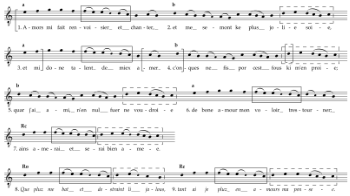
Example 12. Moniot d’Arras, Amors mi fait renvoisier et chanter, stanza 1, reconstructed from M (f. 118v) and T (f. 118r)
(click to enlarge)
[3.9] The later stanzas of Amors mi fait renvoisier, therefore, suggest that Euriaut’s attempt to influence Lisiart’s actions through her song was always going to fail; Gerart’s boasting had already fatally undermined her actions. The same dramatic inevitability is suggested by the song’s musical form, as demonstrated in the following analysis. No manuscript contains a full extant melody for Moniot’s song. Both T (f. 118r) and a (f. 44r) present staves with no notation, while the beginning of M’s (f. 118v) melody is no longer present due to the removal of the segment of the page that probably contained an illuminated initial
[3.10] The key formal characteristic of Amors mi fait renvoisier is the relationship between the melody used for the refrain (lines 8–9) and those used for the rest of the stanza. The refrain uses the same melody twice, first with an open ending in line 8 (labeled Ro) and then with a closed ending in line 9 (labeled Rc). As explored above, the refrain is the only section of the first stanza explicitly to cast the singer as a malmariée; the refrain and its melody thereby become associated with the ill-wed wife both in the first stanza and through the refrain’s repetition at the end of every stanza. It is crucial, therefore, that its melody is not confined to the refrain. On the level of the whole poetic line, line 7 also uses the Rc melody. Looking at the use of motives shorter than a line, R shares numerous characteristics with the a and b melodies, including the f–c descent from melody a, highlighted by solid boxes, and the cadence from melody b, highlighted by dashed boxes. The melody of the refrain in lines 8 and 9 is therefore deeply interwoven with those used for lines 1–7.
[3.11] With her re-texting of the refrain, Euriaut attempts to banish the malmariée from the song, leaving her free as a constant monogamous lover to use Amors mi fait renvoisier to dismiss her unwanted suitor. Her song cannot have her desired consequences, though, because of Lisiart’s trickery and, perhaps, also because of Gerart’s boasting. Instead, Lisiart is able to impose a situation in which the entire court thinks that she has acted like a malmariée, being unfaithful to Gerart with Lisiart. It is therefore significant that the melody associated with the song’s malmariée refrain in the minds of listeners is baked into the structure of Moniot’s song; just like the narrative role of the malmariée, it cannot be removed
4. Conclusions
[4.1] Gerart and Euriaut try to use their songs, borrowed from the trouvères, to bring about the stable loving environment in which they wish to find themselves. In doing so, they face two sets of problems. First, like the protagonists of many thirteenth-century literary narratives, they are confronted with the difficulty of introducing the monologic static temporality of trouvère desire into a narrative situation where other characters can speak back, a process chronicled by scholars including Baumgartner (1981), Huot (1987), Jung (1980), and Kay (1990). In a monologic song, Gerart could have railed against the envious without fear of any ill consequences. In the narrative situation of Violette, however, his careless focus on them ends up calling them into being.
[4.2] Second, and more importantly from the perspective of the present argument, Gerart and Euriaut face the problems that writers from Boethius to Jacques de Vitry warned about, being unable to direct the power of music towards their desired emotional and behavioral consequences. Gerart’s problem is his carelessness. Although his stated purpose is to declare his love for Euriaut and dismiss the jealous, “he couldn’t care less who was envious” (l. 203) of the love described by his song. Therefore, when the formal play of Quant bone dame’s unusual three-line pedes-section pushes him on precipitously to the screed against the envious in the cauda, he lets it sweep him up, ensuring that his song achieves exactly the opposite of his intended effect. Even had he wished to adopt a Boethian approach of ensuring the consequences of a song by rationally understanding how it was put together, this subtly constructed song would likely have evaded his careless approach, as suggested by the formal play with norms carried out by Quant bone dame’s pedes-section and the actions of scribes to produce a post-facto rationalization of the cauda’s poetic structure.
[4.3] Euriaut’s failure to direct the effects of her song, however, is of a different sort. For listeners who already know Moniot’s version of Amours mi fait renvoisier, it is clear that Euriaut carefully manipulates the raw materials of her song in a clever and targeted way: she re-texts its refrain and rids it of its malmariée protagonist, becoming in the process a loose analogue of a Boethian musicus. The promises of writers from Boethius onwards, however, that this would enable her to direct the consequences of her singing, are not fulfilled. Due to Lisiart’s trickery, the melodic echoes of the refrain throughout the song insistently pull their original malmariée role with them and force it upon Euriaut. She therefore becomes analogous to the performers addressed by the Mireour du monde, whom the devil was able to play as if they were a pipe: with song, the story suggests, there is always a risk that someone else will end up calling the tune.
[4.4] Importantly, it is these two songs’ musical forms that enable their hermeneutic affordances. This interaction between form and meaning points towards three important directions for future research. First, it suggests the potential of approaching songs included in thirteenth-century narrative literature through a formal musical lens. The two songs addressed here, when considered through an aesthetics of form, provide a much richer understanding of their respective scenes than might be gained simply from reading their texts. Second, this research contributes to a growing scholarly trend of treating form as an expressive device within trouvère culture. The readings presented here presuppose an audience that is familiar with trouvère song and understands its formal norms, either unconsciously through their knowledge of the repertoire or through conscious study and extrapolation. These norms’ impact can therefore be seen not only in the ways that trouvères play with the structural potential of their own melodies within their multi-stanzaic songs (Leach 2019; Mason 2019; Saltzstein 2023), or in the ways that they affect scribes’ copying of the songs (Bleisch 2022), but also in the ways that narrative literature and other cultural products make use of these songs. Far from the strict and dusty taxonomy of song forms found in some scholarship (Tischler 1997, e.g.), these scholarly trends are achieving a picture of form that is a living, playful, and meaningful part of the trouvère tradition as embodied in those who sung and listened to it. Third, and perhaps most important, the use of these songs in Violette affords a glimpse of the cultural meaning attached to music in the thirteenth century. By showing Violette’s interaction with clerical warnings about song’s unpredictable power, I build on the tradition of scholarship that productively counterposes clerical thought about music with secular musical production (Holsinger 2001; Leach 2007; Peraino 2005). The interaction shown here, in which the actions of Gerart and Euriaut both acknowledge and undermine clerical recommendations about how to determine song’s effects, suggests the fruitfulness of future research that sees clerical thinkers and vernacular musicians as interacting in complex and multidirectional ways. The hermeneutics of form employed here also opens up wider transhistorical comparisons of the participation of music’s formal structures within cultural understandings of music, specifically the seemingly transhistorical anxieties about music’s volatile but powerful ability to influence behavior. On an even broader level, they suggest that, when thinking about music, it might be more useful to explore the entanglements of Abbate’s “drastic” and “gnostic” in all their complexity than to insist on their separation. All three of these directions for future research, however, are only possible when the songs of Violette are understood as actually sounding music whose melodies play vital roles within the narrative. Gerbert de Montreuil was right, it seems, to insist that his text, and those like it, must be “both sung and read.”
Matthew P. Thomson
School of Music
Newman Building
University College Dublin
Dublin 4, Ireland
D04 F6X4
Matthew.thomson@ucd.ie
Works Cited
Abbate, Carolyn. 2004. “Music—Drastic or Gnostic?” Critical Inquiry 30 (3): 505–36. https://doi.org/10.1086/421160.
—————. 1996. Unsung Voices: Opera and Musical Narrative in the Nineteenth Century. Princeton University Press.
Aubrey, Elizabeth. 2000. “Genre as a Determinant of Melody in the Songs of the Troubadours and the Trouvères.” In Medieval Lyric: Genres in Historical Context, ed. William D. Paden, 273–96. University of Illinois Press.
—————. 1996. The Music of the Troubadours. Indiana University Press.
Aurell, Martin. 2017. The Lettered Knight: Knowledge and Aristocratic Behaviour in the Twelfth and Thirteenth Centuries. Translated by Jean-Charles Khalifa and Jeremy Price. Central European University Press. https://doi.org/10.1515/9789633861080.
Baldwin, John W. 2000. Aristocratic Life in Medieval France: The Romances of Jean Renart and Gerbert de Montreuil, 1190–1230. Johns Hopkins University Press.
Baumgartner, Emmanuèle. 1981. “Les Citations lyriques dans le ‘Roman de la Rose’ de Jean Renart.” Romance Philology 35 (1): 260–66.
Bleisch, Nicholas. 2022. “Between Copyist and Editor: Away from Typologies of Error and Variance in Trouvère Song.” Music & Letters 103 (1): 1–26. https://doi.org/10.1093/ml/gcab100.
Boethius. 1989. Fundamentals of Music. Edited and translated by Calvin M. Bower. Yale University Press.
Boogaard, Nico van den. 1969. Rondeaux et refrains du XIIe siècle au début du XIVe. Klincksieck.
Boulton, Maureen Barry McCann. 1993. The Song in the Story: Lyric Insertions in French Narrative Fiction, 1200–1400. University of Pennsylvania Press. https://doi.org/10.9783/9781512807110.
Bradley, Catherine A. 2018. Polyphony in Medieval Paris: The Art of Composing with Plainchant. Cambridge University Press. https://doi.org/10.1017/9781108290456.
—————. 2014. “Seeking the Sense of Sound.” Journal of the Royal Musical Association 139 (2): 405–20. https://doi.org/10.1080/02690403.2014.944826.
Brayer, Edith. 1958. “Contenu, structure, et combinaisons du Miroir du Monde et de la Somme le roi.” Romania 79 (313): 1–38. https://doi.org/10.3406/roma.1958.3110.
Butterfield, Ardis. 2002. Poetry and Music in Medieval France: From Jean Renart to Guillaume de Machaut. Cambridge Studies in Medieval Literature 49. Cambridge University Press.
Callahan, Christopher, Marie-Geneviève Grossel, and Daniel E. O’Sullivan, eds. 2018. Thibaut de Champagne. Les Chansons: Textes et mélodies. Champion classiques. Série Moyen Âge 46. Honoré Champion.
Chavannes, Félix. 1845. Le Mireour du monde: manuscrit du XIVme siècle découvert dans les archives de la commune de La Sarra, et reproduit avec des notes. Mémoires et documents publiés par la Société d’histoire de la Suisse romande 4. G. Bridel.
Coleman, Joyce. 1996. Public Reading and the Reading Public in Late Medieval England and France. Cambridge Studies in Medieval Literature 26. Cambridge University Press.
D’Avray, David. 2001. Medieval Marriage Sermons: Mass Communication in a Culture without Print. Oxford University Press.
Demaules, Mireille. 2003. “L’Art de la ruse dans Le Roman de Violette de Gerbert de Montreuil.” Revue des langues romanes 107 (1): 133–52.
Dillon, Emma. 2012. The Sense of Sound: Musical Meaning in France, 1260–1330. New Cultural History of Music. Oxford University Press. https://doi.org/10.1093/acprof:oso/9780199732951.001.0001.
Doyle, Kara. 2004. “‘Narratizing’ Marie of Ponthieu.” Historical Reflections / Réflexions Historiques 30 (1): 29–54.
Everist, Mark, and Anne Ibos-Augé. 2023. “REFRAIN: Musique, poésie, citation. Le refrain au moyen âge/Music, Poetry, Citation: The Medieval Refrain.” Accessed December 2, 2024. http://refrain.ac.uk.
Gace Brulé. 1985. The Lyrics and Melodies of Gace Brulé. Edited by Samuel N. Rosenberg, Samuel Danon and Hendrik van der Werf. Garland Library of Medieval Literature 39 Series A. Garland.
Gerbert de Montreuil. 1928. Le Roman de la Violette ou de Gerart de Nevers. Edited by Douglas Labaree Buffum. Société des anciens textes français. H. Champion.
Golden, Rachel May. 2020. Mapping Medieval Identities in Occitanian Crusade Song. Oxford University Press. https://doi.org/10.1093/oso/9780190948610.001.0001.
Grau, Anna Kathryn. 2011. “Representing ‘Women’s Songs’ in Stories: Lyric Interpolations and Female Characters in Guillaume de Dole and the Roman de la Violette.” Essays in Medieval Studies 27 (1): 33–44. https://doi.org/10.1353/ems.2011.0007.
Haines, John. 2010. Medieval Song in Romance Languages. Cambridge University Press.
Hepokoski, James A., and Warren Darcy. 2006. Elements of Sonata Theory: Norms, Types, and Deformations in the Late-Eighteenth-Century Sonata. Oxford University Press. https://doi.org/10.1093/acprof:oso/9780195146400.001.0001.
Holsinger, Bruce W. 2001. Music, Body, and Desire in Medieval Culture: Hildegard of Bingen to Chaucer. Figurae. Stanford University Press. https://doi.org/10.1515/9781503617148.
Huot, Sylvia. 1989. “Voices and Instruments in Medieval French Secular Music: On the Use of Literary Texts as Evidence for Performance Practice.” Musica Disciplina 43: 63–113.
—————. 1987. From Song to Book: The Poetics of Writing in Old French Lyric and Lyrical Narrative Poetry. Cornell University Press.
Ibos-Augé, Anne. 2010. “Chanter et lire dans le recit medieval: La Fonction des insertions lyriques dans les oeuvres narratives et didactiques d’oil aux XIIIe et XIVe siècles.” PhD thesis, Université de Bordeaux III. https://doi.org/10.3726/978-3-0351-0064-8.
—————. 2006. “‘Noter biaus chans por ramenbrance de chançons’: Les auteurs narratifs font-ils œuvre de témoins de leur temps musical?” Cahiers de recherches médiévales : CRM (13): 257–70. https://doi.org/10.4000/crm.773.
Jacques de Vitry. 1890. The Exempla or Illustrative Stories from the Sermones vulgares of Jacques de Vitry. Edited by Thomas Frederick Crane. Publications for the Folklore Society.
Jean Renart. 1995. The Romance of the Rose or of Guillaume de Dole = Roman de la Rose ou de Guillaume de Dole. Edited and translated by Regina Psaki. Garland.
Johannes de Grocheio. 2011. Ars Musice. Edited and translated by Constant J. Mews, John N. Crossley, Catherine Jeffreys, Leigh Mckinnon, and Carol J. Williams. Medieval Institute Publications. https://doi.org/10.2307/j.ctv2k88tp6.
Johnson, Susan M. 2007. “The Malmariée Theme in Old French Lyric or What is a Chanson de Malmariée.” In “Chançon legiere a chanter”: Essays on Old French Literature in Honor of Samuel N. Rosenberg, ed. Karen Fresco and Wendy Pfeffer, 133–51. Summa Publications.
Jung, Marc-René. 1980. “L’Empereur Conrad chanteur de poésie lyrique: Fiction et verité dans le ‘Roman de la Rose’ de Jean Renart.” Romania 101: 35–50. https://doi.org/10.3406/roma.1980.2007.
Kay, Sarah. 2013. Parrots and Nightingales: Troubadour Quotations and the Development of European Poetry. Middle Ages Series. University of Pennsylvania Press. https://doi.org/10.9783/9780812208382.
—————. 1990. Subjectivity in Troubadour Poetry. Cambridge University Press. https://doi.org/10.1017/CBO9780511519550.
Keller, Hans-Erich. 1990. “L’Esprit courtois et Le Roman de la Violette.” In Courtly Literature: Culture and Context: Selected Papers from the 5th Triennal Congress of the International Courtly Literature Society, Dalfsen, the Netherlands, 9–16 August, 1986, ed. Keith Busby and Erik Kooper, 323–35. J. Benjamins. https://doi.org/10.1075/upal.25.26kel.
Krause, Kathy M. 2007. “Géographie et héritage: les manuscrits du Roman de la Violette.” Babel 16: 81–99. https://doi.org/10.4000/babel.694.
—————. 1996. “L’héroine et l’authorité du discours: Le Roman de la Violette et Le Roman de la Rose ou Guillaume de Dole.” Le Moyen Age 102 (2): 191–216. https://doi.org/10.3917/rma.022.0191.
Leach, Elizabeth Eva. 2023. Medieval Sex Lives: The Sounds of Courtly Intimacy on the Francophone Borders. Cornell University Press. https://doi.org/10.7591/cornell/9781501771873.001.0001.
—————. 2022. “Shared Small Sources for Two Early Fourteenth-Century Metz Chansonniers?” In A Medieval Songbook: Trouvère MS C, ed. Elizabeth Eva Leach, Joseph W. Mason, and Matthew P. Thomson, 121–45. Boydell Press. https://doi.org/10.1017/9781800103764.009.
—————. 2019. “Do Trouvère Melodies Mean Anything?” Music Analysis 38 (1–2): 3–46. https://doi.org/10.1111/musa.12121.
—————. 2009. “Music and Masculinity in the Middle Ages.” In Masculinity and Western Musical Practice, ed. Ian D. Biddle and Kirsten Gibson, 21–39. Ashgate.
—————. 2007. Sung Birds: Music, Nature, and Poetry in the Later Middle Ages. Cornell University Press.
Lug, Robert. 2025. “Vorbild oder Imitat? Jean Renarts Roman de la Rose.” Romanische Zeitschrift für Literaturgeschichte 49 (1/2): 1–45.
—————. 2022a. “Common Exemplars of U and C.” In A Medieval Songbook: Trouvère MS C, ed. Elizabeth Eva Leach, Joseph W. Mason, and Matthew P. Thomson, 82–120. Boydell Press. https://doi.org/10.1017/9781800103764.008.
—————. 2022b. “Zur Rezeption des Roman de la Violette in Metz und zu seiner Datierung.” Romanische Zeitschrift für Literaturgeschichte 46 (1/2): 3–38.
—————. 2000. “Katharer und Waldenser in Metz: Zur Herkunft der ältesten Sammlung von Trobador-Liedern (1231).” In Okzitanistik, Altokzitanistik und Provenzalistik: Geschichte und Auftrag einer europäischen Philologie, ed. Angelica Rieger, 249–74. Peter Lang.
Marshall, J. H. 1972. The Razos de trobar of Raimon Vidal and Associated Texts. Oxford University Press.
Mason, Joseph W. 2022. “Oral and Written Transmission in the Early Jeu-Parti.” Music & Letters 103 (3): 399–429. https://doi.org/10.1093/ml/gcac014.
—————. 2021. “Trouver et partir: The Meaning of Structure in the Old-French Jeu-Parti.” Early Music History 40: 207–51. https://doi.org/10.1017/S0261127921000024.
—————. 2019. “Structure and Process in the Old French Jeu-Parti.” Music Analysis 38 (1–2): 47–79. https://doi.org/10.1111/musa.12137.
Mölk, Ulrich, and Friedrich Wolfzettel. 1972. Répertoire métrique de la poésie lyrique française des origines à 1350. Wilhelm Fink Verlag.
Payer, Pierre J. 2009. Sex and the New Medieval Literature of Confession, 1150–1300. Studies and Texts (Pontifical Institue of Mediaeval Studies); Mediaeval Law and Theology 1: 163. Pontifical Institute of Mediaeval Studies.
Peraino, Judith A. 2011. Giving Voice to Love: Song and Self-Expression from the Troubadours to Guillaume de Machaut. Oxford University Press. https://doi.org/10.1093/acprof:oso/9780199757244.001.0001.
—————. 2005. Listening to the Sirens: Musical Technologies of Queer Identity from Homer to Hedwig. University of California Press. https://doi.org/10.1525/california/9780520215870.001.0001.
Pesce, Dolores. 2022. The Malmariée in the Thirteenth-Century Motet. Royal Musical Association Monographs 40. Routledge. https://doi.org/10.4324/9781003335405.
Räkel, Hans-Herbert S. 1977. Die musikalische Erscheinungsform der Trouvèrepoesie. P. Haupt.
Reimer, Erich. 1978. “Musicus und Cantor. Zur Sozialgeschichte eines musikalischen Lehrstucks.” Archiv für Musikwissenschaft 35 (1): 1–32. https://doi.org/10.2307/930797.
Ruisard, Rachel. 2021. “Women’s Voices in a Fourteenth-Century Chansonnier: Representation and Performance in Oxford, Bodleian Library, Ms Douce 308.” PhD diss., University of Maryland, College Park.
Saenger, Paul Henry. 1997. Space between Words: The Origins of Silent Reading. Figurae. Stanford University Press. https://doi.org/10.1515/9781503619081.
Saltzstein, Jennifer. 2023. Song, Landscape, and Identity in Medieval Northern France: Toward an Environmental History. Oxford University Press. https://doi.org/10.1093/oso/9780197547779.001.0001.
—————. 2019. “Songs of Nature in Medieval Northern France: Landscape, Identity, and Environment.” Journal of the American Musicological Society 72 (1): 115–80. https://doi.org/10.1525/jams.2019.72.1.115.
—————. 2013. The Refrain and the Rise of the Vernacular in Medieval French Music and Poetry. Gallica 30. D.S. Brewer. https://doi.org/10.1515/9781782041061.
Schoen-Nazzaro, Mary B. 1978. “Plato and Aristotle on the Ends of Music.” Laval théologique et philosophique 34 (3): 261–73. https://doi.org/10.7202/705684ar.
Schwan, Eduard. 1886. Die altfranzösischen Liederhandschriften: ihr Verhältniss, ihre Entstehung und ihre Bestimmung, eine litterarhistorische Untersuchung. Weidmann.
Spanke, Hans. 1955. G. Raynauds Bibliographie des altfranzösischen Liedes. E. J. Brill.
St Augustine. 2014–2016. Confessions. Edited and translated by Carolyn J. B. Hammond. Loeb Classical Library 26–7. Harvard University Press.
Tavoni, Mirko. 2022. “De vulgari eloquentia.” In Dante’s “Other Works”: Assessments and Interpretations, ed. Zygmunt G. Barañski and T. J. Cachey. University of Notre Dame Press. https://doi.org/10.2307/jj.21996115.11.
Tischler, Hans. 1997. Trouvère Lyrics with Melodies: Complete Comparative Edition. 16 vols. Corpus Mensurabilis Musicae 107. American Institute of Musicology; Hänssler-Verlag.
Wier, Claudia Rene. 2023. “Performing Celebrity and Anna Renzi’s Cross-Dressed Performance as Ergindo.” Theatre Survey 64 (3): 291–323. https://doi.org/10.1353/tsu.2023.a974931.
Zingesser, Eliza. 2020. Stolen Song: How the Troubadours became French. Cornell University Press. https://doi.org/10.7591/cornell/9781501747571.001.0001.
Footnotes
* Grateful thanks go to all who read with, engaged, and improved this work, including Ardis Butterfield, Suzannah Clark, Elizabeth Eva Leach, and Joseph W. Mason, as well as to Kathy M. Krause for invaluable insights on the manuscript tradition of the Roman de la Violette. Further thanks are due to the anonymous readers, whose thoughtful critiques and suggestions sharpened my argument significantly, and all members of the School of Music at University College Dublin, who at different points encouraged the initial and final stages of this research, which was generously supported by the Irish Research Council.
The following manuscript sigla are used. The sigla preceded by “Violette” are taken from Gerbert de Montreuil 1928, vii–ix; the remaining sigla, which refer to trouvère manuscripts, are those established by Spanke 1955.
F-Pn fr. 1374: Paris, Paris, Bibliothèque nationale de France, fonds français 1374 (also known as Violette B)
F-Pn fr. 1553: Paris, Bibliothèque nationale de France, fonds français 1553 (also known as Violette A)
RUS-SPsc fr. 4° v. XIV. 3: St Petersburg, National Library of Russia, fr. 4° v. XIV. 3 (also known as Violette C)
US-NYpm MS. 36: New York, Pierpont Morgan Library, MS. 36 (also known as Violette D)
K: Paris, Bibliothèque de l’Arsenal, 5198
L: Paris, Bibliothèque nationale de France, fonds français 765
M: Paris, Bibliothèque nationale de France, fonds français 844
N: Paris, Bibliothèque nationale de France, fonds français 845
O: Paris, Bibliothèque nationale de France, fonds français 846
P: Paris, Bibliothèque nationale de France, fonds français 847
T: Paris, Bibliothèque nationale de France, fonds français 12615
U: Paris, Bibliothèque nationale de France, fonds français 20050
V: Paris, Bibliothèque nationale de France, fonds français 24406
X: Paris, Bibliothèque nationale de France, nouvelle acquisitions françaises 1050
a: Vatican City, reg. lat. 1490
Return to text
The following manuscript sigla are used. The sigla preceded by “Violette” are taken from Gerbert de Montreuil 1928, vii–ix; the remaining sigla, which refer to trouvère manuscripts, are those established by Spanke 1955.
F-Pn fr. 1374: Paris, Paris, Bibliothèque nationale de France, fonds français 1374 (also known as Violette B)
F-Pn fr. 1553: Paris, Bibliothèque nationale de France, fonds français 1553 (also known as Violette A)
RUS-SPsc fr. 4° v. XIV. 3: St Petersburg, National Library of Russia, fr. 4° v. XIV. 3 (also known as Violette C)
US-NYpm MS. 36: New York, Pierpont Morgan Library, MS. 36 (also known as Violette D)
K: Paris, Bibliothèque de l’Arsenal, 5198
L: Paris, Bibliothèque nationale de France, fonds français 765
M: Paris, Bibliothèque nationale de France, fonds français 844
N: Paris, Bibliothèque nationale de France, fonds français 845
O: Paris, Bibliothèque nationale de France, fonds français 846
P: Paris, Bibliothèque nationale de France, fonds français 847
T: Paris, Bibliothèque nationale de France, fonds français 12615
U: Paris, Bibliothèque nationale de France, fonds français 20050
V: Paris, Bibliothèque nationale de France, fonds français 24406
X: Paris, Bibliothèque nationale de France, nouvelle acquisitions françaises 1050
a: Vatican City, reg. lat. 1490
1. “Et s’est li contes biaus et gens,/ Que je vous voel dire et conter,/ Car on i puet lire et chanter;/ Et si est si bien acordans/ Li cans au dit, les entendans/ En trai a garant que di voir” (ll. 36–41). Translation of the first sentence adapted from Butterfield (2002, 22), who uses “fair” instead of “beautiful.” All quotations of Violette’s text are taken from Gerbert de Montreuil 1928. The dating of Violette has traditionally depended on the biography of its dedicatee, Marie, Countess of Ponthieu. Although the possible date range for its composition had long been taken as 1227–29 (Gerbert de Montreuil 1928, lv–lvii; Doyle 2004), it has recently been extended to 1231 (Lug 2022b) .
Return to text
2. According to the evidence gathered by Martin Aurell (2017, 112–22), romans seem generally to have been read aloud to a mixed-gender audience, who often felt free to interrupt and suggest a different approach to telling the tale. In general, while reading aloud was the norm (Coleman 1996), silent reading did become more frequent and popular towards the end of the thirteenth century (Saenger 1997).
Return to text
3. Two of these four manuscripts are from the thirteenth century. F-Pn fr. 1374 (also known as manuscript B in studies of Violette) dates from the middle of the thirteenth century and comes from the southwest frontier of the French-speaking area. F-Pn fr. 1553 (Violette MS A) was produced in Picardy soon after 1285 (Krause 2007). The two remaining manuscripts, RUS-SPsc fr. 4° v. XIV. 3 (Violette MS C) and US-NYpm MS M.36 (Violette MS D), were both copied in the fifteenth century. None of Violette’s manuscripts include music notation; although the scribes of RUS-SPsc fr. 4° v. XIV. 3 copied staves into the manuscript, notation was never entered onto them (Kathy M. Krause, personal communication to the author, 01 March 2024).
Return to text
4. This is by no means the only cultural meaning assigned to songs within Violette: they might also, for example, afford characters a space for introspection (Huot 1989, 100) or simply lend a vivid sense of emotional immediacy.
Return to text
5. Such an approach might be characterised by Abbate’s own account (2004, 535–36) of her “drastic” experience of the voice of Ben Heppner in Richard Wagner’s Der Meistersinger von Nürnberg. For a debate that considers the place of drastic sound and gnostic sense in thirteenth-century repertoires, see Dillon 2012 and Bradley 2014.
Return to text
6. The tradition of song-rich narratives grew out of Violette and its predecessor, Jean Renart’s Roman de la Rose, also known as Guillaume de Dole. Renart’s text has usually been dated variously between c. 1208 and 1228 (Zingesser 2020, 82, n. 4). Until recently, Guillaume de Dole, irrespective of its precise dating, had universally been seen as an important influence on Violette (for example, Krause 1996, 191). Robert Lug has recently argued for a chronological reversal of these two texts, placing the completion of the final version of Guillaume de Dole in 1234 (2025). The classic study of the use of songs in narrative texts is still perhaps Boulton 1993, but the phenomenon has since received extensive attention both from musicologists and literary scholars (Butterfield 2002; Ibos-Augé 2010; Kay 2013; Zingesser 2020).
Return to text
7. Songs can also act as a compositional resource for authors of literary narratives, having an impact on the poetic structure of the surrounding narrative text (Ibos-Augé 2010, Ch. 4). Choices surrounding such poetic integration may portray different hierarchical relationships between songs and narrative (Butterfield 2002, Ch. 15; Zingesser 2020, 98–99).
Return to text
8. For exact figures on the numbers of songs, see note 21.
Return to text
9. After the first mention of each song, I provide its number in the catalogue of trouvère song contained in Spanke 1955.
Return to text
10. On dating, see St Augustine 2014–2016, I: xv and Boethius 1989, xix.
Return to text
11. Augustine’s position is quoted widely in thirteenth-century texts, for example in the Mireour du Monde (Chavannes 1845, 76), discussed below. The treatises on virtues and vices of Mireour are difficult to date, but must have originated before 1279/80, when they formed the basis for sections of Friar Laurent’s Somme le Roi (Brayer 1958).
Return to text
12. The dating of Doctrina given here depends on J.H. Marshall’s argument that it formed the final section of Jofre de Foixa’s Regles de trobar, which was written during this time (Marshall 1972, lxxii–lxxviii). For a discussion of music as treated by both Grocheio and Doctrina, see Aubrey 2000.
Return to text
13. On this desire to taxonomize, see Mason 2021, 209–10.
Return to text
14. Mason and Leach’s use of levels of default options explicitly draws on the language of analytical approaches to eighteenth-century sonata structures (Hepokoski and Darcy 2006).
Return to text
15. On the hermeneutic possibilities of form outside of the norms of pedes-cum-cauda patterns, see also the treatment of the Occitan-texted descort in Peraino 2011, Chapter 2.
Return to text
16. Robert Lug (2022b, 6), however, has recently argued that Violette’s king is more likely to correspond to Louis IX (r. 1226–70).
Return to text
17. King Philip Augustus began to pay a fief-rente, or regular pension, to Gace between 1205 and 1212, as recorded in the document known as Register A. Gace was also recorded in Register C (entries made 1212–20) and Register E (entries made from 1220 onwards), but not in Register F (entries from 1247). Another payment is recorded in the household accounts of Prince Louis (who would become Louis VIII) in 1213 (Baldwin 2000, 25; 280). As Lug (2025, 14–15) notes, the implication of these documents is that Gace died sometime between 1220 and 1247.
Return to text
18. These are RS 126, 221, 233, 306, 437, 479, 565=567, 643, 826=788, 1010, 1102, 1422, 1536, 1779=2119. Although U is the earliest of the extant chansonniers, the evidence seems to suggest that written exemplars did exist before this point (Haines 2010; Mason 2022). For considerations of how exemplars may have looked and how they may have been used, see Leach 2022 and Lug 2022a.
Return to text
19. For the two songs RS 479 and 1422, U is the only manuscript to preserve a melody, so these melodies cannot be compared with KLMNOPTX.
Return to text
20. This single exception is RS 126, which has three different melodies, in KNOX, U, and V respectively.
Return to text
21. Refrains are often quoted across numerous thirteenth-century musical and literary genres, although this particular refrain (vdB 913) is found only in Violette. In total, the four different manuscript versions of Violette incorporate 29 refrains and 16 song stanzas. Refrains are referred to by their number in the catalogue provided in Boogaard 1969. A more complete and accessible version of this catalogue can now be consulted at http://refrain.ac.uk (Everist and Ibos-Augé 2023).
Return to text
22. The translation of Quant bone dame in Example 2 is adapted from Gace Brulé 1985, 3.
Return to text
23. A parallel case can be found in Jean Renart’s Guillaume de Dole, when the Emperor Conrad’s song Quant de la foelle leads his seneschal to adopt the stereotyped position of the envious meddler (Kay 1990, 185).
Return to text
24. This is one of numerous tricks that Mireille Demaules sees as being central to the plot of Violette. The frequent resorting of the characters to trickery, she argues, displays a profound mistrust of the persuasive powers of courtly discourse (Demaules 2003).
Return to text
25. This tendency can be seen in Tischler’s (1997, 1: 61–65) list of musical forms found in the trouvère repertory, in the numerous forms that begin with aaa then proceed to other musical material.
Return to text
26. These figures include songs where the repetition of either the A or B melody is not exact. In all cases, however, the variants are minor enough that the formal repetitions are clear.
Return to text
27. It has become relatively conventional to exclude the variant melodies of RV when considering songs as transmitted across many manuscripts, as they seem to hold meaningfully different norms of musical form; they are omitted, for example from Mason’s jeu-parti statistics (2019, 52). V’s melodic language, however, is beginning to receive much-needed attention in work such as Bleisch 2022.
Return to text
28. Of the sixteen song stanzas inserted across all four manuscripts of Violette, 14 are trouvère songs in Old French, while two are troubadour songs in Occitan. Of the two Occitan insertions, Bernart de Ventadorn’s Ab jou mou is in musical pedes-cum-cauda form only in one of the three chansonniers with extant notation. Bernart’s Can vei la lauzeta, meanwhile, is not in pedes-cum-cauda form in any of its manuscripts. On these Occitan insertions, see especially Zingesser 2020, Chapter 3.
Return to text
29. M is used here because it is the only manuscript whose first stanza uses the same poetic structure as all other stanzas: as discussed below, many manuscripts have variant readings around lines 6 and 7 of the first stanza. The translation in Example 3 is adapted from Gace Brulé 1985, 3.
Return to text
30. It is standard in syllabic analyses of Old French trouvère poetry not to count the unstressed ‘e’ at the end of a poetic line; lines which end in such an uncounted syllable are signified by a prime symbol, for example 10’.
Return to text
31. There are many songs in Mölk and Wolfzettel (1972) that begin with three a rhymes but either do not have extant music (52 songs) or have music that does not make use of a pedes-cum-cauda form: of the latter category, there are 191 rondeaux, 10 virelais, 6 lais, 4 ballades, 1 song in ABB form, and 7 songs with through-composed music. None of these are relevant to formal expectations for pedes-cum-cauda form. In addition, the rondeaux only begin with three a rhymes because of Mölk and Wolfzettel’s choice to list them without opening refrains, resulting in variations on patterns such as aaabAB.
Return to text
32. These groups largely follow the contours of the families of manuscripts established by Eduard Schwan (1886).
Return to text
33. Of course, it is also possible that the musicians responsible for O took a fuzzy match between lines 1 and 3 and made it more exact, a possibility supported by Hans-Herbert S. Räkel’s (1977, 294–96) claim that the music scribe of O tends to “correct” melodies so that they are more formally regular.
Return to text
34. These songs are RS 42, 719, 772, 1321, 1572, and 1795.
Return to text
35. RS 772, 1321, 1572, and 1795. In the other two songs, RS 42’s recitational passages occur in lines 2 and 4 of its pedes-section, while RS 719’s are in line 5, in the cauda.
Return to text
36. I am grateful to the anonymous reader for suggesting both this line of reasoning and this example.
Return to text
37. Pitches are designated according to the Guidonian gamut. Pitches in upper case letters (graves, A-G) run from modern A2 to G3; those in lower case letters (acutes, a-g) from A3 to G4; those with doubled letters (superacutes, aa-gg) from A4 to G5.
Return to text
38. There are only three songs in Example 6 in which lines that are essentially a melodic repeat of each other (lines 2 and 4) end on different pitches. In all these cases, this is due to small variations in the repeat, of the sort discussed in note 26.
Return to text
39. The translation in Example 7 is based on that into modern French in Callahan, Grossel, and O’Sullivan 2018, 231.
Return to text
40. For thinking about how to differentiate changes made in oral and written situations, see Mason 2022.
Return to text
41. There are only two major exceptions. In line 6 of the envoi, LNPV give a seven-syllable line 6 while X has eight syllables. In V’s third stanza, line 6 has four syllables, likely due to a copying error.
Return to text
42. While largely excluded from this consideration, V follows the same strategy in Stanza 1 as KLNPX, merging lines 6 and 7 to form a line with 10’ syllables. The two thirteenth-century manuscripts of Violette (A and B) follow a similar strategy to OT, with a seven-syllable line 6.
Return to text
43. I made these suggestions on the basis of comparisons between O and the melodic contours of the relevant passages in other manuscripts.
Return to text
44. These structures may have been influenced by the trouvère songs that recall in their closing lines the melody of their opening lines. For an extreme example, see Loiaus amours qu’est dedens fin cuer mise (RS 1635), especially as found in manuscript U (f. 19r-v). Two stanzas of this song are also used in Guillaume de Dole (Jean Renart 1995, 68–69). Currently, there are no statistical surveys which demonstrate how common this practice might be across the trouvère repertory. Aubrey, who studies the music of the troubadours, argues that 10 troubadour melodies are in “rounded” form, making up 3% of the repertory (1996, 146). This figure, however, only includes songs whose key formal characteristic is that they bring back music from the beginning of the stanza at the end; they exclude, for example, those melodies in ababx form in which the music of A returns at the end of the cauda.
Return to text
45. I thank Elizabeth Eva Leach for this suggestion.
Return to text
46. This refrain, catalogued as vdB 1555, is a refrain both in the modern sense, in that it occurs at the end of every stanza, and in the medieval sense developed above, in that it is a catchy combination of music and text quoted in numerous genres: it appears in the Latin narrative text Quinque incitamenta ad Deum amandum ardenter and in the motet Amis, vostre demoree/ Decantatur. On its use in the motet, see Bradley 2018, 200–208.
Return to text
47. On the inappropriate nature of this boastful behavior for a courtly lover, see Keller 1990.
Return to text
48. The initial was on the other side of the page (f. 118r), accompanying the first song in Moniot’s author corpus, Ne mi donne pas talent (RS 739).
Return to text
49. This argument would still hold in either of the alternative reconstructions suggested above. If lines 1–2 were to use melody R, the music of the refrain would be even further integrated into the rest of the stanza. If lines 1–2 were to use a melody not already present in the song, the melody of the refrain would still be tied into that of the rest of the stanza through the use of Rc in line 7 and the motivic sharing with melodies a and b in lines 3–6.
Return to text
Copyright Statement
Copyright © 2026 by the Society for Music Theory. All rights reserved.
[1] Copyrights for individual items published in Music Theory Online (MTO) are held by their authors. Items appearing in MTO may be saved and stored in electronic or paper form, and may be shared among individuals for purposes of scholarly research or discussion, but may not be republished in any form, electronic or print, without prior, written permission from the author(s), and advance notification of the editors of MTO.
[2] Any redistributed form of items published in MTO must include the following information in a form appropriate to the medium in which the items are to appear:
This item appeared in Music Theory Online in Volume 32, Issue 2 in June 2026. It was authored by Matthew P. Thomson (Matthew.thomson@ucd.ie), with whose written permission it is reprinted here.
[3] Libraries may archive issues of MTO in electronic or paper form for public access so long as each issue is stored in its entirety, and no access fee is charged. Exceptions to these requirements must be approved in writing by the editors of MTO, who will act in accordance with the decisions of the Society for Music Theory.
This document and all portions thereof are protected by U.S. and international copyright laws. Material contained herein may be copied and/or distributed for research purposes only.

Prepared by Leah Amarosa, Editorial Assistant
Number of visits:
1429